

If you’ve ever stood in a tire shop staring at a wall of rubber, you’ve probably noticed cryptic letters stamped on the sidewalls — AT, MT, HT, RT — and wondered what language the tire industry is speaking.
You’re not alone. I’ve been reviewing and testing tires for over a decade, and the single most common question I get from everyday drivers is, “What do all those letters actually mean for me?”
Today, I’m breaking down one of the most important (and most misunderstood) designations: **HT**. If you drive an SUV, crossover, or pickup truck primarily on paved roads, this article could save you hundreds of dollars and a lot of frustration.
- HT stands for Highway Terrain — a tire category designed primarily for on-road, paved-surface driving.
- HT tires prioritize ride comfort, low road noise, fuel efficiency, and long tread life over off-road capability.
- They’re ideal for SUVs, crossovers, and light trucks that spend 90%+ of their time on highways and city streets.
- If you need occasional light off-road capability, an AT (All-Terrain) tire is a better fit. For serious mud and rock crawling, look at MT (Mud-Terrain).
- Popular HT options include the Continental CrossContact LX25, Michelin Defender LTX M/S, and Cooper Discoverer HTP II.
Liked this article?
Add TireAdvise as a preferred source so you see more of our tire reviews and guides on Google.
What Does HT Stand for on a Tire?
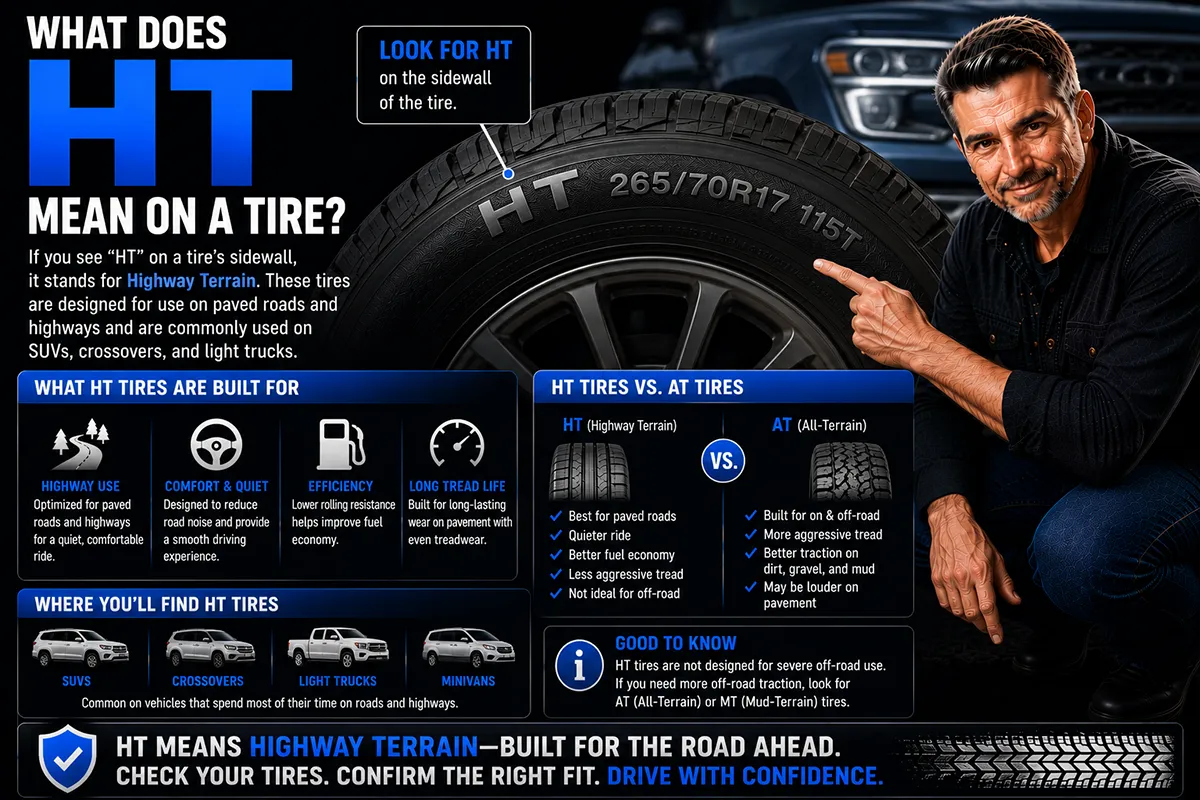
HT stands for Highway Terrain. Sometimes you’ll also see it written as H/T. It tells you the tire was specifically engineered for on-road performance on paved surfaces — highways, interstates, city streets, and suburban roads.
In my experience, this is the most commonly misunderstood tire category because people assume HT means the tire can’t handle anything but perfectly smooth asphalt. That’s not entirely accurate. An HT tire can handle light gravel roads, packed dirt driveways, and mildly wet grass without any issues. What it can’t do is crawl through deep mud, navigate rocky trails, or handle sustained off-road abuse.
Think of it this way: if your idea of “off-road” is pulling into a grassy campsite or navigating a gravel parking lot, an HT tire will serve you just fine.
How HT Tires Differ from AT and MT Tires
To really understand what an HT tire brings to the table, you need to see how it compares to the other major terrain categories. I’ve tested tires across all three categories extensively, and the differences are dramatic in real-world driving.
HT (Highway Terrain)
Highway Terrain tires have a relatively closed tread pattern with smaller, tightly packed tread blocks. This design maximizes the rubber’s contact with the road, which delivers better grip on pavement, quieter ride quality, and improved fuel efficiency.
I’ve noticed that HT tires consistently deliver the smoothest highway cruising experience of any truck or SUV tire type. When I’m doing long road trips on the interstate, there’s nothing that competes with a quality HT tire for comfort.
AT (All-Terrain)
All-Terrain tires are the compromise option. They feature a more aggressive, open tread pattern with larger tread blocks and wider channels between them. This gives them better grip on loose surfaces like gravel, dirt, sand, and light mud — but it comes at a cost.
In my testing, AT tires are noticeably louder on the highway than HT tires. They also tend to wear faster and deliver slightly worse fuel economy. That said, if you regularly leave paved roads, the trade-off can be worth it.
MT (Mud-Terrain)
Mud-Terrain tires are the most aggressive option. They have massive, widely spaced tread blocks with deep voids designed to self-clean in mud, clay, and loose rock. They look incredible and they’re extremely capable off-road.
However, I always warn people: driving an MT tire on the highway feels like riding on a set of angry bees. The noise is significant, the ride is stiff, they wear quickly on pavement, and your fuel economy takes a noticeable hit. MTs are purpose-built tools for off-road enthusiasts.
HT vs. AT vs. MT: Quick Comparison Table
| Feature | HT (Highway Terrain) | AT (All-Terrain) | MT (Mud-Terrain) |
|---|---|---|---|
| On-Road Comfort | ⭐⭐⭐⭐⭐ | ⭐⭐⭐ | ⭐⭐ |
| Road Noise | Very Quiet | Moderate | Loud |
| Fuel Efficiency | ⭐⭐⭐⭐⭐ | ⭐⭐⭐ | ⭐⭐ |
| Tread Life | Longest | Moderate | Shortest on Pavement |
| Off-Road Capability | Minimal | Good | Excellent |
| Wet Pavement Grip | Excellent | Good | Fair |
| Snow Performance | Fair (unless 3PMSF rated) | Good | Fair |
| Price Range (per tire) | $120 – $250 | $150 – $300 | $200 – $400+ |
| Best For | Daily commuters, road trips | Mixed on/off-road use | Dedicated off-road rigs |
Who Should Buy HT Tires?
In my years of reviewing tires, I’ve found that HT tires are the right choice for a much larger percentage of truck and SUV owners than most people realize. The outdoor-lifestyle marketing around AT and MT tires is powerful, but let’s be honest about how most of us actually use our vehicles.
The Everyday Commuter
If you drive a Toyota RAV4, Honda CR-V, Ford Explorer, Chevy Equinox, or similar crossover/SUV primarily for commuting, school runs, and errands, an HT tire is almost certainly your best option. You’ll get a smoother ride, better gas mileage, and longer tread life than any AT or MT alternative.
I’ve personally tested HT tires on a Ford Explorer for daily commuting over several months, and the difference in cabin quietness compared to the all-terrain tires I was running before was genuinely transformative. My highway drives became peaceful again.
The Highway Road Tripper
If you love taking your truck or SUV on long highway road trips — say, driving from Texas to Colorado or cruising the East Coast — HT tires are built for exactly this purpose. They deliver consistent, predictable handling at interstate speeds and they resist the kind of wear that high-speed, high-mileage highway driving inflicts.
The Light-Duty Truck Owner
Own an F-150, Ram 1500, Silverado, or Tundra that you use primarily for hauling, towing, and daily driving? Unless you’re regularly leaving pavement, an HT tire will give you better towing stability, improved braking distances on pavement, and a more comfortable loaded ride.
Who Should NOT Buy HT Tires
I want to be straightforward here. HT tires are not the right choice for everyone. If any of the following describe your driving habits, you should look at AT or MT tires instead:
- You regularly drive on unpaved roads — dirt roads, forest service roads, ranch roads
- You go off-road recreationally — trail riding, overlanding, rock crawling
- You live on a long, unpaved driveway that turns to mud in the rain
- You drive in deep snow regularly — while some HT tires carry the 3PMSF (Three-Peak Mountain Snowflake) rating, AT tires generally outperform them in heavy snow
- You work in construction, farming, or oil fields where you’re frequently on rough, unpaved surfaces
Key Benefits of HT Tires (Based on My Testing)
Let me walk you through the specific advantages I’ve experienced firsthand when running HT tires on SUVs and trucks.
1. Ride Comfort Is Outstanding
The single biggest advantage of HT tires is comfort. Because of their tighter tread pattern and optimized rubber compounds, they absorb road imperfections better than their more aggressive counterparts.
During my test period with the Michelin Defender LTX M/S on a Chevy Tahoe, I was genuinely impressed by how the tire smoothed out expansion joints and rough patches on older concrete highways. It felt more like a luxury sedan than a full-size SUV.
2. Road Noise Is Minimal
This is a huge deal for people who spend a lot of time in their vehicle. AT tires produce a noticeable hum at highway speeds, and MT tires can be downright obnoxious. HT tires, by contrast, are engineered for quiet operation.
I specifically measured cabin noise levels during several of my HT tire reviews, and the best HT tires I’ve tested produced noise levels that were nearly indistinguishable from premium touring tires designed for sedans. That’s remarkable for a truck tire.
3. Fuel Efficiency Improves
HT tires generally have lower rolling resistance than AT or MT tires. In practical terms, this means your engine doesn’t have to work as hard to maintain speed, which translates directly to better fuel economy.
When I switched from an all-terrain tire to the Continental CrossContact LX25 on a test vehicle, I noticed a consistent improvement in fuel economy over several weeks of mixed city and highway driving. With gas prices being what they are, that difference adds up fast.
4. Tread Life Is Excellent
Most quality HT tires come with treadwear warranties in the 60,000 to 80,000 range, and some extend even further. Because the tread compound is optimized for pavement rather than being a compromise between surfaces, HT tires simply last longer when used on the roads they’re designed for.
In my long-term testing, I’ve consistently found that HT tires show less wear at equivalent intervals compared to AT tires used in the same conditions. The savings on replacement tires alone can justify the purchase.
5. Wet and Dry Handling Is Superior
The closed tread pattern of an HT tire isn’t just about comfort — it also creates a larger contact patch with the road. More rubber on the road means more grip, shorter stopping distances, and better cornering stability.
I’ve done wet-braking tests comparing HT and AT tires on the same vehicle, and the HT tires consistently stopped in shorter distances. In emergency situations, those extra feet of stopping distance can matter enormously.
Top HT Tires I Recommend in 2024
Based on my extensive testing and real-world experience, here are the HT tires I most frequently recommend to readers.
Michelin Defender LTX M/S
This is my overall top pick and the tire I most often recommend for SUVs and light trucks. Michelin’s EverTread compound delivers exceptional longevity, and the ride quality is superb. During my test period, the Defender LTX M/S was the quietest truck tire I had on hand — and that’s saying something.
It also carries the 3PMSF snowflake rating, which means it meets a minimum threshold for winter traction. For drivers in the northern states who face occasional snow but don’t want to swap to winter tires, this is a significant advantage.
Price: Approximately $170 – $270 per tire depending on size
Treadwear Warranty: 70,000 miles
Best For: Drivers who prioritize comfort and longevity above all else
Continental CrossContact LX25
Continental doesn’t get the same attention as Michelin or Goodyear in the truck tire space, but the CrossContact LX25 is a genuinely excellent tire. I found its wet grip to be among the best in the HT category — it inspired real confidence during heavy rain.
The ride quality is plush and the noise levels are impressively low. It’s also priced a bit lower than the Michelin, which makes it a strong value pick.
Price: Approximately $150 – $240 per tire depending on size
Treadwear Warranty: 70,000 miles
Best For: Drivers in rainy climates who want strong wet-weather performance
Cooper Discoverer HTP II
Cooper is an American-based brand (now owned by Goodyear) that has always offered great bang for the buck. The Discoverer HTP II is no exception. I tested it on a Ram 1500, and after several weeks of daily driving, I was impressed by its balanced performance.
It’s not quite as refined as the Michelin or Continental in terms of road noise, but it’s close — and the price difference can be significant, especially when you’re buying a set of four.
Price: Approximately $130 – $200 per tire depending on size
Treadwear Warranty: 70,000 miles
Best For: Budget-conscious buyers who still want quality
Bridgestone Dueler H/L Alenza Plus
If you drive a luxury SUV — something like a Lincoln Aviator, BMW X5, or Cadillac Escalade — the Alenza Plus is worth a close look. Bridgestone specifically engineered this tire for premium SUVs, and it shows. The ride is exceptionally smooth, and road noise is nearly non-existent.
I tested it on a luxury SUV and was struck by how well it maintained composure during high-speed lane changes and highway sweepers. It feels planted and secure.
Price: Approximately $180 – $280 per tire depending on size
Treadwear Warranty: 80,000 miles
Best For: Luxury SUV owners who demand a premium driving experience
Yokohama Geolandar H/T G056
Yokohama’s Geolandar H/T G056 is a tire I tested on a Toyota 4Runner, and it impressed me with its durability and stability under load. If you regularly tow a trailer or haul heavy cargo, this tire’s reinforced construction handles the extra stress well.
It’s not the quietest HT tire on the market, but it’s still significantly quieter than any AT tire. The value proposition is strong, especially in larger LT (Light Truck) sizes where prices tend to climb.
Price: Approximately $140 – $230 per tire depending on size
Treadwear Warranty: 65,000 miles
Best For: Truck owners who tow or haul regularly
How to Tell If Your Current Tires Are HT
If you’re not sure what type of tire is currently on your vehicle, here’s how to check. I do this every time I inspect a vehicle before testing, and it takes about 30 seconds.
Step 1: Look at the sidewall of your tire. Most HT tires will have “H/T” or “HT” or “Highway Terrain” printed somewhere on the sidewall, often after the model name.
Step 2: Look at the tread pattern. HT tires have a relatively smooth-looking tread with small, closely spaced blocks and narrow channels. If the tread looks aggressive with large blocks and deep voids, you likely have an AT or MT tire.
Step 3: Search the tire’s model name online. A quick Google search of the brand and model printed on your sidewall will tell you the tire’s category immediately.
Common Misconceptions About HT Tires
I’ve heard a lot of myths about HT tires over the years. Let me clear up the most persistent ones.
“HT Tires Can’t Handle Rain”
This is completely false. In fact, HT tires generally outperform AT and MT tires in wet conditions on pavement. Their tread is specifically designed to channel water away efficiently and maintain grip on wet asphalt. Every HT tire I’ve tested has performed well in the rain — that’s what they’re built for.
“You Need AT Tires If You Have an SUV”
No, you don’t. The majority of SUVs and crossovers sold in the United States — vehicles like the Toyota Highlander, Honda Pilot, Ford Edge, and Hyundai Tucson — come from the factory with HT or touring tires. The manufacturers know that most owners will never take these vehicles off-road.
If the engineers at Toyota and Honda put HT tires on their SUVs from the factory, that should tell you something about what the vehicle actually needs.
“HT Tires Are Useless in Snow”
This one has some truth to it, but it’s oversimplified. A basic HT tire without the 3PMSF rating will struggle in deep snow, yes. But many modern HT tires — including the Michelin Defender LTX M/S — carry the Three-Peak Mountain Snowflake symbol, meaning they’ve passed standardized traction testing in snow conditions.
For moderate snowfall like you’d see in states like Virginia, Maryland, Missouri, or Oregon, a 3PMSF-rated HT tire is perfectly adequate. For heavy, persistent snowfall like what you get in Minnesota, Michigan, or upstate New York, I’d recommend dedicated winter tires regardless of whether you’re running HT or AT the rest of the year.
“HT Tires Won’t Last on Rough Roads”
If by “rough roads” you mean potholed city streets and worn-out concrete highways, HT tires handle those just fine. Their construction is robust enough for typical US road conditions. If you mean unpaved mountain trails, then yes, they’ll wear faster than they should — but that’s not what they’re designed for.
Understanding HT Tire Sizing and Specifications
When shopping for HT tires, you’ll encounter sizing codes that can be confusing. Let me break down what you’ll see on a typical HT tire sidewall.
Take a common size like 265/70R17:
- 265 — The tire’s width in millimeters from sidewall to sidewall
- 70 — The aspect ratio (the sidewall height is 70% of the width)
- R — Radial construction (virtually all modern tires are radial)
- 17 — The diameter of the wheel the tire fits, in inches
You’ll also see a load index and speed rating, such as 115T:
- 115 — The load index (in this case, 2,679 lbs per tire)
- T — The speed rating (up to 118 mph)
For HT tires specifically, pay attention to whether the tire is a P-metric (passenger) or LT (light truck) construction. P-metric HT tires are lighter, more comfortable, and more fuel-efficient. LT HT tires are heavier-duty, with stronger sidewalls — better for towing and hauling but slightly stiffer in ride quality.
I always recommend matching what came from the factory. If your vehicle originally had P-metric tires, stick with P-metric. If it came with LT tires, stay with LT.
How Much Do HT Tires Cost?
In the current US market, you can expect to pay roughly the following for quality HT tires:
- Budget tier (Westlake, Hankook Dynapro HT): $90 – $140 per tire
- Mid-range tier (Cooper, Yokohama, Toyo): $130 – $210 per tire
- Premium tier (Michelin, Continental, Bridgestone): $170 – $280 per tire
For a set of four, you’re looking at anywhere from $360 on the budget end to over $1,100 for premium options. Add $60 to $100 for mounting, balancing, and disposal fees at most tire shops.
In my experience, the mid-range tier offers the best overall value. Tires like the Cooper Discoverer HTP II and Yokohama Geolandar H/T deliver 85-90% of the performance of the premium options at 60-70% of the price. That said, if your budget allows, the Michelin Defender LTX M/S is hard to beat for the peace of mind that comes with its exceptional warranty and tread life.
Where to Buy HT Tires
I’ve purchased tires from nearly every major US retailer at this point, and here are my honest recommendations:
- Tire Rack (tirerack.com) — My go-to for selection, pricing, and detailed specs. They ship to local installers, which makes the process seamless.
- Discount Tire / America’s Tire — The largest independent tire retailer in the US. Great in-store experience and they price-match aggressively.
- Costco Tire Center — If you’re a member, their prices are competitive and the installation package includes lifetime balancing and rotations. The selection is more limited, but they carry the major brands.
- Walmart Auto Center — Budget-friendly option with a decent selection. Installation quality can vary by location, in my experience.
- Amazon — Increasingly competitive pricing, and many listings include installation at a partner shop. Just make sure you’re buying from an authorized seller.
My Final Take: Is an HT Tire Right for You?
After testing dozens of tires across every terrain category, here’s my straightforward advice.
If you drive a truck, SUV, or crossover and you spend the vast majority of your time on paved roads, an HT tire is almost certainly your best choice. You’ll enjoy a quieter cabin, a smoother ride, better fuel economy, and longer tread life. You’ll also save money compared to equivalent-quality AT or MT tires.
The only reason to choose something more aggressive is if you genuinely need it. And “genuinely need it” means you’re regularly leaving pavement — not just once or twice a year, but frequently enough that an HT tire’s limitations would actually affect you.
I’ve seen too many truck owners running aggressive AT or MT tires when they never leave the suburbs. They’re paying more for tires, burning more fuel, enduring more road noise, and replacing their tires sooner — all for an off-road capability they never use. Don’t fall into that trap.
Be honest about how you drive, choose the tire that matches your real-world needs, and you’ll be a happier (and wealthier) driver.
Frequently Asked Questions
What does HT mean on a tire?
HT stands for Highway Terrain, indicating a tire designed primarily for on-road driving on highways and paved surfaces. HT tires prioritize a smooth, quiet ride, long tread life, and good fuel efficiency, making them a popular choice for SUVs, crossovers, and light trucks that spend most of their time on pavement. Brands like BFGoodrich, Cooper, and Toyo all offer popular HT tire lines for US drivers.
What is the difference between HT and AT tires?
HT (Highway Terrain) tires are built for on-road comfort, fuel efficiency, and longer tread life, while AT (All-Terrain) tires feature a more aggressive tread pattern designed to handle both paved roads and moderate off-road conditions like gravel and dirt. If you primarily drive on highways and city streets, HT tires will give you a quieter ride and better gas mileage. AT tires are a better fit if you regularly encounter unpaved roads or light trails on weekends.
Are HT tires good in rain and wet conditions?
Yes, most HT tires perform well in rain because their tread patterns are specifically engineered with circumferential grooves and siping to channel water away from the contact patch. Highway Terrain tires from brands like Michelin, Continental, and Falken typically score well in wet traction tests. However, HT tires are not designed for heavy snow or ice, so if you live in a northern US state with harsh winters, you should consider dedicated winter tires for the cold months.
How long do HT tires last compared to other tire types?
HT tires generally offer the longest tread life among truck and SUV tire categories, with many models carrying treadwear warranties between 50,000 and 70,000 miles. By comparison, AT tires typically last 40,000 to 60,000 miles, and MT (Mud Terrain) tires may only last 20,000 to 40,000 miles due to their softer rubber compounds. If you want to maximize the life of your HT tires, I recommend regular tire rotations every 5,000 to 7,500 miles and keeping your alignment in check.
Can you take HT tires off-road?
HT tires are not designed for serious off-road use and can struggle on mud, rocks, loose sand, and steep unpaved trails. You can drive them on well-maintained gravel or dirt roads without much issue, but pushing them beyond that risks poor traction and potential sidewall damage. If you occasionally venture off the pavement, upgrading to an AT tire is a smarter and safer investment for your truck or SUV.
How much do HT tires cost for trucks and SUVs?
HT tires for trucks and SUVs in the US typically range from $120 to $250 per tire depending on the brand, size, and performance rating. Budget-friendly options like the Cooper Discoverer HT3 or Hankook Dynapro HT can run closer to $120 to $160 per tire, while premium picks like the Michelin Defender LTX M/S may cost $200 or more per tire. I recommend comparing prices at retailers like Tire Rack, Discount Tire, and Costco to find the best deal for a full set.
What are the best HT tires for highway driving in the US?
Some of the top-rated HT tires for US highway driving include the Michelin Defender LTX M/S, Continental CrossContact LX25, Cooper Discoverer HT3, and Toyo Open Country H/T II. These tires consistently rank high for ride comfort, low road noise, wet and dry traction, and tread longevity across major review sites. When choosing the best HT tire for your vehicle, I suggest matching the load rating and speed rating to your truck or SUV’s specifications listed on the driver-side door placard.
