

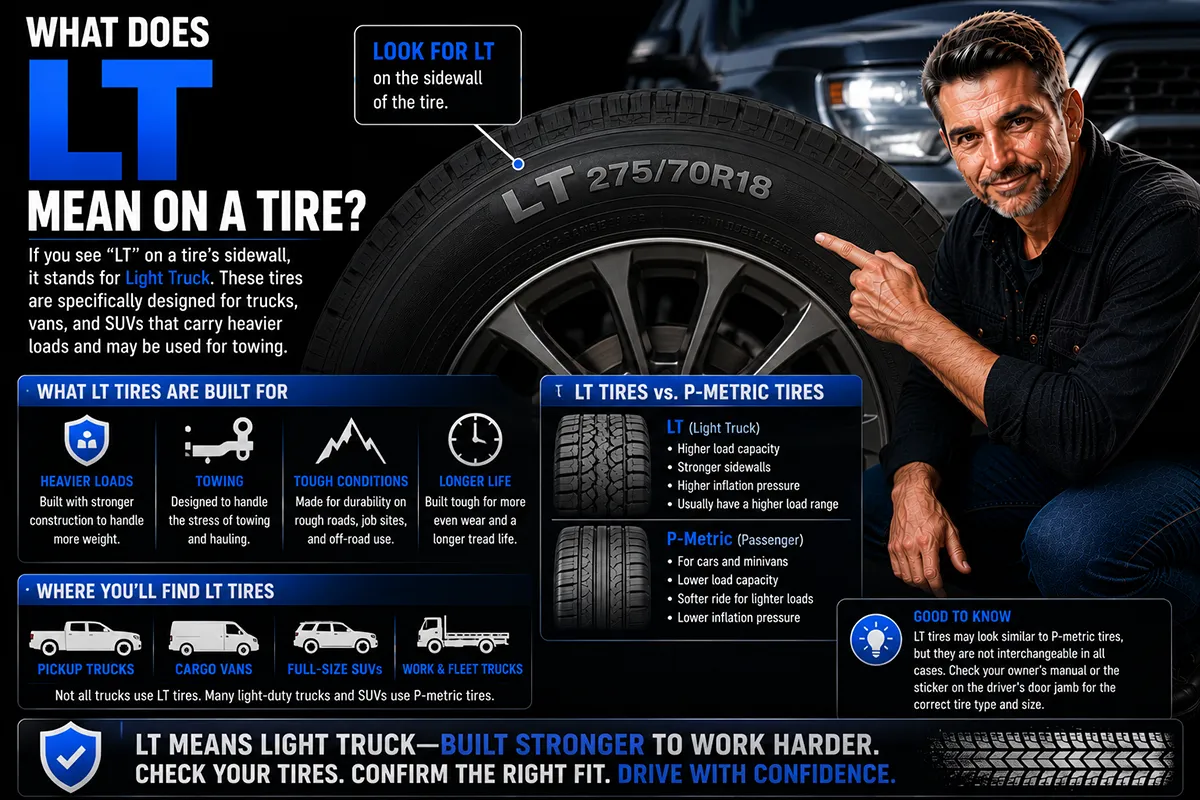
I was helping my neighbor pick out new tires for his Ram 1500 last spring when he pointed at the sidewall and asked me a question I’ve heard dozens of times: “What does that LT at the beginning actually mean?”
It’s one of those details that seems minor until you realize it affects your truck’s load capacity, ride quality, fuel economy, and even your safety on the highway.
After spending years testing and reviewing tires across every major category — and after personally running both P-metric and LT tires on my own trucks — I can tell you that understanding this two-letter code is one of the most important things you can do before buying your next set of tires.
- LT stands for “Light Truck” — it’s a tire designation indicating the tire is engineered for heavier vehicles, towing, and hauling.
- LT tires have stronger internal construction (more plies) than P-metric (passenger) tires, giving them higher load ratings.
- They typically require higher inflation pressures and offer a firmer ride compared to P-metric tires.
- If your truck or SUV came with LT tires from the factory, you should replace them with LT tires — not P-metric.
- Switching from P-metric to LT (or vice versa) without understanding the differences can compromise safety and void warranties.
- Common LT tire sizes start with “LT” (e.g., LT265/70R17) or end with “/LT” in some flotation sizes.
Liked this article?
Add TireAdvise as a preferred source so you see more of our tire reviews and guides on Google.
LT Stands for Light Truck — But There’s Nothing “Light” About It
Let’s get the basic answer out of the way. LT stands for Light Truck. When you see “LT” at the beginning of a tire size — like LT265/70R17 — it means that tire was specifically designed and built for light truck applications.
Now, the name is a bit misleading. “Light truck” doesn’t mean a small, lightweight vehicle. In the tire industry, it refers to vehicles in the Class 1 through Class 3 range, which includes half-ton, three-quarter-ton, and one-ton pickup trucks, full-size SUVs, and heavy-duty vans. We’re talking about vehicles like the Ford F-150, Chevy Silverado 2500HD, Toyota Tundra, Suburban, and Ram ProMaster.
The “light” part distinguishes these vehicles from medium and heavy-duty commercial trucks (think 18-wheelers), which use a completely different tire classification system. So when you see LT on a tire, think “heavy-duty tire for everyday trucks” — not “tire for a light vehicle.”
Where Exactly Do You Find the LT Designation?
The LT marking appears on the tire’s sidewall, right before the numerical tire size. Here’s what a full LT tire size looks like:
LT265/70R17 121/118S E
Let me break that down piece by piece:
- LT — Light Truck designation
- 265 — Tread width in millimeters
- 70 — Aspect ratio (sidewall height is 70% of the tread width)
- R — Radial construction
- 17 — Wheel diameter in inches
- 121/118 — Load index (single/dual rear wheel configuration)
- S — Speed rating
- E — Load range (ply rating equivalent)
There’s also a less common format you’ll see on flotation-sized tires, where the LT appears at the end of the size. For example: 33×12.50R15LT. Same meaning, just a different placement convention.
I’ve noticed that a lot of shoppers overlook that trailing “LT” on flotation sizes. During my time reviewing off-road tires, I’ve seen people accidentally order P-metric flotation tires when they needed LT-rated ones, simply because they didn’t check the end of the size string. Always look carefully.
LT Tires vs. P-Metric Tires: What’s Actually Different?
This is where things get really practical. The difference between an LT tire and a P-metric (passenger) tire isn’t just a letter on the sidewall. It’s a fundamentally different approach to tire engineering.
I’ve run both types on my own trucks over the years, and the differences are immediately noticeable — in how they ride, how they handle load, and how long they last under stress.
Construction and Ply Count
LT tires are built with more robust internal construction. They typically feature additional body plies and stronger sidewall reinforcement compared to P-metric tires of the same physical dimensions.
Most P-metric tires have a standard load or extra load rating, which corresponds roughly to a 4-ply rating. LT tires, on the other hand, are available in Load Range C (6-ply rated), D (8-ply rated), E (10-ply rated), and even F (12-ply rated).
In my experience, this extra construction translates directly into real-world durability. I’ve tested LT tires on rough gravel roads and construction sites where a P-metric tire would have been shredded. The thicker sidewalls and reinforced bead area on LT tires make them significantly more resistant to punctures, cuts, and impacts.
Load Capacity
This is the biggest functional difference. LT tires can carry substantially more weight per tire than P-metric tires of the same size.
For example, a P265/70R17 tire might have a maximum load capacity of around 2,200 pounds at its maximum inflation pressure. An LT265/70R17 Load Range E tire can handle approximately 3,195 pounds per tire at its rated pressure. That’s a massive difference — and it matters if you’re towing a boat, hauling building materials, or loading up a truck camper.
Inflation Pressure
LT tires are designed to operate at higher inflation pressures than P-metric tires. While a typical P-metric tire maxes out at 44 PSI, LT tires commonly have maximum pressures of 65 PSI (Load Range C), 65 PSI (Load Range D), 80 PSI (Load Range E), or even higher.
I want to emphasize: the operating pressure isn’t always the maximum pressure. You should follow the pressure listed on your vehicle’s door placard or in the owner’s manual. But the higher pressure capability is what gives LT tires their superior load-carrying ability.
Ride Quality and Noise
Here’s the trade-off that nobody warns you about until you’ve already mounted a set of LT tires. Because of their stiffer construction and higher operating pressures, LT tires generally deliver a firmer, harsher ride compared to P-metric tires.
I noticed this immediately when I switched from P-metric all-terrains to LT-rated all-terrains on one of my test trucks. The road felt rougher. Expansion joints on the highway were more jarring. Small bumps that used to disappear were suddenly noticeable.
It’s not unbearable — but if you’re driving an unloaded half-ton truck around town and you don’t tow or haul anything, you may find the ride quality of LT tires to be unnecessarily stiff.
Fuel Economy
Heavier construction means more rolling resistance. More rolling resistance means slightly lower fuel economy. In my testing, the difference was noticeable over time — not dramatic, but consistent.
If you’re driving a daily commuter truck that never sees a payload, P-metric tires will typically give you better fuel efficiency. But if you need the load capacity, that’s a trade-off worth making.
LT vs. P-Metric Comparison Table
Here’s a quick-reference table I put together based on my firsthand experience and industry specifications:
| Feature | LT (Light Truck) Tires | P-Metric (Passenger) Tires |
|---|---|---|
| Designation | LT before size (e.g., LT265/70R17) | P before size (e.g., P265/70R17) |
| Intended Vehicles | Pickup trucks, HD SUVs, vans | Cars, crossovers, light SUVs |
| Load Capacity | Higher (varies by load range) | Lower (Standard Load or Extra Load) |
| Typical Max PSI | 65–80+ PSI | 44 PSI (Standard), 50 PSI (XL) |
| Ply Rating Equivalent | 6-ply (C) to 12-ply (F) | 4-ply equivalent |
| Ride Quality | Firmer, stiffer | Softer, more comfortable |
| Sidewall Durability | Excellent (thicker sidewalls) | Good but more vulnerable |
| Fuel Efficiency | Slightly lower | Slightly better |
| Price (Comparable Size) | $180–$350+ per tire | $130–$250+ per tire |
| Best For | Towing, hauling, off-road, commercial use | Daily driving, commuting, light use |
When Do You Actually Need LT Tires?
Not every truck needs LT tires. I know that sounds surprising given everything I’ve just explained, but it’s true. The key question is: what are you doing with your vehicle?
You Definitely Need LT Tires If:
- Your vehicle came with LT tires from the factory. This is the single most important rule. If the manufacturer specced LT tires, it’s because the vehicle’s Gross Vehicle Weight Rating (GVWR) and Gross Axle Weight Ratings (GAWR) require the load capacity that only LT tires provide. Don’t downgrade.
- You regularly tow trailers, boats, or RVs. Towing puts enormous stress on tires. I’ve tested tires while hauling a 7,000-pound travel trailer, and I can tell you that LT tires handle the sustained load and heat buildup far better than P-metric alternatives.
- You haul heavy payloads. Contractors, farmers, and anyone who regularly loads up the bed with heavy materials need LT tires for the load capacity and sidewall protection.
- You drive a three-quarter-ton or one-ton truck. Vehicles like the F-250, F-350, Silverado 2500HD, and Ram 2500/3500 almost universally require LT tires. No exceptions.
- You drive on rough terrain frequently. Construction sites, rocky trails, and unpaved rural roads are hard on tires. The reinforced construction of LT tires gives you a meaningful margin of safety against sidewall damage.
You Might Not Need LT Tires If:
- You drive a half-ton truck purely for commuting. Many modern half-ton trucks like the Ford F-150 and Ram 1500 come with P-metric tires from the factory. If you’re not towing or hauling, those P-metric tires are perfectly appropriate.
- You drive a crossover or midsize SUV. Vehicles like the Toyota RAV4, Honda CR-V, or even the Toyota 4Runner typically use P-metric tires. These vehicles don’t have the GVWR to justify LT tires in most cases.
- Ride comfort is your top priority. If you’ve never towed anything and your truck primarily ferries kids to school, LT tires will only make your ride stiffer and your fuel bill slightly higher.
What Happens If You Switch from LT to P-Metric (or Vice Versa)?
This is a question I get asked constantly, and I always answer it the same way: proceed with extreme caution.
Switching from LT to P-Metric
If your truck came with LT tires and you switch to P-metric tires of the same size, you are almost certainly reducing your vehicle’s load capacity. This can be dangerous — especially if you tow or haul.
I’ve seen this happen firsthand. A friend of mine put P-metric all-terrain tires on his Silverado 2500HD because they were cheaper and he liked the tread pattern. After several days of towing his boat in the Texas summer heat, he had a blowout on I-35. The P-metric tires simply couldn’t handle the combined weight and heat.
If your vehicle’s door placard specifies LT tires, do not substitute P-metric tires. Period.
Switching from P-Metric to LT
Going the other direction — upgrading from P-metric to LT — is generally safer from a load-capacity standpoint. But it comes with trade-offs.
I’ve done this myself. I put LT-rated BFGoodrich KO2s on a half-ton truck that originally wore P-metric tires. The towing confidence improved dramatically. The tires shrugged off gravel roads that used to make me nervous.
But the ride on pavement was noticeably stiffer. Fuel economy dropped a bit. And I had to adjust my tire pressures carefully because the LT tires had different inflation requirements than the originals.
If you’re upgrading to LT tires, make sure you:
- Verify the load index meets or exceeds your vehicle’s requirements
- Adjust inflation pressures according to the new tire’s load/inflation table (not just the door placard)
- Understand that your speedometer calibration may be affected if the overall tire diameter changes
Understanding LT Tire Load Ranges
One of the most confusing aspects of LT tires is the load range system. I’ll simplify it based on what I’ve learned through years of testing.
The load range tells you how much air pressure the tire can safely handle, which directly determines its maximum load capacity. Here’s the breakdown:
- Load Range C: Max 50 PSI — 6-ply rated equivalent. Common on lighter-duty LT tires.
- Load Range D: Max 65 PSI — 8-ply rated equivalent. A good middle ground for half-ton trucks that tow occasionally.
- Load Range E: Max 80 PSI — 10-ply rated equivalent. The most common load range for three-quarter-ton and one-ton trucks. This is what I run on my heavy-duty test trucks.
- Load Range F: Max 95 PSI — 12-ply rated equivalent. Typically found on commercial-grade tires for the heaviest applications.
Important note: “Ply rated” doesn’t mean the tire literally has that many plies. Modern tires use fewer, stronger plies to achieve the same load capacity. The ply rating is a legacy term that indicates equivalent strength.
In my experience, Load Range E is the sweet spot for most truck owners who tow and haul regularly. Load Range C tires are fine for lighter applications, and Load Range F tires are overkill unless you’re running a commercial fleet.
Popular LT Tire Models Worth Considering
I’ve tested a wide range of LT tires over the years. Here are some of the models that have consistently impressed me in real-world driving:
BFGoodrich All-Terrain T/A KO2
This is probably the most popular LT all-terrain tire in America, and for good reason. I’ve run KO2s on multiple trucks, and they deliver excellent off-road traction while remaining civilized on the highway. The CoreGard sidewall technology genuinely resists punctures — I’ve driven over some nasty debris without a single issue.
Prices typically range from $200 to $330 per tire depending on size.
Falken Wildpeak AT3W
The Wildpeak AT3W has become my go-to recommendation for budget-conscious truck owners who need an LT tire. It performs surprisingly well in snow (it carries the 3-Peak Mountain Snowflake rating), handles well on wet pavement, and costs significantly less than some premium alternatives. I tested these during a winter trip through Colorado, and they inspired real confidence on snowy mountain passes.
Expect to pay $170 to $280 per tire.
Toyo Open Country AT III
Toyo’s latest Open Country AT3 is an excellent LT all-terrain option. I found the on-road manners to be particularly impressive for an LT tire — quieter than I expected and with surprisingly good ride quality. Off-road, it handles mud and loose surfaces with authority.
Pricing runs from $190 to $320 per tire.
Michelin Defender LTX M/S
If your primary concern is highway driving with occasional light off-road use, the Defender LTX M/S is hard to beat. I’ve tested this tire extensively, and it delivers phenomenal treadwear longevity and outstanding wet traction. It’s available in both P-metric and LT versions, so make sure you’re selecting the right one for your application.
These typically cost $200 to $340 per tire.
Other Tire Designation Letters You Should Know
While we’re on the subject, LT isn’t the only letter code you’ll encounter on tire sidewalls. Here are the other common designations and what they mean:
- P (P-Metric): Designed for passenger vehicles including cars, minivans, crossovers, and light-duty SUVs and trucks. Example: P265/70R17.
- ST (Special Trailer): Designed exclusively for trailer use. These tires are built to handle the unique stresses of being pulled (not driven). Never use ST tires on a vehicle’s drive or steer axle.
- C (Commercial): Used primarily in European markets for commercial van tires. You’ll occasionally see these in the US on vehicles like the Mercedes Sprinter.
- No letter prefix (Euro-Metric): If there’s no letter before the tire size (e.g., 265/70R17), it’s a Euro-Metric tire. These have slightly different load calculation standards than P-metric tires. They’re common on imported vehicles.
Understanding these distinctions has saved me from making purchasing mistakes more than once. I once nearly ordered ST tires for a truck because the size numbers matched — the only difference was that two-letter prefix. Always check the full designation.
How to Read Your Vehicle’s Tire Requirements
Before you shop for any replacement tires, you need to know what your vehicle requires. Here’s my process:
Step 1: Check the door placard. Open your driver’s side door and look for the tire information sticker on the door jamb or the edge of the door itself. It will list the original tire size(s), recommended inflation pressures, and the vehicle’s load capacity.
Step 2: Look at what’s currently on the vehicle. If you bought the truck used, the current tires might not match the door placard. Always reference the placard as the authoritative source.
Step 3: Check the owner’s manual. The manual will specify whether LT or P-metric tires are required and may list acceptable alternative sizes.
Step 4: Consult a professional. If you’re unsure, take your vehicle to a reputable tire dealer. Places like Discount Tire, Tire Rack, or your local independent tire shop can verify what you need. I’ve found that Discount Tire’s staff, in particular, is usually well-trained on matching the right tire type to your vehicle.
Common Myths About LT Tires
Over the years, I’ve encountered a lot of misinformation about LT tires. Let me clear up some of the most persistent myths.
Myth 1: “LT Tires Last Longer Than P-Metric Tires”
Not necessarily. While LT tires are more durable in terms of sidewall strength and puncture resistance, their treadwear depends on the specific compound, tread design, and driving conditions — just like any other tire. I’ve tested LT tires that wore faster than comparable P-metric tires because of their softer tread compound.
Myth 2: “More Plies Always Means a Better Tire”
A higher ply rating means a higher load capacity — not necessarily a “better” tire. If you’re driving an unloaded half-ton truck, a Load Range E tire is overkill. The extra stiffness will reduce comfort without providing any meaningful benefit. Match the load range to your actual needs.
Myth 3: “You Can Run LT Tires at the Same Pressure as P-Metric”
This is dangerous. LT tires and P-metric tires have different load-per-PSI curves. An LT tire at 35 PSI carries significantly less weight per tire than a P-metric tire at 35 PSI (of the same size). If you switch to LT tires, you may need to run higher pressures to achieve the same load capacity. Always reference the tire manufacturer’s load/inflation tables.
Myth 4: “LT Tires Are Only for Off-Road”
LT is a load rating designation, not a terrain designation. There are LT highway tires, LT all-terrain tires, LT mud-terrain tires, and even LT winter tires. The LT classification speaks to the tire’s construction and load capacity, not where it’s designed to be driven.
LT Tire Pricing: What to Expect in 2024
LT tires generally cost more than equivalent P-metric tires because of their heavier construction and additional materials. Here’s what I’ve seen in the current US market:
- Budget LT tires: $140–$200 per tire. Brands like Hankook Dynapro AT2, Cooper Discoverer AT3 4S, and Firestone Destination AT2 fall into this range.
- Mid-range LT tires: $200–$300 per tire. This is where you’ll find the Falken Wildpeak AT3W, Toyo Open Country AT3, and General Grabber ATX.
- Premium LT tires: $280–$400+ per tire. BFGoodrich KO2, Nitto Ridge Grappler, Michelin Defender LTX M/S, and Goodyear Wrangler DuraTrac live here.
For a full set of four LT tires plus installation, you’re typically looking at $800 to $1,800 depending on size and brand. I always recommend budgeting for professional mounting, balancing, and alignment when you buy new tires — it’s worth the extra $100-$150 to protect your investment.
My Final Advice on LT Tires
After years of testing tires on everything from stock F-150s to heavily modified overland rigs, here’s what I always tell people about LT tires:
Respect the designation. If your vehicle requires LT tires, don’t cut corners with P-metric substitutes to save a few bucks. The load capacity difference exists for a reason, and the consequences of a tire failure under load are severe.
Match the tire to the job. If you tow every weekend, get LT tires with the appropriate load range. If you drive your truck to the office and back, P-metric tires (if your vehicle supports them) will give you a more comfortable ride and better fuel economy.
Don’t over-buy. A Load Range E tire on a half-ton truck that never carries anything heavier than groceries is a waste of money and comfort. Be honest about your usage patterns.
Always check pressures. LT tires are particularly sensitive to proper inflation. Under-inflated LT tires can overheat and fail catastrophically, especially under load. I check my tire pressures at least once a week — more often when towing.
The LT designation is one of the most important pieces of information on your tire’s sidewall. Now that you understand what it means, why it matters, and how to make the right choice for your vehicle, you’re already ahead of most tire shoppers.
Drive safe, and don’t hesitate to reach out in the comments if you have questions about your specific truck and tire setup. I’m always happy to help.
Frequently Asked Questions
What does LT mean on a tire?
LT stands for Light Truck, and it indicates the tire was specifically designed and built for light truck applications, including pickup trucks, SUVs, and vans that carry heavy loads or tow trailers. LT tires feature reinforced sidewalls and stronger internal construction compared to standard passenger (P-metric) tires, making them better suited for demanding driving conditions. You’ll find the LT designation at the beginning of the tire size code, such as LT265/70R17, right on the sidewall.
What is the difference between LT and P tires?
The main difference between LT (Light Truck) and P (Passenger) tires is their load-carrying capacity and construction. LT tires have thicker sidewalls, more robust internal plies, and higher load ratings, which means they can safely handle heavier payloads and towing — but they typically ride a bit firmer and cost $30–$80 more per tire than comparable P-metric options. P tires are engineered for everyday passenger vehicles and prioritize ride comfort and fuel efficiency over heavy-duty performance.
Do I need LT tires on my truck?
You need LT tires if you regularly haul heavy loads, tow trailers, or drive a ¾-ton or 1-ton pickup like a Ford F-250 or Chevy Silverado 2500, since these vehicles require the higher load ratings that LT tires provide. If you drive a half-ton truck like an F-150 or RAM 1500 mainly for commuting and light use, P-metric tires may work just fine and offer a smoother ride. Always check your vehicle’s door jamb placard or owner’s manual to confirm the manufacturer-recommended tire type before making a switch.
Can I put LT tires on a passenger car or regular SUV?
Technically you can mount LT tires on some passenger vehicles or crossover SUVs if the bolt pattern and size match, but it’s generally not recommended. LT tires are stiffer and heavier, so they’ll give you a noticeably rougher ride, reduced fuel economy, and potentially affect your speedometer accuracy. I’d recommend sticking with P-metric or passenger-rated tires unless your specific vehicle or driving demands genuinely require the extra load capacity.
Are LT tires better for off-road driving and towing?
LT tires are significantly better for towing and heavy off-road use because their reinforced construction resists punctures, sidewall damage, and the extra heat generated by heavy loads. Popular LT options for US drivers include the BFGoodrich All-Terrain T/A KO2, Falken Wildpeak AT3W, and Toyo Open Country A/T III, all of which handle rugged terrain and highway towing with confidence. If you frequently drive on gravel roads, construction sites, or unpaved trails in addition to towing, LT-rated all-terrain tires are a smart investment.
How long do LT tires last compared to regular tires?
LT tires generally last between 40,000 and 60,000 miles depending on the brand, tread compound, and driving conditions, which is comparable to or slightly less than many P-metric tires that can reach 60,000–80,000 miles. The heavier construction of LT tires handles abuse better, but their stiffer rubber compounds can wear faster if used primarily on highways without heavy loads. Rotating your LT tires every 5,000–7,500 miles and maintaining proper inflation pressure — which is often higher than P tires, around 50–80 PSI — will help maximize their tread life.
Do LT tires cost more than regular passenger tires?
Yes, LT tires typically cost more than P-metric tires in the same size, with most LT tires ranging from $150 to $350+ per tire depending on brand and size, compared to $100–$200 for equivalent passenger tires. The higher price reflects the extra materials, reinforced sidewalls, and heavy-duty construction built into every LT tire. Brands like Cooper Discoverer, General Grabber, and Hankook Dynapro offer solid LT options at mid-range prices for US drivers looking for value without sacrificing durability.
