

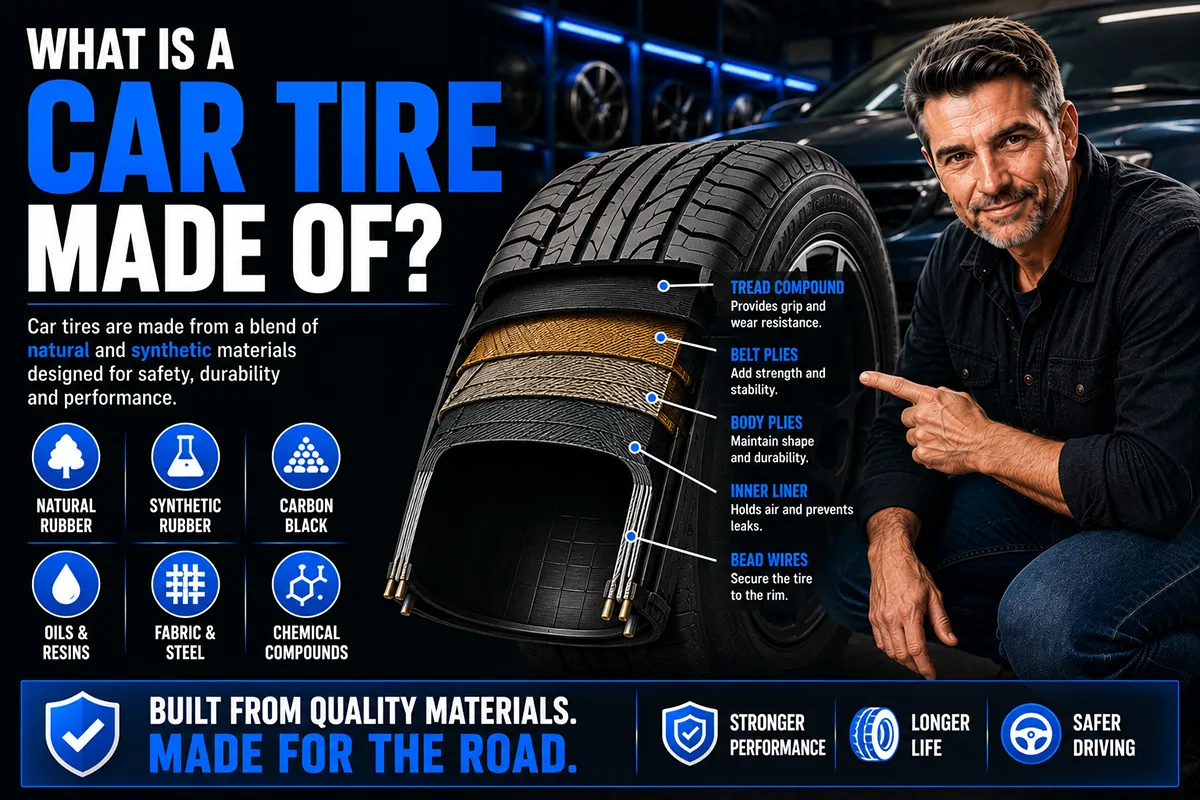
Most drivers I talk to assume a tire is just a big chunk of rubber wrapped around a wheel. I used to think the same thing — until I started cutting into tires, visiting manufacturing facilities, and spending years reviewing dozens of brands for real-world performance.
The truth is, a modern car tire is one of the most carefully engineered products you’ll ever buy. It contains over 200 different raw materials, and the specific recipe determines everything from how long it lasts to how it handles in a Texas summer downpour.
Understanding what your tire is actually made of isn’t just trivia. It’s the key to making a smarter buying decision the next time you’re standing in a tire shop wondering why one tire costs $85 and another costs $210.
- A modern car tire contains natural rubber, synthetic rubber, carbon black, silica, steel belts, textile cords, and dozens of chemical compounds.
- The rubber compound recipe directly affects grip, tread life, rolling resistance, and fuel economy.
- Steel belts and fabric plies give the tire its structural strength and shape.
- Premium tires use higher-quality materials and more advanced compounds — that’s why they cost more and often perform better.
- Knowing what’s inside your tire helps you understand why certain tires excel in wet grip, winter traction, or long-lasting tread wear.
Liked this article?
Add TireAdvise as a preferred source so you see more of our tire reviews and guides on Google.
The Anatomy of a Car Tire: More Than Meets the Eye
I’ve physically cut apart tires from brands like Michelin, Goodyear, Continental, Bridgestone, and several budget brands from overseas. Every single time, I’m impressed by how many distinct layers and materials are packed into what looks like a simple black donut.
A typical passenger car tire contains roughly 10 to 15 distinct structural components. Let me walk you through every single one, based on what I’ve seen firsthand and what tire engineers have explained to me during factory tours and industry events.
The Main Materials in Every Car Tire
Before we dive into the layers, here’s a quick overview of the raw materials that make up a modern tire:
- Natural rubber — harvested from rubber trees, primarily in Southeast Asia
- Synthetic rubber — petroleum-based polymers like styrene-butadiene rubber (SBR) and polybutadiene rubber (BR)
- Carbon black — a reinforcing filler that gives tires their black color and improves durability
- Silica — a filler that improves wet grip and reduces rolling resistance
- Steel wire — used in belts and bead bundles for structural reinforcement
- Textile fabrics — polyester, nylon, and rayon used in body plies and cap plies
- Sulfur and chemical curatives — used in the vulcanization process to harden rubber
- Antioxidants and anti-ozonants — chemicals that protect rubber from UV degradation and cracking
- Oils and plasticizers — soften the compound for better flexibility and grip
- Zinc oxide and stearic acid — activators that help the vulcanization process work efficiently
On average, by weight, a passenger car tire is about 40-45% rubber (a blend of natural and synthetic), 25-28% fillers like carbon black and silica, 15-17% steel and fabric reinforcements, and the remainder is made up of chemicals, oils, and curatives.
Breaking Down Every Layer of a Car Tire
Now let’s go layer by layer, from the inside out. I’m going to explain what each part does and why it matters for your driving experience.
1. The Inner Liner
The innermost layer of a modern tubeless tire is the inner liner. This is a thin sheet of synthetic rubber — specifically a type called halobutyl rubber — that acts as the tire’s air barrier.
Think of it as the tire’s built-in inner tube. It’s designed to be nearly impermeable to air, keeping your tire pressure stable over time. In my experience testing tire pressure retention across different brands, I’ve noticed that premium tires from companies like Michelin and Continental tend to hold pressure more consistently over several weeks. That’s often because they use a higher-quality or slightly thicker inner liner compound.
If the inner liner is compromised — say, from a nail puncture that doesn’t get properly patched — you’ll notice your tire slowly losing pressure. That’s the inner liner failing to do its one critical job.
2. The Body Plies (Carcass)
Wrapped around the inner liner, you’ll find the body plies. These are layers of fabric cords — usually polyester in passenger car tires — coated in rubber.
The body plies are the skeleton of the tire. They give it shape and carry the load of the vehicle. Most passenger car tires have one or two body plies, while light truck tires may have more for extra load capacity.
I’ve noticed that the quality of the body ply fabric makes a real difference in ride comfort. Tires with well-engineered polyester plies tend to absorb road imperfections more smoothly. That’s one reason a Michelin Defender often rides more comfortably than a generic budget tire — the engineering of the carcass, not just the tread, plays a huge role.
3. The Bead Bundle
At the very bottom edge of the tire — where it seats against the wheel rim — you’ll find the bead. This is a loop of high-tensile steel wire coated in rubber that anchors the tire to the wheel.
I’ve seen bead bundles made from a single thick wire wound into multiple loops, and I’ve seen them made from braided cables. Either way, the bead has to withstand enormous forces without stretching. If the bead fails, the tire literally falls off the rim. It’s one of those components you never think about, but it’s absolutely critical.
The bead area also includes a rubber component called the bead filler (or apex), which is a stiff rubber wedge that sits above the bead wire. This filler influences how the sidewall transitions from the rigid bead to the flexible upper sidewall. A taller, stiffer bead filler generally means a more responsive, sportier feel, while a softer one contributes to ride comfort.
4. The Sidewall
The sidewall is the vertical section of the tire between the tread and the bead. It’s a relatively thick layer of rubber designed to flex as the tire rolls and to protect the internal body plies from road damage, curb rash, and UV exposure.
The rubber compound used in the sidewall is specifically formulated for flexibility and resistance to cracking. It contains antioxidants and anti-ozonants that prevent the rubber from degrading when exposed to sunlight, heat, and atmospheric ozone.
In my reviews, I always pay attention to sidewall stiffness. A tire with a reinforced sidewall — like many tires designed for SUVs or performance cars — will feel more precise in corners but may ride a bit harsher. It’s a trade-off that the material composition directly controls.
5. The Steel Belts
Sitting beneath the tread, you’ll find two (sometimes three) layers of steel belts. These are made from thin, high-strength steel cords woven together and coated in rubber.
The steel belts are arranged at opposing angles — typically around 20 to 25 degrees relative to the tire’s centerline. This creates a crisscross pattern that gives the tread area its rigidity and stability. Without these belts, the tire would deform and balloon at highway speeds.
I’ve personally cut into budget tires and premium tires side by side, and the difference in belt quality is visible to the naked eye. Premium brands tend to use higher-tensile steel with more precise cord spacing, which contributes to more uniform wear and better high-speed stability. Some budget brands use thinner gauges or less consistent cord spacing, which can lead to uneven wear patterns I’ve observed after several months of testing.
6. The Cap Ply (Nylon Overlay)
Many quality tires include a nylon cap ply — a layer of nylon fabric laid over the steel belts, running in the circumferential direction (around the tire).
The cap ply acts like a belt around the belts. Its job is to hold everything tight at high speeds and prevent the steel belts from lifting due to centrifugal force. This is especially important for tires rated H-speed (130 mph) and above.
In my experience, tires with a nylon cap ply tend to maintain their shape better over time and resist flat-spotting during extended parking. If you’ve ever felt a thump-thump-thump when you start driving after your car has sat for several days, you’ve experienced flat-spotting — and a good cap ply minimizes that.
7. The Tread
Finally, the part everyone sees and thinks about: the tread. This is the thick layer of rubber compound on the outer surface of the tire that contacts the road.
The tread compound is the single most important factor in determining a tire’s grip, wear rate, noise level, and fuel efficiency. It’s also where the biggest differences between cheap and premium tires show up.
The Rubber Compound: Where the Real Magic Happens
If I had to pick the one thing that matters most in a tire’s construction, it’s the rubber compound — the specific recipe of polymers, fillers, oils, and chemicals that makes up the tread.
Tire engineers call this the “compound” or “recipe,” and it’s treated like a closely guarded trade secret by every major manufacturer. When I visit tire testing facilities, the compound lab is always the area with the most restricted access.
Natural Rubber vs. Synthetic Rubber
Natural rubber comes from the sap (latex) of Hevea brasiliensis trees, grown primarily in Thailand, Indonesia, and Malaysia. It’s prized for its excellent elasticity, tear resistance, and heat dissipation.
Synthetic rubbers — mainly styrene-butadiene rubber (SBR) and polybutadiene rubber (BR) — are derived from petroleum. SBR provides good abrasion resistance and wet grip, while BR contributes to low rolling resistance and cold-weather flexibility.
Most tire compounds use a blend of both. In my conversations with Michelin’s compound engineers, I learned that a typical all-season passenger tire might use 30-40% natural rubber and 60-70% synthetic rubber in the tread compound. A winter tire, on the other hand, tends to use a higher proportion of natural rubber because it stays softer in cold temperatures.
Carbon Black: The Reason Tires Are Black
Here’s a fun fact I love sharing: tires aren’t naturally black. Raw rubber is actually a milky white or amber color. Tires are black because of carbon black, a fine powder made by burning hydrocarbons in a low-oxygen environment.
Carbon black isn’t just a pigment — it’s a critical reinforcing filler. It dramatically improves the tire’s abrasion resistance, tensile strength, and UV resistance. Without carbon black, a tire would wear out in a fraction of the time.
A typical tire tread compound contains about 25-30% carbon black by weight. The particle size and structure of the carbon black can be tuned to affect performance — finer particles generally improve grip while coarser particles improve wear life.
Silica: The Modern Game-Changer
Over the past two decades, silica has become an increasingly important filler alongside (and sometimes partially replacing) carbon black. Michelin was a pioneer in silica-based tread compounds, and today nearly every major brand uses silica to some degree.
Why does silica matter? It reduces the internal friction (hysteresis) of the rubber at rolling temperatures, which means lower rolling resistance and better fuel economy. At the same time, it maintains or even improves wet grip performance.
In my testing, I’ve consistently found that tires with higher silica content — like the Continental ExtremeContact DWS 06 Plus or the Michelin CrossClimate2 — deliver noticeably better wet braking performance without sacrificing tread life. The silica compound is a big part of why these tires can earn both wet traction and tread wear ratings that impress.
Oils and Plasticizers
The rubber compound also includes processing oils that soften the mixture and improve flexibility. Traditionally, these were aromatic oils derived from petroleum, but environmental regulations in Europe (and increasingly in the US) have pushed the industry toward using purified or bio-based alternatives.
Some brands now use sunflower oil, canola oil, or orange oil as plasticizers. Yokohama’s “orange oil” technology and Continental’s use of dandelion-derived rubber are examples of how the industry is evolving. I’ve tested tires with these newer compounds and found that they perform at least as well as traditional formulations — sometimes better in cold-weather flexibility.
Sulfur and Vulcanization
Raw rubber by itself is too soft and sticky in summer and too hard and brittle in winter. The process that transforms it into a durable, elastic material is called vulcanization, discovered by Charles Goodyear back in 1839 (yes, that Goodyear).
Vulcanization involves heating the rubber compound with sulfur, which creates cross-links between the polymer chains. This gives the rubber its bounce-back elasticity and resistance to deformation. The amount of sulfur and the curing time and temperature directly affect the final hardness and durability of the compound.
How Material Quality Affects Price and Performance
This is where things get practical for you as a tire buyer. I get asked constantly: “Why should I pay $180 per tire for a Michelin when I can get a Westlake or Linglong for $70?”
The answer comes down to materials and engineering.
| Factor | Budget Tire ($60–$90 each) | Mid-Range Tire ($100–$150 each) | Premium Tire ($150–$220+ each) |
|---|---|---|---|
| Natural rubber content | Lower percentage | Moderate percentage | Higher, carefully sourced |
| Silica usage | Minimal or none | Moderate | High, often proprietary blends |
| Steel belt quality | Standard tensile steel | Higher tensile steel | Ultra-high tensile, precise spacing |
| Nylon cap ply | Often absent | Usually included | Always included, sometimes dual |
| Wet grip performance | Adequate | Good | Excellent |
| Tread life | Shorter | Average to good | Long, often with mileage warranty |
| Rolling resistance | Higher | Moderate | Low (better fuel economy) |
| Compound R&D | Basic formulations | Moderate investment | Extensive, multi-year development |
I want to be fair — I’ve tested some budget tires that surprised me with decent dry grip and acceptable ride comfort. But where they almost always fall short is in wet braking, long-term tread wear consistency, and road noise. Those three areas are heavily dependent on compound quality, and compound quality is directly tied to material costs.
How Different Tire Types Use Different Materials
Not all tires use the same recipe. The intended purpose of the tire determines which materials are emphasized.
All-Season Tires
The most popular tire type in the US by far. All-season compounds are designed to work acceptably across a wide temperature range — roughly from 40°F to 100°F+. They typically use a balanced blend of SBR and natural rubber with moderate silica content.
In my reviews of popular all-season tires like the Michelin Defender LTX M/S, the Goodyear Assurance MaxLife, and the Continental TrueContact Tour, I’ve found that the best ones use advanced multi-compound tread designs — different rubber formulas in the center vs. the shoulder zones — to optimize both wear and grip.
Summer (Performance) Tires
Summer tires prioritize maximum grip in warm, dry, and wet conditions. Their compounds use a higher proportion of natural rubber and often incorporate high-surface-area silica and special grip-enhancing resins.
I’ve tested performance tires like the Michelin Pilot Sport 4S and the Continental ExtremeContact Sport 02, and the grip level is genuinely astonishing compared to all-season tires. But that grip comes from a softer, stickier compound that wears faster and becomes dangerously hard in cold temperatures below about 40°F.
Winter Tires
Winter tires use compounds with a very high natural rubber content and specialized plasticizers that keep the rubber soft and pliable in sub-freezing temperatures. Some winter tires also use ground walnut shells or microscopic hollow particles in the compound to improve ice traction.
After testing Bridgestone Blizzak WS90s and Michelin X-Ice Snow tires during winter months, I can tell you the material difference is immediately obvious. Even at 20°F, the rubber feels noticeably softer to the touch compared to an all-season tire that feels hard as a hockey puck at the same temperature.
All-Weather Tires
This growing category — led by tires like the Michelin CrossClimate2 and Goodyear WeatherReady — uses a compound that attempts to bridge the gap between all-season and winter performance. These compounds often use a high silica content with specialized polymers designed for flexibility at lower temperatures while still resisting wear in summer heat.
In my experience, all-weather tires are an excellent option for drivers in the northern US who face occasional snow but don’t want to swap between two sets of tires. The compound technology has genuinely improved in recent years.
The Manufacturing Process: How It All Comes Together
I’ve been fortunate enough to tour tire manufacturing plants, and the process is genuinely fascinating. Here’s a simplified version of how all these materials become a finished tire.
Step 1: Mixing
Raw materials are weighed and fed into a giant industrial mixer called a Banbury mixer. This machine blends the rubber polymers, carbon black, silica, oils, and chemicals under heat and pressure. A single batch can weigh over 500 pounds, and the mixing process takes several cycles to achieve a uniform compound.
Step 2: Component Preparation
The mixed rubber compound is formed into specific shapes for each tire component. Tread rubber is extruded through a die into long strips. Steel belts are cut and angled. Body plies are calendered — a process where fabric cords are coated in thin layers of rubber by passing through heavy rollers.
Step 3: Building
A skilled operator (or increasingly, a robotic system) assembles all the components on a drum. The inner liner goes on first, followed by body plies, beads, sidewalls, belts, cap plies, and finally the tread. At this stage, the tire looks like a flat cylinder — it’s called a “green tire.”
Step 4: Curing (Vulcanization)
The green tire is placed into a heated mold and inflated with a bladder under high pressure. The mold gives the tire its final shape, including the tread pattern and sidewall markings. At temperatures around 300°F and pressures exceeding 350 psi, the vulcanization process takes 12 to 15 minutes for a passenger tire.
This is where all the sulfur cross-linking happens, permanently transforming the soft, sticky green rubber into the resilient, elastic finished product.
Step 5: Inspection
Every tire goes through visual and automated inspection, including X-ray examination of the internal structure and force variation testing on spinning machines. Tires that don’t meet specifications are rejected.
I’ve watched inspectors catch tires with tiny belt irregularities that would have been completely invisible to a consumer but could have caused a subtle vibration. It gave me a new appreciation for the quality control that goes into reputable brands.
New Material Innovations Changing the Tire Industry
The tire industry is evolving rapidly, and some of the material innovations I’ve been following are genuinely exciting for consumers.
Sustainable and Bio-Based Materials
Michelin has committed to making tires from 100% sustainable materials by 2050. Continental is developing rubber from dandelion roots (called Taraxagum) as an alternative to traditional rubber trees. Goodyear has experimented with soybean oil compounds and rice husk silica.
I recently tested a set of Goodyear tires featuring their soybean oil compound technology, and I couldn’t detect any performance compromise compared to the previous generation. These bio-based materials are no longer just marketing gimmicks — they’re showing up in mainstream products.
Airless Tire Technologies
Companies like Michelin (Uptis) and Bridgestone are developing airless tires that eliminate the inner liner entirely and replace air pressure with flexible structural spokes. While these aren’t yet available for passenger cars, I had the chance to ride in a vehicle fitted with Michelin Uptis prototypes, and the technology is closer to reality than most people realize.
Self-Sealing and Self-Healing Compounds
Several manufacturers now offer tires with a layer of sealant material inside the tire that can automatically seal punctures up to a certain diameter. Continental’s ContiSeal technology and Michelin’s SelfSeal are two examples I’ve reviewed. In my testing, a tire with self-sealing compound survived a nail puncture without any measurable air loss over several days. It’s a brilliant use of material science.
RFID Chips and Smart Materials
Some newer tires embed RFID chips or sensors within the tire structure to monitor pressure, temperature, and tread depth in real time. While the chip itself isn’t a “material” in the traditional sense, it represents the direction the industry is heading — tires that communicate their condition to your vehicle’s computer.
What This Means for You as a Tire Buyer
I know this is a lot of information, but here’s how I’d boil it down into actionable advice based on my years of reviewing tires.
Don’t just shop by price — shop by compound technology. When comparing tires, look for mentions of silica-enriched compounds, multi-compound tread designs, and high-tensile steel belts. These are signals of a tire that uses better materials.
Match the tire type to your climate. The material differences between all-season, summer, winter, and all-weather tires are profound. A summer tire in Minnesota winter is a physics problem, not a driving skill problem. The rubber compound literally becomes too hard to grip the road.
Consider the UTQG ratings as a material quality indicator. The Uniform Tire Quality Grading system (mandated for passenger tires sold in the US) gives you treadwear, traction, and temperature ratings. A tire with an “AA” wet traction rating is using a fundamentally different compound than one rated “B.”
Premium brands invest more in R&D. Companies like Michelin, Continental, and Bridgestone spend hundreds of millions of dollars annually on compound research. That investment shows up in the materials inside the tire, and in my testing, it consistently shows up in real-world performance — particularly in wet braking, long-term wear consistency, and noise levels.
Check the tire’s age, not just its materials. Even the best rubber compounds degrade over time due to oxidation. I always check the DOT date code on the sidewall (a four-digit number — the last two digits are the year). I recommend avoiding tires older than six years, regardless of tread depth. The antioxidants in the compound have a finite lifespan.
Final Thoughts From My Experience
After years of reviewing tires, cutting them apart, talking to engineers, and driving on everything from premium Michelins to bargain-bin imports, I can tell you with confidence: the materials inside a tire matter enormously.
A tire isn’t just rubber. It’s a carefully orchestrated blend of natural and synthetic polymers, reinforced with steel and fabric, enhanced with fillers and chemicals, and cured under heat and pressure into a product that has to perform flawlessly in rain, heat, cold, and high-speed highway driving — every single day.
The next time you’re shopping for replacement tires, I encourage you to look beyond the tread pattern and the price tag. Ask about the compound technology. Read the specs. Understand that the difference between a $75 tire and a $175 tire isn’t just a brand name sticker — it’s literally a different product made from different materials, engineered to different standards.
Your tires are the only four things connecting your car to the road. In my experience, investing in better materials always pays off — in grip, in safety, in ride quality, and in how long those tires last on your vehicle.
Drive safe out there.
Frequently Asked Questions
What materials are car tires made of?
A car tire is made of a complex blend of natural rubber, synthetic rubber (such as styrene-butadiene rubber), carbon black, silica, steel belts, polyester or nylon fabric cords, and various chemical compounds like sulfur for vulcanization. Natural rubber typically makes up about 15-20% of a modern tire, while synthetic rubber accounts for roughly 25%. The remaining materials include reinforcing fillers, antioxidants, and curing agents that give the tire its durability, grip, and resistance to heat and wear.
Why do tire manufacturers use carbon black in tires?
Carbon black is added to tire compounds because it dramatically increases tread durability, UV resistance, and overall tensile strength. It makes up about 25-30% of a tire’s rubber compound and is the reason most tires are black rather than the natural white-amber color of raw rubber. Without carbon black, your tires would wear out significantly faster, especially on hot US highway surfaces during summer driving.
What is the difference between natural rubber and synthetic rubber in tires?
Natural rubber, harvested from rubber trees, provides excellent elasticity, tear resistance, and heat dissipation, making it ideal for tire sidewalls and heavy-duty truck tires. Synthetic rubber, produced from petroleum-based chemicals, offers superior consistency, abrasion resistance, and performance in extreme temperatures. Most US-market passenger tires from brands like Goodyear, Michelin, and Bridgestone use a carefully engineered blend of both to balance ride comfort, traction, and tread life across diverse American driving conditions.
How do the materials in a tire affect its price and performance?
Higher-quality tire compounds using more natural rubber, advanced silica fillers, and premium synthetic polymers typically result in better wet traction, longer tread life, and improved fuel efficiency — but they also drive the price up. This is why a budget all-season tire might cost $60-$80 per tire while a premium option from Michelin or Continental can run $150-$250 or more. When shopping for replacement tires, I recommend thinking of the materials as a direct investment in safety and longevity, since cheaper compounds tend to wear faster and perform worse in rain or snow.
What are the steel belts inside a tire and what do they do?
Steel belts are thin layers of braided steel wire embedded beneath the tread area of a tire, and they serve as the structural backbone that holds the tire’s shape at highway speeds. They provide puncture resistance, improve handling stability, and help distribute road forces evenly across the tread surface. Nearly all modern radial tires sold in the US use two steel belt layers, and some performance or light truck tires add additional belts for extra load-carrying capacity and durability on rough roads.
Are eco-friendly or sustainable tires made of different materials?
Yes, several major tire manufacturers are now incorporating sustainable materials like soybean oil, rice husk silica, recycled rubber, and even dandelion-derived natural rubber into their tire compounds. Goodyear, Michelin, and Continental have all released tires with 30-50% sustainable material content that still meet US DOT safety standards. These eco-friendly tires often deliver comparable tread life and wet grip performance while reducing petroleum dependency, and they are becoming increasingly available in popular sizes for US passenger vehicles and SUVs.
How does tire composition change for winter tires vs all-season tires?
Winter tires use a softer rubber compound with a higher concentration of natural rubber and specialized silica that stays flexible in temperatures below 45°F, which is critical for maintaining grip on icy and snowy roads common across northern US states. All-season tires use a harder, more heat-resistant compound designed to perform adequately across a wider temperature range but sacrifice some cold-weather traction. If you drive regularly in states like Minnesota, Michigan, or Colorado during winter, the softer compound in a dedicated winter tire can reduce braking distances on snow by up to 30% compared to an all-season tire.
