

A few years ago, I made a mistake that cost me a full set of tires way earlier than it should have. I ignored tire rotations on my daily driver — a midsize sedan I used for commuting and weekend road trips across the Southeast.
By the time I noticed the front tires were nearly bald while the rears still looked practically new, it was too late. I had to replace all four tires months before I’d budgeted for it, and the uneven wear had already started affecting my braking and wet-weather grip.
That experience changed how I approach tire maintenance forever, and it’s exactly why I’m writing this guide today.
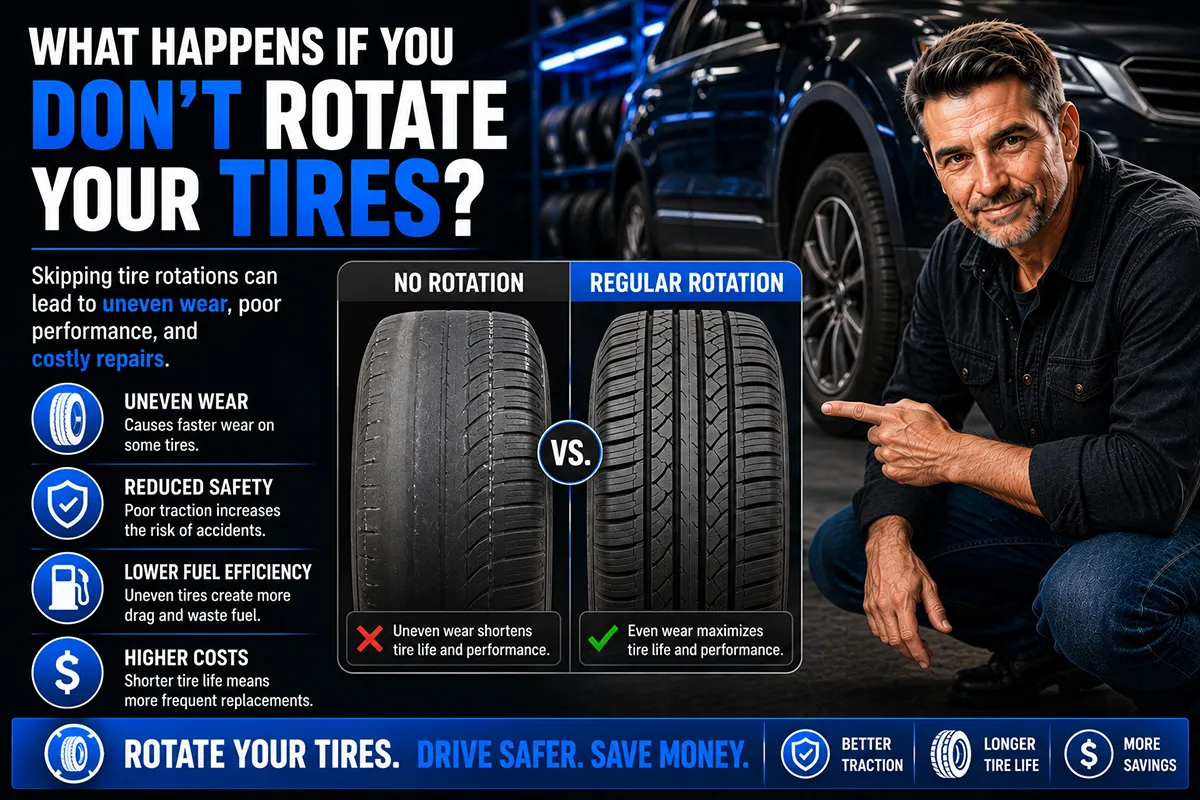
- Skipping tire rotations causes uneven tread wear, which shortens tire life significantly — sometimes by a third or more.
- Front tires on FWD vehicles wear faster because they handle steering, braking, and most of the acceleration forces.
- Uneven wear leads to poor handling, reduced wet traction, increased road noise, and potential safety hazards.
- Most manufacturers recommend rotating every six months or at every other oil change — and many tire warranties require it.
- Rotation is cheap (often free with a tire purchase) and takes less than 30 minutes at most shops.
- Neglecting rotations can void your treadwear warranty, costing you hundreds of dollars in lost coverage.
Liked this article?
Add TireAdvise as a preferred source so you see more of our tire reviews and guides on Google.
Why Tire Rotation Matters More Than Most Drivers Think
I’ve reviewed hundreds of tires over the years, and one pattern keeps showing up in reader questions: people buy great tires, skip rotations, then blame the tire brand when they wear out unevenly. The truth is, even the best tires on the market will develop uneven wear if you never rotate them.
Tire rotation is the process of moving each tire to a different position on the vehicle — typically swapping front tires to the rear and vice versa — to ensure that all four tires wear down at roughly the same rate. It sounds simple because it is. But the consequences of skipping it are anything but.
What Actually Happens When You Skip Tire Rotations
Let me walk you through exactly what happens to your tires, your vehicle’s performance, and your wallet when you neglect this basic maintenance step. I’ve seen all of these consequences firsthand — both on my own vehicles and on the cars of friends and family who’ve asked me for tire advice after things went wrong.
1. Uneven Tread Wear Develops Quickly
The most immediate and visible consequence is uneven tread wear. On a front-wheel-drive vehicle — which accounts for the majority of sedans, crossovers, and compact SUVs sold in the US — the front tires do almost all the heavy lifting.
They handle acceleration, the majority of braking force, and all of the steering input. That’s an enormous amount of stress concentrated on just two of your four tires. Without rotation, the fronts will wear down dramatically faster than the rears.
I’ve personally measured tread depth differences of several thirty-seconds of an inch between front and rear tires on vehicles that skipped rotations for extended periods. On one of my test vehicles — a popular compact SUV — the front tires showed clear wear indicators while the rears still had most of their original tread depth.
2. You’ll Replace Tires Much Sooner Than Expected
Here’s where it starts to hurt financially. When your front tires wear out prematurely, you can’t just replace two tires and call it a day — at least not ideally.
Most tire experts, including myself, recommend replacing all four tires at the same time for optimal handling and safety. At the very least, you should replace tires in pairs (both fronts or both rears). But if your rears still have plenty of life left, you’re essentially wasting that remaining tread by being forced into an early replacement cycle.
I’ve calculated that skipping rotations can reduce your overall tire life by 20% to 40%, depending on your vehicle type and driving habits. On a set of mid-range all-season tires that costs around $500 to $700 installed, that’s $100 to $280 you’re throwing away by not spending 30 minutes at a tire shop twice a year.
3. Handling and Ride Quality Deteriorate
This is the consequence that scares me the most as a reviewer, because it directly affects safety. Uneven tire wear changes how your vehicle handles — and not in a subtle way.
I noticed this on my own sedan before I finally replaced those neglected tires. The car started pulling slightly to one side. Turn-in response felt sluggish. During hard braking, the vehicle didn’t track straight.
These are the kinds of handling changes that happen gradually, so you might not notice them day to day. But they’re there, and they become dangerously apparent in emergency situations — like when you need to swerve to avoid debris on the highway or brake hard for a sudden stop on a rain-slicked road.
4. Wet Traction Suffers Dramatically
Tread depth is the single most important factor in wet-weather grip. The grooves and sipes in your tire tread are specifically designed to channel water away from the contact patch, preventing hydroplaning.
As your front tires wear down faster than your rears (on a FWD vehicle), you lose wet traction exactly where you need it most — on the tires that steer and stop the car. I’ve tested tires at various stages of wear, and the difference in wet braking distance between a tire with full tread and one approaching the wear indicators is significant and measurable.
In heavy rain — the kind we get regularly in the Southeast, Gulf Coast, and Pacific Northwest — this can be the difference between stopping in time and not stopping in time.
5. Road Noise Increases Noticeably
This one surprised me when I first experienced it, but it makes perfect sense. Uneven tire wear creates irregular tread patterns that generate more road noise as the tire rolls along the pavement.
I started noticing a low humming sound in my sedan that I initially thought was a wheel bearing issue. After some investigation, it turned out to be the unevenly worn front tires creating a cupping pattern — small, scalloped dips in the tread surface — that produced a rhythmic drone at highway speeds.
Once I replaced the tires and committed to regular rotations, the cabin was noticeably quieter. If your car seems louder than it used to be on the highway, take a close look at your tire wear patterns before you start worrying about more expensive mechanical problems.
6. Vibrations and Ride Comfort Problems
Closely related to the noise issue, uneven wear can cause steering wheel vibrations and a generally rougher ride. When tread wears unevenly, the tire is no longer perfectly round in a functional sense — some spots have more rubber than others.
This creates slight imbalances that your vehicle’s suspension has to absorb, leading to vibrations that you feel through the steering wheel, the floorboard, or even the seats. I’ve driven vehicles where the vibration from unevenly worn tires was so pronounced that the driver assumed they needed new shocks or struts.
A good tire rotation — and in severe cases, a replacement — resolved the issue completely without any suspension work.
How Different Drivetrains Affect Wear Patterns
Not all vehicles wear their tires the same way, and understanding your drivetrain helps explain why rotation patterns matter so much. I’ve owned and tested vehicles across all major drivetrain types, and here’s what I’ve observed.
| Drivetrain Type | Primary Wear Pattern Without Rotation | Most Affected Tires | Common US Vehicles |
|---|---|---|---|
| Front-Wheel Drive (FWD) | Front tires wear much faster; shoulder and center wear from acceleration, braking, and steering | Both fronts | Honda Civic, Toyota Camry, Hyundai Elantra, most sedans and compact crossovers |
| Rear-Wheel Drive (RWD) | Rear tires wear faster from acceleration forces; fronts wear from steering and braking | Both rears | Ford Mustang, Chevrolet Camaro, BMW 3 Series, many trucks |
| All-Wheel Drive (AWD) | More even wear overall, but fronts still wear slightly faster due to steering loads | Fronts (slightly) | Subaru Outback, Toyota RAV4 AWD, Mazda CX-5 AWD |
| Four-Wheel Drive (4WD) | Similar to RWD when in 2WD mode; more even when 4WD engaged, but off-road use creates unique wear | Varies by usage | Jeep Wrangler, Toyota Tacoma, Ford F-150 |
The key takeaway from this table is that no drivetrain is immune to uneven wear. Even AWD vehicles, which distribute power more evenly, still develop wear differences because the front tires handle all steering input plus a significant portion of braking force.
The Financial Cost of Skipping Rotations
Let me put some real numbers to this so you can see exactly what’s at stake. I’ve tracked tire costs across dozens of sets over my career, and the math is clear.
Scenario 1: Regular Rotations
You buy a set of four mid-range all-season tires — something like the Continental TrueContact Tour or the Michelin Defender — for around $600 to $800 installed, including mounting, balancing, and disposal fees. With regular rotations every six months, all four tires wear evenly and reach the end of their usable life at approximately the same time.
Your cost per month of tire ownership is predictable, and you get the full advertised tread life from the manufacturer. Many shops — Costco, Discount Tire, America’s Tire, Tire Rack — offer free rotations for the life of the tire when you purchase from them. So the rotation cost is literally zero dollars.
Scenario 2: No Rotations
Same tires, same vehicle, same driving habits. But you skip rotations entirely. Your front tires wear out much sooner — based on my experience, roughly 30% to 40% earlier than they would with regular rotation.
Now you’re forced to replace at least two tires ahead of schedule. If you buy just two, you’ve got mismatched tread depths front to rear, which creates its own handling issues. If you replace all four to maintain consistency, you’re throwing away perfectly good rear tires with plenty of life left.
Either way, you’re spending an extra $200 to $400 that you didn’t need to spend. Over the life of a vehicle you own for several years, that adds up to potentially over a thousand dollars in wasted tire rubber.
Your Tire Warranty Might Be Void
This is something that catches a lot of drivers off guard, and I think it’s one of the most important reasons to keep up with rotations. Most major tire manufacturers — Michelin, Bridgestone, Goodyear, Continental, Pirelli, and others — include a treadwear warranty with their tires.
These warranties promise a certain amount of tread life under normal driving conditions. But here’s the catch: virtually all of them require proof of regular tire rotations to honor the warranty claim.
I’ve helped several friends file treadwear warranty claims over the years, and the process always involves showing rotation records. If you can’t prove that you rotated your tires at the recommended intervals, the manufacturer can — and will — deny your claim.
That warranty you thought would protect your $800 tire investment? Gone. Because you skipped a free service that takes less than half an hour.
How Often Should You Rotate Your Tires?
The general industry recommendation, and the one I follow personally, is to rotate your tires every six months or at every other oil change — whichever comes first. This is the interval recommended by the Tire Industry Association and most vehicle manufacturers.
I find it easiest to tie rotations to oil changes because it’s already a scheduled service you’re doing anyway. Most quick-lube shops and dealerships will do a tire rotation at the same time for a small fee — usually $20 to $40 — or sometimes for free as part of a maintenance package.
Some tire retailers, like Discount Tire and Costco, offer free lifetime rotations when you purchase tires from them. In my experience, this is one of the best reasons to buy from these retailers. That “free” rotation benefit can save you hundreds of dollars over the life of the tires while ensuring you maintain your warranty.
My Personal Rotation Schedule
Here’s what I do on every vehicle I own or test long-term. I set a calendar reminder for every six months. On that date, I either take the car to my local Discount Tire (where I buy most of my test tires) or do it myself in my garage.
When I rotate, I also check tread depth at multiple points on each tire using a simple tread depth gauge — a tool that costs less than $5 at any auto parts store. This lets me catch any unusual wear patterns early, before they become expensive problems.
I also check tire pressure during every rotation. Incorrect tire pressure is actually one of the leading causes of uneven wear, and it compounds the problem if you’re also skipping rotations.
Can You Rotate Tires Yourself?
Absolutely, and I do it regularly on my personal vehicles. All you need is a floor jack, a set of jack stands, and a lug wrench or impact wrench. The entire process takes me about 20 to 25 minutes.
Here’s the basic process I follow for a front-wheel-drive vehicle using the forward cross pattern:
- Step 1: Loosen all lug nuts slightly while the car is still on the ground.
- Step 2: Jack up one end of the vehicle and secure it on jack stands. Never work under a car supported only by a jack.
- Step 3: Remove the tires and move them according to the rotation pattern — left front goes to right rear, right front goes to left rear, left rear goes to left front, right rear goes to right front.
- Step 4: Torque all lug nuts to the manufacturer’s specification (usually found in your owner’s manual or on a sticker inside the driver’s door jamb).
- Step 5: Lower the vehicle and double-check lug nut torque.
One important note: if your vehicle has different-sized tires front and rear (common on some sports cars and performance sedans) or directional tires, the rotation pattern is different. Directional tires can only be swapped front to rear on the same side. Staggered setups (different widths front and rear) may not be rotatable at all — in that case, your best option is to have them dismounted and remounted on opposite-side wheels, which requires a tire shop.
Always check your owner’s manual for the recommended rotation pattern for your specific vehicle.
Signs Your Tires Need Rotation Right Now
If you’re reading this and wondering whether you’ve waited too long, here are the warning signs I look for. Any one of these means you should get your tires rotated as soon as possible — and possibly inspected for damage or excessive wear.
- Visible tread difference front to rear: Get down at eye level with your tires and compare. If the fronts look noticeably more worn than the rears (or vice versa), you’re overdue.
- Vehicle pulling to one side: While this can also indicate an alignment issue, uneven tire wear is a common culprit.
- Increased road noise: A humming or droning sound that gets louder at highway speeds, especially if it seems to come from one corner of the vehicle.
- Steering wheel vibration: Vibrations at certain speeds that weren’t there before can indicate cupping or irregular wear.
- Poor wet traction: If your car feels less confident in rain than it used to, worn front tires could be the reason.
- Uneven wear patterns: Look for wear that’s heavier on the inside edge, outside edge, or center of the tread. These patterns indicate not just a need for rotation but potentially an alignment or inflation issue as well.
Rotation vs. Alignment vs. Balancing: Know the Difference
I get these three services confused by readers all the time, so let me clarify quickly. They’re all important, but they address different issues.
Tire Rotation is moving tires to different positions on the vehicle to promote even wear. It addresses wear distribution. Cost: free to $40 depending on where you go.
Wheel Alignment is adjusting the angles of the wheels so they’re perfectly perpendicular to the ground and parallel to each other. It addresses handling, tracking, and prevents certain types of abnormal wear (like inner or outer edge wear). Cost: typically $75 to $150 at most shops.
Tire Balancing is adding small weights to the wheel to ensure even weight distribution as the tire spins. It addresses vibrations and ensures smooth rotation at all speeds. Cost: usually $15 to $50 per tire.
In my experience, you should rotate at every recommended interval, balance whenever you notice vibrations or when new tires are installed, and align whenever you notice pulling or after hitting a significant pothole or curb. I also recommend an alignment check whenever you buy new tires — it protects your investment from day one.
What Happens to AWD Vehicles Specifically?
I want to spend a moment on AWD vehicles because the consequences of skipping rotations are even more severe for them. AWD systems rely on all four tires being very close in circumference — meaning they need to be close in tread depth.
When you skip rotations on an AWD vehicle and the tires develop significantly different tread depths, the AWD system’s differentials and transfer case have to work harder to compensate for the difference in rotational speed between the tires.
Over time, this extra stress can damage expensive drivetrain components. I’ve spoken with mechanics who’ve seen transfer case failures in Subarus, Audis, and other AWD vehicles that were directly linked to mismatched tire wear.
On an AWD vehicle, a new transfer case can cost $1,500 to $3,000 or more to replace. That makes the free tire rotation look like the best deal in automotive maintenance.
Real-World Consequences I’ve Witnessed
Beyond my own experience, I want to share a few situations I’ve encountered that really drive home why this matters.
A friend of mine drove a Honda CR-V for several years without a single rotation. By the time she came to me complaining about poor traction in the rain, her front tires were below the legal minimum tread depth of 2/32 of an inch in most US states, while her rear tires were still at around 7/32. She was driving on essentially unsafe tires without realizing it.
Another case involved a colleague with a Toyota Tacoma who skipped rotations and developed severe cupping on the front tires. The noise was so loud that he actually took the truck to a mechanic thinking the transmission was failing. The fix was new tires and a rotation schedule — and an alignment for good measure.
These aren’t extreme cases. They’re everyday situations that happen to everyday drivers who simply didn’t know — or didn’t bother — to rotate their tires regularly.
The Bottom Line: Tire Rotation Is Non-Negotiable
After years of testing tires, reviewing products, and helping readers make smart tire decisions, I can say this with absolute confidence: tire rotation is the single most impactful and cost-effective thing you can do to extend the life of your tires and maintain your vehicle’s safety.
It’s free or nearly free at most shops. It takes less than 30 minutes. It preserves your tread warranty. It keeps your handling predictable and your traction consistent. And it can save you hundreds — if not thousands — of dollars over the life of your vehicle.
If you haven’t rotated your tires recently, call your local tire shop today or check whether your tire retailer offers free rotations. If you bought your tires from Costco, Discount Tire, or Tire Rack-affiliated installers, there’s a very good chance you’re already covered.
And if you’re shopping for new tires right now, factor in the rotation benefit when choosing where to buy. A slightly higher upfront price at a retailer that includes free lifetime rotations is almost always a better deal than saving $20 at a shop that charges for every rotation.
Your tires are the only thing connecting your car to the road. Treat them accordingly.
Frequently Asked Questions
What happens if you never rotate your tires?
If you never rotate your tires, the front tires will wear down significantly faster than the rears on front-wheel-drive vehicles, which is the majority of cars on US roads. This uneven tread wear shortens overall tire life by up to 20%, meaning you could be replacing a $600-$800 set of tires thousands of miles earlier than necessary. You’ll also notice reduced traction, longer braking distances, and a rougher ride as the wear pattern becomes more pronounced.
How long can you go without rotating tires before damage occurs?
Most tire manufacturers and brands like Michelin, Goodyear, and Bridgestone recommend rotating every 5,000 to 7,500 miles. If you skip even one rotation cycle, you’ll start developing uneven wear patterns that can’t be reversed. Going beyond 15,000 miles without a rotation often creates enough tread depth difference between axles that your tires may no longer perform safely in rain or snow, which is especially dangerous during harsh US winter driving conditions.
Can skipping tire rotation void your tire warranty?
Yes, most major tire manufacturers require proof of regular tire rotations to honor their treadwear warranties. If you file a warranty claim with brands like Continental, Firestone, or Cooper and can’t show service records of rotations at recommended intervals, your claim will likely be denied. I always recommend keeping receipts or using a shop that logs your service history digitally so you’re covered if a tire wears out prematurely.
What does uneven tire wear from not rotating look like?
The most common sign is noticeably more tread on your rear tires compared to your front tires, especially on front-wheel-drive cars where the front tires handle steering, braking, and power delivery. You might also see feathering along the tread edges or cupping, which looks like scalloped dips in the rubber. If you run your hand across the tread and it feels smooth one direction but rough the other, that’s a clear indicator you’ve gone too long without a rotation.
Does not rotating tires affect gas mileage and fuel costs?
Unevenly worn tires increase rolling resistance, which can reduce your fuel economy by 2-3% over time. While that may sound small, with US gas prices averaging $3.00-$3.50 per gallon, that adds up to $100 or more per year for the average American driving 13,500 miles annually. Regular tire rotations help maintain consistent tread depth across all four tires, keeping rolling resistance low and your fuel costs predictable.
Is it cheaper to rotate tires regularly or just replace them early?
Tire rotation is dramatically cheaper, typically costing $25-$50 per service or even free with a tire purchase from retailers like Discount Tire, Costco, or America’s Tire. A full set of quality replacement tires runs $500-$1,000 or more depending on size and brand. By rotating every 5,000-7,500 miles, you can extend your tire life from roughly 40,000 miles to the full 60,000-80,000 miles many tires are rated for, saving you hundreds of dollars over the life of the set.
Can you rotate your tires yourself to avoid uneven wear?
Absolutely — if you have a jack, jack stands, and a lug wrench, you can rotate your own tires at home in about 30-45 minutes. For most front-wheel-drive vehicles, you’ll move the front tires straight to the rear and cross the rear tires to the front. Just make sure to check your owner’s manual first, since some vehicles with directional tires or staggered wheel setups require a specific rotation pattern. Doing it yourself saves money and ensures you stay on schedule.
