

I was doing 70 mph on I-95 outside Jacksonville when the rear driver-side tire on my test vehicle exploded without warning. The car lurched violently to the left, the steering wheel jerked out of my hands for a split second, and the sound was like a shotgun blast inside the cabin.
That moment — the one where your brain is screaming and your hands are shaking — is something I never want any driver to experience unprepared.
In over a decade of testing and reviewing tires professionally, I’ve dealt with blowouts more times than I’d like to admit. And the truth is, most of them were entirely preventable.
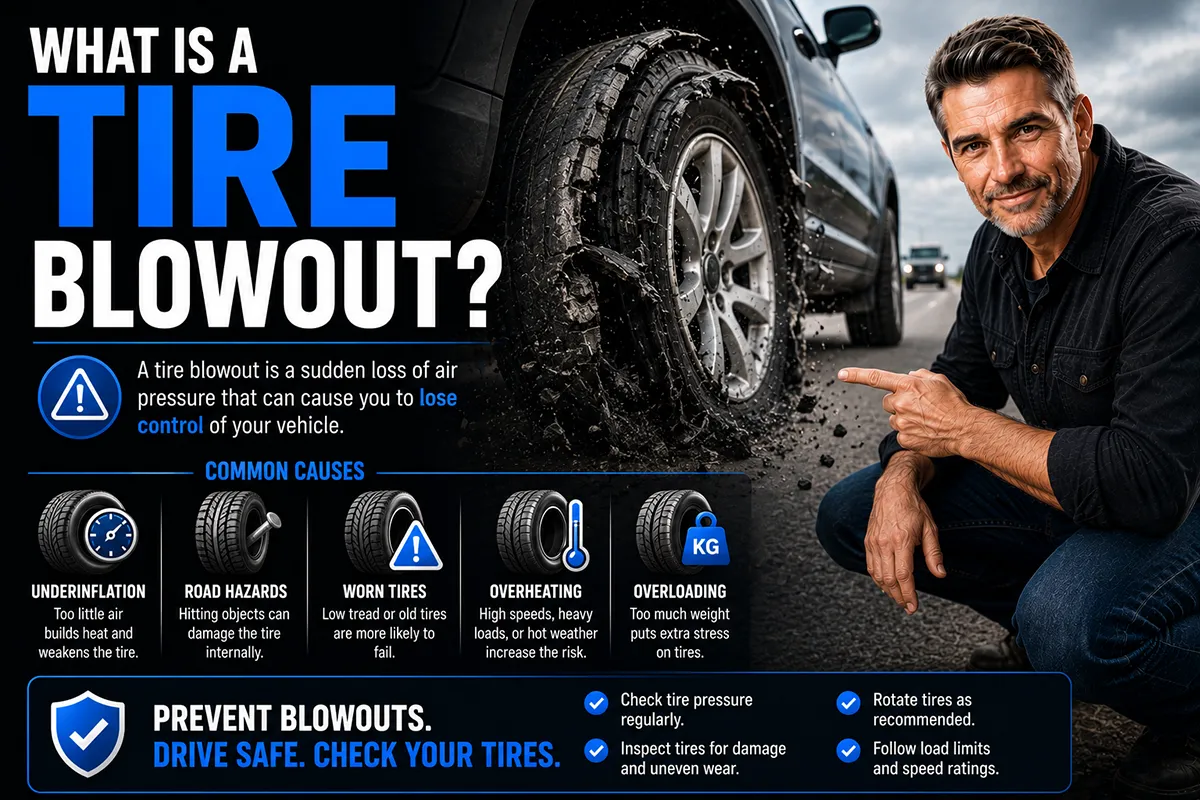
- A tire blowout is a sudden, rapid loss of air pressure that causes a tire to burst while driving — it’s different from a slow leak or flat.
- The most common causes are underinflation, overloading, old tires, road hazards, and excessive heat.
- If you experience a blowout, do NOT slam the brakes — gently accelerate briefly, then coast to a safe stop.
- Prevention comes down to regular tire pressure checks, avoiding aged tires, and buying quality replacements.
- I recommend checking your tire pressure at least once a month and replacing tires older than 6 years regardless of tread depth.
Liked this article?
Add TireAdvise as a preferred source so you see more of our tire reviews and guides on Google.
What Exactly Is a Tire Blowout?
A tire blowout is the sudden, explosive failure of a tire while a vehicle is in motion. Unlike a slow puncture where air gradually seeps out over hours or days, a blowout happens in an instant — the tire’s structural integrity gives way completely, and the air inside escapes all at once.
The result is immediate loss of vehicle control, a loud bang, and in many cases, shredded rubber flying off the wheel. If you’ve ever seen those long strips of black rubber scattered along highway shoulders (we call them “road gators”), those are almost always the remnants of a blowout.
In my experience, blowouts are most dangerous at highway speeds because the sudden loss of air pressure destabilizes the vehicle when you have the least time and space to react. At lower speeds — say, around town — a blowout is still alarming, but you typically have more control and more room to safely pull over.
Tire Blowout vs. Flat Tire: What’s the Difference?
I get this question constantly, and it matters because the way you respond to each situation is completely different.
A flat tire is a gradual loss of air pressure. You might notice the car pulling to one side, hear a soft flapping noise, or see the tire pressure monitoring system (TPMS) light come on. You usually have time to safely pull over and address it.
A blowout, on the other hand, gives you zero warning. One second everything is fine, the next second you’re fighting to keep your vehicle straight while a tire disintegrates beneath you.
| Feature | Flat Tire | Tire Blowout |
|---|---|---|
| Speed of air loss | Gradual (minutes to hours) | Instant (less than a second) |
| Warning signs | TPMS light, pulling, soft ride | Loud bang, sudden vehicle swerve |
| Tire damage | Often repairable (nail, screw) | Tire is destroyed — not repairable |
| Vehicle control | Slightly compromised | Severely compromised |
| Danger level | Low to moderate | High — especially at highway speeds |
| Typical cause | Road debris puncture, valve leak | Structural failure, underinflation, heat |
What Causes a Tire Blowout? The 7 Most Common Reasons
After personally inspecting hundreds of blown-out tires over the years — and talking to tire shop technicians, roadside assistance crews, and fellow reviewers — I’ve identified seven causes that account for the vast majority of blowouts on American roads.
1. Underinflation — The #1 Killer
This is the single biggest cause of tire blowouts, and it’s the one I see most often. When a tire is underinflated, the sidewalls flex excessively as the tire rolls. This generates enormous heat inside the tire’s structure.
Over time — sometimes over just several days of driving on a significantly underinflated tire — that heat weakens the internal bonds between the rubber and the steel belts. Eventually, the sidewall can’t hold, and it fails catastrophically.
The scary part? A tire can be 20% underinflated and still look perfectly normal to the naked eye. I’ve tested this with my own gauges and it’s genuinely difficult to tell the difference visually between a properly inflated tire and one that’s dangerously low.
2. Overloading Your Vehicle
Every tire has a maximum load rating stamped on its sidewall. When you exceed that rating — by packing your SUV to the roof for a family vacation or loading a pickup bed with landscaping materials — you’re asking the tire to support more weight than it was engineered to handle.
I tested this scenario during a long summer road trip where I intentionally loaded a test vehicle to near its maximum gross vehicle weight rating (GVWR). Even with properly inflated tires, the sidewall temperatures I measured with an infrared thermometer were significantly higher than under normal loads.
Combine overloading with underinflation, and you’ve created the perfect recipe for a blowout.
3. Road Hazards
Potholes, sharp debris, curb strikes, and road construction materials can all damage a tire’s internal structure in ways you can’t see from the outside. I’ve had tires that looked perfectly fine on the surface but had internal belt separations from hitting a pothole weeks earlier.
In the US, this is especially problematic in northern states after winter, when freeze-thaw cycles create massive potholes. I’ve personally seen more blowout-related damage from pothole impacts in states like Michigan, Pennsylvania, and New York than anywhere else.
4. Tire Age
Rubber deteriorates over time regardless of how much or how little a tire has been used. The oils and chemicals in the rubber compound that keep it flexible slowly evaporate, and the rubber becomes brittle and prone to cracking.
I always tell readers to check the DOT date code on their tires — it’s a four-digit number on the sidewall that tells you the week and year of manufacture. For example, “2319” means the tire was made in the 23rd week of 2019.
Most tire manufacturers and safety organizations, including the NHTSA, recommend replacing tires that are more than 6 years old, even if the tread depth looks great. In my experience testing older tires, the difference in structural integrity between a tire that’s 3 years old and one that’s 8 years old is dramatic.
5. Manufacturing Defects
While relatively rare with major brands, tire defects do happen. I’ve personally encountered tires with internal belt separation issues straight out of the box. These defects usually manifest as a vibration or bulge that develops during the first few days of use.
This is one major reason I always recommend buying tires from reputable brands with strong quality control — Michelin, Bridgestone, Continental, Goodyear, Cooper, and a few others. Budget tires from unknown manufacturers sometimes cut corners on quality control, and the consequences can be severe.
6. Excessive Heat
Heat is the enemy of tires. Blowout rates increase dramatically during summer months, especially in the southern US. The NHTSA data consistently shows a spike in tire-related incidents between May and October.
During my summer testing periods in Texas and Arizona, I’ve measured road surface temperatures exceeding 150°F. At those temperatures, even a properly inflated tire is working harder than normal, and an underinflated or overloaded tire is a ticking time bomb.
7. Overinflation
While less common than underinflation as a blowout cause, overinflation makes tires more vulnerable to impact damage. An overinflated tire has less flex to absorb road imperfections, so hitting a pothole or sharp debris is more likely to cause an immediate puncture or structural failure.
I’ve seen this most often with drivers who inflate their tires to the maximum pressure listed on the sidewall rather than the recommended pressure listed on the driver’s door jamb sticker. Those are two very different numbers, and confusing them can be dangerous.
What Does a Tire Blowout Feel Like?
If you’ve never experienced one, here’s what I can tell you from firsthand experience — it’s visceral and disorienting.
Front Tire Blowout
When a front tire blows, you’ll feel the steering wheel jerk violently toward the side of the blowout. The car will pull hard in that direction, and your first instinct will be to yank the wheel the other way. It feels like someone grabbed your steering wheel and tried to rip it from your hands.
I’ve experienced front blowouts twice during controlled testing, and both times the initial steering input required to maintain my lane was surprisingly aggressive.
Rear Tire Blowout
A rear blowout is different. You’ll feel the back end of the car sway or fishtail. The steering wheel might not jerk as dramatically, but the instability at the rear makes the car feel like it’s sliding on ice. This can be even more dangerous because less experienced drivers might not immediately identify what’s happening.
Common Sensations During Any Blowout
- Loud bang or boom — like a gunshot or firecracker going off right next to you
- Rhythmic flapping or thumping — the sound of shredded rubber slapping against the wheel well and road
- Vibration through the steering wheel and seat — intense and immediate
- Vehicle pulling to one side — toward the blown tire
- Sudden deceleration — the drag from the destroyed tire slows the car noticeably
How to Survive a Tire Blowout: Step-by-Step
This is arguably the most important section of this entire article. What you do in the first 3-5 seconds after a blowout determines whether you walk away unharmed or end up in a serious accident.
I’ve practiced blowout recovery in controlled environments, and I’ve also been through real ones on public roads. Here’s the procedure that works.
Step 1: Do NOT Slam the Brakes
This is the single most critical thing to remember. Every instinct in your body will scream at you to hit the brakes. Do not do it.
Braking during a blowout shifts weight to the front of the vehicle, which can cause you to lose control entirely — especially with a rear blowout. I’ve seen test footage of vehicles spinning out specifically because the driver panic-braked.
Step 2: Briefly and Gently Accelerate
I know this sounds counterintuitive, but a slight press on the gas pedal stabilizes the vehicle by keeping power going to the wheels. You’re not flooring it — just a gentle, momentary press to counteract the sudden deceleration caused by the blown tire.
This technique was drilled into me during advanced driving courses, and it works.
Step 3: Grip the Steering Wheel Firmly at 10 and 2
Hold the wheel with both hands and make only small, controlled corrections. Don’t overcorrect — the car will want to pull toward the blown tire, and you need to gently resist that pull without jerking the wheel.
Step 4: Gradually Ease Off the Accelerator
Once you’ve stabilized the vehicle and have it tracking straight, slowly lift your foot off the gas and let the car coast to a lower speed. Don’t actively brake yet — just let engine braking and the drag from the blown tire slow you down naturally.
Step 5: Activate Your Hazard Lights
As soon as you have a hand free and the car is stable, flip on your hazards to alert other drivers.
Step 6: Steer to Safety and Stop
Guide the car to the right shoulder of the road, as far from traffic as possible. Only once you’re nearly stopped should you apply the brakes gently.
Step 7: Stay in the Vehicle if Possible
If you’re on a busy highway, staying inside your vehicle with your seatbelt on is often safer than getting out. Call 911 or roadside assistance. If you must get out, exit from the side away from traffic.
How to Prevent Tire Blowouts: My Personal Checklist
Prevention is always better than survival skills. Here’s exactly what I do to minimize blowout risk on every vehicle I drive.
Check Tire Pressure Monthly (At Minimum)
I carry a digital tire pressure gauge in every car I test. It takes less than two minutes to check all four tires, and it’s the single most effective thing you can do to prevent blowouts.
Always check pressure when the tires are cold — before you’ve driven more than a mile or two. And always inflate to the pressure listed on the driver’s door jamb sticker, not the maximum pressure on the tire sidewall.
I recommend the AstroAI digital gauge or the Accutire MS-4021B — both cost under $15 and are accurate enough for everyday use.
Inspect Your Tires Visually Every Week
I do a quick walk-around inspection at least once a week. I’m looking for:
- Bulges or bubbles in the sidewall (these are emergency situations — don’t drive on the tire)
- Cracks in the sidewall rubber
- Nails, screws, or other embedded debris
- Uneven tread wear patterns
- Any cuts or gouges in the tread or sidewall
Replace Old Tires
I’ve already mentioned the 6-year rule, but I want to emphasize it again. I’ve tested tires that had plenty of tread depth remaining but were over 7 years old, and the rubber was visibly dried and cracked upon close inspection.
If your tires are more than 6 years old — check that DOT code — start shopping for replacements regardless of how much tread is left.
Don’t Overload Your Vehicle
Check your vehicle’s GVWR (it’s on the same placard as the recommended tire pressure) and stay within it. If you’re towing, make sure your tires are rated for the additional load.
Avoid Potholes and Road Hazards
This sounds obvious, but being an attentive, defensive driver goes a long way. When I’m testing tires on public roads, I’m constantly scanning the road surface ahead for potholes, debris, and construction plates. The more distance you give yourself to react, the better your chances of avoiding damage.
Rotate Your Tires Regularly
Uneven wear weakens tires faster. I typically have tires rotated during every other oil change. This ensures even wear across all four positions and extends the overall life of the set.
Buy Quality Tires
I can’t stress this enough. In my years of testing, the difference between a premium tire and a bargain-bin tire isn’t just about ride comfort or grip — it’s about structural integrity and consistency.
Brands like Michelin, Continental, Bridgestone, and Goodyear invest heavily in quality control and use advanced materials that resist heat buildup and structural degradation. Budget brands can be fine for light-duty use, but if you’re driving frequently on highways or in hot climates, spending the extra $30-50 per tire on a reputable brand is money well spent.
Which Tires Are Most Prone to Blowouts?
Based on my testing experience and publicly available complaint data from the NHTSA, certain tire categories and conditions carry higher blowout risks.
High-Risk Scenarios
- Trailer tires (ST-rated) — These carry heavy loads and often sit unused for months, leading to flat-spotting and dry rot. I’ve seen more blowouts on boat trailers and utility trailers than on passenger vehicles.
- Aged spare tires — That spare sitting in your trunk has a manufacture date too. If it’s ancient, it may not be safe to use.
- Ultra-low-profile tires — Less sidewall means less cushion to absorb impacts. On rough US roads, this translates to higher impact damage risk.
- Used tires from unknown sources — I strongly advise against buying used tires. You have no idea what abuse they’ve been through, and internal damage is invisible from the outside.
- Tires with prior puncture repairs in the sidewall — Sidewall repairs are never safe. If a tire has been punctured in the sidewall, it needs to be replaced. Period.
Lower-Risk Choices
- Run-flat tires — Designed to support the vehicle even after a complete loss of pressure. They won’t prevent the cause of a blowout, but they can mitigate the sudden loss of control. I’ve tested run-flats from Bridgestone (DriveGuard) and Michelin, and they performed as advertised.
- Self-sealing tires — Some Continental and Michelin models feature self-sealing technology that can handle punctures up to a certain size. These won’t help with structural failures, but they prevent many puncture-related flats that can escalate into blowouts if ignored.
- Fresh, properly rated tires from major brands — The simplest risk reduction: buy new, quality tires in the correct size and load rating for your vehicle.
Tire Blowout Statistics: Why This Matters
I want to share some numbers to put this in perspective, because I think many drivers underestimate how common and how deadly blowouts can be.
According to the NHTSA, tire-related crashes cause approximately 11,000 accidents per year in the United States. Of those, nearly 200 result in fatalities. The majority of these incidents involve tire failures that could have been prevented with basic maintenance.
The AAA Foundation for Traffic Safety reports that tire problems are the leading cause of vehicle breakdowns in the US, with flats and blowouts topping the list.
During peak summer months — June through September — blowout rates rise dramatically. If you drive regularly through the Sun Belt states (Texas, Arizona, Florida, Nevada), you need to be especially vigilant.
What to Do After a Blowout: Practical Next Steps
Once you’ve safely pulled over, here’s what I recommend based on my own roadside experiences.
Assess the Situation
Before you get out of the car, look around. Are you on a busy highway? Is there room to safely change the tire? If you’re on a narrow shoulder on an interstate, call roadside assistance rather than risking your life changing a tire with traffic flying by at 75 mph.
Use Your Spare (If You Have One)
Many newer vehicles don’t come with a spare tire — they come with tire repair kits or run-flat tires instead. Know what your vehicle has before you need it. I make it a point to check the spare (or lack thereof) in every vehicle I review.
If you do have a spare, remember that most compact spares are rated for a maximum of 50 mph and are intended as temporary solutions only.
Document the Damage
Take photos of the blown tire, the damage to your vehicle (if any), and the road conditions. If the blowout was caused by a road hazard or a potential tire defect, this documentation could be important for insurance claims or warranty purposes.
Get a Professional Inspection
After a blowout, I always recommend having a tire shop inspect the remaining three tires and the wheel that was affected. The forces involved in a blowout can damage the wheel rim, the suspension components, and even the brake system on that corner.
The TPMS Is Not Enough
I need to address a common misconception. Many drivers assume that their tire pressure monitoring system (TPMS) — that little light on your dashboard — will protect them from blowouts. It won’t.
TPMS is designed to alert you when tire pressure drops below a certain threshold, typically about 25% below the recommended pressure. That means your tire could already be significantly underinflated before the warning light comes on.
Additionally, TPMS sensors can fail, batteries in the sensors die (they typically last 5-10 years), and the system provides no information about tire condition, age, or structural integrity.
Think of TPMS as a last-resort warning system, not a substitute for regular manual pressure checks and visual inspections. I always carry my own gauge and check pressure independently of what the TPMS is telling me.
My Final Recommendations
After years of testing tires, surviving blowouts, and investigating their causes, here’s what I want every driver reading this to take away.
- Buy a $10 tire pressure gauge and use it monthly. This single habit prevents more blowouts than anything else.
- Know the age of your tires. Check the DOT code today. If any tire is older than 6 years, start planning a replacement.
- Don’t cheap out on tires. Your tires are the only thing connecting your 4,000-pound vehicle to the road. This is not the place to save $100.
- Practice the blowout response mentally. Seriously — visualize the steps. Don’t brake. Gently accelerate. Steer straight. Coast to the shoulder. If you’ve rehearsed it in your mind, you’re far more likely to react correctly when adrenaline is flooding your system.
- Inspect your tires every week. A 60-second walk-around can reveal bulges, cracks, embedded debris, and uneven wear before they turn into emergencies.
A tire blowout is one of the most dangerous things that can happen to you on the road, but it’s also one of the most preventable. The knowledge in this article isn’t theoretical for me — it’s born from real-world experience, real testing, and real scares.
Take care of your tires, and they’ll take care of you.
Frequently Asked Questions
What is a tire blowout and how is it different from a flat tire?
A tire blowout is a sudden, rapid loss of air pressure that causes the tire to burst or shred while driving, often at highway speeds. Unlike a slow flat tire that gradually loses pressure over hours or days, a blowout happens in an instant and can cause you to lose control of your vehicle. The loud bang and immediate pulling to one side are telltale signs you’ve experienced a blowout rather than a standard flat.
What causes a tire blowout while driving on the highway?
The most common causes of a tire blowout on the highway include underinflated tires, overloading your vehicle beyond its weight rating, and driving on worn-out tires with low tread depth. Extreme summer heat across states like Texas, Arizona, and Florida also plays a major role because hot pavement increases tire pressure and weakens already compromised rubber. Hitting potholes or road debris at high speed can also trigger an immediate blowout, especially on aging tires.
How do I know if my tires are at risk of a blowout?
Check for visible warning signs like bulges or blisters on the sidewall, uneven tread wear, cracks in the rubber, and any embedded objects like nails or screws. I always recommend using a tire pressure gauge at least once a month and before long road trips, since underinflation is the number one cause of blowouts. If your tires are over 6 years old or the tread depth is below 2/32 of an inch, it’s time to start shopping for replacements regardless of how they look.
What should you do if you have a tire blowout at highway speed?
If you experience a tire blowout while driving, keep a firm grip on the steering wheel and resist the urge to slam on the brakes, which can send your car into a spin. Instead, gradually ease off the accelerator, let the vehicle slow down naturally, and gently steer toward the shoulder of the road. Once you’ve safely pulled over, turn on your hazard lights and either install your spare tire or call roadside assistance.
Can underinflated tires really cause a blowout?
Absolutely — underinflation is the leading cause of tire blowouts in the US, according to the National Highway Traffic Safety Administration. When a tire runs low on air, the sidewalls flex excessively, generating dangerous heat buildup that weakens the tire’s internal structure. I check my tire pressure against the recommended PSI listed on the driver’s door jamb sticker, not the number on the tire sidewall, to make sure I’m running at the correct inflation for my specific vehicle.
How much does it cost to replace a tire after a blowout?
Replacing a single tire after a blowout typically costs between $100 and $300 for most passenger cars and sedans in the US, depending on the brand and size you choose. Popular all-season replacements from brands like Michelin, Goodyear, and Cooper fall in that range, while truck and SUV tires can run $150 to $400 or more each. Keep in mind you may also need to replace the matching tire on the opposite side to maintain even tread depth and safe handling, so I’d budget for at least two tires.
Do new tires prevent blowouts, and how often should I replace my tires?
New, high-quality tires with proper tread depth and strong sidewall construction significantly reduce your risk of a blowout compared to aged or worn tires. Most tire manufacturers and the NHTSA recommend replacing tires every 6 years regardless of tread life, and sooner if the tread wears down to 2/32 of an inch. Investing in reputable brands with blowout-resistant technology and maintaining correct tire pressure are the two best steps US drivers can take to stay safe on the road.
