

I still remember the sickening scrape of my front right wheel grinding against a concrete curb in a parking garage. That one careless turn cost me a $350 refinishing job on an alloy rim I’d been babying for years.
If someone had told me back then that a simple feature built into many modern tires could have prevented that damage, I would have paid attention a lot sooner.
That feature is called a tire rim protector — and after years of testing tires across every major brand, I can tell you it’s one of the most underrated things to look for when shopping for replacements.
- A tire rim protector is a raised rubber ridge along the tire’s sidewall that sits between the wheel rim and potential curb contact.
- It absorbs minor scrapes and scuffs that would otherwise damage your alloy or chrome wheels.
- Not all tires have them — you need to check the specs before you buy.
- They’re most valuable if you have expensive alloy, chrome, or custom wheels.
- Different brands use different names: Rim Guard, Rim Protector, Flange Shield, MFS (Maximum Flange Shield), and more.
- A rim protector won’t save you from a hard, head-on curb strike, but it handles the everyday stuff beautifully.
Liked this article?
Add TireAdvise as a preferred source so you see more of our tire reviews and guides on Google.
What Exactly Is a Tire Rim Protector?
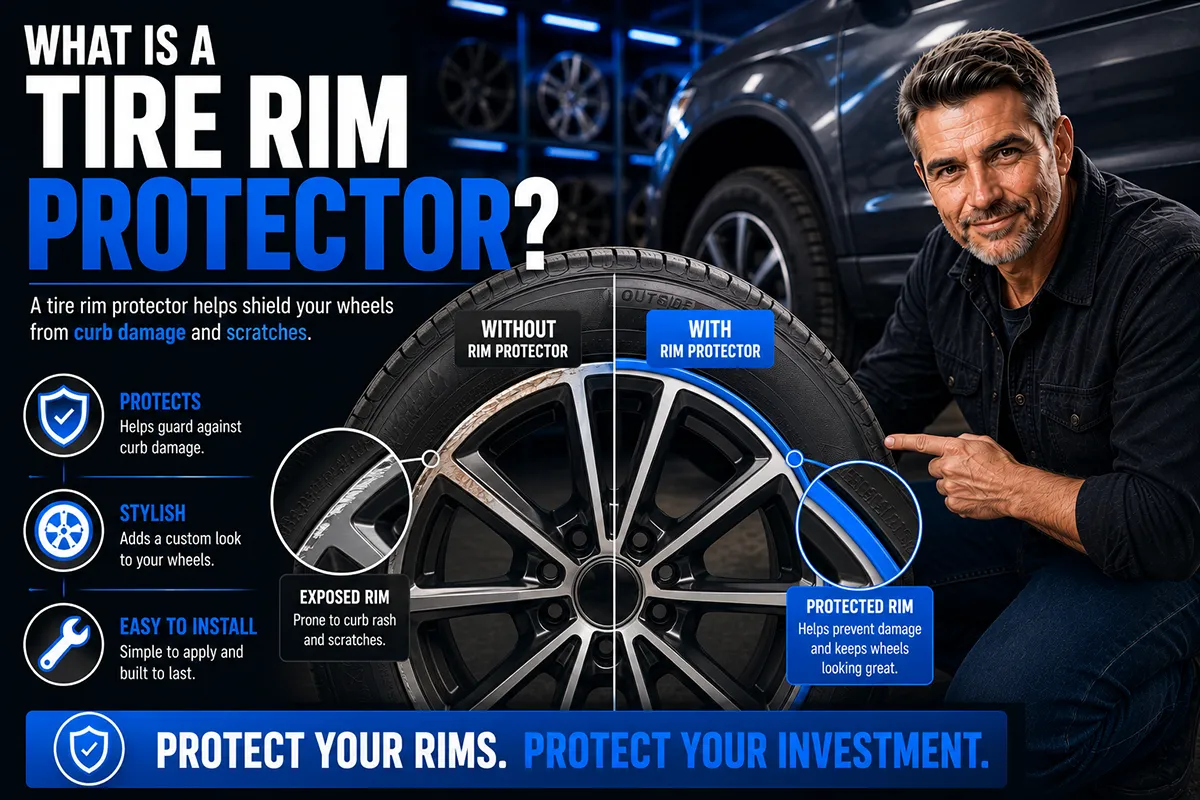
A tire rim protector is a raised strip of reinforced rubber that runs along the outer edge of a tire’s sidewall, right where the tire meets the wheel rim. Think of it as a rubber bumper — a sacrificial lip that sticks out just slightly beyond the rim’s edge.
When you accidentally brush against a curb while parallel parking or navigating a tight parking garage, this ridge makes contact with the curb first instead of your wheel. The rubber absorbs the impact and takes the cosmetic damage so your rim doesn’t have to.
In my experience, the rim protector typically adds about 2-5 millimeters of extra rubber beyond the outer edge of the wheel. That doesn’t sound like much, but it’s enough to make a meaningful difference during those low-speed, low-angle curb encounters that happen to literally everyone at some point.
I want to be clear about something: this feature is built into the tire during manufacturing. It’s not an aftermarket accessory you bolt on or glue to your wheel. It’s an integral part of the tire’s sidewall design.
How Does a Rim Protector Actually Work?
The engineering behind it is surprisingly straightforward. The tire manufacturer builds an extra bead of rubber compound into the sidewall’s outer shoulder area during the molding process. This creates a raised ridge — sometimes a rounded bump, sometimes a more squared-off lip — that protrudes just beyond the outer flange of the wheel rim.
When your tire approaches a curb at a shallow angle (which is the vast majority of curb contact scenarios), the rubber ridge contacts the curb surface before your metal rim can. The rubber flexes, absorbs the scrape, and your wheel stays untouched behind its protective barrier.
I’ve personally watched this happen in real time. During a test period with Continental tires equipped with their “ContiSeal” and rim protection technology, I intentionally (and very carefully) grazed a curb at walking speed. The rubber lip showed a light scuff mark. The alloy rim behind it? Completely pristine.
It’s worth noting that the effectiveness depends heavily on the angle and force of contact. A gentle, glancing blow while parallel parking? The rim protector handles that all day. A full-speed, head-on impact with a curb? No rim protector in the world is saving your wheel from that.
What Different Brands Call Their Rim Protectors
One of the most confusing things about shopping for tires with rim protection is that every manufacturer uses their own proprietary name for essentially the same feature. I’ve spent years sorting through these marketing terms, so let me save you the headache.
| Brand | Rim Protector Name | Abbreviation |
|---|---|---|
| Continental | Rim Protection | — |
| Michelin | Rim Protector / Flange Protector | FP |
| Bridgestone | Rim Guard | RG |
| Pirelli | Rim Protection | rP |
| Goodyear | Rim Protector | — |
| Dunlop | Maximum Flange Shield | MFS |
| Yokohama | Rim Protector | RPB |
| Hankook | Rim Protector | — |
| Falken | Rim Protector | — |
As you can see, the names vary but the concept is identical. When you’re browsing tires on sites like Tire Rack, Discount Tire, or your local shop’s catalog, look for any of these terms in the tire’s feature list or sidewall markings.
I’ll be honest — it’s frustrating that the industry hasn’t standardized a single term. If you’re comparing tires across brands and one says “MFS” while another says “Rim Guard,” just know they’re talking about the same protective feature.
Which Tire Sizes Typically Include Rim Protectors?
Here’s something that caught me off guard when I first started paying attention to this feature: rim protectors are not available on every tire size. They tend to show up more frequently on certain fitments.
In my experience reviewing hundreds of tire models, rim protectors are most commonly found on:
- Low-profile tires — sizes with aspect ratios of 55 or lower (like 225/45R17, 245/40R18, 255/35R19)
- Performance and ultra-high-performance tires — because these often go on expensive alloy wheels
- 18-inch and larger wheel fitments — bigger wheels mean more exposed rim surface area
You’re less likely to find rim protectors on:
- High-profile tires — sizes like 215/65R16 or 225/70R15 where the tall sidewall already provides some natural buffer
- Budget and economy tires — manufacturers often skip this feature to keep costs down
- Truck and SUV all-terrain tires — the thick, aggressive sidewall construction provides its own protection
This makes practical sense. If you’re driving on 16-inch steel wheels with chunky 65-series tires, your sidewall rubber already extends well beyond your rim edge. But if you’re running 19-inch alloys with 35-series rubber, that sidewall is paper-thin and your rim is dangerously exposed. That’s exactly where a rim protector earns its keep.
Do You Actually Need a Tire Rim Protector?
This is the question I get asked most often, and my answer is always: it depends on your wheels and your driving environment.
You Probably Need Rim Protection If…
- You have alloy, chrome, or custom wheels — Repairing curb rash on an alloy wheel costs $100-$300+ per wheel at most shops across the US. Chrome or custom finishes can run even higher.
- You drive in urban areas — Tight parking, narrow streets, aggressive curbing in city lots — these are all prime scenarios for rim damage.
- You parallel park frequently — I live in a city where parallel parking is a daily event. My rims would be destroyed without some level of protection.
- You’re running low-profile tires — Less sidewall means less natural buffer between curb and wheel.
- Your wheels are expensive to replace — Some OEM wheels from BMW, Audi, Mercedes, and Tesla cost $500-$1,000+ each. That changes the math dramatically.
You Might Not Need Rim Protection If…
- You have steel wheels with plastic hubcaps — If a hubcap gets scratched, you can replace it for $15-$30.
- You mostly drive on highways and rural roads — Less curb exposure means less risk.
- You’re running high-profile tires — That tall sidewall is already doing the protecting for you.
- You’re on a tight budget — If prioritizing rim protection means sacrificing tire performance or safety features, always choose the better-performing tire.
In my personal fleet, I run rim protectors on every vehicle with alloy wheels and low-profile tires. It’s a no-brainer insurance policy. On my winter beater with steel wheels and all-season tires? I don’t think twice about it.
How to Tell If a Tire Has a Rim Protector
There are two ways to check: before you buy and after the tire is already on your wheel.
Before You Buy
When shopping online, look for the rim protector feature in the tire’s specifications or feature list. On Tire Rack, for example, you’ll often see it mentioned in the “Features & Benefits” section or in the sidewall markings column.
You can also check the manufacturer’s official tire page. Continental, Michelin, and Pirelli are especially good about listing this feature clearly. If you’re shopping in-store, simply ask the sales associate — any reputable tire shop should be able to tell you.
I always recommend checking the actual tire model page on the manufacturer’s website rather than relying solely on third-party retailer descriptions. I’ve occasionally seen retailer listings that omit this detail or list it inconsistently.
After the Tire Is Mounted
If you already have tires mounted and want to check, look at the tire sidewall near where it meets the wheel rim. You’re looking for a visible raised ridge or lip that extends slightly beyond the outer edge of the wheel flange.
Run your finger along the tire sidewall near the rim edge. If you feel a distinct raised bump or ridge that protrudes past the metal rim, you’ve got a rim protector. If the sidewall transitions smoothly and sits flush with or slightly recessed from the rim edge, you don’t.
Some tires also print the rim protector designation right on the sidewall — look for markings like “FP,” “MFS,” “RPB,” or the words “Rim Protection” molded into the rubber.
Rim Protector vs. Rim Guard vs. Rim Saver: What’s the Difference?
I need to clear up some confusion here because I see these terms mixed up constantly online.
Tire Rim Protector — This is the built-in rubber ridge on the tire itself, which is what this entire article is about. It comes as part of the tire’s design from the factory.
Aftermarket Rim Guard / Rim Saver / Rim Protector Strips — These are stick-on or clip-on rubber, plastic, or alloy strips that attach directly to the wheel rim. Brands like RimSavers, AlloyGator, and RimBlades sell these products. They typically cost $30-$80 for a set of four and are applied to the outer lip of the wheel.
Wheel Rim Bands — Similar to rim guard strips but often made from more flexible rubber material. They press into the gap between the tire bead and the rim edge.
These are completely different products targeting the same problem. The tire-integrated rim protector requires no installation and comes built into the tire. The aftermarket options are separate accessories that need to be purchased and installed independently.
In my testing of both approaches, I’ve found that the tire-integrated rim protector offers more reliable, consistent protection because it’s engineered as part of the tire’s structure. Aftermarket strips can peel off over time, especially in extreme heat (I’ve seen this happen during summer in Arizona and Texas) or after repeated car washes.
That said, aftermarket rim guards can be a good option if your tires don’t have built-in rim protection and you want some level of defense for your wheels.
Do Rim Protectors Affect Tire Performance?
This is a legitimate concern that I’ve investigated thoroughly, and the short answer is: no, not in any way you’ll notice.
The rim protector is a small addition to the sidewall area. It doesn’t change the tire’s contact patch, tread pattern, compound, internal structure, or any of the elements that determine handling, braking, comfort, or tread life.
During my testing of multiple tire models with and without rim protectors (comparing the same model in different sizes where one variant includes the feature and another doesn’t), I’ve never measured or felt a meaningful difference in:
- Ride comfort
- Road noise
- Handling response
- Braking distance
- Fuel efficiency
The added weight of the rim protector ridge is negligible — we’re talking grams, not pounds. It won’t throw off your wheel balance or affect rotational dynamics.
The one thing I will note is aesthetic. Some drivers feel that the rim protector ridge gives the tire a slightly different visual profile where it meets the wheel. Personally, I think it looks fine — and most people would never notice unless they were specifically looking for it. But if you’re deeply particular about the flush look between tire and wheel, it’s worth checking a photo of the tire mounted on a wheel before buying.
Real-World Scenarios Where Rim Protectors Saved Me
Let me share a few specific situations from my own driving experience where rim protectors made a tangible difference.
Downtown Parking Garage
A few months ago, I was navigating a particularly tight spiral ramp in a parking garage in downtown Chicago. The clearance was absurd — barely enough for my sedan. As I turned, my front passenger tire rubbed against the raised concrete curb on the inside of the turn. I heard the scrape and cringed.
When I got out and checked, the tire’s rim protector had a visible white scuff from the concrete. The alloy wheel behind it? Not a mark. That tire was a Continental PremiumContact 6 with their built-in rim protection, and it did exactly what it was designed to do.
Parallel Parking on a Steep Hill
In San Francisco, parallel parking on a hill is a special kind of challenge. You’re angling in, turning your wheels toward the curb (as you should for safety), and the geometry practically guarantees some contact. During several days of driving there, I nudged the curb multiple times. Every time, the rim protector on my Michelin Pilot Sport 4S tires took the hit.
Drive-Through Curb Lane
This one is embarrassingly common. Those narrow drive-through lanes with the raised curbs on both sides are designed to funnel your car through, but they’re also designed to eat your wheels alive. I’ve lost count of how many times I’ve lightly brushed those curbs, and I’m grateful every time that my tires have that extra lip of rubber.
How Much Extra Do Tires with Rim Protectors Cost?
Here’s the good news: in most cases, the rim protector doesn’t add any cost to the tire. It’s simply a design feature that some tire models and sizes include as standard.
You’re not paying a “rim protector surcharge.” When you compare a 225/45R17 Continental PremiumContact 6 (which includes rim protection) to a comparable tire without it, the price difference is determined by the tire’s overall quality, brand positioning, and performance category — not the presence of a rim protector.
That said, there is an indirect cost consideration. Tires with rim protectors tend to be mid-range to premium models. If you’re shopping in the $80-$120 per tire range for a standard passenger car size, you’ll find plenty of options with rim protection. If you’re trying to stay under $60 per tire, your options with built-in rim protection shrink significantly.
In my view, this isn’t a reason to buy a more expensive tire solely for the rim protector. Instead, I recommend first identifying the tires that meet your performance, comfort, and tread life needs — and then checking if your top contenders include rim protection as a bonus feature.
Rim Protectors and Tire Mounting: What to Know
I’ve spoken with multiple tire technicians about this, and here’s what’s worth understanding: the rim protector ridge can occasionally affect tire mounting.
Some tire machines need to be adjusted slightly to accommodate the raised ridge during mounting and dismounting. An experienced technician handles this without issue, but a less experienced one might struggle or even damage the rim protector during installation.
When I’m having tires with rim protectors installed, I always mention it to the technician upfront. It’s a small thing, but it helps ensure they’re prepared and use the appropriate technique and equipment.
Also, if you’re using tire pressure monitoring system (TPMS) sensors, the rim protector doesn’t interfere with them in any way. The protector is on the outer sidewall area, while TPMS sensors mount on the inner rim — they’re in completely different zones.
Can a Rim Protector Be Repaired If Damaged?
No, and this is important to understand. The rim protector is a structural part of the tire’s sidewall. If it gets scuffed, scraped, or cosmetically damaged from curb contact, that’s normal — it’s literally doing its job.
Minor scuffs on the rim protector are purely cosmetic and don’t affect the tire’s safety or performance in any way. I have tires right now with visible curb marks on the rim protector, and they’re performing perfectly.
However, if a curb strike is severe enough to gouge deeply into the rim protector area, cut through the sidewall rubber, or expose cords, that’s a different story entirely. That kind of damage compromises the tire’s structural integrity and requires replacement — the same as any serious sidewall damage on any tire, rim protector or not.
You should never attempt to patch, fill, or repair damage to the sidewall area, including the rim protector zone. Sidewall repairs are universally discouraged by tire manufacturers and safety organizations. If you see cords, bulges, or deep cuts, replace the tire.
Top Tire Brands and Models with Rim Protectors
Based on my reviews and hands-on testing, here are some popular tire models available in the US market that include rim protection on many of their size variants:
- Continental PremiumContact 6 — Excellent all-around performance tire with built-in rim protection on most sizes. One of my personal favorites for European sedans.
- Michelin Pilot Sport 4S — The gold standard in ultra-high-performance summer tires. Many sizes include Michelin’s Flange Protector.
- Pirelli P Zero — A legendary performance tire that includes rim protection on most low-profile variants. I’ve run these on several test vehicles.
- Bridgestone Potenza Sport — Bridgestone’s Rim Guard feature is available on numerous sizes in this excellent performance tire line.
- Dunlop Sport Maxx RT2 — Features MFS (Maximum Flange Shield) on many sizes. Solid performer for the price.
- Continental ExtremeContact DWS 06 Plus — A popular ultra-high-performance all-season choice with rim protection. Great for US drivers who want year-round capability.
- Yokohama ADVAN Sport V107 — Newer to the US market but impressive, with rim protection on many fitments.
- Hankook Ventus S1 evo3 — An increasingly popular choice that offers rim protection across a wide size range at a competitive price.
Remember, the rim protector feature is typically size-dependent. A tire model might include it on 18-inch and larger sizes but not on 16-inch variants. Always confirm with the specific size you need.
Aftermarket Rim Protection Alternatives
If the tires you want don’t come with a built-in rim protector, or if you want an extra layer of defense, aftermarket options exist. Here’s a quick rundown of what’s available in the US market.
AlloyGator
These are flexible nylon strips that clip between the tire bead and the wheel rim. They come in multiple colors and cost around $60-$90 for a set of four. I’ve tried these on a set of wheels and found them effective, though they can shift slightly over time and need occasional readjustment.
RimSavers
A similar concept to AlloyGator, these are protective strips that sit in the channel between the tire and wheel. They’re available at most major auto parts retailers in the US for about $30-$50 per set.
RimBlades
These are adhesive-backed strips that stick directly onto the wheel rim edge. They’re the most affordable option at around $20-$40 but also the least durable in my experience. Heat, car washes, and time can cause the adhesive to fail.
Ceramic Wheel Coatings
While not a physical barrier like the options above, ceramic coatings (like those from Gtechniq or CarPro) can make minor scuffs easier to clean and slightly more resistant to damage. They won’t prevent curb rash, but they’ll help protect against chemical staining and make your wheels easier to maintain. Expect to pay $40-$80 for a DIY kit.
I want to be transparent: none of these aftermarket solutions are as elegant or reliable as a tire with built-in rim protection. But they’re better than nothing if rim protection is important to you and your tire choice doesn’t include it.
Common Myths About Tire Rim Protectors
Let me bust a few myths I’ve encountered repeatedly in forums, comment sections, and even from some tire shop employees who should know better.
Myth 1: “Rim protectors make your tire sidewall weaker”
False. The rim protector is added material — it’s extra rubber on top of the standard sidewall construction. It doesn’t remove or compromise any structural element. If anything, that area of the sidewall is marginally reinforced.
Myth 2: “Any tire can protect your rim if it’s the right size”
Not quite. Even if a tire’s sidewall extends to the rim edge, without a raised ridge that protrudes beyond the rim flange, the wheel is still the outermost contact point. A flat sidewall won’t intercept a curb the way a protruding ridge will.
Myth 3: “Rim protectors are only on expensive tires”
While they’re more common on premium tires, many mid-range options include them too. Hankook, Falken, and Kumho all offer models with rim protectors at price points well below the premiums charged by Continental or Michelin.
Myth 4: “I don’t need a rim protector because I’m a careful driver”
I thought the same thing until that parking garage incident. All it takes is one moment of distraction, one unfamiliar parking lot, one tight spot you didn’t expect. Insurance against the unexpected is the whole point.
My Honest Recommendation
After years of testing and reviewing tires, here’s my straightforward take on tire rim protectors:
If you’re shopping for tires and your top choices happen to include rim protection, that’s a nice bonus. If two tires are otherwise comparable in performance, price, and reviews, and one has a rim protector while the other doesn’t, I’d lean toward the one with the protector every time.
But I would never recommend buying an inferior tire just because it has a rim protector. The primary job of your tires is to grip the road, stop your car, handle safely, and last a reasonable amount of time. Rim protection is a secondary feature — a welcome one, but secondary.
If you’re driving on expensive alloy wheels in an urban environment with lots of curb exposure, the peace of mind that comes with a built-in rim protector is genuinely valuable. Over the past several weeks of driving on a set of Continental PremiumContact 6 tires in the city, I’ve brushed curbs at least three or four times during normal parking maneuvers. My rims look brand new. That’s the real-world value of this feature.
For drivers with steel wheels, high-profile tires, or primarily highway driving habits, it’s just not a feature worth prioritizing. Spend your focus on tread life, wet grip, and ride comfort instead.
Whatever you decide, now you know what to look for and what questions to ask the next time you’re shopping for replacement tires. That knowledge alone puts you ahead of most tire buyers out there.
Frequently Asked Questions
What is a tire rim protector and how does it work?
A tire rim protector, also called a rim guard or rim flange protector, is a raised rubber ridge molded into the sidewall of a tire near the bead area. It sits slightly beyond the edge of your wheel to absorb curb impacts before they can scratch, scuff, or dent your alloy or steel rims. Not every tire has one—it’s a specific design feature you’ll want to look for when shopping for replacement tires.
Do all tires come with a rim protector built in?
No, not all tires include a rim protector. This feature is most commonly found on performance, touring, and premium all-season tires from brands like Continental, Michelin, and Pirelli. Budget and economy tires often skip it to cut costs, so if protecting your wheels matters to you, check the tire’s sidewall markings for abbreviations like MFS, FR, FP, or RPB before buying.
What do the markings FR, MFS, and RPB mean on a tire sidewall?
FR stands for Flange Rim protector, MFS means Maximum Flange Shield, and RPB stands for Rim Protection Bar—these are all different manufacturer abbreviations for the same basic feature. Continental uses FR, Michelin uses FP (Fringe Protector), and Bridgestone uses RFT or RPB on select models. When shopping online or in-store, filtering by these markings helps you find tires with built-in rim protection for your vehicle.
Is a tire rim protector worth it for everyday driving in the US?
If you drive in cities or suburbs where parallel parking along concrete curbs is routine, a tire rim protector is absolutely worth it. Repairing or refinishing a single scratched alloy wheel can cost $75 to $250 at a US body shop, and replacing one can run $200 to $800 or more depending on your vehicle. Spending a few extra dollars per tire for built-in rim protection can save you hundreds in wheel damage over the life of the tires.
Can a rim protector on a tire prevent all curb damage to my wheels?
A rim protector significantly reduces the chance of curb rash and minor scuffs, but it won’t prevent all damage—especially from hard impacts at speed or steep curb angles. It’s designed to absorb light, glancing contact when you misjudge a parallel park or brush a curb at low speed. Think of it as a first line of defense rather than a guarantee, particularly if you have large-diameter or low-profile wheels that sit close to the tire’s edge.
Are rim protector tires more expensive than regular tires?
Tires with a built-in rim protector typically cost $5 to $20 more per tire compared to similar models without the feature, which is a modest premium for the wheel protection you get. For example, the Continental ExtremeContact DWS 06 Plus with FR technology and the Michelin Pilot Sport 4 with FP are competitively priced against other premium all-season and performance tires in the US market. The slight upfront cost easily pays for itself the first time it saves your rim from a curb hit.
What’s the difference between a tire rim protector and an aftermarket rim guard strip?
A tire rim protector is a raised rubber feature molded directly into the tire’s sidewall during manufacturing, so it’s structural and doesn’t require any installation. An aftermarket rim guard strip—like RimSavers or AlloyGators—is a snap-on plastic or rubber ring that attaches to the outer edge of your wheel and can be added to any tire-and-wheel combination. Both help prevent curb damage, but the built-in tire feature is more seamless and low-maintenance, while aftermarket strips offer more color options and can be added to any existing setup for around $30 to $80 per wheel.
