

I was standing at a rest stop off I-40 in Oklahoma when a retired trucker walked up to my car, pointed at my rear passenger tire, and said, “That one’s low — you can hear it.” He pulled a wooden stick from his cab, smacked each of my tires, and proved his point in about ten seconds flat.
That was my introduction to the tire thumper, and honestly, it changed how I think about basic tire maintenance. Most everyday drivers have never heard of this tool, but it’s been a staple in the commercial trucking world for decades.
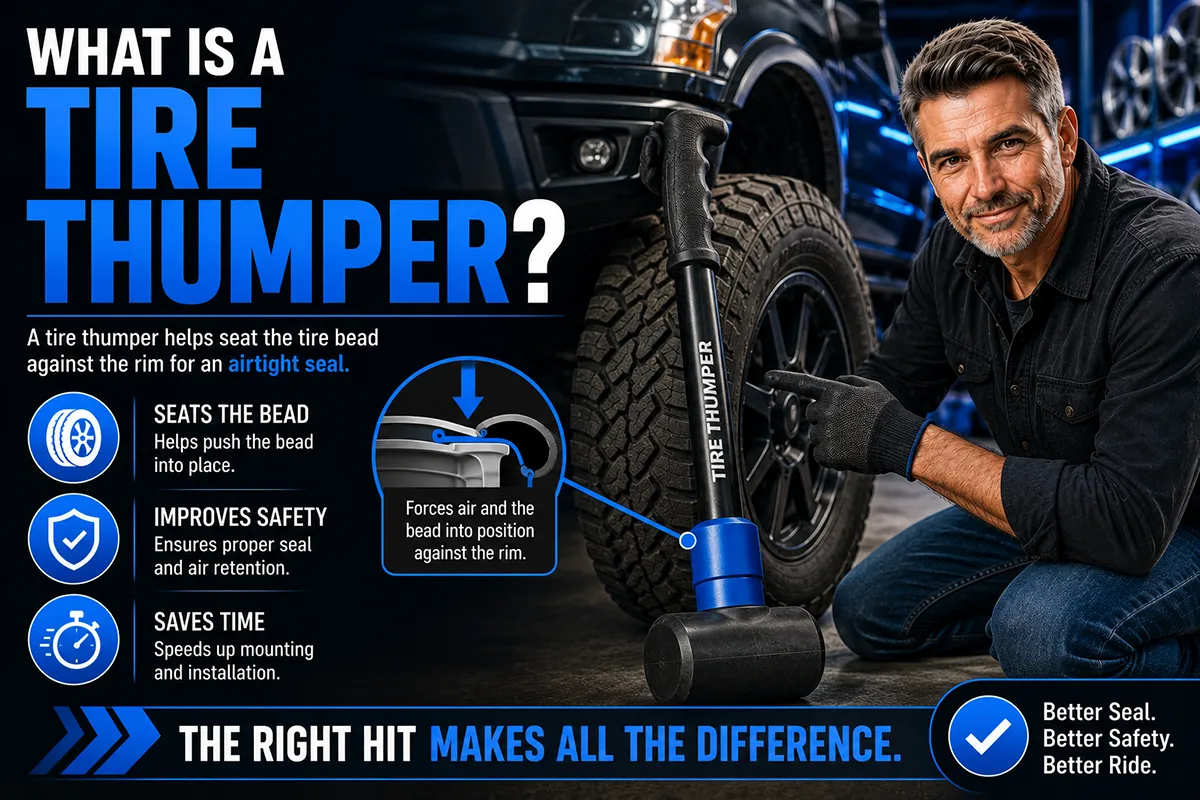
- A tire thumper is a baton-like tool used to quickly check tire inflation by striking the tread and listening to the sound.
- It’s been used by truck drivers for decades and works surprisingly well on passenger car tires too.
- A properly inflated tire produces a firm, resonant “thump” — an underinflated tire sounds dull and flat.
- Tire thumpers cost between $8 and $35 and are available in wood, rubber, and metal versions.
- They don’t replace a digital tire pressure gauge but serve as an excellent quick-check tool before you hit the road.
- I recommend keeping one in your trunk alongside a reliable gauge for a complete tire safety kit.
Liked this article?
Add TireAdvise as a preferred source so you see more of our tire reviews and guides on Google.
What Exactly Is a Tire Thumper?
A tire thumper is a simple striking tool — usually shaped like a short baton or billy club — designed to check whether a tire is properly inflated. You swing it against the tire’s tread surface, and the resulting sound and rebound tell you a lot about the air pressure inside.
The concept is almost laughably simple. A fully inflated tire will produce a sharp, resonant bounce-back and a satisfying “thump” sound. An underinflated or flat tire will absorb the impact, producing a dull thud with very little rebound.
I’ve been using tire thumpers on and off for several years now, and I can tell you that once your ear is trained, the difference between a healthy tire and a low one is unmistakable. It takes maybe two or three practice sessions before you start picking up on the subtle audio cues.
A Brief History: How Truckers Made This Tool Famous
Tire thumpers didn’t originate in the passenger car world. They come straight from the commercial trucking industry, where drivers need to check 18 wheels (sometimes more) before every trip.
Imagine being a long-haul trucker pulling into a truck stop at 4 AM. You’ve got a 53-foot trailer with dual axles, and you need to verify that every single tire is road-ready. Crouching down with a pressure gauge on each one takes a long time. A tire thumper lets you walk the length of your rig, striking each tire, and identify problems in under a minute.
The Federal Motor Carrier Safety Administration (FMCSA) requires pre-trip inspections, and while a thumper alone doesn’t satisfy the formal inspection requirements, it’s the go-to first-pass tool that most experienced drivers rely on. If something sounds off, then they break out the gauge for a precise reading.
I spoke with several truck drivers at a Love’s Travel Stop in Texas during a road trip, and every single one of them carried a thumper. One driver told me he’d caught a slow leak on his trailer tire purely from the sound difference during a routine thump check. That leak, if missed, could have led to a blowout at highway speed.
How Does a Tire Thumper Actually Work?
The physics behind a tire thumper are straightforward. A properly inflated tire is essentially a pressurized rubber container. When you strike it with a solid object, the air pressure inside creates resistance, causing the tool to bounce back quickly and the tire to emit a higher-pitched, resonant sound.
When a tire is underinflated, there’s less internal pressure to resist the impact. The rubber absorbs more energy, the thumper doesn’t bounce back as crisply, and the sound is noticeably duller and lower in pitch.
Think of it like tapping a basketball versus a deflated ball. You don’t need any special training to hear the difference between those two — and the same principle applies here.
What You’re Listening For
In my experience, here’s what each sound indicates:
- Sharp, high-pitched thump with strong rebound: The tire is properly inflated or close to it. This is what you want to hear on every tire.
- Dull, flat thud with weak rebound: The tire is underinflated. The worse the sound, the lower the pressure. This tire needs immediate attention with a gauge.
- Dead sound with zero rebound: The tire is flat or nearly flat. You likely have a serious leak or puncture.
- Inconsistent sound compared to other tires: Even if a tire doesn’t sound “bad” on its own, if it sounds different from the other three, that’s a red flag worth investigating.
I always recommend doing a comparison check. Thump all four tires in sequence. Your ears will naturally pick up on the odd one out, even if you’re new to using the tool.
Types of Tire Thumpers: Which One Should You Buy?
Not all tire thumpers are created equal. I’ve tested several varieties over the years, and each has its strengths and weaknesses depending on your use case.
Wooden Tire Thumpers
The classic. Most wooden thumpers are made from hardwoods like hickory, oak, or sometimes exotic woods like cocobolo. They’re typically around 18 to 19 inches long and shaped like a miniature baseball bat.
I personally started with a wooden hickory thumper, and it remains my favorite for everyday use. The natural weight and density of hardwood provide excellent feedback — you can really feel the difference in rebound between a properly inflated tire and a low one.
Wooden thumpers typically run between $10 and $25, depending on the wood type and craftsmanship. Brands like Ken-Tool and Tire Check make solid options that are easy to find online or at truck stops across the US.
The downside? Wood can crack or splinter over time, especially if you leave it in your trunk during extreme temperature swings. I’ve had one develop a hairline crack after a particularly brutal summer in Arizona.
Rubber Tire Thumpers
Rubber thumpers are gentler on your tires and tend to be more durable in harsh conditions. They won’t crack, split, or absorb moisture, making them a great choice for drivers in humid climates or those who leave tools in their vehicle year-round.
The trade-off is that rubber provides slightly less audio feedback compared to wood. The sound difference between an inflated and underinflated tire is still detectable, but it’s more subtle. I found that it took me a bit longer to train my ear with a rubber thumper compared to the wooden version.
Price-wise, rubber thumpers are usually in the $8 to $20 range. They’re widely available at auto parts stores like AutoZone, O’Reilly, and Advance Auto Parts, as well as on Amazon.
Metal Tire Thumpers
Metal thumpers — often made from aluminum or steel — deliver the sharpest rebound and clearest audio distinction. If you’re purely optimizing for diagnostic accuracy, metal is hard to beat.
However, I don’t typically recommend metal thumpers for everyday car owners. They can potentially damage tire sidewalls or wheel finishes if you’re not careful with your swing. They’re also heavier, which matters less for a trucker but can be a nuisance in a compact sedan’s trunk.
Metal thumpers generally cost between $15 and $35. They’re more popular in the commercial trucking world than among passenger car drivers.
Comparison Table: Tire Thumper Types
| Feature | Wooden | Rubber | Metal |
|---|---|---|---|
| Price Range | $10–$25 | $8–$20 | $15–$35 |
| Sound Feedback | Excellent | Good | Excellent |
| Rebound Feel | Very Good | Moderate | Excellent |
| Durability | Moderate (can crack) | High | Very High |
| Risk of Tire Damage | Low | Very Low | Moderate |
| Best For | Most drivers | Humid climates / gentle use | Commercial / trucking |
| My Recommendation | ⭐ Top Pick | Runner-Up | Niche Use |
How to Use a Tire Thumper on Your Car (Step-by-Step)
Using a tire thumper isn’t complicated, but there’s a right way and a wrong way to do it. Here’s the method I’ve refined over years of practice.
Step 1: Start With a Known Good Tire
Before you can identify a problem tire, you need to know what a healthy tire sounds like. Use a digital pressure gauge to verify that at least one tire is at the manufacturer’s recommended PSI (check your driver’s side door jamb sticker for the correct number). Then thump that tire and memorize the sound and feel.
Step 2: Hold the Thumper Correctly
Grip the thumper near the handle end — not the middle. You want a controlled, pendulum-like swing, not a death grip overhead smash. The motion should come from your wrist, not your shoulder.
I see people at truck stops sometimes winding up like they’re swinging a sledgehammer. That’s unnecessary and risks damaging the tire or your wrist. A firm, controlled flick is all you need.
Step 3: Strike the Center of the Tread
Aim for the center of the tread face — the part of the tire that contacts the road. Avoid the sidewall. Sidewalls are thinner and more vulnerable to damage, especially from metal thumpers. The tread area gives you the most consistent and reliable feedback.
Step 4: Thump All Four Tires in Sequence
Walk around your vehicle and thump each tire one after the other. This comparative approach is key. You’re not just listening to one tire in isolation — you’re listening for consistency across all four.
If three tires sound nearly identical and the fourth is noticeably different, you’ve found your problem child. It’s that simple.
Step 5: Follow Up With a Gauge
If any tire sounds or feels off, pull out your pressure gauge and get an exact reading. The thumper is a screening tool, not a precision instrument. It tells you “something might be wrong” — the gauge tells you exactly what’s wrong and by how much.
Tire Thumper vs. Tire Pressure Gauge: Do You Need Both?
This is the question I get asked more than any other, and my answer is always the same: yes, you need both, because they serve fundamentally different purposes.
A tire pressure gauge — whether it’s a simple pencil gauge or a high-end digital unit — gives you an exact PSI reading. It’s the gold standard for tire pressure measurement. But it requires you to remove the valve cap, press the gauge firmly onto the valve stem, and read the display. On four tires, this process takes a few minutes.
A tire thumper gives you a quick, approximate check that takes about 15 seconds for all four tires. It won’t tell you that your left rear is at 28 PSI when it should be at 35 PSI. But it will tell you that your left rear doesn’t sound right and deserves a closer look.
I think of it this way: the thumper is your first line of defense, and the gauge is your confirmation tool. Together, they form a fast, reliable tire safety system that costs under $50 total.
When the Thumper Excels
- Quick pre-drive checks: I thump my tires every morning before I leave the house. It takes seconds and gives me peace of mind.
- Returning to a parked car: After your car has been sitting in a parking lot, airport long-term lot, or hotel garage for several days, a quick thump check tells you if anything went wrong while you were away.
- Road trips: At rest stops, a fast thump around the car is a great habit, especially during long summer drives when heat can affect tire pressure.
- Cold mornings: Tire pressure drops approximately 1 PSI for every 10°F decrease in temperature. After a cold front rolls through, a thumper helps you quickly screen for tires that may have dropped too low.
When the Gauge Is Essential
- Monthly precision checks: The NHTSA recommends checking tire pressure at least once a month with a gauge. A thumper can’t replace this.
- After filling tires with air: You need exact numbers to hit your target PSI.
- Seasonal tire changes: When you swap between all-season and winter tires, you need precise inflation data.
- TPMS warning light: If your dashboard TPMS light comes on, a gauge confirms the issue and helps you fix it.
Can a Tire Thumper Really Work on Passenger Car Tires?
This is a fair question, and I understand the skepticism. Tire thumpers were designed for heavy-duty truck tires that operate at much higher pressures (typically 80-120 PSI) compared to passenger car tires (usually 30-36 PSI). At those higher pressures, the difference between an inflated and underinflated tire is more dramatic.
But here’s what I’ve found in my own testing: tire thumpers absolutely work on passenger car tires. The difference is more subtle, yes, but it’s still clearly audible once you’ve calibrated your ear.
I ran a controlled experiment in my own driveway. I set all four tires on my sedan to the recommended 35 PSI, thumped each one, and noted the sound. Then I deliberately let air out of one tire down to 20 PSI and thumped again. The difference was obvious — even my wife, who had never used a thumper before, correctly identified the low tire on her first try.
At 25 PSI (only 10 PSI low), the difference was subtler but still detectable. Below 20 PSI, it was glaringly apparent. So while a thumper might not catch a tire that’s only 2-3 PSI low, it will absolutely flag a tire with a meaningful pressure deficit — the kind that affects your safety, fuel economy, and tire longevity.
Why Underinflated Tires Are More Dangerous Than You Think
I want to take a moment to explain why quick tire pressure checks matter so much, because many drivers underestimate the risks of underinflation.
According to the National Highway Traffic Safety Administration (NHTSA), underinflated tires are a factor in approximately 11,000 crashes per year in the United States. The agency also reports that nearly one in four vehicles on the road has at least one significantly underinflated tire.
What Happens When You Drive on Low Tires
- Increased heat buildup: An underinflated tire flexes more as it rolls, generating excess heat. Heat is the number one enemy of tire longevity and the primary cause of blowouts.
- Reduced handling and braking: Low-pressure tires have a larger, less stable contact patch. This leads to mushier steering response and longer stopping distances — exactly what you don’t want in an emergency.
- Accelerated, uneven wear: Underinflated tires wear faster on the outer edges of the tread. I’ve seen tires that should have lasted much longer get destroyed in a fraction of the time because of chronic underinflation.
- Worse fuel economy: The US Department of Energy estimates that for every 1 PSI drop in tire pressure below the recommended level, fuel economy decreases by about 0.2%. On a car with four tires each 5 PSI low, that adds up fast.
- Increased risk of blowouts: This is the big one. A severely underinflated tire at highway speed is a ticking time bomb. The excess flexing and heat generation can cause the tire’s internal structure to fail catastrophically.
This is exactly why a tool that takes 15 seconds to screen all four tires is so valuable. You don’t need to be a mechanic or a trucker to benefit from it.
Other Uses for a Tire Thumper You Might Not Know About
While the primary purpose is tire pressure checking, tire thumpers have found their way into several other roles. I want to be upfront about these because I think they’re worth mentioning.
Personal Safety Tool
Many long-haul truckers carry tire thumpers partly as a personal safety tool. A solid hardwood or metal thumper is an effective deterrent when you’re stopped at a remote rest area at night. For everyday drivers, this secondary purpose might be relevant if you frequently travel through isolated areas.
I want to be clear — I’m not encouraging anyone to use a tire thumper as a weapon. But having a legitimate tool in your vehicle that also happens to be sturdy and accessible provides a certain peace of mind. It’s legal to carry in all 50 states because it’s a genuine automotive tool with a clear primary purpose.
Checking Spare Tires
How often do you check your spare tire? If you’re like most people, the answer is “almost never.” I’m guilty of this myself. A tire thumper is perfect for a quick check on your spare, especially since many spares are stored in hard-to-reach locations where using a pressure gauge is awkward.
I’ve gotten into the habit of giving my spare a thump every few weeks. During one of these checks, I discovered my compact spare had gone completely flat — likely from a slow valve stem leak. If I’d needed that spare in an emergency, I would have been stranded.
RVs, Trailers, and Towed Vehicles
If you tow a trailer, haul a boat, or drive an RV, a tire thumper becomes even more valuable. These vehicles often have tires that are difficult to access with a gauge, and the consequences of a tire failure on a loaded trailer can be severe.
I use my thumper religiously when I’m towing my small utility trailer. A quick walk-around with the thumper before hitching up has become part of my standard pre-tow checklist.
Where to Buy a Tire Thumper in the US
Tire thumpers are easy to find and affordable. Here are my recommended places to pick one up:
- Amazon: The widest selection. You’ll find everything from basic wooden models for under $10 to premium hardwood and leather-wrapped versions for $25+. I recommend reading reviews and sticking with sellers that have strong ratings.
- Truck stops (Pilot, Flying J, Love’s, TA): If you’re on a road trip and want to buy one in person, virtually every major truck stop in America stocks tire thumpers. Prices are usually $12–$20 for a standard wooden model.
- AutoZone, O’Reilly, Advance Auto Parts: Some locations carry them, though selection is more limited than truck stops or online retailers. Call ahead to check availability.
- Walmart: Available online and occasionally in-store in the automotive section. Pricing is competitive, usually under $15.
- Harbor Freight: If you have one nearby, they occasionally stock thumpers or similar tools at budget prices.
My Personal Tire Thumper Recommendation
After testing several models over the years, my go-to recommendation for everyday car owners is a standard 18-inch hardwood hickory thumper. Hickory has the ideal combination of density, durability, and weight for clear feedback without being excessively heavy.
I specifically like models with a slight taper — thicker at the striking end and narrower at the grip. This weight distribution creates a natural pendulum effect that makes the wrist-flick motion almost effortless.
For budget-conscious buyers, a basic unfinished hardwood thumper for around $10-$12 does the job perfectly. You don’t need anything fancy. If you want a little more refinement, look for a model with a lacquered finish and a leather wrist strap — these typically run $18-$25 and look great in your trunk tool kit.
If you live in a particularly humid climate (Florida, the Gulf Coast, the Pacific Northwest), consider a rubber thumper instead. It won’t absorb moisture or warp over time, and it’s essentially maintenance-free.
Building a Complete Tire Safety Kit for Your Trunk
Since we’re talking about tire thumpers, let me share the complete tire safety kit I keep in every vehicle I own. This setup costs under $75 total and has saved me from multiple roadside headaches.
- Tire thumper (wooden, hickory): For quick daily checks — approximately $12.
- Digital tire pressure gauge: I use the AstroAI digital gauge, which is accurate to ±0.5 PSI and costs about $10-$12 on Amazon.
- Portable tire inflator: A 12V plug-in compressor that runs off your car’s cigarette lighter. I keep a VIAIR 77P, which runs about $30-$40 and handles passenger car tires easily.
- Tire repair kit: A basic plug kit for emergency puncture repairs — around $8-$10.
- Valve stem caps (metal): A set of metal valve stem caps to prevent debris and moisture from damaging your valve cores — about $5.
- Reflective safety triangles: Required by law in some situations and just good practice — around $10 for a set of three.
This kit fits in a small bag and covers virtually every common tire emergency you’ll encounter on US roads. The thumper is the first tool I reach for because it tells me in seconds whether I need the rest of the kit.
Common Misconceptions About Tire Thumpers
Over the years, I’ve encountered several myths about tire thumpers that I want to address directly.
“They’re Only for Truck Drivers”
This is the biggest misconception. While tire thumpers originated in the trucking industry, the underlying physics work on any pneumatic tire. I’ve used mine on sedans, SUVs, minivans, and even my neighbor’s riding mower tires. If it holds air, a thumper can check it.
“They Can Damage Your Tires”
A moderate strike on the tread surface will not damage a tire. Modern passenger tires are engineered to withstand road impacts from potholes, debris, and curbs at highway speed. A controlled thump from a wooden stick is well within the tire’s design tolerance.
That said, avoid striking the sidewall, and don’t use excessive force. You’re checking a tire, not playing whack-a-mole.
“TPMS Makes Them Obsolete”
Tire Pressure Monitoring Systems are fantastic, and I’m glad they’ve been mandatory on all new US vehicles since 2007. But TPMS has limitations. Most direct TPMS systems don’t alert you until a tire is 25% or more below the recommended pressure. That means on a car with a 35 PSI recommendation, the light might not come on until you’re at about 26 PSI — which is already significantly low.
A tire thumper can help you catch pressure drops in that middle zone where the TPMS stays silent but your tire is still underperforming. It’s a complementary tool, not a replacement, and vice versa.
“You Need Special Training to Use One”
No, you don’t. As I mentioned earlier, my wife correctly identified an underinflated tire on her very first attempt. The learning curve is incredibly short. After a few practice sessions in your driveway, you’ll be confident in your ability to screen your tires quickly and accurately.
Final Thoughts: A $12 Tool That Could Save Your Life
I’ve reviewed hundreds of tires and tire-related products over the years, and the tire thumper remains one of the simplest, most cost-effective safety tools I’ve ever recommended. It’s not high-tech. It’s not glamorous. It’s basically a stick.
But that stick can tell you in under 15 seconds whether your tires are safe to drive on. In a country where the average driver covers thousands of highway miles per year and underinflated tires contribute to thousands of crashes annually, that’s not a trivial benefit.
I recommend picking one up the next time you’re at a truck stop, browsing Amazon, or visiting your local auto parts store. Toss it in your trunk, thump your tires before your next long drive, and see for yourself how quickly it becomes part of your routine.
It worked for that retired trucker in Oklahoma. It works for me. And I’m confident it’ll work for you too.
Frequently Asked Questions
What is a tire thumper and what is it used for?
A tire thumper is a sturdy stick or baton, typically 12 to 19 inches long, that drivers use to quickly check tire pressure by striking the tire and listening to the sound it makes. A properly inflated tire produces a solid, resonant thump, while an underinflated or flat tire gives a dull, flat thud. Tire thumpers are especially popular among truck drivers and RV owners in the US who need to check multiple tires quickly during pre-trip inspections without kneeling down with a gauge on every tire.
How do you use a tire thumper to check tire pressure?
To use a tire thumper, firmly strike the tread of each tire and pay attention to the sound and the amount of bounce-back you feel. A well-inflated tire will produce a sharp, high-pitched thump and the thumper will bounce back noticeably, while an underinflated tire sounds flat and absorbs more of the impact. I recommend starting with tires you know are properly inflated so you can learn the difference. While a tire thumper is a great quick-check tool, it should not fully replace a calibrated tire pressure gauge for accurate PSI readings.
Are tire thumpers accurate for checking tire inflation?
Tire thumpers are useful for detecting significantly underinflated or flat tires, but they are not precision instruments and cannot tell you the exact PSI of a tire. Experienced drivers develop an ear for the difference between a properly inflated tire and one that is dangerously low, but subtle pressure drops of 5 to 10 PSI can be hard to detect with a thumper alone. For accurate tire pressure monitoring, I always recommend pairing a tire thumper with a quality digital tire pressure gauge, which you can pick up for $10 to $25 at most US auto parts stores.
What are tire thumpers made of and which material is best?
Tire thumpers are commonly made from hardwood, aluminum, polycarbonate, or rubber-coated materials, and each has its advantages. Hardwood thumpers like those made from hickory or oak are traditional favorites among US truckers because they are durable and produce a clear, consistent sound. Aluminum and polycarbonate thumpers are lightweight and weather-resistant, making them a good choice for drivers in rainy or humid US climates. I personally prefer a solid hardwood thumper because the acoustic feedback feels the most reliable.
How much does a tire thumper cost and where can I buy one?
Most tire thumpers cost between $8 and $30 depending on the material and brand, making them one of the most affordable tire safety tools available. You can find them at US retailers like Walmart, AutoZone, O’Reilly Auto Parts, and Amazon, as well as truck stop chains like Love’s and Pilot Flying J. Popular US brands include Ken-Tool and Bully Tools, though many independent woodworkers on Etsy also sell handcrafted hardwood thumpers.
Do I need a tire thumper if I already have a tire pressure monitoring system (TPMS)?
Even if your vehicle is equipped with a TPMS, a tire thumper is still a useful backup tool, especially since TPMS sensors can malfunction, have dead batteries, or fail to alert you until pressure drops significantly below the recommended level. A tire thumper gives you a fast physical check you can perform during any stop, which is particularly valuable for drivers towing trailers or driving RVs where TPMS coverage may not extend to every tire. I keep one in my vehicle as a quick first check before long road trips across US highways.
Is a tire thumper only for semi-trucks or can regular car drivers use one?
While tire thumpers are traditionally associated with commercial truck drivers doing pre-trip inspections, any US driver can benefit from keeping one in their vehicle. They work well on passenger car tires, SUV tires, and especially on dual-rear-wheel setups on pickup trucks where inner tires are difficult to reach with a gauge. If you regularly drive long distances on US interstates or through remote areas where tire service is limited, a tire thumper adds a quick and easy layer of safety to your routine tire checks.
