

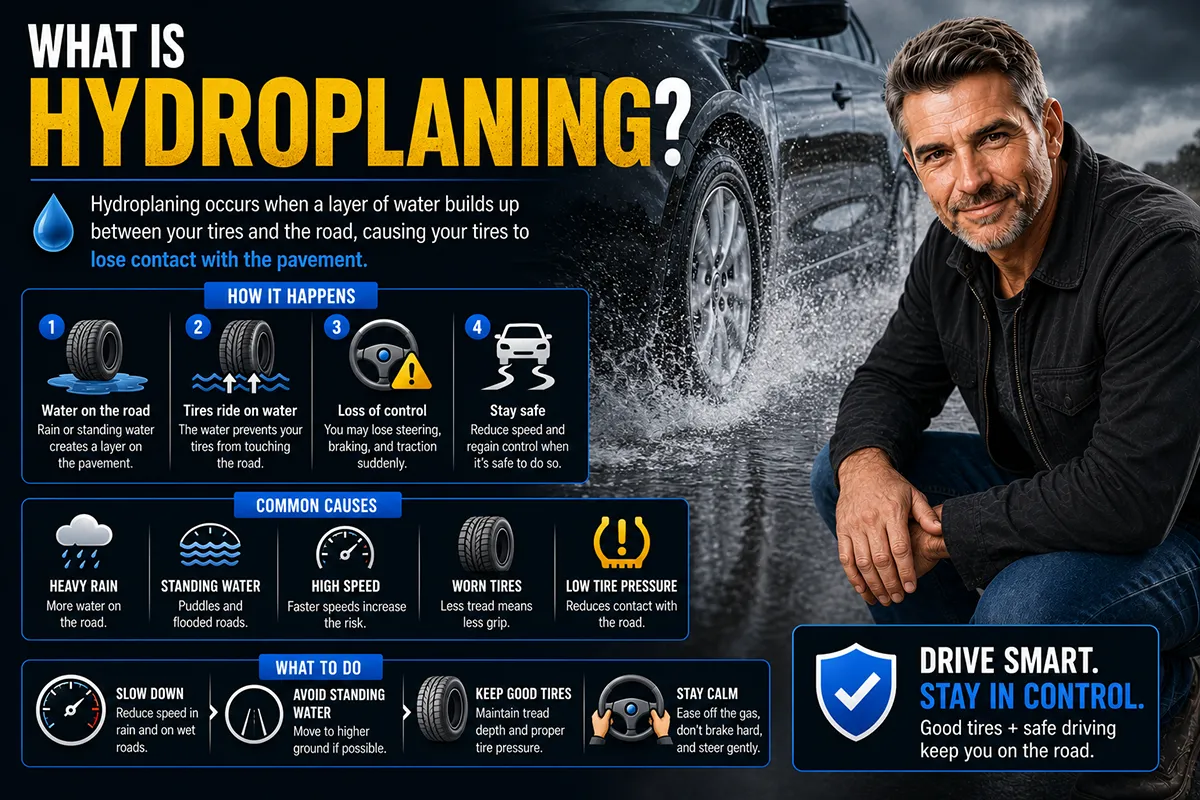
I’ll never forget the first time I hydroplaned. I was driving on I-95 during a summer downpour, doing maybe 60 mph, when suddenly my steering went completely weightless. For about two full seconds, my car was a 3,500-pound sled with zero traction.
Those two seconds felt like twenty. I’ve been reviewing tires professionally for years now, and that experience is what made me obsessively focused on wet-weather performance in every tire I test.
If you’ve ever felt that gut-dropping sensation of your car gliding across standing water, you know exactly why this topic matters. And if you haven’t — trust me, you want to understand hydroplaning before it catches you off guard.
- Hydroplaning occurs when a layer of water builds between your tires and the road, causing a complete loss of traction.
- It can happen at speeds as low as 35 mph on as little as 1/10 inch of standing water.
- Tire tread depth is the single biggest factor you can control — tires at 4/32″ or less dramatically increase your risk.
- Tire design matters enormously: wide circumferential grooves and open tread patterns channel water away faster.
- If you hydroplane, do NOT slam the brakes — ease off the gas, keep the wheel steady, and let your tires regain contact.
- Choosing the right replacement tires is one of the most effective ways to reduce hydroplaning risk year-round.
Liked this article?
Add TireAdvise as a preferred source so you see more of our tire reviews and guides on Google.
What Exactly Is Hydroplaning?
Hydroplaning — sometimes called aquaplaning — is what happens when your tires encounter more water on the road than they can physically displace. Instead of cutting through the water film to grip the pavement, your tires ride up on top of the water layer.
When this happens, you lose the ability to steer, brake, or accelerate effectively. Your tires are essentially surfing on water, completely disconnected from the road surface beneath them.
I think the best analogy is water skiing. When a water skier picks up enough speed, they rise above the surface and glide on top of it. Your tires can do the exact same thing — except you’re not wearing a life vest, and there’s no boat driver in control.
The Physics Behind It
Here’s what’s happening at the tire-road interface. Under normal conditions, your tire’s tread pattern is designed to channel water away from the contact patch — that’s the small rectangle of rubber that actually touches the road at any given moment. On most passenger car tires, that contact patch is roughly the size of your hand.
When water accumulates on the road faster than your tires can evacuate it, hydraulic pressure builds up in front of the tire. At a certain speed, that water pressure becomes strong enough to lift the tire off the pavement entirely.
The result? A thin but devastating film of water sits between your rubber and the road. Friction drops to near zero. You become a passenger in your own car.
The Three Types of Hydroplaning
In my years of testing tires in wet conditions, I’ve learned that hydroplaning isn’t one-size-fits-all. Engineers actually categorize it into three distinct types:
- Dynamic hydroplaning: This is the most common type and what most drivers picture. Your tires encounter standing water at speed, and the water wedge lifts the tire off the road. This is heavily influenced by speed, water depth, and tire tread design.
- Viscous hydroplaning: This can happen on even a very thin film of water — sometimes mixed with road oils and grime — on smooth pavement. It’s especially common in the first few minutes of rainfall when oils on the road surface haven’t been washed away yet. I’ve experienced this on freshly paved highways that were barely damp.
- Reverted rubber hydroplaning: This occurs when a locked-up tire (usually during hard braking without ABS) generates enough heat to turn water into steam, which then creates a cushion between the tire and road. Modern ABS systems have made this type much rarer, but I’ve spoken with drivers of older vehicles who’ve experienced it firsthand.
Understanding these distinctions has fundamentally changed how I evaluate tires during wet-weather testing. A tire that handles standing water well might still struggle on that slick, oily film during the first minutes of a rain shower.
When and Where Hydroplaning Happens Most
Through my own testing and from years of reading crash data, I can tell you that hydroplaning doesn’t require a biblical flood. It can happen in frustratingly ordinary conditions.
Speed Thresholds
Most research — including studies from NASA’s tire hydroplaning research (yes, NASA studies this) — suggests that hydroplaning can begin at speeds as low as 35 mph. However, the risk increases dramatically above 55 mph.
I’ve personally induced controlled hydroplaning on test tracks at speeds that most drivers would consider perfectly normal for highway driving. That’s what makes it so dangerous — it strikes during routine driving, not just reckless behavior.
Water Depth
It takes surprisingly little water. As little as 1/10 inch of standing water can cause hydroplaning, depending on your speed and tire condition. That’s thinner than a nickel standing on its edge.
In my experience, the most dangerous water accumulations happen in the following situations:
- Highway ruts: Worn wheel paths on interstates create shallow channels where water pools. I see this constantly on I-10 in Texas and I-75 in Florida.
- Underpasses and low spots: Water naturally collects in road depressions, sometimes creating pools several inches deep that appear suddenly.
- Early rainfall: The first 10-15 minutes of rain are statistically the most dangerous because road oils float to the surface and mix with water before being washed to the shoulders.
- Highway off-ramps: Banked curves with poor drainage are hydroplaning hotspots, and you’re often braking while entering them.
Seasonal and Regional Risks in the US
If you drive in the US, your hydroplaning risk varies enormously by region. After testing tires in conditions across multiple states, here’s what I’ve observed:
- Southeast (FL, GA, SC, LA): Sudden, intense summer thunderstorms dump massive amounts of rain in short periods. Florida alone averages over 50 inches of rain annually, and I’ve found that many roads there drain poorly due to the flat terrain.
- Pacific Northwest (WA, OR): Persistent drizzle keeps roads wet for months. The hydroplaning risk here is more chronic than acute — the road is almost always wet from October through April.
- Northeast (NY, PA, NJ): Spring melt combined with rain creates deceptive water conditions, and aging infrastructure means more road ruts and poor drainage.
- Texas and the Southwest: Hard-packed surfaces and sudden monsoon-style rains create some of the worst flash-flooding conditions I’ve driven in.
How Your Tires Are Your First Line of Defense
This is where my expertise as a tire reviewer really comes into play. After evaluating dozens of tire models in wet conditions, I can tell you without hesitation: your tires are the single most important factor in preventing hydroplaning that you can directly control.
Not your ABS. Not your traction control. Not even your driving skill. Your tires.
Here’s why.
Tread Depth: The Number You Need to Know
New tires typically ship with 10/32″ to 11/32″ of tread depth. At that depth, the grooves in your tires can channel a remarkable amount of water — some tire manufacturers claim their tires can evacuate up to 8 gallons of water per second at highway speeds.
But here’s what I’ve found through testing: hydroplaning resistance doesn’t decline linearly as tread wears. It drops off a cliff.
At 4/32″ of remaining tread — which is still technically above the legal minimum of 2/32″ in most US states — I’ve measured a dramatic reduction in wet braking performance during my testing sessions. Several tire brands that performed excellently when new became mediocre or even concerning at 4/32″.
That’s why I always recommend replacing your tires at 4/32″, not the legal minimum of 2/32″. At 2/32″, your tires are essentially racing slicks in the rain. They have almost zero ability to channel water away from the contact patch.
Here’s a quick reference for how tread depth affects hydroplaning risk:
| Tread Depth | Hydroplaning Risk | My Recommendation |
|---|---|---|
| 10/32″ – 8/32″ (New) | Low — full water evacuation capability | Ideal. Enjoy the grip. |
| 7/32″ – 5/32″ (Mid-life) | Moderate — noticeable decline in heavy rain | Reduce speed in heavy rain. Start budgeting for replacements. |
| 4/32″ (Replace zone) | High — significant loss of wet traction | Replace ASAP, especially if you drive in rain frequently. |
| 3/32″ – 2/32″ (Legal minimum) | Very High — almost no water channeling | Unsafe in wet conditions. Replace immediately. |
| Below 2/32″ (Illegal in most states) | Extreme — tire is effectively a slick | Do not drive on these tires. |
Tread Pattern Design: Not All Tires Are Created Equal
This is something I’m genuinely passionate about because I see the differences firsthand during every wet test session. The engineering behind a tire’s tread pattern has a massive impact on hydroplaning resistance, and it varies wildly between brands and models.
Here are the key design elements I look for:
- Wide circumferential grooves: These are the deep channels that run around the tire in the direction of travel. They act as the primary highways for water evacuation. I’ve tested tires with four wide circumferential grooves that dramatically outperformed tires with only two in standing water.
- Lateral grooves and channels: These run from the center of the tread outward toward the shoulders, pushing water sideways out from under the tire. The angle and width of these channels matter more than most people realize.
- Sipes: These are the tiny slits cut into the tread blocks. They create additional edges that bite into wet surfaces and help break up the water film at a micro level. In my experience, heavily siped tires consistently perform better on wet roads.
- Open vs. closed tread patterns: Tires with more void area (the empty space in the tread) generally evacuate water faster. However, this is always a trade-off with noise and tread life — more void area typically means a louder tire that wears faster.
Tire Type Matters More Than You Think
Not all tire categories handle water equally. Here’s what I’ve found from testing across different tire types:
All-season tires represent the middle ground. Most are designed with decent hydroplaning resistance, but there’s enormous variation within this category. Premium all-season tires from brands like Michelin, Continental, and Bridgestone typically outperform budget options significantly in wet conditions.
Summer/performance tires often have excellent wet grip because of their softer rubber compounds and aggressive tread designs, but they can vary widely. Some ultra-high-performance summer tires actually have less tread void, which can reduce water evacuation despite their superior rubber grip.
All-terrain and highway truck tires present a unique situation. The wider footprint of truck tires means more water needs to be displaced, and I’ve found that many popular all-terrain tires sacrifice wet performance for off-road capability. If you drive a truck or SUV in rain-heavy areas, this is something to prioritize during your tire search.
Winter tires actually tend to have very good hydroplaning resistance because of their deep tread and heavy siping. However, their soft compounds wear rapidly in warm weather, so they’re not a year-round solution for most US drivers.
What to Do If You Hydroplane
Even with perfect tires, hydroplaning can still happen in extreme conditions. Knowing how to respond could save your life. I’ve had to use these techniques myself, and I’ve practiced them extensively on wet test tracks.
Step 1: Don’t Panic
Easier said than done — I know. But the worst thing you can do is jerk the steering wheel or slam the brakes. Both of these instinctive reactions can cause your car to spin the moment your tires regain traction.
Step 2: Ease Off the Gas
Gently lift your foot off the accelerator. Don’t stomp on the brakes. You want to gradually reduce your speed so the tires can catch up with the water flow and re-establish contact with the road.
If you’re in a vehicle with manual transmission, do not downshift aggressively — this can have the same effect as braking.
Step 3: Keep the Wheel Steady
Point your wheels in the direction you want to go. Small, gentle inputs only. If you feel the car starting to slide sideways, steer gently into the slide — the same technique used in ice driving.
Step 4: Wait for Traction to Return
You’ll feel it when your tires reconnect with the pavement. The steering will suddenly feel heavier and more responsive. Once you have traction back, you can gently correct your course and continue driving at a reduced speed.
Step 5: Reassess Your Situation
After a hydroplaning event, I always recommend pulling off the road when it’s safe to do so. Check yourself, check your passengers, and take a moment to slow your heart rate. Then consider reducing your speed significantly for the remainder of the drive.
How to Prevent Hydroplaning: A Practical Checklist
Prevention is always better than reaction. Here’s my comprehensive checklist based on years of driving, testing, and reviewing tires across every condition imaginable.
Tire Maintenance
- Check tread depth monthly: Use a tread depth gauge (they cost about $5 at any auto parts store) or the classic penny test. Insert a penny into the tread with Lincoln’s head pointing down. If you can see the top of Lincoln’s head, your tread is at or below 2/32″ and you need new tires immediately.
- Maintain proper tire pressure: Underinflated tires change the shape of the contact patch, reducing water evacuation efficiency. I check my tire pressure every two weeks and always before long highway trips. Your correct pressure is on the sticker inside your driver’s door jamb — not on the tire sidewall.
- Rotate your tires regularly: Uneven wear creates inconsistent hydroplaning resistance across your four tires. One tire with significantly less tread than the others can cause unpredictable handling in wet conditions.
- Inspect for irregular wear patterns: Cupping, feathering, or one-sided wear can reduce wet traction even if overall tread depth looks adequate. These patterns often indicate alignment or suspension issues that should be addressed.
Driving Habits
- Slow down in rain: This is the simplest and most effective prevention method. Reducing your speed by just 5-10 mph dramatically reduces hydroplaning risk. I know it’s tempting to keep pace with traffic, but your safety is worth more than saving a few minutes.
- Avoid standing water: If you can see puddles or water accumulation, steer around them when it’s safe to do so. The deepest water is typically in the outside lanes and in wheel ruts.
- Follow tire tracks: The car ahead of you has already displaced some of the water in its path. Driving in its tire tracks gives you a slight advantage — the water depth is marginally less.
- Turn off cruise control in rain: This is crucial. If you hydroplane while cruise control is engaged, the system may try to accelerate to maintain speed, which is exactly what you don’t want. I always disengage cruise control the moment I see rain or wet pavement.
- Increase following distance: I use the 4-second rule in rain instead of the normal 3-second rule. Wet braking distances are significantly longer, even with excellent tires.
- Avoid sudden maneuvers: Smooth steering inputs, gentle braking, and gradual acceleration all help maintain traction on wet surfaces.
Vehicle Considerations
- Alignment: A properly aligned vehicle tracks straight, which means your tires are meeting the road at the optimal angle for water evacuation. Misalignment can compromise even the best tires’ wet performance.
- Weight distribution: Lighter vehicles hydroplane more easily because there’s less force pressing the tires into the road. If you drive a lightweight car, this is one more reason to invest in high-quality tires with excellent wet ratings.
- Tire width: Wider tires must displace more water across a broader contact patch, which can actually increase hydroplaning risk in certain conditions. This is a counterintuitive fact that surprises many performance car enthusiasts I talk to.
Choosing Replacement Tires with Hydroplaning Resistance in Mind
If you’re reading this on TireAdvise.com, you’re probably shopping for replacement tires. Here’s how I recommend approaching the buying process with wet-weather safety as a priority.
What to Look For
UTQG wet traction rating: Every tire sold in the US carries a Uniform Tire Quality Grading rating. For wet traction, the scale runs from AA (best) to C (worst). I strongly recommend only considering tires rated A or AA for wet traction, especially if you live in a rain-prone area.
Manufacturer wet testing data: Major brands like Michelin, Continental, Goodyear, and Bridgestone publish wet braking distances and hydroplaning speed data for their tires. I cross-reference this data with my own testing whenever possible.
Tread design features: Look for tires marketed with specific hydroplaning technologies. For example, Continental’s tires often feature wide “aqua channels,” Michelin uses their EverGrip technology on certain models, and Bridgestone has developed specific water evacuation designs for their Turanza and Alenza lines.
Independent test results: Organizations like Consumer Reports, Tire Rack, and various European testing bodies (like ADAC in Germany) conduct rigorous wet-weather testing. I always look at these results alongside my own observations.
My General Recommendations by Category
I won’t name a single “best” tire here because the right choice depends on your vehicle, driving style, and budget. But I can share general principles I’ve developed through extensive testing:
For sedans and compact cars, prioritize all-season tires with high wet traction ratings and deep circumferential grooves. The premium all-season segment from Michelin, Continental, and Bridgestone consistently delivers the strongest hydroplaning resistance in my testing.
For SUVs and crossovers, pay extra attention to hydroplaning resistance because the heavier vehicle weight and wider tires create a unique challenge. Look for highway-oriented SUV tires rather than aggressive all-terrain patterns if wet-weather driving is your primary concern.
For trucks, the trade-offs are real. If you need off-road capability, accept that most all-terrain tires sacrifice some wet-road performance and adjust your driving accordingly. If your truck is primarily a daily driver and highway cruiser, highway-terrain tires will serve you better in the rain.
For performance vehicles, consider a set of high-performance all-season tires if you live somewhere with frequent rain. Ultra-high-performance summer tires offer incredible dry grip but can vary in their hydroplaning resistance. During my test periods, I’ve seen significant differences between performance tire models in standing water.
Budget vs. Premium: Does Price Matter for Wet Safety?
I get asked this constantly, and my honest answer is yes — with some nuance.
In my testing over the past several years, premium tires from top-tier manufacturers consistently outperform budget alternatives in wet conditions. The difference isn’t subtle. I’ve measured wet braking distance differences of several car lengths between a premium all-season tire and a budget alternative during controlled testing sessions.
That said, a few mid-tier brands have impressed me with wet performance that punches above their price point. General Tire (owned by Continental), Cooper (now part of Goodyear), and Hankook have all produced models that deliver strong wet-weather performance at prices well below the flagship options.
My rule of thumb: never buy the absolute cheapest tire available if you drive in rain regularly. The difference between a $90 tire and a $130 tire can be substantial in wet braking and hydroplaning resistance. That extra $40 per tire — $160 for the set — is some of the best safety money you can spend.
Common Myths About Hydroplaning
In my years of writing about and testing tires, I’ve encountered a lot of misinformation about hydroplaning. Let me clear up some of the most persistent myths.
Myth: “I have AWD/4WD, so I don’t need to worry about hydroplaning.”
This is probably the most dangerous myth out there. All-wheel drive helps you accelerate on slippery surfaces, but it does absolutely nothing to help you stop or steer on standing water. I’ve tested AWD vehicles that hydroplane just as readily as front-wheel-drive sedans. Your drivetrain is irrelevant when your tires aren’t touching the road.
Myth: “New tires always prevent hydroplaning.”
New tires certainly reduce the risk, but they don’t eliminate it. If you’re driving fast enough through deep enough water, even brand-new premium tires will hydroplane. Tread depth buys you a wider margin of safety — it’s not a guarantee.
Myth: “Wider tires are always safer in the rain.”
Actually, the opposite can be true. Wider tires have to displace more water across a broader footprint, which can increase hydroplaning susceptibility at certain speeds. This is why some performance car drivers actually switch to slightly narrower tires for the rainy season.
Myth: “Hydroplaning only happens in heavy rain.”
I’ve already addressed this, but it bears repeating. Viscous hydroplaning can occur on a barely damp road, especially on smooth pavement with a light oil film. The first few minutes of rain after a dry spell are often the most treacherous.
Myth: “I can feel hydroplaning starting and react in time.”
Sometimes you can feel a slight lightness in the steering before full hydroplaning occurs. But in many cases — especially during dynamic hydroplaning at highway speeds — the onset is nearly instantaneous. By the time you realize what’s happening, you’re already riding on water. This is why prevention through proper tires and smart driving is so much more effective than relying on your reaction time.
The Bottom Line: Respect the Water
After years of testing tires in every wet condition imaginable — from light morning dew to torrential downpours on test tracks — I’ve developed an enormous respect for what water can do to even the most capable vehicles.
Hydroplaning is not something that only happens to bad drivers or on cheap tires. It’s a physics problem, and it can affect anyone driving on wet roads. But the good news is that you have significant control over your risk level.
Keep your tires in good shape. Replace them before they hit 4/32″ of tread depth. Choose quality replacement tires with strong wet-weather ratings. Slow down when it rains. Turn off cruise control. And if the worst happens, stay calm, ease off the gas, and let physics bring you back to solid ground.
Your tires are the only thing between your car and the road. On a rainy day, they might be the only thing between you and a catastrophe. Treat them accordingly.
I hope this guide helps you understand not just what hydroplaning is, but what you can actually do about it. If you’re shopping for replacement tires and wet-weather performance is a priority — and it should be — check out our detailed tire reviews here on TireAdvise.com where I break down wet braking, water evacuation, and hydroplaning resistance for every tire I test.
Stay safe out there.
Frequently Asked Questions
What is hydroplaning and why does it happen?
Hydroplaning occurs when your tires lose contact with the road surface because a layer of water builds up between the rubber and the pavement faster than your tires can channel it away. It typically happens when you drive over standing water at speeds above 35 mph, especially if your tires have worn tread or insufficient tread depth. When your tires hydroplane, you temporarily lose steering, braking, and acceleration control, which is why it’s one of the most dangerous wet-weather driving hazards on US roads.
What tire tread depth is too low for hydroplaning protection?
Most tire safety experts recommend replacing your tires once the tread depth reaches 4/32 of an inch if you regularly drive in rain, even though the legal minimum in most US states is 2/32 of an inch. At 2/32, your tires have lost nearly all of their ability to evacuate water through the tread grooves, dramatically increasing your hydroplaning risk. I always recommend using a tread depth gauge — they cost under $5 at any auto parts store — to check your tires monthly during the rainy season.
Do certain tires prevent hydroplaning better than others?
Yes, tires specifically designed with wide circumferential grooves and high-sipe-density tread patterns are significantly better at resisting hydroplaning. US-market all-season tires like the Michelin Defender 2, Continental TrueContact Tour, and Bridgestone Turanza QuietTrack are engineered with advanced hydroplaning-resistant tread designs and typically cost between $130 and $200 per tire depending on size. When shopping for replacement tires, look for models that score highly in wet braking and wet traction tests, as these directly correlate with hydroplaning resistance.
How do I regain control if my car starts hydroplaning?
If you feel your car start to hydroplane, ease off the gas pedal gradually without slamming the brakes, and keep your steering wheel pointed in the direction you want to travel. Abrupt braking or sharp steering inputs can cause a spin, especially if only some of your tires have lost traction. Once you feel the tires reconnect with the pavement, you can gently apply the brakes if needed. Practicing this calm response before you ever need it is the best way to stay safe on wet US highways during heavy summer storms.
Does tire pressure affect hydroplaning risk?
Absolutely — underinflated tires increase your hydroplaning risk because the center of the tread lifts slightly, reducing the contact patch’s ability to push water aside effectively. I check my tire pressure at least once a month and always inflate to the vehicle manufacturer’s recommended PSI found on the driver’s door jamb sticker, not the maximum number printed on the tire sidewall. Even 5-10 PSI below the recommended pressure can noticeably degrade wet traction and increase stopping distances on rain-soaked roads.
At what speed does hydroplaning start on US highways?
Hydroplaning can begin at speeds as low as 35 mph on heavily flooded roads, but it becomes much more likely above 55 mph, which is a common speed on US interstates and state highways during rainstorms. The exact speed depends on your tire tread depth, tire pressure, the amount of standing water, and your vehicle’s weight. As a general rule, reducing your speed by 5-10 mph below the posted limit during heavy rain significantly lowers your chances of losing traction.
Are wider tires more likely to hydroplane than narrower tires?
Wider tires can be more susceptible to hydroplaning because they need to displace a larger volume of water across a broader contact patch, but modern tire engineering has largely offset this disadvantage with optimized tread patterns and deeper grooves. If you’re driving an SUV or truck with wide all-terrain tires, choosing a model with dedicated rain grooves — like the Goodyear Wrangler DuraTrac RT or Falken Wildpeak A/T4W — can help maintain wet-road grip. Ultimately, tread depth and tread design matter far more than tire width alone when it comes to real-world hydroplaning resistance.
