

When I pulled into the tire shop last year to replace the worn-out factory tires on my sedan, the technician asked me a question I wasn’t expecting: “Do you want to stick with the OE tire, or would you like to look at some aftermarket replacements?”
I’d been reviewing tires for years at that point, and even I had to pause. The price difference was significant, the options were overwhelming, and the stakes felt high. If you’ve ever stood in a tire shop feeling confused about whether to buy the same tires your car came with or try something different, you’re not alone.
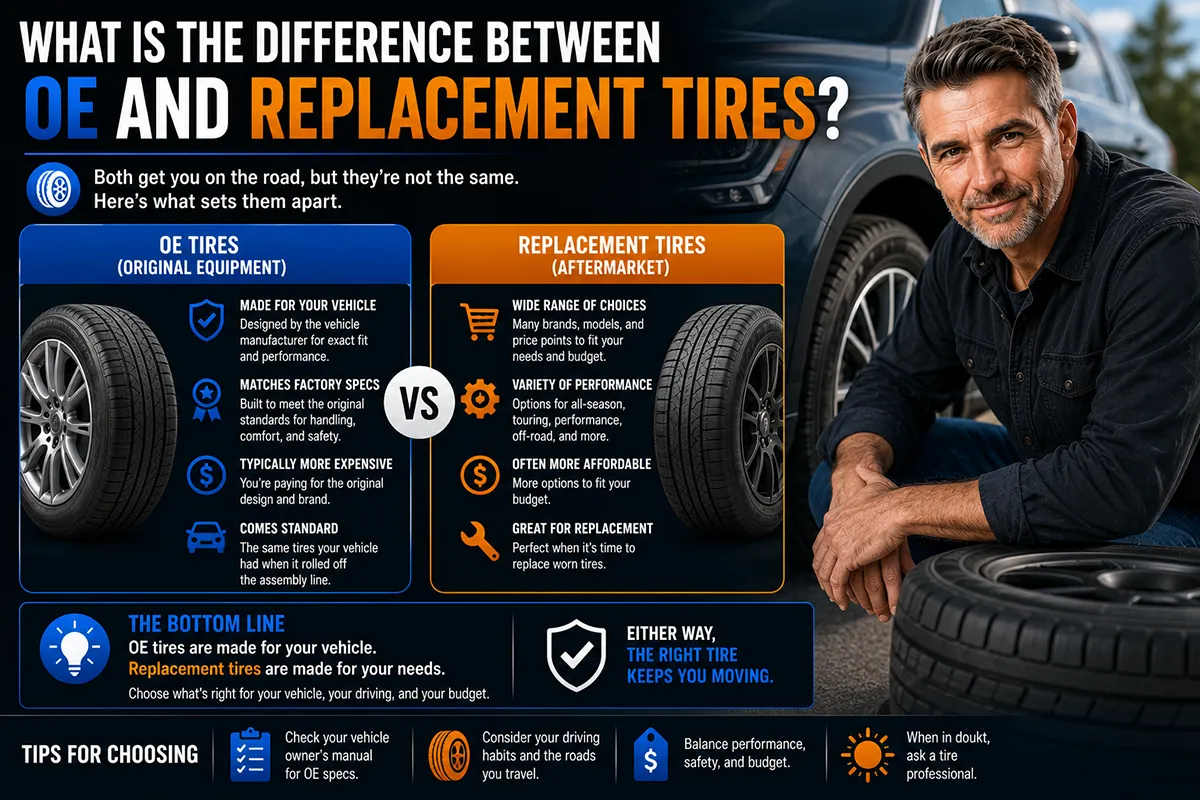
- OE (Original Equipment) tires are specifically designed and tuned for your vehicle by the automaker and tire manufacturer working together.
- Replacement tires are designed for broader use and often offer better tread life, wet grip, or ride comfort than the OE version.
- OE tires prioritize the car’s original ride character; replacement tires let you customize performance to your driving style.
- You do NOT have to buy OE tires when replacing — aftermarket options are often a better value.
- Always match the correct tire size, load rating, and speed rating regardless of which route you choose.
Liked this article?
Add TireAdvise as a preferred source so you see more of our tire reviews and guides on Google.
What Are OE Tires, Exactly?
OE stands for “Original Equipment.” These are the tires that come pre-installed on your vehicle when it rolls off the factory floor. They’re not just random tires picked off a shelf — they’re the result of a deep collaboration between the automaker and the tire manufacturer.
Here’s what most people don’t realize: when a company like Toyota or Ford develops a new vehicle, they work directly with tire makers like Michelin, Bridgestone, Continental, or Goodyear to create a tire that’s specifically tuned for that car. The engineers tweak the rubber compound, tread pattern, sidewall stiffness, and internal construction to match the vehicle’s suspension, weight distribution, noise targets, and fuel efficiency goals.
That’s why you’ll sometimes see special markings on OE tires. For example, BMW uses a star symbol (★), Mercedes-Benz uses “MO,” Porsche uses “N0” through “N4,” and Audi uses “AO.” These markings tell you the tire passed that automaker’s specific validation testing.
In my experience, OE tires tend to be fine-tuned for a balanced, predictable driving experience that matches the car’s intended character. If you drive a luxury sedan, the OE tire is often optimized for a quiet, smooth ride. If you drive a sporty coupe, the OE tire might prioritize sharp handling response.
What Are Replacement Tires?
Replacement tires — sometimes called aftermarket tires — are tires designed and sold by tire manufacturers for the general consumer market. They’re built to fit a wide range of vehicles based on standardized tire sizes rather than being custom-developed for one specific car.
When I say “replacement,” I don’t mean inferior. In fact, some of the best tires I’ve ever tested are aftermarket options that outperform the OE rubber in nearly every measurable category. The difference is simply in how they’re developed and who they’re developed for.
Replacement tires are engineered to serve a category of drivers rather than a specific vehicle platform. A tire like the Michelin Defender 2 or the Continental TrueContact Tour, for instance, is designed to deliver excellent all-season traction, long tread life, and a comfortable ride across dozens of different sedans and crossovers.
The advantage here is choice. When you shop for replacement tires, you can prioritize what matters most to you — whether that’s tread longevity, winter grip, fuel efficiency, sporty handling, or simply the lowest price.
The Key Differences Between OE and Replacement Tires
Now let’s get into the specifics. I’ve spent years testing both OE and replacement tires back-to-back on the same vehicles, and the differences are real — though not always in the ways you’d expect.
1. Development Process
OE tires go through a joint development process that can take two to three years. The automaker sets performance targets — rolling resistance, noise levels, handling balance, ride comfort — and the tire manufacturer engineers a product to meet those exact specifications.
Replacement tires are developed by the tire company independently. They’re tested across multiple vehicles and optimized for broad appeal within a performance category (touring, ultra-high performance, all-terrain, etc.).
2. Tread Compound and Design
This is where things get interesting. I’ve noticed that OE tires often use slightly softer rubber compounds compared to their replacement counterparts. Automakers want the car to feel great during test drives and early ownership, so they optimize for grip and ride quality — sometimes at the expense of tread longevity.
Replacement tires, on the other hand, are frequently engineered with harder, more durable compounds because consumers shopping for tires care a lot about how long they last. That’s why you’ll often see replacement tires carrying treadwear warranties of 60,000, 70,000, or even 80,000 miles, while OE tires from the same brand may carry a shorter warranty or none at all.
3. Ride Comfort and Noise
In my testing, OE tires typically deliver a ride that feels “of a piece” with the car. Everything feels integrated — the way the suspension absorbs bumps, how the steering communicates road texture, the sound levels inside the cabin. That’s by design, since the car was literally tuned with those tires.
When I’ve swapped to replacement tires, I’ve noticed subtle changes. Sometimes the ride gets slightly firmer. Sometimes road noise increases or decreases. In several cases, the replacement tire actually improved ride comfort over the OE, especially on models where the factory tire was prioritizing low rolling resistance over cushioning.
4. Fuel Efficiency
Automakers are under intense pressure to meet federal fuel economy standards (CAFE regulations in the US). Because of this, OE tires are almost always optimized for low rolling resistance. That means they’re designed to require less energy to roll, which directly improves the car’s MPG numbers on the EPA test cycle.
I’ve measured real-world fuel economy differences when switching from OE to replacement tires, and the impact is usually small — often one to two MPG at most. But it exists. If fuel economy is a top priority for you, it’s worth checking the rolling resistance ratings of any replacement tire you’re considering.
5. Price
Here’s a surprise that catches many shoppers off guard: OE-spec tires are often more expensive than comparable replacement tires, especially for premium and luxury vehicles. The reason is simple — they’re a niche product with lower production volume and specialized engineering.
For example, I’ve seen cases where the OE-spec version of a Michelin Pilot Sport costs $30 to $50 more per tire than the standard retail version of the same tire without the automaker’s marking. You’re paying for that OE validation stamp.
Replacement tires, because they’re produced at scale for a broader market, often deliver better value per dollar. You can typically find a high-quality replacement tire for $120 to $200 per tire for most sedans and crossovers, whereas the OE equivalent might run $150 to $260 or more.
6. Availability
This is a practical consideration that I don’t see discussed enough. OE tires can be difficult to find. If your car came with a tire that has a specific OE marking, not every tire shop carries it. You might have to order it and wait, or visit a dealership.
Replacement tires are widely available at every major tire retailer — Discount Tire, Tire Rack, Costco, Walmart, America’s Tire, and local independent shops. You can usually get them installed the same day.
OE vs. Replacement Tires: Side-by-Side Comparison
| Feature | OE Tires | Replacement Tires |
|---|---|---|
| Developed For | One specific vehicle | A broad category of vehicles |
| Tread Life | Often shorter | Often longer with better warranties |
| Ride Integration | Tuned to match the vehicle perfectly | Good but may feel slightly different |
| Fuel Efficiency | Optimized for low rolling resistance | Varies by model; check specifications |
| Price | Often higher ($150–$260+/tire) | Often lower ($120–$200/tire) |
| Availability | Limited; may require special order | Widely available at all major retailers |
| Selection | Usually only 1–2 options | Dozens of options per tire size |
| Treadwear Warranty | Shorter or none | Typically longer (60K–80K miles) |
Do You Have to Replace Your Tires With OE Tires?
Absolutely not. This is one of the biggest misconceptions I encounter with readers, and I want to put it to rest right now.
There is no legal requirement, warranty obligation, or safety reason that forces you to buy OE tires when it’s time to replace. Your vehicle warranty will not be voided by installing a different brand or model of tire, as long as you use the correct size, load index, and speed rating.
I’ve personally swapped dozens of vehicles from OE tires to aftermarket alternatives and have never had a warranty issue. The Magnuson-Moss Warranty Act — a US federal law — actually protects consumers from this kind of thing. A manufacturer can’t void your warranty just because you used a non-OE part, unless they can prove that specific part caused the failure.
When Should You Stick With OE Tires?
Despite everything I just said, there are legitimate situations where buying the OE tire makes sense. Here’s when I typically recommend it:
You Love How Your Car Drives Right Now
If you’re completely satisfied with the ride quality, handling, noise levels, and overall feel of your vehicle, the easiest way to maintain that experience is to buy the same OE tire again. In my experience, this is especially true for luxury vehicles from brands like BMW, Mercedes-Benz, and Lexus, where the suspension tuning and tire work together as a carefully calibrated system.
You Drive a High-Performance Vehicle
Performance cars — think Porsche 911, Corvette, BMW M series — have very specific tire requirements. The OE tires on these vehicles are sometimes uniquely engineered with proprietary compounds and constructions that you genuinely can’t replicate with an off-the-shelf replacement. I tested a Porsche Cayman once with its OE-spec Michelin Pilot Sport 4S (N0 marked) and then with the standard retail version. The difference was subtle but real — the OE version had slightly better turn-in response and a more planted feel at high speeds.
Your Vehicle Has a Tire Pressure Monitoring System (TPMS) Calibration Concern
Some newer vehicles calibrate their TPMS and driving assist systems based on the exact rolling diameter and characteristics of the OE tire. While most replacement tires in the same size will work fine, it’s worth double-checking with your dealer if you drive a vehicle with advanced driver-assistance features.
When Should You Choose a Replacement Tire Instead?
In most cases, I actually recommend replacement tires over OE. Here’s why:
You Want Better Tread Life
This is the number one reason I steer people toward replacement tires. I’ve tested OE tires that showed significant wear after just a couple of seasons of normal driving, while replacement alternatives in the same size were still going strong well beyond that. If you want your tires to last, the aftermarket is your friend.
You Need Better Winter or Wet Performance
OE all-season tires are often designed as a compromise — they need to be quiet, fuel-efficient, and comfortable, so winter and wet traction sometimes take a back seat. If you live in the Midwest, Northeast, or Pacific Northwest where rain and snow are a fact of life, a replacement tire specifically designed for those conditions can make a massive difference in safety.
I live in an area that gets moderate snowfall, and after several days of driving on OE all-season tires during a winter storm, I swapped to a set of dedicated winter tires. The improvement was night and day — braking distances shortened dramatically, and I felt far more confident on packed snow.
You Want to Spend Less
Budget matters. And when I compare the cost of a full set of OE tires against a well-reviewed replacement option, the savings can be $100 to $200 or more for the set. Brands like General Tire, Cooper, Falken, and Hankook make excellent replacement tires that cost significantly less than premium OE-spec options without a major drop in performance.
You Want More Choices
When you open yourself up to the replacement market, you go from one or two tire options to potentially 20 or 30. That means you can find a tire that’s optimized for exactly what you care about — whether it’s highway comfort, aggressive off-road capability, track-day grip, or all-weather versatility.
How to Choose the Right Replacement Tire
If you’ve decided to go the replacement route, here’s the process I follow every time I help someone pick new tires:
Step 1: Check Your Current Tire Size
Look at the sidewall of your current tire or the placard on the driver’s side door jamb. You’ll see a code like P225/65R17 or 245/40R18. This tells you the width, aspect ratio, construction type, and rim diameter. Your replacement tire must match this size exactly unless you’re intentionally upsizing or downsizing (which is a separate discussion).
Step 2: Match the Load Index and Speed Rating
After the tire size, you’ll see numbers and a letter — something like 102H. The 102 is the load index (how much weight each tire can safely carry), and the H is the speed rating (the maximum safe speed for the tire). Always match or exceed your vehicle’s requirements. Never go lower.
Step 3: Identify Your Priorities
Ask yourself: What do I wish my current tires did better? If you want a quieter ride, look at touring tires. If you want better snow traction, consider all-weather or winter tires. If you want sharper handling, look at performance tires. Be honest about your driving habits — most of us aren’t taking our RAV4 to a racetrack.
Step 4: Read Reviews and Compare
This is where sites like ours come in. I always recommend reading multiple professional reviews and checking consumer feedback on sites like Tire Rack before committing. Pay attention to tread life reports, noise complaints, and wet traction scores — these are the areas where tires differ the most in real-world use.
Step 5: Consider Treadwear Warranties
A treadwear warranty isn’t a guarantee that your tires will last that exact distance, but it does give you recourse if they wear out prematurely. I’ve personally filed a treadwear warranty claim before, and the process was straightforward — the tire manufacturer prorated the cost of the replacement. Look for tires with solid warranty coverage, especially if you drive a lot.
Real-World Example: My Experience Switching From OE to Replacement
Let me share a specific experience that illustrates the OE vs. replacement difference perfectly.
I was driving a popular midsize SUV that came with a well-known brand’s OE all-season tire. The ride was smooth, the cabin was quiet, and fuel economy was right on target with the EPA estimates. No complaints — the OE tires did exactly what the automaker wanted them to do.
But after a couple of years, the tread was wearing thin. I had to make a choice: buy the same OE tire again or try something different.
I chose a highly-rated replacement all-season tire from a competing brand. The price was about $35 less per tire, and it came with a 70,000-mile treadwear warranty — the OE tire had no mileage warranty at all.
After several days of driving on the new tires, here’s what I noticed:
- Tread noise: Slightly louder on coarse asphalt, but barely noticeable with the windows up.
- Ride comfort: Nearly identical. Maybe a touch firmer over sharp bumps.
- Wet traction: Noticeably better. The replacement tire had deeper circumferential grooves and more aggressive siping.
- Fuel economy: Down by about 0.5 MPG — essentially negligible.
- Handling: Slightly less precise turn-in, but perfectly fine for daily driving.
Overall, the replacement tire was a better value by a wide margin. I saved money upfront, got better wet weather safety, and the tires lasted significantly longer. For my driving style and needs, it was the right call.
Common Myths About OE vs. Replacement Tires
Let me bust a few myths I see floating around forums and social media.
Myth: “OE tires are always better quality”
Not true. OE tires are tuned differently, but that doesn’t mean they’re superior. In many cases, the OE tire uses a softer compound that wears faster. “Better” depends entirely on what you value.
Myth: “Replacement tires will void my warranty”
As I mentioned earlier, the Magnuson-Moss Warranty Act prevents this. You can install any tire that meets the correct size and rating specifications without jeopardizing your vehicle warranty.
Myth: “OE tires are cheaper because the automaker buys in bulk”
The automaker does get volume pricing, but that discount applies to them, not to you. When you buy OE replacement tires at a retail shop, you’re often paying a premium for the OE-spec version.
Myth: “You have to buy OE tires for safety”
Any tire that matches your vehicle’s size, load index, and speed rating requirements is safe to use. Period. The DOT and NHTSA regulate tire safety standards in the US, and every tire sold here must meet those standards regardless of whether it’s OE or aftermarket.
A Note on “OE Replacement” Tires
Here’s a term that causes confusion: “OE replacement.” This doesn’t mean the tire has OE markings. It means the tire is designed to be a direct replacement for common OE fitments. It’ll be the same size and category, but it won’t carry the automaker’s specific designation.
Many tire manufacturers sell both versions. For example, Michelin might sell the Pilot Sport 4S as a general retail tire and also as a Porsche N0-spec tire. The retail version and the OE version may have slightly different compounds or internal structures, even though they look identical on the outside.
When you see a tire advertised as an “OE replacement” on Tire Rack or Discount Tire, it simply means it fits the same size and application as the tire your car originally came with.
My Recommendations for Popular Vehicle Categories
Based on my testing and real-world experience, here’s what I generally recommend for common vehicle types when it’s time to replace:
Sedans and Compact Cars
For most sedan and compact car owners, I recommend a high-quality replacement all-season touring tire. The Michelin Defender 2, Continental TrueContact Tour, and Bridgestone Turanza QuietTrack are all excellent choices that typically outperform OE tires in tread life and wet traction.
Midsize SUVs and Crossovers
This is the most popular vehicle segment in the US, and there’s fierce competition in the replacement tire market. I’ve had great results with the Michelin CrossClimate 2 (especially in states with variable weather), the Continental CrossContact LX25, and the Yokohama Avid Ascend GT. All three offer strong value versus OE options.
Trucks and Full-Size SUVs
If you tow, haul, or go off-road, the replacement market is where you’ll find tires specifically built for those tasks — something OE tires rarely prioritize. The BFGoodrich All-Terrain T/A KO2, Falken Wildpeak A/T3W, and Toyo Open Country A/T III are all fantastic options I’ve personally tested and trust.
Performance and Sports Cars
This is the one category where I’d lean toward OE tires, or at least OE-comparable replacements. If you drive hard, the specific tuning of an OE performance tire matters more. That said, the Michelin Pilot Sport 4S (retail version), Continental ExtremeContact Sport 02, and Bridgestone Potenza Sport are all exceptional and widely used by enthusiasts.
The Bottom Line: Which Should You Buy?
After years of testing and writing about tires, here’s my honest take: for the vast majority of US drivers, a well-chosen replacement tire is the smarter purchase.
You’ll save money. You’ll likely get longer tread life. You’ll have more options to match your specific needs. And in most cases, you won’t notice a meaningful difference in ride quality or handling compared to the OE tire.
The exception is if you drive a high-end performance car, if you absolutely love how your car drives on its current tires, or if you value the peace of mind that comes with buying exactly what the automaker intended. In those cases, the OE tire is a perfectly valid choice — just know that you’re paying a premium for it.
Whatever you choose, the most important thing is to buy the correct size tire, maintain proper inflation pressures, and get your alignment checked at installation. Those three things matter far more than the OE vs. replacement debate.
Drive safe out there.
Frequently Asked Questions
What is the difference between OE tires and replacement tires?
OE (Original Equipment) tires are specifically designed and selected by your vehicle’s manufacturer to match the car’s performance, handling, and fuel efficiency specifications. Replacement tires are aftermarket options from brands like Michelin, Continental, or Bridgestone that fit your vehicle but may offer different tread patterns, compounds, or performance characteristics. While OE tires are tuned for a balanced factory experience, replacement tires give you the flexibility to prioritize traits like longer tread life, better wet traction, or improved ride comfort based on your personal driving needs.
Are OE tires better quality than aftermarket replacement tires?
Not necessarily — OE tires aren’t inherently higher quality, they’re just optimized for the specific vehicle they ship on. Many replacement tires from top-tier brands actually outperform OE tires in independent testing for tread life, grip, and wet braking distance. Automakers sometimes choose OE tires based on cost negotiations and fuel economy targets rather than pure performance, so upgrading to a premium replacement tire can be a noticeable improvement for everyday US driving conditions.
Should I replace my OE tires with the same brand and model?
You can, but you don’t have to. Sticking with the exact OE tire ensures the same ride feel and handling your car was designed around, which some drivers prefer. However, many US drivers find that switching to a highly rated replacement tire in the same size gives them better tread life or improved performance in rain and snow — just make sure you match the correct tire size, load index, and speed rating listed on your door placard.
Why do OE tires seem to wear out faster than replacement tires?
Many drivers notice their factory OE tires wear out in 25,000–40,000 miles, while quality replacement tires can last 50,000–70,000 miles or more. This is because automakers often prioritize a softer compound for OE tires to deliver a quiet, comfortable ride and strong grip during test drives, which can sacrifice long-term tread life. When it’s time to replace them, choosing a tire with a higher UTQG treadwear rating can significantly extend your mileage between tire purchases.
Do replacement tires cost more or less than OE tires?
Replacement tires typically range from $80 to $250+ per tire depending on size and brand, and they can be either cheaper or more expensive than the original OE tires that came on your vehicle. Luxury and performance vehicles often have OE tires that cost $200–$400 each, so switching to a comparable aftermarket option can save you money without sacrificing quality. I recommend comparing prices at US retailers like Tire Rack, Discount Tire, and Costco to find the best deal on a well-reviewed replacement tire in your size.
Can I use a different tire size than my OE tires when buying replacements?
It’s generally best to stick with the exact tire size specified by your vehicle manufacturer, as changing the diameter or width can affect your speedometer accuracy, ABS function, and overall handling. However, some drivers choose a slightly different aspect ratio or opt for a plus-size setup for aesthetic or performance reasons — if you go this route, consult a tire professional to ensure the overall diameter stays within 3% of the original. Mismatched sizes can also void certain vehicle warranty coverage, so always check your owner’s manual first.
How do I find out what OE tires originally came on my car?
The easiest way is to check the tire information placard on the driver’s side door jamb, which lists the recommended tire size, load index, and inflation pressure for your vehicle. You can also look up your exact year, make, and model on sites like Tire Rack or your manufacturer’s website to see the specific OE tire brand and model that shipped from the factory. Knowing your OE tire specs is essential when shopping for replacements because it gives you a reliable baseline to compare tread life, performance ratings, and pricing against aftermarket options.
