

I walked out to my car on the first truly cold morning last November and found my tire pressure monitoring system lit up like a Christmas tree. Every single tire had dropped below the warning threshold overnight — and I hadn’t driven over a single nail.
That moment reminded me of something I tell every driver I talk to: winter is the silent tire pressure killer, and most people don’t realize how much air they’re losing until a dashboard light scares them half to death.
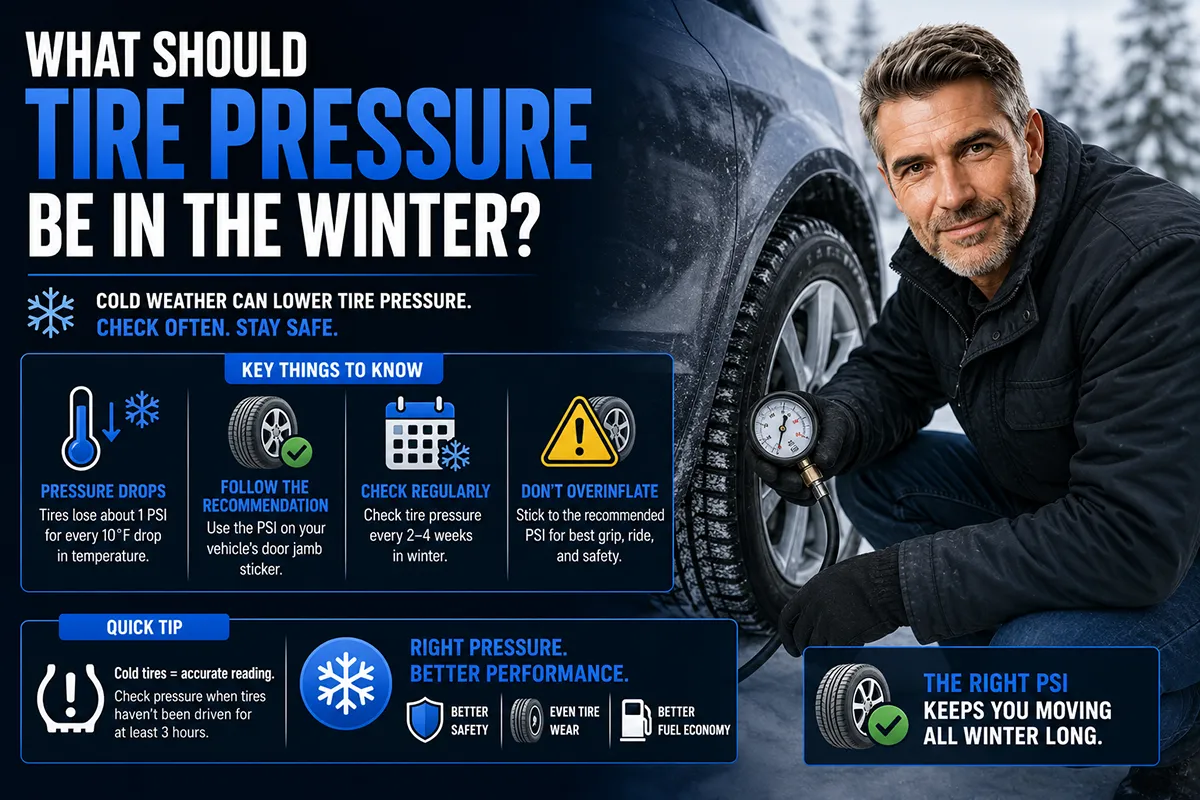
- Tire pressure drops about 1 PSI for every 10°F decrease in temperature.
- Always inflate to the pressure listed on your driver’s side door jamb — NOT the number on the tire sidewall.
- Most passenger vehicles call for 30–35 PSI, but check your specific recommendation.
- Check tire pressure at least once a month in winter, ideally when tires are cold (before driving).
- Don’t overinflate to “compensate” for cold — this reduces traction and causes uneven wear.
- A $10 digital gauge is the best winter tire tool you’ll ever buy.
Liked this article?
Add TireAdvise as a preferred source so you see more of our tire reviews and guides on Google.
Why Does Tire Pressure Drop in Cold Weather?
This is basic physics, but it matters enormously for your safety. Air is a gas, and when gas gets cold, its molecules slow down and take up less space. That means the air inside your tires literally contracts when temperatures fall.
The rule of thumb I’ve confirmed repeatedly over years of testing and monitoring is straightforward: you lose approximately 1 PSI (pound per square inch) for every 10°F drop in ambient temperature. So if you filled your tires to a perfect 35 PSI during a 70°F September afternoon, and you wake up to a 20°F December morning, you’ve potentially lost about 5 PSI without driving a single mile.
That’s a significant drop. A tire running 5 PSI below its recommended pressure handles differently, wears differently, and burns more fuel. I’ve measured the difference with my own gauges, and it’s consistent every single winter.
It’s Not a Leak — It’s Science
I can’t tell you how many people I’ve talked to who assumed they had a slow puncture when their TPMS light came on during the first cold snap. In most cases, it’s purely thermal contraction. The air didn’t escape — it just shrank.
That said, cold weather can exacerbate existing slow leaks. If a tire consistently loses pressure faster than the others, that’s worth getting checked at a tire shop. But if all four tires drop uniformly, you can almost always blame the thermometer.
What Should Your Tire Pressure Actually Be in Winter?
Here’s where I see the most confusion, so I want to be crystal clear: your winter tire pressure should be the exact same number recommended by your vehicle’s manufacturer.
You don’t need a special “winter setting.” You don’t need to add a few extra PSI to compensate. You need to maintain the same recommended pressure that applies year-round — you just need to check it more often because cold weather keeps pulling it down.
Where to Find Your Recommended Pressure
There are two numbers people commonly confuse, and using the wrong one can cause real problems:
- The door jamb sticker: Open your driver’s side door and look for a sticker on the door frame or the edge of the door itself. This is the number that matters. It’s the pressure your vehicle manufacturer determined is optimal for your specific car’s weight, handling characteristics, and tire size. For most passenger cars, this is somewhere between 30 and 35 PSI. Trucks and SUVs sometimes run 35–40 PSI or higher.
- The tire sidewall number: The number molded into your tire’s sidewall (often something like “Max Press 51 PSI” or “Max Press 44 PSI”) is the maximum pressure that tire can safely hold. It is NOT your target inflation pressure. I’ve seen people inflate to this number thinking they were doing the right thing, and they ended up with a harsh ride, reduced traction, and premature center-tread wear.
If the sticker on your door jamb is missing or illegible, check your owner’s manual. You can also look up the information online using your vehicle’s year, make, and model.
Common Recommended Pressures by Vehicle Type
To give you a general idea, here’s a table of typical recommended tire pressures I’ve seen across vehicles I’ve tested and owned. Remember — always defer to your specific vehicle’s recommendation.
| Vehicle Type | Typical Recommended PSI (Front) | Typical Recommended PSI (Rear) | Max Sidewall PSI (Do NOT use this) |
|---|---|---|---|
| Compact Sedan (e.g., Honda Civic, Toyota Corolla) | 32–35 PSI | 32–35 PSI | 44–51 PSI |
| Midsize Sedan (e.g., Toyota Camry, Honda Accord) | 33–36 PSI | 33–36 PSI | 44–51 PSI |
| Crossover SUV (e.g., Toyota RAV4, Ford Escape) | 33–36 PSI | 33–36 PSI | 44–51 PSI |
| Full-Size Truck (e.g., Ford F-150, Ram 1500) | 35–40 PSI | 35–40 PSI | 44–80 PSI |
| Performance Vehicle (e.g., Ford Mustang, Subaru WRX) | 33–38 PSI | 33–38 PSI | 44–51 PSI |
Should You Add Extra PSI in Winter? No — Here’s Why
I hear this advice floating around online forums constantly: “Just add 2-3 extra PSI in winter to stay ahead of the cold.” I strongly disagree with this approach, and here’s why.
When you overinflate a tire, even slightly, you reduce the contact patch — the area of rubber that actually touches the road. In summer, this might just mean slightly less grip and some center-tread wear. In winter, it can be genuinely dangerous.
Overinflation Reduces Winter Traction
I’ve driven on overinflated tires in icy and snowy conditions during controlled testing, and the difference in grip is noticeable. An overinflated tire tends to ride on its center strip, which means less rubber is gripping the road surface. On a cold, wet road or one with black ice, you want every square inch of contact you can get.
The recommended pressure on your door jamb sticker already accounts for the optimal contact patch. Trust the engineers on this one.
What About Underinflation?
Underinflation is the bigger winter risk, and it’s what actually happens when people neglect their pressure checks. Running tires 5-7 PSI below recommended pressure in winter creates a different set of problems:
- Increased stopping distance: Underinflated tires flex more, generating unpredictable heat and reducing braking efficiency on cold pavement.
- Poor handling response: The sidewalls become mushy, and the car feels vague in turns. I’ve experienced this firsthand on underinflated all-season tires, and it’s unsettling on a slippery road.
- Accelerated shoulder wear: The outer edges of the tread carry too much load, which eats through tread life faster than anything else.
- Reduced fuel economy: More rolling resistance means your engine works harder. I’ve seen fuel economy drop by 1-2 MPG from chronic underinflation.
How Often Should You Check Tire Pressure in Winter?
In summer, I tell people to check their pressure once a month. In winter, I bump that recommendation to every two weeks at minimum — and ideally once a week if you live in an area where temperatures swing dramatically.
Here’s why: in many parts of the US, winter temperatures can vary by 30°F or more within a single week. I’m in the Midwest, and I’ve seen it go from 40°F on a Tuesday to 5°F by Friday. That’s a potential swing of 3-4 PSI in just a few days, purely from temperature change.
The “Cold Tire” Rule
Always check your tire pressure when the tires are cold — meaning the car has been parked for at least three hours, or you’ve driven less than a mile at low speed. Driving heats up your tires, which temporarily raises the pressure reading and gives you a false number.
I make it a habit to check first thing in the morning before I head out for the day. It takes less than five minutes with a decent gauge, and it’s one of the single best things you can do for winter driving safety.
Can You Trust Your TPMS?
Your tire pressure monitoring system is a safety net, not a diagnostic tool. Most TPMS systems are set to trigger a warning when pressure drops 25% below the recommended level. For a tire with a 35 PSI recommendation, that means the light won’t come on until you’re down around 26 PSI — which is seriously underinflated.
In other words, your TPMS light might stay off even when your tires are 4-5 PSI low, which is already affecting your handling and wear. I never rely on TPMS alone. A good digital gauge is indispensable.
The Best Way to Check and Adjust Tire Pressure in Winter
After years of doing this, I’ve nailed down a simple routine that takes almost no time and keeps my tires at the perfect pressure all winter long.
What You Need
- A quality digital tire pressure gauge: I use a simple digital gauge I picked up at an auto parts store for about $10. Brands like Accutire and AstroAI are reliable and accurate. Avoid pencil-style gauges — they’re harder to read and less consistent in cold weather.
- A portable tire inflator (optional but recommended): A 12V inflator that plugs into your car’s power outlet is a game changer in winter. I keep one in my trunk at all times. You can find solid options from brands like Viair, EPAuto, and Ryobi for $30–$60. No more driving to the gas station on underinflated tires to use an air pump that may or may not work.
My Step-by-Step Winter Pressure Check
- Wait until tires are cold. First thing in the morning is ideal.
- Remove the valve cap and press your gauge firmly onto the valve stem. Hold it straight to avoid air escaping.
- Read the PSI and compare it to your door jamb recommendation.
- If low, add air using your portable inflator or a gas station pump. Add air in short bursts and re-check frequently. It’s easy to overshoot.
- If high, release a tiny bit of air by pressing the pin inside the valve stem with the back of the gauge or a small tool. Re-check after each release.
- Replace the valve cap. This sounds trivial, but valve caps keep moisture and debris out of the valve stem. In winter, moisture inside the valve can freeze and cause the valve to leak. I’ve seen it happen.
- Repeat for all four tires — and don’t forget the spare if your vehicle has a full-size or compact spare.
What About Nitrogen-Filled Tires in Winter?
Nitrogen inflation has gained popularity over the past several years, and some tire shops push it as a premium service. I’ve tested nitrogen in winter conditions, and here’s my honest take.
Nitrogen molecules are slightly larger than oxygen molecules, which means nitrogen permeates through the rubber more slowly. In theory, nitrogen-filled tires maintain pressure more consistently over time. Some studies suggest nitrogen-filled tires lose pressure about 2-3 times slower than air-filled tires.
Is It Worth It for Winter?
In my experience, nitrogen is a marginal improvement, not a game changer. Your tires will still lose pressure in cold weather because thermal contraction affects nitrogen the same way it affects regular air — both are gases that contract when cooled.
The 1 PSI per 10°F rule still applies with nitrogen. You still need to check your pressure regularly.
If your local tire shop offers free nitrogen fills (Costco, for example, fills with nitrogen at no extra charge), then great — take advantage of it. But I wouldn’t pay $5-10 per tire for nitrogen refills specifically for winter pressure stability. That money is better spent on a good gauge and a portable inflator.
Winter Tire Pressure and Tire Type: Does It Change?
Whether you’re running all-season tires, winter/snow tires, or all-weather tires, the recommended pressure from your vehicle manufacturer stays the same. The pressure recommendation is based on your vehicle’s weight and handling characteristics, not the specific tire installed.
All-Season Tires in Winter
Most American drivers run all-season tires year-round, and they work fine in mild winter conditions. However, I’ve noticed that all-season tires become noticeably stiffer in cold temperatures because the rubber compound hardens. This makes proper inflation even more critical — you’re already losing some flexibility in the rubber, so you don’t want to compound the problem with incorrect pressure.
Dedicated Winter/Snow Tires
If you’ve mounted a set of winter tires (like the Bridgestone Blizzak WS90, Michelin X-Ice Snow, or Continental VikingContact 7), the recommended pressure is still whatever your vehicle’s door jamb sticker says. Winter tire rubber compounds are designed to stay flexible in freezing temperatures, which gives them a natural traction advantage. But they still need the right air pressure to perform at their best.
I’ve driven on winter tires at both correct and incorrect pressures during the same season, and I can tell you the difference in braking performance on snow-covered roads is measurable. Proper pressure keeps the tread blocks engaging the surface correctly.
Performance and Low-Profile Tires
If you run low-profile tires (like 45-series or lower), winter pressure monitoring is even more important. Low-profile tires have less sidewall flex to absorb impacts, and when they’re underinflated, you’re at much higher risk of pothole damage — which is already a bigger threat in winter when roads are in worse condition.
I cracked a wheel on a pothole during a winter drive several years ago, and I’m convinced the tire being 4 PSI low played a role. Less air means less cushion between the road and the rim.
What Happens If You Ignore Winter Tire Pressure?
I want to paint a clear picture of the real-world consequences, because I’ve seen all of them.
Reduced Traction on Icy and Wet Roads
Incorrect tire pressure changes the shape of your tire’s contact patch. Underinflation causes the center of the tread to bow inward, concentrating contact on the shoulders. Overinflation does the opposite — you ride on a narrow center strip. Either way, you’re not getting the full benefit of your tread design, which is engineered to channel water, slush, and snow away from the contact area.
On black ice, this can be the difference between maintaining control and ending up in a ditch. I don’t say that for dramatic effect — I’ve personally felt the rear end get loose on a wet highway on-ramp when my tires were low, and it’s a moment you don’t forget.
Uneven Tire Wear
Over the course of a winter season — roughly four to five months in most northern US states — chronic underinflation or overinflation accelerates tread wear significantly. I’ve inspected tires in spring that showed obvious shoulder wear (from underinflation) or center wear (from overinflation) that developed entirely over one winter.
That wear reduces the tire’s remaining tread life and can push you into needing replacement tires sooner than expected. Considering a set of good all-season tires runs $400-$800+ for most vehicles, maintaining proper pressure is the cheapest insurance against premature wear.
Increased Risk of Blowouts
This is the extreme scenario, but it’s real. Severely underinflated tires flex excessively, which generates heat — even in cold weather. That heat weakens the tire’s internal structure over time and can lead to a sudden blowout. On a snowy highway at 65 mph, a blowout is about as dangerous as it gets.
A Quick Note on Spare Tires in Winter
Here’s something I always remind people about: check your spare tire’s pressure too. If your vehicle has a full-size spare or a compact “donut” spare, it’s sitting in your trunk or under your vehicle, exposed to the same cold temperatures.
I’ve helped someone change a flat in winter only to discover their spare was also flat. It’s a miserable situation. Most compact spares are recommended at 60 PSI, which makes them especially sensitive to temperature-induced drops. Add it to your monthly check — it takes 30 seconds.
My Personal Winter Tire Pressure Routine
I’ve refined this routine over many winters, and it’s simple enough that anyone can adopt it:
- Early November: As nighttime temperatures start dipping into the 30s, I do a full pressure check and top off all four tires plus the spare. This is also when I swap to winter tires if I’m running a dedicated set.
- Every Sunday morning: I do a quick gauge check before my first drive of the day. It takes five minutes. If I need to add air, I use my portable inflator right in the driveway.
- After major temperature swings: If there’s a cold front coming through that’s going to drop temperatures by 20°F or more, I check my pressure the following morning. It’s almost always down.
- Before long trips: Any time I’m heading out for a winter road trip — holiday travel, ski trips, whatever — I check pressure the morning of departure. Highway driving at high speeds amplifies the effects of improper inflation.
This routine has kept me from ever being caught off guard by a TPMS warning in the middle of a long winter drive. It’s preventive maintenance at its simplest.
What About Temperature Fluctuations During the Day?
This is a nuance that most people don’t think about. In winter, it’s common for morning temperatures to be in the teens and afternoon temperatures to climb into the 40s. That’s a 20-30°F swing in a single day, which means your tire pressure could be 2-3 PSI higher by afternoon than it was in the morning.
Should you worry about this? Generally, no. If you set your pressure correctly in the morning when tires are cold, the slight increase during the day is normal and within a safe range. The afternoon warmth is temporary, and your pressure will settle back down overnight.
The key is to always set your pressure based on the cold reading. If you check and adjust in the afternoon after driving, you’ll likely end up underinflated by the next morning.
Winter Tire Pressure Myths I Want to Debunk
After years of talking to fellow drivers, reading forums, and testing tires myself, I keep encountering the same myths. Let me put a few to rest.
Myth 1: “Lower pressure gives better traction in snow”
This comes from the off-road world, where airing down tires on sand or deep mud increases the contact patch and improves flotation. Some people try to apply this logic to winter driving on roads. It doesn’t work the same way.
On paved roads — even snow-covered ones — running significantly lower pressure makes your tires squirm, reduces steering precision, and increases the risk of hydroplaning on slush. I’ve tested this theory at various pressure levels on snowy roads, and the manufacturer’s recommended pressure consistently provided the best balance of traction, handling, and braking.
Myth 2: “TPMS will tell me if I have a problem”
As I mentioned earlier, TPMS alerts you when pressure is about 25% below recommended — that’s a severe drop. By the time you see that light, your tire has been underperforming for a while. Use a gauge proactively.
Myth 3: “I filled my tires in October, I’m good for the winter”
No, you’re not. A single fill in October, followed by a 40°F temperature drop over the next two months, means you’ll likely be 4-6 PSI low by December. Winter tire pressure management is an ongoing task, not a one-time thing.
Myth 4: “Tire pressure doesn’t matter much if I have AWD”
All-wheel drive helps you accelerate on slippery surfaces. It does not help you stop or turn. Tire pressure directly affects braking and handling, which are the two things that save you in a winter emergency. AWD is not a substitute for proper tire maintenance.
Final Thoughts: Simple Habit, Huge Payoff
Managing tire pressure in winter isn’t complicated, expensive, or time-consuming. It’s one of those simple habits — like checking your oil or replacing wiper blades before winter — that pays for itself many times over in safety, tire longevity, and fuel efficiency.
In my experience, the drivers who check their pressure regularly in winter are the ones who get the most life out of their tires, spend less on fuel, and feel more confident behind the wheel when roads get ugly. The drivers who ignore it end up with uneven wear, reduced traction, and that uneasy feeling that their car isn’t handling right.
Invest $10 in a digital gauge. Set a weekly reminder on your phone. Spend five minutes every Sunday morning. That’s it. Your tires — and your wallet — will thank you all winter long.
Frequently Asked Questions
What should tire pressure be in the winter for most cars?
For most passenger vehicles in the US, you should maintain the tire pressure recommended on your driver’s side door jamb sticker, typically between 30 and 35 PSI, even during winter months. The manufacturer’s recommended pressure doesn’t change with the seasons, but cold temperatures cause tire pressure to drop roughly 1 PSI for every 10°F decrease in outside temperature. I check my tires at least once a month in winter and always when they’re cold, meaning the car has been parked for at least three hours.
Why does my tire pressure light come on when it gets cold outside?
Your TPMS warning light triggers because cold air contracts, reducing the air volume inside your tires and lowering the pressure below the sensor’s threshold, usually about 25% under the recommended PSI. This commonly happens on the first cold morning of the season, even if your tires were properly inflated in warmer weather. Simply add air to bring each tire back to the manufacturer’s recommended pressure, and the light should turn off after a few minutes of driving.
Should I overinflate my tires in winter to compensate for cold weather pressure loss?
No, you should never overinflate your tires beyond the manufacturer’s recommended PSI to compensate for winter pressure drops. Overinflation reduces the contact patch between your tire and the road, which decreases traction on cold, icy, or snow-covered roads — exactly the conditions where you need grip the most. Instead, check your pressure regularly with a reliable gauge and top off to the exact recommended PSI when tires are cold.
How often should I check tire pressure during winter months?
I recommend checking your tire pressure at least once every two weeks during winter, or anytime the outside temperature drops significantly, such as 15°F or more overnight. Rapid temperature swings are common across much of the US from November through March, and each swing can change your pressure enough to affect handling and fuel economy. A quality digital tire gauge costs under $15 and takes less than two minutes to use on all four tires plus your spare.
Does low tire pressure in winter affect gas mileage and tire wear?
Yes, underinflated tires increase rolling resistance, which can reduce your fuel economy by up to 3% for every 1 PSI drop across all four tires, according to the US Department of Energy. Low pressure also causes uneven tire wear, particularly on the outer edges of the tread, which can shorten the lifespan of tires that cost anywhere from $100 to $250 each for popular brands like Michelin, Goodyear, and Bridgestone. Keeping your tires at the correct winter tire pressure protects both your wallet and your safety.
Is the recommended tire pressure different for winter tires vs all-season tires?
The recommended tire pressure is determined by your vehicle, not the type of tire, so the same PSI listed on your door jamb sticker applies whether you’re running dedicated winter tires or all-season tires. However, if you’ve switched to a different tire size for winter — like downsizing to a smaller wheel and tire package — the correct pressure may differ, so check with your tire shop or consult a load-inflation table. Brands like Bridgestone Blizzak and Michelin X-Ice include pressure guidelines in their documentation for common fitments.
What happens if I drive on low tire pressure on icy or snowy roads?
Driving on underinflated tires in winter conditions significantly increases your risk of hydroplaning on wet roads and reduces braking performance on ice and packed snow. Low pressure distorts the tire’s contact patch, which compromises the effectiveness of tread patterns and siping designed to channel water and grip cold surfaces. In severe cases, prolonged driving at low PSI can cause sidewall damage or a blowout, which is especially dangerous on highways during winter storms common in states like Michigan, Minnesota, and the Northeast corridor.
