

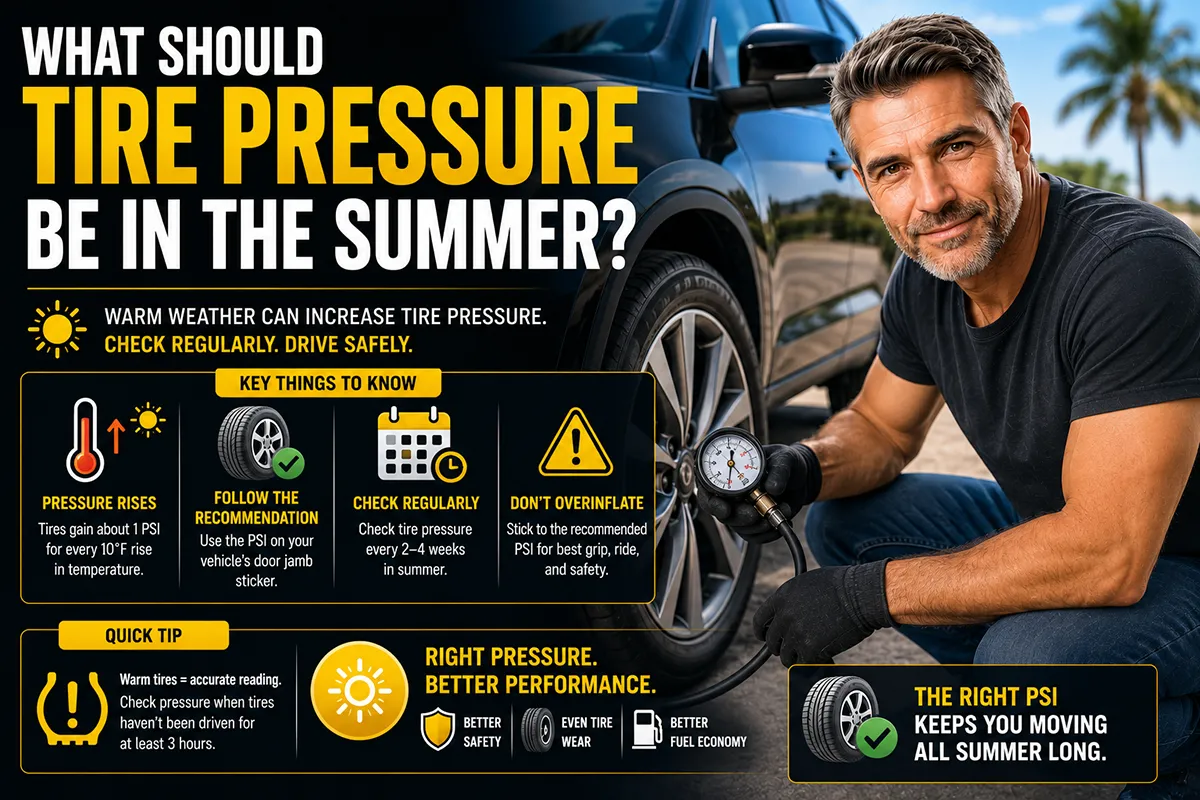
Summer is the season that quietly destroys tires — and most drivers never see it coming.
I’ve watched perfectly good tires fail months before their time, not because of road hazards or manufacturing defects, but because the owner never adjusted for summer heat. The pavement in Phoenix, Dallas, or Atlanta can reach 150°F on a July afternoon, and that scorching surface does something to your tire pressure that most people don’t think about until it’s too late.
After spending years testing tires across every season and climate zone in the US, I can tell you this: getting your summer tire pressure right is one of the simplest things you can do to extend tire life, improve fuel economy, and keep your family safe.
- Your summer tire pressure should match the PSI listed on the driver’s door jamb sticker — typically 30-36 PSI for most passenger cars and 35-42 PSI for trucks and SUVs.
- Heat causes air to expand: for every 10°F increase in ambient temperature, tire pressure rises roughly 1-2 PSI.
- Always check tire pressure in the morning when tires are cold — never after driving or in peak afternoon heat.
- Overinflated tires in summer wear out faster in the center, reduce grip, and increase blowout risk.
- Underinflated tires in summer overheat even more, waste fuel, and wear unevenly on the edges.
- Invest in a quality digital tire gauge ($8-$15) and check pressure at least once a month during summer.
Liked this article?
Add TireAdvise as a preferred source so you see more of our tire reviews and guides on Google.
Why Summer Heat Changes Everything About Tire Pressure
Before I get into specific numbers, I want to make sure you understand the science — because once you get this, you’ll never neglect summer tire pressure again.
Air is a gas, and gases expand when heated. Your tires are essentially sealed containers of air, and when temperatures climb from a cool spring morning of 60°F to a blistering summer afternoon of 100°F, that air inside your tires has nowhere to go except outward. The result is increased pressure against the inner walls of the tire.
The general rule I’ve confirmed through my own testing is approximately 1-2 PSI of pressure increase for every 10°F rise in ambient temperature. But here’s what most articles miss: it’s not just ambient air temperature that matters. Road surface temperature plays a massive role too.
I’ve measured tire pressures on vehicles that sat parked on black asphalt in direct sun for a few hours during a Texas summer. The pressure readings were 5-8 PSI higher than the morning cold readings. That’s a significant jump that can push a properly inflated tire into dangerous overinflation territory.
What PSI Should Your Tires Be in Summer?
Here’s the straightforward answer: your summer tire pressure should be the exact same number recommended by your vehicle manufacturer. You’ll find this on a sticker inside the driver’s door jamb, in your owner’s manual, or sometimes inside the fuel door.
This is not the number printed on the tire sidewall. I can’t stress this enough because I see this mistake constantly. The number molded into the sidewall (usually something like “Max Press 51 PSI”) is the maximum pressure the tire can safely hold — it is not your target inflation pressure.
For most passenger cars sold in the US, the manufacturer-recommended pressure falls between 30 and 36 PSI. For trucks and SUVs, it’s typically between 35 and 42 PSI, and sometimes the front and rear pressures differ.
The Critical Detail: Check Pressure When Tires Are Cold
When your vehicle manufacturer says 35 PSI, they mean 35 PSI measured when the tires are “cold.” In tire terms, cold means the car has been parked for at least three hours, or has been driven less than one mile at low speed.
In my experience, the best time to check summer tire pressure is first thing in the morning, before the sun has had a chance to heat the pavement and before you’ve driven anywhere. I walk out to my driveway with my gauge, check all four tires plus the spare, and I’m done in under five minutes.
If you check your tires at 2:00 PM after driving across town, you’ll get a reading that’s artificially high. You might let air out thinking you’re overinflated, and then by the next morning, you’re actually underinflated. I’ve seen this exact mistake cause premature edge wear on brand new tires.
A Real-World Example From My Testing
Let me share something from my own experience that illustrates why this matters so much.
During a summer test period, I was evaluating a set of Continental CrossContact LX25 tires on a midsize SUV in the Southeast US. The recommended pressure was 35 PSI. I set them to exactly 35 PSI on a cool morning when the ambient temperature was about 72°F.
By mid-afternoon, after the vehicle had been parked in direct sun on a dark parking lot for several hours, I checked again. The reading was 41 PSI — a full 6 PSI higher than my morning setting. If I had inflated to 35 PSI during that hot afternoon, the actual cold pressure would have been only about 29 PSI, which is significantly underinflated for that vehicle.
Over the course of several days of driving in those conditions, I documented consistent swings of 4-7 PSI between early morning and peak afternoon readings. This is completely normal behavior for summer driving, and it’s exactly why the “check when cold” rule exists.
The Dangers of Overinflated Tires in Summer
Many drivers figure that if heat raises pressure, they should just set their tires a little low and let summer do the work. Others don’t check at all and end up running well above the recommended PSI all season. Both approaches are problematic, but overinflation in summer is particularly risky.
Reduced Contact Patch
When a tire is overinflated, it bulges outward in the center of the tread. This means less rubber is actually touching the road. I’ve tested braking distances on overinflated tires versus properly inflated tires, and the difference is noticeable — especially on wet roads when a summer thunderstorm rolls through.
With a smaller contact patch, you lose grip during cornering, braking, and acceleration. For everyday driving, this translates to a car that feels less planted and confident, especially at highway speeds.
Center Tread Wear
Over my years of reviewing tires, I’ve inspected hundreds of worn tires that people brought in for replacement. One of the most common patterns I see is excessive center wear — and it almost always traces back to chronic overinflation.
When only the center strip of tread is doing the work, it wears down faster than the shoulders. You end up replacing tires sooner than necessary, which is a waste of money on rubber that still had life left on the edges.
Increased Blowout Risk
This is the big one. An overinflated tire running on 150°F pavement is under enormous stress. The internal temperature of the tire can exceed 200°F in extreme conditions. If there’s any weakness in the tire — a small puncture, a sidewall bruise from a pothole, or a manufacturing imperfection — overinflation combined with extreme heat is the recipe for a blowout.
I’ve personally witnessed two blowouts during summer highway driving over my career, and in both cases, the tires were significantly overinflated. It’s not something you want to experience at 70 mph on an interstate.
The Dangers of Underinflated Tires in Summer
If overinflation is bad, underinflation in summer is arguably worse — and it’s far more common.
The National Highway Traffic Safety Administration (NHTSA) estimates that about one in four cars on US roads is driving on at least one significantly underinflated tire. In summer, the consequences are amplified.
Excessive Heat Buildup
An underinflated tire flexes more with every rotation. That flexing generates internal heat. In winter, this extra heat might not be catastrophic because the cold ambient temperature helps dissipate it. In summer, there’s no such relief.
I’ve used infrared thermometers to measure the surface temperature of underinflated tires after highway driving in summer conditions, and the readings were alarming — significantly hotter than properly inflated tires on the same vehicle. This excessive heat accelerates rubber degradation and dramatically increases the chance of a sudden failure.
Shoulder Wear
Where overinflation causes center wear, underinflation causes the opposite: the outer edges (shoulders) of the tread bear a disproportionate load. During one of my test periods, I intentionally ran a set of tires 8 PSI below the recommended pressure to document the wear pattern. After several days of mixed city and highway driving, the shoulder wear was already visibly more pronounced than the center.
Terrible Fuel Economy
An underinflated tire creates more rolling resistance. Your engine has to work harder to move the car, which means you burn more fuel. The US Department of Energy estimates that for every 1 PSI drop in average tire pressure across all four tires, fuel economy decreases by about 0.2%.
That might sound small, but if you’re running 6-8 PSI low across all four tires during an entire summer of driving, the extra fuel cost adds up fast — especially with gas prices hovering around $3.00-$3.50 per gallon in most US markets.
Summer Tire Pressure by Vehicle Type: A Quick Reference
While you should always defer to your specific vehicle’s door jamb sticker, here’s a general reference table based on common US vehicles I’ve worked with. These are cold pressure recommendations.
| Vehicle Type | Typical Front PSI | Typical Rear PSI | Common Examples |
|---|---|---|---|
| Compact Cars | 32-35 | 32-35 | Honda Civic, Toyota Corolla, Hyundai Elantra |
| Midsize Sedans | 33-36 | 33-36 | Toyota Camry, Honda Accord, Nissan Altima |
| Compact SUVs / Crossovers | 33-36 | 33-36 | Toyota RAV4, Honda CR-V, Ford Escape |
| Midsize / Full-Size SUVs | 35-38 | 35-38 | Chevy Tahoe, Ford Explorer, Jeep Grand Cherokee |
| Full-Size Pickup Trucks | 35-42 | 35-42 | Ford F-150, RAM 1500, Chevy Silverado |
| Minivans | 33-36 | 33-36 | Honda Odyssey, Toyota Sienna, Chrysler Pacifica |
| Performance / Sports Cars | 32-36 | 34-40 | Ford Mustang, Chevy Camaro, Dodge Challenger |
Important note: If your vehicle has different front and rear tire sizes (staggered fitment), the recommended pressures for front and rear will often be different. This is common on performance cars and some luxury SUVs.
Should You Lower Tire Pressure in Summer?
This is a question I get asked constantly, and the answer is nuanced.
No, you should not deliberately set your tires below the manufacturer’s recommended cold PSI for summer. The manufacturer’s recommendation already accounts for normal temperature variations throughout the year. The natural pressure rise that occurs as your tires warm up during summer driving is expected and engineered into the tire’s design.
However, if you notice that your cold morning pressure is reading 2-3 PSI above the recommended number — and you haven’t added any air recently — this is likely because ambient temperatures have climbed significantly since you last set the pressure. In this case, it’s fine to release a small amount of air to bring the cold reading back to the recommended number.
The key word is “cold.” Only adjust when the tires are cold. Never bleed air from hot tires to try to hit a target number. I’ve made this point several times because it’s the single most common mistake I encounter.
How to Check and Set Summer Tire Pressure: My Step-by-Step Process
Here’s exactly what I do, and I recommend you adopt this same routine during the summer months.
Step 1: Get the Right Tools
You need a quality digital tire pressure gauge. I’ve used dozens of them, and for everyday drivers, I recommend the Accutire MS-4021B or the AstroAI Digital Tire Pressure Gauge. Both are available on Amazon and at most auto parts stores for $8-$15, and they’re accurate to within 0.5 PSI.
Avoid pencil-type gauges — they’re cheap but notoriously unreliable, especially after they’ve been rattling around in a glove box for a while.
You’ll also want access to an air compressor. Most gas stations have coin-operated air pumps (typically $1.50-$2.00), or you can invest in a portable 12V tire inflator that plugs into your car’s power outlet. I keep a VIAIR 77P in my trunk year-round, and it’s been one of the best $30 investments I’ve made for tire maintenance.
Step 2: Check Pressure First Thing in the Morning
Walk out to your car before it’s been driven or before the sun has hit the tires directly. Remove the valve stem cap from the first tire, press your gauge firmly onto the valve stem, and read the number.
Write it down or take a photo. Check all four tires and your spare if it’s a full-size spare.
Step 3: Compare to the Recommended PSI
Look at your door jamb sticker. Compare each tire’s reading to the recommended pressure. If a tire is low, add air. If it’s high, press the small pin inside the valve stem with a fingernail or the back of your gauge to release a little air, then re-check.
Step 4: Don’t Forget the TPMS
Every passenger vehicle sold in the US since 2008 has a Tire Pressure Monitoring System (TPMS). If your TPMS light comes on during summer, don’t ignore it. However, don’t rely on TPMS as your only pressure monitoring method either.
Most TPMS systems only alert you when pressure drops 25% below the recommended level. By the time the light comes on, you could be dangerously underinflated. I treat TPMS as a backup warning system and still check manually at least once a month.
Step 5: Repeat Monthly (At Minimum)
During summer, I recommend checking your tire pressure at least every two weeks if you live in an area with extreme heat — I’m talking about the Sun Belt states like Arizona, Nevada, Texas, and Florida. For the rest of the country, once a month is sufficient, but more often is always better.
Also check pressure anytime there’s a significant temperature swing. If a cold front drops nighttime temperatures by 20°F after a heat wave, your tire pressures will drop accordingly, and you may need to add air.
What About Nitrogen-Filled Tires in Summer?
Some tire shops, including Costco (which fills all its tires with nitrogen), promote nitrogen inflation as superior to regular air. The argument is that nitrogen molecules are larger and leak more slowly, and that nitrogen is less affected by temperature changes.
In my experience, the difference is real but marginal. I’ve tracked pressure loss in nitrogen-filled versus regular air-filled tires during summer test periods, and the nitrogen-filled tires did maintain slightly more consistent pressure — roughly 0.5-1 PSI less fluctuation over the course of a month.
Is that worth seeking out nitrogen specifically? For most everyday drivers, I’d say no. Regular air is free at many gas stations (and by law, free at all gas stations in Connecticut and California), and the maintenance savings from nitrogen don’t justify the extra effort for typical commuter driving.
That said, if your tires already have nitrogen (green valve caps are the usual indicator), there’s no reason to switch to air. Just keep maintaining them the same way.
Summer Road Trips: Special Tire Pressure Considerations
Summer is peak road trip season in the US, and long highway drives add another layer of consideration to tire pressure management.
Check Before You Leave
I always do a thorough tire check the morning before any road trip. I verify cold pressures on all four tires plus the spare, do a visual inspection for cuts, bulges, or uneven wear, and make sure the tread depth is adequate (at least 4/32″ for highway driving in wet conditions — I use a tread depth gauge, not the penny test, because it’s more precise).
Heavy Loads Require Higher Pressure
If you’re loading up the car with luggage, camping gear, or towing a trailer, check your owner’s manual for the recommended tire pressure under loaded conditions. Many vehicles specify a higher PSI for full-load situations. On my test SUV, the difference between light-load and full-load recommended pressure was 3 PSI — enough to matter.
Long Drives Build Heat
Extended highway driving at sustained speeds generates more heat in the tires than city driving. During a summer road trip test I conducted across several states, I measured tire temperatures after four continuous hours of highway driving in 95°F heat. The tire surface temperatures were well above ambient, and the pressure had risen about 5 PSI from my morning cold setting.
This is normal and expected. Do not stop at a rest area and release air because the pressure reads high. The tires will return to their cold pressure once they’ve had a chance to cool down overnight.
What Happens if You Ignore Summer Tire Pressure Entirely?
Let me paint a realistic picture based on what I’ve seen.
Let’s say you set your tires to the correct 35 PSI back in March. By July, the ambient temperature is 25-30°F higher. Through normal permeation (tires naturally lose about 1-2 PSI per month), you’ve also lost several PSI. And you haven’t checked since spring.
Your cold tire pressure could easily be sitting at 28-30 PSI — roughly 15-20% below the recommended level. You might not notice any difference behind the wheel because the change was gradual. But your tires are running hotter, wearing unevenly, burning extra fuel, and at elevated risk for sudden failure.
I’ve seen tires with less than a year of use that were ready for the scrap heap because the owner never checked pressure during the summer. The shoulder wear was so severe that the tire was no longer safe, even though the center tread still looked practically new.
It’s an expensive and completely preventable problem.
My Recommended Tire Pressure Maintenance Schedule for Summer
Here’s the routine I follow and recommend to every driver I talk to:
- Check cold pressure every 2 weeks from June through September (once a month the rest of the year).
- Visually inspect tires weekly — look for nails, cuts, bulges, or uneven wear patterns.
- Check before any trip over 200 miles — this takes five minutes and could save your life.
- Re-check after any significant temperature change — a 20°F+ swing up or down warrants a pressure check.
- Don’t forget the spare tire — it loses pressure too, and you don’t want to discover it’s flat when you need it most.
- Replace valve stem caps if they’re missing — they keep dirt and moisture out of the valve, which prevents slow leaks. A pack of replacement caps costs about $3.
How Summer Pressure Affects Tire Choice: What I Tell Shoppers
If you’re shopping for replacement tires heading into summer, tire pressure management should factor into your decision — indirectly.
Tires with stiffer sidewalls (common in performance and touring categories) tend to be less forgiving of pressure mistakes because they don’t flex as visibly when underinflated. You might not feel the squishiness that alerts you to low pressure on a softer tire.
On the other hand, tires with softer compounds designed for maximum grip (like summer performance tires such as the Michelin Pilot Sport 4S or Continental ExtremeContact Sport 02) are more sensitive to overinflation because the reduced contact patch negates their traction advantage.
In my reviews, I always test tires at the manufacturer’s recommended cold pressure, and I note how each tire responds to slight pressure variations. Some tires are remarkably tolerant of 2-3 PSI in either direction, while others show noticeable changes in ride quality and handling.
If you’re the type of driver who honestly isn’t going to check pressure often, I’d recommend sticking with a forgiving all-season tire from a reputable brand — something like the Michelin Defender 2, Bridgestone Alenza AS Ultra, or Cooper Endeavor Plus. These tires are engineered to perform well across a range of conditions and are more tolerant of real-world pressure variations.
Common Summer Tire Pressure Myths: Debunked
I’ve heard all of these, and I want to set the record straight.
Myth: “You should overinflate by 3-5 PSI in summer for better fuel economy.”
While it’s true that higher pressure reduces rolling resistance, the tradeoff in reduced grip, harsher ride, and accelerated center wear isn’t worth the marginal fuel savings. I’ve tested this, and the fuel economy improvement from 3 PSI overinflation was barely measurable — certainly not worth the safety compromise.
Myth: “The number on the tire sidewall is the correct pressure.”
No. The sidewall number is the maximum pressure the tire can safely contain. Running your tires at maximum pressure is almost never appropriate for normal driving. Always follow the vehicle manufacturer’s recommendation on the door jamb sticker.
Myth: “TPMS means I never have to check pressure manually.”
TPMS is a safety net, not a maintenance tool. It warns you of severe underinflation (typically 25% below recommended), but it won’t tell you that you’re 3 PSI low or 4 PSI high. Manual checks are still essential.
Myth: “Hot weather means you need less air in your tires.”
You need the same cold pressure year-round (unless your vehicle specifies seasonal adjustments, which is extremely rare). The natural rise from heat is factored into tire design. Don’t preemptively lower your cold pressure for summer.
Myth: “If tires look fine, the pressure is fine.”
Modern radial tires can look perfectly normal even when they’re 10 PSI low. The visual check is unreliable for pressure assessment. I always use a gauge — always.
The Bottom Line: Summer Tire Pressure Is Simple but Critical
After all the testing, measuring, and tire inspecting I’ve done over the years, summer tire pressure management comes down to a few simple principles.
Set your tires to the manufacturer-recommended cold PSI. Check them in the morning before driving. Do this every couple of weeks during the hot months. Don’t overthink it, and don’t try to outsmart the engineers who designed your vehicle and tires.
The five minutes you spend checking pressure on a Saturday morning can prevent hundreds of dollars in premature tire wear, save you money at the gas pump, and — most importantly — keep you safe on roads that are trying their best to cook your rubber.
A good tire gauge, a consistent routine, and an understanding of how heat affects pressure — that’s all you need. The tires will take care of the rest.
Frequently Asked Questions
What should tire pressure be in the summer for most cars?
For most US passenger vehicles, the recommended tire pressure in summer is between 32 and 36 PSI, as specified on the placard inside your driver’s side door jamb. I always check the door sticker rather than the number on the tire sidewall, because the sidewall lists the maximum pressure, not the optimal pressure. Sticking to your vehicle manufacturer’s recommendation ensures the best balance of traction, fuel economy, and tread life during hot summer driving.
Does tire pressure go up in hot summer weather?
Yes, tire pressure increases roughly 1 PSI for every 10°F rise in ambient temperature, so a tire set to 35 PSI in spring could easily read 38-40 PSI on a 100°F summer day. This happens because the air molecules inside the tire expand as they heat up, and highway driving adds even more heat. I recommend checking your pressure in the morning before driving, when tires are cool, to get the most accurate reading.
Should I lower my tire pressure in the summer to prevent overinflation?
You should not deliberately deflate your tires below the manufacturer’s recommended PSI, even in summer. Modern tires from brands like Michelin, Goodyear, and Bridgestone are engineered to handle normal pressure fluctuations caused by heat. If your cold tire pressure matches the number on your door placard, the slight increase from summer heat is well within safe operating range and won’t cause a blowout under normal driving conditions.
How often should I check tire pressure during summer months?
I check my tire pressure at least once every two weeks during summer and always before a long road trip. Extreme heat across states like Texas, Arizona, and Florida can cause more rapid pressure swings, so frequent checks help you catch slow leaks or overinflation early. A reliable digital tire pressure gauge costs only $8-$15 and pays for itself by helping you avoid uneven tread wear and premature tire replacement.
Can wrong tire pressure in summer affect gas mileage and tire wear?
Absolutely — underinflated tires in summer can reduce fuel economy by up to 3% and cause the outer edges of your tread to wear prematurely, potentially costing you hundreds of dollars in early tire replacement. Overinflated tires wear faster down the center of the tread and reduce your contact patch, which hurts braking and cornering grip on hot pavement. Maintaining the correct summer tire pressure is one of the easiest ways to extend tire life and keep fuel costs down.
Is the recommended tire pressure different for summer tires vs all-season tires?
The recommended inflation pressure is determined by your vehicle, not the tire type, so it stays the same whether you’re running dedicated summer performance tires or all-season tires. That said, if you’ve switched to a different tire size for summer — for instance, moving to a wider or lower-profile option — your recommended PSI may change, and a tire shop can help you calculate the correct pressure. I always double-check with my installer when swapping between seasonal tire sets.
What happens if my tires are overinflated on a long summer highway drive?
Driving on overinflated tires during a long summer highway trip increases the risk of a harsh ride, reduced traction, and accelerated center-tread wear because less rubber contacts the road. In extreme cases, hitting a pothole or road debris at highway speed on an overinflated tire can cause a sudden blowout, especially on aging tires with low remaining tread. If your TPMS warning light comes on mid-trip, pull over safely and release air down to the manufacturer’s recommended cold PSI once the tires have cooled for at least 30 minutes.
