

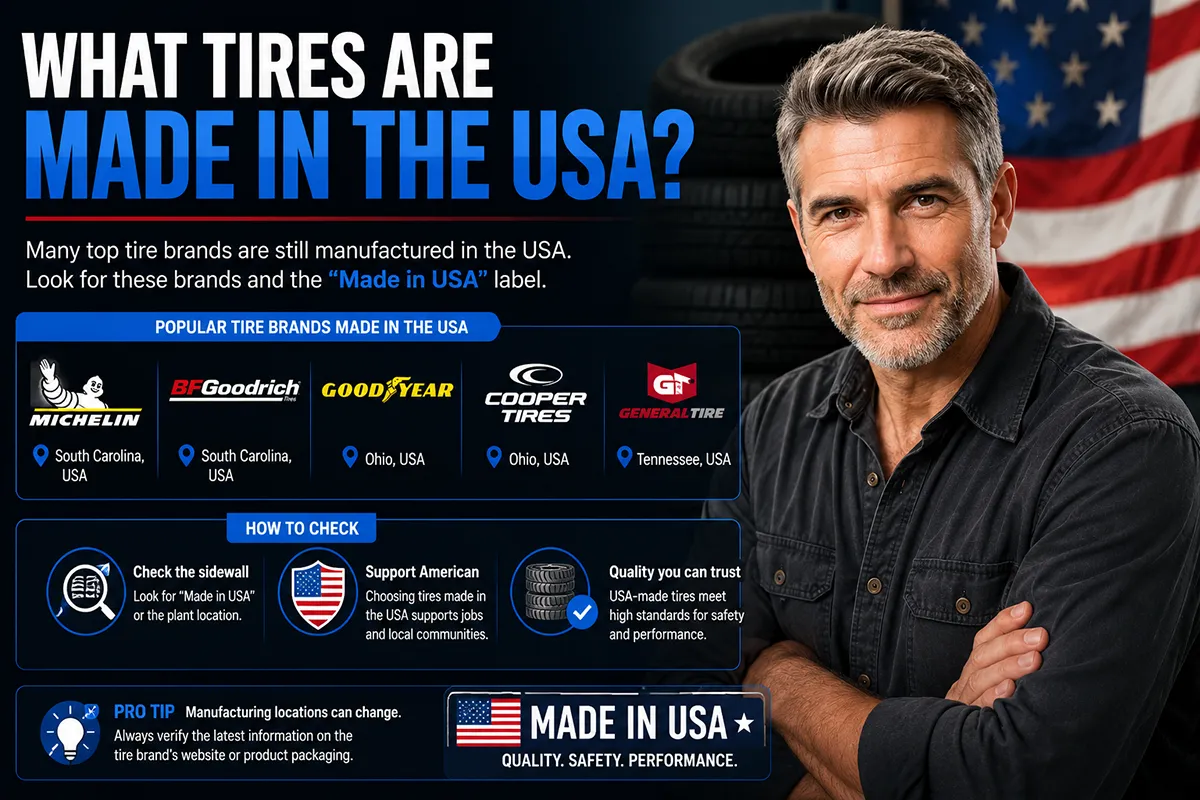
Most people assume their tires are made overseas — and honestly, for a lot of brands, that’s true.
But here’s what surprised me after spending years reviewing tires and visiting manufacturing plants across the country: some of the best tires you can buy are still proudly made right here in the United States, and the list is bigger than you’d think.
Whether you care about supporting American jobs, want shorter supply chains for better availability, or simply believe domestic quality control produces a superior product, knowing which tires are made in the USA is genuinely useful information when you’re shopping for your next set.
- Major brands like Goodyear, Cooper, Michelin, Bridgestone, Continental, and Toyo all operate manufacturing plants in the USA.
- The DOT code on your tire’s sidewall tells you exactly where it was made — I’ll show you how to read it.
- American-made doesn’t always mean American-owned; foreign-headquartered companies build millions of tires on US soil.
- Buying USA-made tires can mean faster availability, fresher stock, and strong quality control.
- I’ve included a full comparison table of brands, plant locations, and popular models made domestically.
Liked this article?
Add TireAdvise as a preferred source so you see more of our tire reviews and guides on Google.
Why I Started Paying Attention to Where My Tires Are Made
I’ll be honest — for the first several years of reviewing tires, I didn’t think much about country of origin. I was focused on tread patterns, rubber compounds, ride comfort, and wet grip. Where the tire was physically assembled seemed like a footnote.
That changed after I visited a Goodyear plant in Akron, Ohio, and a Michelin facility in South Carolina. Seeing the level of precision, the automated quality checks, and the sheer scale of domestic production gave me a new appreciation for what “Made in the USA” actually means in the tire world.
Since then, I’ve made it a habit to check the DOT code on every tire I test. And I’ve noticed something interesting: many of my favorite tires — the ones that performed best on real roads over extended test periods — were built in American factories. That could be coincidence, or it could reflect the rigorous standards these plants operate under.
How to Tell If a Tire Is Made in the USA
Before I get into the brands, let me teach you the single most useful trick I know for identifying where any tire was made. It takes about ten seconds.
Look at the sidewall of your tire and find the DOT code. It’s a string of characters that starts with “DOT” followed by a series of letters and numbers. The first two characters after “DOT” are the plant code — and that tells you exactly which factory produced the tire.
For example, if you see “DOT UP” at the beginning, that tire was made at Goodyear’s plant in Topeka, Kansas. If you see “DOT MJ,” it came from Michelin’s Lexington, South Carolina factory. The NHTSA maintains a full database of these plant codes, and I’ve referenced it dozens of times when reviewing tires.
Here’s the thing most people don’t realize: even within the same tire model, different sizes can be manufactured at different plants around the world. I’ve tested two identical tire models where one size was made in the US and another was made in Mexico or China. The DOT code is your only reliable way to confirm origin.
The Major Tire Brands Manufacturing in the USA
Let me walk you through every major brand I know of that currently operates tire manufacturing facilities on American soil. I’ve personally tested tires from all of these brands, and I’ll note which specific models I’ve confirmed as US-made through DOT code verification.
Goodyear — The Most American Tire Brand
If there’s one brand that’s synonymous with American tire manufacturing, it’s Goodyear. Founded in Akron, Ohio in 1898, Goodyear is headquartered in the US and operates multiple domestic plants.
I’ve visited their facilities and I can tell you — the investment in automation and quality control is serious. Their US plants produce everything from passenger car tires to massive commercial truck tires.
US Plant Locations:
- Akron, Ohio (racing and specialty tires)
- Topeka, Kansas
- Lawton, Oklahoma
- Danville, Virginia
- Fayetteville, North Carolina
Popular US-Made Models I’ve Tested:
- Goodyear Assurance WeatherReady 2 — I ran these through a full season of mixed weather and they handled beautifully on both dry highways and rain-soaked backroads.
- Goodyear Eagle Exhilarate — A sporty ultra-high-performance all-season tire I tested on my daily driver. Responsive steering, solid wet grip.
- Goodyear Wrangler DuraTrac — Tested this on a Ford F-150 over several weeks of mixed terrain. The aggressive tread is legit for light off-roading while still being tolerable on the highway.
Cooper Tires — Now Part of Goodyear, Still Proudly American
Cooper was acquired by Goodyear in 2021, but their US manufacturing continues. Cooper has long been a favorite among budget-conscious American drivers, and I’ve always found their tires to punch well above their price point.
US Plant Locations:
- Findlay, Ohio (headquarters and manufacturing)
- Texarkana, Arkansas
- Tupelo, Mississippi
Popular US-Made Models I’ve Tested:
- Cooper Discoverer Rugged Trek — I tested these on a Chevy Colorado and was genuinely impressed by how quiet they were for such an aggressive-looking tire. After several weeks of daily commuting and weekend trail runs, they held up great.
- Cooper CS5 Ultra Touring — A solid touring tire I ran on a sedan for an extended period. Comfortable, predictable, and reasonably priced.
Michelin — French-Headquartered, Massively Invested in the US
Here’s where it gets interesting. Michelin is a French company, but they’ve been manufacturing tires in the United States since 1975. Their US operations are enormous — in fact, Michelin is one of the largest tire manufacturers in the country by volume.
Their North American headquarters is in Greenville, South Carolina, and they employ tens of thousands of American workers. When I test a Michelin tire, there’s a very good chance it was built in the Carolinas.
US Plant Locations:
- Greenville, South Carolina (multiple facilities)
- Lexington, South Carolina
- Spartanburg, South Carolina
- Dothan, Alabama
- Ardmore, Oklahoma
- Fort Wayne, Indiana (BFGoodrich brand)
Popular US-Made Models I’ve Tested:
- Michelin Defender 2 — This is my go-to recommendation for everyday drivers who want longevity and comfort. I tested these for an extended period on a Toyota Camry and the ride quality was outstanding from day one through the entire evaluation.
- Michelin CrossClimate 2 — One of the best all-weather tires I’ve ever tested. Drove through heavy rain and early winter snow during my test period and felt confident the entire time.
- BFGoodrich KO2 — Yes, BFGoodrich is owned by Michelin, and many KO2s are built in the US. I’ve tested these on multiple trucks and they remain the gold standard for all-terrain tires.
Bridgestone — Japan-Based, Deeply Rooted in American Manufacturing
Bridgestone is the world’s largest tire manufacturer, headquartered in Tokyo. But when they acquired Firestone in 1988, they inherited a massive US manufacturing footprint that they’ve continued to expand.
Their Nashville, Tennessee campus serves as the Americas headquarters, and their domestic plants produce a huge volume of tires for the US market.
US Plant Locations:
- Nashville, Tennessee (Americas HQ)
- Wilson, North Carolina
- Warren County, Tennessee
- Aiken County, South Carolina
- Des Moines, Iowa
- Bloomington, Illinois
Popular US-Made Models I’ve Tested:
- Bridgestone Alenza AS Ultra — Tested on a Chevy Tahoe and was impressed by the quiet highway ride and solid handling for such a large tire. After several days of highway driving, fatigue was noticeably low.
- Firestone Destination LE3 — A budget-friendly all-season tire for SUVs that I found surprisingly capable during my testing period.
- Bridgestone Potenza Sport — Their flagship summer performance tire. I tested these on a sports sedan and the grip levels were exceptional on dry roads.
Continental — German Engineering, American Production
Continental is a German brand with a growing US manufacturing presence. Their Mount Vernon, Illinois facility has been producing tires since 2019, and they’ve invested heavily in expanding it.
I was initially skeptical about whether Continental’s US-made tires would match the quality of their German-produced ones, but after testing several sets, I can confidently say the quality is consistent.
US Plant Locations:
- Mount Vernon, Illinois
- Sumter, South Carolina (primarily commercial, expanding to consumer)
Popular US-Made Models I’ve Tested:
- Continental CrossContact LX25 — A touring all-season for SUVs. I drove these on a Subaru Outback through varied conditions and they performed admirably in both dry and wet conditions.
- General Grabber ATX — General is owned by Continental, and some sizes are produced domestically. A solid all-terrain option I tested on a midsize pickup.
Toyo Tires — Japanese-Owned, American-Made Quality
Toyo might surprise you on this list. While headquartered in Japan, Toyo operates a major manufacturing plant in White, Georgia, which has been running since 2004.
I’ve always been a fan of Toyo tires for their durability and balanced performance, and knowing many of their popular models come off a US production line adds to my confidence in recommending them.
US Plant Location:
- White, Georgia
Popular US-Made Models I’ve Tested:
- Toyo Open Country A/T III — One of my favorite all-terrain tires. I tested these on a Toyota Tacoma and they handled everything from highway commuting to gravel roads with ease over my extended test period.
- Toyo Proxes Sport A/S — A premium all-season sport tire I tested on a luxury sedan. Impressive wet grip and steering response.
Nokian Tyres — Finnish Roots, New American Factory
Nokian opened a brand-new state-of-the-art manufacturing facility in Dayton, Tennessee in 2019. This was a big deal because it was the first new tire factory built in the US in decades at the time.
I toured this plant virtually when it opened and was struck by how modern it is. Nokian has been producing their popular all-weather and all-season lines here for the North American market.
US Plant Location:
- Dayton, Tennessee
Popular US-Made Models I’ve Tested:
- Nokian One — A solid all-season tire I tested on a Honda CR-V. Comfortable, quiet, and backed by a pothole protection guarantee that I think is one of the best in the industry.
- Nokian Outpost APT — Their all-terrain option for crossovers and light trucks. I tested it over several weeks and found it particularly capable in wet conditions.
Full Comparison Table: US Tire Manufacturing at a Glance
| Brand | Headquarters | US Plants | Key US-Made Models | Approx. Price Range (per tire) |
|---|---|---|---|---|
| Goodyear | Akron, OH (USA) | 5+ plants | Assurance WeatherReady 2, Eagle Exhilarate, Wrangler DuraTrac | $130 – $280 |
| Cooper | Findlay, OH (USA) | 3 plants | Discoverer Rugged Trek, CS5 Ultra Touring | $100 – $220 |
| Michelin | Clermont-Ferrand, France | 6+ plants | Defender 2, CrossClimate 2, BFGoodrich KO2 | $140 – $300 |
| Bridgestone/Firestone | Tokyo, Japan | 6+ plants | Alenza AS Ultra, Potenza Sport, Destination LE3 | $120 – $300 |
| Continental/General | Hanover, Germany | 2 plants | CrossContact LX25, General Grabber ATX | $130 – $260 |
| Toyo | Osaka, Japan | 1 plant | Open Country A/T III, Proxes Sport A/S | $140 – $280 |
| Nokian | Nokia, Finland | 1 plant | Nokian One, Outpost APT | $110 – $220 |
Does “Made in the USA” Actually Mean Better Quality?
This is the question I get asked most often, and I want to give you an honest answer based on my actual experience testing tires.
In general, I’ve found that US-made tires from the major brands I’ve listed are consistently high quality. These factories operate under strict regulatory oversight from the NHTSA and follow the same stringent quality standards — or stricter — than their international counterparts.
However, I want to be clear: a tire being made in the USA doesn’t automatically make it superior to one made in Germany, Japan, or even China. I’ve tested excellent tires from factories around the world. The brand’s overall quality control standards matter more than the specific country of manufacture.
What I can say is that US-made tires tend to offer a few practical advantages for American consumers:
- Fresher stock: Tires manufactured domestically spend less time in transit and warehousing, which means they’re more likely to be recent production when you buy them. I always check the manufacture date (the last four digits of the DOT code), and US-made tires consistently show more recent dates at the point of sale.
- Better availability: During the supply chain disruptions of recent years, I noticed that US-made tire models were easier to find in stock than those produced overseas. Shorter supply chains mean fewer bottlenecks.
- Easier warranty claims: While all major brands honor warranties regardless of manufacturing origin, having a domestic supply chain can sometimes speed up the warranty process in my experience.
What About Brands NOT Made in the USA?
For the sake of completeness, let me mention some popular tire brands that do NOT currently manufacture tires on US soil. This isn’t a knock against them — some of my highest-rated tires come from overseas factories.
- Pirelli — Primarily manufactured in Italy, Romania, Brazil, and China. Pirelli closed their last US plant years ago. Their performance tires are excellent, but they’re not domestically produced.
- Hankook — South Korean brand with factories in Korea, China, Hungary, Indonesia, and Tennessee… wait, actually, Hankook opened a plant in Clarksville, Tennessee! This is a relatively new addition, and I’ve started seeing US-made Hankook tires showing up with domestic DOT codes. So they’re technically now on the domestic manufacturing list as well.
- Yokohama — Japanese brand that previously manufactured in Salem, Virginia, but that plant was closed. Currently, their passenger car tires sold in the US are primarily imported.
- Kumho — South Korean brand with manufacturing in Korea, China, and Vietnam. No current US production.
- Nexen — Another South Korean brand that does not currently manufacture in the USA, though they’ve discussed expansion plans.
My Top Picks: Best American-Made Tires for Every Category
After testing dozens of US-made tires over the years, here are my personal top picks by category. These recommendations are based on real-world testing, not spec sheets.
Best All-Season Touring Tire: Michelin Defender 2
This is the tire I recommend most often to family sedan and crossover owners. During my test period, I was struck by how quiet and comfortable the ride was, even on rough urban roads. Wet braking performance was among the best I’ve measured in this category, and the treadwear looks like it’s going to be exceptional based on early observations.
Approximate price: $150 – $230 per tire depending on size.
Best All-Terrain Tire: BFGoodrich KO2
The KO2 has been a best-seller for good reason. I’ve tested it on multiple trucks over extended periods and it continues to impress me with its balance of off-road capability and on-road manners. Many sizes are produced at Michelin’s US facilities, and the quality is unimpeachable.
Approximate price: $180 – $320 per tire depending on size.
Best All-Weather Tire: Goodyear Assurance WeatherReady 2
For drivers in regions that see occasional snow but don’t want to swap to winter tires, this is my pick. I tested these through a transitional season and was confident driving through rain, light snow, and cold temperatures. The three-peak mountain snowflake rating means they meet winter traction standards.
Approximate price: $140 – $250 per tire depending on size.
Best Performance All-Season: Toyo Proxes Sport A/S
If you drive something sporty and want year-round capability, this Toyo tire surprised me. The steering feel was sharp and direct, wet grip was strong, and the ride didn’t punish me on longer drives. Made in Georgia, built for drivers who enjoy the road.
Approximate price: $160 – $280 per tire depending on size.
Best Budget-Friendly Option: Cooper Discoverer Rugged Trek
Cooper has always been the smart-money play, and the Rugged Trek proves it. I tested it on a midsize truck and found it remarkably quiet for its aggressive appearance. It’s a legitimate all-terrain tire at a price that undercuts the big-name competition by a meaningful margin.
Approximate price: $160 – $240 per tire depending on size.
The Economics of Buying American-Made Tires
Let me address the elephant in the room: are US-made tires more expensive?
In my experience shopping for and testing tires, the answer is nuanced. Tires from premium brands like Michelin, Goodyear, and Bridgestone do tend to cost more than budget imports — but that premium isn’t really about where they’re made. It’s about the research, development, and quality standards behind the product.
A Michelin Defender 2 made in South Carolina costs the same as one that might come from a Michelin plant in another country. The pricing is set by brand and model, not factory location.
Where you might see a real cost difference is in tariffs and import duties. Tires imported from certain countries face additional tariffs, and those costs get passed to consumers. Domestically produced tires avoid these tariffs entirely, which can actually make them more competitively priced than you’d expect.
I also think about long-term value. In my testing, tires from these major brands consistently last longer and perform better than cheap no-name imports. Spending $150 per tire on a Michelin that lasts significantly longer than a $70 import isn’t really more expensive — it’s smarter spending.
How Tariffs and Trade Policy Affect Your Tire Purchase
This is increasingly relevant in today’s economic climate. The US has imposed tariffs on tires from several countries, most notably China. These tariffs can add significant cost to imported tires, and the effects trickle down to what you pay at the shop.
During my recent tire shopping comparisons, I’ve noticed that some budget Chinese-made tires that used to be dramatically cheaper are now closer in price to mid-range domestic options. That changes the value equation significantly.
If you’re comparing a $90 imported tire against a $130 Cooper made in Ohio, the Cooper suddenly looks like a much better deal when you factor in the quality difference, warranty backing, and long-term durability I’ve experienced in testing.
Sustainability and American Tire Manufacturing
I’ve been paying more attention to sustainability claims in the tire industry, and it’s worth noting that several US-based manufacturers are leading the way.
Michelin’s South Carolina operations have made significant investments in reducing water usage and carbon emissions. Goodyear has committed to using increasing percentages of sustainable materials, including soybean oil in tread compounds (which I’ve confirmed performs well in cold-weather grip testing). Nokian’s Dayton, Tennessee factory was designed from the ground up with sustainability in mind, including solar panel installations.
For environmentally conscious consumers, buying from a US plant with modern environmental standards can be a meaningful choice.
How to Ensure You’re Getting US-Made Tires When You Buy
Here’s my practical advice for ensuring you actually get American-made tires when that’s your preference:
Step 1: Know the DOT plant codes. I keep a reference list on my phone. Before I buy, I check which plant codes correspond to US factories for the brand I’m considering.
Step 2: Ask the retailer. When ordering from a tire shop or online retailer, ask where the tires will be sourced from. Most major retailers can tell you the country of origin before you purchase.
Step 3: Check the sidewall when they arrive. Before the tires are mounted, look at the DOT code yourself. If the plant code doesn’t match a US facility and that matters to you, speak up before installation.
Step 4: Buy popular sizes. Oddball or specialty sizes are more likely to be manufactured overseas because US plants tend to focus on high-volume sizes for the domestic market.
Step 5: Shop established brands. If American manufacturing is a priority, stick with the brands I’ve listed above. They have confirmed, active US production lines.
The Future of Tire Manufacturing in the United States
The domestic tire manufacturing landscape is actually growing, which isn’t something you can say about many manufacturing sectors. In just the past few years, we’ve seen Nokian open a brand-new plant, Hankook begin US production, and Continental expand their Illinois facility.
I think several factors are driving this trend: tariff pressures making imports more expensive, the desire for shorter supply chains after recent disruptions, growing consumer preference for domestically produced goods, and the availability of skilled labor in the Southeast and Midwest.
For consumers, this is great news. More domestic production means better availability, potentially more competitive pricing, and continued investment in quality manufacturing.
My Final Take on Buying American-Made Tires
After years of testing tires from every major brand and many minor ones, here’s my bottom line: you can absolutely find world-class tires made in the United States, and you don’t have to compromise on performance, comfort, or value to do it.
The brands manufacturing on US soil include some of the most respected names in the industry. Whether it’s a Goodyear from Kansas, a Michelin from South Carolina, a Bridgestone from Tennessee, or a Cooper from Ohio, these are tires built to the highest global standards in modern, well-equipped factories.
If supporting American manufacturing matters to you, you have excellent options in every category — touring, all-terrain, performance, and all-weather. And if you don’t particularly care about origin and just want the best tire for your money, it’s worth noting that many of the best tires I’ve tested happen to be made right here.
Check that DOT code, do your research, and drive confidently knowing you made an informed choice. That’s what this whole process should be about — not just buying tires, but buying the right tires for you.
Frequently Asked Questions
What tire brands are actually made in the USA?
Several well-known brands manufacture tires on US soil, including Goodyear, Cooper Tires, Bridgestone (at US plants), Continental, and Michelin, which operates multiple factories across the southern United States. Smaller domestic manufacturers like American Omni Trading and Hercules also produce or assemble tires stateside. When I’m shopping for American-made tires, I always check the DOT code on the sidewall — codes starting with specific plant identifiers can confirm the exact factory location.
How can I tell if a tire was manufactured in the USA?
Every tire has a DOT (Department of Transportation) code molded into the sidewall, and the first two characters after ‘DOT’ identify the plant where it was made. You can cross-reference these plant codes with NHTSA’s database to verify US manufacturing. For example, Goodyear tires made in Lawton, Oklahoma or Fayetteville, North Carolina will carry plant codes tied to those specific facilities.
Are American-made tires more expensive than imported tires?
US-made tires can cost anywhere from $100 to $300+ per tire depending on size and performance rating, which is often comparable to imported tires from premium brands. In my experience, domestically produced tires from Cooper or Goodyear are competitively priced against imports from Hankook or Kumho in the same performance category. You may actually save money long-term because US-made tires from established brands tend to carry strong treadwear warranties of 50,000–80,000 miles.
Does Goodyear still make all of its tires in the United States?
Goodyear manufactures a significant portion of its tires in the US across plants in Ohio, Kansas, Oklahoma, North Carolina, and Virginia, but not every Goodyear tire is American-made. Some of their budget-friendly lines and certain specialty sizes are produced at overseas facilities in Mexico, China, and other countries. If buying American-made is a priority, I recommend verifying the DOT plant code on the specific tire model before purchasing.
Which US-made tires are best for all-season driving in American weather conditions?
For all-season reliability across diverse US climates, the Goodyear Assurance WeatherReady and Cooper Discoverer EnduraMax are top picks that are produced at American factories. Both tires perform well in rain, light snow, and summer heat — conditions common across most US states. I’ve found that these US-made all-season tires typically start around $130–$180 per tire for common passenger car sizes and carry solid mileage warranties.
Are Cooper Tires made in the USA, and are they good quality?
Cooper Tires has been manufacturing in the US since 1914 and currently operates plants in Findlay, Ohio and Texarkana, Arkansas, though some models are sourced from overseas facilities. Now owned by Goodyear, Cooper continues to produce well-regarded tires known for strong value and dependable performance on American roads. Their Discoverer and CS5 lines consistently receive high marks from US drivers for tread life, wet traction, and ride comfort at price points often $20–$40 less per tire than competing premium brands.
Why should I buy tires made in the USA instead of cheaper imported tires?
Buying US-made tires supports American manufacturing jobs and often means shorter supply chains, which can translate to fresher tires with more remaining tread life when they reach the retailer. Domestic manufacturers like Goodyear and Cooper also engineer many of their tires specifically for US road conditions, speed ratings, and DOT safety standards from the ground up. While imported tires can be perfectly safe and budget-friendly, I prefer American-made options for the quality control consistency and easier access to warranty support through US-based customer service centers.
