

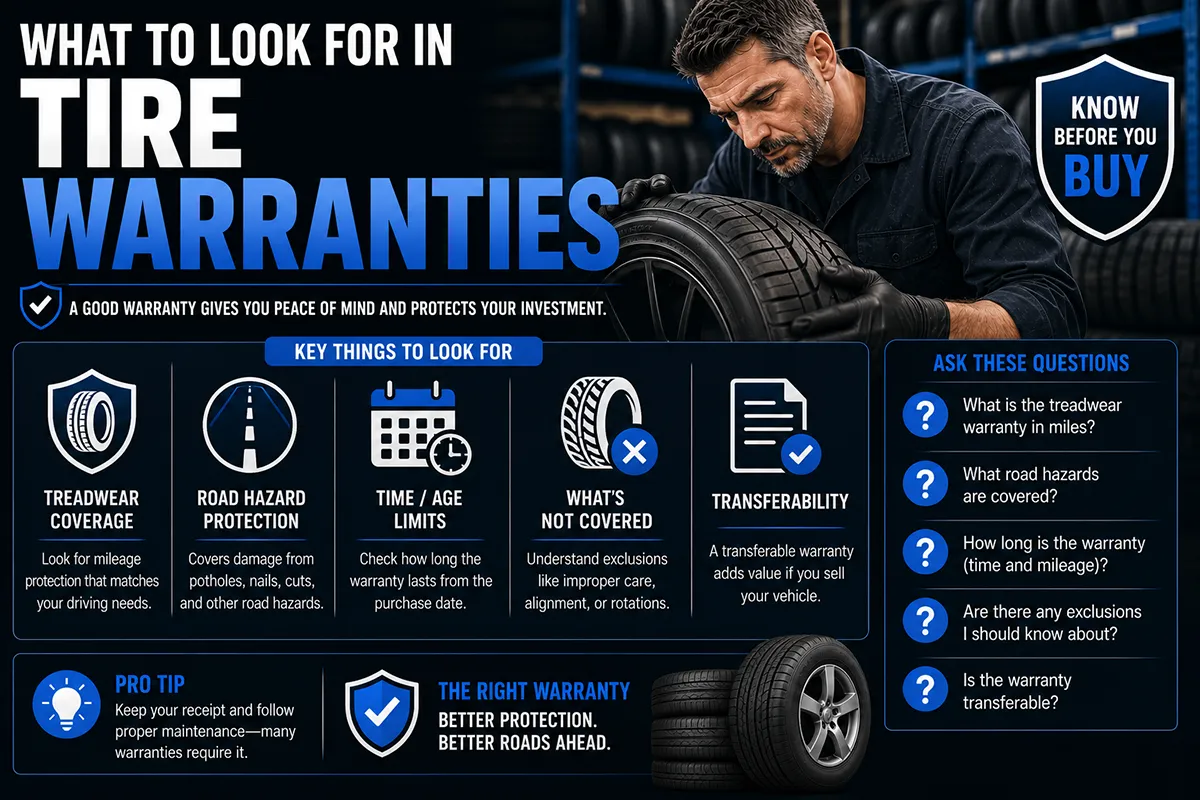
I learned the hard way that not all tire warranties are created equal. I once bought a set of tires thinking I was covered for just about anything — only to find out that the warranty was practically useless when I actually needed it.
That experience cost me hundreds of dollars and taught me a lesson I’ll never forget: always read the fine print before you hand over your credit card.
- Tire warranties generally fall into three categories: treadwear/mileage, road hazard, and manufacturer defect coverage
- Mileage warranties require proof of regular rotations and proper maintenance — skip one and you could void the whole thing
- Road hazard warranties are often sold separately and vary wildly in what they actually cover
- Always check whether your warranty is prorated or non-prorated — it dramatically affects your payout
- Keep every receipt, rotation record, and alignment printout from day one
- Some brands like Michelin, Continental, and Discount Tire offer significantly better warranty programs than competitors
Liked this article?
Add TireAdvise as a preferred source so you see more of our tire reviews and guides on Google.
Why Tire Warranties Matter More Than You Think
Let me put this into perspective. A decent set of four tires for an average sedan or crossover in the US runs anywhere from $400 to $900 — and that’s before installation, balancing, alignment, and taxes. That’s a serious investment for most families.
A good warranty can save you hundreds of dollars if something goes wrong. A bad warranty — or one you don’t fully understand — can leave you paying out of pocket for problems you assumed were covered.
In my years of testing and reviewing tires, I’ve seen nearly every warranty scenario play out. I’ve helped friends file claims, I’ve gone through the process myself, and I’ve spoken with tire shop managers about what they see customers get wrong most often. This guide is built from all of that real-world experience.
The Three Main Types of Tire Warranties
Before you can evaluate any tire warranty, you need to understand that there are three distinct types. Most tires come with at least one, and some come with all three. But each one covers very different situations.
1. Manufacturer’s Defect Warranty (Workmanship and Materials)
This is the most basic warranty that comes standard with virtually every new tire sold in the United States. It covers defects in how the tire was made — things like belt separation, sidewall bulges that appear without any road damage, or tread that starts to come apart under normal driving conditions.
In my experience, manufacturer defect claims are relatively rare but incredibly important when they do happen. I had a set of tires several years ago where one developed a noticeable vibration after only a few weeks of driving. The shop inspected it and found a belt separation that was clearly a manufacturing issue. The replacement was covered at no cost.
Most manufacturer defect warranties last for a set time period (usually around five to six years from the date of manufacture) or until the tread is worn down to 2/32 of an inch. The key here is the date of manufacture — not the date you bought the tire. I’ll explain why that matters later.
2. Treadwear Warranty (Mileage Warranty)
This is the warranty most people think about when they’re shopping for tires. Brands advertise numbers like 50,000, 60,000, or even 80,000 on the tire’s treadwear warranty. The idea is simple: if your tires wear out before they hit that mileage threshold, you should get some form of credit toward replacements.
But here’s what most people don’t realize — and I say this after watching dozens of claims get denied — treadwear warranties are almost always prorated. That means you don’t get a free tire. You get a credit based on how much tread you’ve used, and you pay the difference.
I’ve seen people who were expecting a full replacement walk out of a tire shop angry because they only got a 30% credit. The math works against you the more tread you’ve used.
3. Road Hazard Warranty
Road hazard warranties cover damage from things you hit on the road — nails, potholes, glass, debris, and other unavoidable hazards. This is often the most valuable warranty you can get, and it’s also the one that’s most commonly sold as an add-on rather than included for free.
In my testing, I’ve had tires pick up nails, screws, and even a piece of metal bracket from the highway. Road hazard coverage has saved me real money on more than one occasion. If you do a lot of highway driving or commute through construction zones, this warranty is worth every penny.
Prorated vs. Non-Prorated Warranties: The Biggest Distinction
If there’s one thing I want you to walk away from this article understanding, it’s the difference between prorated and non-prorated warranties. This single distinction determines how much money you’ll actually save when you file a claim.
Prorated Warranties
A prorated warranty gives you a credit based on how much tread life remains. If you’ve used 60% of the tread and the tire fails, you’ll get a credit for roughly 40% of the tire’s current price. You pay the remaining 60% plus installation.
Most treadwear warranties are prorated. And “current price” is important — manufacturers use the retail price at the time of the claim, not what you originally paid. If the tire’s price has gone up, your out-of-pocket cost could be surprisingly high.
Non-Prorated Warranties
A non-prorated warranty gives you a full replacement — or a full credit — regardless of how much tread you’ve used, as long as the tire is within the warranty period. These are much more consumer-friendly but also much less common.
Some road hazard warranties from retailers like Discount Tire and Costco offer non-prorated coverage for a limited period after purchase, then switch to prorated coverage after that. In my experience, that initial non-prorated window is where these warranties really shine.
Comparison: Prorated vs. Non-Prorated Warranty
| Feature | Prorated Warranty | Non-Prorated Warranty |
|---|---|---|
| Replacement Cost | You pay based on tread used | Full replacement at no charge |
| Common With | Treadwear/mileage warranties | Road hazard (early period), defect |
| Availability | Standard on most tires | Less common; often an add-on |
| Consumer Value | Moderate — decreases over time | High — best value early in tire life |
| Price Basis | Current retail price at claim time | N/A — full replacement provided |
| Best For | Long-term tread guarantees | Early-life tire failures and road damage |
What Voids a Tire Warranty (And How to Avoid It)
This is where most people get burned. I can’t tell you how many times I’ve heard someone say, “I thought I was covered,” only to find out their warranty was voided by something they didn’t even know about.
Missed Tire Rotations
Almost every treadwear warranty requires proof that you rotated your tires at regular intervals — typically every 5,000 to 7,500 miles or as specified by the tire manufacturer. If you can’t produce receipts or records showing consistent rotations, your claim will almost certainly be denied.
I keep a simple folder in my glove compartment with every rotation receipt. It takes two seconds to file, and it’s saved me from headaches more than once. Some tire shops also keep digital records, but I never rely solely on that — shops close, systems get wiped, and records get lost.
Improper Tire Pressure
Running your tires underinflated or overinflated can void a warranty. If a tire shows signs of irregular wear that suggests chronic pressure issues, the manufacturer can refuse your claim.
I check my tire pressure at least once a month, and I always keep a quality digital gauge in my car. It takes less than five minutes and can save your warranty — and your tires.
Alignment Issues
If your tires are wearing unevenly because your vehicle’s alignment is off, that’s on you — not the tire manufacturer. Most warranties explicitly exclude damage caused by misalignment.
I recommend getting an alignment check whenever you install new tires and again every year or so after that. Keep the printout. It’s your proof that you maintained proper alignment if a warranty claim ever comes up.
Mixing Tire Sizes or Types
Installing tires that don’t match your vehicle’s specifications — or mixing different tire brands and sizes on the same axle — can void your warranty. This seems obvious, but I’ve seen it happen more often than you’d think, especially when people replace just one or two tires at a time.
Using Tires on the Wrong Vehicle
Passenger tires on a heavy-duty truck? Winter tires driven all summer until they’re bald? Performance tires on a vehicle that exceeds the tire’s load rating? All of these scenarios can void your warranty. Always make sure the tire matches your vehicle’s requirements.
What the Major Brands Actually Offer
I’ve tested tires from almost every major brand sold in the US market. Here’s a breakdown of what the biggest names offer in terms of warranty coverage, based on my firsthand experience dealing with each company.
Michelin
Michelin consistently offers some of the best warranty programs in the industry. Their standard treadwear warranty is generous, and they include a satisfaction guarantee on many lines that lets you return tires within a set period if you’re not happy. They also offer a three-year flat tire assistance program on most of their consumer tires.
In my experience, Michelin’s claims process is straightforward. Their customer service team has been responsive the few times I’ve contacted them, and their authorized dealers seem well-trained on how to handle warranty situations.
Continental
Continental is another brand that takes warranties seriously. They offer solid treadwear coverage and a Total Confidence Plan on many of their tire lines, which bundles roadside assistance, a satisfaction trial period, and road hazard coverage into one package.
I’ve been impressed with how clearly Continental communicates their warranty terms. Their website lays out exactly what’s covered, what’s excluded, and what documentation you need. That transparency goes a long way.
Bridgestone/Firestone
Bridgestone and Firestone tires come with manufacturer defect warranties and treadwear guarantees that are competitive but fairly standard. Where they stand out is through Firestone Complete Auto Care shops, which make it easy to file claims in person if you bought from one of their locations.
I’ve found that buying Bridgestone/Firestone tires through their own retail network simplifies the warranty process significantly compared to buying from a third-party installer.
Goodyear
Goodyear’s warranty program is solid, especially on their higher-end lines like the Assurance and Eagle series. They offer a comfort guarantee on some lines and treadwear warranties that range from modest to very generous depending on the specific model.
One thing I appreciate about Goodyear is that many of their tires are available through Costco and Discount Tire, both of which layer their own warranty programs on top of Goodyear’s. That double coverage can be a real advantage.
Budget Brands (Ironman, Westlake, Lexani, etc.)
Here’s where things get tricky. Budget tire brands often advertise treadwear warranties, but the claims process can be much more difficult. Some budget brands don’t have a strong dealer network in the US, which means finding an authorized warranty center can be a hassle.
I’m not saying budget tires are bad — I’ve tested several that offer decent performance for the price. But I always tell readers to factor in warranty quality when comparing a budget tire at $70 per tire versus a name brand at $110 per tire. That $40 difference often buys you significantly better support if something goes wrong.
Retailer Warranties vs. Manufacturer Warranties
This is a distinction that many buyers overlook, and it’s one I think is crucial. When you buy tires, you may actually receive two separate warranties: one from the tire manufacturer and one from the retailer or installer.
Discount Tire / America’s Tire
Discount Tire offers one of the best retailer warranty programs in the US. Their certificate program — which you purchase at the time of installation — covers road hazard damage and includes a non-prorated period followed by a prorated period. The cost is reasonable (usually $20-$35 per tire), and I’ve personally used it more than once.
What I like most about Discount Tire’s program is how easy it is to use. Walk into any Discount Tire location, show them the damage, and they handle the rest. No calling a hotline, no mailing in forms, no waiting weeks for an answer.
Costco
Costco includes road hazard coverage, lifetime tire balancing, lifetime rotation, and flat repair — all at no extra cost when you buy tires through them. Their warranty is one of the most generous in the retail space, and it’s one of the biggest reasons people buy tires at Costco.
In my experience, Costco’s tire center can be slow due to demand, but the warranty value is hard to beat. If you’re a Costco member, this should be a major factor in your tire buying decision.
Tire Rack
Tire Rack offers an optional road hazard warranty that you can add at checkout. Their program is solid and covers nails, glass, potholes, and other common hazards. They also have a network of recommended installers, which makes the warranty somewhat portable.
I’ve ordered from Tire Rack multiple times and find their warranty terms to be clearly written and fair. The only downside is that you’re dealing with an online purchase, so claims require shipping or visiting an installer rather than just walking into a store you already have a relationship with.
Walmart Auto Care Centers
Walmart offers a Road Hazard Warranty for a per-tire fee at the time of purchase. It covers the cost of repair or replacement due to hazard damage and is valid at any Walmart Auto Care Center nationwide. The pricing is competitive, usually around $10-$15 per tire.
I’ve used Walmart’s tire service a few times over the years, and the experience has been inconsistent — it varies a lot by location. But the warranty itself is straightforward and reasonably priced.
Retailer vs. Manufacturer Warranty Comparison
| Warranty Source | What It Covers | Typical Cost | How Claims Work |
|---|---|---|---|
| Manufacturer (Michelin, etc.) | Defects, treadwear | Included with tire purchase | Through authorized dealer |
| Discount Tire | Road hazard, repair | $20-$35 per tire | Walk into any location |
| Costco | Road hazard, balancing, rotation, repair | Included with purchase | Any Costco Tire Center |
| Tire Rack | Road hazard | Optional add-on at checkout | Online or through installer network |
| Walmart | Road hazard, repair | $10-$15 per tire | Any Walmart Auto Care Center |
The DOT Code: Why the Manufacture Date Matters
Here’s something that caught me off guard the first time I discovered it. Every tire has a DOT code stamped on the sidewall. The last four digits tell you the week and year the tire was manufactured. For example, “2423” means the tire was made in the 24th week of 2023.
Why does this matter for warranties? Because most manufacturer warranties start from the date of manufacture, not the date of purchase. If you buy a tire that’s been sitting in a warehouse for two years, you’ve already lost two years of warranty coverage before you’ve driven a single day on it.
I always check the DOT code before I accept a new set of tires. If the tires are more than six months old, I ask for fresher stock. Most reputable shops will accommodate this request without pushback. If they won’t, I take my business elsewhere.
Satisfaction Guarantees: An Underrated Perk
Some tire manufacturers offer satisfaction guarantees — also called trial periods or comfort guarantees. These allow you to return or exchange your tires within a set time frame if you’re not happy with them.
Michelin, Continental, and Pirelli all offer some form of satisfaction guarantee on select tire lines. In my experience, these programs are legitimate and relatively easy to use, though they do come with conditions (you usually need to buy four tires, install them at an authorized dealer, and make the claim within a specific window).
I’ve used a satisfaction guarantee once, during a test period where I felt a particular tire was significantly noisier than expected for its category. The dealer processed the exchange without any drama. It’s a safety net that gives you confidence to try a new brand or model without feeling locked in.
What to Do Before You Buy: My Pre-Purchase Warranty Checklist
After years of doing this, I’ve developed a simple checklist that I go through before every tire purchase. I recommend you do the same.
- Read the full warranty document — Not the marketing summary, not the bullet points on the website. The actual terms and conditions. It’s usually a PDF on the manufacturer’s website.
- Ask about the retailer’s warranty — Find out what the shop offers on top of the manufacturer’s coverage. Ask about road hazard, balancing, and rotation packages.
- Check the DOT code — Make sure your tires are fresh. Don’t accept tires that were manufactured more than 12 months ago.
- Confirm maintenance requirements — Know exactly what the warranty requires: rotation intervals, pressure checks, alignment records, etc.
- Understand the proration schedule — Ask the dealer to explain exactly how much you’d pay out of pocket at various stages of the tire’s life if you needed a replacement.
- Get everything in writing — Keep your purchase receipt, warranty certificate, installation invoice, and all maintenance records in one place.
- Ask about transferability — If you sell your car, can the warranty transfer to the new owner? Some do, most don’t.
Red Flags to Watch For
Over the years, I’ve encountered a few warning signs that tell me a tire warranty isn’t as good as it looks on paper. Here are the ones I watch for most carefully.
Extremely High Mileage Claims With No Brand Reputation
If a budget tire brand you’ve never heard of is advertising a 90,000-mile treadwear warranty, be skeptical. The warranty is only as good as the company backing it. If the brand goes under or doesn’t have US-based support, that warranty is worthless.
“Limited” Without Clear Limits
The word “limited” in a warranty name doesn’t tell you much. What matters is what’s actually excluded. If the warranty document is vague about exclusions or hard to find, that’s a red flag.
No Road Hazard Option at All
If neither the manufacturer nor the retailer offers any form of road hazard coverage, I’d think twice about buying from that source. Road hazard damage is one of the most common tire issues US drivers face, and having zero protection for it is a real gap.
Warranty Only Valid at the Original Purchase Location
Some smaller independent shops offer their own in-house warranties that are only valid at their single location. If you move, travel, or the shop closes, you’re out of luck. I always prefer warranties that are valid at any authorized dealer or any location within a national chain.
How to File a Tire Warranty Claim (Step by Step)
If you do need to file a claim, here’s the general process I’ve followed — and recommend — based on my experience.
Step 1: Bring the Tire to an Authorized Dealer
For manufacturer warranty claims, you’ll usually need to go to an authorized dealer for the tire brand. For retailer warranties, go back to the store where you bought them or any location in their network.
Step 2: Present Your Documentation
Bring your original receipt, warranty certificate, and records of all tire rotations, pressure checks, and alignment services. The more documentation you have, the smoother the process.
Step 3: Let the Dealer Inspect the Tire
The dealer will examine the tire to determine the cause of failure. They’ll check for manufacturing defects, road hazard damage, or signs of neglect/abuse. This inspection is the make-or-break moment for your claim.
Step 4: Dealer Submits the Claim
If the claim is valid, the dealer will submit it to the manufacturer on your behalf. For retailer warranties, the shop usually handles everything in-house.
Step 5: Receive Your Credit or Replacement
Depending on the warranty type and proration, you’ll either get a new tire at no cost, a credit toward a replacement, or a partial refund. Make sure you understand the amount before agreeing to the replacement.
My Final Advice on Tire Warranties
After testing and reviewing hundreds of tires over the years, here’s what I believe: the warranty shouldn’t be the only reason you choose a tire, but it should absolutely be a factor in your decision.
A great tire with a weak warranty is still a great tire. But when two tires are close in performance and price, the one with better warranty coverage wins every time in my book.
I also believe that retailer warranties are just as important — sometimes more important — than manufacturer warranties. Companies like Discount Tire and Costco have built their tire businesses around exceptional post-purchase support, and that’s something you benefit from directly.
Don’t overlook the basics: keep your receipts, rotate your tires on schedule, check your pressure monthly, and get your alignment checked regularly. These simple habits don’t just extend the life of your tires — they keep your warranty intact so it’s actually there when you need it.
The bottom line? A tire warranty is only as good as your understanding of it. Take fifteen minutes to read the terms before you buy. That small investment of time can save you hundreds of dollars down the road.
Frequently Asked Questions
What does a tire warranty typically cover?
A standard tire warranty usually covers defects in materials and workmanship for a set period, often 4-6 years from the date of purchase. Many major brands like Goodyear, Michelin, and Bridgestone also include treadwear warranties that guarantee your tires will last a specific number of miles, such as 50,000 or 70,000 miles. If your tires wear out prematurely or fail due to a manufacturing defect, the warranty may entitle you to a prorated credit or free replacement.
What is the difference between a treadlife warranty and a manufacturer’s warranty on tires?
A manufacturer’s warranty covers defects in materials and workmanship, meaning if the tire was built incorrectly or uses faulty rubber compounds, you’re protected. A treadlife warranty, also called a mileage warranty, guarantees that the tread will last a certain number of miles under normal driving conditions. I always recommend checking both, because a tire can have a strong manufacturer’s warranty but no mileage guarantee, which leaves you unprotected if the tread wears out faster than expected.
Are tire road hazard warranties worth the extra cost?
Road hazard warranties can absolutely be worth it, especially if you regularly drive on rough US roads, through construction zones, or in areas with a lot of potholes and debris. These warranties typically cover damage from nails, glass, and curb impacts that a standard manufacturer’s warranty won’t touch. They usually cost between $15 and $30 per tire and can save you $150 or more on a single replacement. I recommend them for drivers in states with harsh winters or poorly maintained roads, where tire damage is more common.
What voids a tire warranty and how can I avoid it?
The most common reasons a tire warranty gets voided include improper tire inflation, failure to rotate tires at recommended intervals (usually every 5,000-7,000 miles), using tires on misaligned vehicles, and mounting tires on the wrong size rim. Many warranties also require you to keep service records as proof of regular maintenance. I always keep my rotation receipts and check my tire pressure monthly to make sure I stay covered under the warranty terms.
How do prorated tire warranties work when filing a claim?
With a prorated tire warranty, the amount of credit you receive decreases based on how much tread you’ve already used. For example, if your tire has a 60,000-mile warranty and it fails at 30,000 miles, you’ve used 50% of the tread life, so you’d only get roughly 50% off the cost of a replacement tire. It’s important to understand that the replacement cost is usually based on the current retail price, not what you originally paid. I recommend asking the dealer to walk you through the proration formula before purchasing so there are no surprises.
Do all tire brands offer the same warranty coverage in the US?
No, warranty coverage varies significantly between tire brands and even between tire models from the same manufacturer. Premium brands like Michelin and Continental often offer longer mileage warranties (up to 80,000 miles) and more comprehensive satisfaction guarantees, while budget brands may only cover manufacturing defects with no mileage guarantee at all. Some brands, like Discount Tire’s in-house certificates, offer non-prorated replacement within the first few years, which can be a much better deal. I always compare the warranty details side by side when shopping, because a cheaper tire with no mileage warranty can actually cost more in the long run.
What should I look for in the fine print of a tire warranty before buying?
Before buying, I always check for specific mileage limits, the proration schedule, required maintenance like rotations and alignments, and whether the warranty is transferable if you sell the vehicle. Look for any exclusions related to commercial use, off-road driving, or speed rating mismatches, as these are common gotchas that void coverage. Also confirm whether you need to file claims at the original point of purchase or if any authorized dealer can process it, since that flexibility matters if you move or travel frequently across the US.
