

I once walked into a discount tire shop and found a set of “brand new” all-season tires at an unbelievable price. They had full tread depth, looked pristine on the rack, and the salesman swore they were a steal.
Then I checked the DOT date code on the sidewall — those tires were manufactured over seven years ago. They’d been sitting in a warehouse, slowly degrading, and the shop was trying to move them before they became a total loss.
That experience taught me something that most everyday drivers never think about: a tire can look perfectly new and still be too old to safely put on your car. And if a shop is willing to sell it to you anyway, that’s a red flag you need to recognize before you hand over your credit card.
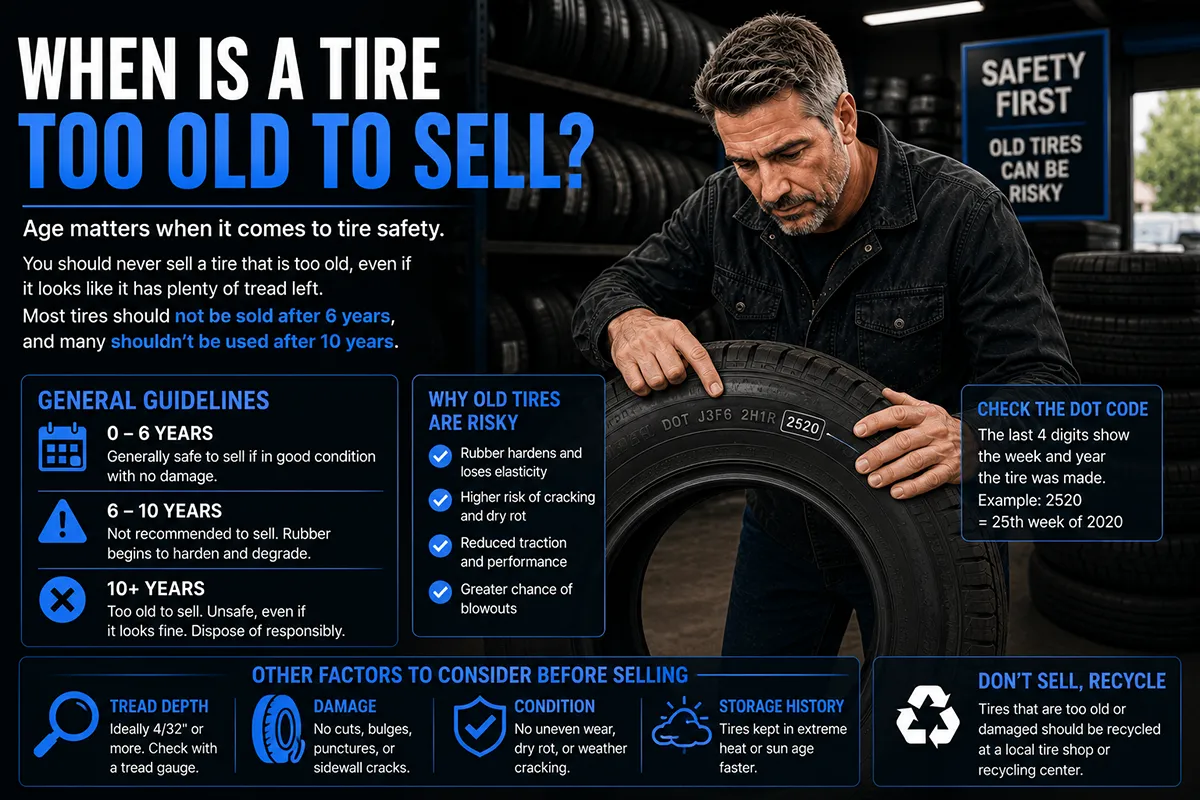
- Tires have a finite lifespan regardless of tread depth — most manufacturers recommend replacement after 6 years from the date of manufacture, with 10 years being the absolute maximum.
- The DOT date code stamped on every tire sidewall tells you exactly when it was made (week and year).
- In my experience, you should avoid buying any tire that’s already more than 2-3 years old at the time of purchase — you’re paying for less usable life.
- Rubber degrades through oxidation, heat exposure, and UV damage even when a tire is sitting unused on a shelf.
- There is no federal law in the US banning the sale of aged tires, so the responsibility falls on you as the buyer to check.
Liked this article?
Add TireAdvise as a preferred source so you see more of our tire reviews and guides on Google.
Why Tire Age Matters Even More Than Tread Depth
Most drivers I talk to think of tire replacement as a tread depth issue. When the tread wears down, you buy new tires. Simple enough, right?
But here’s what the tire industry doesn’t always make obvious: rubber is an organic compound that degrades over time through a process called oxidation. It doesn’t matter whether the tire has been driven on heavily or has been sitting untouched in a climate-controlled warehouse — the chemical bonds in the rubber break down gradually from the moment the tire is manufactured.
I’ve personally inspected tires with nearly full tread depth that showed alarming signs of age-related deterioration. Tiny surface cracks along the sidewall, a slight hardening of the rubber compound, and a general brittleness that you can feel when you press your thumbnail into the surface. These are tires that look fine at a glance but have lost a significant portion of their grip, flexibility, and structural integrity.
Heat accelerates this process dramatically. If you live in Texas, Arizona, Florida, or any Sun Belt state, your tires age faster than those on a car garaged in Minnesota. I’ve seen tires in Phoenix that showed age-related cracking after just four years of use — something I wouldn’t typically see until year six or seven in cooler climates.
How to Read the DOT Date Code on Any Tire
This is the single most important skill I can teach you if you’re shopping for tires, whether new or used. Every tire sold in the United States is required by the Department of Transportation to carry a DOT identification number on its sidewall.
The part you care about is the last four digits of that code. These four numbers tell you the week and year the tire was manufactured.
For example, if the last four digits read 2321, that tire was made in the 23rd week of 2021. If it reads 0818, the tire was produced in the 8th week of 2018.
Where to Find the DOT Code
Look on the lower sidewall of the tire, near the rim. The full DOT code starts with the letters “DOT” followed by a series of numbers and letters. On some tires, the complete code with the date only appears on one side — usually the side that faces inward when mounted on the vehicle, which is frankly annoying.
I always recommend asking the installer to show you the DOT code on all four tires before they mount them. If they can’t or won’t, that’s a warning sign. Any reputable shop will be happy to let you verify.
What If There Are Only Three Digits?
If you find a DOT code that ends in only three digits, you’re looking at a tire manufactured before the year 2000. For example, a code ending in 358 means the tire was made in the 35th week of either 1988 or 1998. These tires are ancient by any standard and should absolutely not be on any vehicle, let alone sold to a consumer.
I’ve actually encountered tires from the 1990s being sold at swap meets and small used tire shops. It’s more common than you’d think, and it’s genuinely dangerous.
What the Major Tire Manufacturers Say About Tire Age
I’ve spent considerable time reading through technical service bulletins, warranty documents, and safety advisories from the major tire manufacturers. Here’s a summary of their official positions on tire age:
| Manufacturer | Recommended Max Age (From Manufacture) | Absolute Max Age |
|---|---|---|
| Michelin | 10 years (with annual inspections after 5 years) | 10 years |
| Goodyear | Replace after 6 years of service | 10 years from manufacture |
| Bridgestone / Firestone | Replace after 6 years of service | 10 years from manufacture |
| Continental | Replace after 6 years of service | 10 years from manufacture |
| General Tire | 6 years from date of manufacture | 6 years |
| Cooper Tires | 6 years from date of manufacture | 6 years |
The consensus across the industry is clear: six years from the date of manufacture is the general guideline for tire replacement, and ten years is the absolute maximum regardless of condition.
I want to emphasize that this is from the date of manufacture, not the date of purchase. A tire that sat on a shelf for three years before you bought it has already used up half of its recommended service life before it ever touched pavement.
So When Is a Tire Too Old to Sell?
This is where things get frustrating for consumers. As of the time I’m writing this, there is no federal law in the United States that prohibits the sale of aged tires. None. A shop can legally sell you a tire that’s eight, nine, or even twelve years old and face no legal consequences — as long as it doesn’t have a recalled design defect.
Some states have tried to address this. Maryland, for instance, considered legislation to restrict the sale of used tires older than six years. But comprehensive nationwide regulation simply doesn’t exist yet.
In my professional opinion and based on my years of reviewing and testing tires, here’s where I draw the line:
- 0-2 years old at time of sale: This is ideal. You’re getting nearly the full useful life of the tire. Most major retailers like Tire Rack, Discount Tire, and Costco typically sell tires within this window.
- 2-3 years old at time of sale: Still acceptable, but I’d expect a meaningful discount. You’re losing a year or two of usable life.
- 3-5 years old at time of sale: I would not buy these unless the discount is extreme, and even then, I’d hesitate. You might only get two or three years of safe service from them.
- 5+ years old at time of sale: These tires should not be sold to consumers, period. In my view, any retailer offering tires this old — whether new-old-stock or used — is prioritizing profit over your safety.
The Used Tire Market: Where Old Tires Go to Hide
I’ve visited dozens of used tire shops across the US for research, and honestly, some of what I’ve seen is alarming. The used tire market is where age-expired tires most commonly end up, and the lack of regulation means consumers are largely on their own.
Used tire shops serve an important role — not everyone can afford $600 to $1,200 for a new set of tires. I understand that reality. But I’ve personally inspected used tires on display that were eight and nine years old, priced at $40 to $60 each, with no age disclosure whatsoever.
The sellers often point to the remaining tread depth as proof of value. And yes, a tire with 7/32″ of tread remaining looks like a good deal. But if that tire was manufactured in 2016 and you’re buying it in 2025, the rubber compound has degraded to a point where the grip characteristics have fundamentally changed.
My Rules for Buying Used Tires
If your budget absolutely requires used tires, here’s my personal checklist:
- Check the DOT date code on every single tire. If the seller can’t show it to you or claims it’s “not important,” walk away.
- Refuse any tire older than four years from the date of manufacture — you’ll get limited safe use from it.
- Inspect the sidewalls carefully for cracking, bulging, or any signs of previous repair near the shoulder area.
- Run your hand along the inner liner if possible, feeling for bumps, patches, or irregularities.
- Make sure all four tires match in brand, model, and size. Mixing old tires from different manufacturers creates unpredictable handling.
I’d rather see someone buy a quality budget-friendly new tire — brands like General, Cooper, Hankook, or Falken offer solid options under $100 per tire for many common sizes — than gamble on aged used rubber.
How Rubber Degrades: The Science Behind Tire Aging
I’m not a chemist, but I’ve spent enough time talking to tire engineers and reading technical papers to explain this in plain language.
Tire rubber is a complex blend of natural and synthetic rubber, carbon black, silica, sulfur, antioxidants, and various other chemicals. When the tire is freshly manufactured, these compounds work together to provide flexibility, grip, and structural strength.
Over time, oxygen molecules penetrate the rubber and break the polymer chains that give the tire its elasticity. This is called thermo-oxidative aging, and it happens whether the tire is in use or not. The antioxidants mixed into the compound slow this process, but they don’t stop it entirely — and they eventually get consumed.
What This Looks Like in Practice
Here’s what I’ve observed when testing or inspecting aged tires:
- Hardened rubber: The tire’s surface becomes noticeably stiffer. When I press my thumbnail into the tread surface of a new tire, it leaves a temporary impression. On an aged tire, the rubber resists the impression — it’s lost its pliability.
- Surface cracking (weather checking): Fine cracks appear in the sidewall and between the tread blocks. Early-stage cracking can be subtle, but advanced cracking is visible without even bending the tire.
- Reduced wet grip: This is the one that scares me the most. An aged tire compound simply cannot conform to the road surface and channel water the way a fresh compound can. I’ve experienced this firsthand — driving on tires that were technically within tread depth specs but felt genuinely unsafe in heavy rain.
- Increased risk of blowout: As the internal rubber components degrade, the bond between the tire’s layers weakens. This can lead to tread separation — one of the most dangerous tire failures — especially at highway speeds.
The infamous Ford Explorer / Firestone tire recall in the early 2000s brought tire aging into public awareness. Many of those failures were linked to tires whose rubber had degraded, particularly in hot climates, leading to catastrophic tread separations. That tragedy is a permanent reminder that tire age is a life-or-death issue.
What About Spare Tires?
This is a question I get constantly, and it’s a good one. The full-size or compact spare tire sitting in your trunk is subject to the exact same aging process as the tires on your wheels. In some ways, it’s even more vulnerable — spare tires are often stored in exposed areas beneath the vehicle or in poorly ventilated trunk compartments where heat can build up.
I check the DOT code on spare tires during every vehicle review I do. And I can tell you that on many vehicles I’ve tested — even relatively recent model years — the spare tire matches the car’s original manufacture date. On a 10-year-old car that’s had its road tires replaced twice, the spare is often still the original.
My advice: check your spare tire right now. If it’s older than six years, replace it. A spare tire that fails during an emergency roadside situation is arguably more dangerous than a tire that fails under normal driving conditions, because you’re already in a vulnerable position.
Climate and Storage Conditions: How They Accelerate Aging
Where you live and where your tires spend their time matters enormously. I’ve tested tires across various US climates, and the differences in aging are striking.
Hot Climates
Tires in the southern United States age significantly faster. In my experience reviewing tires from vehicles in Arizona and south Texas, I’ve routinely seen age-related cracking develop a full one to two years earlier than on comparable tires in northern states. The combination of intense UV exposure, extreme ambient heat, and hot pavement temperatures accelerates every aspect of rubber degradation.
If you live in a hot climate, I’d recommend mentally subtracting a year from the manufacturer’s age recommendations. Treat five years as your replacement threshold rather than six.
Cold Climates
Interestingly, extreme cold doesn’t accelerate chemical aging the way heat does. But it does cause aged rubber to become dangerously brittle. A tire that’s borderline old will perform especially poorly when temperatures drop below freezing. The already-hardened rubber becomes even less flexible, dramatically reducing grip on cold, wet, or icy roads.
Storage Conditions for Unmounted Tires
If you’re storing seasonal tires — winter tires during summer, for instance — how you store them affects their lifespan:
- Keep them in a cool, dry, dark environment. A climate-controlled garage or basement is ideal.
- Avoid storing them near electric motors, furnaces, or welding equipment — ozone generated by these devices degrades rubber rapidly.
- Store them upright if possible, or stacked horizontally with cardboard between them.
- Use tire storage bags to limit oxygen and UV exposure.
I store my personal winter tire set in opaque tire bags inside my garage, and after several years of seasonal swaps, they’ve held up noticeably better than a previous set I stored uncovered in a shed.
What Retailers and Shops Should Be Doing
I believe the tire industry as a whole needs to do better on this issue. Here’s what responsible retailers should be doing — and what I look for when I recommend a shop:
- Transparent date disclosure: The manufacture date should be clearly communicated to every customer at the time of sale. Some retailers, like Tire Rack, actually show the expected manufacture date range when you order online. I wish every retailer did this.
- Inventory rotation: Good retailers follow first-in, first-out inventory practices to ensure older stock gets sold before it ages out. Large operations like Costco and Discount Tire are generally good about this.
- Refusing to sell old stock: The best retailers pull tires from their inventory once they hit a certain age threshold — typically four to five years from manufacture. If a retailer is willing to sell tires older than this, I’d question their commitment to customer safety.
- Consumer education: Every tire purchase should include a brief explanation of the DOT date code and why tire age matters. In my experience, fewer than one in ten salespeople I’ve interacted with voluntarily bring this up.
How to Protect Yourself When Buying Tires
Whether you’re buying online or in-store, here’s my practical advice for making sure you don’t end up with old tires:
Buying Online
When ordering from online retailers like Tire Rack, SimpleTire, or Amazon, the biggest risk is receiving tires that have been sitting in a distribution center for years. Here’s what I do:
- Contact the retailer before purchasing and ask for the expected manufacture date of the tires in stock.
- Specify in the order notes (if possible) that you want tires manufactured within the last 12 months.
- Inspect the DOT code immediately upon delivery. If the tires are older than you’re comfortable with, initiate a return before having them mounted.
Tire Rack, to their credit, has been fairly responsive when I’ve reached out about tire age. They typically ship tires that are less than 18 months old, and in my personal orders, I’ve usually received tires manufactured within the past six to eight months.
Buying In-Store
At brick-and-mortar shops, you have the advantage of physically inspecting the tires before they go on your car. Use it.
- Ask the technician to show you the DOT date code on each tire before installation.
- If the tires are already mounted when you arrive for pickup, ask to see the codes on the vehicle.
- Don’t be shy about rejecting a tire that’s too old. A good shop will swap it for a fresher one from their stock.
I’ve personally sent tires back at the counter twice in my life. Both times, the shop had no issue replacing them with newer stock. But if I hadn’t checked, I would have driven out on tires that were already past the halfway point of their useful life.
Real-World Consequences: Why I Take This So Seriously
I take tire age seriously because I’ve seen what happens when people don’t. During my time testing and reviewing tires, I’ve heard firsthand accounts from drivers who experienced tread separations on aged tires, some at highway speed.
One story that stuck with me was from a reader who bought a used set of “like-new” tires for his family’s SUV from a local shop. They looked great — barely worn, matching set, well-known brand. He didn’t check the date. During a summer road trip through New Mexico, one of the rear tires suffered a catastrophic tread separation at highway speed. He was able to maintain control, but his family was shaken, and the vehicle sustained body damage from the flailing tread.
When he later inspected the remaining tires, the DOT codes showed they were manufactured over nine years prior. The shop had sold him expired rubber with a smile.
That’s not an isolated incident. NHTSA (the National Highway Traffic Safety Administration) has investigated numerous complaints related to aged tire failures. While they haven’t yet mandated age limits on tire sales, their research consistently supports the six-to-ten-year replacement window recommended by manufacturers.
My Bottom Line: The Age Limits I Personally Follow
After years of testing tires, visiting manufacturers, talking to engineers, and driving on more rubber compounds than I can count, here are the age thresholds I follow for myself and recommend to every reader:
- When buying new tires: I want tires manufactured within the last 18 months. I’ll accept up to 24 months. Anything older, and I ask for a different set or a discount.
- When considering used tires: I won’t buy anything older than three years from manufacture, and I prefer two years or less.
- For tires currently on my vehicle: I plan to replace them by year five, regardless of remaining tread. In hot climates, I’d move that to year four.
- Absolute maximum age for any tire in service: Six years from manufacture. I will not drive on a tire older than this, period. I don’t care if it has 90% tread remaining.
- Spare tires: Same rules apply. I check them annually and replace them on the same schedule.
These are conservative thresholds compared to some manufacturer recommendations, and I’m comfortable with that. Tires are the only thing connecting your vehicle to the road. Every safety system in your car — ABS, traction control, stability control, collision avoidance — ultimately depends on the grip those four patches of rubber provide. Compromising on tire age is compromising on all of it.
Final Thoughts
The next time you shop for tires, bring your phone, find the DOT code, and check the date before you agree to anything. It takes thirty seconds and could save your life.
I’ve been reviewing tires for years, and I still check the date code on every single tire that goes on my vehicles. It’s become second nature, like checking the expiration date on milk. Except the stakes are infinitely higher.
If your tire shop won’t show you the manufacture date, find a different shop. If an online order arrives with tires older than you expected, send them back. And if someone offers you a deal on used tires that seems too good to be true, check the date — because it almost certainly is.
Your tires deserve the same attention you give your brakes, your oil, and your seatbelts. Age matters. Don’t let anyone tell you otherwise.
Frequently Asked Questions
How old is too old to sell a tire in the United States?
Most tire manufacturers and industry safety organizations recommend that tires should not be sold as new if they are more than 6 years old from the date of manufacture, even if they have never been mounted. After 6 years, the rubber compounds begin to degrade due to oxidation, making the tire unsafe regardless of tread depth. I always recommend checking the DOT date code on the sidewall before purchasing any tire, whether it’s from a dealership, warehouse, or online retailer.
Is it legal to sell old or expired tires in the US?
There is currently no federal law in the United States that prohibits the sale of aged tires, which surprises many drivers. However, some states have introduced legislation targeting the sale of used tires that are visibly worn or damaged. Despite the lack of a nationwide ban, reputable tire retailers like Tire Rack, Discount Tire, and Costco typically follow manufacturer guidelines and avoid selling tires older than 5-6 years from the manufacture date.
How do I check the age of a tire before buying it?
You can determine a tire’s age by reading the DOT code stamped on the sidewall near the rim. The last four digits indicate the week and year of manufacture — for example, ‘2321’ means the tire was made in the 23rd week of 2021. I always check this code in-store before paying, because some shops may stock older inventory that has been sitting in a warehouse for years, especially on less popular tire sizes.
Can old tires with good tread still be dangerous to drive on?
Absolutely — tire age matters just as much as tread depth when it comes to safety. Rubber degrades over time through a process called dry rot, which causes cracking in the sidewalls and weakens the tire’s internal structure, increasing the risk of blowouts at highway speeds. This is especially critical in hot US climates like Texas, Arizona, and Florida, where heat accelerates rubber deterioration. Even if the tread looks full, I would not trust a tire older than 10 years under any driving conditions.
How long can tires sit in a warehouse before they are considered too old to sell?
Industry best practice suggests that tires should be sold within 18 to 24 months of their manufacture date to ensure buyers get maximum usable life. While a tire sitting in climate-controlled storage for 3-4 years may still be technically safe, you are losing years of service life before you even mount it. If I’m spending $150-$300 per tire on a quality brand like Michelin or Goodyear, I want to make sure the DOT date shows it was manufactured within the last year or two.
Should I avoid buying tires online because they might be old stock?
Buying tires online from reputable US retailers like Tire Rack, Amazon, or SimpleTire is generally safe, but you should always verify the manufacture date when the tires arrive. Most trustworthy online sellers guarantee tires manufactured within the last 1-2 years, and some will let you request specific production dates before shipping. I recommend contacting customer service before ordering to ask about their tire age policy, and immediately inspecting the DOT code when your tires are delivered.
What happens if a tire shop tries to sell me old tires?
If you discover a shop is selling tires that are more than 5-6 years old without disclosure, you have every right to refuse the purchase and request newer inventory. I would also report the business to your state’s consumer protection agency and leave a detailed online review to warn other drivers. Some shops discount aged inventory by $20-$50 per tire, which might seem tempting, but the reduced lifespan and safety risk make it a poor value — you’re better off paying full price for a freshly manufactured tire from a reputable dealer.
