

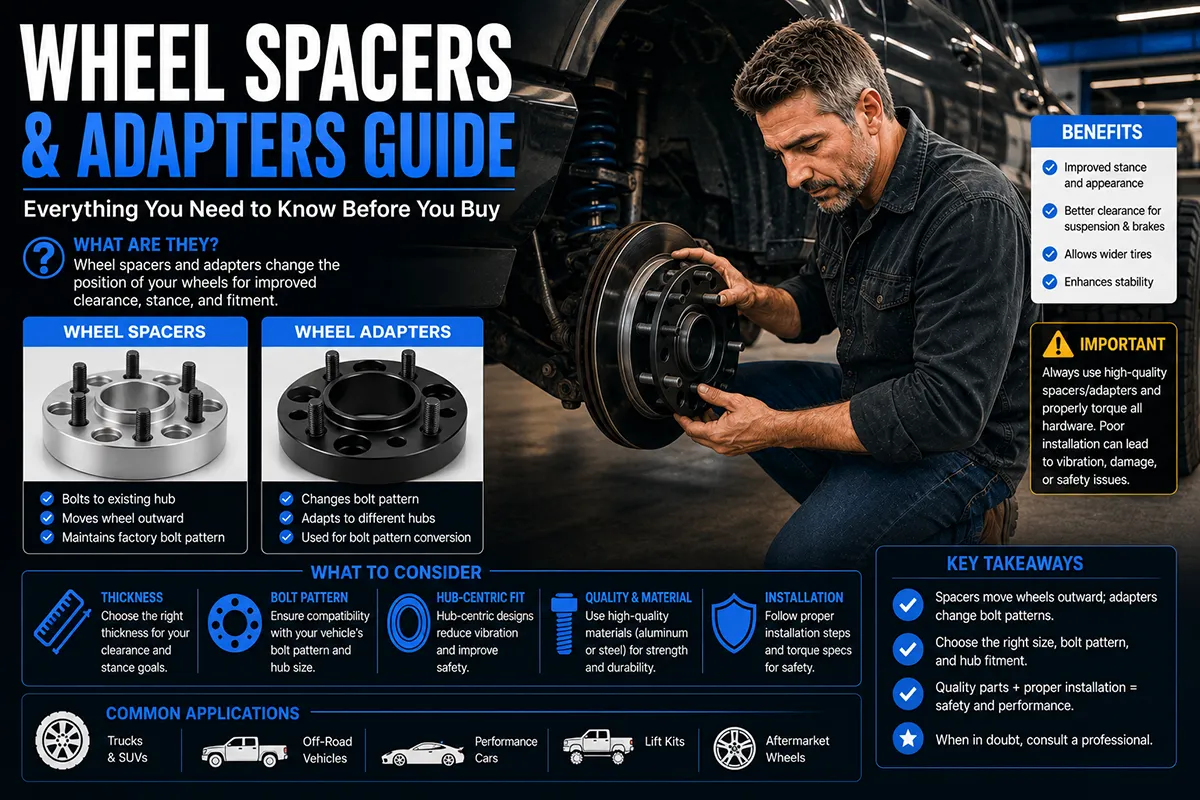
I’ve lost count of how many times a fellow car enthusiast has asked me, “Are wheel spacers actually safe?” — usually right after they’ve seen a truck with an aggressive stance rolling down the highway.
It’s one of those topics that sparks heated debates in every garage, forum, and Facebook group. Some people swear by them, others treat them like ticking time bombs.
After years of installing, testing, and reviewing spacers and adapters on everything from daily-driven sedans to weekend trail trucks, I’m here to give you the real, unfiltered truth — no hype, no scare tactics.
- Wheel spacers push your wheels outward for a wider stance, better clearance, or to fix offset issues — quality hub-centric spacers with proper torque are generally safe.
- Wheel adapters change your bolt pattern so you can run wheels designed for a different vehicle — they require extra care and precise fitment.
- Always buy from reputable US brands like BORA, Spidertrax, or Titan Wheel Accessories — cheap eBay spacers are genuinely dangerous.
- Torque your lug nuts to spec, re-torque after initial driving, and inspect regularly — this is non-negotiable.
- Spacers under 1.5 inches are the sweet spot for most daily drivers; anything thicker may require extended studs or longer bolts.
Liked this article?
Add TireAdvise as a preferred source so you see more of our tire reviews and guides on Google.
What Are Wheel Spacers and Why Do People Use Them?
Let me start with the basics, because I’ve met plenty of people who confuse spacers with adapters. They’re related but different, and understanding the distinction matters before you spend a dime.
A wheel spacer is a flat, circular piece of metal — usually aluminum alloy — that bolts between your wheel hub and your wheel. Its job is simple: push the wheel outward from the vehicle, creating a wider track width.
People use them for a bunch of reasons. Some want to fix a wheel that sits too far inward after a suspension lift. Others want a more aggressive, “flush” look where the tire sits right at the edge of the fender. And some folks need them to clear brake calipers after upgrading to bigger brakes.
In my experience, the most common reason everyday drivers reach for spacers is fitment correction. You bought a set of aftermarket wheels that don’t quite sit right, or your new tires are rubbing the inner fender, and a small spacer solves the problem instantly.
What Are Wheel Adapters and How Are They Different?
Wheel adapters serve a completely different purpose, even though they look similar. An adapter changes your vehicle’s bolt pattern — meaning it lets you bolt on wheels that weren’t originally designed for your car or truck.
For example, say you’ve got a Chevy Silverado with a 6×139.7mm bolt pattern, but you found a killer deal on a set of Ford wheels with a 6x135mm pattern. An adapter bridges that gap.
Adapters are typically thicker than spacers because they need to accommodate two different bolt patterns. They bolt onto your hub studs and then have their own set of studs or bolt holes for the new wheel.
I want to be upfront: adapters introduce more complexity and more potential failure points than spacers. I’ve used them successfully on project vehicles, but I always recommend that daily drivers stick with wheels that match their factory bolt pattern when possible.
Types of Wheel Spacers: Slip-On vs. Bolt-On
Not all spacers are created equal, and this is where a lot of first-time buyers make mistakes. There are two main categories, and the one you choose has a major impact on safety.
Slip-On (Non-Hub-Centric) Spacers
These are thin spacers — usually between 3mm and 12mm — that simply slide over your existing wheel studs. Your factory lug nuts then clamp the wheel and spacer together against the hub.
I’ve used thin slip-on spacers for minor offset corrections, and they work fine for that purpose. But there are limitations. Because they rely entirely on the lug nuts to stay centered, there’s a greater risk of vibration if they’re not perfectly seated.
I always recommend hub-centric slip-on spacers that have a lip matching your hub bore. This keeps everything centered and drastically reduces the chance of a wobble at highway speeds.
Bolt-On (Hub-Centric) Spacers
These are the gold standard, and what I recommend for anything over 15mm thick. Bolt-on spacers attach to your hub with one set of bolts, and then your wheel bolts onto the spacer’s own studs.
The beauty of this design is that the spacer becomes an extension of your hub. It’s hub-centric, meaning it has a machined lip that mates perfectly with your hub’s center bore. The load is carried by the hub — not the bolts — just like your factory setup.
In my testing across multiple vehicles, bolt-on hub-centric spacers from quality manufacturers have been rock-solid. Zero vibration, zero loosening, zero issues. Period.
Choosing the Right Size: How Thick Should Your Spacers Be?
This is probably the most common question I get, and the answer depends on what you’re trying to accomplish.
- 3mm–10mm: Minor offset correction. Great for getting aftermarket wheels to sit flush or clearing a brake caliper. You’ll likely use slip-on spacers in this range.
- 15mm–25mm (roughly 0.6″–1″): The sweet spot for most people. Gives a noticeably wider stance without dramatically changing suspension geometry. Bolt-on spacers are ideal here.
- 30mm–50mm (roughly 1.2″–2″): Aggressive stance territory. Popular on trucks with leveling kits or lifts. You’ll definitely want bolt-on, hub-centric spacers, and you should check for fender clearance.
- 2 inches and above: These are typically adapter territory and common on off-road rigs. At this thickness, you’re significantly changing your vehicle’s track width and should have your alignment checked.
Here’s a rule I live by: use the thinnest spacer that solves your problem. Going bigger than necessary just introduces stress on components that weren’t designed for it.
The Safety Question: Are Wheel Spacers Actually Dangerous?
Let me be blunt. Quality wheel spacers, properly installed and maintained, are not dangerous. I’ve run them on my own daily driver and on vehicles I’ve tested over extended periods without a single incident.
The horror stories you hear online almost always trace back to one of three causes:
- Cheap, no-name spacers: Poorly machined, made from inferior alloy, inconsistent tolerances. I’ve personally measured eBay spacers with runout so bad I wouldn’t put them on a wheelbarrow.
- Improper installation: Wrong torque, missing hub-centric rings, mismatched thread pitch. This is user error, not a spacer problem.
- Zero maintenance: Lug nuts loosen over time, especially on new installations. If you never re-torque, eventually something fails.
I want to emphasize this: the spacer itself is rarely the failure point. It’s almost always the installation or the quality of the product. This is why I’m borderline aggressive about recommending only trusted, US-distributed brands.
My Recommended Brands: Who I Trust With My Own Vehicles
Over the years, I’ve tested spacers and adapters from a wide range of manufacturers. Here are the ones I personally trust and recommend to friends and readers.
BORA Wheel Spacers
BORA is a US-based company out of Michigan, and they’ve been my go-to for truck spacers. Their products are CNC-machined from 6061-T6 billet aluminum, and the tolerances are impressively tight. I’ve measured their hub-centric bores with a dial indicator and found them consistently within spec.
Their pricing runs between $100 and $250 for a pair, depending on thickness and application. Worth every penny.
Spidertrax
If you’re into off-roading, Spidertrax is basically the industry standard. They’re made in the USA, come with a lifetime warranty, and are built to handle serious abuse. I’ve run their 1.25-inch spacers on a Jeep Wrangler through some punishing trail conditions and they performed flawlessly.
Expect to pay $150–$300 per pair. They’re not cheap, but when you’re bouncing over rocks at Moab, you want the best.
Titan Wheel Accessories
For budget-conscious buyers who still want quality, Titan is a solid choice. They’re widely available on Amazon, offer a huge range of sizes and bolt patterns, and are made from forged aluminum. I’ve tested their 1-inch spacers on a daily-driven pickup and had no complaints after several weeks of mixed highway and city driving.
Pricing is attractive — usually $50–$120 per pair.
US Wheel Adapters
For those specifically needing bolt pattern adapters, US Wheel Adapters is a reputable source. They manufacture domestically and offer custom sizing. I’ve used their 5×4.5 to 5×5 adapters on a project build and the fitment was precise.
Spacers vs. Adapters: Comparison Table
| Feature | Wheel Spacers | Wheel Adapters |
|---|---|---|
| Primary Purpose | Push wheel outward, widen stance | Change bolt pattern to fit different wheels |
| Bolt Pattern | Same on both sides | Different on each side |
| Typical Thickness | 3mm–50mm | 1″–2.5″+ |
| Complexity | Low to moderate | Moderate to high |
| Safety Risk (If Quality) | Low | Moderate (more failure points) |
| Average Price (Pair) | $50–$250 | $80–$350 |
| Best For | Offset correction, stance, caliper clearance | Running wheels from a different vehicle |
| Recommended for Daily Driving? | Yes (quality brands) | Use caution; match bolt pattern when possible |
How to Install Wheel Spacers the Right Way
I’ve installed spacers more times than I can count, and every single time I follow the same process. Cutting corners on installation is how people get hurt.
Step 1: Gather Your Tools
You’ll need a floor jack, jack stands, a torque wrench (this is mandatory — not a suggestion), a breaker bar, and a wire brush or brake cleaner for the hub surface.
Step 2: Prep the Hub Surface
This step gets skipped constantly, and it drives me crazy. Use a wire brush to clean any rust, dirt, or debris from the hub face. Then wipe it down with brake cleaner. The spacer needs to sit perfectly flat against the hub. Any contamination creates an uneven surface that can lead to vibration or loosening.
Step 3: Install the Spacer
For slip-on spacers, slide the spacer over the studs and onto the hub. Make sure it’s fully seated and the hub-centric ring (if included) is snug.
For bolt-on spacers, mount the spacer to the hub using the provided bolts. Tighten them in a star pattern to the manufacturer’s recommended torque spec — usually between 80 and 110 ft-lbs for truck applications, but always check your specific product’s documentation.
Step 4: Mount the Wheel
Install your wheel onto the spacer’s studs (for bolt-on) or over the factory studs (for slip-on). Hand-tighten the lug nuts, then torque them to your vehicle manufacturer’s lug nut torque specification in a star pattern.
Step 5: Re-Torque After Initial Driving
This is the step that separates responsible owners from everyone else. After your first drive — I usually do it after a few days of normal driving — re-torque every lug nut and spacer bolt. Check them again after another week. Then add it to your routine whenever you rotate your tires.
I cannot stress this enough: re-torquing is the single most important safety practice when running spacers.
What Spacers Do to Your Vehicle’s Handling and Wear
Let’s talk about the real-world effects, because spacers don’t just change how your vehicle looks. They change how it drives.
The Good
A wider track width improves lateral stability. I’ve noticed this most on trucks with a high center of gravity — adding 1.25-inch spacers to a Tacoma I tested made a genuine difference in how planted it felt during highway lane changes.
Spacers can also improve the appearance of your tire and wheel setup dramatically. If your aftermarket wheels have too much positive offset, they’ll look like they’re hiding inside the fender well. A spacer brings them out to a flush, factory-truck look that honestly improves the whole aesthetic of the vehicle.
The Not-So-Good
Here’s where I have to be honest, because no review is worth reading if it only tells you what you want to hear.
Wider track width increases the scrub radius, which puts additional stress on wheel bearings, ball joints, and tie rod ends. On a typical passenger car with 15mm spacers, this effect is minimal. On a lifted truck running 2-inch spacers with oversized tires, the added leverage is significant and will accelerate wear on front-end components over time.
I’ve also noticed that thicker spacers — particularly on the front axle — can make steering feel slightly heavier, especially at low speeds. It’s not dramatic, but it’s there.
And then there’s the tire wear factor. If your spacers push the tires past the fender edge, you’re now exposed to more road debris and splash. Some states also have laws about tires extending beyond the body — check your local regulations.
Legal Considerations: Are Spacers Street-Legal in the US?
This is a gray area that I always advise people to investigate for their specific state. There’s no federal law banning wheel spacers, but individual states have their own rules.
For example, some states require that tires and wheels be fully covered by the fender. If your spacers push the tire past the fender line, you could technically fail a vehicle inspection or get cited.
Other states have no specific regulations about spacers at all. I’ve driven vehicles with spacers through numerous state inspections without issues, but I always made sure the tires remained within the fender line.
My advice: check your state’s DOT or DMV website, or simply ask the shop doing your next inspection. Better to know before you buy.
Common Mistakes I’ve Seen (And Made)
I’ll be the first to admit I’ve made mistakes with spacers, especially early in my career. Here are the most common pitfalls I see.
Mistake #1: Buying on Price Alone
I once ordered a set of $30 spacers from an unknown brand on eBay for a test. When they arrived, one spacer was visibly thicker on one side than the other. The stud threads were rough, and the hub bore was oversized. They went straight in the trash.
If you can’t find reviews from real users, and the brand has no website or customer service, walk away. Your wheels literally keep your car on the road — this is not where you save money.
Mistake #2: Forgetting Hub-Centric Rings
If you’re using slip-on spacers that aren’t hub-centric by design, you need hub-centric rings. Without them, the spacer (and your wheel) are centered only by the lug nuts. At highway speeds, even a fraction of a millimeter of runout creates vibration that’ll drive you insane and stress your wheel bearings.
Mistake #3: Not Checking Stud Length
When you add a slip-on spacer, you’re eating into the available thread engagement on your factory studs. The general rule is that you need at least as many full turns of thread engagement as the diameter of the stud. For a typical 12mm stud, that means at least 12mm of thread engagement.
If your spacer is 15mm thick and your factory studs only have 25mm of exposed thread, you’re down to 10mm of engagement — not enough. You’ll need extended wheel studs.
Mistake #4: Stacking Spacers
Never stack two spacers together. Just don’t. If you need 2 inches of spacing, buy a single 2-inch spacer. Stacking creates an additional failure plane and I’ve seen it cause serious problems.
Do Wheel Spacers Affect Your Tires?
Since TireAdvise.com is all about tires, let me address this directly — because spacers absolutely can impact your tire situation.
First, wider track width changes how weight is distributed across the tire’s contact patch. In most cases with moderate spacers, this effect is negligible. But if you’re running thick spacers that dramatically change your vehicle’s geometry, you may see slightly uneven wear patterns, particularly on the inner or outer edges.
Second, spacers change your effective wheel offset, which means the scrub radius changes. This can cause your tires to wear slightly faster on the edges if your alignment isn’t adjusted to compensate. I always recommend getting a four-wheel alignment after installing spacers, especially if they’re 20mm or thicker.
Third, and this is practical: spacers can affect what tire sizes fit your vehicle. If you’re pushing the wheel outward, a tire that previously had adequate fender clearance might suddenly rub. Always test-fit before committing, and consider going slightly narrower on your tire width if clearance is tight.
When Should You NOT Use Spacers?
I believe in being straightforward about when spacers aren’t the right answer.
- When you can buy the correct offset wheel instead. If you’re buying new wheels anyway, just get the right offset. It’s cleaner, simpler, and eliminates the spacer variable entirely.
- When your vehicle’s wheel bearings are already worn. Spacers increase bearing load. If your bearings are already on their way out, spacers will accelerate the failure.
- When you’re not willing to maintain them. Spacers require periodic torque checks. If you’re the “set it and forget it” type, you’re better off without them.
- When state laws prohibit them. Don’t risk a failed inspection or a ticket for aesthetics.
- On vehicles with known suspension weaknesses. Some cars have fragile front-end components that don’t appreciate the added stress. Do your vehicle-specific research first.
My Real-World Experience: Testing Spacers Across Multiple Vehicles
I want to give you some concrete context from my own testing, because I think real experience matters more than theory.
On a 2019 RAM 1500, I tested 1.5-inch BORA spacers on all four corners. The visual transformation was immediate — the factory wheels finally looked proportional to the truck. Over my extended test period, including highway driving, towing a small utility trailer, and daily commuting, I experienced zero vibration, zero loosening (with proper re-torque schedule), and no abnormal tire wear.
On a 2017 Toyota 4Runner, I installed Spidertrax 1.25-inch spacers before a trip through some moderate trails in Colorado. They gave me the clearance I needed for wider tires and performed perfectly through washboard roads, rocky switchbacks, and highway cruising back home.
On a 2020 Honda Civic — yes, a sedan — I tested 15mm slip-on spacers with hub-centric rings to push the wheels flush with the fenders after installing aftermarket wheels with too much positive offset. The result was subtle but noticeably better looking, and the car drove identically to before. No vibration, no noise, no issues during several weeks of daily driving.
Final Thoughts: Are Wheel Spacers Worth It?
After all my testing, installations, and conversations with mechanics, fabricators, and fellow enthusiasts, here’s my honest verdict.
Wheel spacers are a legitimate, useful modification when done right. They solve real fitment problems, improve aesthetics, and can enhance stability. But they demand respect — buy quality, install correctly, and maintain religiously.
Wheel adapters are a more specialized tool. They work, but they add complexity. Use them when you have a specific need, not just because you found cheap wheels at a swap meet.
If you take away one thing from this guide, let it be this: the difference between a safe spacer setup and a dangerous one is entirely in your hands. Buy from brands that stand behind their products, torque everything to spec, re-check your work, and you’ll be just fine.
I’ve been running spacers on my own vehicles for years, and I’ll continue to do so. But I’ll never cut corners on quality or installation — and neither should you.
Frequently Asked Questions
What is the difference between wheel spacers and wheel adapters?
Wheel spacers push your existing wheels outward from the hub to create a wider stance, while wheel adapters change your vehicle’s bolt pattern so you can mount wheels designed for a different vehicle. If you’re simply looking for better clearance for larger replacement tires or a more aggressive look, spacers are what you need. Adapters are the go-to when you’ve found a great set of wheels that don’t match your truck or car’s factory bolt pattern.
Are wheel spacers safe for daily driving on US highways?
High-quality, hub-centric wheel spacers from reputable US brands like Spidertrax, Bora, or TeraFlex are absolutely safe for daily highway driving when installed correctly and torqued to spec. I always recommend re-torquing the lug nuts after the first 50-100 miles and checking them periodically, just like you would with any new wheel installation. Cheap, universal spacers with poor metallurgy are where safety concerns come in, so avoid no-name imports sold for under $20 a pair.
Do wheel spacers affect tire wear or alignment?
Wheel spacers change your vehicle’s scrub radius and offset, which can cause uneven or accelerated tire wear if you go too wide—typically anything beyond 1.5 inches without additional suspension modifications. A moderate spacer of 1 to 1.25 inches usually has minimal impact on tire wear, but I strongly recommend getting a four-wheel alignment after installation to ensure everything is dialed in. This is especially important if you’ve also upsized to wider replacement tires.
What size wheel spacers do I need for my truck or SUV?
The right spacer size depends on your goal: 0.25- to 0.5-inch spacers typically solve brake caliper clearance issues with new wheels, while 1- to 2-inch spacers give a noticeably wider stance for trucks like the F-150, Silverado, or RAM 1500. To measure, mount your current wheel and check the gap between the tire sidewall and the fender—that tells you the maximum spacer width before the tire rubs. Always account for suspension compression and turning clearance, especially if you’re running larger all-terrain or mud-terrain replacement tires.
How much do wheel spacers and adapters cost installed?
A quality pair of hub-centric wheel spacers typically costs between $60 and $200 in the US, depending on thickness and brand, while bolt-pattern adapters run $80 to $300 per pair due to their added complexity. Professional installation usually adds $50 to $100 for labor, including torquing and a test drive. I recommend budgeting for an alignment at the same time, which adds another $75 to $120 but protects your new replacement tires from premature wear.
Can I use wheel adapters to put 6-lug wheels on a 5-lug car?
Yes, 5-to-6 lug and 6-to-5 lug wheel adapters are widely available and let you run wheels from a completely different bolt pattern, which opens up a huge selection of aftermarket and OEM options. However, make sure the adapter is rated for your vehicle’s weight and that the center bore is hub-centric for a vibration-free ride. Keep in mind that mismatched bolt patterns can sometimes limit your replacement tire size options, so verify fitment with a tire shop before purchasing.
Do I need hub-centric or lug-centric wheel spacers for my vehicle?
Hub-centric spacers are always the better choice because they center the wheel precisely on the hub, eliminating vibrations at highway speeds—this is especially important for US drivers who regularly cruise at 65-75 mph. Lug-centric spacers rely solely on the lug nuts to center the wheel, which can lead to a slight imbalance and premature wear on both the spacer and your replacement tires. Most reputable brands like Bora and Spidertrax sell vehicle-specific hub-centric spacers that match your exact hub bore diameter.
