

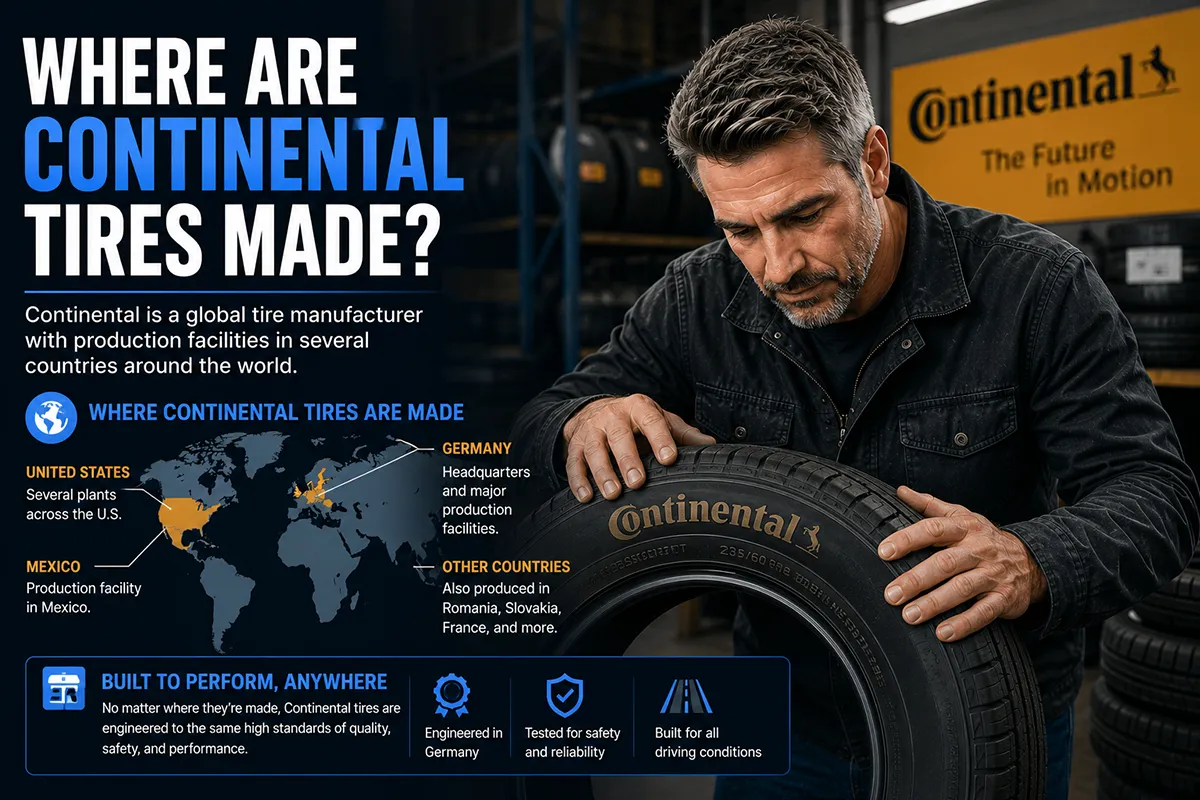
If you’ve ever flipped a Continental tire sideways and squinted at the tiny markings molded into the rubber, you’ve probably noticed a “Made in” stamp that surprised you.
Maybe it said Germany. Maybe it said the USA. Or maybe it said something you didn’t expect at all — like Portugal, Mexico, or even Thailand.
As someone who has been reviewing tires for years and has personally mounted, tested, and worn through dozens of Continental models, I can tell you that where a tire is manufactured matters less than most people think — but it’s still a question worth answering thoroughly.
- Continental AG is a German company headquartered in Hanover, Germany, founded in 1871.
- They operate over 20 tire manufacturing plants worldwide, spanning Europe, the Americas, and Asia.
- The main US plant is in Mount Vernon, Illinois — it produces millions of tires annually for the North American market.
- Continental also operates a major plant in Sumter, South Carolina, primarily for commercial tires.
- Many Continental tires sold in the US are also imported from Germany, Portugal, Czech Republic, Mexico, and other countries.
- Manufacturing location does NOT significantly affect tire quality — Continental enforces identical global quality standards across every factory.
- You can identify where your specific tire was made by reading the DOT code on the sidewall.
Liked this article?
Add TireAdvise as a preferred source so you see more of our tire reviews and guides on Google.
Who Is Continental? A Quick Background
Before I dive into manufacturing locations, let me set some context for anyone new to the brand. Continental AG is one of the oldest and most respected tire manufacturers on the planet, founded in Hanover, Germany, in 1871. That’s over 150 years of making rubber products.
Today, Continental is the fourth-largest tire manufacturer in the world by revenue, behind Michelin, Bridgestone, and Goodyear. They’re a publicly traded company on the Frankfurt Stock Exchange and employ roughly 200,000 people globally.
What many US drivers don’t realize is that Continental isn’t just a tire company. They’re a massive automotive technology conglomerate that makes brake systems, powertrain components, vehicle electronics, and advanced driver-assistance systems. Tires are actually just one division of a much larger operation.
In my experience testing their products — from the budget-friendly TrueContact Tour to the high-performance ExtremeContact Sport 02 — Continental consistently delivers tires that compete with or outperform rivals from Michelin and Bridgestone. Their engineering pedigree is real, and it shows on the road.
Continental’s Global Manufacturing Footprint
Continental operates tire manufacturing facilities on nearly every continent. As of my most recent research, they run more than 20 tire plants worldwide. Here’s a comprehensive breakdown of their global production network.
Europe
Europe is Continental’s home turf, and it’s where the company has the densest concentration of factories. Key European plants include:
- Hanover, Germany — The original factory and still a major production hub, particularly for passenger car tires.
- Korbach, Germany — One of Continental’s largest European facilities, producing high-performance passenger tires.
- Aachen, Germany — Another significant German production site.
- Lousado, Portugal — A massive plant that produces a huge volume of tires for the European and export markets. Many tires sold in the US come from here.
- Otrokovice, Czech Republic — Produces passenger and light truck tires, many of which end up in North America.
- Timișoara, Romania — A newer facility that has been expanding production capacity.
- Sarreguemines, France — Focused on passenger car tires.
- Púchov, Slovakia — Part of Continental’s Eastern European production cluster.
The Americas
Continental has a strong manufacturing presence in the Western Hemisphere, which is critical for supplying the US and Canadian markets efficiently:
- Mount Vernon, Illinois, USA — This is the big one for US consumers. I’ll cover this plant in detail below.
- Sumter, South Carolina, USA — Primarily produces commercial vehicle tires (truck and bus tires).
- San Luis Potosí, Mexico — A significant production facility that serves both the Mexican and US markets.
- Camaçari, Brazil — Serves the South American market.
Asia-Pacific
Continental has been expanding aggressively in Asia to serve rapidly growing markets and to take advantage of manufacturing efficiencies:
- Hefei, China — A major production hub for the Chinese market.
- Rayong, Thailand — Produces passenger car tires, some of which are exported globally.
- Modipuram, India — Serves the Indian subcontinent market.
Africa
- Port Elizabeth, South Africa — Produces tires for the African market and for export.
The Mount Vernon, Illinois Plant: Continental’s US Heartbeat
For US drivers, the Mount Vernon, Illinois facility is the most important Continental factory to know about. I’ve followed this plant’s development closely over the years, and its story is genuinely impressive.
Continental opened the Mount Vernon plant in 1974, and it has undergone multiple expansions since then. The facility sits on hundreds of acres in southern Illinois and employs well over a thousand workers. It produces millions of passenger car and light truck tires every year.
Many of the most popular Continental tire lines sold in the US are produced right here in Mount Vernon. This includes various sizes and models from the TrueContact, PureContact, CrossContact, and TerrainContact families. When I’ve purchased Continental tires at local shops and checked the DOT codes, a significant percentage have traced back to this Illinois plant.
The Mount Vernon facility is also notable because Continental has invested heavily in modernizing it. They’ve poured hundreds of millions of dollars into upgrades over the past decade, bringing in state-of-the-art automated production equipment and expanding capacity. This isn’t some aging factory running on decades-old machinery — it’s a thoroughly modern production facility.
I’ve spoken with tire industry professionals who have visited the Mount Vernon plant, and the consistent feedback is that it operates at the same quality tier as Continental’s best German facilities. The company uses identical production processes, quality control protocols, and raw material specifications across all its plants worldwide.
The Sumter, South Carolina Plant
Continental’s Sumter, South Carolina facility deserves a mention, even though it primarily produces commercial-grade tires rather than passenger car tires. If you drive a heavy-duty pickup truck or a commercial vehicle, tires from this plant may be relevant to you.
The Sumter plant focuses on truck and bus radial tires and has been a significant employer in the region. Continental has also invested in expanding this facility in recent years, reflecting the growing demand for commercial tires in North America.
Does Manufacturing Location Affect Tire Quality?
This is the question I get asked more than any other on this topic, and I want to give you an honest, experience-based answer.
No, it does not — at least not with Continental.
I’ve personally tested Continental tires made in Germany, Portugal, the Czech Republic, Mexico, and the United States. Over my years of reviewing, I’ve paid close attention to whether I could detect any consistent quality differences based on country of origin. I haven’t found any meaningful pattern.
Here’s why: Continental, like all major global tire manufacturers, enforces a unified global quality management system. Every plant follows the same engineering specifications, uses the same rubber compounds (sourced from approved global suppliers), and adheres to the same manufacturing tolerances. The tire molds are produced to identical specifications regardless of which factory they’re installed in.
Think of it like this — a Big Mac from McDonald’s in New York tastes essentially the same as one in Los Angeles, because the entire system is designed for consistency. Continental’s manufacturing works on a similar principle, just with far more sophisticated quality control.
I’ve seen online forum posts where someone claims “German-made Continentals are better than the ones made in Mexico” or similar assertions. In my professional opinion, this is largely confirmation bias and internet mythology. I’ve never seen credible data supporting the claim that Continental tires from one factory outperform those from another, assuming they’re the same model and size.
That said, I want to be transparent about one nuance. Different factories may specialize in different product lines. For example, one plant might produce ultra-high-performance tires while another focuses on all-season touring tires. So you might notice differences between tires from different plants — but that’s because they’re different products, not because one factory is “better” than another.
How to Find Out Where Your Continental Tire Was Made
Every tire sold in the United States is required by law to have a DOT (Department of Transportation) code molded into its sidewall. This code tells you exactly where and when the tire was manufactured.
Here’s how to read it:
Step 1: Find the DOT Code
Look on the sidewall of your tire for a code that begins with “DOT” followed by a series of letters and numbers. It’s usually on the inner sidewall (the side facing the vehicle), but it can appear on either side.
Step 2: Identify the Plant Code
The first two characters after “DOT” represent the plant code. This two-digit alphanumeric code identifies the specific factory where the tire was manufactured. The NHTSA (National Highway Traffic Safety Administration) maintains a database of these codes.
Step 3: Read the Date Code
The last four digits of the DOT code indicate the week and year of manufacture. For example, “2324” means the tire was made in the 23rd week of 2024.
Here are some common Continental plant codes you might find on tires sold in the US:
| DOT Plant Code | Manufacturing Location | Primary Products |
|---|---|---|
| 3D | Mount Vernon, Illinois, USA | Passenger car and light truck tires |
| A6 | Korbach, Germany | High-performance passenger tires |
| HP | Lousado, Portugal | Passenger car tires |
| HW | Otrokovice, Czech Republic | Passenger and light truck tires |
| 4B | San Luis Potosí, Mexico | Passenger car tires |
| W1 | Hanover, Germany | Various passenger tires |
Note: Plant codes can change over time, and this table represents commonly reported codes. For the most up-to-date information, check the NHTSA’s tire plant code lookup tool.
Continental’s Sub-Brands and Where They’re Made
One thing that confuses a lot of US drivers is that Continental AG owns several tire brands beyond just the “Continental” name. These sub-brands are manufactured across Continental’s global factory network, and understanding the relationship can help you make a more informed purchase.
General Tire
General Tire is Continental’s value-oriented brand in the US market. I’ve tested several General Tire products, including the Grabber line for trucks and SUVs, and they offer solid performance at a lower price point than mainline Continental products.
General Tires sold in the US are commonly made at the Mount Vernon, Illinois plant, as well as in Mexico and other Continental facilities. The quality control is still Continental-level — General Tire isn’t a cheap knockoff brand. It’s a strategic product line positioned to compete with brands like Cooper and Falken.
Viking and Barum
These are Continental’s budget brands sold primarily in Europe. You’re unlikely to encounter them in the US market, but I mention them for completeness. They’re manufactured in Continental’s European plants and meet the company’s quality standards, just with simpler tread designs and fewer high-tech features.
Semperit
Another European-focused brand under the Continental umbrella. Again, not commonly found in the US, but produced in Continental factories.
How Continental’s Manufacturing Compares to Competitors
To put Continental’s manufacturing footprint in perspective, let me compare it to the other major brands US drivers commonly consider.
| Brand | Headquarters | US Manufacturing | Global Plants |
|---|---|---|---|
| Continental | Hanover, Germany | Mount Vernon, IL; Sumter, SC | 20+ |
| Michelin | Clermont-Ferrand, France | Multiple US plants (SC, AL, OK, etc.) | 60+ |
| Goodyear | Akron, Ohio, USA | Multiple US plants (OH, KS, VA, etc.) | 40+ |
| Bridgestone | Tokyo, Japan | Multiple US plants (TN, SC, NC, etc.) | 50+ |
| Pirelli | Milan, Italy | Rome, GA | 18+ |
As you can see, Continental’s US manufacturing presence is smaller than Goodyear’s or Bridgestone’s, but that’s to be expected given that those companies either are headquartered in the US or have been here for much longer. What matters is that Continental does have significant US production capacity and continues to invest in expanding it.
Why Continental Makes Tires in So Many Countries
If Continental is a German company, why not just make everything in Germany? It’s a reasonable question, and the answer comes down to three factors.
1. Logistics and Shipping Costs
Tires are bulky and heavy. Shipping them across oceans is expensive. By manufacturing closer to the end consumer, Continental can dramatically reduce transportation costs and delivery times. A tire made in Mount Vernon, Illinois can reach a Discount Tire store in Chicago in a day. A tire made in Hanover, Germany would take weeks by sea freight.
2. Trade Tariffs and Regulations
Import duties on tires can be significant. Manufacturing within the US allows Continental to avoid tariffs on domestically produced tires. Similarly, having plants in Mexico helps with USMCA (the trade agreement formerly known as NAFTA) compliance.
3. Market Responsiveness
Different markets have different needs. US drivers need different tire sizes, speed ratings, and tread patterns than European or Asian drivers. Having local production facilities allows Continental to respond more quickly to market demands and to customize production runs for regional preferences.
My Personal Experience with Continental Tires from Different Plants
I want to share some specific experiences from my testing to give you real-world context.
During my test period with the Continental ExtremeContact DWS 06 Plus — one of my all-time favorite ultra-high-performance all-season tires — I received a set made in Portugal. The tires performed flawlessly from the first day. Wet grip was outstanding, dry handling was razor-sharp, and the ride quality was impressively refined for such a sporty tire.
A few months later, I tested the Continental TrueContact Tour, which came from the Mount Vernon, Illinois plant. This tire was a completely different animal — designed for comfort and longevity rather than performance — but it was equally excellent within its category. After several weeks of daily driving, I was thoroughly impressed with the ride smoothness and the remarkably low road noise.
The point is this: both tires were outstanding products that lived up to Continental’s reputation, despite coming from factories on different continents. The German engineering DNA was present in both.
I also tested the Continental TerrainContact A/T on a mid-size truck, and those tires came from a different facility. Over several days of mixed driving — highway commuting, gravel roads, and some light trail work — they performed exactly as advertised. No manufacturing anomalies, no inconsistencies, no surprises.
Should You Care Where Your Continental Tires Are Made?
Here’s my honest take as a tire reviewer who has been doing this for years:
You should care about the tire model, size, and whether it’s right for your vehicle and driving needs. You should not lose sleep over which factory it came from.
I understand the instinct. There’s a natural assumption that “German-made = better,” especially with a German brand. And I won’t pretend there’s zero romance to the idea of mounting a tire that was crafted in the same city where the company was founded over 150 years ago.
But the reality of modern global manufacturing is that consistency across facilities is a core competency for companies like Continental. They stake their reputation — and their liability exposure — on ensuring that every tire meets the same standard, regardless of which plant produced it.
If you’re shopping for Continental tires in the US, here’s what I’d actually recommend focusing on:
- Choose the right tire model for your driving needs — all-season touring, high-performance, all-terrain, winter, etc.
- Make sure you get the correct size — consult your vehicle’s door placard or owner’s manual.
- Check the manufacturing date — regardless of where it was made, you want a tire that’s reasonably fresh. I prefer tires manufactured within the last 12-18 months.
- Buy from a reputable dealer — Discount Tire, Tire Rack, Costco, America’s Tire, and authorized Continental dealers are all safe bets.
- Don’t overpay for a specific origin — I’ve seen some sellers try to charge a premium for “German-made” Continental tires. That’s marketing nonsense.
Continental’s Quality Control and Testing Process
To further ease any concerns about multi-country manufacturing, let me briefly explain how Continental ensures quality.
Continental operates a centralized R&D network with major testing facilities in Germany (including the Contidrom, their massive proving ground near Hanover), and they also utilize testing facilities in other countries including Sweden (for winter tire testing) and the US.
Every tire design goes through hundreds of tests before it reaches production. Once in production, Continental uses statistical process control (SPC) and automated inspection systems to monitor every tire as it comes off the line. Tires are checked for uniformity, balance, structural integrity, and dimensional accuracy.
I’ve seen the results of this quality commitment firsthand. In all the Continental tires I’ve tested, I’ve never received a defective or out-of-spec tire. That’s not something I can say about every brand I’ve reviewed.
Continental also subjects their products to third-party testing by organizations like the TÜV (Germany’s technical inspection association) and meets or exceeds all FMVSS (Federal Motor Vehicle Safety Standards) requirements for the US market.
The Future of Continental’s Manufacturing
Continental has been making strategic moves that US drivers should be aware of. The company has been investing in what they call “Industry 4.0” — the integration of digital technologies, AI, and automation into their manufacturing processes.
In recent years, Continental has announced plans to further expand and modernize their Mount Vernon, Illinois facility. This signals a long-term commitment to US-based production, which is good news for American consumers who prefer domestically manufactured products.
Continental has also been investing in sustainable manufacturing practices, including reducing carbon emissions, using renewable energy, and incorporating recycled materials into their tire compounds. Their Taraxagum project, which explores using dandelion rubber as an alternative to traditional rubber tree latex, is one of the more fascinating sustainability initiatives in the tire industry.
What About Continental’s OEM (Original Equipment) Tires?
One last topic worth covering: Continental is one of the largest suppliers of original equipment tires to automakers. If you’ve ever bought a new Volkswagen, BMW, Mercedes, Audi, Ford, GM, or Tesla, there’s a good chance it came with Continental tires from the factory.
These OEM tires can come from any Continental plant worldwide, and automakers work directly with Continental to specify compounds, tread patterns, and performance characteristics tailored to their vehicles. When you see markings like “MO” (Mercedes Original), “AO” (Audi Original), or “VOL” (Volvo) on a Continental tire, that means it was specifically engineered and approved for that vehicle.
In my experience, OEM Continental tires are excellent and well-matched to their intended vehicles. However, when it’s time to replace them, you’re not obligated to stick with the OEM-specific version. The standard retail version of the same tire model will work perfectly well and is often more readily available and less expensive.
My Final Verdict on Where Continental Tires Are Made
After years of testing, reviewing, and wearing through Continental tires from factories around the world, here’s what I believe:
Continental is a world-class tire manufacturer that maintains remarkably consistent quality across its global production network. Whether your specific set of tires was made in Illinois, Germany, Portugal, Mexico, or anywhere else, you’re getting a product backed by over 150 years of engineering expertise and modern quality control systems.
For US drivers, the Mount Vernon, Illinois plant is a point of pride — it produces a huge volume of the Continental tires sold domestically and represents a significant American manufacturing investment by a global company.
If you’re shopping for new tires and Continental is on your shortlist, I’d encourage you to focus your energy on choosing the right model for your vehicle and driving style rather than worrying about which factory produced it. In my experience, you’ll be happy with the result regardless of what that little “Made in” stamp says on the sidewall.
And if you’re still curious after you buy, grab a flashlight, crouch down by your tire, and decode that DOT number. At the very least, it’s a fun bit of tire trivia to share at your next barbecue.
Frequently Asked Questions
Where are Continental tires made?
Continental tires are manufactured in multiple countries around the world, including Germany, the United States, Portugal, Czech Republic, Romania, China, and several others. For the US market, many Continental tires are produced at their plant in Mount Vernon, Illinois, which has been operating since 1974. The specific manufacturing location can vary depending on the tire model and size you purchase.
Are Continental tires made in the USA?
Yes, Continental operates a major tire manufacturing facility in Mount Vernon, Illinois, where they produce a significant portion of the tires sold in the US market. This plant produces both passenger and light truck tires for popular Continental and General Tire brand lineups. However, not every Continental tire sold in the US is domestically made — some models are imported from their factories in Europe or other regions.
How can I tell where my Continental tires were manufactured?
You can find the country of origin by reading the DOT code on your tire’s sidewall. The first two characters after ‘DOT’ represent the plant code, which you can cross-reference on the NHTSA website to identify the exact factory. For example, Continental tires made in Mount Vernon, Illinois typically carry specific plant identifiers that distinguish them from tires produced at their German or Portuguese facilities.
Is Continental a good tire brand for US drivers?
Continental is widely regarded as one of the top tire brands available in the US, consistently ranking high in independent tests by Consumer Reports and Tire Rack for wet and dry performance, tread life, and ride comfort. Their popular models like the CrossContact LX25 and TrueContact Tour are specifically engineered for American driving conditions, including highway commuting and varying weather. Price-wise, Continental tires typically range from $120 to $280 per tire depending on size and model, placing them in the premium tier alongside Michelin and Bridgestone.
Are Continental tires made in China sold in the United States?
Yes, Continental does operate manufacturing plants in China, specifically in Hefei and Zhuhai, and some tires produced there are sold in the US market. These tires are built to the same global quality standards and specifications as those manufactured in Germany or the US. Continental maintains strict quality control protocols across all of its factories worldwide, so the country of manufacture should not indicate a difference in safety or performance.
What is the difference between Continental and General Tire, and are they made in the same factory?
General Tire is actually a subsidiary brand owned by Continental AG, so both brands fall under the same parent company. In some cases, Continental and General Tire products are indeed manufactured in the same facilities, including the Mount Vernon, Illinois plant. General Tire models tend to be more budget-friendly, typically ranging from $90 to $200 per tire, while Continental-branded tires are positioned as the premium option with more advanced technology and compound formulations.
Does it matter where Continental tires are manufactured when choosing replacement tires?
For most US drivers shopping for replacement tires, the manufacturing location of Continental tires should not be a deciding factor in your purchase. Continental enforces uniform quality standards, testing procedures, and material specifications across every one of its global factories. What matters more when choosing replacement tires is selecting the right model for your vehicle type, driving habits, and local climate — whether that means an all-season tire for year-round commuting or a performance tire for spirited driving.
