

You’re standing in a parking lot with a flat tire, rain starting to drizzle, and you’re staring at your Dodge Caravan wondering where on earth they hid the spare. I’ve been there — and I can tell you that Dodge didn’t exactly make it obvious.
After years of working with tires, reviewing replacements, and helping friends and family deal with roadside emergencies, I’ve learned that knowing where your spare lives *before* you need it is one of the most underrated pieces of car knowledge out there.
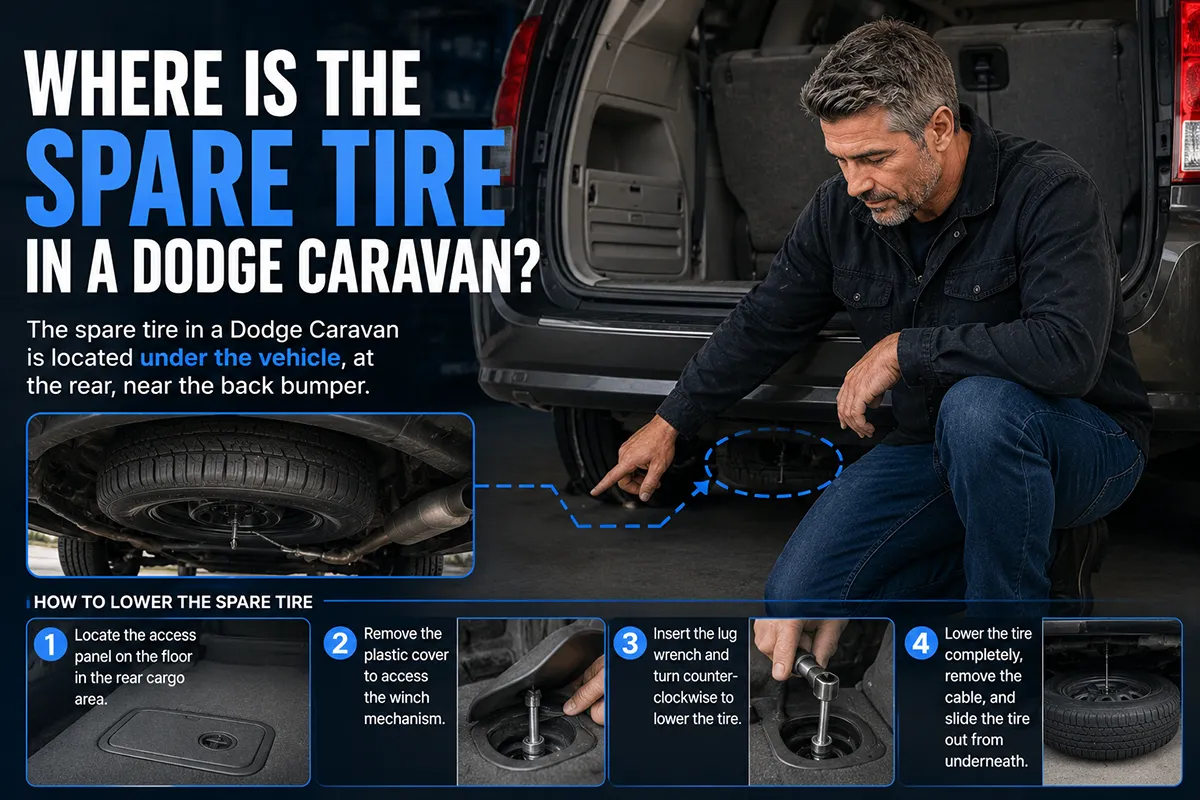
- The spare tire in most Dodge Caravans (1996–2020) is mounted underneath the vehicle, between the rear axle and the rear bumper.
- You lower it using a winch mechanism accessed through a hole in the rear cargo area floor or through the rear bumper.
- The jack and lug wrench are typically stored under the front passenger seat or in a compartment in the rear cargo area.
- The spare is a compact “donut” spare (T125/70D15 or similar) — not a full-size tire — and is rated for temporary use only at speeds under 50 mph.
- I recommend checking your spare’s air pressure at least twice a year because under-vehicle spares lose pressure over time.
Liked this article?
Add TireAdvise as a preferred source so you see more of our tire reviews and guides on Google.
Why This Question Matters More Than You Think
I’ve reviewed hundreds of tires and helped countless drivers choose replacements, but one thing I always stress is the importance of knowing your spare tire situation. It doesn’t matter if you’ve got the best all-season tires money can buy — a nail doesn’t care about your tread compound.
The Dodge Caravan (and its sibling, the Dodge Grand Caravan) was one of America’s best-selling minivans for decades, produced from 1984 all the way through 2020. Millions of these vans are still on US roads today. Yet I consistently hear from owners who have no idea where the spare tire is located or how to access it.
That’s a problem. And it’s one I want to solve for you right now — before you’re stranded.
Dodge Caravan Spare Tire Location: The Complete Breakdown
Let me cut right to it. In virtually every Dodge Caravan and Grand Caravan from 1996 through 2020, the spare tire is stored underneath the rear of the vehicle. It’s mounted to the undercarriage using a cable-and-winch system, hanging horizontally between the rear axle and the rear bumper.
If you crouch down behind your Caravan and look underneath toward the rear, you’ll see it hanging there — usually covered in road grime if it’s never been accessed. It’s held in place by a steel cable that connects to a winch mechanism inside the vehicle.
This under-vehicle mounting system is extremely common in minivans, SUVs, and trucks. Dodge used it because it saves valuable interior cargo space — something minivan buyers prioritize.
Differences by Generation
While the general location stays the same, there are slight differences in how you access the spare depending on your Caravan’s model year. Here’s a quick breakdown based on my hands-on experience with multiple generations:
- 1996–2000 (Third Generation): Spare is under the rear. The winch bolt is accessed through a small hole in the rear cargo floor, usually hidden under the cargo mat or a plastic cover.
- 2001–2007 (Fourth Generation): Same under-vehicle location. The access point is typically through the rear cargo area floor. Some models have the access hole near the rear bumper instead.
- 2008–2020 (Fifth Generation / Grand Caravan): Spare remains underneath the rear. On most of these models, the winch bolt access point is through a hole in the rear cargo floor, beneath the carpet. Some later models also allow access through a small square hole in the rear bumper area.
Regardless of generation, the process is fundamentally the same: you insert a rod into a bolt, turn it counterclockwise, and the spare lowers to the ground on a cable.
How to Access and Remove the Spare Tire: Step-by-Step
I’ve done this process personally on multiple Dodge Caravans, including during an actual roadside flat tire situation on a 2014 Grand Caravan. Here’s exactly how to do it.
Step 1: Locate Your Tools
Before you can lower the spare, you need to find the jack kit. In most Dodge Caravans, the jack, lug wrench, and winch rod are stored in one of two places:
- Under the front passenger seat: This is the most common location, especially in 2008–2020 models. Slide the seat all the way back and look underneath — there’s usually a molded tray or strap holding the jack assembly.
- Rear cargo area compartment: In some earlier models, the tools are stored in a well or compartment in the rear cargo area, often beneath the floor panel.
The kit should include a scissor jack, a lug wrench (sometimes L-shaped or cross-shaped), and a long metal rod that serves as the winch tool. This rod is the key to lowering the spare.
Step 2: Find the Winch Access Point
Open the rear liftgate and pull back the cargo area carpet. You should see a small circular or square hole in the floor — this is the access point to the spare tire winch bolt. In some models, you may need to remove a plastic plug or cap.
On certain model years, the access point is actually through the rear bumper. Look for a small square hole in the center of the rear bumper fascia, just above the license plate area.
Step 3: Lower the Spare Tire
Insert the long metal rod (or the assembled winch tool — sometimes the lug wrench and rod connect together) into the access hole. You’ll feel it engage with a bolt or nut inside.
Turn the rod counterclockwise. As you turn, you’ll feel resistance — that’s the cable unwinding from the winch spool. The spare tire will begin to lower from underneath the vehicle.
Keep turning until the tire rests on the ground with enough slack in the cable to pull it out from under the vehicle.
Step 4: Retrieve the Spare
Once the tire is on the ground, slide it out from underneath the vehicle. You’ll notice the cable passes through a hole in the center of the wheel. There’s a retainer or guide plate that you’ll need to tilt the tire to remove from the cable end.
This part can be a little tricky if you’ve never done it before. The cable end has a flat piece that passes through a keyhole-shaped slot in the retainer. Tilt the tire and align the flat piece with the wide part of the slot to release it.
Step 5: Change Your Tire
From here, the process is standard tire changing:
- Loosen the lug nuts on the flat tire (before jacking up the vehicle).
- Position the scissor jack under the vehicle’s designated jack point (check your owner’s manual — it’s typically on the pinch weld behind the front wheel or in front of the rear wheel).
- Jack up the vehicle until the flat tire clears the ground.
- Remove the lug nuts and flat tire.
- Mount the spare, hand-tighten the lug nuts in a star pattern.
- Lower the vehicle and torque the lug nuts to spec (100 ft-lbs is typical for the Caravan).
Step 6: Stow the Flat Tire
I always recommend putting the flat tire back in the spare tire location under the vehicle or at least inside the cargo area. Don’t leave it on the roadside — and don’t drive off without stowing it safely.
What Kind of Spare Tire Does the Dodge Caravan Have?
This is something a lot of owners don’t realize until they actually look at the spare. The Dodge Caravan comes with a compact temporary spare — commonly called a “donut” spare. It is not a full-size tire.
Here are the typical spare tire specifications I’ve encountered across various Caravan model years:
| Model Year Range | Common Spare Tire Size | Type | Max Speed Rating | Recommended Max Pressure |
|---|---|---|---|---|
| 1996–2000 | T125/70D15 | Compact Temporary | 50 mph | 60 psi |
| 2001–2007 | T125/70D15 or T135/70D16 | Compact Temporary | 50 mph | 60 psi |
| 2008–2020 | T135/70D17 or T145/80D17 | Compact Temporary | 50 mph | 60 psi |
The key takeaway: this spare is designed to get you to a tire shop — not to serve as a permanent replacement. I’ve seen people drive on donut spares for weeks, and I strongly advise against it. These tires are narrower, have less traction, and will affect your Caravan’s handling, braking, and Stow ‘n Go seat functionality (if the spare replaces a rear tire).
In my experience, you should aim to get a replacement tire within a day or two at most.
Common Problems With the Dodge Caravan Spare Tire System
Over the years of working with Dodge Caravans, I’ve encountered several recurring issues that every owner should know about. Being aware of these can save you serious frustration during an emergency.
1. The Winch Mechanism Seizes Up
This is the number one problem I see. Because the spare tire lives underneath the vehicle and is exposed to road salt, water, mud, and debris, the winch mechanism can corrode and seize over time. I’ve personally worked on Caravans where the winch bolt simply would not turn, no matter how much force I applied.
Prevention is simple: lower and raise your spare at least once a year. Apply some penetrating lubricant (like PB Blaster) to the winch mechanism while you’re at it. If you live in the northern US where road salt is used heavily in winter, I’d recommend doing this twice a year.
2. The Spare Tire Is Flat When You Need It
A spare tire that’s been sitting under your van for years will lose air pressure. This is just physics — all tires lose pressure gradually, and compact spares are no exception.
I check spare tire pressures for every vehicle I review, and I can tell you that a surprising number of them are dangerously low. The recommended pressure for most Caravan compact spares is 60 psi — significantly higher than the 35-36 psi typical for the regular tires. Check it with a quality gauge every time you check your regular tires.
3. The Cable or Retainer Is Rusted or Damaged
The steel cable and retainer plate can rust, making it difficult to disengage the spare from the cable. In severe cases, the cable can fray or break. If you notice rust or damage during your annual inspection, replace the components. A spare tire winch cable for a Dodge Caravan typically costs $20–$50 at auto parts stores like AutoZone or O’Reilly.
4. The Spare Is Missing Entirely
If you bought your Caravan used, there’s a chance the previous owner removed the spare and never replaced it. I’ve seen this more times than I’d like to admit. Always verify the spare is actually there when purchasing a used minivan.
Should You Replace the Compact Spare With a Full-Size Tire?
I get this question a lot, and my answer is: it depends on your priorities.
A full-size spare gives you the peace of mind of having a complete, road-ready tire that you can drive on normally after installation. However, the under-vehicle mounting system on the Dodge Caravan is designed for the compact spare’s dimensions and weight. A full-size tire (like a 225/65R16 or 225/65R17 common on Grand Caravans) may not fit properly in the spare tire cradle.
Some Caravan owners I’ve spoken with have successfully mounted a full-size tire underneath, but it often requires aftermarket modifications or simply carrying the full-size spare inside the cargo area. That eats into the Caravan’s main selling point — its cavernous interior space.
My recommendation: stick with the compact spare for the under-vehicle mount, but keep it properly inflated and inspected. If you’re planning a long road trip through remote areas, consider tossing a full-size tire inside the van as a backup. That’s what I do when I’m driving through less-populated parts of the western US where the nearest tire shop might be hours away.
Where to Buy a Replacement Spare Tire for a Dodge Caravan
If your spare is damaged, aged out (I recommend replacing any spare over 10 years old regardless of appearance), or missing, here’s where you can find replacements:
- Walmart Auto Center: They carry compact spare tires and can often order one specific to your Caravan. Prices typically range from $60–$120 for the tire and wheel assembly.
- Amazon: Search for your specific spare tire size and you’ll find multiple options. I’ve seen complete spare tire kits (tire + wheel) for Dodge Caravans priced between $80–$150.
- Discount Tire / America’s Tire: They can order a compact spare and even install it on the winch mechanism for you. This is my preferred option because they’ll also check the winch system while they’re at it.
- Local junkyards (Pull-A-Part, LKQ, etc.): If you’re on a budget, you can often find a complete spare assembly from a salvaged Caravan for $30–$60. Just make sure the tire isn’t cracked or dry-rotted.
- Dodge dealership: The most expensive option, but you’ll get an OEM-spec spare. Expect to pay $120–$200+.
When shopping for a replacement, always verify the bolt pattern matches your Caravan. Most Dodge Caravans use a 5x115mm bolt pattern, but some older models may differ. Double-check before you buy.
Tools You Should Keep in Your Dodge Caravan at All Times
Based on my experience dealing with flat tires and roadside situations, I recommend keeping these items in your Caravan beyond the factory jack kit:
- A portable tire inflator: A 12V plug-in inflator (like the EPAuto or VIAIR models, typically $25–$40) can reinflate a slow leak or top off your spare before mounting it. I keep one in every vehicle I drive regularly.
- A tire pressure gauge: Don’t rely on the inflator’s built-in gauge. A quality standalone gauge from brands like Milton or Accu-Gage ($8–$15) is more accurate.
- Penetrating lubricant: A small can of PB Blaster or Liquid Wrench. If your winch bolt is stuck, this can be a lifesaver.
- Work gloves: The underside of your vehicle is dirty, and the spare will be filthy. A pair of mechanic’s gloves ($5–$10) makes the job much more pleasant.
- A flashlight or headlamp: Flat tires don’t always happen in daylight. A rechargeable LED flashlight is essential.
- A breaker bar: If your lug nuts are overtightened (which happens more often than you’d think), the factory lug wrench might not give you enough leverage. A short breaker bar ($15–$20 at Harbor Freight) can make all the difference.
Spare Tire Safety Tips I Always Share
After spending years testing tires and dealing with countless flat-tire scenarios, here are the safety tips I always pass along to Dodge Caravan owners:
Never Exceed 50 MPH on a Compact Spare
I know this is tempting — especially on the highway. But compact spares are not built for highway speeds. Their smaller contact patch, thinner sidewalls, and different rolling diameter put stress on your drivetrain and reduce your braking capability. I’ve driven on compact spares during test situations, and the handling difference is immediately noticeable — even at lower speeds.
Don’t Drive Long Distances on the Spare
Most manufacturers recommend no more than 50–70 miles on a compact spare. I’ve pushed it a little further in real-world situations when necessary, but I always make getting to a tire shop my top priority. The longer you drive on a donut, the more stress you put on your differential and transmission — especially if the spare is on a drive wheel.
Be Aware of Stow ‘n Go Limitations
If you have a Grand Caravan with Stow ‘n Go seating and your flat is on one of the rear wheels, mounting the compact spare on the rear can affect the Stow ‘n Go floor compartments because of the different ride height. It’s a minor issue, but worth being aware of.
Check the Spare’s Age
Every tire has a DOT date code on its sidewall — a four-digit number where the first two digits are the week and the last two are the year of manufacture. For example, “2318” means the tire was made in the 23rd week of 2018. I recommend replacing any spare tire that’s more than 10 years old, regardless of how it looks. Rubber degrades over time, and a blowout on a degraded spare defeats the entire purpose of carrying one.
What About the Chrysler Voyager and Dodge Caravan’s Successor?
Since the Dodge Grand Caravan was discontinued after the 2020 model year, many drivers are now moving to the Chrysler Voyager or the Chrysler Pacifica. The spare tire situation varies:
- Chrysler Voyager (2020–2023): The Voyager, which was essentially a budget-trim Pacifica, came with a compact spare tire in the same under-vehicle location. The access and lowering process is very similar to the Grand Caravan.
- Chrysler Pacifica (gas models): Most gas-powered Pacifica models include a compact spare under the vehicle. Same general process applies.
- Chrysler Pacifica Hybrid: The hybrid version does NOT come with a spare tire. The battery pack occupies the space where the spare would normally be. Instead, it comes with a tire repair kit (inflator and sealant). This is something I always flag for buyers — if you want a spare tire in a Pacifica Hybrid, you’ll need to carry one inside the vehicle.
If you’re a Dodge Caravan owner considering an upgrade, keep the spare tire situation in mind when shopping. In my opinion, having a physical spare tire is always preferable to relying solely on a sealant kit.
My Final Thoughts
I’ve been reviewing tires and advising drivers for years, and one of the simplest, most impactful things you can do for your safety is to familiarize yourself with your spare tire before you need it. Go outside this weekend, open up the rear of your Dodge Caravan, find the access hole, and practice lowering the spare. Check its pressure. Make sure the winch turns freely. Verify your jack and lug wrench are present and in working order.
The five to ten minutes this takes could save you an hour of frustration and stress on the side of a busy highway. And trust me — changing a tire when you’ve done it before in your driveway is a completely different experience than figuring it out for the first time on the shoulder of I-95 with traffic screaming past.
Your Dodge Caravan’s spare tire is right there underneath the rear of the vehicle, waiting patiently for the day you need it. Just make sure it’s ready when that day comes.
Frequently Asked Questions
Where is the spare tire located in a Dodge Caravan?
In most Dodge Caravan and Grand Caravan model years, the spare tire is stored underneath the vehicle toward the rear, mounted to the undercarriage between the rear wheels. You’ll need to use the jack and lug wrench (usually found under a panel in the rear cargo area) to lower the spare tire using a cable-and-winch mechanism. On some older models, the spare may be tucked inside the rear cargo area beneath the floor panel, so always check your owner’s manual for your specific year.
What size spare tire does a Dodge Grand Caravan use?
Most Dodge Grand Caravan models from 2008–2020 come equipped with a compact temporary spare tire, commonly a T135/80R17 or similar donut-style spare. This compact spare is designed for short-distance, low-speed driving (under 50 mph) and should be replaced with a full-size tire as soon as possible. If you’re shopping for a replacement spare, expect to pay between $80 and $150 depending on the brand and retailer.
How do you lower the spare tire on a Dodge Caravan?
To lower the spare tire, open the rear liftgate and locate the jack tool kit, which typically includes a rod-style tool and lug wrench. Insert the rod into the access hole near the rear bumper or through the cargo floor, then turn it counterclockwise to lower the spare tire cable until the tire reaches the ground. Slide the tire out from under the vehicle, unhook it from the cable retainer, and you’re ready to mount it.
Can I replace the compact spare on my Dodge Caravan with a full-size tire?
You can technically replace the compact spare with a matching full-size tire, but a full-size tire may not fit in the factory spare tire storage location under the Dodge Caravan without modifications. Many US drivers prefer to carry a full-size matching tire for longer road trips, especially in states with harsh weather, but you’d likely need to store it in the cargo area. A full-size replacement tire for a Dodge Caravan typically runs between $100 and $180 each depending on the brand and tread type.
How long can you drive on a spare tire on a Dodge Grand Caravan?
If your Dodge Grand Caravan has a compact donut spare, you should drive no more than 50 miles at speeds under 50 mph before replacing it with a full-size tire. Driving beyond these limits puts extra stress on your differential and transmission, and the thin spare offers significantly less traction, especially on wet or icy US roads. I always recommend heading straight to a tire shop to get a proper replacement or repair as soon as possible.
What should I do if the spare tire on my Dodge Caravan is flat or missing?
If you discover your spare is flat or missing, your best options are to call roadside assistance, use a portable tire inflator to temporarily re-inflate your damaged tire, or apply a tire sealant kit for a slow leak. Many newer Dodge Caravan owners in the US carry a 12V portable air compressor and plug kit as backup, which you can find at retailers like Walmart or AutoZone for $30–$60. It’s a good habit to check your spare tire pressure every few months since spares lose air over time even when unused.
Does the 2020 Dodge Grand Caravan come with a spare tire or just a tire repair kit?
The 2020 Dodge Grand Caravan does come equipped with a compact spare tire, jack, and lug wrench as standard equipment, unlike some newer minivans that have switched to tire repair kits only. The spare is located underneath the rear of the vehicle in the factory-mounted carrier. Since 2020 was the final model year for the Grand Caravan before being replaced by the Chrysler Pacifica and the new Chrysler Voyager, it’s worth confirming what your specific trim level includes if you’re buying one used.
