

You finally pulled the trigger on a great deal for tires online — maybe from Tire Rack, Amazon, or Walmart.com — and now you’re staring at four massive boxes in your garage wondering, “Okay, now what?”
You’re not alone. This is the exact moment where a lot of first-time online tire buyers feel stuck. The savings were real, but nobody told you how the installation part actually works.
I’ve been buying tires online for years and have had them installed at more than a dozen different places across the country. Let me walk you through every option, what it actually costs, and the mistakes I’ve learned to avoid the hard way.
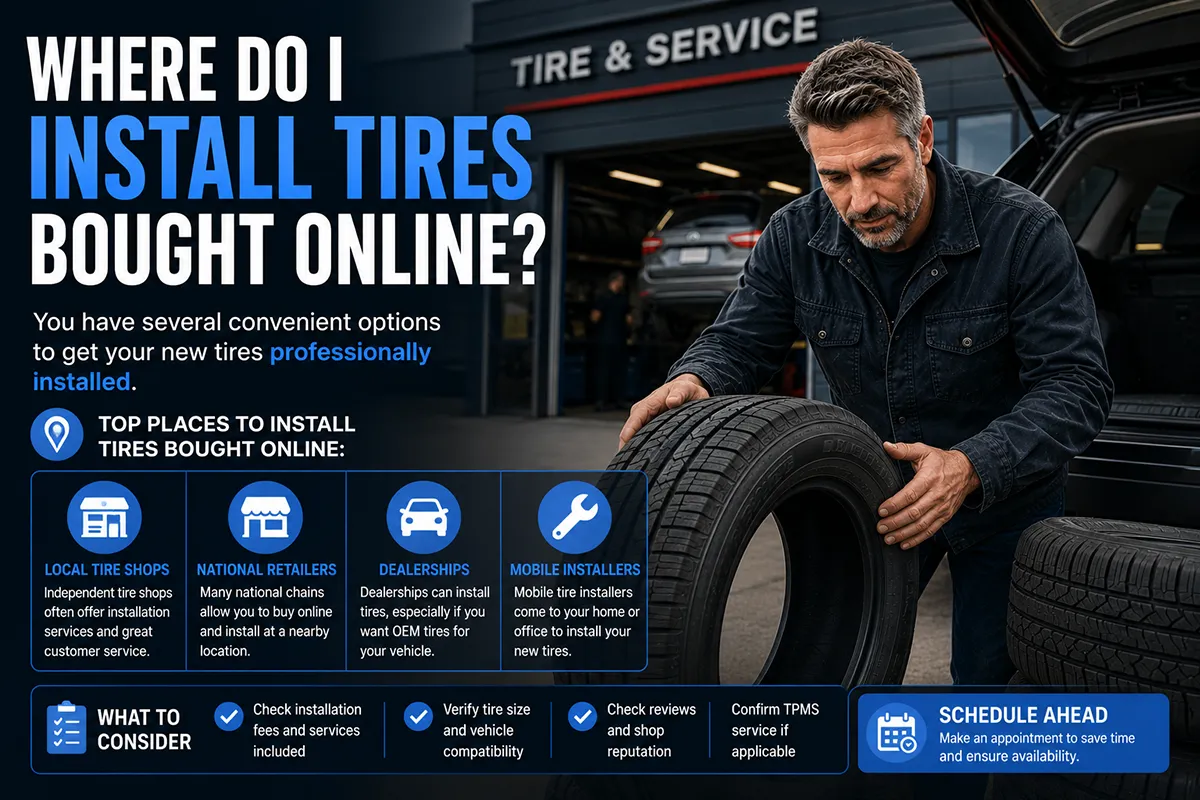
- You can get online-purchased tires installed at local tire shops, national chains (Discount Tire, Walmart, Costco), dealerships, and even mobile tire installers.
- Installation typically costs $15–$45 per tire, depending on the shop and services included.
- Many online retailers (Tire Rack, Simple Tire, Amazon) offer direct-to-installer shipping to make the process seamless.
- Always call ahead to confirm the shop accepts customer-supplied tires before showing up.
- Don’t forget to ask about mounting, balancing, valve stems, TPMS resets, and old tire disposal — these are often separate charges.
Liked this article?
Add TireAdvise as a preferred source so you see more of our tire reviews and guides on Google.
Why More People Are Buying Tires Online (And Facing This Question)
The online tire market has exploded over the past decade. Companies like Tire Rack, Simple Tire, Amazon, and even Walmart’s online marketplace have made it incredibly easy to compare prices, read reviews, and find tires for far less than many brick-and-mortar shops charge.
In my experience, I’ve saved anywhere from $50 to $200 on a set of four tires by buying online versus accepting the first quote from a local shop. That’s real money — enough to cover installation costs and still come out ahead.
But the trade-off is that buying online separates the purchase from the installation. When you buy at a physical tire shop, they handle everything. When you buy online, you need to figure out the installation logistics yourself.
The good news? It’s way easier than most people think. You have more options than you probably realize, and I’ve tested most of them.
Option 1: Local Independent Tire Shops
This is my go-to recommendation for most people, and it’s where I’ve had the best overall experiences.
Almost every town in America has at least one or two independent tire shops — the kind with a hand-painted sign, a small waiting area, and a mechanic who’s been doing this for decades. These shops are almost always happy to install tires you bring in.
Why I prefer local shops
The pricing is usually very competitive. I’ve paid as little as $15 per tire for mount and balance at independent shops, and the service tends to be fast and personal. Most of the time, I’m in and out within an hour.
Local shops also tend to be more flexible. They’ll work with you on scheduling, and they don’t usually charge surprise fees for TPMS resets or valve stem replacements — or if they do, the prices are transparent and reasonable.
How to find a good one
I always check Google Reviews and Yelp before choosing a shop. Look for places with at least a 4.0-star rating and read the recent reviews carefully. You want a shop where people mention fair pricing and honest service.
Call ahead before showing up. Ask specifically: “Do you install customer-supplied tires, and what’s your per-tire charge for mount, balance, and disposal?” This one phone call saves you a world of potential frustration.
Option 2: National Tire Chains
If you prefer the consistency of a big-name operation, several national chains will install tires you purchased elsewhere. Here’s what I’ve found at the major players.
Discount Tire / America’s Tire
Discount Tire (called America’s Tire on the West Coast) is one of the largest tire retailers in the US, and in my experience, they’re one of the most accommodating when it comes to installing tires bought elsewhere.
I’ve had them install online-purchased tires on two different vehicles. They charged around $20–$25 per tire for mounting, balancing, and new valve stems. The staff was professional both times, and the wait was reasonable.
One thing I really appreciate about Discount Tire: they don’t give you attitude about bringing in tires from somewhere else. Some shops make you feel like you’re committing a crime by not buying from them. Discount Tire doesn’t play that game.
Walmart Auto Care Centers
Walmart is a popular option because they’re everywhere and their pricing is among the cheapest. As of my most recent visit, Walmart charges about $16–$20 per tire for installation, which includes mounting, balancing, valve stems, and TPMS reset.
Here’s the catch: Walmart’s auto centers can be hit or miss on quality and wait times. I’ve had smooth, quick experiences, and I’ve also waited over three hours on a busy Saturday. If you go the Walmart route, I strongly recommend booking an appointment online and going on a weekday if possible.
Also, Walmart will only install tires that meet the vehicle manufacturer’s specifications. If you bought tires that are a different size than your OEM recommendation, they may refuse the install.
Costco Tire Center
Costco is a fantastic place to buy AND install tires, but here’s the thing most people don’t realize: Costco generally will not install tires that were not purchased through Costco. I’ve confirmed this at multiple locations.
If you’re a Costco member and haven’t bought your tires yet, it might be worth pricing them through Costco first. Their installation package is one of the best values in the industry — it includes lifetime balancing, rotations, flat repair, and nitrogen fills. But for tires bought elsewhere, you’ll likely need to look at other options.
Firestone Complete Auto Care
Firestone shops will install outside tires, though in my experience, their per-tire installation pricing tends to be higher — around $30–$40 per tire. They do solid work, and their shops are clean and professional, but you’re paying a premium for the brand name.
Pep Boys
Pep Boys has installed customer-supplied tires for me in the past. Their pricing was in the $25–$35 per tire range. Service quality has been decent but unremarkable. They’re a solid backup option if nothing else is nearby.
Option 3: Ship Directly to an Installer
This is the real game-changer that makes buying tires online almost as convenient as buying them in person — and it’s the option I use most often now.
Many major online tire retailers have partnerships with installation networks across the country. Instead of having tires shipped to your home and then lugging them to a shop yourself, you can ship them directly to a participating installer.
How Tire Rack’s installer network works
Tire Rack pioneered this model, and they do it best. During checkout, you enter your zip code and Tire Rack shows you a list of partner shops nearby. You select one, and Tire Rack ships your tires directly to that shop. Then you just book an appointment and show up.
I’ve used this probably half a dozen times, and it’s seamless. The installer already has your tires waiting when you arrive. You don’t touch a box. You don’t load anything into your trunk. It just works.
Installation pricing through Tire Rack’s partner shops typically runs $20–$30 per tire, though it varies by location. Tire Rack’s website shows you the installer’s pricing upfront, so there are no surprises.
Simple Tire’s installation partners
Simple Tire offers a similar ship-to-installer option. Their network includes many independent shops and some chains. I’ve used it once, and the process was straightforward — not quite as polished as Tire Rack’s, but it got the job done.
Amazon’s tire installation service
Amazon now offers tire installation through a partnership with Sears Auto Centers, Discount Tire, and other local shops. When you buy tires on Amazon, you can add installation during checkout and select a nearby participating shop.
I tried this once out of curiosity. The tires were shipped to a local Sears Auto Center, and I scheduled my appointment through Amazon. The installation itself was fine, though the communication between Amazon’s system and the shop felt a little disjointed. I’d probably default to Tire Rack’s system if given the choice, but Amazon’s option works.
Option 4: Your Car Dealership
Yes, your dealership’s service department will usually install tires you bring in. But in my experience, this is the most expensive option.
Dealership tire installation pricing tends to range from $35–$50 per tire, and some charge additional fees for TPMS recalibration, especially on newer vehicles. Unless you have a good relationship with your dealer or they’re running a special, I’d save this as a last resort.
That said, if you drive a car with specialized wheels, large-diameter rims, or run-flat tires, a dealership might have the specific equipment and expertise that a budget shop doesn’t. For my daily driver? I skip the dealer. For a friend’s BMW with staggered 20-inch wheels? The dealer was the right call.
Option 5: Mobile Tire Installation Services
Mobile tire installers come to you — your home, your office, wherever your car is parked. They pull up in a van equipped with tire mounting and balancing machines and do everything right there in your driveway.
Services I’ve tried
I’ve used two mobile tire services: Tire Agent’s mobile option and a local independent mobile installer I found on Google. Both times, the experience was surprisingly professional.
The technician arrived on time, had all the necessary equipment, and completed a four-tire swap in about 45 minutes. The convenience factor is unbeatable — I was working from home both times and barely had to interrupt my day.
Pricing and availability
Mobile installation typically costs $25–$45 per tire, so it’s a bit more expensive than going to a shop. But when you factor in the time saved — no driving to a shop, no waiting room, no arranging a ride — the premium is worth it for a lot of people.
Availability is the main limitation. Mobile tire services are more common in metro areas. If you live in a rural area, this might not be an option.
Installation Cost Comparison Table
Here’s a side-by-side comparison based on my actual experiences and current pricing as of 2024:
| Installation Option | Cost Per Tire | Includes TPMS Reset? | Accepts Outside Tires? | Convenience Rating |
|---|---|---|---|---|
| Local Independent Shop | $15–$25 | Usually included | Yes (call first) | ⭐⭐⭐⭐ |
| Discount Tire | $20–$25 | Yes | Yes | ⭐⭐⭐⭐⭐ |
| Walmart Auto Care | $16–$20 | Yes | Yes (OEM size only) | ⭐⭐⭐ |
| Costco Tire Center | N/A | N/A | No (Costco tires only) | N/A |
| Firestone | $30–$40 | Usually extra | Yes | ⭐⭐⭐⭐ |
| Pep Boys | $25–$35 | Varies | Yes | ⭐⭐⭐ |
| Dealership | $35–$50 | Yes | Usually yes | ⭐⭐⭐ |
| Mobile Installer | $25–$45 | Usually included | Yes | ⭐⭐⭐⭐⭐ |
What’s Actually Included in “Tire Installation”?
This is where a lot of people get surprised by extra charges. When a shop quotes you a per-tire price, you need to understand exactly what’s included — and what isn’t.
Mounting
This is the process of physically putting the new tire onto your wheel rim. It requires a specialized machine and is always included in any installation quote.
Balancing
After a tire is mounted, small weights are placed on the wheel to ensure it spins evenly. Unbalanced tires cause vibrations at highway speeds. Balancing should always be included, but double-check.
Valve stems
If your car has standard rubber valve stems (as opposed to TPMS sensors with built-in metal stems), these should be replaced every time you get new tires. Some shops include new valve stems; others charge $2–$5 per stem.
TPMS reset/relearn
If your vehicle has a Tire Pressure Monitoring System (most cars made after 2007 do), the system may need to be reset after new tires are installed. Some shops include this in their installation fee. Others charge $5–$15 per tire for the service. Always ask.
Old tire disposal
Your old tires need to go somewhere. Most shops charge a disposal or environmental fee of $2–$5 per tire. This is standard and unavoidable — it’s actually regulated by many states.
Alignment
A wheel alignment is NOT part of tire installation, but many shops will try to upsell you on one. Do you always need an alignment with new tires? Not necessarily — but if your old tires showed uneven wear, it’s a smart investment. A four-wheel alignment typically costs $80–$120.
In my experience, I get an alignment with about every other set of tires, or whenever I notice uneven wear patterns forming.
Step-by-Step: How I Install Tires Bought Online
Here’s my actual process, refined over many sets of tires and several years of doing this:
Step 1: Buy the right tires
Before anything else, make sure you’re buying the correct tire size for your vehicle. Check the sticker on your driver’s side door jamb or your owner’s manual. Online retailers like Tire Rack also let you search by year, make, and model to show only compatible tires.
Step 2: Decide where to install
Before you even place your tire order, figure out your installation plan. Call a few local shops and get quotes. If you’re using Tire Rack or Simple Tire, check their installer maps during checkout.
Step 3: Ship to installer or to your home
If your preferred shop is in the installer network of your online retailer, ship directly to them. It saves you the hassle of storing and transporting four bulky tires. If you need to ship to your home first, make sure you have space to store them and a vehicle large enough to transport them.
I once made the mistake of ordering tires to my apartment without thinking about how I’d get them to the shop. I ended up making two trips in the back seat of a sedan. Learn from my pain.
Step 4: Schedule an appointment
Don’t just show up. Call ahead or book online. Let them know you’ll be bringing in (or they’ll be receiving) customer-supplied tires. Confirm the installation price and what’s included.
Step 5: Drop off your car
Show up on time. If your tires were shipped to your home, bring them with you. If they were shipped to the shop, confirm they’ve arrived before your appointment.
Step 6: Inspect the work
When your car is done, take a minute before you drive off. Visually check that all four tires are mounted correctly and the lug nuts are present. Check your tire pressure — it should match the specification on your door jamb sticker. Confirm your TPMS light is off.
After several days of driving on new tires, I always go back and check (or have the shop recheck) the torque on the lug nuts. Many shops recommend a re-torque after the first few days of driving, and I think it’s a smart practice.
Tips I’ve Learned the Hard Way
Over the years, I’ve made plenty of mistakes with online tire purchases and installations. Here’s what I wish someone had told me upfront.
Always verify the shop accepts outside tires
I once drove 20 minutes to a shop with four tires in my trunk, only to be told they don’t install customer-supplied tires. A 60-second phone call would have saved me the trip.
Don’t forget about the warranty
Many tire manufacturers offer tread life warranties and road hazard coverage, but they may require professional installation to be valid. Keep your installation receipt. Some warranties also require that you get your tires rotated on a regular schedule, so ask about that too.
Check for online retailer installation rebates
Tire Rack and Simple Tire occasionally offer rebates or credits that help offset installation costs. I’ve gotten $40–$70 back in installation rebates on multiple occasions. Check for current promotions before you buy.
Consider buying a road hazard warranty
Some installation shops offer their own road hazard protection plans for $10–$20 per tire. In my experience, this is one of the few upsells that’s actually worth considering — especially if you drive in areas with construction, potholes, or debris. I’ve used a road hazard warranty once after a nail destroyed a nearly new tire, and it saved me the full cost of replacement.
Inspect your tires when they arrive
Before taking your tires to a shop (or before your appointment if they were shipped directly), inspect each tire. Look for the DOT date code on the sidewall — it’s a four-digit number indicating the week and year of manufacture. You want tires manufactured within the last 12–18 months. If you receive tires that are three or four years old, contact the retailer for a replacement.
What If a Shop Refuses to Install My Tires?
It happens, though it’s becoming less common. There are a few legitimate reasons a shop might decline:
- Wrong tire size: If the tires don’t match your vehicle’s specifications, a reputable shop will refuse to install them for safety reasons.
- Damaged tires: If a tire was damaged during shipping, they won’t mount it.
- Old tires: Tires that are several years old (even if never used) may be declined due to safety concerns about rubber degradation.
- Shop policy: Some shops simply don’t install tires they didn’t sell. Their business, their rules.
If you’re turned away, don’t panic. There are plenty of other options. In my experience, I’ve never been unable to find an installer within a reasonable distance.
Is It Worth Buying Tires Online?
After doing this many times, my answer is a definitive yes — for most people, most of the time.
The savings are real. Even after factoring in shipping (often free from major retailers) and installation fees, buying online has saved me significant money on every set I’ve purchased this way.
The selection is also far superior. A local shop might carry three or four options in your size. Online, you can compare dozens of brands and models, read hundreds of reviews, and make a truly informed decision.
The only scenario where I’d recommend buying locally instead is if your local shop is running a genuine deal that includes installation, balancing, alignment, and a road hazard warranty all bundled together. Some shops periodically offer these packages, and they can be hard to beat on total value.
My Personal Go-To Setup
For what it’s worth, here’s what I do every time I need new tires now:
I start by researching options on Tire Rack. I read professional reviews, user reviews, and compare specs. Once I’ve narrowed it down, I check pricing across Tire Rack, Simple Tire, Amazon, and Walmart.com.
Then I look at Tire Rack’s installer map to find a well-reviewed local shop that accepts direct shipments. I place my order, ship directly to the installer, and book my appointment for a few days after the estimated delivery date.
On installation day, I drop off my car, grab a coffee, and come back in about an hour. Simple, affordable, and I end up with exactly the tires I want at the best price I could find.
It took me a few tries to dial in this process, but now it’s second nature. And honestly, it’s less hassle than haggling at a tire shop in person.
Final Thoughts
The question “where do I install tires bought online?” used to be a real barrier for a lot of people. It’s not anymore. Between local shops, national chains, direct-to-installer shipping, and mobile services, you’ve got more options than ever.
My biggest piece of advice? Don’t let installation logistics scare you away from buying online. The process is straightforward, the savings are real, and once you’ve done it once, you’ll wonder why you ever overpaid at a tire shop.
Just remember to call ahead, confirm what’s included in the installation price, keep your receipts for warranty purposes, and inspect the work before you drive off. Do those four things, and you’ll have a completely painless experience.
If you found this guide helpful, bookmark TireAdvise.com for more no-nonsense tire buying guides and reviews. I’m always testing new tires and trying new installation options, and I share everything I learn right here.
Frequently Asked Questions
Where can I get tires installed that I bought online?
You can get tires you bought online installed at independent tire shops, national chains like Discount Tire, Tire Rack installation partners, Walmart Auto Care Centers, Costco Tire Centers (if purchased through them), and many local mechanics. Most shops charge between $15 and $45 per tire for mounting and balancing when you bring your own tires. I recommend calling ahead to confirm the shop accepts customer-supplied tires, as some locations have policies against it or charge a slightly higher labor rate.
Does Walmart install tires purchased from another retailer or online store?
Yes, most Walmart Auto Care Centers will install tires you purchased online or from another retailer. The standard installation fee is around $16 per tire for mounting and balancing, which includes valve stems and a lifetime balance and rotation package. Keep in mind availability varies by location, so I’d suggest scheduling an appointment online or calling your local Walmart to confirm they can accommodate customer-supplied tires.
How much does it cost to have someone mount and balance tires I bought online?
Mounting and balancing tires you bought online typically costs between $15 and $45 per tire at most US shops, with the national average falling around $20 to $30 per tire. This usually includes mounting the tire on the rim, balancing, installing new valve stems, and disposing of your old tires. Some retailers like Tire Rack partner with local installers and offer bundled installation rates as low as $18 per tire if you ship directly to the shop.
Can I ship tires I bought online directly to an installer near me?
Yes, many online tire retailers like Tire Rack, SimpleTire, and Amazon let you ship tires directly to a partnered local installer, which saves you the hassle of transporting them yourself. When you check out, you can often select a nearby installation shop and the tires will be delivered straight to them. I’ve found this is the most convenient option because the shop will have your tires ready and waiting when you arrive for your appointment.
Will Discount Tire or Les Schwab install tires I didn’t buy from them?
Discount Tire generally will install tires you purchased elsewhere, though the installation fee may be slightly higher than for tires bought in-store — typically around $20 to $25 per tire for mount and balance. Les Schwab, on the other hand, historically prefers to install tires they sell and may decline outside tires at some locations, so it’s best to call your nearest store first. If you’re in the western US where Les Schwab is dominant, an independent shop or Discount Tire is usually a more reliable option for customer-supplied tires.
Is it cheaper to buy tires online and have them installed locally vs. buying at a tire shop?
In most cases, buying tires online and paying separately for local installation saves you $50 to $200+ on a full set compared to purchasing from a brick-and-mortar tire shop. Online retailers frequently offer lower per-tire prices, rebates, and free shipping that offset the $60 to $120 you’ll spend on mounting and balancing at a local installer. I always compare the total cost — tire price plus shipping plus installation fees — against quotes from at least two local shops to make sure I’m actually getting a better deal.
What should I look for when choosing a local shop to install my online tires?
Look for a shop with good Google reviews that specifically mentions accepting customer-supplied tires, transparent pricing for mounting, balancing, and old tire disposal, and a warranty on the installation work. Make sure they have experience with your tire size and vehicle type — especially if you drive an EV or a truck requiring larger off-road tires. I also recommend asking whether their installation includes a road force balance and TPMS sensor reset, since some budget shops skip those steps and it can lead to vibrations or dashboard warning lights.
