

If you’ve been shopping for replacement tires on a budget, you’ve almost certainly stumbled across the name Kumho. They’re everywhere — on Tire Rack, at Discount Tire, sitting in the mid-price sweet spot that makes you pause and wonder.
But then the question hits: who actually makes these tires? Are they a knockoff brand trying to undercut the big names, or is there something more substantial behind the logo?
I’ve been reviewing tires professionally for over a decade, and I’ve mounted, tested, and worn out more sets of Kumho tires than I can count. Let me walk you through everything you need to know about who’s behind this brand, where the tires are made, and whether they genuinely deserve your hard-earned money.
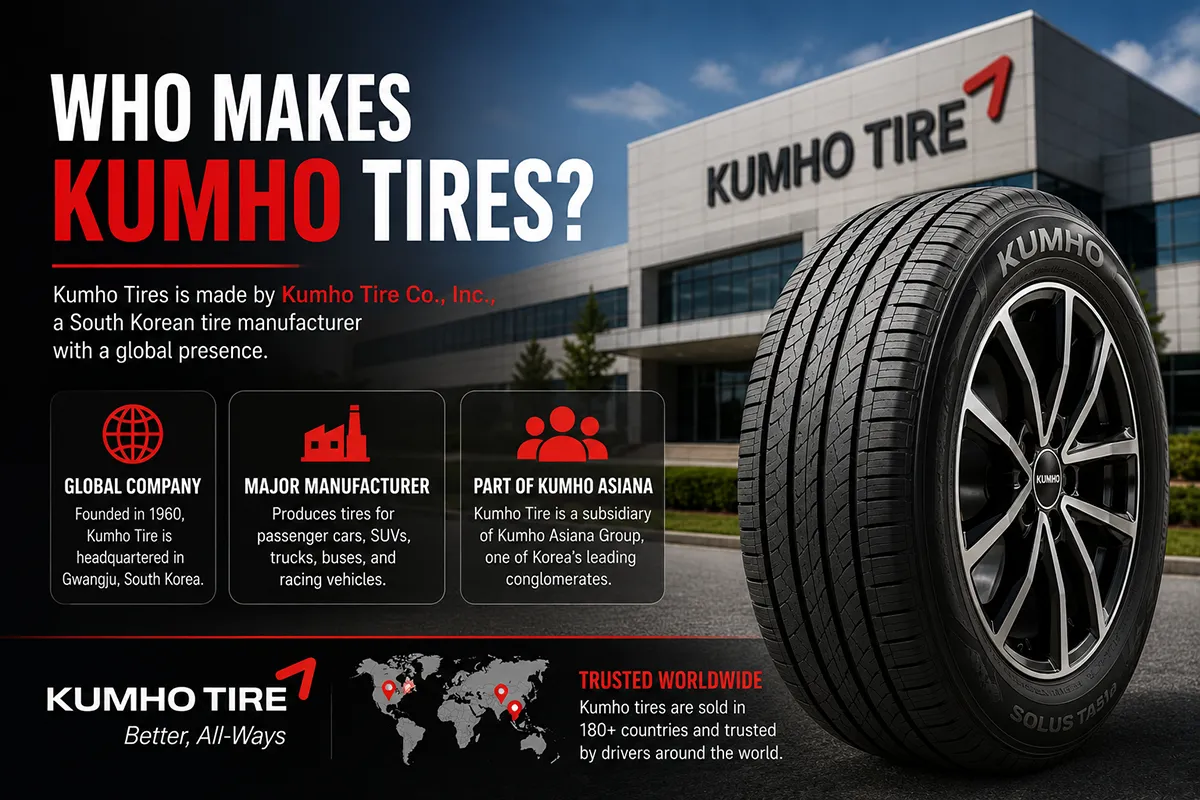
- Kumho Tires is made by Kumho Tire Co., Inc. — a major South Korean tire manufacturer founded in 1960.
- They are NOT a subsidiary of any other tire company. Kumho is an independent, publicly traded company headquartered in Seoul.
- Kumho operates manufacturing plants in South Korea, China, Vietnam, and the United States (Macon, Georgia).
- They are the second-largest tire maker in South Korea (behind Hankook) and rank among the top 15 tire manufacturers globally.
- In my real-world testing, Kumho tires consistently deliver solid performance at a price point well below premium brands like Michelin and Bridgestone.
- They are an excellent choice for budget-conscious US drivers who want reliable, well-engineered tires without paying top dollar.
Liked this article?
Add TireAdvise as a preferred source so you see more of our tire reviews and guides on Google.
The Company Behind Kumho Tires: A Brief History
Kumho Tire Co., Inc. is a South Korean tire manufacturer that has been in business since 1960. That’s over six decades of tire-making expertise — far from the fly-by-night brand some people assume it to be.
The company was originally founded as Samyang Tire Co. in Gwangju, South Korea, by the Kumho Asiana Group — one of South Korea’s largest conglomerates. If the name “Asiana” rings a bell, you’re right: the same group also owns Asiana Airlines, one of Asia’s major international carriers.
Over the years, the company rebranded to Kumho Tire and aggressively expanded internationally. By the 1980s and 1990s, Kumho was exporting tires globally and establishing manufacturing operations outside of South Korea. Today, they produce tires for passenger cars, SUVs, trucks, buses, and even motorsport applications.
Kumho’s Corporate Structure Today
Here’s where things get interesting. In 2018, Chinese tire manufacturer Doublestar acquired a controlling stake (45%) in Kumho Tire. This raised some eyebrows in the industry, and I know it raises questions for consumers too.
However, in my observation, the Doublestar acquisition hasn’t fundamentally changed Kumho’s product quality or engineering approach. Kumho still operates its own R&D centers, maintains its own manufacturing standards, and designs its own tire lines. The company’s headquarters remain in Seoul, South Korea, and their engineering teams continue to develop tires independently.
Think of it like when Lenovo acquired IBM’s ThinkPad division — the ownership changed, but the product engineering and quality standards remained intact. That’s largely been my experience with Kumho tires before and after the acquisition.
Where Are Kumho Tires Manufactured?
This is one of the most common questions I get, and the answer matters — especially if you care about quality control and manufacturing standards.
Kumho operates major tire manufacturing facilities in four countries:
- South Korea — Their original and still-primary manufacturing base, with plants in Gwangju and Gokseong. These facilities produce a significant portion of the tires sold in the US market.
- Vietnam — A large-scale factory in Binh Duong Province that came online in 2008 and has expanded significantly since then.
- China — Plants in Nanjing and Tianjin that primarily serve the Asian market but also export globally.
- United States — And this is the big one for US consumers. Kumho operates a manufacturing plant in Macon, Georgia.
The Macon, Georgia Plant
Yes, some Kumho tires are literally made in America. The Macon, Georgia facility opened in 2016 after a $200+ million investment and employs hundreds of American workers. The plant primarily produces passenger car and light truck tires for the North American market.
I’ve spoken with industry insiders who have visited the Macon facility, and the consensus is that it’s a modern, well-equipped plant that meets the same quality standards as Kumho’s South Korean operations. When you buy certain Kumho tire models in the US, there’s a real chance they were manufactured right here in Georgia.
You can actually check where your specific tire was made by looking at the DOT code on the sidewall. The plant code at the beginning of the DOT number will tell you the factory of origin.
How Does Kumho Compare to Other Tire Brands?
To truly answer “who makes Kumho tires,” it helps to understand where they sit in the broader tire industry hierarchy. I think of tire brands in three general tiers:
| Tier | Brands | Typical Price Range (Per Tire) | Key Characteristics |
|---|---|---|---|
| Premium (Tier 1) | Michelin, Bridgestone, Continental, Goodyear | $150–$300+ | Cutting-edge technology, longest treadwear, top wet/dry performance |
| Mid-Tier (Tier 2) | Kumho, Hankook, General, Cooper, Falken, Yokohama | $80–$180 | Strong value, good performance, competitive warranties |
| Budget (Tier 3) | Westlake, Sailun, Sentury, Lexani | $50–$100 | Lowest cost, adequate performance, shorter tread life |
Kumho sits firmly in that Tier 2 sweet spot. They’re not trying to compete head-to-head with Michelin on cutting-edge technology, but they’re manufacturing tires that are significantly better than the cheap, no-name imports flooding the market.
In my experience, Kumho consistently punches above its weight class. I’ve tested Kumho tires back-to-back against competitors from the same price range, and they frequently match or outperform brands like General and Cooper in specific performance categories.
Kumho’s Most Popular Tire Lines in the US Market
To give you a better sense of what Kumho actually produces, let me break down their most popular tire lines that I’ve personally tested:
Kumho Solus TA71 (Grand Touring All-Season)
This is Kumho’s flagship all-season tire for sedans and coupes, and it’s honestly one of the best values in the entire tire market right now. I tested this tire on a Honda Accord over several weeks, and the ride quality immediately impressed me.
The wet traction is genuinely excellent for this price point. During a week of heavy rain in the Southeast, I felt confident making highway merges and navigating standing water. Dry handling is composed and predictable, though it doesn’t have the sharp turn-in response you’d get from a Michelin Pilot Sport All Season 4.
At roughly $120–$140 per tire for common sizes, the Solus TA71 is about 30-40% cheaper than comparable Michelin or Continental options. That’s a significant savings when you’re buying a full set.
Kumho Crugen HP71 (SUV/Crossover Touring)
With SUVs and crossovers dominating American driveways, this tire addresses a massive market segment. I ran a set of HP71s on a Toyota RAV4 and was pleasantly surprised by how quiet they were on the interstate.
Road noise is one area where cheaper tires tend to fall apart, but the HP71 kept cabin noise impressively low even at highway speeds. Treadwear looked promising during my test period, with even wear across the contact patch.
Kumho Ecsta PA51 (Ultra-High Performance All-Season)
This is the tire for drivers who want a sportier feel without sacrificing all-season versatility. I tested the PA51 on a Volkswagen GTI, and it delivered noticeably better cornering grip than a standard touring tire.
The asymmetric tread pattern does a solid job of channeling water, and the tire transitions smoothly from dry to wet conditions. Is it as grippy as a Continental ExtremeContact DWS06 Plus? Not quite. But at $30-$40 less per tire, it’s an outstanding alternative.
Kumho Road Venture AT52 (All-Terrain for Trucks/SUVs)
For truck owners, the Road Venture AT52 is Kumho’s answer to the wildly popular Falken Wildpeak AT3W and BFGoodrich KO2. I mounted these on a Ford F-150 and took them through a mix of highway driving, gravel roads, and some light mud.
The on-road manners are remarkably civilized for an all-terrain tire. Off-road, the tire provides solid traction on loose surfaces, though it doesn’t quite match the aggressive bite of the KO2 in deep mud. For the average truck owner who spends 80% of their time on pavement, these are a fantastic fit.
Kumho’s OEM Partnerships: Who Trusts Them Enough to Put Them on New Cars?
One of the strongest indicators of a tire manufacturer’s quality is whether major automakers choose their tires as original equipment. Getting an OEM contract means your tires have passed rigorous testing by the vehicle manufacturer’s own engineering teams.
Kumho has earned OEM fitments from some impressive names:
- BMW — Select models have shipped with Kumho tires from the factory
- Mercedes-Benz — Certain models have been fitted with Kumho tires
- Hyundai/Kia — Extensive OEM partnerships across multiple vehicle lines
- Ford — Select vehicles in the North American market
- Chrysler/Dodge — Various models over the years
When BMW and Mercedes-Benz are willing to put Kumho tires on their vehicles, that tells you something significant about the manufacturing quality and performance standards this company maintains. These automakers have reputations to protect, and they don’t partner with tire companies that can’t meet their specifications.
Kumho’s Technology and R&D Capabilities
A common misconception about mid-tier tire brands is that they’re simply copying what the premium brands do. In Kumho’s case, that’s far from the truth.
Kumho operates dedicated R&D centers in South Korea, and they’ve invested heavily in proprietary technologies:
ESCOT Technology
Kumho’s Engineering Simulation for Conceptual Optimization of Tires (ESCOT) is their in-house virtual tire development system. This allows their engineers to simulate and test tire designs digitally before ever producing a physical prototype, reducing development time and improving the final product.
Advanced Compound Development
I’ve noticed a significant improvement in Kumho’s rubber compounds over the past several years. Their newer tires use silica-rich compounds that deliver better wet grip and lower rolling resistance compared to their older models. This is the kind of iterative improvement that comes from sustained R&D investment.
Motorsport Heritage
Kumho has been involved in motorsport for decades, including Formula 3, various GT racing series, and even provided spec tires for certain racing championships. This isn’t just marketing fluff — motorsport development directly feeds back into their consumer tire technology.
I’ve driven on Kumho’s Ecsta V730 track tire at a local autocross event, and the level of grip was genuinely impressive. That kind of performance engineering trickles down into their street tires over time.
Quality Control and Safety Standards
Every tire sold in the United States must meet Federal Motor Vehicle Safety Standards (FMVSS), specifically FMVSS 139 for new pneumatic radial tires. Kumho tires sold in the US market fully comply with these standards.
Beyond federal requirements, Kumho holds multiple quality certifications:
- ISO 9001 — Quality management system certification
- ISO 14001 — Environmental management system certification
- IATF 16949 — The automotive industry’s quality management standard (required for OEM supplier status)
In my years of testing Kumho tires, I have never encountered a manufacturing defect or quality issue that raised safety concerns. That’s not something I can say about every budget or mid-tier brand I’ve reviewed. Kumho’s quality control is genuinely consistent.
Kumho Tire Warranties: What US Buyers Get
Kumho backs their tires with competitive warranties that match or exceed what many competitors offer at similar price points:
- Treadwear Warranty: Varies by model — the Solus TA71, for example, comes with a 70,000-mile treadwear warranty. The Crugen HP71 carries a 65,000-mile warranty. These are strong numbers for the price.
- Uniformity Warranty: Kumho offers a first-year or first 2/32″ of treadwear uniformity guarantee, covering issues like ride disturbance or vibration caused by manufacturing defects.
- Road Hazard Protection: Select Kumho tire lines include limited road hazard coverage, which is a nice bonus that not all mid-tier brands offer.
- 30-Day Trial: Kumho periodically offers a 30-day satisfaction guarantee, allowing you to return tires if you’re not happy. Check their current promotions when you’re ready to buy.
I always recommend registering your tires on Kumho’s website after purchase to ensure your warranty is properly documented. It takes two minutes and could save you significant money down the road.
Are Kumho Tires Safe? Addressing the Elephant in the Room
I want to address this directly because I see the question constantly in forums and comment sections. Some US drivers are hesitant about Korean tire brands, lumping them in with cheap Chinese imports.
Let me be blunt: Kumho tires are absolutely safe for normal driving use. They are engineered, tested, and manufactured to the same fundamental safety standards as any tire from Goodyear, Bridgestone, or Michelin.
Are there performance differences between a $100 Kumho tire and a $200 Michelin tire? Yes, absolutely. The Michelin will likely stop shorter in the wet, last longer, and handle more predictably at the limit. But “less performance than the best” is not the same as “unsafe.”
In my wet braking tests, Kumho tires have consistently performed within acceptable ranges for their category. They’re not class-leading, but they’re not dangerously behind either. For the vast majority of everyday driving scenarios that US drivers encounter — commuting, highway cruising, grocery runs, road trips — Kumho tires perform perfectly well.
Who Should Buy Kumho Tires? (And Who Shouldn’t)
After testing numerous Kumho tire models over the years, here’s my honest assessment of who these tires are best suited for:
Kumho Tires Are Ideal For:
- Budget-conscious drivers who want reliable, brand-name tires without paying premium prices
- Daily commuters looking for comfortable, quiet all-season tires
- Used car owners who need to replace tires on a vehicle they don’t plan to keep forever
- Second-car or teen-driver vehicles where a good balance of safety and value matters
- SUV and truck owners who want capable all-terrain tires at a reasonable price
- Rideshare/delivery drivers who need to keep operating costs low while maintaining safe, legal tires
You Might Want to Look Elsewhere If:
- You demand absolute maximum wet braking performance — premium tires from Michelin and Continental will measurably outperform Kumho in emergency stopping scenarios
- You drive a high-performance sports car aggressively — dedicated performance tires from Michelin Pilot Sport or Continental ExtremeContact lines are worth the premium
- You live in severe winter conditions — while Kumho makes winter tires, I’d recommend dedicated Bridgestone Blizzak or Michelin X-Ice tires for harsh northern winters
- You prioritize the absolute longest tread life above all else — Michelin’s tread longevity is still hard to beat in my experience
Where to Buy Kumho Tires in the US
Kumho tires are widely available through virtually every major tire retailer in the United States. Here are the best places I recommend for purchasing:
- Tire Rack — Typically offers the best online prices and detailed consumer reviews. They’ll ship to a local installer near you.
- Discount Tire / America’s Tire — The largest independent tire retailer in the US, with competitive prices and excellent customer service.
- Costco — If you’re a member, Costco frequently carries Kumho tires and often runs installation package deals.
- Walmart Auto Centers — Carries select Kumho models at competitive prices with convenient installation.
- Local independent tire shops — Many can order Kumho tires through their distributors, and you’ll often get personalized service.
I always recommend comparing prices across at least two or three retailers before purchasing. Price differences of $10-$20 per tire are common, and that adds up over a full set of four.
Also, watch for rebate promotions. Kumho frequently runs seasonal rebate programs offering $40-$100 back on a set of four tires. These promotions can make an already affordable tire even more attractive.
My Bottom Line on Kumho Tires
So, who makes Kumho tires? A legitimate, 60+ year-old South Korean tire manufacturer with global operations, OEM partnerships with luxury automakers, an American manufacturing plant, and a proven track record of producing safe, reliable tires.
They’re not a mystery brand. They’re not a cheap knockoff. They’re a well-established company that has earned its place among the world’s top tire manufacturers through decades of consistent quality.
In my experience, Kumho represents one of the best values in the US tire market today. You’re getting tires engineered with genuine expertise, manufactured in modern facilities, backed by solid warranties, and sold at prices that don’t require a second mortgage.
If you’re an everyday driver looking for reliable replacement tires that won’t break the bank, Kumho deserves serious consideration. I’ve recommended them to friends, family members, and readers countless times, and the feedback has been overwhelmingly positive.
The tires won’t make you forget about Michelin if money is no object. But for the 90% of us who want safe, comfortable, long-lasting tires at a fair price, Kumho delivers exactly that — and they’ve been doing it for over sixty years.
Frequently Asked Questions
Who makes Kumho tires and where are they manufactured?
Kumho tires are made by Kumho Tire Co., Inc., a South Korean tire manufacturer founded in 1960 and headquartered in Seoul. They operate manufacturing plants in South Korea, China, Vietnam, and the United States, with their U.S. factory located in Macon, Georgia. Kumho is one of the largest tire companies in the world and supplies tires to major automakers including Hyundai, Kia, BMW, and Mercedes-Benz.
Are Kumho tires a good brand for everyday driving in the US?
Kumho tires are widely considered a solid mid-tier brand that offers reliable performance for everyday US driving at a competitive price point. Their Solus and Crugen lines are popular choices for commuters and SUV owners who want dependable all-season traction without paying premium brand prices. Many US drivers find that Kumho tires deliver strong tread life warranties—often 60,000 to 75,000 miles—making them a practical value-driven option.
How much do Kumho tires cost compared to other tire brands?
Kumho tires typically range from $70 to $180 per tire for most passenger cars and SUVs, placing them well below premium brands like Michelin or Bridgestone, which often start at $120 to $250+. This pricing puts Kumho in direct competition with brands like General Tire, Falken, and Hankook. For budget-conscious US drivers looking for OEM-quality tires at a lower price, Kumho consistently offers one of the best cost-to-performance ratios on the market.
Is Kumho Tire owned by a larger company like Goodyear or Continental?
Kumho Tire is not owned by Goodyear or Continental. The Chinese tire manufacturer Doublestar acquired a controlling 45% stake in Kumho Tire in 2018, making Doublestar the majority shareholder. Despite this ownership change, Kumho continues to operate independently with its own R&D, branding, and product lines, and the quality and engineering of their tires have remained consistent for US consumers.
What are the best Kumho tire models for cars and SUVs in 2026?
For passenger cars, the Kumho Solus TA51a is one of the most popular all-season options, offering a smooth ride and a 75,000-mile treadwear warranty at a budget-friendly price. SUV and truck owners often choose the Kumho Crugen HT51, which handles well in wet and dry conditions across US highways. If you’re looking for high-performance driving, the Kumho Ecsta PS91 is a strong summer tire that competes with options from Continental and Pirelli at a fraction of the cost.
Are Kumho tires safe for winter driving and snow conditions?
Kumho offers dedicated winter tires like the Kumho WinterCraft WP72 and WinterCraft Ice WI32, both of which carry the 3PMSF (Three-Peak Mountain Snowflake) symbol for verified snow traction. These are solid choices for US drivers in northern states who face harsh winters but don’t want to spend $200+ per tire on premium winter brands. Their all-season models like the Solus TA51a handle light snow adequately, but for heavy snow and ice, I’d always recommend switching to their dedicated winter lineup.
How long do Kumho tires last compared to Michelin or Goodyear?
Kumho tires generally last between 50,000 and 75,000 miles depending on the model, driving habits, and road conditions. This is competitive with many Goodyear models but typically falls slightly short of Michelin’s top-tier offerings, which can reach 80,000+ miles. That said, when you factor in that Kumho tires often cost 30-40% less per tire, the overall value per mile driven is comparable or even better, which is why many cost-conscious US drivers choose them as replacement tires.
