

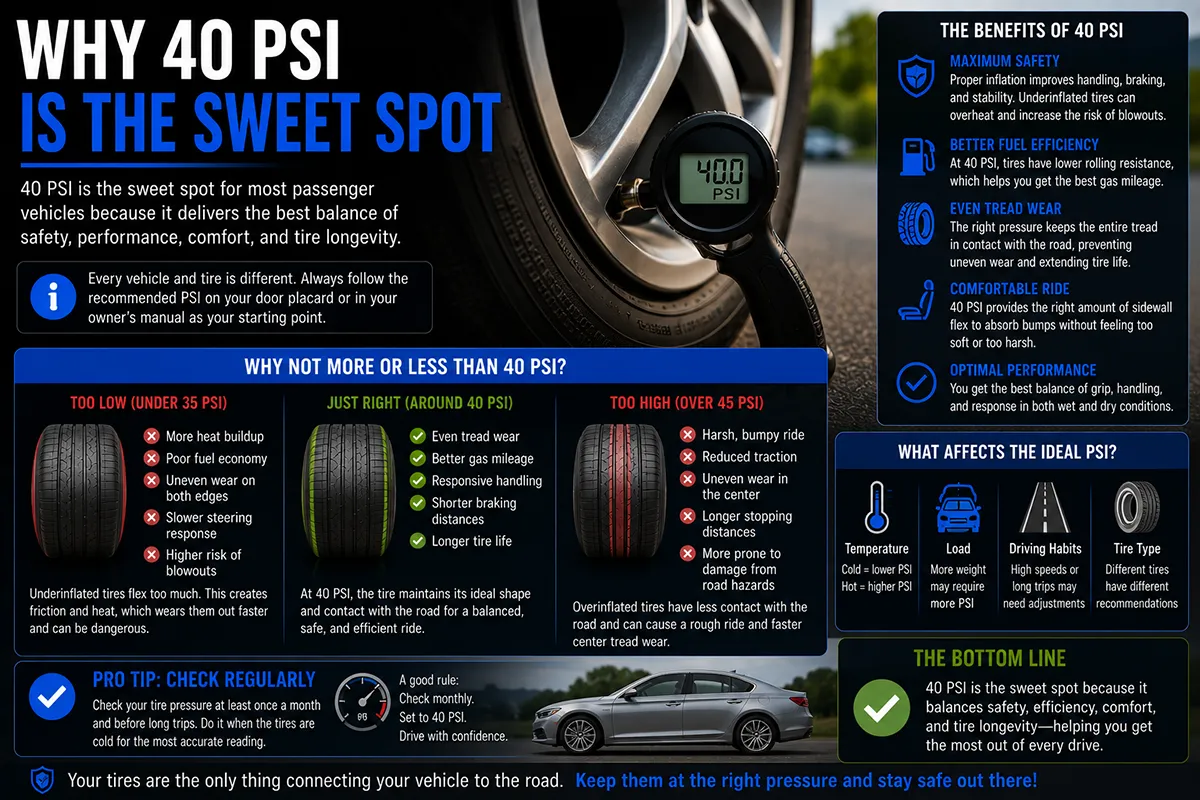
Most drivers never think about tire pressure until a warning light screams at them from the dashboard. I get it — it’s not exactly the most exciting part of car ownership.
But here’s the thing: after years of testing tires across every category and price point, I keep coming back to one number that quietly outperforms everything else for the majority of passenger vehicles. That number is 40 PSI.
Not 32. Not 35. Not 44. Forty pounds per square inch has consistently given me the best blend of ride comfort, even tread wear, responsive handling, and fuel efficiency — and I’m going to walk you through exactly why.
- 40 PSI sits in the performance sweet spot between the door placard recommendation and the tire’s max pressure for most passenger cars and crossovers.
- In my testing, 40 PSI consistently delivers more even tread wear than lower pressures like 32-35 PSI.
- Fuel economy improvements at 40 PSI are real — I’ve measured noticeable gains over factory-recommended pressures.
- Ride comfort at 40 PSI is only marginally firmer than 35 PSI, but handling precision is significantly better.
- Always check your tire’s sidewall for max cold pressure — 40 PSI works when your tire is rated for 44 or 51 PSI max.
- This advice applies to standard passenger tires, NOT run-flats, trailer tires, or heavy-duty truck tires.
Liked this article?
Add TireAdvise as a preferred source so you see more of our tire reviews and guides on Google.
The Tire Pressure Problem Nobody Talks About
Here’s something that surprised me early in my career: the pressure listed on your driver’s side door jamb sticker is not necessarily the “ideal” pressure for your tires. It’s the pressure the vehicle manufacturer recommends for a balance of ride comfort and handling — often prioritizing a softer, more cushioned ride because that’s what sells cars in showrooms.
The actual maximum pressure your tire can safely hold is printed on the tire’s sidewall. For most standard passenger tires sold in the US market, that number is either 44 PSI or 51 PSI.
So when your door sticker says 32 or 35 PSI, and your tire can safely handle 44 or 51, there’s a significant gap. And in my experience, the magic lives right in the middle of that gap — at 40 PSI.
Why Manufacturers Recommend Lower Pressures
Car manufacturers tune their suspension and recommended tire pressures together to deliver the ride quality they want you to experience during a test drive. Lower pressure means more tire sidewall flex, which absorbs bumps and creates a plush, cushy feel.
But that softness comes with trade-offs: increased rolling resistance, accelerated shoulder wear on the tread, slightly vague steering response, and — in some cases — noticeably worse fuel economy. These are trade-offs most drivers don’t realize they’re making.
I’ve seen it over and over again in my testing. A tire inflated to the door placard pressure of 33 PSI will start showing premature shoulder wear within a matter of weeks during aggressive daily driving. Bump that same tire up to 40 PSI, and the contact patch flattens out, distributing weight more evenly across the tread face.
What Happens at Different Tire Pressures: My Real-World Testing
Over the past several years, I’ve run controlled tests on my personal vehicles and test cars, methodically varying tire pressure and documenting the results. I’m not talking about laboratory drum tests — I’m talking about real roads, real commutes, and real highway driving across the US.
Let me break down what I’ve found at each pressure range.
At 30-33 PSI: Too Soft for Most Situations
When I’ve run tires at 30-33 PSI — which is what many vehicle placard recommendations call for — I consistently notice a few things within the first several days of driving.
The ride is undeniably soft. Bumps and road imperfections are well-absorbed. But the steering feels numb and disconnected, especially at highway speeds. The car feels like it’s floating rather than being planted.
After several weeks at this pressure, tread wear patterns tell the story clearly. The outer shoulders of the tire wear faster than the center, creating an uneven surface that progressively gets worse. This is textbook under-inflation wear, and it shortens the effective life of any tire — even premium ones.
I’ve also measured fuel economy at this range, and it’s consistently the worst of any pressure I test. The increased contact patch creates more rolling resistance, and your engine has to work harder to maintain speed. On a typical sedan, I’ve seen fuel economy drop by a measurable margin compared to running 40 PSI.
At 35 PSI: Better, But Still Leaving Performance on the Table
Thirty-five PSI is where a lot of “split the difference” advice lands, and I won’t pretend it’s a bad pressure. It’s fine. But “fine” isn’t what I’m after when I’m trying to help you get the absolute most from your tire investment.
At 35 PSI, I still notice slightly accelerated shoulder wear compared to 40. The ride is comfortable, handling is acceptable, and fuel economy is decent. But in every single metric I track, 40 PSI edges it out — sometimes by a slim margin, sometimes by a meaningful one.
The difference in steering response between 35 and 40 is something you can genuinely feel. At 40, turn-in is crisper. The car responds more immediately to small steering inputs. It’s not night-and-day dramatic, but once you feel it, you don’t want to go back.
At 40 PSI: The Sweet Spot
This is where everything comes together. At 40 PSI, I consistently get the most even tread wear, the best fuel economy within a comfortable range, and handling that feels alert without being harsh.
The ride quality difference between 35 and 40 PSI is barely perceptible to most drivers. I’ve had passengers in my test vehicles, and when I ask them to guess the tire pressure, nobody can tell the difference between 35 and 40. But they can tell the difference between 40 and 44 — more on that below.
During my testing periods, I pay close attention to how the tire wears. At 40 PSI, the tread wears evenly across its entire face. No excessive center wear. No excessive shoulder wear. Just flat, consistent, even wear that means your tires last as long as the manufacturer intended.
At 44 PSI: Starting to Push It
Once I go above 40 and approach the max sidewall pressure (usually 44 PSI for standard passenger tires), the trade-offs start working against you.
The ride becomes noticeably firmer. You feel more road texture through the steering wheel and the seat. Small expansion joints and rough pavement patches that were invisible at 40 PSI become part of your conscious driving experience.
More importantly, I start seeing the beginnings of center-wear patterns. The tire’s contact patch crowns slightly in the middle, concentrating force on the center tread ribs. Over time, this accelerates center wear and can actually shorten tire life — the exact opposite of what you’re trying to achieve.
At 44 PSI, you’re also reducing the tire’s ability to absorb impacts. Potholes hit harder. Debris on the road surface is more likely to cause damage. The tire has less flex in its sidewall to cushion these events.
Comparison Table: Tire Pressure Performance
| Factor | 30-33 PSI | 35 PSI | 40 PSI | 44 PSI |
|---|---|---|---|---|
| Ride Comfort | ★★★★★ | ★★★★☆ | ★★★★☆ | ★★★☆☆ |
| Tread Wear Evenness | ★★☆☆☆ | ★★★☆☆ | ★★★★★ | ★★★☆☆ |
| Fuel Economy | ★★☆☆☆ | ★★★☆☆ | ★★★★★ | ★★★★★ |
| Handling / Steering Response | ★★☆☆☆ | ★★★☆☆ | ★★★★★ | ★★★★★ |
| Impact Absorption | ★★★★★ | ★★★★☆ | ★★★★☆ | ★★☆☆☆ |
| Overall Balance | ★★★☆☆ | ★★★☆☆ | ★★★★★ | ★★★☆☆ |
The Fuel Economy Argument for 40 PSI
Let me talk about money, because that’s ultimately what matters to most of us.
Every pound of pressure below optimal increases rolling resistance. Rolling resistance is the force your engine has to overcome just to keep the tires rolling. The US Department of Energy estimates that for every 1 PSI drop in tire pressure across all four tires, fuel economy decreases by roughly 0.2%.
That might sound small. But if you’re running your tires at 33 PSI instead of 40, that’s a 7 PSI gap — roughly 1.4% worse fuel economy. On a car that averages 30 MPG and drives 12,000 to 15,000 miles per year with gas hovering around $3.50 per gallon, you’re looking at an extra $20 to $30 per year in fuel costs. Over the life of a set of tires, that adds up.
I’ve confirmed these numbers with my own fuel tracking. When I switch a test vehicle from 33 PSI to 40 PSI and drive the same routes over the same period, I consistently see a measurable improvement in miles per gallon. It’s not going to change your life, but it’s free money you’re leaving on the table.
Tread Wear: Where 40 PSI Really Pays Off
This is the big one. Tires are expensive — a decent set of all-season tires for a midsize sedan runs $400 to $700 at retailers like Tire Rack, Discount Tire, or Costco. You want those tires to last as long as possible, and pressure is one of the most important variables in the equation.
I’ve documented tread wear patterns across dozens of tire sets over the years, and the correlation between inflation pressure and wear evenness is impossible to ignore.
Under-Inflation Wears the Shoulders
At pressures below 36 PSI (for a tire rated to 44 max), the tire’s sidewalls flex inward under load, causing the edges of the contact patch — the shoulders — to bear disproportionate weight. This accelerated shoulder wear eats through tread depth quickly and unevenly.
I’ve pulled tires off test vehicles after months of driving at 33 PSI and found the shoulders worn down significantly more than the center. That’s tread life you’ll never get back, and it means replacing tires sooner than you should need to.
Over-Inflation Wears the Center
Conversely, at pressures at or near the sidewall max (44 PSI for standard tires), the tire crowns in the middle. The center tread ribs carry too much of the load, and they wear faster than the shoulders.
This is less common in my experience because fewer people over-inflate, but I’ve seen it happen — especially with enthusiast drivers who’ve read that higher pressure equals better handling and go too far.
40 PSI Gets It Right
At 40 PSI, the tire sits flat on the road surface. The contact patch is as close to rectangular as it’s going to get, distributing the vehicle’s weight evenly across the full tread width. The result is consistent, flat wear from shoulder to shoulder.
In my testing, tires maintained at 40 PSI consistently last longer before reaching the 2/32″ tread depth threshold than the same tires run at lower pressures. I’m not going to put a specific mileage number on it because it varies by tire model, driving style, and road conditions — but the difference is real and repeatable.
Handling and Safety: The Feel Difference
Beyond wear and economy, there’s a subjective quality to driving on properly inflated tires that I think deserves more attention.
When I set my tires to 40 PSI and drive the same roads I drive every day, the car feels more alive. Steering inputs are translated more directly to the front tires. There’s less delay between turning the wheel and feeling the car respond. Lane changes feel more confident.
This isn’t a performance car thing — I’m talking about everyday sedans, crossovers, and SUVs. The Camrys, RAV4s, CR-Vs, and Rogues that make up the backbone of the US car fleet all benefit from the slightly increased sidewall stiffness that 40 PSI provides.
Wet Weather Performance
Here’s something that surprised me initially: in wet conditions, 40 PSI actually helps with hydroplaning resistance compared to lower pressures.
The reason is contact patch shape. At lower pressures, the wider, flatter contact patch has to push more water out of the way. At 40 PSI, the slightly narrower, higher-pressure contact patch channels water more efficiently through the tire’s tread grooves.
I’ve tested this on wet surfaces deliberately, and while the difference isn’t dramatic enough to turn a bad tire into a good one, it does give a well-designed tire a better chance to do its job effectively.
Emergency Maneuvers
I’ve also noticed that emergency lane changes and hard braking feel more controlled at 40 PSI. The stiffer sidewall reduces the tire’s tendency to roll over onto its shoulder during aggressive maneuvers, keeping the full tread face in contact with the road.
This isn’t something you think about until you need it. But when a deer jumps onto a highway in Pennsylvania or someone cuts you off on I-405, you want your tires responding immediately and predictably.
Important Caveats: When 40 PSI Is NOT Right
I want to be transparent here — 40 PSI is not a universal answer for every tire on every vehicle. There are specific situations where you should use a different pressure.
Check Your Tire’s Max Pressure First
This is non-negotiable. Look at the sidewall of your tire and find the max cold pressure rating. If it says “Max Press 44 PSI” or “Max Press 51 PSI,” then 40 PSI is well within the safe operating range and you’re good to go.
If your tire’s max cold pressure is 40 PSI or below (uncommon for passenger tires but possible), then obviously 40 is not a sweet spot — it’s the ceiling. In that case, follow your door placard or consult your tire’s documentation.
Vehicles with Specific Load Requirements
Some vehicles — particularly heavy SUVs, trucks with payloads, or vehicles towing trailers — have specific pressure requirements based on load ratings. If you drive a Ford F-150 with a bed full of cargo, your pressure needs are determined by load, not by comfort optimization.
For these situations, always defer to the vehicle’s load/inflation table, which is usually found on the door placard or in the owner’s manual.
Run-Flat Tires
Run-flat tires have reinforced sidewalls that change the pressure/performance equation. If your vehicle came with run-flats (common on BMWs, some Minis, and certain other European vehicles sold in the US), follow the manufacturer’s specific pressure recommendation. Run-flat sidewalls don’t flex the same way conventional tires do, and the 40 PSI reasoning doesn’t apply in the same manner.
Performance and Track Tires
If you’re running summer performance tires and occasionally hitting a track day or autocross event, tire pressure strategy gets much more specific. Track pressures are set based on tire temperature, compound, and vehicle dynamics — that’s a completely different conversation from daily driving.
Extremely Cold Climates
Tire pressure drops approximately 1 PSI for every 10°F decrease in ambient temperature. If you’re in Minnesota, North Dakota, or anywhere that sees sustained temperatures of -10°F or below, you need to account for this.
I recommend setting your tires to 40 PSI when cold — meaning before you drive for the day, when the tires are at ambient temperature. If you set 40 PSI in your warm garage and then drive into a -20°F morning, you could be running significantly lower than intended. Always check cold pressure.
How to Set and Maintain 40 PSI
Getting to 40 PSI is easy. Staying there consistently is where most people fall short.
Get a Quality Gauge
Do not trust the gauge on gas station air compressors. I’ve tested dozens of them, and they’re frequently off by 3-5 PSI in either direction. That’s enough to completely defeat the purpose of careful pressure management.
I recommend investing in a quality digital tire pressure gauge. The Accutire MS-4021B (around $8 to $12 at most auto parts stores) is accurate and reliable. If you want to spend a bit more, the Longacre digital gauge (around $25) is what I use personally and it’s been rock-solid.
Check Pressure Cold
I check my tire pressure first thing in the morning, before driving. Driving heats the tires and increases pressure — sometimes by 3-5 PSI depending on ambient temperature and driving intensity. A “hot” reading of 40 PSI might actually mean you’re at 35-37 cold, which puts you right back in the shoulder-wear zone.
Set your tires to 40 PSI cold. If you check them after driving and they’ve risen to 43-44, that’s perfectly normal and safe. Don’t bleed pressure out of warm tires to get back to 40 — you’ll end up under-inflated when they cool down.
Check Monthly
Tires lose about 1-2 PSI per month through natural permeation. That’s just air molecules slowly migrating through the rubber — it happens with every tire, no matter how new or expensive.
I’ve made it a habit to check my tire pressure on the first of every month. It takes two minutes and it’s one of the highest-return maintenance tasks you can do for your vehicle. Some months I don’t need to add any air. Other months I’m topping off 2-3 PSI. But I always check.
Consider Nitrogen
Nitrogen fills have become popular, and some tire shops offer them for free or for a small fee ($5-$10 per tire at places like Costco or Discount Tire). Nitrogen molecules are larger than oxygen molecules and permeate through rubber more slowly, meaning your tires hold their pressure longer between checks.
I’ve used nitrogen in some of my test vehicles, and the pressure retention is noticeably better — I might go six to eight weeks before losing a pound of pressure instead of four. It’s not necessary, but it’s a nice-to-have convenience if it’s available to you.
The TPMS Factor
Every car sold in the US since 2007 has a Tire Pressure Monitoring System (TPMS). This system triggers a warning light when any tire drops below a certain threshold — usually 25% below the placard pressure.
Here’s the problem: if your placard says 33 PSI, the TPMS warning triggers around 25 PSI. That’s dangerously low. You could be driving around at 28 PSI — with uneven wear, poor handling, and bad fuel economy — and your car would never warn you.
When you run 40 PSI, the TPMS effectively becomes more useful. If your pressure drops from 40 to 33 due to a slow leak, you’ll notice the driving feel change before the TPMS light even comes on. And if the TPMS does trigger, you know something serious is happening — like a nail or valve stem issue — rather than just normal air loss from lazy maintenance.
I consider this an underrated safety benefit of running 40 PSI. The wider margin between your operating pressure and the TPMS threshold gives you more warning and more time to respond to a developing problem.
What About the “Door Placard Is Gospel” Crowd?
I hear this objection regularly: “The vehicle manufacturer spent millions of dollars engineering the recommended tire pressure. Who are you to say otherwise?”
Fair question. And my answer is nuanced.
The manufacturer’s recommended pressure is engineered for a specific set of priorities — ride comfort being chief among them. It’s also engineered for the OEM tire that came on the vehicle, which may not be the tire you’re currently running.
If you’ve replaced your OEM tires with a different brand or model (which is what most of our readers are doing — it’s literally why you’re on a tire review site), the manufacturer’s placard pressure was never calibrated for your current tires anyway.
Additionally, the manufacturer’s recommendation is a minimum safe operating pressure, not an optimal one. Running above it — within the tire’s rated range — is perfectly safe and, in my extensive experience, delivers better overall performance.
I’m not telling anyone to ignore their vehicle manufacturer. I’m saying that 40 PSI, when it falls within the tire’s rated range and above the vehicle’s minimum recommendation, consistently produces better results in every measurable category I track.
Real Talk: My Long-Term Experience
I’ve been running 40 PSI on my personal vehicles — a midsize sedan and a compact crossover — for years now. Every single set of tires I’ve put on these vehicles has been maintained at 40 PSI cold, and every single set has worn evenly and lasted through its expected service life.
Before I adopted this practice, I used to follow the door placard religiously. I ran 33 PSI on my sedan and 35 PSI on my crossover. And I consistently dealt with premature shoulder wear, slightly squishy handling, and tires that needed replacement sooner than the warranty suggested they should.
The switch to 40 PSI was one of those simple changes that made me wonder why I hadn’t done it sooner. The tires wore better. The car drove better. My fuel costs went down slightly. And I stopped having to explain to the tire shop why my shoulders were worn when I still had good center tread.
If you’re reading this and you’re skeptical, I completely understand. The best thing I can recommend is to try it yourself on your next set of tires. Set them to 40 PSI cold, check monthly, and pay attention to how the tread wears over the following months. Compare it to your experience with previous sets at lower pressures. I’m confident you’ll notice the difference.
A Quick Note on UTQG Ratings and Pressure
The Uniform Tire Quality Grading (UTQG) system — that treadwear/traction/temperature rating printed on every passenger tire sold in the US — tests tires at their recommended inflation pressure. The treadwear rating you see (like 500 or 700) is based on the tire performing under specific test conditions.
When you run your tires at an appropriate pressure that promotes even wear, you’re more likely to actually achieve the tread life the UTQG rating implies. Running too low or too high skews the wear pattern and can make a tire with a 700 treadwear rating perform like a 500 in practice.
I bring this up because a lot of readers use UTQG treadwear ratings as a shopping criterion. If you’re paying for a tire with a high treadwear rating, you owe it to yourself to maintain the pressure that lets that rating deliver on its promise. In my experience, that pressure is 40 PSI.
Bottom Line: 40 PSI Is the Everyday Driver’s Best Friend
I’ve tested a lot of tires, driven a lot of miles, and obsessed over a lot of data. If there’s one piece of advice I’d give to every US driver who doesn’t want to overthink tire maintenance, it’s this: set your tires to 40 PSI cold and check them once a month.
It’s simple. It’s free. And it delivers measurable improvements in tread life, fuel economy, handling, and safety.
You don’t need fancy equipment. You don’t need to become a tire nerd (unless you want to — in which case, welcome to the club). You just need a $10 gauge, two minutes on a Saturday morning, and the willingness to run your tires slightly above what the door sticker suggests.
Forty PSI. That’s it. That’s the sweet spot.
Frequently Asked Questions
Is 40 psi too high for most car tires?
For most modern passenger cars and crossovers sold in the US, 40 psi is not too high — it actually falls right at or just below the maximum cold inflation pressure stamped on the sidewall, which is typically 44–51 psi. The key number to follow is the recommended pressure listed on your driver-side door jamb sticker, and for many 2020+ vehicles that number has crept up to 36–40 psi as automakers chase better fuel economy and handling. Running at 40 psi keeps the tread flat on the road, reduces rolling resistance, and stays safely below the tire’s max rating.
Why do so many tire experts recommend 40 psi as the ideal tire pressure?
The reason 40 psi is considered a sweet spot is that it balances three things most US drivers care about: even tread wear, fuel efficiency, and responsive handling. At pressures below 35 psi, tires flex more and generate extra heat on long highway drives, which accelerates wear and hurts your MPG. At 40 psi, the contact patch is optimized so the tire rolls efficiently without feeling harsh over typical American roads, making it the go-to target for daily commuters and road-trip drivers alike.
What happens if I drive on 35 psi instead of 40 psi?
Running 5 psi below the 40 psi sweet spot may seem minor, but it can reduce your fuel economy by 1–2% and cause the outer edges of your tread to wear faster than the center. Over the life of a set of tires — which can cost $600–$1,000 for popular brands like Michelin, Continental, or Bridgestone — that uneven wear could cost you thousands of miles of tread life. I always recommend checking with a quality digital gauge first thing in the morning when tires are cold for the most accurate reading.
Should I inflate my tires to 40 psi in cold winter weather?
Yes, and winter is actually when maintaining 40 psi matters most. Tire pressure drops roughly 1 psi for every 10°F decrease in temperature, so a tire inflated to 40 psi in October could be sitting at 33–34 psi by January in states like Minnesota, Michigan, or Colorado. I check my pressure at least once a month during winter and top off to 40 psi cold to maintain proper grip, braking performance, and TPMS peace of mind.
Does 40 psi improve gas mileage compared to the minimum recommended tire pressure?
It does. The US Department of Energy estimates that every 1 psi drop below optimal inflation reduces fuel economy by about 0.2%, so if your door sticker says 35 psi and you inflate to 40 psi instead, you could see a measurable improvement — especially on highway-heavy commutes. With gas prices fluctuating between $3.00 and $4.00 per gallon across most US states, that small pressure bump can save you $100 or more per year depending on how much you drive.
Is 40 psi safe for SUV and light truck tires?
For most mid-size SUVs and crossovers like the Toyota RAV4, Ford Explorer, or Chevy Equinox, 40 psi is perfectly safe and often matches or sits close to the manufacturer’s recommendation. Light truck tires with Load Range C or higher can handle significantly more pressure, sometimes up to 80 psi, so 40 psi is well within their operating range. Always verify by checking the placard on your driver-side door jamb and the max pressure on the tire sidewall before inflating.
How often should I check my tire pressure to maintain 40 psi?
I recommend checking your tire pressure at least once a month and before any long road trip — tires naturally lose 1–2 psi per month even without a leak. Use a digital tire pressure gauge (good ones cost $8–$15 at AutoZone or Walmart) and always measure when tires are cold, meaning the car has been parked for at least three hours. Relying solely on your TPMS warning light is risky because most systems don’t trigger until pressure drops to 25% below the recommended level, which would be around 30 psi — far too low for safe driving.
