

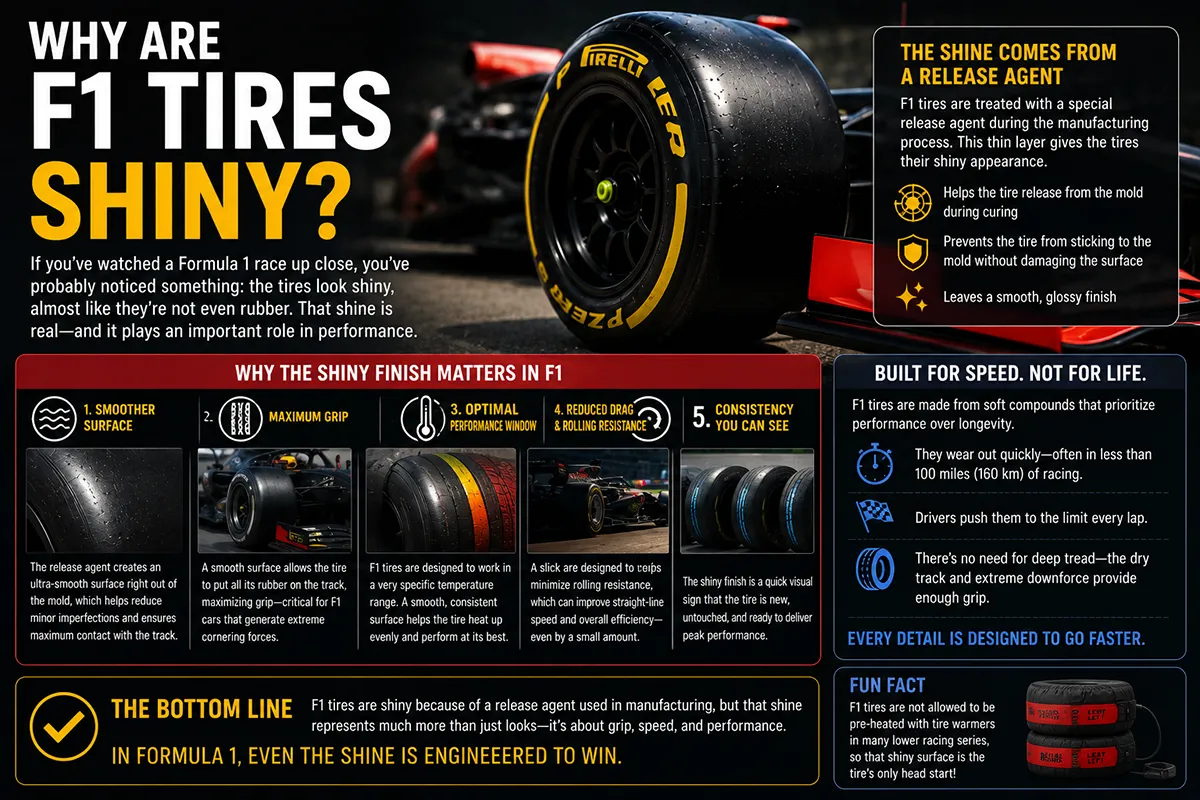
If you’ve ever watched a Formula 1 race and noticed how impossibly glossy those tires look sitting on the grid, you’re not alone. I’ve been reviewing tires for over a decade, and this is one of the most common questions I get from readers.
The answer is surprisingly simple — but it also opens the door to a fascinating conversation about tire construction, rubber compounds, and what actually matters when you’re shopping for your next set of all-seasons or performance tires here in the US.
- F1 tires are shiny because of a thin layer of mold release coating and a special outer rubber layer applied during manufacturing.
- This shiny layer actually reduces grip — F1 drivers must “scrub in” new tires to remove it before they perform at peak levels.
- Your everyday tires have a similar mold release agent, which is why brand-new tires can feel slightly slippery at first.
- The shine you see on new retail tires is typically a cosmetic tire dressing, not the same thing as the F1 coating.
- Understanding tire surface science can help you make smarter buying decisions and break in new tires safely.
Liked this article?
Add TireAdvise as a preferred source so you see more of our tire reviews and guides on Google.
The Real Reason F1 Tires Look So Shiny
Let me cut straight to the point. F1 tires are shiny because of two things: a mold release agent and a thin outer rubber layer that forms during the manufacturing process.
When Pirelli — the exclusive tire supplier for Formula 1 since 2011 — manufactures these tires, they use molds to shape the rubber into its final form. To prevent the cured rubber from sticking to the mold (imagine trying to get a cake out of a pan without greasing it first), they apply a release agent. This chemical coating leaves a visible, glossy sheen on the tire’s surface.
But there’s more to it than just mold release. During the vulcanization process — where raw rubber is heated and pressurized to become the tough, elastic material we recognize as a tire — the outermost layer of rubber undergoes a slightly different curing process than the layers beneath it. This creates what tire engineers often call a “skin” on the tire surface.
I’ve had the opportunity to handle freshly manufactured tires at industry events, and I can tell you firsthand: that shiny layer feels distinctly different from the rubber underneath. It’s smoother, slightly waxy to the touch, and noticeably less grippy than the working surface beneath it.
Why the Shine is Actually a Problem in F1
Here’s where it gets interesting for performance enthusiasts. That beautiful glossy surface you see on F1 tires during pre-race ceremonies? It’s actually the enemy of grip.
F1 drivers and their engineers know that brand-new tires don’t deliver maximum performance right out of the box. The shiny outer layer needs to be worn away first — a process known as “scrubbing in” the tires. During the first few laps on a new set, drivers will weave back and forth on straightaways and push through corners to generate heat and friction, gradually removing that slick outer coating.
Once the shiny surface is gone, the working rubber compound beneath it is exposed. This is where the real grip lives. The underlying compound is engineered to interact with the track surface at a molecular level, providing the extraordinary levels of traction that allow F1 cars to pull multiple G’s through corners.
I find this concept fascinating because it directly parallels what happens with your everyday tires — just at a much less dramatic scale.
Do Your Regular Tires Have This Same Shiny Coating?
Yes, they absolutely do. And this is the part that actually matters for you as a tire buyer.
Every tire manufactured for the consumer market goes through a similar molding and vulcanization process. Every single one gets a mold release agent applied during production. That’s why when you look at a brand-new tire straight from the warehouse, the sidewalls and tread surface often have a slightly shiny, almost matte-gloss appearance.
I’ve installed hundreds of new tires over the years — from budget options like the Westlake RP18 to premium picks like the Michelin Pilot Sport 4S — and every single one has that telltale factory sheen when it comes out of the packaging.
This is different from the “wet look” shine you see on tires at car shows or dealership lots. That ultra-glossy appearance comes from aftermarket tire dressing products like Meguiar’s Endurance Tire Gel or Chemical Guys VRP. The factory coating is subtler but functionally more important.
The Break-In Period for New Tires
This is something I always tell readers, and it directly connects to the F1 tire story: new tires need a break-in period.
When I install a fresh set of tires on any test vehicle, I always spend the first several days of driving being extra cautious. I avoid hard braking, aggressive cornering, and rapid acceleration. The reason? That mold release agent and the cured outer layer need time to wear off before the tire delivers its full grip potential.
Most tire manufacturers recommend a break-in period for new tires. Michelin, Bridgestone, and Continental all include language in their documentation suggesting that drivers take it easy initially. In my experience, it usually takes a few days of normal commuting before new tires start to feel truly planted and confident.
I learned this lesson the hard way early in my career. I installed a set of high-performance summer tires and immediately pushed them hard on a twisty back road. The rear end stepped out on me in a sweeping turn that should have been well within the tire’s capability. After that, I always respect the break-in period.
The Science Behind Tire Rubber Compounds
To truly understand why F1 tires are shiny — and what that means for your tire buying decisions — it helps to understand a bit about how tire rubber works.
Vulcanization: Turning Goo into Grip
Raw rubber, whether natural or synthetic, is essentially useless for tires. It’s soft, sticky when warm, and brittle when cold. The vulcanization process, discovered by Charles Goodyear in 1839 (yes, that Goodyear), involves mixing rubber with sulfur and other chemicals, then heating it under pressure.
This process creates cross-links between the polymer chains in the rubber, giving it the elasticity, durability, and temperature resistance that tires need. The specific recipe of chemicals, fillers, and processing conditions determines the tire’s performance characteristics.
In F1, Pirelli creates five different dry-weather compounds, ranging from the hardest (C1) to the softest (C5). Each compound has a different balance of grip and durability. The softer the compound, the more grip it provides — but the faster it wears out.
How This Applies to Consumer Tires
Your everyday tires use the same fundamental chemistry, just optimized for different priorities. Instead of maximum grip for a 45-minute race stint, consumer tire compounds are engineered to balance:
- Treadwear longevity — Most drivers want tires that last several years of regular driving
- Wet and dry grip — Adequate traction in the varied conditions we face across the US
- Fuel efficiency — Low rolling resistance to help with gas mileage
- Comfort and noise — A quiet, smooth ride for daily commuting
- Temperature range — Performance across seasons (especially for all-season tires)
When you see a tire rated with a UTQG treadwear rating of 500 versus 200, that’s largely a reflection of compound differences. The 200-rated tire uses a softer, grippier compound (more like an F1 tire) while the 500-rated tire uses a harder compound optimized for longevity.
I’ve tested tires across the entire spectrum, and I can tell you that compound choice is one of the single biggest factors in how a tire performs. It’s the hidden variable that separates a $70 tire from a $200 tire in the same size.
F1 Tires vs. Your Tires: A Side-by-Side Comparison
I think a comparison table helps put things in perspective. Here’s how F1 tires stack up against typical consumer tires across key categories:
| Feature | F1 Tires (Pirelli) | Consumer Performance Tire | Consumer All-Season Tire |
|---|---|---|---|
| Shiny Coating | Yes — mold release + cured outer layer | Yes — mold release agent | Yes — mold release agent |
| Break-In Needed | Yes — 1 to 3 laps | Yes — several days of driving | Yes — several days of driving |
| Tread Depth | ~2.5mm (slick, no tread pattern) | ~10/32″ (with tread pattern) | ~10/32″ to 11/32″ |
| Lifespan | Approximately 75–125 miles | Years of regular driving | Years of regular driving |
| Cost Per Tire | ~$2,700 each (estimated) | $120–$300 each | $80–$200 each |
| Tread Pattern | Slick (no grooves in dry compounds) | Directional or asymmetric | Symmetric or asymmetric |
| Operating Temperature | 212°F–284°F (100°C–140°C) | Ambient to ~160°F | Ambient to ~140°F |
The numbers really drive home how different these worlds are. But the underlying principles — mold release agents, compound chemistry, the importance of tire surface condition — are fundamentally the same.
What About Tire Shine Products? Are They Related?
This is a great tangent because many drivers confuse the factory coating with aftermarket tire shine products. They’re completely different things serving completely different purposes.
Factory Mold Release vs. Tire Dressing
The factory mold release agent is a functional chemical applied during manufacturing. Its sole purpose is to let the tire come out of the mold cleanly. It’s not meant to look pretty — the shine is just a side effect.
Aftermarket tire dressings, on the other hand, are purely cosmetic. Products like Armor All, Chemical Guys VRP, or Meguiar’s Endurance Tire Gel are designed to make your sidewalls look deep black and glossy. They serve no performance function.
In fact, I generally advise caution with tire shine products. I’ve seen cases where solvent-based dressings caused premature sidewall cracking, especially on tires exposed to intense UV in states like Arizona, Texas, and Florida. If you want to use a tire dressing, I recommend water-based formulas and applying them only to the sidewall — never on the tread surface.
I once made the mistake of detailing a test vehicle and accidentally getting tire dressing on the tread contact patch. The first turn out of my driveway felt like driving on ice. That experience permanently cemented in my mind the importance of keeping the tread surface clean and free of any coatings.
Why F1 Tires Don’t Have Tread (And Why Yours Should)
Another question that naturally follows the “why are they shiny” discussion is: “why are F1 tires completely smooth?” This is relevant because it ties into how tread patterns affect the surface appearance of consumer tires.
F1 dry-weather tires (called “slicks”) have no tread pattern at all. The reason is pure physics. A smooth surface maximizes the contact patch — the area of rubber touching the road. More rubber on the road means more grip. It’s that simple.
But F1 races happen on smooth, clean, dry racetracks (when they use slicks). Your daily drive takes you over wet roads, gravel, oil patches, standing water, and surfaces that range from fresh asphalt to crumbling concrete. Tread patterns are essential for channeling water away from the contact patch to prevent hydroplaning.
This is why tread design matters so much when you’re shopping for consumer tires. I always evaluate:
- Groove depth and width — Deeper, wider grooves evacuate more water
- Sipe density — Those tiny slits in the tread blocks that provide additional wet and winter grip
- Tread block pattern — Directional patterns (V-shaped) tend to excel in wet conditions; asymmetric patterns offer a good all-around balance
- Void ratio — The ratio of grooves to rubber affects both grip and noise levels
Interestingly, F1 does have treaded tires for wet conditions — the “intermediate” and “full wet” tires. These have tread patterns designed to displace water, and they can evacuate up to 85 liters of water per second at high speeds. That’s an astonishing engineering feat.
Practical Tips for US Drivers: What to Do When Your New Tires Feel Slippery
Now let me bring this all back to something actionable for you. If you’re reading this article, there’s a good chance you’re either about to buy new tires or recently installed a set. Here’s what the F1 tire shiny-surface phenomenon means for your real-world driving.
1. Expect Reduced Grip on Brand-New Tires
Don’t let the excitement of new tires make you overconfident. During the first several days of driving, keep your speeds moderate and avoid aggressive maneuvers. The mold release agent and outer rubber layer need to wear off before you’re getting the tire’s advertised performance.
I test a lot of tires in my work, and I always schedule my first impressions after the break-in period rather than immediately after installation. The difference in grip between a fresh tire and one that’s been properly scrubbed in is genuinely noticeable, especially on performance tires.
2. Don’t Panic if New Tires Feel “Off”
I regularly get emails from readers saying things like, “I just spent $800 on new tires and they feel worse than my old ones.” Almost every time, they’re still in the break-in period.
Give your new tires time. After several days of normal commuting, go back and re-evaluate. Chances are they’ll feel dramatically better once that factory surface is worn away and the rubber has had a chance to adapt to your driving style and local road conditions.
3. Avoid Tire Shine on the Tread
This seems obvious, but I’ve seen it happen more times than you’d think. When detailing your car, keep all tire dressing products strictly on the sidewall. Any product on the tread surface creates a slippery film that severely compromises grip.
I recommend applying tire dressing with a foam applicator pad rather than spraying it on. This gives you much better control and prevents overspray from reaching the tread or your brake components.
4. Understand UTQG Ratings
The UTQG (Uniform Tire Quality Grading) system, mandated by the US Department of Transportation, gives you three key ratings: treadwear, traction, and temperature. These ratings are stamped right on the sidewall of every passenger tire sold in the US.
- Treadwear: A comparative number (higher = longer lasting, but potentially less grippy)
- Traction: Rated AA, A, B, or C (AA is the highest wet braking grip)
- Temperature: Rated A, B, or C (measures heat resistance at speed)
A tire with a treadwear rating of 200 and a traction rating of AA uses a softer, grippier compound — closer to the F1 philosophy. A tire rated at 700 treadwear with an A traction rating prioritizes longevity over maximum grip.
Neither is “better” — it depends entirely on your priorities. I personally run a 300-rated performance tire on my sports car and a 600-rated all-season on my family SUV. Different tools for different jobs.
The Color-Coded F1 System and What Consumer Tires Can Learn From It
One of the things I admire about F1 is the transparency of their tire system. Each compound is color-coded: red for soft, yellow for medium, white for hard, green for intermediate, and blue for wet. You can tell at a glance what compound each car is running and make predictions about strategy.
Consumer tires don’t have this luxury, but I wish they did. The closest thing we have is the UTQG system, and even that requires you to know what the numbers mean.
When I’m reviewing a tire, I always try to convey the compound character in plain language. Is this a soft, grippy tire that will wear faster? Or a hard, durable tire that sacrifices some ultimate grip? This is information every buyer deserves, and it’s something that directly connects to the F1 story.
Some brands are getting better about this. Michelin’s consumer tire lineup, for example, clearly differentiates between their comfort-oriented (Defender, Primacy) and performance-oriented (Pilot Sport) lines, with compound differences being a key distinction.
Why Tire Surface Condition Matters More Than You Think
Let me share one more insight from my years of testing. Tire surface condition isn’t just about the factory coating — it’s an ongoing factor throughout the tire’s life.
Heat Cycling and Surface Degradation
Every time you drive, your tires go through heat cycles. They warm up during driving and cool down when parked. Over time, this repeated heating and cooling changes the properties of the tire surface. The rubber can become harder and less grippy — a phenomenon called “heat cycling degradation.”
This is why old tires with plenty of tread depth can still feel less grippy than new ones. The rubber compound at the surface has chemically aged, even if the tire still looks fine visually.
In F1, teams sometimes “scrub” a set of tires during practice — running them for just a lap or two to remove the shiny outer layer — and then save them for the race. These “scrubbed” tires offer the best of both worlds: the shiny surface is gone, but the compound hasn’t been degraded by extensive heat cycling.
For consumer drivers, the practical takeaway is this: if your tires are more than five or six years old, even if the tread looks deep, the rubber compound may be significantly degraded. Most tire manufacturers and the NHTSA recommend replacing tires that are more than six years old regardless of remaining tread.
Storage and UV Damage
If you swap between summer and winter tires (common in northern US states like Michigan, Minnesota, and New York), how you store your off-season tires matters. UV exposure, extreme temperatures, and ozone can all degrade the tire surface, affecting that crucial outer layer of rubber.
I store my off-season tires in black tire bags in a climate-controlled garage. It’s a small effort that significantly extends tire life and maintains the integrity of the rubber compound.
My Top Recommendations for Tire Shoppers
Let me wrap up with some specific, actionable guidance based on everything we’ve discussed about tire surfaces, compounds, and performance.
If You Want Maximum Grip (The “Soft Compound” Philosophy)
Look at tires like the Michelin Pilot Sport 4S, Continental ExtremeContact Sport 02, or Bridgestone Potenza RE-71RS. These use softer compounds with lower UTQG treadwear ratings (typically 200-340) and deliver outstanding dry and wet grip.
In my testing, the Pilot Sport 4S remains the gold standard for performance tires on public roads. The break-in period is real — during the first few days, the tire felt good but not spectacular. After that initial period, the grip became extraordinary and fully justified its premium price tag (typically $180-$280 per tire depending on size).
If You Want Long Life (The “Hard Compound” Philosophy)
Consider the Michelin Defender LTX M/S, Continental TrueContact Tour, or Bridgestone Alenza AS Ultra. These prioritize treadwear with UTQG ratings often above 700, and they offer solid all-around performance without the rapid wear of softer compounds.
I recently spent an extended test period with the Continental TrueContact Tour on a family sedan, and I was impressed by how it balanced longevity with decent wet grip. It’s not going to win any track days, but for daily commuting across varied US road conditions, it’s an excellent choice at around $130-$180 per tire.
If You Want the Best Balance
The Continental ExtremeContact DWS 06 Plus and Michelin Pilot Sport All Season 4 offer what I consider the best compromise between grip and longevity. They use medium-soft compounds that provide surprisingly good performance while still delivering acceptable tread life for daily driving.
I’ve been running the Pilot Sport All Season 4 on a test vehicle through various weather conditions — dry heat, heavy rain, and even light snow — and it handles everything with confidence. It’s not as sharp as a dedicated summer tire or as robust in snow as a winter tire, but it’s remarkably capable year-round. These typically run $150-$250 per tire.
Final Thoughts: From the F1 Grid to Your Driveway
The shiny surface on F1 tires is just a manufacturing artifact — a mold release agent and cured outer layer that actually hinders performance until it’s worn away. But understanding why it exists opens up a deeper appreciation for tire science that directly applies to your daily driving.
Every tire you buy has that same factory coating. Every tire needs a break-in period. And the compound beneath that shiny surface is the single most important factor in how your tire will perform over its lifetime.
I’ve spent years testing tires across every category, from ultra-high-performance summer tires to rugged all-terrain options. The lessons from F1 — that surface condition matters, that compound choice is everything, and that a tire’s performance evolves from the moment it’s mounted — are universal truths that apply whether you’re racing at 200 mph or commuting at 65 mph on the interstate.
So the next time you see those gleaming F1 tires on the starting grid, you’ll know exactly what you’re looking at. And the next time you install a fresh set of tires on your car, you’ll know to take it easy for a few days and let that factory shine wear off before you push them to their limits.
Drive safe, break in those new tires properly, and remember — the real performance is hiding just beneath the surface.
Frequently Asked Questions
Why are F1 tires so shiny compared to regular car tires?
F1 tires look shiny because they are coated with a thin layer of mold release agent during manufacturing and have an extremely smooth, unmarked surface that hasn’t been driven on public roads. Once the car completes a few laps, the shiny coating scrubs off and the tires take on a matte, grained appearance. Your everyday replacement tires from brands like Goodyear or Michelin also have a slight sheen when brand new, but it’s far less noticeable because of different rubber compounds and tread patterns.
What is the shiny coating on new F1 tires made of?
The shiny coating is primarily a mold release compound, often silicone-based, that prevents the rubber from sticking to the manufacturing mold during the curing process. Pirelli, the sole F1 tire supplier, applies this during production, and it burns or wears off within the first few laps of driving. If you’ve ever noticed a slick, glossy look on brand-new tires you bought at a US tire shop, that’s essentially the same type of release agent at work.
Do shiny new tires have less grip than broken-in tires?
Yes, brand-new tires with that factory sheen tend to offer slightly less grip until the release agent and surface oils wear away, which is why tire experts recommend driving cautiously for the first 500 miles on new replacement tires. In F1, drivers do dedicated warm-up laps to scrub the shiny layer and bring the tires up to operating temperature. For US drivers, this break-in period matters especially on wet or cold roads, so take it easy after a fresh tire installation whether you’re running Bridgestone, Continental, or any other brand.
Why do F1 tires look different from the tires on my car?
F1 tires are designed for maximum performance on smooth racetracks at extreme speeds, so they use slick, treadless surfaces with ultra-soft rubber compounds that would wear out in miles on US highways. Your street tires have deep tread grooves engineered to channel water, handle potholes, and last 40,000–80,000 miles in real-world conditions. The shiny, smooth appearance of F1 tires is a byproduct of having no tread pattern and a fresh mold release coating, whereas consumer tires prioritize longevity and all-season safety over outright track grip.
Can I make my car tires shiny like F1 tires, and is it safe?
You can use tire shine products like Chemical Guys VRP or Meguiar’s Endurance to give your tires a glossy, F1-like look, and most water-based formulas are perfectly safe for the rubber. However, I’d avoid applying any shine product to the tire tread itself, as it can reduce grip on US roads, especially in rain or snow. Stick to coating only the sidewalls, and choose a non-greasy, UV-protective formula that also helps prevent dry rot and cracking from sun exposure.
How long do F1 tires last compared to street tires in the US?
F1 tires are designed to last roughly 30 to 60 miles depending on the compound, which is why they look pristine and shiny at the start of every stint. In contrast, a quality set of all-season replacement tires from brands like Michelin, Goodyear, or Bridgestone typically lasts 50,000 to 80,000 miles for everyday US driving. The massive difference comes down to rubber softness: F1 tires sacrifice durability for maximum grip, while your street tires balance performance with cost-effective longevity at around $150–$300 per tire.
Do F1 wet-weather tires also have a shiny appearance?
Yes, F1 intermediate and full wet tires come out of the mold with the same shiny release agent coating as the slick dry tires. The key visual difference is that wet tires have grooved tread patterns to disperse standing water, similar in concept to the all-season or rain tires you’d buy for driving in heavy US rainstorms. Once a few laps are completed, the shine disappears on wet-weather F1 tires just as it does on slicks, and the treaded rubber underneath provides the hydroplaning resistance the driver needs.
