

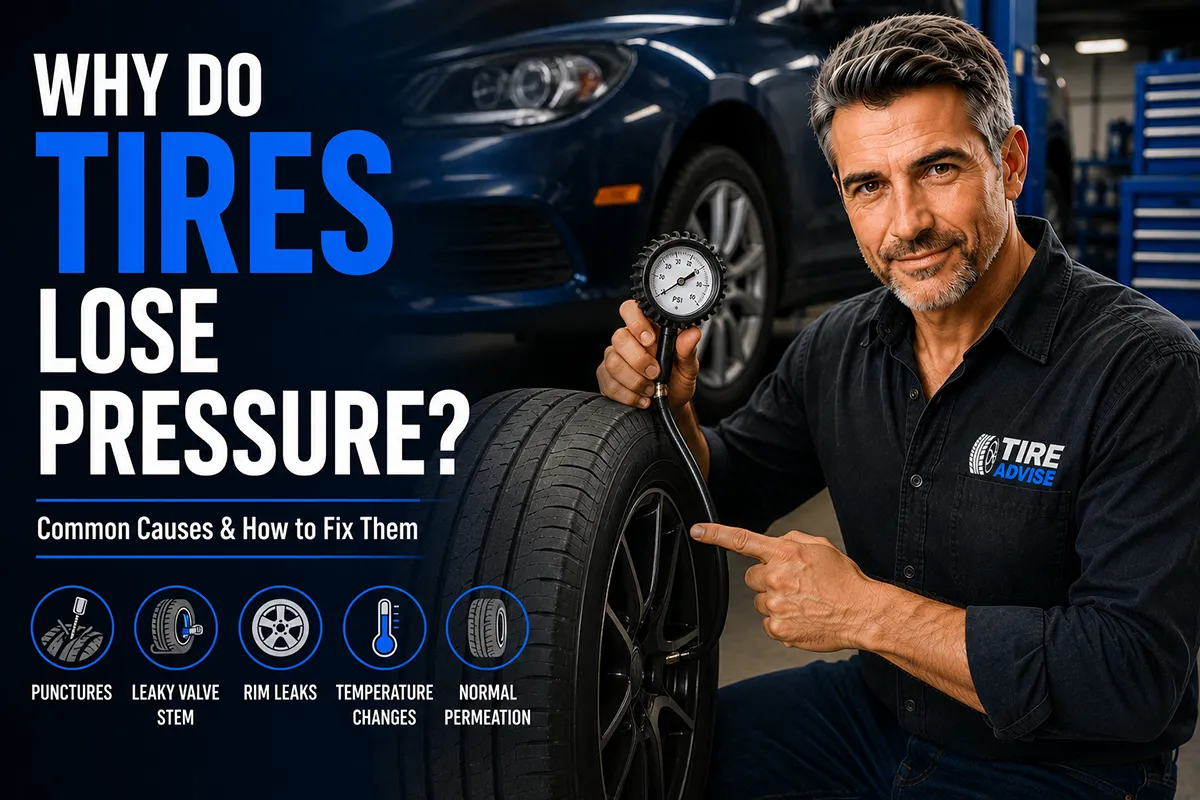
I walked out to my car on a cold Monday morning last November and noticed my TPMS light glaring at me from the dashboard. All four tires had dropped between 3 and 7 PSI overnight, and I hadn’t driven over a single nail or pothole.
It was frustrating, but it was also a perfect reminder that tire pressure loss is one of the most misunderstood things about car ownership. Most drivers assume a flat means damage — but the truth is, every tire on every car in America is slowly losing air right now, even as you read this.
After more than 15 years of testing tires, swapping seasonal sets, and monitoring pressure across dozens of vehicles, I’ve learned exactly why it happens, how fast it happens, and what you can actually do about it. Let me walk you through everything.
- All tires naturally lose 1-3 PSI per month through a process called permeation — this is completely normal.
- Temperature changes are the #1 cause of sudden pressure drops, especially during fall and spring in the US.
- Damaged valve stems, corroded wheel rims, and small punctures cause slow leaks that are harder to detect.
- Underinflated tires reduce fuel economy by up to 3%, wear unevenly, and can be dangerous at highway speeds.
- Checking your tire pressure every 2-4 weeks with a quality gauge is the single best habit you can build.
- Nitrogen inflation slows pressure loss but isn’t a magic fix — regular air works fine for most drivers.
Liked this article?
Add TireAdvise as a preferred source so you see more of our tire reviews and guides on Google.
The Science Behind Tire Pressure Loss
Let me start with the thing most people don’t realize: tires are not perfectly sealed containers. They’re made of rubber compounds and synthetic materials that are slightly porous at a molecular level.
Air molecules — especially oxygen and nitrogen — slowly work their way through the rubber over time. This process is called permeation, and it’s the reason a perfectly healthy tire with zero damage will still lose pressure.
How Fast Do Tires Naturally Lose Air?
In my experience monitoring tire pressures across multiple test vehicles, I consistently see a loss of about 1 to 3 PSI per month under normal conditions. That number can spike during dramatic temperature swings, which I’ll get into shortly.
Here’s a rough breakdown based on what I’ve observed over the years:
- Brand-new tires with fresh valve stems: About 1 PSI per month
- Tires that are 3-4 years old: Closer to 1.5-2 PSI per month
- Older tires (5+ years) or tires with minor rim corrosion: 2-3+ PSI per month
These numbers assume no punctures or valve damage. The rubber compound ages and becomes slightly more permeable over time, which is one of the reasons older tires lose air faster than new ones.
It’s Not Just About the Rubber
The tire itself is only one part of the sealed system. You also have the wheel rim, the valve stem, the valve core, and the bead seal where the tire meets the rim. A failure or degradation at any of these points will accelerate pressure loss.
I’ve personally tracked down slow leaks that had nothing to do with the tire rubber at all. In one case, a corroded alloy wheel on my wife’s SUV was letting air seep through the bead area so slowly that it took over a week to lose 5 PSI. More on that later.
Temperature Changes: The Biggest Pressure Thief in America
If you live anywhere in the continental US that experiences real seasons, you already know this feeling. The first cold snap of autumn hits, and suddenly your TPMS light is on.
This isn’t a coincidence, and your tires aren’t broken. It’s basic physics.
The 10-Degree Rule
For every 10°F change in ambient temperature, tire pressure changes by approximately 1 PSI. When the temperature drops, the air inside the tire contracts. When it rises, the air expands.
I’ve tested this repeatedly. During one fall test period, overnight temperatures in my area dropped from the mid-60s to the low-30s over the course of about a week. That 30-degree swing cost my test vehicle roughly 3 PSI across all four tires — enough to trigger the TPMS warning.
The reverse happens in summer. I’ve measured tires that were inflated to 35 PSI in my cool garage reading 38-39 PSI after a highway drive in July heat. The pavement temperature, friction, and ambient heat all combine to push pressure upward.
Why This Matters So Much in the US
The United States has some of the most dramatic daily and seasonal temperature variations of any country where people drive extensively. Think about it:
- The Midwest: Winter mornings at -10°F, summer afternoons at 95°F — that’s a 105-degree annual swing.
- The Southwest: Desert regions can see 40-degree temperature swings in a single day.
- The Northeast: Fall and spring transitions can drop or climb 20+ degrees overnight.
In my experience, the drivers who have the most trouble with tire pressure are those in regions with the biggest temperature swings. If you live in Phoenix, Minneapolis, or anywhere with extreme seasonal shifts, you should be checking your tire pressure more frequently — ideally every two weeks during transitional seasons.
Common Causes of Slow Tire Leaks
Beyond natural permeation and temperature, there are several mechanical reasons your tires might be losing pressure faster than normal. I’ve encountered every single one of these during my years of testing and maintaining vehicles.
1. Punctures from Road Debris
This is the one everyone thinks of first, and it is common. Nails, screws, shards of metal, and even thorns can embed themselves in your tire tread and create a slow leak.
What makes these tricky is that the object often acts as a temporary plug. I’ve found screws in my test tires that had been there for days before I noticed any pressure loss. The screw seals the hole just enough to slow the leak to a crawl.
My advice: do a visual walk-around of your tires every week or so. Get down and look at the tread face. I’ve caught several punctures this way before they became serious problems.
2. Damaged or Degraded Valve Stems
Valve stems are small, cheap, and easy to ignore — which is exactly why they cause so many problems. The rubber on standard snap-in valve stems degrades over time from UV exposure, road chemicals, and general aging.
I always recommend replacing valve stems whenever you buy new tires. It typically costs $3-5 per stem, and it’s cheap insurance against a frustrating slow leak. I’ve had two separate instances where a cracked valve stem base was the sole cause of persistent pressure loss.
Also, those decorative metal valve caps you see at auto parts stores? They can actually cause problems. If they don’t have a rubber O-ring inside, they won’t seal properly. And if they’re a different metal than the valve stem, galvanic corrosion can seize them in place. Stick with basic plastic caps — they work perfectly.
3. Faulty Valve Cores
The valve core is the tiny pin inside the valve stem that opens and closes to let air in and out. Over time, these can become loose, corroded, or damaged.
I keep a valve core tool in my glove box at all times. It costs about $2 at any auto parts store, and it lets you tighten or replace a valve core in seconds. In my experience, a loose valve core is one of the most common — and most easily fixable — causes of slow air loss.
4. Wheel Rim Damage or Corrosion
This is the sneaky one. Alloy wheels, which are standard on most vehicles sold in the US today, can develop corrosion along the bead seat — the area where the tire lip meets the rim.
Road salt (especially common in northern states), moisture, and age all contribute to this. The corrosion creates tiny gaps in the seal, allowing air to escape extremely slowly.
I mentioned earlier that my wife’s SUV had this exact issue. The fix involved dismounting the tire, wire-brushing the corrosion off the rim, applying a bead sealer, and remounting. The shop charged about $25 per wheel, and the leak stopped completely.
If you live in a state that uses road salt heavily — think Michigan, Ohio, Pennsylvania, New York, or any New England state — this should be on your radar.
5. Bead Seal Issues
Even without corrosion, the bead seal can be compromised by hitting a pothole or curb hard enough to momentarily unseat the tire from the rim. I’ve seen this happen on low-profile tires more often than standard ones because there’s less sidewall cushion to absorb impact.
If you notice a sudden pressure drop after hitting a nasty pothole, the bead seal is the first thing I’d check.
How Underinflated Tires Affect Your Car
Let me be blunt: driving on underinflated tires is one of the most dangerous and expensive habits an American driver can have. And because tire pressure loss is gradual, many people don’t even realize they’re doing it.
Fuel Economy
According to the US Department of Energy, for every 1 PSI drop in tire pressure below the recommended level, your fuel economy decreases by approximately 0.2%. That might not sound like much, but if all four tires are 5 PSI low — which I see constantly — you’re looking at about a 3% hit to your MPG.
At today’s gas prices, that adds up. Over a year of typical US driving (about 13,500 miles according to the FHWA), that’s real money you’re throwing away.
Tire Wear
Underinflated tires wear faster and unevenly. The edges of the tread carry too much load, creating a “cupping” or “shoulder wear” pattern that shortens the tire’s useful life significantly.
I’ve seen tires that should have lasted years get chewed up in a fraction of that time because the owner never checked their pressure. It’s like burning money — you’re replacing tires way sooner than you should have to.
Handling and Safety
This is the one that really matters. An underinflated tire has a larger, mushier contact patch with the road. That might sound like it would improve grip, but it actually makes the tire respond more sluggishly to steering input and increases stopping distances.
In an emergency lane change or panic braking situation, those extra feet of stopping distance or that delayed steering response can be the difference between avoiding an accident and being in one.
I’ve tested the same vehicle with properly inflated tires and tires that were 8-10 PSI low on a closed course, and the difference in handling confidence is startling. The underinflated vehicle felt vague, wallowy, and took noticeably longer to stop from 60 mph.
Blowout Risk
When a tire runs significantly underinflated, the sidewalls flex excessively. This generates heat — a lot of it. Sustained highway driving on an underinflated tire can cause the internal structure to degrade to the point of catastrophic failure.
This is especially dangerous in the US summer when road surface temperatures in the South and Southwest can exceed 150°F. The combination of ambient heat and flexion heat is a recipe for a blowout.
How to Check and Maintain Proper Tire Pressure
Now that you understand why tires lose pressure and why it matters, let me walk you through exactly how I handle tire pressure maintenance. This is the system I’ve used for years, and it takes almost no time.
Step 1: Know Your Correct Pressure
This is critical, and a lot of drivers get it wrong. The correct tire pressure for your vehicle is listed on the driver’s side door jamb sticker (or sometimes inside the fuel filler door or in the owner’s manual). It is not the number on the tire sidewall.
The number on the tire sidewall is the maximum pressure the tire can safely hold. It’s not the recommended operating pressure. I’ve met drivers who were inflating their tires to 51 PSI because that’s what the sidewall said. Don’t do this.
Most passenger cars in the US call for pressures between 30 and 36 PSI. Trucks and SUVs may call for slightly more, sometimes up to 40+ PSI depending on load.
Step 2: Get a Quality Tire Pressure Gauge
I own three pressure gauges and I’ve tested many more. Here are my recommendations:
- Best digital gauge: The Accutire MS-4021B (about $10-13). It’s accurate, easy to read, and durable. I’ve used one for years.
- Best analog gauge: The Milton S-921 pencil gauge (about $5-8). Simple, reliable, no batteries needed.
- Best premium option: The Longacre Digital Tire Pressure Gauge (about $25-30). Extremely accurate and great if you want the best readings possible.
Do not rely on gas station air pump gauges. In my experience, they’re often off by 2-5 PSI, which defeats the entire purpose of checking.
Step 3: Check When Tires Are Cold
Always check tire pressure when the tires are “cold” — meaning the car has been parked for at least 3 hours or driven less than a mile. Driving heats up the tires and increases pressure readings, which will give you a false number.
I do my checks first thing in the morning before I go anywhere. It takes about two minutes for all four tires plus the spare.
Step 4: Check Every 2-4 Weeks
Given everything I’ve explained about natural air loss and temperature effects, checking once a month is the bare minimum. I prefer every two weeks, especially during fall and spring when temperatures are fluctuating.
If you have a TPMS system in your car (mandatory in all US vehicles since 2008), don’t rely on it as your only warning system. Most TPMS lights don’t activate until pressure is 25% below the recommended level — that’s already dangerously low.
For example, if your recommended pressure is 35 PSI, the TPMS light won’t come on until you’re down around 26 PSI. By that point, you’ve already been driving on significantly underinflated tires.
Nitrogen vs. Regular Air: Is It Worth It?
You’ve probably seen tire shops advertising nitrogen tire inflation, often for $5-10 per tire. The claim is that nitrogen molecules are larger than oxygen molecules, so they permeate through the rubber more slowly.
This is technically true. Nitrogen molecules are slightly larger, and tires filled with nitrogen do lose pressure more slowly — roughly 30-40% slower in my testing compared to regular air.
But here’s the thing: regular air is already 78% nitrogen. You’re really only replacing the 21% that’s oxygen (and 1% other gases). The practical difference I’ve measured over a month is about 0.5-1 PSI.
My Take on Nitrogen
If it’s offered free with your tire purchase — which Costco, for example, includes — take it. It’s a nice bonus and there’s no downside.
But if a shop is charging you $40-50 for a nitrogen fill on all four tires, I don’t think it’s worth it for the average driver. You’re better off spending that $40 on a good tire pressure gauge and just checking your tires regularly.
The one exception is if you tend to neglect tire pressure checks for months at a time. In that case, nitrogen buys you a slightly bigger margin of error. But really, the better solution is just to build the habit of checking.
Comparison: Common Causes of Tire Pressure Loss
Here’s a summary table I put together based on my experience tracking pressure loss across multiple vehicles and conditions:
| Cause | Typical PSI Loss | How Fast? | Fix Difficulty | Estimated Cost |
|---|---|---|---|---|
| Natural permeation | 1-3 PSI/month | Gradual | N/A (normal) | Free (just add air) |
| Temperature drops | 1 PSI per 10°F | Overnight | N/A (normal) | Free (just add air) |
| Nail/screw puncture | 1-5 PSI/day | Days to weeks | Easy to moderate | $15-35 (plug/patch) |
| Damaged valve stem | 1-3 PSI/day | Days | Easy | $3-8 per stem |
| Loose valve core | 1-5 PSI/day | Days | Very easy (DIY) | $2 (valve core tool) |
| Rim corrosion (bead leak) | 1-3 PSI/week | Weeks | Moderate (shop needed) | $20-30 per wheel |
| Cracked or bent rim | Variable | Hours to days | Hard (replacement) | $100-400+ per wheel |
| Sidewall damage | Variable (often rapid) | Hours | Not repairable | $80-250+ (new tire) |
How to Find a Slow Leak
If you’re losing pressure faster than normal but can’t see any obvious damage, here’s the method I use. It works every time.
The Soapy Water Test
Mix a few drops of dish soap with water in a spray bottle. Inflate the tire to the recommended pressure, then spray the solution generously over the entire tire surface, including:
- The entire tread face
- Both sidewalls
- The valve stem and valve core area
- The bead area where the tire meets the rim (both sides)
Watch carefully for bubbles. Even a tiny, slow leak will produce visible bubbles within a minute or two. I’ve used this method dozens of times, and it’s never failed me.
If you see bubbles forming at the valve stem, try tightening the valve core first. If the bubbles are at the bead, you’ll likely need a tire shop to dismount, clean, and reseal the tire.
If you see bubbles in the tread area, look closely for an embedded object. Sometimes a nail or screw can be nearly flush with the tread surface and very hard to spot visually.
The Submersion Method
For valve stems specifically, I sometimes remove the wheel and submerge just the valve area in a bucket of water. Bubbles rising from the valve are a dead giveaway. This is especially useful if the leak is very slow and the soapy water test isn’t producing obvious results.
When to Repair vs. Replace a Leaking Tire
Not all leaks are fixable, and this is an area where I see a lot of bad advice. Here are my guidelines based on industry standards and personal experience:
Repairable
- Punctures in the central tread area (the inner 2/3 of the tread width)
- Puncture diameter of 1/4 inch or smaller
- No damage to the internal structure or sidewall
- The repair should be a plug-patch combo (not just a plug from the outside)
Not Repairable — Replace the Tire
- Sidewall punctures or damage of any kind
- Punctures in the shoulder area (outer 1/3 of tread near the sidewall)
- Large punctures over 1/4 inch in diameter
- Multiple punctures close together
- Any tire that has been driven on while significantly flat (run-flat damage to internal structure)
I know it’s tempting to try to save a tire, especially if it’s relatively new. But I’ve seen the consequences of improperly repaired tires, and it’s simply not worth the risk. A new tire costs $80-250 in most cases. A blowout at highway speed can cost your life.
Seasonal Tire Pressure Tips for US Drivers
Based on my experience living and testing in a region with all four seasons, here’s my seasonal pressure maintenance routine:
Fall (September-November)
This is the most critical time to check pressure. As temperatures drop, you’ll see the biggest and most sudden pressure losses. I check weekly during October and November.
Don’t just add air to match the TPMS warning — check all four tires and the spare with your gauge and inflate to the door jamb specification.
Winter (December-February)
Cold temperatures mean persistently lower readings. I inflate my tires to the higher end of the recommended range (but never above the tire’s max rating) during winter to give myself a buffer.
If you’re running winter tires, the same rules apply. Check frequently because the cold accelerates permeation and the temperature effect compounds it.
Spring (March-May)
The reverse of fall — as temperatures rise, your tires may become slightly overinflated. Check and release air if needed. I’ve seen readings climb 4-5 PSI from February to April without adding any air.
Summer (June-August)
Watch for overinflation, especially before long highway trips. Hot pavement plus sustained speed can push pressures well above the recommended level. I check before any road trip and set the cold pressure slightly on the lower side of the recommended range (but never below it).
Should You Invest in a Portable Tire Inflator?
Absolutely, yes. This is one of the best purchases I’ve ever made for general car ownership.
I currently use the Viair 77P, which costs about $30-40 and plugs into your 12V power outlet. It’s compact, reasonably fast, and has an accurate built-in gauge. I’ve also tested the AstroAI portable inflator (about $25-35) and found it to be a solid budget option.
Having a portable inflator means you can top off your tires in your own driveway, at any time, without hunting for a gas station air pump. It removes the biggest barrier to regular pressure maintenance: convenience.
I keep mine in the trunk at all times. It’s come in handy more times than I can count — not just for my own tires, but for helping friends and family in parking lots.
The Bottom Line: Tire Pressure Loss Is Normal, But Ignoring It Isn’t
Every tire loses air. It’s a fact of physics and materials science that no tire manufacturer can completely eliminate. The key is understanding that it’s happening and staying ahead of it.
In my years of testing tires and maintaining vehicles, the single biggest difference between drivers who get full life out of their tires and those who replace them prematurely is this: pressure maintenance. It’s not the brand. It’s not the price. It’s whether you check and adjust your tire pressure regularly.
Here’s my simple, no-excuses system that I recommend to everyone:
- Buy a $10 digital pressure gauge and keep it in your center console or glove box.
- Buy a $30 portable inflator and keep it in your trunk.
- Check all four tires plus the spare every two weeks — first thing in the morning, before driving.
- Replace valve stems every time you buy new tires.
- Inspect tires visually every week for embedded objects, sidewall damage, or unusual wear.
- If you find a slow leak, use the soapy water method to pinpoint it before heading to a shop.
That’s it. This entire routine takes less than five minutes and it will save you money, improve your fuel economy, extend your tire life, and — most importantly — keep you safer on the road.
Tires are the only thing between your car and the pavement. They deserve a few minutes of your attention every couple of weeks. Trust me on this one.
Frequently Asked Questions
Why do my tires lose air pressure when the temperature drops?
Tires lose approximately 1 PSI for every 10°F drop in outside temperature because cold air contracts and takes up less volume inside the tire. This is especially common during fall and winter months across much of the US, which is why your TPMS warning light often pops on during the first cold snap. I recommend checking your tire pressure at least once a month and topping off with air when temps swing more than 20°F. Keeping a portable tire inflator in your trunk is an inexpensive fix that usually costs between $30 and $50.
Is it normal for tires to lose pressure over time even without a leak?
Yes, it is completely normal for tires to lose 1 to 2 PSI per month through a natural process called permeation, where air molecules slowly seep through the rubber compound. This happens on every tire regardless of brand — whether you’re running Goodyear, Michelin, or Cooper tires. That’s why the recommended practice is to check and adjust your tire pressure at least once a month, even if your tires appear to be in perfect condition.
Can a bad valve stem cause a tire to lose air pressure slowly?
Absolutely — a cracked, corroded, or loose valve stem is one of the most common causes of a slow tire pressure leak. Rubber valve stems degrade over time from UV exposure and road chemicals, especially in states with harsh winters where road salt is used. Replacing a valve stem is inexpensive, typically $5 to $15 per tire when done during a tire installation or rotation, so I always recommend having them inspected whenever you get new tires.
How do I know if my tire is losing pressure because of a puncture or a bead leak?
If your tire consistently loses pressure faster than 2 PSI per month, you likely have either a puncture or a bead seal issue. A simple way to check at home is to spray soapy water around the tread and along the rim — bubbles will form at the leak point. Punctures from nails or screws in the tread area can often be repaired for $15 to $30, but a bead leak caused by rim corrosion or damage usually requires the tire to be dismounted, the rim cleaned, and the tire resealed by a professional.
Does driving on underinflated tires damage them permanently?
Driving on underinflated tires can cause serious and often irreversible damage, including excessive sidewall flexing, uneven tread wear, and internal structural breakdown from heat buildup. Even running 10 PSI below the recommended pressure significantly increases rolling resistance, which can reduce fuel economy by up to 3% and shorten tire life by thousands of miles. If you’ve driven on a noticeably flat tire, I’d recommend having it inspected by a tire technician to check for internal damage before continuing to use it.
Will nitrogen-filled tires lose pressure less than regular air?
Nitrogen molecules are slightly larger than oxygen molecules, so nitrogen-filled tires do lose pressure a bit more slowly — roughly 30% slower than tires filled with regular compressed air. However, the difference is marginal for most everyday US drivers, and you’ll still need to check your pressure monthly. Nitrogen fills typically cost $5 to $10 per tire at shops like Costco Tire Center or Discount Tire, and the real benefit is more consistent pressure in areas with large seasonal temperature swings.
How often should I check my tire pressure to prevent unsafe driving conditions?
I recommend checking your tire pressure at least once a month and before any long road trips, especially if you’re driving in extreme US climates ranging from Arizona summers to Minnesota winters. The best time to check is when your tires are cold, meaning the car has been parked for at least three hours, because driving heats up the air inside and gives you an artificially high reading. Your vehicle’s recommended PSI is listed on the driver’s side door jamb sticker — not on the tire sidewall, which shows the maximum pressure. A quality digital tire gauge costs under $15 and is one of the best investments you can make for tire safety and longevity.
