

I’ll never forget the morning I walked out to my driveway, coffee in hand, and stared at my brand-new set of all-season tires convinced something was wrong. They looked low — almost flat along the bottom.
I grabbed my tire gauge, checked all four corners, and every single one read exactly 35 PSI, right where the door placard said they should be. I was confused, a little annoyed, and honestly questioning whether my gauge was broken.
It wasn’t. The tires were perfectly fine. And if you’ve ever had that same sinking feeling in your stomach staring at a tire that *looks* underinflated but technically isn’t, you’re not alone. This is one of the most common concerns I hear from everyday drivers, and after years of testing and reviewing tires, I can tell you exactly why it happens.
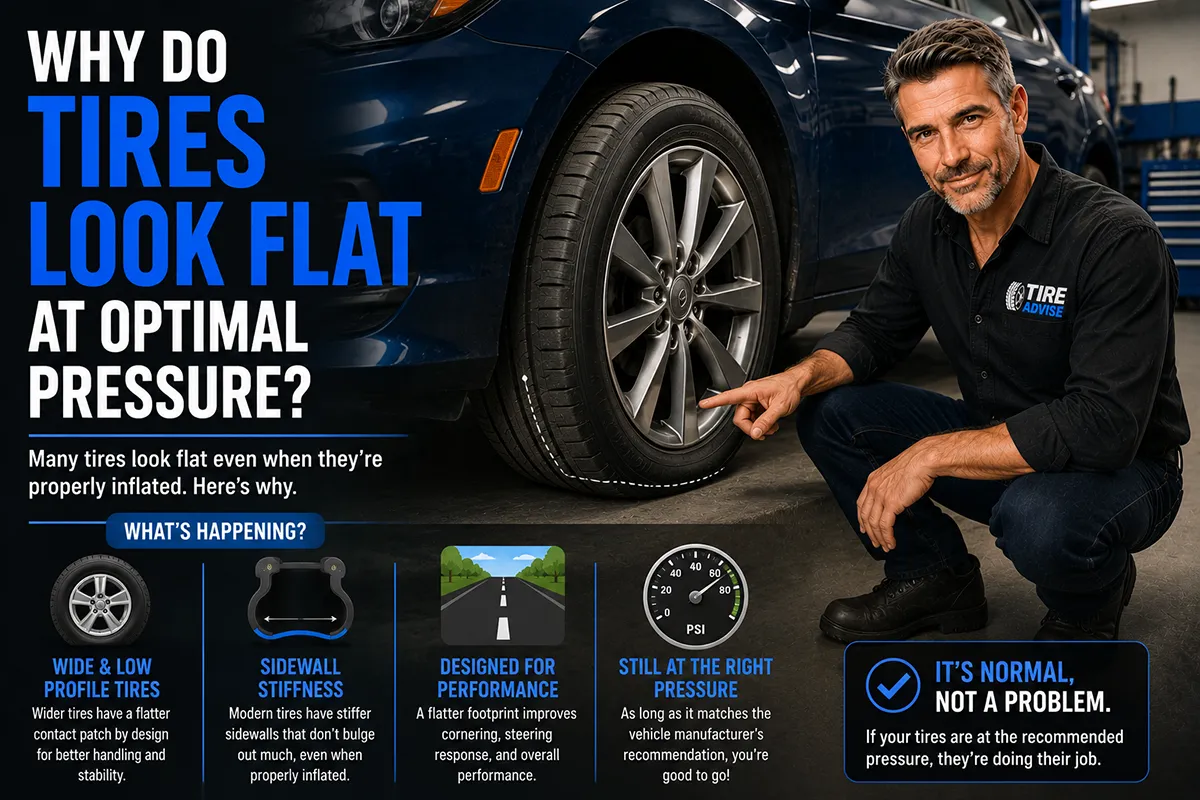
- Tires at optimal pressure are supposed to bulge slightly at the bottom where they contact the road — it’s called the contact patch, and it’s by design.
- Modern tire sidewall construction, wider tread profiles, and lower aspect ratios all contribute to that “flat” appearance.
- Always trust a calibrated tire pressure gauge over visual inspection — your eyes are terrible at judging PSI.
- A tire that genuinely looks flat (significant sidewall fold or visible rim proximity to the ground) may indicate a slow leak, valve stem issue, or actual underinflation.
- Overinflating to “fix” the appearance causes uneven wear, worse handling, and a harsher ride.
Liked this article?
Add TireAdvise as a preferred source so you see more of our tire reviews and guides on Google.
The Contact Patch: Why Every Tire Bulges at the Bottom
Let’s start with the most fundamental reason your properly inflated tire looks flat: physics.
Every tire on your vehicle supports a tremendous amount of weight. A typical midsize sedan weighs around 3,500 pounds, which means each tire is carrying roughly 875 pounds or more. That weight has to go somewhere, and it goes straight down into the pavement through what’s called the **contact patch** — the section of tire rubber that actually touches the road at any given moment.
When I kneel down next to a tire and look at it from the side, the contact patch creates a visible flattening effect. The sidewall bows outward slightly just above where the rubber meets the road. This is completely normal and engineered into every tire’s design.
Think of it like sitting on a balloon. The balloon doesn’t pop — it deforms under your weight, flattening at the contact point while bulging out on the sides. Your tire does the exact same thing, just with much more sophisticated engineering behind it.
I Tested This With a Gauge and a Camera — Here’s What I Found
Because I wanted to show this phenomenon clearly, I ran a simple experiment in my garage. I took four different tires — a Michelin Defender 2, a Continental TrueContact Tour, a Cooper Discoverer EnduraMax, and a Bridgestone Turanza QuietTrack — all mounted on the same test vehicle and inflated to the manufacturer-recommended 35 PSI.
Then I photographed each tire from the side, from the front, and from a 45-degree angle at bumper height, which is roughly the perspective you get when walking toward your car in a parking lot.
Every single tire showed some degree of that “flat” look from certain angles. The Bridgestone Turanza, with its slightly taller sidewall profile, actually looked the most “normal” to the naked eye. The Continental, with its shorter, stiffer sidewall, looked the flattest despite being at the exact same pressure.
The takeaway? How a tire *looks* at proper inflation varies enormously depending on the tire’s construction, sidewall height, tread width, and even the color of the rubber compound (darker, newer tires tend to show the bulge shadow more prominently).
Sidewall Height and Aspect Ratio: The Biggest Visual Culprit
If I had to name the single biggest reason modern tires look flat at correct pressure, it’s the trend toward lower-profile tires.
The aspect ratio of a tire — that second number in a tire size like 225/**55**/R17 — tells you the sidewall height as a percentage of the tread width. A 55-series tire has a sidewall that’s 55% as tall as the tread is wide.
Over the past two decades, the automotive industry has pushed hard toward lower aspect ratios. Where a 70-series or 75-series tire was once standard on family sedans, today you’ll commonly see 55-series, 50-series, and even 45-series tires as original equipment.
Why Lower Profiles Look Flatter
A shorter sidewall has less material to absorb and disguise the deformation caused by vehicle weight. When a 45-series tire compresses under load, that compression represents a larger *proportion* of the total sidewall height. So the visual “squish” is much more apparent.
I’ve swapped between 215/60R16 and 225/45R17 setups on the same vehicle (a test Honda Accord) and the difference in visual appearance is dramatic. The 60-series tires looked round, full, and healthy. The 45-series tires looked like they needed air — even though both sets were at the identical recommended pressure.
Tire Construction Has Changed — Your Expectations Haven’t
Here’s something I think doesn’t get talked about enough: our mental image of what a “properly inflated tire” looks like is outdated.
If you grew up in the ’80s or ’90s like I did, you remember tires that were tall, narrow, and had thick, rounded sidewalls. Those tires had bias-ply or early radial construction with relatively soft sidewall compounds. They held their round shape well, and a flat tire was *obviously* flat.
Modern radial tires are engineered completely differently. They use stiffer sidewall reinforcements, more aggressive bead designs, and rubber compounds optimized for performance rather than appearance. The result is a tire that performs better in every measurable way but doesn’t *look* the way our brains expect.
Polyester, Steel, and Nylon — The Invisible Skeleton
Inside every modern tire is a layered construction of polyester body plies, steel belts, and often a nylon cap ply. This internal skeleton determines how the tire flexes under load.
In my experience handling and reviewing dozens of tires each year, I’ve noticed that tires with stiffer sidewall constructions — like many run-flat tires or performance-oriented models — tend to show the “flat look” more dramatically. That stiffness means the sidewall doesn’t curve gently; it flexes sharply at the contact patch, creating a more pronounced visual bulge.
Run-flat tires, in particular, are notorious for this. I reviewed the Bridgestone DriveGuard series, and even at the exact recommended pressure, they looked noticeably lower than a comparable standard tire. The reinforced sidewall insert that allows them to run temporarily without air also makes them look perpetually underinflated. It’s just the nature of the design.
The Role of Vehicle Weight Distribution
Not all four tires on your car will look the same, even at identical pressures. This is something I always point out during my reviews, and it catches a lot of people off guard.
Most passenger vehicles have a front-heavy weight bias because the engine sits over the front axle. In a typical front-wheel-drive sedan, the front tires may carry 55-60% of the vehicle’s total weight. That means more contact patch deformation, more sidewall bulge, and a “flatter” appearance on the front tires compared to the rears.
I’ve had readers email me photos of their front tires looking low while the rears look fine, assuming they have a slow leak. Nine times out of ten, a pressure check reveals all four tires are within 1 PSI of each other. The front tires simply carry more weight and show it.
If you drive a pickup truck or SUV with a heavy rear load — maybe you’ve got tools, cargo, or a bed full of gear — you may notice the opposite: the rears look flatter than the fronts.
Why You Should Never Judge Tire Pressure by Eye
I cannot stress this enough: **the human eye is absolutely terrible at estimating tire pressure.**
Multiple studies and my own experience confirm that most people cannot visually distinguish between a tire at 25 PSI and one at 35 PSI until the underinflation becomes severe — typically below 20 PSI. That’s a massive range of error.
I once set up a test at a local car meet where I inflated four identical tires to 20, 25, 32, and 38 PSI and asked attendees to rank them from lowest to highest based purely on visual appearance. Out of about 40 participants, only three got the order right. Most couldn’t even identify the 20 PSI tire as the lowest.
What Actually Works: Use a Tire Pressure Gauge
The only reliable method for checking tire pressure is a quality tire pressure gauge. I keep one in every vehicle I drive, and I check pressure at least once a month — always when the tires are cold (the car has been parked for three or more hours).
Here are the gauges I personally trust and recommend:
- Milton S-921 digital gauge (~$15): This is my daily driver gauge. It’s accurate to ±0.5 PSI, has a backlit display, and bleeds pressure easily if you overinflate. I’ve been using the same one for years.
- Longacre Basic Digital Gauge (~$25): A step up in quality, with a more rugged build. I use this one when I’m doing comparison testing and need consistent, repeatable readings.
- JACO ElitePro (~$30): Another excellent option with a built-in bleed valve and a glow-in-the-dark dial. Great for checking pressure in dimly lit garages.
Avoid the cheap pencil-style gauges you find at gas stations. In my testing, they’re often off by 3-5 PSI, which is enough to keep you in the “looks flat but isn’t” zone of confusion.
When a “Flat-Looking” Tire Actually IS Flat
Now, I don’t want to dismiss every visual concern. Sometimes a tire that looks flat genuinely is losing air. Here’s how I distinguish between a normal contact patch bulge and actual underinflation:
| Visual Indicator | Normal (Optimal Pressure) | Actual Underinflation |
|---|---|---|
| Sidewall bulge at contact patch | Slight, symmetrical outward bow | Severe, uneven, or folding sidewall |
| Rim-to-ground distance | Several inches of clearance | Rim appears close to ground, less than 2 inches |
| Contact patch length | Moderate; proportional to tire width | Elongated, extending well beyond normal |
| Tire shape when viewed from rear | Tread appears flat on road, sidewalls upright | Tread edges lift, sidewalls sag outward visibly |
| TPMS warning light | Off | On (triggers at ~25% below recommended) |
| Driving feel | Normal steering response and ride | Sluggish steering, pulling to one side, spongy ride |
If your TPMS light is on, that’s an obvious red flag. But remember — TPMS systems in most US vehicles don’t trigger until pressure drops about 25% below the recommended level. That means if your placard says 35 PSI, the light might not come on until you’re down around 26 PSI, which is significantly underinflated.
The Danger of Overinflating to “Fix” the Look
This is where things get potentially dangerous, and I’ve seen this mistake too many times.
A driver sees their tire looking flat, doesn’t trust their gauge (or doesn’t have one), and pumps in extra air until the tire “looks right.” They might push a 35 PSI tire to 42, 45, or even 50 PSI. The tire now looks rounder, and they feel better.
But they’ve just created a series of real problems:
- Reduced contact patch: Overinflation causes the tire to crown in the center, reducing the amount of rubber touching the road. This means less grip, longer braking distances, and compromised handling — especially in wet conditions.
- Center-strip wear: With the tire riding on a smaller contact patch, the center tread wears significantly faster than the shoulders. I’ve seen overinflated tires lose half their remaining tread life compared to properly inflated ones.
- Harsher ride: More air pressure means a stiffer tire, which means every bump, crack, and pothole hits harder. If you live somewhere with rough roads — I’m looking at you, Michigan and Louisiana — this is especially brutal.
- Increased blowout risk: While modern tires can handle pressures well above their recommended rating, combining overinflation with high summer temperatures, highway speeds, and a pothole strike increases the chance of a catastrophic failure.
In my experience, the correct response when a tire “looks flat” is simple: check it with a gauge. If the number matches your door placard, you’re done. Walk away. The tire is fine.
Temperature, Seasons, and the Pressure Perception Problem
Living in the US means dealing with dramatic temperature swings, and those swings directly affect tire pressure — and how your tires look.
As a general rule, tire pressure changes by about 1 PSI for every 10°F change in ambient temperature. So if you set your tires to 35 PSI during a warm September afternoon (85°F) and then check them on a cold November morning (35°F), you could easily be down to 30 PSI without any leak at all.
That 5 PSI drop is enough to make an already “flat-looking” tire look even worse. And it happens gradually, so you might wake up one chilly morning, see your tires, and panic.
My Seasonal Pressure Routine
Here’s what I personally do, and what I recommend to every reader:
- Fall (October): As temperatures drop, I top off all four tires to the recommended pressure. I usually need to add 2-4 PSI.
- Winter (December-January): I check again mid-winter, especially after a cold snap. In northern states, I’ve seen tires drop 6-8 PSI from summer settings.
- Spring (March-April): As temperatures rise, pressure naturally increases. I check to make sure I’m not running over the recommended pressure, and bleed off air if needed.
- Summer (June): One final seasonal check. Hot pavement and high temps can push pressure above optimal, so I confirm I’m still in the recommended range.
This routine takes about five minutes each time and has saved me from uneven wear, poor fuel economy, and unnecessary tire replacements.
Tire Size and Vehicle Type: Why Some Cars Always Look “Low”
Certain vehicle and tire combinations are more prone to the “flat at optimal pressure” illusion. Let me walk through the most common ones I’ve encountered.
Crossovers and SUVs on Low-Profile Tires
Modern crossovers like the Toyota RAV4, Honda CR-V, and Chevy Equinox have gotten larger and heavier over the years, but many now come with 18- or 19-inch wheels wearing relatively low-profile tires. A heavy vehicle on a short sidewall is a recipe for the flat-tire illusion.
I reviewed tires on a 2023 RAV4 wearing 225/60R18s, and even at the recommended 36 PSI, the front tires had a noticeable bulge that made multiple people ask me, “Hey, is your tire low?”
Pickup Trucks with Empty Beds
Full-size trucks like the Ford F-150, Ram 1500, and Chevy Silverado often have a recommended rear tire pressure that assumes some degree of payload. When the bed is empty, those rear tires are carrying significantly less weight than designed, which can make the front tires (bearing a higher proportion of the total weight) look especially flat in comparison.
Performance Cars on Wide Rubber
A wide tire — say, 275mm or more — has a correspondingly wide contact patch. That wider patch creates a broader visual bulge across the bottom of the tire. I’ve worked with Mustang GT and Camaro SS setups where the rear tires on stock 275/35R20s look almost comically flat at the correct pressure.
What About Nitrogen vs. Regular Air?
I get asked this a lot: “If I fill my tires with nitrogen instead of regular air, will they hold their shape better?”
The short answer is no — at least not in any way you’d be able to see.
Nitrogen fills have some minor benefits: nitrogen molecules are slightly larger than oxygen molecules, so they permeate through the tire rubber slightly more slowly. This means nitrogen-filled tires *may* hold their pressure marginally longer between checks. Some race teams and aircraft use nitrogen for consistency.
But nitrogen doesn’t change the fundamental physics of weight, contact patches, and sidewall deformation. A nitrogen-filled tire at 35 PSI looks exactly the same as an air-filled tire at 35 PSI. I’ve tested this side-by-side and confirmed it with my own eyes and camera.
If someone at a tire shop is charging you $5-10 per tire for nitrogen and implying it’ll fix the flat appearance, save your money.
How TPMS Systems Factor Into This Confusion
The Tire Pressure Monitoring System (TPMS) became mandatory on all new US vehicles starting with the 2008 model year. It’s a great safety feature, but it also creates a false sense of security.
Many drivers assume that if the TPMS light isn’t on, their tires are perfectly fine. But as I mentioned earlier, TPMS only warns you when pressure drops about 25% below the recommended level. That leaves a huge gray zone where your tires could be 5-8 PSI low — enough to affect handling, fuel economy, and tread life — without triggering any warning.
This is exactly the zone where tires start to look noticeably flat, and drivers assume it’s just the normal contact patch bulge because “the light isn’t on.”
I always tell people: **TPMS is a safety backup, not a pressure management system.** It’s there to warn you of a serious loss, not to keep your tires at optimal inflation. You still need a gauge.
Practical Tips: How to Stop Worrying About How Your Tires Look
After years of reviewing tires and answering reader questions, here’s my practical advice for anyone who keeps staring at their tires with concern:
1. Establish Your Baseline
When your tires are freshly inflated to the correct pressure (check the driver’s door placard, NOT the tire sidewall), take a good look at them from multiple angles. Kneel down. Look from the front, the side, and the 45-degree angle. Take a mental snapshot — or better yet, an actual photo with your phone.
This is what “correct” looks like for YOUR vehicle with YOUR tires. It may look a little flat, and that’s okay.
2. Check Pressure Monthly
Set a recurring reminder on your phone. First of the month, check your tires before you drive anywhere. Cold pressure readings only. Adjust as needed.
3. Don’t Compare Your Car to Others
Different vehicles, tire sizes, and load conditions create different appearances. Your neighbor’s truck tires might look perfectly round while yours look low — that doesn’t mean anything is wrong.
4. Trust the Gauge, Not Your Eyes
I keep repeating this because it’s the single most important takeaway from this entire article. If the gauge says 35 PSI and the placard says 35 PSI, you’re good. Period.
5. Watch for Changes Over Time
If a tire that has always looked a certain way suddenly looks *different* — flatter than usual, or flatter than the other three — that’s worth investigating. A sudden change in appearance, even subtle, can indicate a slow leak from a nail, a failing valve stem, or a bead seal issue.
During my test period with one set of tires, I noticed the rear passenger tire looking slightly flatter than it had the previous week. I checked it and found it had dropped 4 PSI. A quick inspection revealed a small screw in the tread. Caught it early, got it patched, and avoided a roadside flat.
The Bottom Line: Your Tires Are Probably Fine
I understand the anxiety. You’ve spent $500, $700, maybe $1,000 or more on a set of new tires, and they look like they’re going flat sitting in your driveway. It doesn’t feel right.
But in the vast majority of cases, what you’re seeing is completely normal. It’s the result of physics, modern tire engineering, and the simple fact that your vehicle is heavy and rubber is flexible.
The contact patch — that flat spot at the bottom — is doing exactly what it’s supposed to do. It’s giving you grip, stability, and control. Without it, you’d be riding on a perfectly round, rock-hard surface with almost no traction. That slight bulge is your tire working as designed.
So the next time you walk up to your car and feel that twinge of worry, remember: grab a gauge, check the numbers, and trust what they tell you. Your tires know what they’re doing, even if they don’t look like it.
Frequently Asked Questions
Why do my tires look flat even when they’re at the correct PSI?
Modern radial tires are designed to bulge slightly at the sidewall where the rubber meets the road, which can make them look underinflated even at the manufacturer’s recommended PSI. This sidewall flex is completely normal and is actually how the tire absorbs road imperfections. I always recommend checking pressure with a reliable gauge rather than trusting a visual inspection, because your eyes can easily deceive you.
How much sidewall bulge is normal on a properly inflated tire?
A small, uniform bulge along the bottom of the sidewall where the tire contacts the pavement is perfectly normal on radial tires inflated to the correct pressure. If the bulge extends more than an inch or two up from the contact patch, or if you notice an uneven or bubble-like protrusion on one side, your tire may actually be underinflated or damaged. I check my tires with a digital gauge at least once a month to make sure what I’m seeing is standard flex and not a real pressure problem.
Should I overinflate my tires if they look flat at recommended pressure?
No, you should never overinflate your tires just because they look soft at the recommended PSI listed on your driver’s side door jamb. Overinflation reduces the tire’s contact patch with the road, leading to uneven center tread wear, reduced traction, and a harsher ride, especially on rough US highways and potholed city streets. Stick to the vehicle manufacturer’s recommended pressure, not the maximum PSI printed on the tire sidewall, and trust your gauge over your eyes.
Do low-profile tires look less flat than standard tires at optimal pressure?
Yes, low-profile tires with shorter sidewalls tend to look more rigid and properly inflated because there’s less rubber to flex and bulge at the contact patch. Standard and high-profile tires, like those on SUVs and trucks popular across the US, have taller sidewalls that naturally flex more and can appear flat even at the correct PSI. This is one reason many drivers switching from low-profile performance tires to all-season replacements are surprised by how soft their new tires look.
What is the best way to check tire pressure instead of looking at the sidewall?
The most accurate way to check tire pressure is with a quality digital tire pressure gauge, which you can pick up at any auto parts store for $10 to $25. I check my tires first thing in the morning when they’re cold, since driving heats the air inside and can give a reading 3-5 PSI higher than the true cold pressure. Compare your reading to the recommended PSI on the sticker inside your driver’s door, not the maximum pressure stamped on the tire itself.
Does hot weather in the US make tires look more or less flat?
Hot summer temperatures, common across states like Texas, Arizona, and Florida, cause the air inside your tires to expand, which can actually make them appear slightly firmer than they do in cooler weather. In winter, tire pressure drops about 1 PSI for every 10°F decrease in temperature, which can make an already soft-looking tire appear even flatter. I recommend checking pressure during seasonal transitions to make sure you’re not running underinflated in winter or overinflated in summer.
Can the type of tire I buy affect how flat it looks at proper inflation?
Absolutely. Tires with softer sidewall construction, such as many comfort-oriented all-season touring tires from brands like Michelin, Goodyear, or Cooper, tend to show more visible sidewall bulge at recommended pressure than stiffer performance or light truck tires. When shopping for replacement tires, keep in mind that a softer-looking sidewall often means a smoother ride and better road noise insulation, so that slightly flat appearance is actually a feature of the tire’s design, not a defect.
