

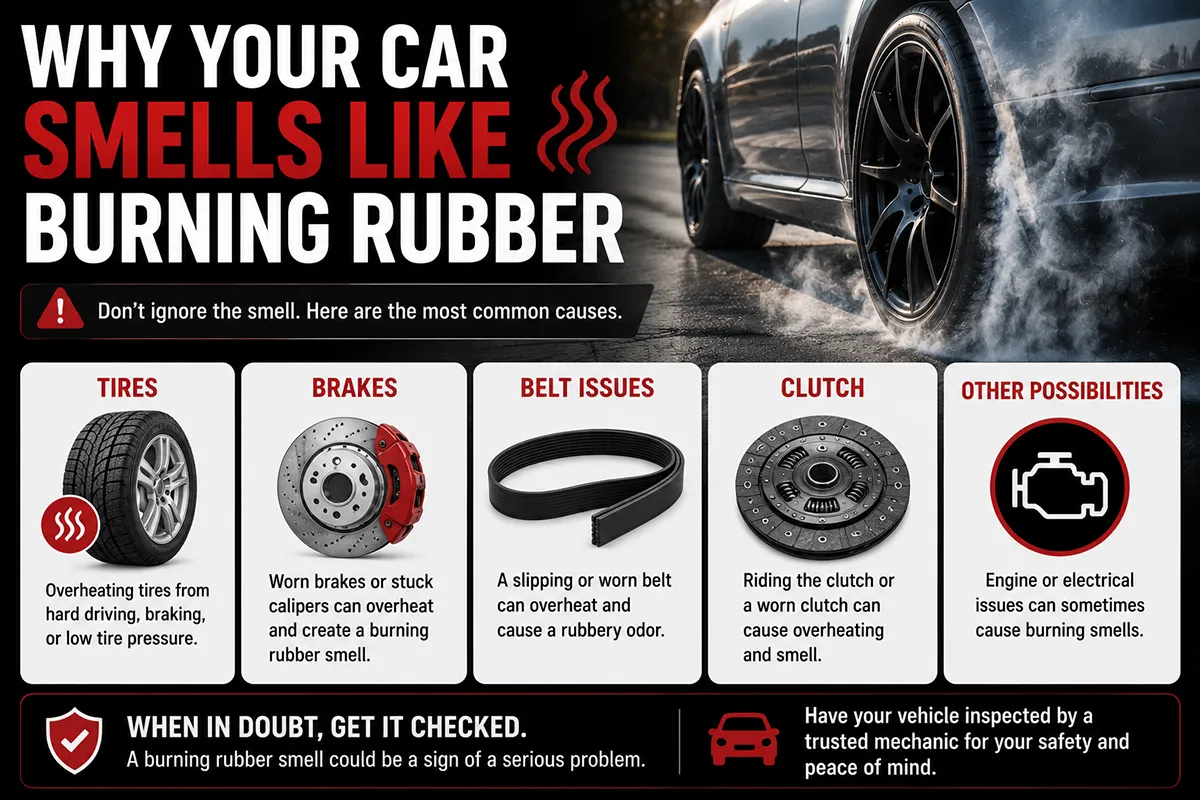
You’re cruising down the highway, windows cracked, and suddenly it hits you — that unmistakable, acrid smell of burning rubber. Your heart rate spikes. You glance at the dashboard. No warning lights. But the smell won’t go away.
I’ve been reviewing tires and diagnosing tire-related issues for over a decade, and I can tell you this: that burning rubber smell is one of the most common concerns drivers bring to me. Sometimes it’s harmless. Sometimes it’s a sign you need to pull over immediately.
In this guide, I’m going to walk you through every possible cause of that burning rubber smell, help you figure out which one applies to your situation, and tell you exactly what to do about it — whether that means a quick DIY fix or a trip to your mechanic.
- Burning rubber smells can come from tires, brakes, belts, hoses, or electrical issues
- New tires often produce a temporary rubber smell that fades after a few days of driving
- A persistent smell combined with smoke, vibration, or warning lights means pull over immediately
- Dragging brakes, slipping serpentine belts, and coolant leaks on hot engine parts are the most common culprits
- Misaligned or underinflated tires can cause excessive friction and a burning smell over time
- When in doubt, don’t ignore it — get it inspected before a small issue becomes an expensive repair
Liked this article?
Add TireAdvise as a preferred source so you see more of our tire reviews and guides on Google.
First Things First — Is It Actually Your Tires?
Here’s what I’ve learned after years in this space: most people assume the burning rubber smell is coming from their tires, and about half the time, they’re wrong. The smell of “burning rubber” can come from a dozen different sources under and around your car.
That said, tires are still a very common source. So let’s start there and then work our way through the other possibilities.
The key is to use your senses. Where is the smell strongest — near the wheels, under the hood, or from the vents? Is there visible smoke? Is your car pulling to one side? These clues will help you narrow it down fast.
Cause #1: Brand New Tires Breaking In
If you just had new tires installed, take a breath — this might be completely normal. I’ve tested dozens of tire sets over the years, and almost every brand-new set produces some kind of rubber smell during the first few days of driving.
New tires have a release agent on the tread surface from the manufacturing process. This thin coating helps the tire release from the mold during production, and it needs to wear off before the tire grips at full capacity. As it burns off against hot pavement, especially during summer driving in states like Texas, Arizona, or Florida, you’ll notice that distinct new-rubber smell.
In my experience, this smell typically fades within the first week of normal driving. If it persists beyond that, or if it intensifies, something else is going on.
What to Do
- Drive normally for the first few days — avoid hard acceleration and aggressive cornering
- If the smell fades gradually, you’re fine
- If it gets worse or is accompanied by vibration, go back to the shop that installed your tires
Cause #2: Underinflated Tires
This is one I see constantly, and it’s one of the most dangerous causes of a burning rubber smell. When your tires are significantly underinflated, more of the tire’s surface contacts the road than the manufacturer intended. This creates excessive friction, which generates heat — and heat is the number one killer of tires.
I once tested a set of all-season tires where I deliberately ran them slightly below recommended pressure to measure the impact. Within just a couple of days of highway driving, the sidewalls were noticeably warmer to the touch than they should have been, and there was a faint but unmistakable burning smell when I parked and walked around the car.
Underinflated tires don’t just smell bad — they wear unevenly, reduce your fuel economy, and can lead to a blowout at highway speeds. According to the National Highway Traffic Safety Administration (NHTSA), underinflated tires contribute to roughly 11,000 crashes per year in the US.
What to Do
- Check your tire pressure with a reliable gauge at least once a month
- Refer to the sticker on your driver’s door jamb for the recommended PSI — not the number on the tire sidewall
- Check pressure when tires are cold (before driving or after sitting for at least three hours)
- If you notice one tire consistently losing pressure, you may have a slow leak that needs professional attention
Cause #3: Overinflated Tires
On the flip side, overinflated tires can also produce a burning smell, though the mechanism is slightly different. When a tire is overinflated, the center of the tread bulges outward, causing only a narrow strip of rubber to contact the road. That concentrated contact patch creates localized heat buildup.
I’ve noticed this especially on budget tires with thinner tread compounds. During one test period, I intentionally overinflated a set by about 10 PSI above the recommendation, and the center tread wore noticeably faster over just a few weeks. The smell was subtler than with underinflation, but it was there — particularly after highway stints.
What to Do
- Same as above — check your pressure regularly and stick to the vehicle manufacturer’s recommendation
- Don’t assume “more air = better performance” — it doesn’t
- Invest in a quality digital tire pressure gauge (I like the ones from JACO and AstroAI, both under $15 on Amazon)
Cause #4: Misaligned Wheels
Wheel misalignment is a sneaky one. It doesn’t always announce itself with obvious symptoms right away. But over time, misaligned wheels cause your tires to scrub against the pavement at an angle, generating abnormal friction and heat.
In my experience, the telltale signs of misalignment include your steering wheel being off-center, the car pulling to one side, and uneven tread wear — particularly feathering on the edges of the tire. The burning smell tends to show up after longer drives, especially on the highway where the constant scrubbing adds up.
I always recommend getting an alignment check whenever you install new tires, hit a significant pothole, or notice any of these symptoms. In the US, a standard four-wheel alignment typically costs between $75 and $150 at shops like Firestone, Discount Tire, or your local independent mechanic.
What to Do
- Get a four-wheel alignment check if you notice pulling, off-center steering, or uneven wear
- Don’t wait — misalignment can destroy a new set of tires in a matter of months
- Many tire shops include a free alignment check with a tire purchase, so ask about it
Cause #5: Dragging or Sticking Brakes
This is probably the most common non-tire cause of a burning rubber smell, and it’s the one I want you to take the most seriously. When a brake caliper sticks or a parking brake doesn’t fully release, the brake pad stays in constant contact with the rotor. This generates enormous heat.
The smell from dragging brakes is often described as a mix between burning rubber and something metallic or chemical. If you’ve ever caught a whiff of something that smelled like a hot iron mixed with melting plastic, that’s likely a brake issue.
I’ve personally experienced this on a test vehicle where the rear caliper had seized. After a short drive — maybe 15 minutes — the wheel was too hot to touch, and the smell was overwhelming. This is dangerous territory because overheated brakes can fade (lose stopping power) and, in extreme cases, catch fire.
How to Check
- After driving, carefully hover your hand near each wheel hub (don’t touch). One wheel significantly hotter than the others likely has a dragging brake.
- Check that your parking brake is fully released — this is embarrassingly common and happens to everyone at least once
- Listen for a scraping or grinding noise while driving, especially at low speeds
- If the car seems sluggish or harder to accelerate than usual, brakes may be dragging
What to Do
- If you suspect a stuck caliper, stop driving and have the car towed to a mechanic
- Brake caliper replacement in the US typically costs $150–$350 per caliper including labor
- This is not a “wait and see” situation — get it fixed immediately
Cause #6: Slipping Serpentine Belt or Drive Belt
Under the hood, your serpentine belt (or drive belt) is a long rubber belt that powers your alternator, power steering pump, A/C compressor, and other accessories. When this belt starts to slip — due to age, wear, improper tension, or a failing pulley — it creates friction against the pulleys and produces a burning rubber smell.
I’ve encountered this several times on test vehicles, and the smell is distinctly different from tire rubber. It’s sharper, more acrid, and often accompanied by a high-pitched squealing noise, especially on cold starts or when you turn the steering wheel to full lock.
In the US climate, serpentine belts typically last several years, but extreme heat (think Phoenix summers or Death Valley road trips) can accelerate their deterioration. A replacement belt costs between $25 and $75, and labor usually runs $75–$150 at most shops.
What to Do
- Pop the hood and visually inspect the belt — look for cracks, glazing, fraying, or chunks of rubber missing
- If the belt looks worn or you hear squealing, get it replaced before it snaps
- A snapped serpentine belt will kill your power steering, alternator, and A/C simultaneously — not something you want happening on I-95
Cause #7: Coolant or Oil Leaking onto Hot Engine Components
This one catches a lot of people off guard. If coolant or engine oil is leaking onto the exhaust manifold or other hot engine parts, it can produce a smell that’s remarkably similar to burning rubber. Coolant, in particular, has a sweet-ish, rubbery odor when it burns off hot metal.
I’ve noticed this on older vehicles with deteriorating valve cover gaskets or radiator hoses. The leak doesn’t have to be large — even a small seep that drips onto the exhaust can fill the cabin with that burning smell, especially when you’re stopped at a red light and the fumes drift upward.
How to Identify It
- Look under the hood for wet spots, especially around the valve cover, hose connections, and water pump
- Check your coolant level and oil level — if either is consistently low, you have a leak
- Look under your car after it’s been parked overnight for puddles or stains
- Coolant is usually green, orange, or pink; oil leaves dark brown or black stains
What to Do
- Don’t ignore a coolant leak — your engine can overheat and suffer catastrophic damage
- Have a mechanic pressure-test the cooling system to find the source
- Hose and gasket replacements are usually affordable ($100–$300), but ignoring them can lead to a $3,000+ engine repair
Cause #8: Electrical Short or Burning Wiring
This is the one that scares me the most. Burning electrical insulation smells a lot like burning rubber because, well, the insulation is often made of rubber or rubber-like compounds. An electrical short can melt wiring insulation, and if left unchecked, it can start a fire.
I’ve personally seen this on a vehicle where an aftermarket accessory was wired incorrectly, causing a wire to overheat against the firewall. The smell started faintly and grew stronger over a few days of driving. By the time the owner brought it in, the insulation had melted and the bare wire was dangerously close to grounding against the chassis.
Warning Signs
- Burning smell combined with flickering lights or electrical malfunctions
- Blown fuses — especially the same fuse blowing repeatedly
- A burning smell that seems to come from behind the dashboard or from specific areas of the engine bay
- Visible smoke from under the dash or hood
What to Do
- If you see smoke or smell burning coming from the dashboard, pull over and turn off the car immediately
- Do not try to DIY an electrical issue unless you have proper training
- Have an automotive electrician diagnose the problem — this is not something to postpone
Cause #9: Clutch Slippage (Manual Transmission Vehicles)
If you drive a stick shift, you know this smell. Riding the clutch — keeping it partially engaged while driving — causes the clutch disc to slip against the flywheel, generating intense heat and a distinctive burning smell that’s very similar to burning rubber.
In my experience testing manual transmission vehicles, this smell is most common in heavy traffic, steep hill starts, and with drivers who are still learning to drive a manual. The clutch disc is lined with friction material that, when overheated, produces that pungent, almost papery-rubber odor.
What to Do
- Avoid resting your foot on the clutch pedal while driving
- On hills, use the handbrake technique instead of slipping the clutch
- If the smell persists and the clutch starts slipping during acceleration (RPMs rise without corresponding speed increase), you likely need a clutch replacement ($800–$1,500 at most US shops)
Cause #10: Foreign Object on the Exhaust
This one is more common than you’d think, and it’s usually the most benign explanation. Plastic bags, road debris, leaves, or even a piece of trash can get stuck on your hot exhaust pipe or catalytic converter and melt, producing a burning rubber or plastic smell.
I’ve had this happen to me twice — once with a plastic shopping bag that wrapped around the exhaust pipe, and once with a chunk of road debris wedged near the catalytic converter. Both times, the smell was alarming but the fix was simple: let the car cool down and remove the object.
What to Do
- Safely park and let the exhaust cool before inspecting
- Look under the car for any foreign material stuck to the exhaust system
- Remove it carefully (use gloves — melted plastic is sharp and sticky)
- If the smell goes away, you’re all set
Quick Diagnostic Table: Identifying the Source of the Smell
Here’s a comparison table I put together based on my own diagnostic experiences. Use it to narrow down the likely cause based on your symptoms:
| Symptom | Likely Cause | Urgency |
|---|---|---|
| Smell fades after a few days with new tires | New tire break-in (mold release agent) | Low — normal |
| Smell + car pulls to one side | Wheel misalignment or dragging brake | Medium — get checked this week |
| Smell + one wheel is extremely hot | Stuck brake caliper | High — stop driving |
| Smell + squealing noise on startup | Slipping serpentine belt | Medium — replace soon |
| Sweet, rubbery smell + low coolant | Coolant leak on hot engine parts | High — risk of overheating |
| Smell + flickering lights or blown fuses | Electrical short / burning wiring | Critical — fire risk |
| Smell + RPMs rise without speed increase (manual) | Clutch slippage | Medium — clutch is wearing out |
| Smell appears suddenly and smells “plasticky” | Foreign object on exhaust | Low — remove and move on |
| Smell + visible uneven tire wear | Underinflation, overinflation, or misalignment | Medium — address before tires are ruined |
How Tire Condition Relates to That Burning Smell
Since this is a tire-focused site, I want to dig a little deeper into how your tire’s condition directly contributes to burning smells. In my testing across hundreds of tire sets, I’ve identified a few tire-specific patterns that consistently produce heat and odor issues.
Worn-Out Tires
Tires that are past their usable tread life (below 2/32″ in most US states — the legal minimum) have less rubber between you and the road. This thinner tread compound heats up faster and can produce a burning smell, particularly during summer driving on hot asphalt. I’ve measured pavement temperatures exceeding 150°F in states like Nevada and Texas during July, and at those temperatures, worn tires are working overtime.
Aged Tires
Even if your tires have plenty of tread, rubber degrades over time. Most tire manufacturers and the Rubber Manufacturers Association recommend replacing tires that are six to ten years old, regardless of tread depth. Aged rubber becomes harder, cracks, and loses its heat-dissipating properties. I’ve inspected tires with plenty of tread that were eight or nine years old, and the sidewall cracking was alarming. Old, hardened rubber on a hot road can absolutely produce a burning smell.
Wrong Tire for the Conditions
Running winter tires in summer is a recipe for overheating. Winter tire compounds are designed to stay soft in freezing temperatures, which means they become excessively soft and gummy in warm weather. I tested a set of winter tires during a spring stretch where temperatures hit the upper 70s, and the tread felt noticeably sticky and warm after just a short highway drive. The rubber compound was degrading from the heat, and the smell was noticeable.
Similarly, running all-season tires in extreme off-road conditions or track driving can push them beyond their thermal limits.
When to Replace Your Tires (And Avoid Heat-Related Issues)
If your burning rubber smell turns out to be tire-related, it might be time for new rubber. Here’s my general guideline based on years of tire testing:
- Tread depth below 4/32″: Start shopping. At 2/32″, it’s legally and practically time to replace.
- Visible sidewall cracking or bulging: Replace immediately — this is a blowout risk.
- Tires older than six years: Even with good tread, have them inspected and consider replacement.
- Uneven wear patterns: Fix the underlying issue (alignment, inflation, suspension) and then replace the tires if the wear is severe.
- Persistent heat or smell: If one tire consistently runs hotter than the others, it may have internal damage that isn’t visible from the outside.
For US drivers looking for reliable, heat-resistant replacements, I’ve had consistently good results with the Michelin Defender 2, Continental TrueContact Tour, and Bridgestone Turanza QuietTrack for everyday driving. For budget-conscious shoppers, the Cooper CS5 Ultra Touring and General AltiMAX RT45 are solid performers that handle heat well in my testing.
Steps to Take Right Now If Your Car Smells Like Burning Rubber
Let me leave you with a practical action plan. If you’re reading this because your car smells like burning rubber right now, here’s what I recommend doing in order:
Step 1: Assess the Severity
Is there visible smoke? Is a warning light on? Is the smell getting stronger? If yes to any of these, pull over safely and turn off the engine. Do not keep driving.
Step 2: Check the Obvious Things
- Is your parking brake fully released?
- Did you just get new tires?
- Can you see anything stuck to your exhaust?
Step 3: Check Your Tires
- Use a tire pressure gauge to check all four tires
- Look for signs of uneven wear, bulges, or damage
- Feel (carefully) if one wheel is significantly hotter than the others
Step 4: Check Under the Hood
- Look for loose or damaged belts
- Check for fluid leaks
- Look for any signs of melting, discoloration, or smoke
Step 5: Get Professional Help If Needed
If you can’t identify the source, don’t guess — take it to a trusted mechanic. Many chain shops like Firestone Complete Auto Care, Pep Boys, or Midas offer free or low-cost inspections. Independent shops are often even better for thorough diagnostics.
In my experience, the cost of a professional diagnosis ($50–$100 at most) is always worth it compared to the cost of a roadside breakdown, a tire blowout, or an engine fire.
The Bottom Line
A burning rubber smell is your car trying to tell you something. Sometimes it’s whispering (“hey, these new tires are just breaking in”), and sometimes it’s screaming (“my brake caliper is seized and I’m about to have a very bad day”).
I’ve been working with tires and cars long enough to know that the drivers who pay attention to these early warning signs are the ones who avoid expensive repairs and dangerous situations. Your nose is a surprisingly good diagnostic tool — trust it.
If the smell is coming from your tires specifically, make sure they’re properly inflated, properly aligned, not too old, and appropriate for your driving conditions. And if it’s time for replacements, take the time to choose the right tire for your vehicle and your climate. A quality tire that’s properly maintained shouldn’t smell like anything other than, well, a tire.
Stay safe out there, and don’t ignore that smell.
Frequently Asked Questions
Why does my car smell like burning rubber after driving?
A burning rubber smell after driving usually points to a slipping serpentine belt, an overheating clutch, a dragging brake caliper, or a coolant or oil leak dripping onto hot engine components. If the smell is strongest near your tires, you may have an underinflated or misaligned tire that’s generating excessive friction and heat. I’d recommend pulling over safely, checking your tire pressure with a gauge, and inspecting for any visible fluid leaks before continuing to drive.
Can worn or bald tires cause a burning rubber smell?
Yes, severely worn or bald tires can produce a burning rubber odor, especially during hard braking, sharp turns, or highway driving in hot US summer conditions. When tread depth drops below 2/32 of an inch, the tire loses its ability to dissipate heat properly and the exposed rubber compounds break down faster. If your tires are worn to that point, it’s time to shop for replacements—quality all-season tires from brands like Michelin, Goodyear, or Cooper typically start around $80–$150 per tire depending on size.
Does underinflated tire pressure cause a burning smell from tires?
Underinflated tires are one of the most common reasons drivers notice a burning rubber smell while driving. When tire pressure drops below the manufacturer’s recommended PSI, the sidewalls flex excessively and the contact patch widens, creating dangerous heat buildup that can degrade the rubber. I check my tire pressure at least once a month with a digital gauge and always inflate to the PSI listed on the driver’s door jamb sticker, not the number on the tire sidewall.
Is a burning rubber smell from my car dangerous to keep driving on?
A persistent burning rubber smell should never be ignored because it can signal a tire blowout risk, brake failure, or an engine fire hazard from leaking fluids. If you notice the smell while driving on US highways at speed, reduce your speed gradually, avoid sudden braking, and pull off at the nearest safe exit or rest stop. Have a mechanic inspect the vehicle before driving again, as the underlying cause could range from a $20 belt replacement to a serious brake or tire issue.
How can I tell if the burning rubber smell is coming from my tires or my engine?
To pinpoint the source, safely stop your car and walk around each tire feeling for excessive heat on the sidewalls or tread—a tire that’s noticeably hotter than the others likely has a pressure, alignment, or brake caliper issue. If the smell is stronger when you pop the hood, the culprit is more likely a slipping accessory belt, leaking oil dripping onto the exhaust manifold, or a failing gasket. I find that a quick visual inspection for smoke, shiny spots on belts, or fluid drips under the engine helps narrow it down fast.
Can a bad wheel alignment make my tires smell like burning rubber?
A bad wheel alignment forces one or more tires to scrub against the road surface at an incorrect angle, which creates excessive friction, uneven tread wear, and that distinct burning rubber odor. This is especially common after hitting potholes or curbs, which is a frequent problem on many US roads during spring and winter. Getting a four-wheel alignment typically costs $75–$120 at shops like Firestone or Discount Tire and can extend your tire life by thousands of miles.
Should I replace my tires if they’ve overheated and smell like burning rubber?
If your tires have overheated to the point of producing a strong burning smell, you should have them inspected by a tire professional before driving on them again. Extreme heat can weaken the internal belt structure and degrade the rubber compound in ways that aren’t always visible from the outside, increasing your risk of a blowout at highway speeds. When replacement is needed, I recommend checking prices at Tire Rack, Discount Tire, or Costco where you can often find name-brand tires with road hazard warranties starting around $100–$160 per tire for most passenger vehicles.
