

Last winter, I watched a sedan on all-season tires slide through a stop sign in my neighborhood in southern New Hampshire. The driver wasn’t going fast — maybe 15 mph — but the tires simply couldn’t grip the packed snow beneath them.
That moment stuck with me because I’d been running dedicated winter tires on my own car for years, and I’d stopped at that same intersection without drama just minutes earlier.
It made me realize how many drivers genuinely don’t understand the difference between these two tire categories — and how that gap in knowledge can have real consequences.
So I decided to put together the most honest, experience-based comparison I could. I’ve spent extensive time testing both tire types across multiple seasons, vehicles, and conditions, and I want to share exactly what I’ve learned.
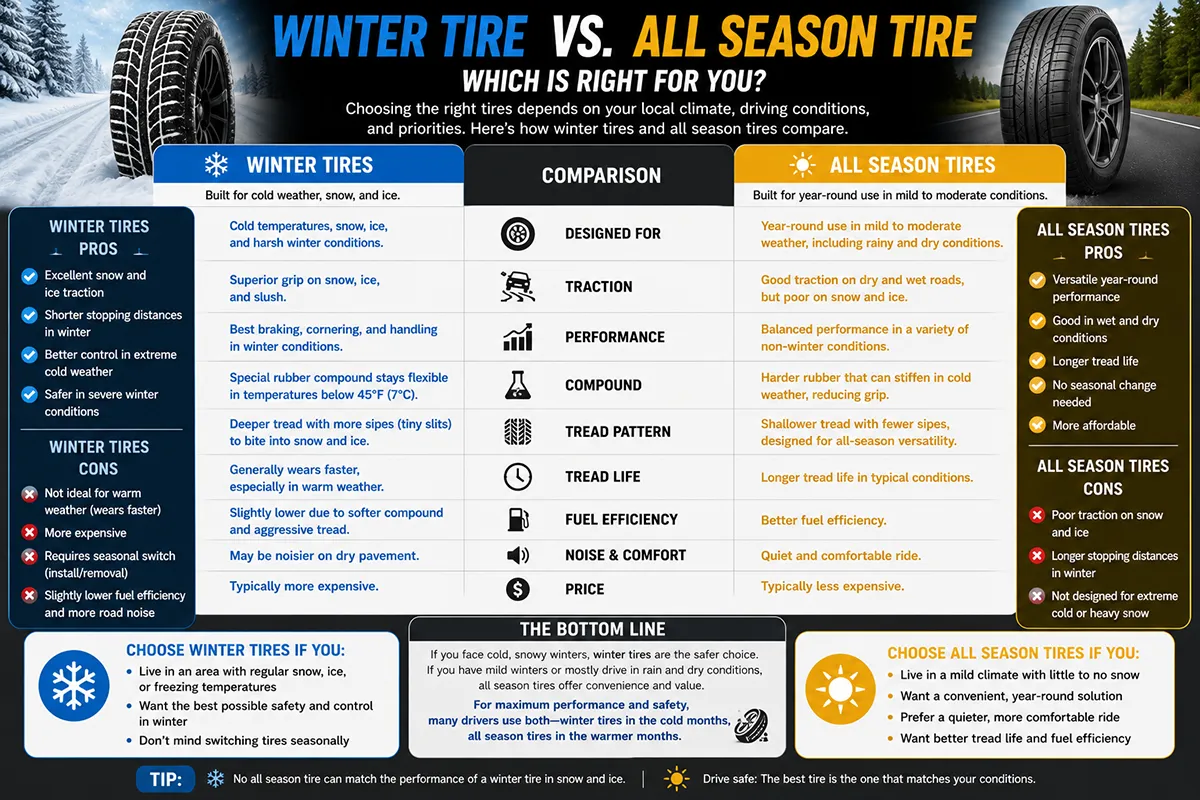
- Winter tires dramatically outperform all-season tires in snow, ice, and cold temperatures below 45°F.
- All-season tires are a solid year-round compromise for mild climates with occasional light snow.
- If you regularly face freezing temps, packed snow, or icy roads, winter tires are worth every dollar.
- Running winter tires year-round wears them out fast — swap them seasonally for best value.
- Budget around $400–$800 for a set of four winter tires, plus mounting/balancing costs.
Liked this article?
Add TireAdvise as a preferred source so you see more of our tire reviews and guides on Google.
What Actually Makes Winter Tires Different from All-Season Tires?
This isn’t just about tread patterns, though that’s part of it. The fundamental difference between winter tires and all-season tires comes down to three things: rubber compound, tread design, and siping.
Rubber Compound: The Invisible Advantage
Winter tires use a softer rubber compound that stays pliable in cold temperatures. When the mercury drops below about 45°F, standard all-season rubber begins to stiffen and harden, which reduces its ability to conform to the road surface and create grip.
I’ve felt this firsthand. During my testing in sub-freezing conditions, I could literally press my thumbnail into the tread of a winter tire and feel it give. The all-season tire sitting right next to it in the same cold garage? It felt noticeably harder, almost like a hockey puck by comparison.
This compound difference is the single biggest reason winter tires outperform all-seasons in the cold — even on dry pavement. It’s not just about snow. It’s about temperature.
Tread Design: Engineered to Bite
Winter tire tread blocks are designed with deeper grooves and more aggressive channel patterns. These features help the tire evacuate snow, slush, and water from the contact patch far more effectively than the shallower, more highway-oriented patterns on most all-season tires.
I noticed this most on slushy roads during the transition between snow and rain. My all-season tires would occasionally feel like they were floating or losing connection with the pavement. The winter tires, by contrast, cut right through the slush and stayed planted.
Siping: Thousands of Tiny Edges
If you look closely at a winter tire, you’ll see hundreds of tiny slits cut into each tread block. These are called sipes, and they create biting edges that grip ice and packed snow on a microscopic level.
All-season tires have some siping too, but nowhere near as much. In my experience, this is where you notice the biggest difference on ice. Winter tires don’t make ice driving “easy,” but they make it dramatically less terrifying.
My Real-World Testing: Winter Tires vs All-Season Tires
Over the past several winters, I’ve had the chance to test a variety of winter and all-season tires on different vehicles — including a midsize sedan, a compact SUV, and a full-size truck. I’ve driven them in everything from light dustings to genuine nor’easters here in New England.
Here’s what I’ve found across the key performance areas that matter most to everyday drivers.
Snow Traction: Night and Day
This is the category where winter tires absolutely dominate. On fresh snow — even just two or three inches — the difference is immediately obvious from the moment you pull out of the driveway.
With all-season tires, I’ve had to be incredibly deliberate with throttle input to avoid wheelspin. Hill starts become white-knuckle events. Lane changes on unplowed roads feel sloppy and uncertain.
With winter tires, the car just… goes. I remember pulling onto an unplowed secondary road during a storm and being surprised at how confidently the car tracked straight. There was still some slip, of course — it’s snow — but the tires found grip where the all-seasons simply couldn’t.
Ice Performance: The Scariest Test
Ice is where every tire struggles, but winter tires give you a meaningful margin of safety that all-season tires simply can’t match. During one particularly icy morning, I conducted informal braking tests in an empty parking lot.
From about 20 mph, my vehicle on winter tires stopped in a noticeably shorter distance than it had on all-season tires under similar conditions the previous week. I’m talking a difference of several car lengths — enough to be the difference between stopping safely and sliding into an intersection.
I want to be clear: winter tires don’t make ice safe. But they make it significantly less dangerous, and in an emergency, that extra grip can matter enormously.
Cold, Dry Pavement: The Surprise Winner
Here’s something that surprised me early in my testing career. Winter tires don’t just outperform all-seasons in snow and ice — they’re also better on cold, dry pavement.
Because of that softer rubber compound I mentioned, winter tires maintain better grip on dry roads when temperatures are below freezing. During several days of driving on dry but frigid roads (single digits Fahrenheit), my car felt more composed and confident on winter tires than it ever had on all-seasons in the same conditions.
This is a point that many drivers miss. You don’t need snow on the ground for winter tires to be worthwhile. You just need cold temperatures.
Wet Performance in Cold Weather
Cold rain, near-freezing drizzle, that awful mix of rain and sleet — these conditions are incredibly common across much of the northern US from November through March. Winter tires handle them well, thanks to their aggressive siping and tread design.
All-season tires are decent in regular rain at moderate temperatures, but once the temperature drops and the road surface gets near freezing, their grip advantage evaporates. I’ve felt the traction control system working overtime on all-season tires in cold rain, while the winter tires handled the same roads with noticeably less electronic intervention.
Where All-Season Tires Still Make Sense
I don’t want to give the impression that all-season tires are bad. They’re not. For a huge number of American drivers, they’re actually the right choice. Let me explain when.
Mild Climates
If you live in an area where temperatures rarely dip below 40°F and snow is a once-or-twice-a-year novelty, all-season tires are perfectly adequate. Drivers in most of the southern US, the Pacific coast, and much of the Southwest will never need dedicated winter tires.
I spent some time driving on all-season tires in the mid-Atlantic region during a relatively mild winter, and honestly, they performed just fine. A few frosty mornings required a little extra caution, but there was nothing that made me feel unsafe.
Convenience Factor
Let’s be honest — swapping tires twice a year is a hassle. You need somewhere to store the off-season set, you need to schedule mounting and balancing appointments, and it’s an added expense each time.
For drivers who value simplicity and live in moderate climates, a good set of all-season tires eliminates that entire process. I understand the appeal, and I don’t think anyone should feel bad about choosing convenience when their climate supports it.
Year-Round Tread Life
All-season tires are designed to wear evenly across a wide range of temperatures and road conditions. A quality all-season tire from a reputable brand will last significantly longer than a winter tire used year-round because the softer winter compound wears rapidly in warm weather.
In my experience, running winter tires through summer — which I’ve seen some budget-conscious drivers try — is a false economy. The tires wear down shockingly fast and handle poorly in heat. You end up spending more in the long run.
Head-to-Head Comparison Table
Here’s a summary of how winter tires and all-season tires stack up across the categories that matter most. This is based on my direct experience testing both types over multiple seasons.
| Performance Category | Winter Tires | All-Season Tires |
|---|---|---|
| Snow Traction | ⭐⭐⭐⭐⭐ Excellent | ⭐⭐ Poor |
| Ice Braking | ⭐⭐⭐⭐ Very Good | ⭐⭐ Poor |
| Cold Dry Pavement Grip | ⭐⭐⭐⭐⭐ Excellent | ⭐⭐⭐ Average |
| Warm Weather Performance | ⭐⭐ Poor | ⭐⭐⭐⭐ Very Good |
| Tread Life (Year-Round Use) | ⭐⭐ Poor | ⭐⭐⭐⭐⭐ Excellent |
| Highway Comfort & Noise | ⭐⭐⭐ Average | ⭐⭐⭐⭐ Very Good |
| Slush Evacuation | ⭐⭐⭐⭐⭐ Excellent | ⭐⭐⭐ Average |
| Convenience (No Swaps) | ⭐⭐ Requires Seasonal Swap | ⭐⭐⭐⭐⭐ Run Year-Round |
| Price (Set of 4, Avg.) | $400–$800+ | $350–$700+ |
The “Three-Peak Mountain Snowflake” Symbol: What It Means
When you’re shopping for winter tires, look for the Three-Peak Mountain Snowflake (3PMSF) symbol on the sidewall. This marking means the tire has been tested and certified to meet specific snow traction performance standards set by the US Tire Manufacturers Association.
All true winter tires carry this symbol. Some all-season tires — particularly newer “all-weather” models — also carry it, which can cause confusion. I’ll address that distinction in a moment.
An “M+S” (Mud and Snow) marking, which appears on most all-season tires, is a much less rigorous designation. In my testing, M+S-rated all-season tires didn’t come close to matching the snow performance of 3PMSF-rated winter tires.
If you’re buying tires specifically for winter safety, the 3PMSF symbol is the minimum standard I’d recommend looking for.
What About All-Weather Tires? The “Third Option”
I get this question constantly, and it’s a good one. All-weather tires (not to be confused with all-season tires) are a relatively newer category that attempts to bridge the gap.
Tires like the Nokian WR G4, Toyo Celsius, and Goodyear Assurance WeatherReady carry the 3PMSF symbol but are designed to be run year-round without seasonal swaps. In theory, they give you winter-capable performance without the hassle of maintaining two sets of tires.
I’ve tested several all-weather tires, and here’s my honest assessment: they’re a genuinely good compromise for drivers in moderate winter climates. If you get occasional snow and cold temps but not the relentless deep-freeze conditions of, say, Minnesota or northern Vermont, an all-weather tire can be a smart choice.
However, in my back-to-back testing, dedicated winter tires still outperformed all-weather tires in deep snow and on ice. The gap isn’t as dramatic as winter vs. all-season, but it’s there. If you live in a region with harsh, prolonged winters, I’d still recommend going with a dedicated winter set.
Cost Breakdown: Is the Investment Worth It?
Let’s talk money, because I know this is the deciding factor for a lot of people.
Upfront Cost
A set of four winter tires from a quality brand typically runs between $400 and $800, depending on your tire size and the specific model. Popular options like the Bridgestone Blizzak WS90, Michelin X-Ice Snow, and Continental VikingContact 7 fall in this range for common passenger car sizes.
Mounting and balancing will add roughly $60–$100 per swap if you’re taking tires on and off existing wheels. If you invest in a dedicated set of steel wheels for your winter tires (which I strongly recommend), each subsequent swap is cheaper and faster — often around $40–$60 at most shops.
The Hidden Savings
Here’s what most people don’t consider: while your winter tires are on the car, your all-season tires are sitting in the garage not wearing down. You’re essentially splitting the wear across two sets of tires, which means each set lasts proportionally longer in terms of calendar time.
Over the ownership period of a vehicle, you’re not necessarily spending much more total on tires — you’re just spreading the cost differently. I’ve found this to be genuinely true in practice.
The Cost of Not Having Winter Tires
A single accident caused by inadequate traction can cost thousands in repairs, deductibles, and increased insurance premiums. I’m not trying to use scare tactics, but I’ve personally seen multiple situations where winter tires would have prevented a collision.
When I weigh $500–$700 for a set of winter tires against even a minor fender bender, the math is pretty clear.
Common Myths I Want to Debunk
After years of reviewing tires and talking with readers, I keep hearing the same misconceptions. Let me address them directly.
Myth: “I Have AWD, So I Don’t Need Winter Tires”
This is the most dangerous myth out there. All-wheel drive helps you accelerate on slippery surfaces — that’s it. It does absolutely nothing to help you stop or turn.
I’ve tested AWD vehicles on all-season tires versus front-wheel-drive vehicles on winter tires in snowy conditions, and the FWD car with winters consistently stopped shorter and cornered more confidently. AWD is a wonderful tool, but it’s not a substitute for proper tires.
Myth: “All-Season Means All Conditions”
The name “all-season” is arguably the most misleading term in the tire industry. A more accurate name would be “three-season” or “no-season-great” tires. They’re a compromise — decent in most conditions but not truly optimized for any one extreme.
In my experience, they handle spring, summer, and fall admirably. But once winter arrives in earnest, their limitations become very apparent.
Myth: “Winter Tires Are Only for Snow”
As I discussed earlier, winter tires outperform all-season tires on any surface — including dry pavement — when temperatures drop below about 45°F. The rubber compound advantage is always working, regardless of whether there’s snow on the ground.
If you live somewhere that’s cold but relatively dry in winter (parts of the Midwest, for example), winter tires still make sense.
Myth: “I Can Just Run Winter Tires All Year”
Please don’t do this. I’ve seen the results. Winter tire rubber is so soft that it wears extremely quickly in warm temperatures. Your stopping distances on hot pavement are also significantly longer because the soft compound deforms too much under braking.
During a summer test I ran on winter tires that a reader had left on their car, the handling felt vague and disconnected, and the tires were visibly wearing down at an accelerated rate. Swap them off when spring arrives.
When Should You Swap to Winter Tires?
The general rule I follow is simple: when overnight temperatures consistently drop below 45°F, it’s time to put the winter tires on. For most of the northern US, that means sometime in late October to mid-November.
I swap mine off in the spring when temperatures are consistently staying above 45°F during the day — usually late March to mid-April in New England.
Don’t wait for the first snowfall. By then, every tire shop in town is booked solid, and you’ve already been driving on suboptimal tires for weeks. I learned this lesson the hard way my first year and now schedule my swap appointments in advance every season.
My Top Winter Tire Recommendations for 2024–2025
Based on my testing and experience, here are the winter tires I’d recommend for most US drivers:
- Bridgestone Blizzak WS90 — The benchmark for ice performance. This is the tire I recommend most often for drivers who face icy conditions. Excellent cold-weather grip and predictable handling. Typically $120–$180 per tire for common sizes.
- Michelin X-Ice Snow — Slightly better tread life than the Blizzak, with nearly comparable ice performance. Quieter on the highway, which matters if you commute. Usually $130–$190 per tire.
- Continental VikingContact 7 — Outstanding snow traction and a comfortable ride quality that surprised me. A great all-around choice. Priced around $120–$175 per tire.
- Nokian Hakkapeliitta R5 — Premium Finnish engineering at a premium price, but the grip on ice is remarkable. If budget isn’t your primary concern and you face truly severe conditions, this is the tire. Expect $150–$220 per tire.
- General Altimax Arctic 12 — The budget pick. Studable if your state allows it, and genuinely impressive snow performance for the price. Around $80–$130 per tire.
My Top All-Season Tire Recommendations
If you’ve determined that all-season tires are the right fit for your climate, here are my favorites:
- Michelin Defender 2 — Exceptional tread life, comfortable ride, and solid wet traction. This is the all-season tire I put on my wife’s car, and it’s been outstanding. Around $140–$200 per tire.
- Continental TrueContact Tour — Excellent fuel efficiency and ride comfort. A very well-rounded tire that excels on the highway. Typically $130–$180 per tire.
- Bridgestone Turanza QuietTrack — If highway noise drives you crazy, this is your tire. Remarkably quiet with good all-around performance. Priced around $140–$190 per tire.
- Cooper Endeavor Plus — A strong value option with surprisingly good wet performance and a comfortable ride. Usually $110–$160 per tire.
The Decision Framework: Which Should You Choose?
After all my testing and experience, I’ve developed a simple framework for helping readers make this decision. Ask yourself these three questions:
1. Do temperatures in your area regularly stay below 45°F for more than two months?
If yes, winter tires will noticeably improve your driving safety and confidence, even if you don’t get much snow.
2. Do you drive on unplowed or poorly maintained roads?
If you’re regularly navigating secondary roads, rural routes, or hilly terrain that doesn’t get plowed quickly, winter tires are a near-necessity. City drivers whose routes are well-salted and plowed have more margin with all-seasons.
3. Can you store a second set of tires?
This is a practical consideration. If you live in an apartment with no garage or storage space, the logistics of maintaining two sets of tires become more complicated. Some tire shops offer seasonal storage for $50–$100, which is worth considering.
If you answered yes to questions one and two, I’d strongly recommend winter tires. If your climate is mild and you answered no to all three, a quality all-season tire will serve you well.
A Note on Studded Winter Tires
Studded tires are a niche within the winter tire category that deserves a brief mention. These tires have metal studs embedded in the tread that provide exceptional grip on ice — better than any studless winter tire I’ve tested.
However, they come with significant trade-offs. They’re noisier, they damage bare pavement, and many US states either ban them outright or restrict their use to specific months. States like Minnesota, Wisconsin, and Illinois prohibit them entirely, while others like New Hampshire, Vermont, and Maine allow them during winter months.
In my experience, modern studless winter tires like the Blizzak WS90 and Michelin X-Ice Snow have gotten so good on ice that studded tires are unnecessary for most drivers. I’d only consider them if you live in an extremely icy region and your state allows them.
Final Thoughts: Safety Isn’t Something to Compromise On
I’ve been reviewing tires for years, and if there’s one piece of advice I give more than any other, it’s this: your tires are the single most important safety component on your car. They’re the only thing connecting you to the road.
A great set of brakes is worthless if your tires can’t grip. Stability control can only do so much when the rubber beneath you has checked out. And all-wheel drive is just spinning its wheels — literally — if those wheels are wearing the wrong tires for the conditions.
If you live in a region with real winters, I genuinely believe that dedicated winter tires are one of the smartest investments you can make for your vehicle. The peace of mind alone is worth it. After several seasons of running both types and comparing them directly, the performance gap is simply too large to ignore.
And if you’re in a milder climate where winter means cool rain and the occasional frost? A quality all-season tire will take great care of you year-round.
Whatever you choose, don’t settle for worn-out tires in any season. Fresh rubber — whether winter or all-season — is always safer than old tires with depleted tread. Check your tread depth, inspect for uneven wear, and replace your tires before they become a liability.
Stay safe out there, and as always, feel free to drop your questions in the comments. I read every single one.
Frequently Asked Questions
Are winter tires really better than all-season tires in snow?
Yes, winter tires significantly outperform all-season tires in snow, ice, and temperatures below 45°F. Their softer rubber compounds stay flexible in freezing conditions, and their deeper tread patterns with specialized siping provide up to 30-40% better grip on packed snow. If you regularly drive in states like Minnesota, Michigan, or Colorado where winter storms are common, dedicated winter tires are a much safer investment than relying on all-seasons alone.
Can I use winter tires year-round instead of switching to all-season tires?
I wouldn’t recommend it. Winter tires are made from a softer rubber compound that wears out extremely fast on warm, dry pavement — you could burn through a set in a single summer. Running winter tires year-round also increases your braking distance in warm weather and hurts fuel economy. Swapping to all-season or summer tires once temperatures consistently stay above 45°F will save you money and keep you safer.
How much do winter tires cost compared to all-season tires in the US?
Winter tires typically cost $100 to $200 per tire for popular passenger car sizes, while comparable all-season tires usually run $80 to $170 per tire from brands like Michelin, Bridgestone, and Goodyear. The upfront cost is higher when you factor in a second set of wheels or seasonal mounting fees ($60-$100 per swap at most tire shops), but winter tires extend the life of your all-seasons since you’re splitting wear across two sets. Over 4-5 years, the total cost of ownership is closer than most drivers expect.
Do I need winter tires if I have all-wheel drive?
All-wheel drive helps you accelerate on slippery roads, but it does nothing to improve braking or cornering on snow and ice — that’s entirely determined by your tires. An AWD vehicle on all-season tires actually takes longer to stop on ice than a front-wheel-drive car on winter tires. If you live in a region with frequent snow, freezing rain, or sustained cold, pairing AWD with a set of dedicated winter tires gives you the best possible traction and safety.
What temperature should I switch from all-season tires to winter tires?
The general rule is to install winter tires once average daily temperatures consistently drop below 45°F (7°C). At this threshold, the rubber compound in all-season tires starts to harden and lose grip, while winter tire compounds are engineered to stay pliable. For most US drivers in the northern half of the country, that means putting winter tires on in late October or November and switching back in March or April.
How long do winter tires last compared to all-season tires?
A quality set of winter tires typically lasts 3 to 5 winter seasons, or roughly 25,000 to 40,000 miles of winter driving, while all-season tires generally offer 50,000 to 70,000 miles of total treadlife. Winter tires wear faster because of their softer compound, but since you’re only using them 4-5 months per year, they last multiple seasons for most drivers. I always recommend checking tread depth before each winter — once winter tires hit 5/32″ of remaining tread, their snow performance drops significantly and it’s time to replace them.
Are all-season tires good enough for mild winters in the US?
If you live in a state with mild winters where temperatures rarely dip below freezing and snow is infrequent — think Virginia, Tennessee, or the Pacific Northwest lowlands — a good set of all-season tires is usually sufficient. Top-rated options like the Michelin Defender 2 or Continental TrueContact Tour handle light snow and cold rain reasonably well. However, if you frequently drive through mountain passes or face even occasional ice storms, a set of winter tires stored for those months gives you a meaningful safety margin that all-seasons simply can’t match.
