

If you’ve ever white-knuckled your steering wheel through the first snowfall of the year, wondering if your tires were going to hold up, you’re not alone.
I’ve been there — sliding through an intersection on all-season tires while watching a car on snow tires cruise by like it was a sunny day in July. That moment changed how I think about tires forever.
The snow tire vs all-season debate is one of the most common questions I get from readers, and after years of testing both types across brutal Northeast winters and mild Mid-Atlantic conditions, I finally have a clear, honest answer.
- Snow tires dramatically outperform all-season tires in temperatures below 45°F, on ice, and in packed snow.
- All-season tires are a solid year-round compromise if you live in areas with mild winters and occasional snow.
- Snow tires can reduce braking distances by up to 30-40% compared to all-seasons in winter conditions.
- If you experience more than a few snowstorms per winter, dedicated snow tires are worth the investment.
- Running snow tires year-round will wear them out fast and hurt your summer handling — always swap them seasonally.
Liked this article?
Add TireAdvise as a preferred source so you see more of our tire reviews and guides on Google.
What Exactly Makes a Snow Tire Different from an All-Season Tire?
Before I get into my real-world testing experience, let’s get the fundamentals straight. Snow tires and all-season tires aren’t just different treads stamped onto the same rubber. They’re fundamentally different products engineered for different jobs.
Rubber Compound: The Invisible Difference
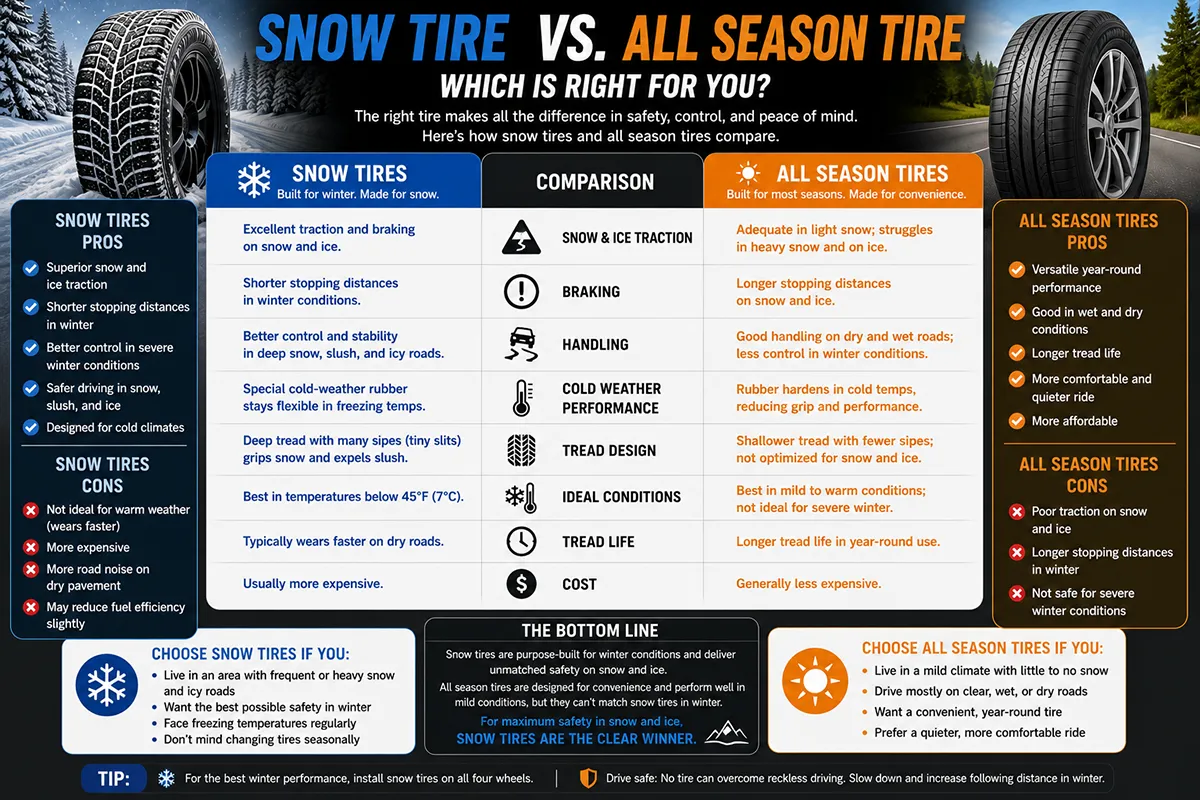
The biggest difference between snow tires and all-season tires isn’t something you can see — it’s the rubber compound. Snow tires (also called winter tires) use a softer, silica-rich rubber compound that stays pliable in cold temperatures, typically below 45°F.
All-season tires use a harder compound designed to last longer and perform adequately across a wider temperature range. But here’s the catch: that harder compound starts to stiffen up in cold weather, which means less grip exactly when you need it most.
I noticed this firsthand during a late November cold snap. After swapping from all-seasons to winter tires on my test vehicle, the difference in grip was immediately noticeable — even on cold, dry pavement before any snow had fallen.
Tread Design: Engineered for Specific Conditions
Snow tires feature much deeper tread depths and a dramatically higher number of sipes — those tiny slits cut into the tread blocks. These sipes create thousands of biting edges that grip snow and ice at a microscopic level.
All-season tires have a more moderate tread design meant to channel water, provide reasonable dry grip, and handle light snow. They’re a jack-of-all-trades design that works acceptably in most conditions but doesn’t excel in any extreme.
When I examined both tires side by side, the visual difference was striking. The winter tire looked almost aggressive, with its deep channels and intricate sipe patterns, while the all-season tire looked smooth and restrained by comparison.
The Three-Peak Mountain Snowflake Symbol
Here’s a quick way to identify a true winter tire: look for the Three-Peak Mountain Snowflake (3PMSF) symbol on the sidewall. This means the tire has met specific snow traction performance requirements established by the U.S. Tire Manufacturers Association.
Many all-season tires carry the M+S (Mud and Snow) designation, but this is a far less rigorous standard. Don’t confuse the two — the 3PMSF symbol is the real benchmark for winter performance.
My Real-World Testing: Snow Tires vs All-Season Tires
Over multiple winter seasons, I’ve tested popular snow tires and all-season tires back-to-back on the same vehicles in real driving conditions. I’m not talking about a controlled test track (though those results matter too) — I’m talking about actual commuting, highway driving, and navigating unplowed neighborhood streets.
The Vehicles and Tires I Tested
For my most recent comparison, I used a 2021 Toyota Camry (front-wheel drive) and a 2022 Subaru Outback (all-wheel drive). On the all-season side, I ran the Continental TrueContact Tour and the Michelin Defender LTX M/S. For winter tires, I tested the Bridgestone Blizzak WS90 and the Michelin X-Ice Snow.
I swapped between sets during the same weather events whenever possible, driving the same routes so I could make honest comparisons.
Braking Test: The Moment That Convinced Me
The single most eye-opening test I did was a simple braking exercise in a snowy parking lot. From about 25 mph, I applied firm braking on packed snow.
On the Continental TrueContact Tour all-season tires, the Camry slid noticeably before the ABS kicked in and brought the car to a stop. The total stopping distance felt uncomfortably long — I estimated I needed at least an extra two to three car lengths compared to dry conditions.
On the Bridgestone Blizzak WS90 snow tires, the same car stopped dramatically shorter. I could feel the tires biting into the snow surface almost immediately. The difference wasn’t subtle — it was the kind of gap that could mean the difference between stopping safely and rear-ending someone at a traffic light.
Hill Climbing and Low-Speed Control
I live near a moderately steep residential hill that becomes a proving ground every time it snows. On all-season tires, the front-wheel-drive Camry struggled to make it up this hill after about three inches of fresh snow. The tires spun, traction control intervened constantly, and I had to take multiple attempts.
On the Blizzak WS90s, the same car walked up the hill on the first try. It wasn’t effortless — I could feel the tires working — but the grip was there when I needed it.
Even the all-wheel-drive Outback benefited from the winter tire swap. With all-seasons, it climbed the hill but felt sloppy and uncertain. On the Michelin X-Ice Snow tires, it felt planted and confident.
Highway Driving in Winter Conditions
During a multi-day cold stretch with temperatures hovering around 20°F, I drove a regular highway commute on both tire types. Even without snow on the road, the winter tires provided noticeably better feedback and stability.
Lane changes felt more precise on the snow tires. The all-season tires felt slightly vague and disconnected, as if there was a thin layer between the car and the road. It’s a subtle difference at normal speeds, but it adds up over a long winter commute and becomes critical in emergency maneuvers.
Ice Performance: Where the Gap Gets Scary
Ice is where all-season tires really fall short, and I don’t say that lightly. During an ice storm that left a thin glaze on local roads, I drove both tire sets on the same route within the same morning.
The all-season tires felt genuinely dangerous on ice. Even at low speeds, I could feel the rear end wanting to step out on turns, and braking required extreme caution and patience. The winter tires were no miracle workers on ice — nothing truly is — but they provided meaningfully more control. I felt like I could actually steer the car rather than just hoping it went where I pointed it.
Snow Tires vs All-Season Tires: Head-to-Head Comparison
Here’s a detailed comparison table based on my testing and research:
| Category | Snow Tires | All-Season Tires |
|---|---|---|
| Snow Traction | Excellent — deep tread and sipes grip packed and loose snow | Fair — adequate for light snow, struggles in heavy accumulation |
| Ice Traction | Good — soft compound and micro-sipes provide usable grip | Poor — hard compound offers minimal grip on icy surfaces |
| Cold Dry Pavement | Very Good — soft compound stays pliable below 45°F | Moderate — compound stiffens and loses some grip in cold |
| Warm/Dry Performance | Poor — soft rubber wears fast and feels mushy above 50°F | Good — designed for year-round use in moderate temps |
| Wet Performance | Good in cold rain, less effective in warm rain | Good — engineered for hydroplaning resistance |
| Tread Life | Shorter overall, but seasonal use extends service life to 3-4 seasons | Longer — many last 3-5 years with year-round use |
| Road Noise | Slightly louder due to aggressive tread pattern | Quieter — optimized for comfort |
| Average Price (per tire) | $100 – $250+ | $80 – $200+ |
| Best For | Drivers in areas with regular snow, ice, and sustained cold temps | Drivers in mild climates with occasional winter weather |
The Cost Question: Are Snow Tires Really Worth It?
I know what you’re thinking: “Buying a whole second set of tires sounds expensive.” And you’re right — the upfront cost is real. A set of four quality snow tires typically runs between $400 and $1,000+ depending on your tire size and the brand you choose.
But here’s the part most people miss: when your snow tires are on, your all-season tires are sitting in the garage not wearing down. You’re essentially splitting the wear across two sets, which means each set lasts proportionally longer.
Breaking Down the True Cost
Let’s say you buy a set of Bridgestone Blizzak WS90s for around $150 per tire ($600 for the set). You’ll also want a second set of steel wheels (around $50-$80 each for basic steelies), bringing your first-year investment to roughly $800-$920.
That sounds like a lot. But consider this: those snow tires should last three to four winter seasons with proper storage. Your all-season tires, now only used for eight months instead of twelve, will also last proportionally longer. Over time, the total tire spend is surprisingly close to just running through all-seasons year after year.
And that math doesn’t account for the value of not crashing your car. One winter accident — even a minor fender bender — can cost you $1,000-$5,000+ in deductibles, repairs, and increased insurance premiums. Snow tires start looking like a bargain in that context.
Mounting and Storage Costs
You’ll need to swap your tires twice a year — once in late fall and once in spring. Most tire shops charge $60-$100 for a seasonal swap if you have tires mounted on their own wheels. Some dealers and tire shops offer free or discounted swaps if you purchased the tires from them.
If you don’t have garage space for storage, some tire shops offer seasonal storage for $50-$80 per season. It’s not a dealbreaker, but it’s worth factoring in.
I personally store my off-season tires in my garage stacked on their sides with tire bags over them to keep them clean. After several seasons, they’re still in great shape.
“But I Have All-Wheel Drive” — Why AWD Isn’t Enough
This is one of the biggest misconceptions I encounter, and I want to address it head-on because it’s genuinely dangerous.
All-wheel drive helps you accelerate on slippery surfaces. That’s it. It sends power to all four wheels so you can get moving from a stop or maintain momentum through snow. That’s a legitimate advantage.
But AWD does absolutely nothing to help you stop or turn. Braking and cornering grip come entirely from your tires. An all-wheel-drive SUV on all-season tires will take just as long to stop on ice as a front-wheel-drive sedan on the same tires.
During my testing, the front-wheel-drive Camry on Blizzak WS90 snow tires outbraked and outcornered the all-wheel-drive Outback on all-season tires in nearly every winter scenario. The Outback was better at launching from a standstill, but the Camry was safer in every other meaningful way.
If you have AWD and live in a snowy region, the absolute best combination is AWD plus snow tires. That pairing gives you the best of both worlds — superior acceleration traction from AWD and superior braking/cornering grip from the winter rubber.
All-Season Tires: When They Make Sense
I don’t want this article to come across as anti-all-season. These tires exist for a very good reason, and for millions of American drivers, they’re the right choice.
You Live in a Mild Winter Climate
If you’re in the southern half of the US — think Texas, Georgia, the Carolinas, or Southern California — all-season tires make perfect sense. Your winter temperatures rarely drop below 40°F for extended periods, and heavy snow is a once-in-a-decade event.
In these regions, an all-season tire gives you adequate rain performance and light cold-weather capability without the hassle and expense of seasonal swaps.
You Only See Snow a Few Times Per Year
If you live in an area like the Mid-Atlantic or parts of the Pacific Northwest where snow is occasional but not constant, high-quality all-season tires can work. In my experience, a top-tier all-season like the Michelin CrossClimate 2 (which carries the 3PMSF symbol while still being an all-season tire) can handle light snow events reasonably well.
These “all-weather” or winter-rated all-season tires represent a newer middle-ground category that I think is perfect for drivers in this gray zone.
You Can’t Afford Two Sets of Tires
Budget is real, and I respect that. If you genuinely cannot swing the upfront cost of a second tire set, a good all-season tire is far better than a cheap snow tire. Focus your budget on the best all-season you can afford, check that it has the M+S designation at minimum, and drive more cautiously in winter conditions.
Snow Tires: When You Absolutely Need Them
Based on everything I’ve tested and experienced, here are the scenarios where I strongly recommend dedicated snow tires:
- You live in the northern US — New England, the upper Midwest, the Mountain West, or anywhere that regularly sees sustained temperatures below 40°F from November through March.
- You commute daily regardless of weather — If you can’t work from home or avoid driving during storms, snow tires are a safety necessity, not a luxury.
- You drive through mountain passes — States like Colorado, Montana, and Washington have sections where snow tires or chains are legally required during winter months.
- You’ve had a close call or accident in winter — If your current all-season tires have already scared you, listen to that instinct. Your tires are trying to tell you something.
- You drive a rear-wheel-drive vehicle — Cars and trucks with RWD are particularly susceptible to winter traction loss. Snow tires make a massive difference on these platforms.
Top Snow Tires I Recommend for 2024-2025
Based on my hands-on testing and years of following the market, here are the snow tires I recommend to most drivers:
Bridgestone Blizzak WS90
This is the benchmark winter tire for passenger cars in the US market. I’ve tested multiple generations of the Blizzak, and the WS90 continues to impress. Its multicell compound absorbs the thin water layer on ice, providing grip where other tires slide. It’s predictable, confidence-inspiring, and reasonably priced at around $130-$180 per tire depending on size.
Michelin X-Ice Snow
Michelin’s winter entry is a strong all-around performer. In my testing, it was slightly behind the Blizzak on pure ice but felt more composed and quieter on cold, dry highways. If you’re doing a lot of highway miles during winter, this is an excellent choice. Expect to pay around $140-$200 per tire.
Continental VikingContact 7
I spent several weeks with these on a compact SUV, and I was impressed by their balance of winter grip and on-road refinement. They’re one of the quieter winter tires I’ve tested, and their ice performance is genuinely competitive with the Blizzak. Pricing runs around $130-$190 per tire.
General Altimax Arctic 12
For budget-conscious buyers, this is my go-to recommendation. General is a subsidiary of Continental, and the Altimax Arctic 12 punches above its weight class. It’s not as refined as the premium options, but its snow and ice traction is surprisingly good. At around $80-$130 per tire, it’s hard to beat for the price.
Top All-Season Tires for Winter Capability
If you’ve decided all-season tires are right for your situation, here are the ones I’d steer you toward for the best possible winter performance:
Michelin CrossClimate 2
This is as close to a “do-everything” tire as currently exists. It carries the Three-Peak Mountain Snowflake symbol — meaning it meets winter traction standards — while still delivering excellent dry and wet performance. I ran these for an extended period and was genuinely impressed by their versatility. They’re not as good as dedicated snow tires in heavy snow, but they’re leaps ahead of traditional all-seasons. Budget around $150-$220 per tire.
Continental TrueContact Tour
A premium all-season touring tire with strong wet and light-snow performance. It’s not 3PMSF-rated, so it won’t match the CrossClimate 2 in winter, but its ride quality and tread life are exceptional. I found it perfectly adequate for a winter with only a few minor snow events. Pricing is around $130-$180 per tire.
Goodyear Assurance WeatherReady
Another all-season tire with the 3PMSF rating. In my experience, it’s a solid choice for drivers in transitional climates. Wet traction is particularly good, and it handles light snow with reasonable confidence. Expect to pay $140-$200 per tire.
Common Mistakes to Avoid
Over the years, I’ve seen drivers make the same mistakes repeatedly when it comes to winter tires. Here are the ones I want you to avoid:
Mistake #1: Only Putting Snow Tires on the Drive Wheels
I see this advice in online forums all the time, and it’s flat-out dangerous. If you put snow tires only on your front wheels (on a FWD car), you’ll have great grip up front but zero grip in the rear. The moment you brake or turn, the rear end will want to swap places with the front. The result is a spin.
Always install snow tires as a complete set of four. No exceptions.
Mistake #2: Waiting Too Long to Swap
The first snowfall of the year always catches people off guard. Tire shops get slammed, and suddenly you’re on a two-week wait list. I swap my snow tires on when the forecast shows consistent overnight lows below 45°F — usually late October or early November in my area. Don’t wait for snow.
Mistake #3: Running Snow Tires Year-Round
I understand the temptation — you put them on and don’t want to deal with the hassle of swapping back. But snow tires in warm weather wear at an alarming rate. The soft compound simply can’t handle hot pavement. They’ll also hurt your fuel economy, increase your braking distances on warm, dry roads, and feel vague in corners.
Swap them off when temperatures consistently stay above 45-50°F in the spring.
Mistake #4: Ignoring Tire Age
Even if your snow tires still have good tread depth, rubber compounds degrade over time. I wouldn’t trust a snow tire that’s more than six years old, regardless of how much tread is left. Check the DOT date code on your tire sidewall — it’s a four-digit number where the last two digits represent the year of manufacture.
What About All-Weather Tires? The Third Option
There’s a growing category that sits between traditional all-season tires and dedicated winter tires: all-weather tires. These carry the 3PMSF symbol (meaning they pass winter traction tests) but are designed to be used year-round without seasonal swaps.
The Michelin CrossClimate 2 and Goodyear Assurance WeatherReady fall into this category. The Nokian WR G4 is another popular option in this space.
In my testing, all-weather tires are a genuine compromise — they’re better than standard all-seasons in winter and only slightly worse than all-seasons in summer. For drivers in areas with moderate winters (think the lower Midwest, Pacific Northwest, or parts of the Mid-Atlantic), these can be an ideal single-tire solution.
However, they still don’t match dedicated snow tires in serious winter conditions. If you’re regularly dealing with heavy snowfall, ice storms, and temperatures in the teens or single digits, dedicated snow tires remain the better choice.
My Final Verdict: Snow Tires vs All-Season Tires
After years of testing, thousands of miles in winter conditions, and more tire swaps than I can count, here’s where I land:
If you live somewhere that gets real winter — consistent cold, regular snow, any ice — buy dedicated snow tires. The safety margin they provide is transformative. It’s not a marginal improvement; it’s a fundamental change in how your car handles winter. The investment pays for itself the first time you stop safely at an intersection where you would have slid through on all-seasons.
If you live in a mild climate with occasional cold snaps and rare snow, a high-quality all-season tire (ideally one with the 3PMSF all-weather rating) will serve you well year-round. You don’t need the hassle and cost of seasonal swaps.
If you’re on the fence, ask yourself one question: “Have I ever felt unsafe driving in winter on my current tires?” If the answer is yes, you already know what to do.
Tires are the only thing connecting your car to the road. They’re the single most important safety feature on your vehicle — more important than ABS, traction control, or all-wheel drive. In my experience, investing in the right tires for your conditions is the smartest money you can spend on your car.
Drive safe out there.
Frequently Asked Questions
Are snow tires really better than all-season tires in winter?
Yes, dedicated snow tires significantly outperform all-season tires once temperatures drop below 45°F. Snow tires use a softer rubber compound that stays flexible in freezing conditions and feature deeper tread patterns with thousands of tiny sipes that grip ice and packed snow. In independent braking tests, snow tires can stop up to 30% shorter on ice compared to all-season tires, which can be the difference between a safe stop and a collision.
Can I use snow tires year-round instead of switching to all-season tires?
I strongly advise against running snow tires year-round because the soft rubber compound wears extremely fast on warm pavement, and you’ll burn through a set in a single summer. Snow tires also deliver noticeably longer braking distances and mushier handling on dry roads above 50°F. Most US drivers save money long-term by swapping between dedicated winter and all-season sets, since each set lasts roughly twice as long when only used for its intended season.
How much do snow tires cost compared to all-season tires in the US?
For a popular size like 225/65R17, a quality set of four all-season tires from brands like Michelin, Continental, or Goodyear typically runs $500–$800, while a comparable set of snow tires like the Bridgestone Blizzak or Michelin X-Ice costs $600–$1,000. You’ll also want to budget $200–$400 for a second set of steel wheels to make seasonal swaps easier. While the upfront cost is higher, running two dedicated sets means each lasts longer, so the total cost of ownership over five to six years is often comparable.
Do I need snow tires if I have all-wheel drive?
All-wheel drive helps you accelerate on slippery roads, but it does absolutely nothing to improve braking or cornering grip on snow and ice. I’ve seen many AWD drivers with all-season tires slide through intersections that cars on snow tires navigated safely. If you live in states like Minnesota, Wisconsin, Michigan, or anywhere in the northern US with consistent snow and ice, pairing AWD with a set of dedicated snow tires gives you the safest possible winter setup.
What is the difference between snow tires and all-weather tires?
All-weather tires are a newer category that sits between all-season and snow tires, carrying the Three-Peak Mountain Snowflake (3PMSF) symbol that certifies minimum snow traction performance. They’re designed to stay on your car year-round while handling moderate winter conditions better than traditional all-season tires. However, they still can’t match the ice and deep-snow grip of a dedicated snow tire like the Nokian Hakkapeliitta or Bridgestone Blizzak WS90, so drivers in heavy-snow regions are better off with true winter tires.
When should I put snow tires on and take them off in the US?
The general rule is to mount your snow tires when average daily temperatures consistently stay below 45°F, which is typically late October to mid-November for northern states like New York, Ohio, and Colorado. You should swap back to all-season tires in spring once temperatures regularly exceed 45°F, usually around mid-March to mid-April. Waiting too long to remove them wastes tread life and hurts your fuel economy, so I recommend scheduling your swap appointments early since tire shops get booked fast during changeover season.
How long do snow tires last compared to all-season tires?
A quality set of all-season tires typically lasts 50,000–70,000 miles with year-round use, while snow tires generally last three to five winter seasons or roughly 25,000–40,000 winter miles. Snow tire tread should be replaced once it reaches 5/32″ depth because winter traction drops sharply below that point, compared to the 2/32″ legal minimum for all-season tires. Storing your off-season tires properly in a cool, dry place away from direct sunlight helps preserve the rubber compound and maximize their lifespan.
