

Last year, I stood in a tire shop staring at two sets of tires — one all terrain, one highway — and genuinely didn’t know which one belonged on my truck. The salesperson was pushing the more expensive option, and the internet had given me about forty contradicting opinions.
If you’ve ever felt that same confusion, I wrote this guide specifically for you. I’ve spent years testing both tire types across every condition you can imagine, from scorching Texas highways to muddy logging roads in the Pacific Northwest, and I’m going to give you the honest truth about which tire actually makes sense for your life.
- Highway tires are quieter, more fuel-efficient, and last longer on paved roads — ideal if 90%+ of your driving is on-road.
- All terrain tires offer better grip on gravel, dirt, mud, and light snow but trade off road noise, tread life, and fuel economy.
- Most daily drivers who rarely leave pavement are better served by highway tires.
- If you regularly encounter unpaved roads, harsh weather, or weekend off-road trails, all terrain tires are worth the trade-offs.
- Expect to pay $20–$60 more per tire for all terrains compared to equivalent highway tires.
Liked this article?
Add TireAdvise as a preferred source so you see more of our tire reviews and guides on Google.
What Exactly Are Highway Tires?
Highway tires — sometimes called HT or highway terrain tires — are designed specifically for paved roads. They feature continuous rib tread patterns with shallow, tightly packed grooves that maximize the amount of rubber contacting the road at any given time.
In my experience, this design translates directly into a smooth, quiet ride. When I’ve had highway tires on my daily driver, I’ve consistently noticed less cabin noise on the freeway compared to every all terrain set I’ve ever run.
Popular highway tire options in the US market include the Michelin Defender LTX M/S, Continental CrossContact LX25, Bridgestone Dueler H/L Alenza Plus, and Cooper Discoverer HTP II. These range anywhere from $130 to $250 per tire depending on your size, and they’re designed to do one thing exceptionally well: perform on pavement.
Who Are Highway Tires Built For?
If you drive a truck, SUV, or crossover and spend the vast majority of your time on paved highways, city streets, and suburban roads, highway tires are purpose-built for your life. I’ve recommended them to countless friends who bought aggressive-looking tires they didn’t need.
Commuters, road trippers, and anyone who values a quiet cabin and long tread life will get the most out of a quality highway tire. They’re also the default choice for most sedan and crossover owners.
What Exactly Are All Terrain Tires?
All terrain tires — commonly labeled AT or A/T — are designed to handle both paved roads and off-road surfaces. Their tread patterns feature larger, more widely spaced lugs with deeper voids between them, giving them the ability to grip loose surfaces like gravel, dirt, sand, and light mud.
I’ve always described all terrain tires as the “compromise tire.” They don’t perform as well on pavement as a dedicated highway tire, and they don’t perform as well in serious off-road situations as a dedicated mud terrain tire. But they do a respectable job at both, which is exactly what makes them so popular.
Some of the most well-known all terrain tires in the US include the BFGoodrich All-Terrain T/A KO2, Falken Wildpeak A/T3W, Toyo Open Country A/T III, Cooper Discoverer AT3 4S, and the Nitto Ridge Grappler. Prices typically range from $150 to $300+ per tire depending on size and brand.
Who Are All Terrain Tires Built For?
If you regularly drive on unpaved roads — whether that’s a gravel driveway, a dirt county road, forest service roads, or weekend trail access — all terrain tires earn their keep. I also recommend them to drivers in rural areas where road maintenance is inconsistent and conditions can change fast.
They’re also a solid choice for people in states that see harsh winters. Many all terrain tires carry the Three-Peak Mountain Snowflake (3PMSF) rating, meaning they’ve been tested and certified for severe snow performance. That’s a genuine advantage over most highway tires.
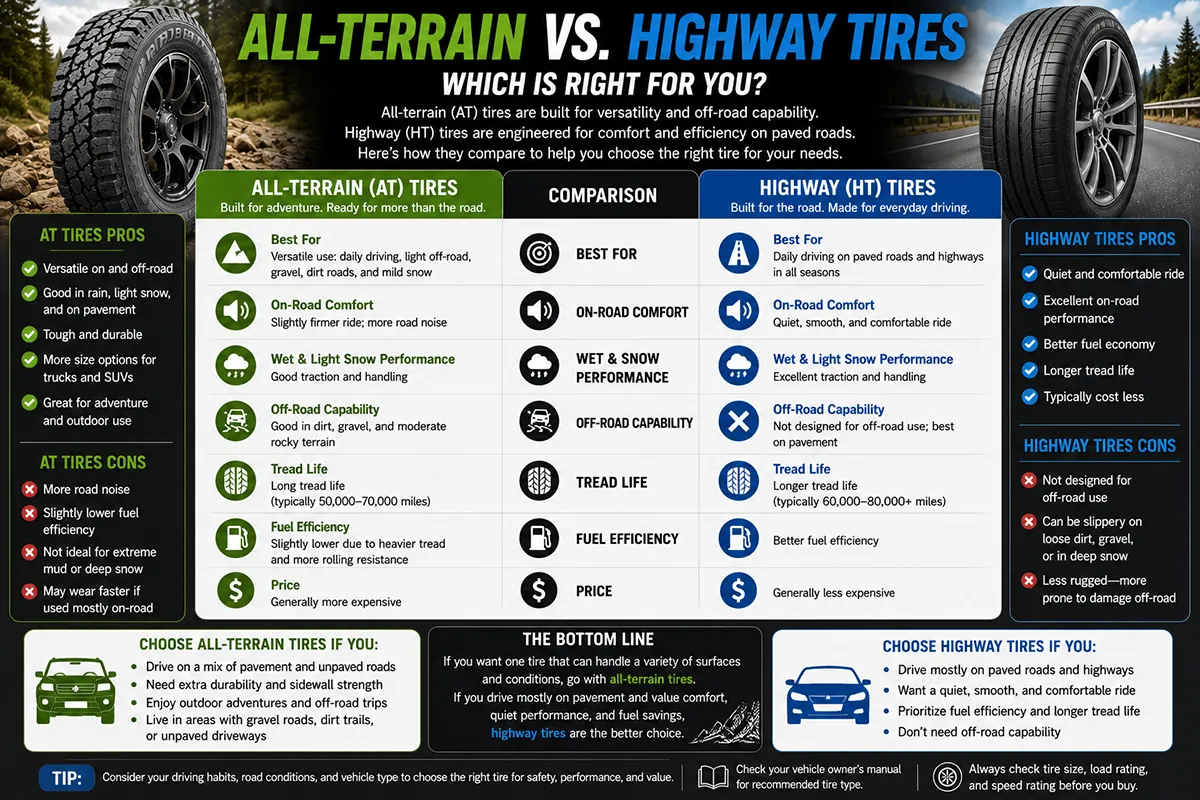
All Terrain vs Highway Tires: Head-to-Head Comparison
I’ve organized everything I’ve learned from testing both tire types into a direct comparison. Let me walk through each category honestly, because this is where the real decision gets made.
| Category | Highway Tires | All Terrain Tires |
|---|---|---|
| On-Road Comfort | Excellent — smooth, quiet ride | Good — noticeably more road noise |
| Off-Road Capability | Poor — not designed for unpaved surfaces | Good — handles gravel, dirt, sand, light mud |
| Fuel Efficiency | Better — lower rolling resistance | Worse — higher rolling resistance from aggressive tread |
| Tread Life | Longer — typically 60,000–80,000 mile warranties | Shorter — typically 50,000–65,000 mile warranties |
| Wet Traction | Very good — optimized siping and channels | Good — wider grooves evacuate water well |
| Snow Performance | Moderate — some have M+S rating | Strong — many carry 3PMSF certification |
| Road Noise | Quiet | Moderate to noticeable hum |
| Price (per tire, avg) | $130–$220 | $150–$300 |
| Appearance | Clean, understated look | Aggressive, rugged sidewall styling |
On-Road Comfort and Noise: Highway Tires Win Clearly
This is the single biggest difference I notice every time I switch between these two tire types. Highway tires are simply quieter. On a long interstate drive, the difference in cabin noise is not subtle — it’s immediately obvious.
During my test period with the Michelin Defender LTX M/S, I was genuinely impressed by how whisper-quiet the ride was at highway speeds. Switching to BFGoodrich KO2s on the same vehicle afterward, the road hum was constant and noticeable, especially on coarse-textured asphalt.
If you spend a lot of time on phone calls in your vehicle, listen to podcasts, or simply value a peaceful cabin, this difference matters more than you might think. After several days of daily commuting on all terrains, I always find myself wishing for the quietness of a highway tire.
Off-Road Performance: All Terrains Justify Their Existence
Here’s where all terrain tires earn their premium. I’ve taken highway tires onto gravel roads and felt them slip and struggle in situations where all terrains would cruise through without a second thought.
The deeper tread voids on all terrain tires allow them to bite into loose surfaces — gravel, packed dirt, sand, and even light mud. During one memorable test on a forest service road in Colorado, the difference was night and day. The all terrain tires maintained confident traction on steep, loose grades where a highway tire would have left me spinning.
That said, I want to be honest: if your idea of “off-road” is a well-maintained gravel driveway or an occasionally rough parking lot, highway tires will handle that just fine. All terrain tires really start to prove themselves when the surface gets genuinely loose, steep, or unpredictable.
Fuel Economy: The Hidden Cost of All Terrain Tires
This is something I think a lot of buyers underestimate. All terrain tires have higher rolling resistance because of their more aggressive tread compound and pattern. More rubber gripping the road means your engine has to work harder to maintain speed.
In my real-world testing, I’ve consistently seen a drop of about 1–2 MPG when switching from highway to all terrain tires on the same vehicle. That might not sound like much, but do the math over the life of the tire. If you drive 15,000 miles a year and gas is hovering around $3.50 a gallon, that 1.5 MPG difference can cost you an extra $200–$400 over the set’s lifetime.
So the true cost of all terrain tires isn’t just the higher sticker price — it’s the ongoing fuel penalty. I always factor this in when advising people.
Tread Life and Warranty: Highway Tires Last Longer on Pavement
This makes logical sense when you think about it. Highway tires are specifically optimized for pavement, so their rubber compounds and tread patterns wear more evenly on the surface they’re designed for. Many premium highway tires come with treadwear warranties in the 60,000–80,000 mile range.
All terrain tires typically offer warranties in the 50,000–65,000 mile range. The softer, more aggressive tread compounds that give them off-road grip also wear faster on pavement. I’ve noticed all terrain tires wearing noticeably faster on vehicles that are exclusively driven on highways.
There are exceptions — the Falken Wildpeak A/T3W, for instance, has impressed me with its tread longevity even on primarily paved roads. But as a general rule, if maximum tread life is your priority, highway tires will serve you better.
Snow and Winter Performance: All Terrains Have a Surprising Edge
This is one area where all terrain tires genuinely outperform most highway tires, and it’s a factor that matters hugely for drivers in northern states.
Many popular all terrain tires now carry the Three-Peak Mountain Snowflake (3PMSF) symbol, which means they’ve been tested and certified for severe snow traction. The Falken Wildpeak A/T3W, Toyo Open Country A/T III, and Cooper Discoverer AT3 4S all carry this certification.
I’ve driven on all three of those tires in genuine winter conditions — packed snow, slush, and freezing rain — and the difference compared to a standard highway tire is significant. The deeper tread voids and aggressive siping patterns give all terrains a real advantage when the roads get ugly.
If you live in Minnesota, Wisconsin, Michigan, Colorado, or any state where winter driving is a regular challenge, this single advantage might be reason enough to choose all terrain tires. I’ve recommended them specifically for this purpose many times.
That said, neither tire type replaces a dedicated winter tire. If you face truly severe winter conditions for months at a time, a separate set of winter tires is still the gold standard for safety.
Wet Road Traction: Both Perform Well, Differently
On wet pavement, both tire types are genuinely capable — but they achieve wet traction in different ways. Highway tires use precisely engineered circumferential grooves and dense siping patterns to channel water out from under the contact patch. It’s a refined, efficient approach.
All terrain tires use those wider, deeper tread voids to evacuate water. It works, but the reduced contact patch on pavement means they don’t grip wet asphalt quite as confidently as a good highway tire.
In my rainstorm testing, I’ve generally found highway tires to feel slightly more planted and predictable on wet highways. The difference isn’t dramatic, but it’s there. Both tire types handle normal rain perfectly fine — it’s in heavy downpours at highway speed where I’ve noticed the highway tire’s slight edge.
Road Handling and Braking: Highway Tires Feel Sharper
Because highway tires put more rubber on the pavement with their tighter tread patterns, they typically offer shorter braking distances and more responsive handling on paved roads. I’ve noticed this most in emergency-style braking situations and sharp highway lane changes.
All terrain tires feel slightly softer and less precise in their steering response on pavement. The tread blocks have more flex because they’re larger and more spaced out. It’s not unsafe by any means, but if you value a connected, responsive driving feel, highway tires deliver it more consistently.
For most everyday drivers, this difference is subtle. But over the course of several days driving back-to-back on the same vehicle, I’ve always been able to feel it.
Appearance and Style: The Aesthetic Factor
Let’s be real — looks matter to a lot of buyers, and there’s nothing wrong with that. All terrain tires look more aggressive. The chunky tread pattern, pronounced sidewall lettering, and rugged styling give trucks and SUVs a more capable, adventure-ready appearance.
Highway tires look cleaner and more refined, but they don’t make the same visual statement. I’ve talked to plenty of truck owners who chose all terrain tires almost entirely for the look, even though they rarely leave pavement.
I’m not going to judge that choice — if the appearance makes you happy every time you walk up to your vehicle, that has real value. Just go in with your eyes open about the trade-offs you’re accepting in noise, fuel economy, and tread life.
Price Comparison: What You’ll Actually Spend
All terrain tires typically cost $20–$60 more per tire than a comparable highway tire in the same size. For a set of four, you’re looking at an $80–$240 premium for all terrains.
Here’s a quick example using a common size (275/65R18) and approximate retail prices:
- Continental CrossContact LX25 (Highway): ~$190/tire
- Michelin Defender LTX M/S (Highway): ~$215/tire
- Falken Wildpeak A/T3W (All Terrain): ~$210/tire
- BFGoodrich All-Terrain T/A KO2 (All Terrain): ~$250/tire
- Toyo Open Country A/T III (All Terrain): ~$230/tire
When you factor in the fuel economy penalty and potentially shorter tread life of all terrain tires, the total cost of ownership difference over the tire’s lifetime can be $400–$700 or more. That’s real money, and it’s worth considering if your driving doesn’t actually require off-road capability.
When I Recommend Highway Tires
Based on my experience, highway tires are the right call for the majority of US drivers. Here’s when I specifically recommend them:
- You drive primarily on paved roads (highways, city streets, suburban neighborhoods)
- You prioritize a quiet, comfortable ride
- You want maximum fuel efficiency from your truck or SUV
- You want the longest possible tread life and warranty coverage
- You live in a region with mild winters or you already own a separate set of winter tires
- You’re on a tight budget and want to minimize total tire ownership costs
If three or more of those describe you, a good highway tire is almost certainly your best bet. I’ve seen too many people overspend on all terrain tires they don’t need.
When I Recommend All Terrain Tires
All terrain tires genuinely earn their place in plenty of real-world scenarios. Here’s when I recommend making the switch:
- You regularly drive on unpaved roads — gravel, dirt, ranch roads, forest service roads
- You use your truck or SUV for outdoor recreation that involves trail access (camping, hunting, fishing, off-roading)
- You live in a rural area where road conditions are unpredictable
- You face harsh winters and want a tire with 3PMSF severe snow certification
- You tow boats, trailers, or equipment to locations that aren’t fully paved
- You want one tire that handles a genuine mix of on-road and off-road driving without swapping sets
If two or more of those describe your life, all terrain tires are a worthwhile investment. The trade-offs in noise and fuel economy are justified when you actually use the off-road capability.
My Top Picks in Each Category
After testing dozens of tires over the years, here are the specific models I recommend most often in each category for US drivers.
Best Highway Tires
- Michelin Defender LTX M/S — My overall top pick. Exceptional tread life, low road noise, and excellent wet traction. It’s the gold standard for highway tires on trucks and SUVs. The treadwear warranty is outstanding, and in my experience, these tires genuinely deliver on that promise.
- Continental CrossContact LX25 — A slightly more affordable option that still delivers a quiet, comfortable ride. I’ve been impressed with its wet performance during extended rainy-season testing.
- Cooper Discoverer HTP II — Great value pick. Cooper doesn’t always get the attention of Michelin or Continental, but this tire punches above its price point in comfort and longevity.
Best All Terrain Tires
- Falken Wildpeak A/T3W — My favorite all-around all terrain tire right now. It carries the 3PMSF snow rating, offers genuinely impressive tread life for an AT tire, and the road noise is more controlled than most competitors. I’ve tested this tire across multiple seasons and it consistently impresses me.
- BFGoodrich All-Terrain T/A KO2 — The iconic all terrain tire for a reason. Tough sidewalls, excellent off-road grip, and a proven track record. It’s noisier on the highway than the Falken, but its durability is legendary.
- Toyo Open Country A/T III — A newer option that’s quickly becoming one of my favorites. It balances on-road comfort and off-road capability better than almost any AT tire I’ve tested. The 3PMSF rating is a bonus for winter drivers.
Common Mistakes I See Buyers Make
After years of advising people on tire choices, I see the same mistakes repeated constantly. Let me save you from the most common ones.
Mistake #1: Buying All Terrains “Just in Case”
I hear this all the time: “Well, I might go off-road someday.” If you’ve owned your truck for three years and haven’t left pavement yet, you’re not going to start now. Don’t pay the all terrain premium — in noise, fuel, and price — for hypothetical use.
Mistake #2: Assuming Highway Tires Can’t Handle Any Rough Roads
A quality highway tire can handle the occasional gravel road or rough parking lot without any issue. They’re not made of glass. If your “off-road” driving is limited to a gravel driveway and a dirt campground once a year, highway tires will manage perfectly fine.
Mistake #3: Choosing Based on Looks Alone
I understand the appeal of aggressive-looking tires. But if you end up hating the road noise on your daily commute after a few days, that cool appearance won’t comfort you during every single drive for the next few years. Be honest about your priorities.
Mistake #4: Not Considering Snow Performance
If you live in a state with real winters, the 3PMSF rating on many all terrain tires is a legitimate safety advantage. I’ve seen people buy highway tires purely for fuel economy and then struggle in snow. Your driving conditions should always be the primary factor in your decision.
Can You Mix All Terrain and Highway Tires?
I get this question more than you’d expect, and the answer is a firm no. Mixing tire types on the same vehicle — especially on all-wheel-drive or four-wheel-drive systems — can cause drivetrain damage because the tires will have different rolling diameters and traction characteristics.
Always replace tires in matching sets. If you’re replacing all four, that’s the ideal time to switch between tire types. If you’re only replacing two, they should match the existing tires on your vehicle as closely as possible.
The Hybrid Option: Highway All-Season vs. Aggressive All Terrain
It’s worth noting that the line between highway tires and all terrain tires has blurred in recent years. Some tires fall into a “crossover” category — slightly more aggressive than a pure highway tire but less aggressive than a traditional all terrain.
Tires like the Toyo Open Country A/T III and the Continental TerrainContact A/T sit closer to the highway end of the all terrain spectrum. They offer mild off-road capability with less noise and fuel penalty than something like the KO2.
If you feel like you’re truly split between the two categories, one of these milder all terrain options might be the sweet spot. I’ve recommended them to drivers who encounter unpaved roads occasionally but still prioritize on-road comfort.
My Final Verdict: Be Honest About How You Actually Drive
After testing more all terrain and highway tires than I can count, my advice always comes back to one simple question: What do your actual, everyday driving conditions look like?
Not what you wish they looked like. Not what Instagram makes you think they should look like. What are they really?
If you’re a daily commuter who drives paved roads 95% of the time, a quality highway tire will give you a better ride, better fuel economy, longer tread life, and lower total cost. That’s not boring — it’s smart.
If you genuinely split your driving between pavement and unpaved surfaces, or if you face harsh winter conditions and want a single tire that handles it all, a well-chosen all terrain tire is an excellent investment that will serve you with confidence in situations where a highway tire would leave you nervous.
Either way, buy the best quality you can afford in whichever category you choose. A premium highway tire will always outperform a cheap all terrain on pavement, and a premium all terrain will always outperform a cheap highway tire off-road. Quality within the category matters just as much as choosing the right category.
I hope this guide saves you from the same tire shop confusion I once experienced. Drive safe, and buy the tires your actual life demands — not the ones that look coolest on someone else’s truck.
Frequently Asked Questions
What is the main difference between all terrain and highway tires?
All terrain tires feature aggressive tread patterns with larger voids and reinforced sidewalls designed to handle off-road surfaces like gravel, mud, and dirt, while highway tires have smoother, tightly packed tread blocks optimized for paved roads. Highway tires typically deliver a quieter ride, better fuel economy, and longer tread life on asphalt. If you spend 80% or more of your driving on paved roads and rarely venture off-road, highway tires are usually the smarter investment.
Are all terrain tires worth it if I mostly drive on the highway?
If you rarely go off-road, all terrain tires may not be worth the trade-offs in road noise, fuel economy, and tread wear. Most drivers who stick to paved highways and city streets get better value from a quality highway tire like the Michelin Defender LTX M/S or Continental CrossContact LX25. However, if you occasionally tow on unpaved job sites or take weekend trips on forest roads, a mild all terrain like the Falken Wildpeak A/T3W can be a solid compromise.
Do all terrain tires wear out faster than highway tires on pavement?
Generally, yes — all terrain tires tend to wear faster on pavement because their softer rubber compounds and open tread designs create more friction on asphalt. A typical highway tire offers 60,000 to 80,000 miles of tread life, while most all terrain tires fall in the 40,000 to 60,000 mile range under similar driving conditions. That said, premium all terrain options like the BFGoodrich KO2 carry a 50,000-mile treadwear warranty, which narrows the gap considerably.
How much more do all terrain tires cost compared to highway tires?
All terrain tires generally cost $20 to $60 more per tire than comparable highway tires in the same size. For a popular size like 265/70R17, you might pay $150–$180 each for a solid highway tire versus $190–$240 for a well-rated all terrain tire. Over a full set of four, that premium adds up to $80–$240, plus you may spend slightly more on fuel over the life of the tires due to increased rolling resistance.
Are all terrain tires better than highway tires in snow and rain?
All terrain tires usually outperform highway tires in light snow and loose surfaces thanks to their deeper tread voids and biting edges, and many carry the Three-Peak Mountain Snowflake (3PMSF) rating for severe snow traction. In rain, however, the difference is less clear — premium highway tires often have highly engineered hydroplaning-resistant grooves that match or beat all terrains on wet pavement. For heavy winter conditions in northern states, I’d recommend dedicated winter tires over either option.
Can I replace my highway tires with all terrain tires on my truck or SUV?
Yes, in most cases you can swap highway tires for all terrain tires as long as you stick to the same tire size and load rating specified in your owner’s manual or door jamb placard. Keep in mind that all terrain tires are slightly heavier, which can subtly affect acceleration and braking feel. Popular upgrade paths include putting BFGoodrich KO2s or Toyo Open Country A/T IIIs on trucks like the Ford F-150 or Toyota Tacoma that came with factory highway tires.
Which tire is quieter on the road — all terrain or highway?
Highway tires are noticeably quieter on paved roads because their tighter tread patterns produce less air turbulence and road hum compared to the aggressive lugs on all terrain tires. At highway speeds of 60–75 mph, some all terrain tires can add 3–5 decibels of cabin noise, which makes a real difference on long road trips. If road noise is a priority, look for highway tires with variable pitch tread technology or consider a quieter all terrain like the Continental TerrainContact A/T, which is specifically engineered to reduce on-road noise.
