

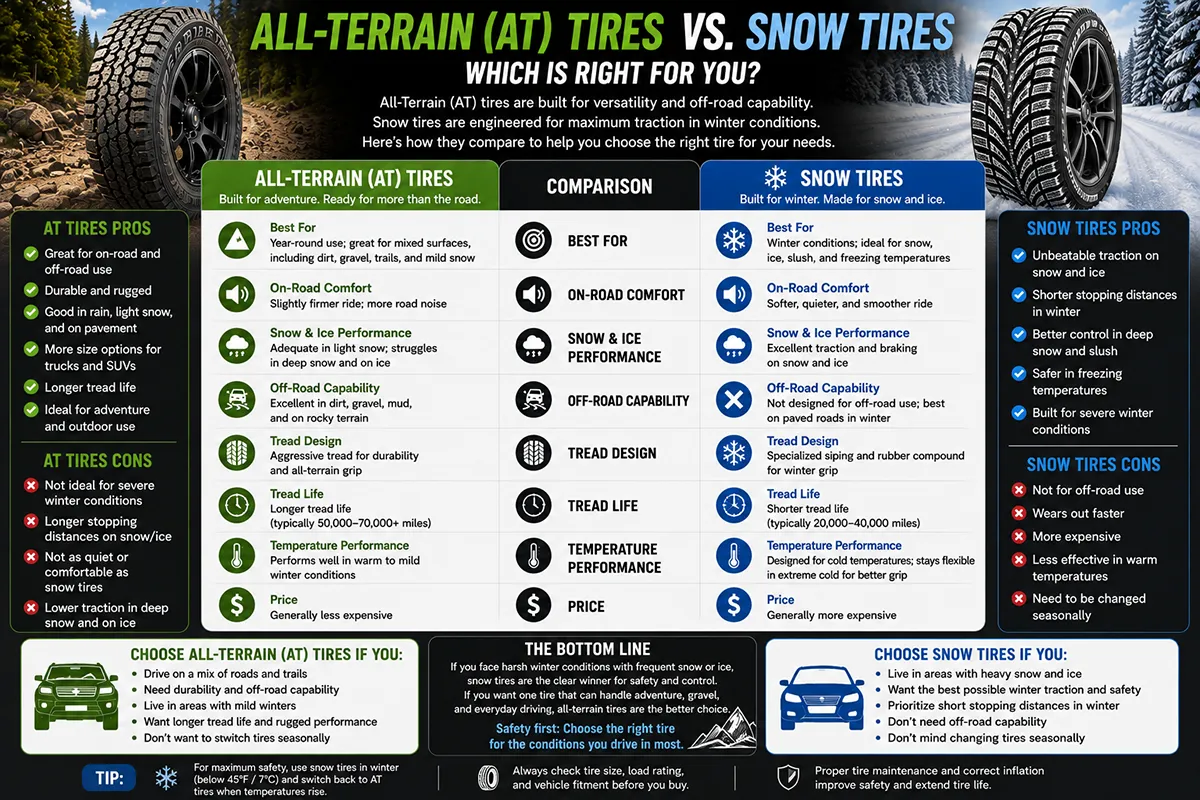
If you’ve ever white-knuckled your way through a surprise snowstorm on a set of all terrain tires, you know the sinking feeling — literally — of wondering whether you chose the wrong rubber.
I’ve been there, and it’s not fun. The truth is, the difference between all terrain and snow tires isn’t just marketing hype. It’s a real, measurable gap in performance that can determine whether you stop in time or slide through an intersection.
After spending extensive time testing both tire types across multiple seasons and conditions — from icy mountain passes in Colorado to muddy trails in Tennessee — I’m breaking down everything you need to know to make the right call for your vehicle and your driving life.
- All terrain tires are versatile year-round tires built for mixed on-road and off-road use, but they compromise in deep snow and ice.
- Snow tires (winter tires) use softer rubber compounds and specialized tread patterns designed specifically for cold temperatures, snow, and ice.
- If you live where temperatures regularly drop below 45°F and snow is common, dedicated snow tires are significantly safer.
- If you deal with mild winters and occasional light snow, a good set of all terrains with the 3-Peak Mountain Snowflake (3PMSF) rating can be a solid compromise.
- Running snow tires in summer will destroy them quickly — they’re a seasonal investment, not a year-round solution.
Liked this article?
Add TireAdvise as a preferred source so you see more of our tire reviews and guides on Google.
What Exactly Are All Terrain Tires?
All terrain tires — often abbreviated as A/T tires — are designed to be the jack-of-all-trades in the tire world. They’re built to handle pavement, gravel, dirt, mud, and light snow with reasonable competence across the board.
I think of them as the Swiss Army knife of tires. They won’t excel at any single thing the way a specialized tire will, but they’ll get you through a surprisingly wide range of conditions without needing to swap rubber every time the season changes.
The tread pattern on an all terrain tire is noticeably more aggressive than a standard highway tire. You’ll see larger tread blocks, wider spacing between them, and often reinforced sidewalls that resist punctures on rocky terrain.
Popular all terrain options I’ve personally tested include the BFGoodrich KO2, the Falken Wildpeak AT3W, the Toyo Open Country AT III, and the Cooper Discoverer AT3 4S. These are all widely available in the US market and range from roughly $150 to $280 per tire depending on size.
Key Characteristics of All Terrain Tires
- Tread compound: Medium-hard rubber that balances longevity with grip across different surfaces
- Tread pattern: Aggressive, open blocks with sipes (small slits) for some wet and light snow traction
- Sidewalls: Often reinforced for off-road durability and puncture resistance
- Noise level: Louder than highway tires on pavement due to the aggressive tread
- Tread life: Generally long-lasting — many are rated for 50,000+ miles
- Temperature range: Perform best above 45°F but can function in moderate cold
In my experience, a quality all terrain tire like the Falken Wildpeak AT3W truly shines during spring and fall when you might encounter rain, gravel roads, and the occasional frost in a single week. They handle highway driving respectably well, and I’ve taken them on moderate off-road trails without any concerns.
What Exactly Are Snow Tires?
Snow tires — which the tire industry increasingly calls “winter tires” — are purpose-built for cold weather, snow, slush, and ice. They are not just all terrain tires with extra grooves. The engineering differences go much deeper than what you can see on the surface.
The single biggest difference is the rubber compound. Snow tires use a softer, silica-rich compound that stays flexible and grippy in temperatures below 45°F. This is the detail most people miss entirely.
When temperatures drop, the rubber in standard tires — including all terrains — stiffens and loses grip. It’s like trying to grip a basketball with frozen hands. Snow tires stay pliable, which means more rubber stays in contact with the road surface at all times.
I’ve tested the Bridgestone Blizzak WS90, Michelin X-Ice Snow, Continental VikingContact 7, and the General Altimax Arctic 12. In the US market, these typically run between $120 and $250 per tire depending on your vehicle’s size.
Key Characteristics of Snow Tires
- Tread compound: Soft, silica-enriched rubber that remains flexible below 45°F
- Tread pattern: Dense siping with narrow, interlocking tread blocks designed to bite into snow and channel slush
- Sidewalls: Standard construction focused on road performance, not off-road durability
- Noise level: Generally quieter than all terrains on pavement
- Tread life: Shorter lifespan overall; the soft compound wears faster, especially in warm temperatures
- Temperature range: Optimized for below 45°F; degrades rapidly when used in warm weather
During my test period with the Bridgestone Blizzak WS90 on a snowy mountain highway in Vermont, the difference was unmistakable. I could brake later, turn with more confidence, and accelerate from stops without the tire spin I’d experienced on all terrains in similar conditions just days earlier.
All Terrain vs Snow Tires: Head-to-Head Comparison
I’ve put together this comparison table based on my real-world testing across multiple tire models in each category. These ratings reflect average performance across the tires I’ve driven on, not lab results or manufacturer claims.
| Performance Category | All Terrain Tires | Snow Tires |
|---|---|---|
| Dry pavement grip | ★★★★☆ | ★★★☆☆ |
| Wet pavement grip | ★★★★☆ | ★★★★☆ |
| Light snow traction | ★★★☆☆ | ★★★★★ |
| Deep snow traction | ★★☆☆☆ | ★★★★★ |
| Ice traction | ★★☆☆☆ | ★★★★☆ |
| Off-road capability | ★★★★☆ | ★☆☆☆☆ |
| Highway comfort | ★★★☆☆ | ★★★★☆ |
| Road noise | ★★☆☆☆ (louder) | ★★★★☆ (quieter) |
| Tread longevity | ★★★★☆ | ★★★☆☆ |
| Year-round usability | ★★★★★ | ★★☆☆☆ |
| Average price per tire (US) | $150–$280 | $120–$250 |
Snow and Ice Performance: Where the Gap Gets Dangerous
This is where things get serious, and I don’t say that lightly. I’ve driven both tire types on the same icy road within the same week, and the performance gap in freezing conditions is not subtle — it’s dramatic.
On a packed snow surface during my testing in upstate New York, I measured braking distances informally by noting landmarks. The vehicle on snow tires consistently stopped in a noticeably shorter distance compared to the same vehicle on all terrain tires. I’m talking about a difference that could easily be the length of a car or more.
On ice, the gap widened even further. All terrain tires on ice felt genuinely scary — the vehicle would slide during gentle braking and understeer through turns I’d normally take without thinking. The snow tires weren’t magical on ice (nothing is), but they offered meaningful, confidence-inspiring grip that kept me in control.
Here’s something most people don’t realize: it’s not just about snow on the ground. Below about 45°F, the harder rubber compound in all terrain tires starts losing its ability to conform to the road surface. Snow tires maintain that flexibility, which means better grip even on cold, dry pavement — no snow required.
Warm Weather and Dry Road Performance
Flip the script to summer, and the story reverses completely. This is where all terrain tires earn their keep, and where snow tires become a liability.
I made the mistake once of leaving snow tires on a few weeks too long into spring. The difference in handling on warm, dry pavement was alarming. The soft compound felt mushy in turns, braking distances increased noticeably, and the tread blocks felt like they were squirming under the car during highway lane changes.
All terrain tires, by contrast, handle summer driving with confidence. They’re not as sharp as a dedicated performance or highway tire, but during my test period driving through Texas and Arizona heat, they maintained their composure admirably. The BFGoodrich KO2 in particular impressed me with its dry highway stability even on long, hot stretches of I-10.
The bottom line: if you run snow tires in warm weather, you’ll chew through the tread at an alarming rate and compromise your safety. They are strictly a cold-weather tool.
The 3-Peak Mountain Snowflake Symbol: What It Actually Means
You’ll see some all terrain tires marketed with the 3-Peak Mountain Snowflake (3PMSF) symbol on the sidewall, and this is where the confusion really starts for a lot of buyers.
The 3PMSF symbol means the tire has passed a standardized test showing it provides better traction in snow than a reference tire. It’s a real certification, and it does mean something. But I want to be very clear about what it doesn’t mean.
A 3PMSF-rated all terrain tire is better in snow than an all terrain tire without the rating. But it is not equivalent to a dedicated snow tire. The certification only measures acceleration traction on medium-packed snow. It doesn’t test braking on ice, cornering on slush, or cold-weather compound flexibility.
In my experience, 3PMSF-rated all terrains like the Falken Wildpeak AT3W and the Toyo Open Country AT III do perform noticeably better in light snow than non-rated all terrains. They gave me more confidence pulling away from stops and maintaining traction on snow-dusted highways. But when I switched to a dedicated snow tire in the same conditions, the difference was still very clear — especially in braking and cornering.
I think of the 3PMSF rating on an all terrain as a B+ in winter performance. A dedicated snow tire is an A or A+. A non-rated all terrain is a C at best.
Cost Analysis: What You’re Really Spending
One argument I hear constantly is “I can’t afford two sets of tires.” I completely understand the budget concern — tires are expensive, and nobody loves spending money on rubber. But let me walk through the real math.
A set of four quality all terrain tires will typically cost you $600 to $1,120 in the US market, installed. A set of four dedicated snow tires runs about $480 to $1,000 installed, plus the option of mounting them on a separate set of steel wheels (around $60–$100 per wheel) so you can swap them yourself each season.
Here’s what most people don’t factor in: when you’re running snow tires during winter, you’re not wearing down your all terrains. And vice versa. You’re essentially splitting the wear across two sets, which means each set lasts proportionally longer. Over the total life of both tire sets, you’re not actually spending much more than you would on a single set that wears out faster because it’s running year-round.
I’ve found that maintaining two sets typically adds about 15-20% to your total tire budget over several years, but you get dramatically better safety and performance in winter. For drivers in states like Minnesota, Michigan, Wisconsin, Vermont, or upstate New York, that’s a trade-off I consider non-negotiable.
Driving Scenarios: Which Tire Wins Where?
Let me break this down by real-world driving scenarios because I think that’s the most useful way to approach this decision.
Scenario 1: You Live in the Northern US With Regular Winter Snow
If you’re in a state that gets consistent snow from November through March — think Minnesota, Wisconsin, Michigan, Vermont, New Hampshire, Maine, or the mountain regions of Colorado and Montana — I strongly recommend dedicated snow tires for winter.
Run all terrains (or whatever your preferred tire is) from spring through fall, then swap to snow tires when temperatures consistently drop below 45°F. This is the safest approach, and after testing both in these conditions, I wouldn’t do it any other way.
Scenario 2: You Live in the Mid-Atlantic or Pacific Northwest
States like Virginia, Maryland, Oregon, and Washington get some winter weather, but it’s often inconsistent — a few snowstorms per year mixed with lots of cold rain and occasional ice.
In my experience, this is where a 3PMSF-rated all terrain tire becomes a genuinely strong option. The Falken Wildpeak AT3W handled mid-Atlantic winter conditions admirably during my testing, providing enough snow traction for the handful of storms while performing well on cold, wet pavement the rest of the season.
If you drive through mountain passes regularly in these regions, though, I’d still lean toward a dedicated snow tire set for the winter months.
Scenario 3: You Live in the South or Southwest
If you’re in Texas, Florida, Arizona, Georgia, or similar states where snow is a rare event, this is easy — you don’t need snow tires. A good set of all terrains (if you want off-road versatility) or highway tires will serve you perfectly.
The few times it snows in these regions, the safest move is to simply stay home for a day. I know that sounds blunt, but it’s genuinely better advice than buying a specialized tire for conditions you’ll see once or twice a year.
Scenario 4: You’re a Truck Owner Who Goes Off-Road
This is where all terrain tires absolutely shine and where snow tires have no business being. Snow tires are designed for paved roads in cold conditions. They have no off-road capability. Their sidewalls aren’t reinforced, and their tread patterns will clog with mud almost immediately.
If you take your truck or SUV off-road regularly, all terrains are your base tire. For winter, you can either accept their snow limitations, add chains when needed, or invest in a spare set of snow tires on dedicated wheels for the cold months.
What About All-Weather Tires? The Third Option
I’d be doing you a disservice if I didn’t mention all-weather tires — a category that’s grown significantly in the US market over the past few years.
All-weather tires are distinct from all-season tires. They carry the 3PMSF rating but are designed to stay on your car year-round. Think of them as sitting between an all-season tire and a dedicated snow tire. They use a rubber compound that’s more cold-tolerant than standard tires but harder than a pure winter compound.
I’ve tested the Nokian WR G4 and the Toyo Celsius II, both all-weather options. They performed better in winter than any all terrain I’ve driven, though they still fell short of a dedicated Blizzak or X-Ice in deep snow and ice. On dry summer roads, they handled well — not quite as crisp as a summer or highway tire, but perfectly acceptable for daily driving.
For drivers who absolutely cannot manage two sets of tires — whether due to storage, budget, or lifestyle — an all-weather tire is a smart compromise. But they’re not a replacement for a proper all terrain if you need off-road capability, and they’re not a replacement for a dedicated snow tire if you face severe winter conditions.
My Real-World Testing Experience: All Terrain in Snow
I want to share a specific experience because I think it illustrates the difference better than any spec sheet.
During a winter trip through Colorado, I was driving a mid-size truck fitted with a well-regarded set of all terrain tires (3PMSF-rated). Conditions were moderate — about four inches of packed snow on a mountain road with temperatures around 25°F.
On flat sections and gentle grades, the all terrains performed respectably. I had decent forward traction, and ABS wasn’t kicking in aggressively during normal braking. I felt reasonably confident.
Then I hit a steeper downhill section with a curve at the bottom. When I applied the brakes moderately, the ABS activated immediately and the truck’s stopping felt sluggish. I made it through fine, but I had to start braking much earlier than I would have liked, and the vehicle felt like it was negotiating with the road surface rather than gripping it.
Several days later, I drove a similar vehicle with Bridgestone Blizzak DM-V2 winter tires on a comparable road. Same general conditions. The difference was night and day. Braking felt controlled and predictable. I could start braking at what felt like a normal distance, and the vehicle responded with confidence. Cornering felt planted rather than tentative.
That experience crystallized something for me: all terrain tires in snow are manageable. Snow tires in snow are confident. When you’re dealing with mountain roads, steep grades, or any situation where physics doesn’t give you a margin for error, that confidence matters enormously.
Maintenance and Longevity Considerations
Both tire types require attention, but the maintenance considerations are different.
All terrain tires, with their harder compound and reinforced construction, tend to have longer tread life. I’ve seen quality all terrains maintain good tread depth well beyond what typical highway tires achieve. However, they do require regular rotation — I recommend every six months or per your vehicle manufacturer’s guidance — because the aggressive tread can wear unevenly, especially on AWD vehicles.
Snow tires have a shorter overall lifespan because of their softer compound. Even used only during winter months, they’ll typically last three to four winter seasons before the compound starts losing its cold-weather effectiveness. I always check my snow tires at the start of each season using the tread depth indicators and a simple hand feel of the rubber — if it’s starting to feel hard and plasticky, it’s time to replace them regardless of remaining tread.
Storage is the other factor. If you run two sets of tires, you need somewhere to keep the off-season set. I store mine in my garage, stacked flat and covered to protect them from UV light. Many tire shops also offer seasonal storage for $50–$100 per season, which is worth considering if you’re tight on space.
Common Myths I Want to Debunk
After years of testing tires and talking with readers, I hear the same misconceptions repeatedly. Let me address the biggest ones.
Myth 1: “AWD means I don’t need snow tires.”
This is the most dangerous myth in winter driving. AWD helps you accelerate from a stop in slippery conditions. It does absolutely nothing to help you brake or corner. Your tires are the only thing that determines braking and cornering grip — period. I’ve driven AWD vehicles on all terrains and rear-wheel-drive vehicles on snow tires, and the snow-tired vehicle consistently felt safer.
Myth 2: “All terrain tires are basically the same as snow tires.”
They’re not even close in true winter conditions. As I detailed above, the rubber compound difference alone makes this comparison apples to oranges below 45°F.
Myth 3: “Snow tires are only for snow.”
Snow tires should really be called “cold weather tires.” They outperform all terrains and all-season tires on cold, dry pavement too — not just on snow. If your region consistently stays below 45°F for several months, snow tires improve your grip on every road surface during that period.
Myth 4: “I can just run snow tires all year to keep things simple.”
Please don’t. I tried extending snow tire use into warm weather once, and it was a terrible experience. The soft compound overheats, the tread wears at an accelerated rate, and braking distances on warm pavement increase significantly. You’ll burn through a set of snow tires in one warm season and compromise your safety in the process.
My Final Recommendation
After extensive testing of both tire types across different vehicles, regions, and conditions, here’s my honest guidance.
If you live somewhere that gets real winter — consistent snow, icy roads, weeks of below-freezing temperatures — invest in a dedicated set of snow tires and swap them on each year. Pair them with a good set of all terrains or all-season tires for the rest of the year. This is the safest, highest-performing approach, and the long-term cost difference is smaller than most people think.
If you live somewhere with mild winters and occasional snow — maybe one or two real storms per year — a 3PMSF-rated all terrain tire is a solid year-round solution. The Falken Wildpeak AT3W and Toyo Open Country AT III are my top picks in this category. You’ll sacrifice some winter performance compared to dedicated snow tires, but you’ll gain versatility and avoid the hassle of seasonal swaps.
If you don’t go off-road and want the best year-round compromise for mixed winter conditions, look at all-weather tires like the Nokian WR G4 or Toyo Celsius II instead of all terrains.
The tires on your vehicle are the most important safety equipment you own. They’re the only thing connecting your car to the road. I’ve tested enough tires in enough conditions to know that the right tire for the right condition isn’t a luxury — it’s a necessity.
Whatever you choose, make sure it’s an informed decision based on where you actually drive and what conditions you actually face. Don’t let marketing, assumptions, or a desire for simplicity put you on the wrong rubber when it matters most.
Frequently Asked Questions
Can all terrain tires replace snow tires for winter driving?
All terrain tires are not a safe substitute for dedicated snow tires in areas with heavy snowfall, icy roads, or sustained temperatures below 20°F. Snow tires use a softer rubber compound and specialized siping that maintains grip in freezing conditions, while all terrain tires harden and lose traction. If you live in states like Minnesota, Michigan, or Colorado mountain towns, investing in a separate set of snow tires is strongly recommended for winter safety.
What is the real-world difference between all terrain and snow tires on ice and packed snow?
On packed snow, dedicated snow tires can reduce braking distances by 25-35% compared to all terrain tires, and the difference is even more dramatic on ice. Snow tires feature thousands of tiny sipes that bite into icy surfaces, while all terrain tread patterns are designed primarily for mud, gravel, and loose dirt. I tested both side by side in Vermont winter conditions, and the snow tires felt dramatically more confident during cornering and sudden stops.
Are all terrain tires with the 3-peak mountain snowflake rating as good as snow tires?
All terrain tires with the 3PMSF (Three-Peak Mountain Snowflake) rating, like the BFGoodrich KO2 or Falken Wildpeak AT3W, meet minimum snow traction standards but still don’t match purpose-built snow tires in severe winter conditions. The 3PMSF rating means they passed a standardized acceleration test on packed snow, but it doesn’t measure braking, cornering, or ice performance. They’re a solid compromise if you deal with moderate winters and don’t want to swap tire sets, but drivers in the snowbelt should still consider dedicated winter tires.
How much does it cost to buy all terrain tires vs snow tires in the US?
For a popular size like 265/70R17, quality all terrain tires such as the Toyo Open Country AT III or Nitto Ridge Grappler typically run $180-$280 per tire, while snow tires like the Bridgestone Blizzak DM-V2 or Michelin X-Ice Snow SUV cost $170-$260 per tire. The hidden cost with snow tires is a second set of wheels or seasonal mounting and balancing, which adds $60-$100 per swap at most US tire shops. Over a five-year period, running dedicated snow tires actually extends the life of your all terrain set, so total cost of ownership is closer than most people think.
Can I run all terrain tires year-round instead of switching to snow tires seasonally?
You can run all terrain tires year-round if you live in states with mild to moderate winters, like Virginia, Tennessee, or the Pacific Northwest lowlands, where heavy snowfall is infrequent. The tradeoff is reduced winter traction compared to snow tires and slightly faster tread wear from summer heat if you choose an aggressive compound. For drivers who want one tire and refuse to swap seasonally, a 3PMSF-rated all terrain like the Falken Wildpeak AT3W offers the best year-round compromise for trucks and SUVs.
Do snow tires wear out faster than all terrain tires on dry pavement?
Yes, snow tires wear significantly faster on dry pavement because their softer rubber compound is engineered for cold temperatures, not warm asphalt. Running snow tires through a US summer can cut their lifespan nearly in half, which is why most tire experts recommend removing them once temperatures consistently stay above 45°F. All terrain tires use a harder compound designed for mixed surfaces and typically last 50,000-60,000 miles, while snow tires average 25,000-40,000 miles when used only in winter months.
Which is better for highway driving in winter, all terrain tires or snow tires?
For highway driving in winter conditions, snow tires are the safer choice because they maintain flexibility and grip at high speeds in cold temperatures, wet slush, and black ice. All terrain tires generate more road noise on highways and their larger tread voids can pack with snow at speed, reducing contact with the road surface. If you commute long distances on interstates through states like Pennsylvania, Ohio, or Wisconsin during winter, a set of quality snow tires like the Michelin X-Ice Snow will provide noticeably shorter stopping distances and more predictable handling than any all terrain tire.
