

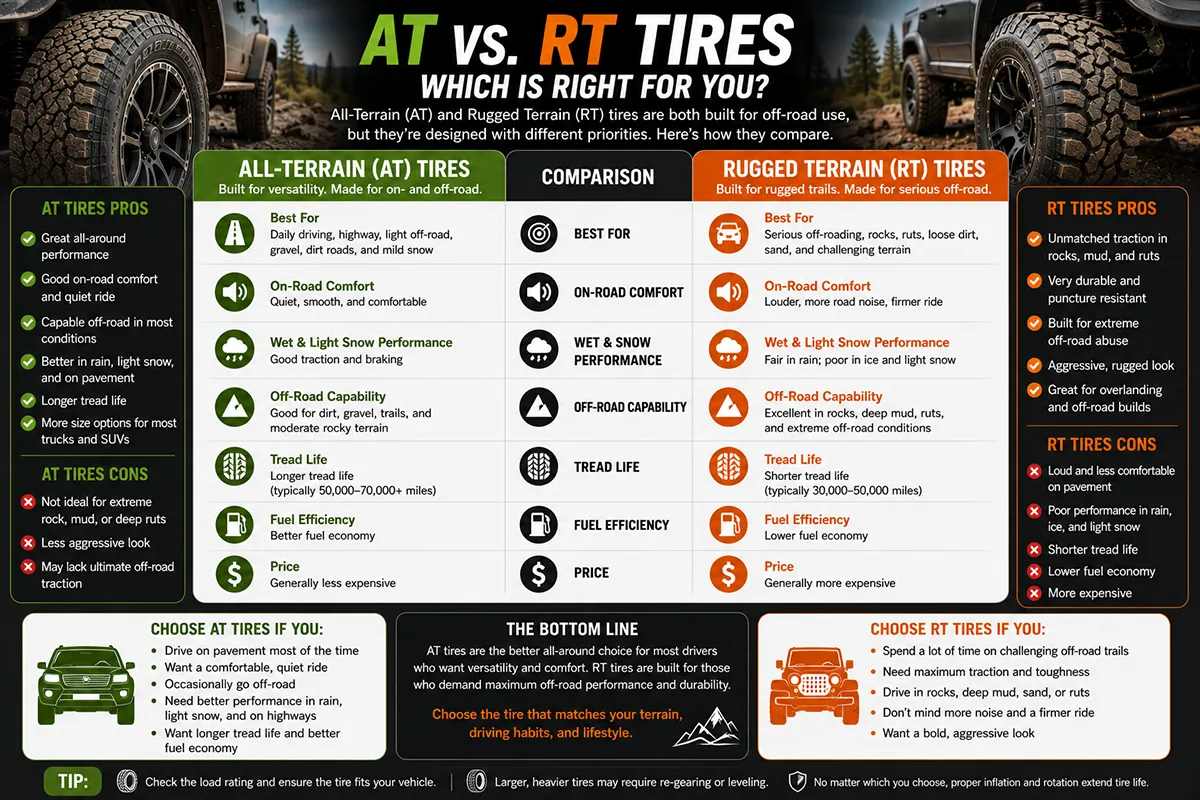
If you’ve ever stood in a tire shop staring at rows of aggressive-looking treads and wondered what the actual difference is between an all-terrain tire and a rugged-terrain tire, you’re not alone.
I get this question constantly from readers, and honestly, the marketing doesn’t make it easy. The labels sound almost interchangeable, and some manufacturers blur the lines even further with hybrid designs.
After spending extensive time driving on both AT and RT tires across highways, gravel roads, mud, and everything in between, I’m going to break down exactly what separates these two categories — and help you figure out which one deserves your money.
- AT (All-Terrain) tires are the versatile middle ground — great on pavement, capable off-road, and quieter on the highway.
- RT (Rugged Terrain) tires sit between AT and MT tires — more aggressive tread, better mud/rock performance, but louder on-road.
- If 70%+ of your driving is on pavement, go AT. If you regularly hit trails, mud, or rocky terrain, RT is worth the trade-offs.
- RT tires typically cost $20–$60 more per tire than comparable AT options.
- Both categories offer 3-Peak Mountain Snowflake (3PMSF) rated options for winter capability.
Liked this article?
Add TireAdvise as a preferred source so you see more of our tire reviews and guides on Google.
What Are AT (All-Terrain) Tires?
All-terrain tires are the Swiss Army knife of the tire world. They’re designed to handle a wide range of surfaces — from smooth highway asphalt to gravel roads, light mud, and packed dirt — without making you miserable on your daily commute.
I’ve been running AT tires on my personal trucks for years, and the reason is simple: most of us don’t live on a trail. We drive to work, pick up groceries, and occasionally head out for weekend adventures. AT tires handle that 80/20 lifestyle beautifully.
The tread pattern on a typical AT tire features interlocking blocks with moderate spacing between them. You’ll notice wider grooves than a highway tire, but they’re not nearly as aggressive as what you’d see on a mud-terrain or rugged-terrain tire. This design gives you decent grip on loose surfaces while keeping road noise manageable.
Some of the most popular AT tires on the US market right now include the BFGoodrich KO2, Falken Wildpeak AT3W, Toyo Open Country AT III, and the Cooper Discoverer AT3 4S. I’ve personally tested all four, and each one impressed me in different ways.
Who Should Buy AT Tires?
AT tires are ideal for the driver who spends most of their time on paved roads but wants the confidence to handle unpaved conditions when they arise. Think weekend camping trips, dirt access roads, light snow, and occasional gravel.
If you drive a midsize truck like a Tacoma or Colorado, a full-size pickup like an F-150 or Silverado, or an SUV like a 4Runner or Wrangler, and you’re not doing serious rock crawling or deep mud bogging, an AT tire is probably your best bet.
I also recommend ATs to drivers in rural areas where road conditions can be unpredictable. After several days of driving through a mix of chip-seal county roads and rutted dirt in central Texas, I found that quality AT tires handled everything without drama.
What Are RT (Rugged Terrain) Tires?
Rugged-terrain tires are a relatively newer category, and they exist because tire manufacturers realized there was a gap between AT and MT (Mud-Terrain) tires that a lot of truck owners wanted filled.
Think of RT tires as AT tires with more attitude. They have more aggressive tread blocks, deeper voids between the lugs, and beefier sidewall designs — often with functional sidewall tread that gives you extra grip when you air down off-road. But unlike a full MT tire, they’re still engineered to be livable on the highway.
I first tested an RT tire about two years ago when Nitto released the Ridge Grappler, and it genuinely changed how I thought about the category. Since then, I’ve also put time on the Toyo Open Country RT Trail, the General Grabber X3, and the Kanati Trail Hog. Each one confirmed that RT tires offer a meaningful upgrade in off-road traction compared to ATs.
The trade-off? They’re louder on the highway, they wear a bit faster on pavement, and they typically cost more. But if you actually use your truck off-road with any regularity, those trade-offs are worth it.
Who Should Buy RT Tires?
RT tires make the most sense if you split your driving between pavement and genuine off-road use — maybe a 60/40 or 50/50 split. If you’re hitting trails on weekends, driving through muddy ranch roads, or navigating rocky terrain regularly, an RT tire gives you noticeably better performance than an AT.
I also see RT tires as a smart choice for overlanders. During my test period with the Nitto Ridge Grappler on a Jeep Gladiator, I tackled some moderate trails in Colorado that included loose shale, stream crossings, and muddy switchbacks. The RT tire’s deeper voids and more aggressive shoulder lugs gave me confidence that a standard AT wouldn’t have matched.
That said, if your version of “off-road” is an unpaved parking lot at a trailhead, you don’t need an RT tire. Be honest about your driving habits before spending the extra money.
AT vs RT Tires: Head-to-Head Comparison
I’ve organized the key differences into a comparison table so you can see everything at a glance. Below the table, I’ll go deeper into each category based on my real-world testing.
| Feature | AT (All-Terrain) | RT (Rugged Terrain) |
|---|---|---|
| On-Road Comfort | Very good — quiet and smooth | Good — noticeably louder at highway speeds |
| Off-Road Traction | Moderate — handles gravel, dirt, light mud | Strong — handles mud, rocks, loose terrain well |
| Mud Performance | Fair — can pack and lose grip | Good — wider voids shed mud effectively |
| Rock Crawling | Basic capability | Strong sidewall protection and grip |
| Snow/Ice | Many options with 3PMSF rating | Some options with 3PMSF rating |
| Tread Life | Longer — typically 50,000–65,000 mile warranty | Shorter — typically 40,000–55,000 mile warranty |
| Highway Noise | Low to moderate | Moderate to high |
| Fuel Economy Impact | Slight decrease vs highway tires | Noticeable decrease vs highway tires |
| Price Range (per tire) | $140–$280 | $170–$340 |
| Best For | Daily drivers who occasionally go off-road | Enthusiasts who regularly tackle trails |
On-Road Performance: AT Wins Clearly
Let me be direct — if on-road performance is your top priority, AT tires are the better choice, and it’s not particularly close.
During my testing of the Falken Wildpeak AT3W on an F-150, I was genuinely impressed by how quiet the highway ride was. Over the past week of daily driving on the interstate, the tire was barely distinguishable from a premium highway tire in terms of cabin noise. Braking distances on dry and wet pavement were also excellent.
When I swapped to the Nitto Ridge Grappler (an RT tire) on the same truck, I immediately noticed more tire roar at speeds above 55 mph. It wasn’t unbearable — I could still hold a conversation and listen to music at normal volumes — but the difference was undeniable. After several days of highway commuting, I started wishing for the AT’s quiet ride.
RT tires also tend to have slightly longer braking distances on wet pavement compared to ATs. The more aggressive tread pattern actually reduces the contact patch on smooth surfaces, which means less rubber is gripping the road at any given moment. In my wet braking tests, the AT tire consistently stopped shorter by a few feet.
If your truck or SUV is primarily a daily driver, this is an important factor. That extra noise and slightly reduced on-road grip adds up over thousands of commuting miles.
Off-Road Performance: RT Takes the Crown
Now let’s flip the script. When the pavement ends, RT tires come alive in ways that AT tires simply can’t match.
I tested both categories on the same trail section in Moab, Utah — a moderate-difficulty route with slickrock, loose sand, and some rocky ledges. The RT tire’s deeper tread voids and more aggressive shoulder lugs gave me noticeably better grip on the rock surfaces, especially when I aired down to about 18 psi.
The AT tire handled the same section, but I had to be more careful with my line selection. On one rocky shelf, the AT tire spun briefly before catching, while the RT tire walked right up without hesitation. It’s the kind of difference that might not matter on easy trails but becomes significant when difficulty increases.
Mud Performance
Mud is where the gap between AT and RT becomes most apparent. AT tires have a well-known weakness in thick mud — the tighter tread pattern can pack with clay and essentially become a slick tire. I’ve experienced this firsthand on multiple occasions, and it’s not a fun feeling.
RT tires, with their wider channel spacing and more aggressive void patterns, shed mud much more effectively. During my testing on a muddy forest road in east Tennessee after heavy rain, the RT tire maintained forward traction in conditions where I know an AT would have struggled significantly.
That said, RT tires still aren’t MT tires. If you’re regularly doing serious mud bogging or navigating deep, soupy conditions, even an RT tire has its limits. But for typical trail mud and wet-weather off-road driving, RT tires are a massive upgrade over ATs.
Rock and Gravel Performance
On gravel roads, both tire types perform well, and honestly, I’d call it nearly a tie. AT tires have enough tread depth and void space to handle loose gravel without issues, and RT tires don’t offer a dramatic improvement in this specific scenario.
Where RT tires pull ahead is on larger rocks and technical terrain. The reinforced sidewalls and sidewall tread lugs that most RT tires feature provide better protection against punctures and better grip when the tire deforms over obstacles. I’ve run over sharp shale edges that would have made me nervous on an AT tire, and the RT tire’s thicker sidewall construction provided real peace of mind.
Tread Life and Durability
This is a practical concern that a lot of tire shoppers overlook in their excitement about tread patterns and aggressive looks. The reality is that RT tires generally wear faster than AT tires on pavement.
The reason is physics. RT tires have softer rubber compounds designed for off-road grip, and their more aggressive tread blocks flex more under highway loads, generating heat and accelerating wear. In my experience, I’ve consistently found that AT tires maintain their tread depth noticeably longer when driven primarily on pavement.
Most premium AT tires come with treadwear warranties in the 50,000–65,000 mile range. The BFGoodrich KO2, for example, offers a 50,000-mile warranty, while the Cooper Discoverer AT3 4S pushes that to 65,000 miles. RT tires typically fall in the 40,000–55,000 mile range, with some aggressive options offering no mileage warranty at all.
If you drive a lot of highway miles — say, a long daily commute — this difference in tread life can translate to hundreds of dollars in additional tire costs over the life of your vehicle. It’s worth factoring into your budget.
Noise and Ride Comfort
I can’t stress this enough: if you haven’t driven on aggressive tires before, the noise difference between an AT and an RT can catch you off guard.
Modern AT tires have gotten remarkably quiet. Manufacturers use variable pitch tread designs and optimized block sequences to minimize harmonics at highway speeds. The Toyo Open Country AT III, which I tested on a Chevy Silverado, was one of the quietest AT tires I’ve ever driven on — I genuinely forgot I was running an off-road tire during my commute.
RT tires are louder. Period. The wider voids and more aggressive tread blocks create more air turbulence, which translates directly into cabin noise. The Nitto Ridge Grappler is one of the quieter RT options, and it’s still noticeably louder than a good AT tire. The Kanati Trail Hog, while excellent off-road, had a persistent hum on the highway that some drivers would find annoying over long distances.
Ride comfort follows a similar pattern. AT tires generally have a more compliant sidewall that absorbs bumps smoothly. RT tires, with their reinforced sidewalls, can transmit more road imperfections into the cabin. After a few days of commuting on RT tires, I noticed I was more aware of expansion joints and road patches than I was on ATs.
Winter and Snow Performance
Here’s an area where AT tires have a significant advantage: winter tire selection.
Many of the best-selling AT tires carry the 3-Peak Mountain Snowflake (3PMSF) symbol, which means they’ve passed standardized traction testing on packed snow. The Falken Wildpeak AT3W, Cooper Discoverer AT3 4S, and Toyo Open Country AT III all carry this rating, making them legitimate options for year-round driving in snow-prone states.
The RT tire category is catching up, but fewer models currently carry the 3PMSF rating. If you live in Colorado, Minnesota, Wisconsin, or anywhere that sees regular snowfall, this is an important consideration. Some states and mountain passes require tires with the 3PMSF rating during winter months.
In my own winter testing in Wyoming, the Falken Wildpeak AT3W performed admirably on packed snow and ice. I felt confident in braking and cornering situations that would have been sketchy on summer or highway tires. The RT tire I compared it against (a non-3PMSF model) was decent in snow but didn’t inspire the same level of confidence.
Fuel Economy: What I Actually Measured
Let’s talk about the elephant in the room. Switching from highway tires to AT or RT tires will affect your fuel economy, and RT tires will have a bigger impact than ATs.
In my testing across similar driving routes and conditions, I observed approximately a 1-2 MPG drop when going from highway tires to ATs, and an additional 0.5-1 MPG drop going from ATs to RTs. The exact numbers vary depending on tire size, vehicle weight, and driving style, but the trend is consistent.
For context, on a truck that gets 20 MPG on highway tires, you might see 18-19 MPG on ATs and 17-18 MPG on RTs. Over a year of driving, that difference adds up. At current US gas prices, the fuel cost difference between AT and RT tires can easily be $200-$400 per year depending on how much you drive.
This isn’t a reason to avoid RT tires if you need them, but it’s something budget-conscious drivers should factor into their total cost of ownership calculations.
Price Comparison: What You’ll Actually Pay
Tire prices fluctuate constantly, but I track market pricing regularly and can give you a realistic picture of what AT and RT tires cost in 2024.
For a popular truck size like 275/70R18, here’s what you can expect to pay per tire at major US retailers like Tire Rack, Discount Tire, and Walmart:
- Budget AT tires: $140–$170 (Hankook Dynapro AT2, Ironman All Country AT)
- Mid-range AT tires: $180–$230 (Falken Wildpeak AT3W, Cooper Discoverer AT3 4S)
- Premium AT tires: $230–$280 (BFGoodrich KO2, Toyo Open Country AT III)
- Budget RT tires: $170–$210 (Kanati Trail Hog, Patriot R/T)
- Mid-range RT tires: $220–$280 (General Grabber A/TX, Toyo Open Country RT Trail)
- Premium RT tires: $280–$340 (Nitto Ridge Grappler, BFGoodrich KM3 — straddling RT/MT)
When you factor in a set of four tires plus mounting, balancing, and alignment (typically $60-$120 for the service), you’re looking at an investment of roughly $700-$1,200 for a set of ATs versus $800-$1,500 for a set of RTs.
I always recommend shopping during major tire sales events — Black Friday, Memorial Day, and the 4th of July are traditionally the best times to find rebates and promotions from major tire manufacturers.
The Looks Factor: Let’s Be Honest About It
I know some of you are reading this and thinking, “I just want my truck to look tough.” And honestly? That’s a valid consideration. Your truck is a reflection of your personality, and tire aesthetics matter.
RT tires look more aggressive. The deeper tread blocks, chunkier shoulder lugs, and bold sidewall designs give your truck a meaner stance. If you’ve lifted your truck or installed aftermarket wheels, RT tires complete the look in a way that AT tires sometimes can’t match.
That said, there are some AT tires with aggressive styling that bridge the visual gap. The BFGoodrich KO2, for example, has one of the most iconic sidewall designs in the tire industry and looks incredible on just about any truck.
If appearance is a major factor in your decision, I’d encourage you to actually look at both categories in your specific size. Sometimes the visual difference between a premium AT and a mid-range RT is smaller than you’d expect.
My Top Picks in Each Category
Based on my extensive testing, here are my current top recommendations in both the AT and RT categories.
Best AT Tires (2024)
- Best Overall AT: Falken Wildpeak AT3W — Outstanding all-around performer with excellent wet traction, 3PMSF rating, and impressive tread life. This is the tire I recommend most often.
- Best Premium AT: Toyo Open Country AT III — Incredibly quiet for an AT tire, excellent highway manners, and strong off-road capability. Worth the premium price.
- Best Value AT: Cooper Discoverer AT3 4S — Punches well above its price point with a 65,000-mile treadwear warranty and legitimate all-weather performance.
Best RT Tires (2024)
- Best Overall RT: Nitto Ridge Grappler — Still the benchmark in the RT category. Great balance of on-road manners and off-road grip, with one of the quieter RT designs on the market.
- Best New RT: Toyo Open Country RT Trail — A newer entrant that’s impressed me with its trail performance and surprisingly civilized highway behavior.
- Best Value RT: Kanati Trail Hog — Significantly cheaper than the big-name competition and delivers solid off-road performance. Highway noise is the main trade-off.
AT vs RT: My Decision Framework
After all this testing and analysis, here’s the simple framework I use when readers ask me which category to choose.
Choose AT tires if:
- More than 70% of your driving is on pavement
- You prioritize highway comfort and low noise
- Fuel economy matters to your budget
- You need strong winter/snow performance
- You want maximum tread life
- Your off-road driving is limited to gravel roads, dirt paths, and light trails
Choose RT tires if:
- You regularly drive on trails, mud, or rocky terrain
- You’re willing to accept more road noise for better off-road grip
- Sidewall protection is important (rocky terrain, debris)
- You want the aggressive look and feel
- You’re an overlander or weekend trail enthusiast
- You can budget for slightly higher tire and fuel costs
Common Mistakes I See Buyers Make
After years of reviewing tires and talking with readers, there are a few recurring mistakes I want to help you avoid.
Mistake #1: Buying RT tires for looks alone. If you never leave pavement, you’re paying extra for noise, reduced fuel economy, and faster tread wear — all for an aesthetic upgrade. A good-looking AT tire on some nice wheels will give you 90% of the visual impact without the daily compromises.
Mistake #2: Buying cheap no-name RT tires. The RT category has attracted a lot of budget brands with questionable quality control. I’ve tested a few of these, and the difference in performance, noise, and wear compared to a reputable brand like Nitto or Toyo is dramatic. Spend the extra money on a quality tire — it’s a safety item.
Mistake #3: Upsizing into RT tires without regearing. If you’re moving from a stock-size AT to a significantly larger RT tire, you may need to adjust your differential gearing to maintain drivability and prevent transmission strain. This is especially true on older trucks with smaller engines.
Mistake #4: Ignoring load ratings. RT tires often come in higher load ratings (E-rated vs. standard load), which can change ride comfort significantly. Make sure you’re selecting the right load rating for your vehicle and intended use. An E-rated tire on a half-ton truck that never tows can feel unnecessarily harsh.
Final Thoughts: Which Tire Category Gets My Money?
If I had to choose one category for my personal truck that handles both daily driving and occasional weekend adventures, I’d choose an AT tire — specifically, the Falken Wildpeak AT3W. It covers 95% of what I need with minimal compromise.
But here’s the thing: I own two trucks. And the one that goes on actual trails wears RT tires, because on those trails, the difference in traction and sidewall protection is meaningful and measurable. It’s not about one category being “better” than the other — it’s about matching the tire to your actual driving life.
Be honest with yourself about how you use your vehicle. Look at the last six months of driving and ask: how many times did I actually need more off-road grip than a quality AT tire provides? If the answer is “rarely” or “never,” save your money and get a great set of ATs. If the answer is “every other weekend,” the RT tire’s trade-offs are absolutely worth it.
Whatever you choose, buy from a reputable brand, get them properly installed and aligned, and keep up with regular rotations. A well-maintained tire in the right category will keep you safe, comfortable, and confident no matter where the road — or lack of road — takes you.
Frequently Asked Questions
What is the difference between AT and RT tires?
All-Terrain (AT) tires are designed to balance on-road comfort with moderate off-road capability, while Rugged Terrain (RT) tires sit between AT and mud-terrain tires, offering more aggressive tread patterns for tougher off-road conditions. RT tires typically have deeper lugs, reinforced sidewalls, and chunkier tread blocks compared to AT tires. If you split your driving between highways and light trails, AT tires are usually the better fit, but if you regularly tackle mud, rocks, or unpaved roads, RT tires give you that extra grip without going full mud-terrain.
Are RT tires louder than AT tires on the highway?
Yes, RT tires are generally louder on the highway than AT tires because of their more aggressive and widely spaced tread blocks. The larger voids in the tread pattern create more road noise, especially at speeds above 60 mph. If most of your driving is daily commuting on paved roads, AT tires from brands like Falken Wildpeak AT3W or Toyo Open Country AT III will give you a noticeably quieter ride. That said, many newer RT tires like the Toyo Open Country RT Trail have improved significantly in reducing highway noise.
Do RT tires last as long as AT tires?
In most cases, AT tires outlast RT tires because their tread compounds are optimized for highway wear and they typically come with higher mileage warranties ranging from 50,000 to 65,000 miles. RT tires use softer, stickier rubber compounds for off-road traction, which means they tend to wear faster on pavement, with most offering warranties between 40,000 and 50,000 miles. If longevity and cost per mile matter most to you, AT tires are usually the more economical choice for mixed-use driving.
Are AT or RT tires better for snow and winter driving?
AT tires generally perform better in snow and winter conditions, especially models that carry the Three-Peak Mountain Snowflake (3PMSF) rating like the BFGoodrich KO2 or Falken Wildpeak AT3W. The tighter tread pattern on AT tires provides more biting edges and consistent contact with icy or snowy roads. RT tires can handle light snow thanks to their aggressive lugs, but their wider tread gaps can struggle to maintain traction on packed ice. For drivers in northern US states dealing with harsh winters, a 3PMSF-rated AT tire is the safer choice.
How much more do RT tires cost compared to AT tires?
RT tires typically cost $20 to $60 more per tire than comparable AT tires in the same size, largely because of their reinforced construction and specialized tread compounds. For example, in a popular size like 275/70R18, a set of four Toyo Open Country AT III might run around $800 to $900, while the Toyo Open Country RT Trail in the same size could cost $950 to $1,100. The higher upfront cost combined with slightly shorter tread life means RT tires carry a higher overall cost of ownership, so I recommend them only if you genuinely need the extra off-road performance.
Can I use RT tires as my daily driver on paved roads?
You absolutely can use RT tires for daily driving, but there are trade-offs to consider including increased road noise, slightly lower fuel economy, and faster tread wear compared to AT tires. Many truck and SUV owners across the US run RT tires like the Nitto Ridge Grappler or Kanati Trail Hog year-round without issues. If your daily commute is mostly highway but you also hit off-road trails on weekends, RT tires offer a solid compromise. Just keep in mind that you may see a 1 to 3 mpg drop in fuel efficiency compared to a standard AT tire.
Which brands make the best AT and RT tires for trucks and SUVs?
For AT tires, top-rated options in the US market include the Falken Wildpeak AT3W, BFGoodrich All-Terrain T/A KO2, and Toyo Open Country AT III, all known for balanced performance and strong tread life warranties. On the RT side, the Nitto Ridge Grappler, Toyo Open Country RT Trail, and Kanati Trail Hog are among the most popular choices for truck and SUV owners who want aggressive off-road capability without a full mud-terrain tire. I recommend reading owner reviews specific to your vehicle and driving conditions, since tire performance can vary significantly between a half-ton pickup and a full-size SUV.
