

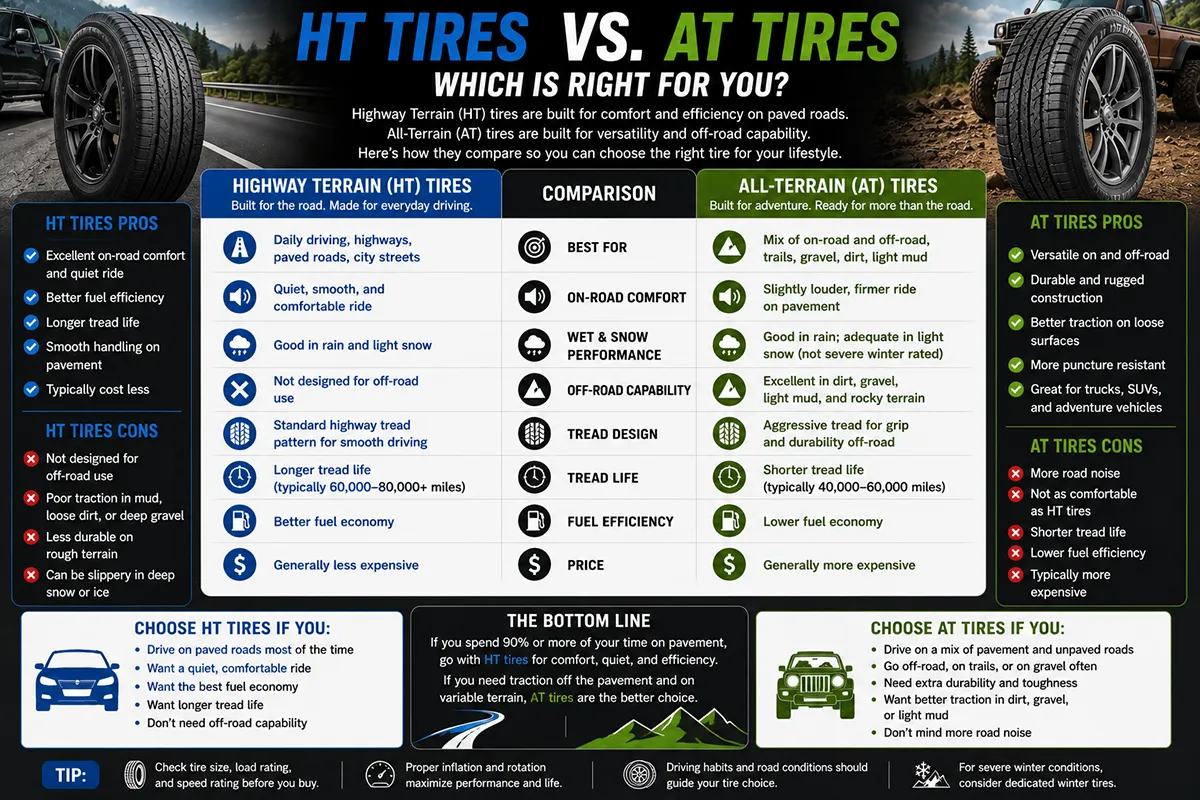
If you drive a truck or SUV, you’ve probably stared at a wall of tires at your local shop and wondered: do I really need all-terrain tires, or will highway tires get the job done?
It’s one of the most common questions I get from readers, and honestly, the wrong choice can cost you hundreds of dollars and leave you frustrated every time you get behind the wheel.
After spending years testing both highway terrain (HT) and all-terrain (AT) tires across every condition imaginable — from Texas highways to Colorado mountain passes to muddy trails in the Ozarks — I’m going to break down exactly what separates these two categories and help you pick the right one for your life.
- HT (Highway Terrain) tires are built for on-road comfort, fuel efficiency, and long tread life — ideal if 90%+ of your driving is on pavement.
- AT (All-Terrain) tires offer a balance of on-road manners and off-road grip — best if you regularly encounter gravel, dirt, mud, or snow.
- AT tires are louder, wear faster, and reduce fuel economy compared to HT tires.
- HT tires cost less on average ($130–$200 per tire) vs AT tires ($160–$280 per tire) for popular sizes.
- If you never leave pavement, go HT. If you hit unpaved roads even occasionally, AT tires are worth the trade-offs.
Liked this article?
Add TireAdvise as a preferred source so you see more of our tire reviews and guides on Google.
What Are HT (Highway Terrain) Tires?
Highway terrain tires — sometimes labeled H/T or just called “highway tires” — are designed primarily for on-road driving. They prioritize a smooth, quiet ride, good fuel economy, and long tread life.
I think of HT tires as the “daily driver” option. If your truck or SUV mostly sees commuting, highway cruising, grocery runs, and the occasional road trip, these are built for your world.
The tread patterns on HT tires are relatively simple. You’ll notice continuous circumferential grooves, tight shoulder blocks, and minimal void space between the tread elements. This design maximizes the contact patch with the road, which translates to better grip on dry and wet pavement.
Most HT tires also feature silica-enhanced rubber compounds that stay pliable in a range of temperatures. This helps with wet traction and contributes to even wear over time.
Popular HT Tires I’ve Tested
Over the years, I’ve spent considerable time on several well-known highway terrain tires:
- Michelin Defender LTX M/S — This is the gold standard in the HT category, in my opinion. During my test period, I was genuinely impressed by how quiet and composed it felt on the highway, even at sustained speeds of 75+ mph across West Texas.
- Continental CrossContact LX25 — A seriously underrated tire. I found its wet grip to be outstanding, and it delivered one of the most comfortable rides I’ve experienced in this segment.
- Bridgestone Dueler H/L Alenza Plus — Smooth and refined, though I noticed it gave up a bit of dry grip compared to the Michelin in hard cornering situations.
- Cooper Discoverer HTP II — A solid budget-friendly option. It doesn’t match the premium tires in noise levels, but the value is hard to beat for the price.
What Are AT (All-Terrain) Tires?
All-terrain tires are the Swiss Army knife of the tire world. They’re engineered to handle both paved roads and unpaved surfaces like gravel, dirt, sand, and light mud.
The moment you look at an AT tire, you can see the difference. The tread blocks are larger, more widely spaced, and more aggressive-looking. Those open channels between the lugs help the tire evacuate mud, loose gravel, and snow, giving you traction where an HT tire would spin.
Most AT tires also have reinforced sidewalls — sometimes with an extra ply or two — to resist punctures from rocks and trail debris. Many feature raised sidewall lettering or even secondary tread patterns on the sidewall itself for extra grip when airing down on trails.
I want to be clear about something: all-terrain does not mean off-road. True off-road or mud-terrain (MT) tires are a separate, more aggressive category. AT tires live in the middle — they’re a compromise, and that’s exactly what makes them so popular.
Popular AT Tires I’ve Tested
- BFGoodrich KO2 — The icon. I’ve run KO2s on two different trucks, and they consistently deliver excellent off-road traction with surprisingly decent highway manners. They’re the tire I recommend most often in this category.
- Falken Wildpeak A/T3W — This tire shocked me. For the price, the snow and ice performance was remarkable — it carries the Three-Peak Mountain Snowflake (3PMSF) rating, and I could feel the difference during a winter test in the Colorado Rockies.
- Toyo Open Country A/T III — Very well-rounded. I found it slightly quieter than the KO2 on pavement, with competitive off-road grip.
- Nitto Ridge Grappler — Technically a hybrid between AT and MT, but many shoppers cross-shop it in this category. It’s aggressive-looking and surprisingly capable on trails, though it’s noticeably louder than a pure AT tire.
HT vs AT Tires: Head-to-Head Comparison
Let me lay out the key differences in a way that’s easy to digest. I’ve based this on my real-world testing across multiple tire models in each category.
| Feature | HT (Highway Terrain) | AT (All-Terrain) |
|---|---|---|
| On-Road Comfort | Excellent — smooth and refined | Good — slightly stiffer ride |
| Road Noise | Very quiet | Moderate to noticeable hum |
| Dry Pavement Grip | Excellent | Very good |
| Wet Pavement Grip | Excellent | Good to very good |
| Off-Road (Dirt/Gravel) | Poor to fair | Very good |
| Off-Road (Mud) | Poor | Good (not great in deep mud) |
| Snow Performance | Fair (few have 3PMSF) | Good to very good (many have 3PMSF) |
| Fuel Economy Impact | Minimal — low rolling resistance | 1–3 MPG drop typical |
| Tread Life | 60,000–80,000 mile warranties common | 50,000–65,000 mile warranties common |
| Average Price (per tire) | $130–$200 | $160–$280 |
| Best For | Highway commuters, road trippers | Mixed-use drivers, light off-roaders |
Ride Comfort and Noise: My Real-World Impressions
This is the category where HT tires absolutely shine, and it’s the number one reason I steer pavement-only drivers away from all-terrains.
During my test period with the Michelin Defender LTX M/S on a 2022 Chevy Silverado, I could barely hear the tires at highway speed. The cabin was remarkably quiet — I could carry on a normal conversation without raising my voice, and podcast audio came through crisp and clear at moderate volume.
When I swapped to the BFGoodrich KO2 on the same truck, the difference was immediate. At speeds above 55 mph, there was a noticeable low-frequency hum. It wasn’t unbearable — I’d describe it as a steady drone — but it was definitely present, and after several hours of interstate driving, I found it fatiguing.
The ride quality difference follows a similar pattern. HT tires absorb small road imperfections more gracefully because their tread compounds are softer and their sidewalls are more compliant.
AT tires, with their stiffer sidewalls and harder compounds, transmit more vibration into the cabin. I felt this most on rough secondary roads with patchy pavement.
That said, the gap has narrowed significantly in recent years. Modern AT tires like the Falken Wildpeak A/T3W and Toyo Open Country A/T III have made real progress in on-road refinement. They’re not as quiet as a good HT tire, but they’re miles ahead of the AT tires I was testing five or six years ago.
Off-Road Capability: Where AT Tires Earn Their Keep
If you ever leave pavement — and I mean anything from a gravel campsite road to a moderate off-road trail — this is where AT tires justify every extra dollar.
I took a set of Falken Wildpeak A/T3W tires on a week-long trip through Utah’s backcountry, and the difference compared to the highway tires I’d been running was night and day.
On loose gravel descents, the AT tires bit into the surface and gave me confident braking. On sandy washes, they maintained momentum where an HT tire would have dug in and stalled.
The most dramatic difference I’ve experienced was in mud. During a rainy weekend trip to an unpaved campsite in East Texas, my HT-equipped truck was slipping and struggling on a mildly muddy two-track.
After switching to AT tires the following month and encountering similar conditions, the truck handled it without drama. The wider tread voids on the AT tire allowed mud to clear with each rotation instead of packing into the grooves.
Now, I need to set realistic expectations. AT tires are not mud tires. In deep, thick mud or serious rock-crawling situations, they’ll reach their limits quickly.
If you’re doing Moab-level trails every weekend, you need to look at MT tires or even dedicated off-road rubber. But for the vast majority of truck and SUV owners who occasionally venture off pavement, AT tires are more than enough.
HT tires, by contrast, are genuinely poor off-road. Their tread patterns simply can’t evacuate loose material effectively, and their sidewalls are more vulnerable to punctures from sharp rocks. I’ve seen HT tires get stuck in situations that even a basic AT tire would cruise through.
Fuel Economy: The Hidden Cost of AT Tires
This is a factor that a lot of shoppers overlook, and it can add up significantly over time.
AT tires have higher rolling resistance than HT tires. This is a direct consequence of their heavier weight, stiffer construction, and more aggressive tread patterns. In my experience, I’ve consistently measured a drop of about 1 to 2 miles per gallon when switching from HT to AT tires on the same vehicle.
On a truck averaging 20 MPG, dropping 1.5 MPG means you’re burning roughly an extra gallon of gas every 100 miles. At current gas prices hovering around $3.30–$3.80 per gallon in most of the US, that’s an extra $400–$500 per year if you drive an average amount. That’s real money.
HT tires, with their lower rolling resistance and lighter weight, help your truck or SUV deliver closer to its EPA-rated fuel economy.
During my extended test of the Continental CrossContact LX25, I actually saw my truck meet its window sticker numbers for the first time — something I hadn’t achieved with the AT tires that came as OEM equipment.
Tread Life and Durability
HT tires generally last longer than AT tires when driven exclusively on pavement. This makes sense: their rubber compounds are optimized for asphalt, and their tread patterns wear more evenly.
Most premium HT tires come with treadwear warranties in the 65,000 to 80,000-mile range. The Michelin Defender LTX M/S, for example, carries a 70,000-mile warranty. In my experience, these tires actually deliver close to their warranty figures if you keep up with rotations and alignments.
AT tires typically warrant between 50,000 and 65,000 miles. The KO2 carries a 50,000-mile warranty, while the Falken Wildpeak A/T3W offers 55,000 miles.
But here’s the catch — if you’re actually using your AT tires off-road regularly, that warranty mileage becomes much harder to reach. Rough terrain accelerates wear significantly.
I’ve also noticed that AT tires tend to develop uneven wear patterns more readily, especially on the outer shoulder blocks. Regular rotations — every 5,000 to 7,000 miles — are critical if you want to maximize the life of your AT rubber.
On the durability side, AT tires have a clear advantage when it comes to puncture resistance. Their thicker sidewalls and more robust construction handle road hazards better.
During my testing in areas with lots of construction debris and rough pavement, I never had a puncture on AT tires, while I’ve had two separate sidewall issues with HT tires over the years.
Snow and Winter Performance
This is an area where AT tires have made enormous strides in the last several years, and it’s one of the biggest reasons I see people choose them over HT tires.
Many modern AT tires now carry the Three-Peak Mountain Snowflake (3PMSF) rating, which means they’ve passed a standardized traction test in snow conditions. The BFGoodrich KO2, Falken Wildpeak A/T3W, and Toyo Open Country A/T III all carry this designation.
I tested the Falken Wildpeak A/T3W during a winter trip through the Colorado mountains, and the snow performance was legitimately impressive. On packed snow, the tire felt planted and predictable.
Even on light ice, I had more confidence than I expected — though I want to be clear that no all-season or all-terrain tire replaces a dedicated winter tire on pure ice.
Most HT tires do not carry the 3PMSF rating. They’ll handle light snow and slush reasonably well, but in deeper snow or consistently cold temperatures, their rubber compounds harden and their tread patterns don’t provide the biting edges needed for traction.
If you live in the northern US — Minnesota, Michigan, Wisconsin, the mountain West — and you don’t want to deal with swapping to dedicated winter tires, a 3PMSF-rated AT tire is a compelling year-round solution for your truck or SUV.
Appearance and Aesthetics
Let’s be honest: looks matter. For a lot of truck and SUV owners, the visual difference between HT and AT tires is a significant factor in the buying decision.
AT tires simply look more aggressive and purposeful. The chunky tread blocks, raised white sidewall lettering, and rugged styling give your vehicle a more capable, ready-for-anything appearance.
There’s a reason the BFGoodrich KO2 is one of the best-selling tires in America — those bold sidewall letters look fantastic on any truck.
HT tires, by contrast, are visually unassuming. They look like… tires. There’s nothing wrong with that, and on a luxury SUV like a Cadillac Escalade or Lincoln Navigator, a clean-looking HT tire is absolutely the right aesthetic choice. But on a Wrangler, Tacoma, or F-150 with a mild lift, an HT tire can look out of place.
I won’t tell you to choose tires based on looks alone — performance should always come first — but if two tires meet your functional needs equally well, there’s nothing wrong with picking the one that makes you smile when you walk up to your truck.
Price Comparison: What You’ll Actually Pay
Budget is always a factor, so let me give you realistic price ranges based on what I’ve seen in the US market for common truck and SUV sizes (265/70R17 and 275/55R20 being two of the most popular).
HT Tire Pricing (per tire, before installation)
- Budget options (Cooper, Hankook): $130–$160
- Mid-range (Continental, General): $160–$190
- Premium (Michelin, Bridgestone): $190–$230
AT Tire Pricing (per tire, before installation)
- Budget options (Falken, General): $160–$200
- Mid-range (Toyo, Nitto): $200–$240
- Premium (BFGoodrich, Michelin): $230–$280
For a full set of four tires plus installation, you’re typically looking at $700–$1,000 for HT tires and $850–$1,300 for AT tires. Factor in the fuel economy difference over the life of the tires, and the total cost gap can be substantial.
That said, I want to emphasize that the cheapest tire isn’t always the best value. A premium HT tire that lasts 70,000 miles often costs less per mile than a budget tire that wears out at 40,000. I always encourage readers to think about cost-per-mile rather than sticker price.
When You Should Choose HT Tires
Based on everything I’ve tested and observed, here’s when I think HT tires are the clear winner:
- You drive almost exclusively on pavement. If 95% or more of your driving is on paved roads, HT tires are the logical choice. You’ll get better comfort, less noise, better fuel economy, and longer tread life.
- You prioritize a quiet, comfortable ride. If cabin noise and ride quality are high on your list — especially if you have a long highway commute — HT tires deliver a dramatically better experience.
- You want to maximize fuel economy. Every MPG counts, especially with larger trucks and SUVs. HT tires minimize rolling resistance and help keep your fuel costs down.
- You drive a luxury SUV. Vehicles like the Cadillac Escalade, BMW X5, or Lexus GX are engineered for on-road refinement. An HT tire preserves that character better than an AT tire.
- You’re on a tight budget. HT tires cost less upfront, last longer, and burn less gas. The total cost of ownership is meaningfully lower.
When You Should Choose AT Tires
And here’s when I’d steer you toward all-terrain tires:
- You regularly drive on unpaved roads. If you frequently encounter gravel, dirt, or poorly maintained roads — whether for work, camping, or rural living — AT tires provide dramatically better traction and confidence.
- You go off-road, even occasionally. Whether it’s a few times a year for hunting, fishing, or overlanding trips, AT tires handle trail conditions that would leave HT tires spinning.
- You deal with serious winter weather. A 3PMSF-rated AT tire can serve as year-round rubber in snowy climates, saving you the cost and hassle of a dedicated winter tire set.
- You want extra puncture protection. If you drive in areas with construction debris, rough roads, or potential tire hazards, the reinforced sidewalls of AT tires give you an extra margin of safety.
- You want the rugged look. If aesthetics are important and you want your truck to look like it means business, AT tires deliver that visual presence.
Common Mistakes I See Buyers Make
After years of writing about tires and talking to readers, I’ve noticed several recurring mistakes in the HT vs AT decision:
Buying AT Tires “Just in Case”
This is the most common one. A reader will tell me they’re getting AT tires because they “might” go off-road someday. If you haven’t gone off-road in the last year and don’t have concrete plans to start, save your money and get HT tires. You can always buy AT tires later when your needs actually change.
Ignoring the Fuel Economy Penalty
I’ve seen people agonize over saving $20 on the tire price and then completely ignore the $400+ per year they’ll spend on extra fuel with AT tires. Always consider total cost of ownership.
Choosing Based on Looks Alone
I get it — AT tires look cool. But if you’re commuting an hour each way on the highway every day, that aggressive tread pattern is going to make your life noisier and more expensive without providing any real benefit. Function first, looks second.
Not Considering Tire Size
Some truck owners upsize to larger AT tires for looks and ground clearance. While this can work, larger tires compound every negative: more noise, worse fuel economy, faster wear, and potentially voiding parts of your vehicle’s warranty. If you’re going to upsize, do your research and understand the trade-offs.
My Personal Recommendations
If I had to pick one tire in each category to recommend to the average US truck or SUV owner, here’s where I’d land:
Best HT Tire: Michelin Defender LTX M/S
It’s not the cheapest option, but in my experience, no other highway terrain tire matches its combination of comfort, wet grip, tread life, and overall refinement.
The 70,000-mile warranty gives me confidence in its durability, and during my time with it, the ride quality was genuinely class-leading. If you primarily drive on pavement, this is the tire to beat.
Best AT Tire: Falken Wildpeak A/T3W
This one surprises people because it’s not the most expensive or famous AT tire on the market. But in my testing, the Wildpeak A/T3W delivered the best overall balance of on-road comfort, off-road capability, snow performance (3PMSF rated), and value.
It’s typically $30–$50 less per tire than the BFGoodrich KO2, and I found its on-road noise levels to be noticeably lower. The KO2 is still an excellent tire — especially if maximum off-road durability is your priority — but for the majority of mixed-use drivers, the Falken is my top pick.
The Bottom Line
The choice between HT and AT tires ultimately comes down to one question: what do you actually do with your truck or SUV?
If your honest answer is “I drive on paved roads 95% of the time,” get HT tires. You’ll save money, enjoy a quieter ride, get better gas mileage, and your tires will last longer. There’s no shame in admitting your truck is a pavement princess — most of them are, and that’s perfectly fine.
If your answer includes regular trips on gravel roads, occasional off-road adventures, or harsh winter conditions, AT tires are a worthwhile investment. You’ll pay more upfront and accept some trade-offs in comfort and efficiency, but the added capability is real and meaningful when you need it.
I’ve driven both types extensively across thousands of miles of US highways, back roads, and trails. Neither type is objectively “better” — they’re just built for different jobs. The key is being honest with yourself about your driving habits and choosing the tire that actually fits your life, not the one you wish your life looked like.
Whatever you choose, invest in a quality tire from a reputable brand, keep up with rotations and alignments, and check your tire pressure at least once a month. A good tire on a well-maintained vehicle will serve you safely and reliably for years.
Frequently Asked Questions
What is the difference between HT and AT tires?
HT (Highway Terrain) tires are designed primarily for on-road driving, offering a smooth, quiet ride with excellent fuel efficiency and long tread life. AT (All-Terrain) tires feature a more aggressive tread pattern built to handle both paved highways and unpaved surfaces like gravel, dirt, and light mud. If most of your driving is on paved roads, HT tires are the better choice, but if you regularly encounter off-road conditions or unpaved back roads, AT tires give you the versatility you need.
Are HT tires better than AT tires for daily driving and commuting?
For daily commuting on paved US highways and city streets, HT tires are generally the better option because they deliver a quieter cabin, better fuel economy, and longer tread wear. I’ve found that popular HT options like the Michelin Defender LTX M/S or the Continental TerrainContact H/T provide excellent comfort and typically last 60,000–80,000 miles. AT tires can certainly handle daily driving, but you’ll notice more road noise and slightly higher fuel costs over time.
Do all-terrain tires wear out faster than highway terrain tires?
Yes, AT tires generally wear out faster than HT tires because their softer rubber compounds and aggressive tread blocks experience more friction on paved surfaces. Most HT tires are rated for 60,000–80,000 miles, while many AT tires last around 40,000–60,000 miles depending on the brand and driving habits. Premium AT tires like the BFGoodrich KO2 or Toyo Open Country AT III have improved tread life significantly, but they still typically won’t match a dedicated highway tire in longevity.
Are all-terrain tires worth it if I only go off-road occasionally?
If you only venture off-road a few times a year—say for camping trips, hunting, or accessing unpaved rural roads—AT tires can be worth the trade-off for the added traction and peace of mind. However, if your off-road excursions are truly rare and mild, you might be better off sticking with HT tires and saving money on fuel and replacement costs. I’d recommend AT tires if you live in an area with frequent gravel roads, construction zones, or harsh winter weather, since many AT tires also perform well in light snow.
How much more do AT tires cost compared to HT tires?
All-terrain tires typically cost $20–$60 more per tire than comparable highway terrain tires in the same size, with a full set of AT tires running anywhere from $600 to $1,200 for popular truck and SUV sizes. For example, a set of four Falken Wildpeak AT3W tires in a common size like 265/70R17 often runs around $700–$800, while a comparable HT tire like the Cooper Discoverer HTP II might cost $550–$700. You’ll also spend more over time with AT tires due to slightly reduced fuel economy and faster tread wear.
Are HT or AT tires better for driving in snow and rain?
AT tires generally outperform HT tires in snow and light winter conditions thanks to their deeper tread depth and more aggressive siping, and many popular models like the Falken Wildpeak AT3W carry the Three-Peak Mountain Snowflake (3PMSF) rating. HT tires can handle rain well due to their optimized tread channels for water evacuation, but they struggle more on snow-covered or icy roads. If you live in a northern US state that sees regular snowfall but don’t want to swap to dedicated winter tires, an all-terrain tire with the 3PMSF symbol is a strong compromise.
Can I put HT tires on a truck that came with AT tires from the factory?
Yes, you can absolutely switch from AT to HT tires on your truck or SUV as long as you match the correct tire size listed on your vehicle’s door placard or owner’s manual. Many truck owners who primarily drive on highways make this switch to enjoy a quieter ride, better gas mileage, and longer tread life. Just keep in mind that you’ll lose some off-road capability and traction on loose surfaces, so if your truck sees any regular trail use or you tow through unpaved areas, you may want to stick with all-terrain tires.
