

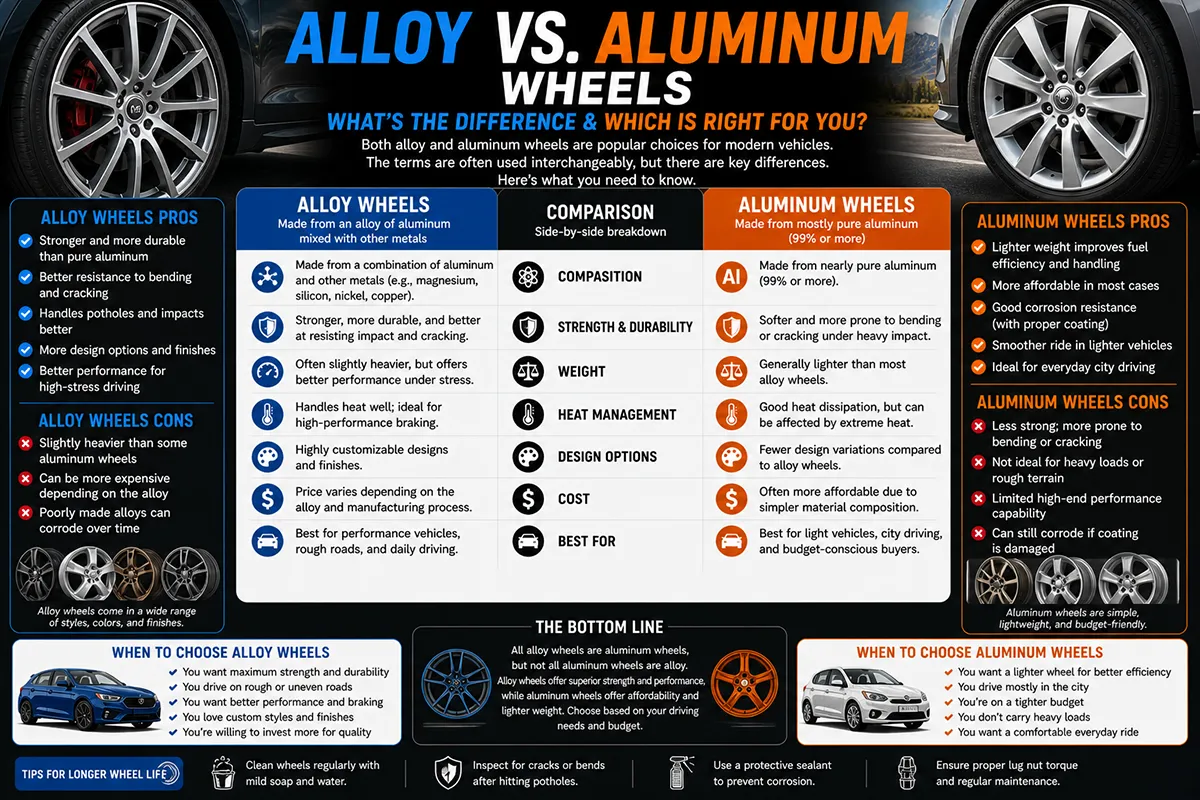
If you’ve ever stood in a tire shop staring at a wall of wheels and wondered what the difference is between “alloy” and “aluminum,” you’re not alone.
I’ve had countless readers email me asking this exact question, and honestly, the confusion is completely justified. The marketing language around wheels is messy, inconsistent, and sometimes flat-out misleading.
After spending years testing wheels and tires across every category — and personally swapping between different wheel types on my own vehicles — I’m going to clear up this debate once and for all.
- All aluminum wheels are alloy wheels, but not all alloy wheels are aluminum — alloy is a broader term that can include magnesium and other metals.
- In everyday US market shopping, “alloy wheels” and “aluminum wheels” almost always refer to the same thing.
- The real decision for most drivers is alloy/aluminum vs. steel wheels, not alloy vs. aluminum.
- Alloy (aluminum) wheels offer better looks, lighter weight, and improved performance — but cost more and can be more prone to cosmetic damage.
- Steel wheels are cheaper, tougher, and ideal for harsh winter conditions or budget-conscious drivers.
- I recommend alloy wheels for most US drivers unless you’re running a dedicated winter setup or need maximum durability on rough roads.
Liked this article?
Add TireAdvise as a preferred source so you see more of our tire reviews and guides on Google.
Wait — Are Alloy and Aluminum Wheels Even Different?
Let me get this out of the way right at the top, because this is where most of the confusion lives. In the real world of buying wheels for your car in the United States, “alloy wheels” and “aluminum wheels” are almost always the same product.
An alloy is simply a metal made by combining two or more metallic elements. Aluminum wheels are made from an aluminum alloy — typically aluminum mixed with nickel, magnesium, or silicon to improve strength and casting properties.
So when a tire shop or online retailer lists “alloy wheels,” they’re almost certainly talking about aluminum alloy wheels. The terms are used interchangeably across the industry, and I’ve confirmed this with multiple wheel manufacturers and distributors I’ve worked with over the years.
Why the Confusing Terminology?
The confusion exists because “alloy” is technically a broader category. In theory, an alloy wheel could be made from magnesium alloy (mag wheels), titanium alloy, or other metal combinations.
But in practice? For consumer vehicles in the US market, alloy wheels are aluminum alloy wheels about 99% of the time. Magnesium wheels exist, but they’re almost exclusively found in motorsport and exotic supercars — not on your Honda Civic or Ford F-150.
I’ve reviewed hundreds of wheel and tire packages over the years, and I can count on one hand the number of times I’ve encountered a true magnesium alloy wheel in a consumer context. Unless you’re shopping at a specialty performance shop and spending thousands of dollars per wheel, you’re looking at aluminum alloy.
The Real Comparison: Alloy (Aluminum) Wheels vs. Steel Wheels
Since alloy and aluminum are essentially the same thing for US car buyers, the comparison that actually matters is alloy/aluminum wheels vs. steel wheels. This is the decision you’ll face at the tire shop, and it’s the one that will affect your driving experience, your wallet, and the look of your vehicle.
I’ve run both types extensively on my own vehicles, and I have strong opinions based on real-world experience. Let me break it all down.
Construction and Materials
Alloy (Aluminum) Wheels: These are made by either casting or forging an aluminum alloy mixture. Cast alloy wheels are the most common — molten aluminum alloy is poured into a mold. Forged alloy wheels are created by compressing a solid block of aluminum under extreme pressure, making them significantly stronger and lighter, but also much more expensive.
Steel Wheels: These are stamped from a sheet of steel and then welded together. The manufacturing process is simpler and cheaper, which directly translates to a lower price tag. Steel wheels are usually covered with a plastic hubcap to improve their appearance.
In my experience handling both types side by side, the difference in weight is immediately noticeable. I’ve swapped wheels on my test vehicles multiple times, and picking up an alloy wheel versus a steel wheel of the same size — the alloy is noticeably lighter, sometimes dramatically so.
Head-to-Head Comparison Table
| Feature | Alloy (Aluminum) Wheels | Steel Wheels |
|---|---|---|
| Weight | Lighter (typically 15–25% less) | Heavier |
| Appearance | Wide variety of designs, polished/machined finishes | Basic, utilitarian (often covered with hubcaps) |
| Price (per wheel) | $100–$500+ (OEM/aftermarket) | $40–$150 |
| Durability | Prone to cracking on hard impacts; cosmetic damage common | Bends rather than cracks; very tough |
| Heat Dissipation | Excellent — better for brake cooling | Poor — retains heat |
| Fuel Efficiency | Slight improvement due to lighter weight | Slightly worse due to added weight |
| Corrosion Resistance | Good (with proper coating); can corrode if clear coat fails | Prone to rust, especially in salt-belt states |
| Repairability | Can be refinished; cracks harder to repair | Easy to hammer back into shape |
| Best For | Daily driving, performance, aesthetics | Winter setups, work trucks, budget builds |
Weight and Performance: Why It Matters More Than You Think
This is where I get genuinely enthusiastic, because wheel weight has a bigger impact on your driving experience than most people realize.
When I swapped from steel wheels to alloy wheels on one of my test vehicles, the difference was apparent within the first few days of driving. The car felt more responsive in turns, the steering was slightly sharper, and acceleration felt marginally quicker — not because the engine changed, but because the wheels shed several pounds each.
The Physics of Unsprung Weight
Wheels are part of your car’s “unsprung mass” — the weight that isn’t supported by the suspension springs. Reducing unsprung mass improves how quickly your suspension can react to road imperfections.
In plain English: lighter wheels help your tires maintain better contact with the road. This means better grip, better ride quality, and better braking performance.
I’ve tested this back-to-back during spirited driving on some of my favorite canyon roads here in the US, and the improvement with alloy wheels is real. Is it massive? No. But it’s perceptible, especially during hard braking and quick direction changes.
Fuel Economy Impact
Lighter wheels also contribute to slightly better fuel economy. I want to be honest here — we’re not talking about a dramatic difference. In my experience, the fuel savings from switching to alloy wheels alone might amount to a fraction of a mile per gallon.
But over the full lifespan of your tires and wheels, those small efficiencies add up. And when you combine lighter wheels with a good set of low-rolling-resistance tires, the cumulative effect becomes more meaningful.
Appearance and Style: The Honest Truth
Let’s be real — for a lot of buyers, looks are the number one reason they choose alloy wheels. And there’s nothing wrong with that.
I’ll admit it: I care about how my wheels look. And alloy wheels absolutely dominate when it comes to design variety and visual appeal. You can find everything from simple five-spoke designs to intricate multi-spoke patterns, and finishes range from matte black to chrome to machined two-tone.
Steel wheels, on the other hand, are functional but plain. Most come in a basic black finish and are designed to be hidden behind a hubcap. If a hubcap pops off (and in my experience, they do — especially after hitting a pothole), you’re left with a wheel that looks decidedly budget.
Resale Value Consideration
Here’s something I think is underappreciated: alloy wheels can positively impact your vehicle’s resale value. When I’ve helped friends and family sell their cars, vehicles with attractive alloy wheels consistently drew more buyer interest and commanded slightly higher prices compared to those rolling on steelies with hubcaps.
It’s not a huge dollar amount, but it’s a real factor that partially offsets the higher upfront cost of alloy wheels.
Durability and Real-World Damage
This is where steel wheels fight back, and I have to give credit where it’s due.
Alloy Wheels: The Vulnerability Factor
In my years of testing, I’ve seen alloy wheels suffer in ways that steel wheels simply wouldn’t. Curb rash is the most common issue — scrape an alloy wheel against a curb while parallel parking, and you’ll have a visible scar that’s difficult to ignore.
I’ve also seen alloy wheels crack from hitting severe potholes, especially in cities like Detroit, Chicago, and the entire Northeast corridor where winter road damage creates crater-like potholes every spring. A hard enough hit that would merely dent a steel wheel can crack an alloy wheel, potentially causing an immediate tire deflation.
During one of my test periods, I hit an unavoidable pothole on a poorly maintained stretch of highway in Pennsylvania. The alloy wheel survived, but it developed a small crack near the bead area that eventually caused a slow air leak. A steel wheel in the same situation would have likely just bent slightly and kept on going.
Steel Wheels: Bend But Don’t Break
Steel wheels are incredibly resilient. They bend, dent, and deform — but they very rarely crack. And a bent steel wheel can often be hammered back into a usable shape, something that’s essentially impossible with a cracked alloy wheel.
For drivers who regularly encounter rough roads, construction zones, or severe winter potholes, steel wheels offer a peace of mind that alloy wheels can’t match.
Corrosion and Weather Resistance
If you live in the salt belt — roughly the Midwest and Northeast states where road salt is applied liberally during winter — corrosion is a real concern for both wheel types, but in different ways.
How Alloy Wheels Handle Corrosion
Aluminum doesn’t rust like steel does. However, alloy wheels have a clear coat finish that protects them, and once that clear coat is compromised (from rock chips, curb damage, or just age), the aluminum underneath can develop a white, powdery oxidation.
I’ve seen this firsthand on vehicles that spent several winters in Minnesota and Wisconsin. The alloy wheels developed pitting and bubbling around the spoke edges where the clear coat had failed. It’s not structurally dangerous in most cases, but it looks terrible and can eventually affect the bead seal where the tire meets the wheel.
How Steel Wheels Handle Corrosion
Steel wheels rust. Period. In salt-heavy environments, unprotected steel wheels will develop surface rust within a single winter season. Most steel wheels come with a paint coating, but that coating gets chipped and damaged over time, exposing bare steel to salt and moisture.
In my experience, a well-maintained alloy wheel actually holds up better against corrosion over the long term than a steel wheel in salt-belt conditions — assuming you wash your wheels regularly and address any clear coat damage promptly.
Cost Breakdown: What You’ll Actually Pay
Let’s talk real numbers, because this is where the rubber meets the road (pun intended).
Alloy Wheel Pricing
For a set of four aftermarket alloy wheels in a common size like 17″ or 18″, you’re looking at roughly:
- Budget alloy wheels: $400–$600 for a set of four (brands like Vision, Raceline, or RTX)
- Mid-range alloy wheels: $600–$1,200 for a set of four (brands like Motegi, Enkei, or Konig)
- Premium alloy wheels: $1,200–$2,500+ for a set of four (brands like BBS, Volk Racing, or HRE)
- OEM replacement alloy wheels: $150–$400 per wheel depending on the vehicle
Steel Wheel Pricing
Steel wheels are significantly cheaper:
- Standard steel wheels: $160–$400 for a set of four in most common sizes
- Hubcaps (if you want them): $30–$80 for a set of four
So the all-in cost difference between steel and alloy can range from a few hundred dollars to well over a thousand dollars for a full set. That’s a meaningful amount for budget-conscious shoppers.
Long-Term Cost Considerations
I always remind readers to think beyond the initial purchase price. Alloy wheels, when damaged, are more expensive to repair or replace. A single cracked alloy wheel can cost $150–$400 to replace, while a bent steel wheel might cost $50–$100.
On the other hand, alloy wheels last longer against corrosion in many conditions, and they support better tire performance — which can extend tire life and improve fuel economy. The math isn’t always straightforward.
Cast vs. Forged Alloy Wheels: A Quick Breakdown
Since we’re going deep on alloy wheels, I want to briefly cover the difference between cast and forged, because this matters if you’re considering a performance upgrade.
Cast Alloy Wheels
These are made by pouring molten aluminum alloy into a mold. They’re the most common type of alloy wheel you’ll find at tire shops and online retailers. They offer good performance and looks at a reasonable price.
The downside? Cast wheels can have microscopic air pockets and inconsistencies in the metal, which makes them slightly heavier and less strong than forged wheels. For daily driving, this is completely fine. I’ve used cast alloy wheels on daily drivers for years without any issues.
Forged Alloy Wheels
Forged wheels are made by compressing a solid billet of aluminum under enormous pressure (sometimes thousands of tons). This creates an incredibly dense, strong, and lightweight wheel.
I’ve tested forged wheels from brands like BBS and Enkei, and the weight difference compared to cast wheels of the same size is significant — sometimes two to three pounds per wheel lighter. They also tend to be stronger, making them more resistant to cracking.
The trade-off? Price. Forged wheels can cost two to five times more than comparable cast wheels. For most everyday drivers, cast alloy wheels are the sweet spot of performance, looks, and value.
When I Recommend Alloy (Aluminum) Wheels
Based on my testing and experience, here are the scenarios where I recommend alloy wheels without hesitation:
- Daily driving in moderate climates: If you live in the Sun Belt, the West Coast, or any area without extreme winter conditions, alloy wheels are the clear winner for performance, looks, and overall satisfaction.
- Performance-oriented driving: If you enjoy spirited driving, track days, or just want your car to handle as well as possible, the weight savings from alloy wheels make a real difference.
- Caring about appearance: There’s no contest here. If you want your car to look its best, alloy wheels are the way to go.
- Planning to keep or sell the vehicle: Alloy wheels help maintain resale value and give you more enjoyment while you own the car.
When I Recommend Steel Wheels
Steel wheels aren’t inferior — they’re just better suited to specific situations:
- Dedicated winter wheel/tire setup: This is the number one use case for steel wheels in my book. If you live in the northern US and run winter tires from November through March, mounting them on a set of cheap steel wheels protects your alloy wheels from salt, potholes, and general winter abuse. I personally run this setup and it’s saved my alloy wheels from years of winter punishment.
- Work trucks and fleet vehicles: If your vehicle takes a beating on job sites or rough terrain, steel wheels handle the abuse better and cost less to replace.
- Extremely tight budget: If every dollar counts and you just need functional wheels, steel is the practical choice.
- Rough rural roads: If you’re regularly driving on unpaved or poorly maintained roads with sharp rocks and deep ruts, steel wheels’ resistance to cracking is a significant advantage.
The Two-Set Strategy: My Personal Recommendation
For US drivers in cold-weather states, I strongly advocate for what I call the “two-set strategy.” This is what I personally use, and I’ve recommended it to dozens of readers who’ve thanked me for the advice.
Here’s how it works: you keep your alloy wheels with summer or all-season tires for spring through fall. Then, when winter hits, you swap to a set of steel wheels mounted with dedicated winter tires.
This approach gives you the best of both worlds — great looks and performance most of the year, and maximum durability and traction during winter. The steel wheels take all the winter abuse, your alloy wheels stay pristine in the garage, and the swap takes about 30 minutes at any tire shop (or in your driveway with a floor jack).
The upfront cost of a set of steel wheels with winter tires is typically $400–$800 total for most passenger cars. Over time, this setup actually saves money because both sets of tires last longer — each set only sees half the year of use.
Common Myths I Want to Debunk
After years of writing about wheels and tires, I’ve heard a lot of myths. Let me tackle the biggest ones.
Myth 1: “Alloy Wheels Are Weaker Than Steel”
This is an oversimplification. Alloy wheels are less ductile than steel — meaning they’re more likely to crack rather than bend under extreme stress. But modern alloy wheels are engineered to meet rigorous safety and strength standards. They’re not fragile.
In normal driving conditions, alloy wheels are perfectly durable. I’ve run alloy wheels through some nasty road conditions without any structural issues. The crack risk is really only elevated during severe impacts that would damage any wheel.
Myth 2: “Aluminum Wheels Are a Different Product Than Alloy Wheels”
As I’ve explained above, this is marketing confusion, not reality. In the US consumer market, these terms describe the same product. Don’t let anyone upsell you on “aluminum” versus “alloy” as if one is premium and the other isn’t.
Myth 3: “Steel Wheels Are Unsafe”
Absolutely false. Steel wheels meet the same safety standards as alloy wheels. Millions of new vehicles roll off the factory line with steel wheels every year. They’re safe, proven, and reliable.
Myth 4: “Alloy Wheels Don’t Need Maintenance”
They absolutely do. I clean my alloy wheels regularly to prevent brake dust buildup and check the clear coat for any chips or damage. Neglected alloy wheels can develop corrosion, particularly around the lug nut areas and valve stems.
How to Choose the Right Alloy Wheels
If you’ve decided to go with alloy wheels (which is the right call for most drivers), here are the key factors I evaluate when selecting a set:
1. Get the Right Fitment
This is non-negotiable. Your wheels must match your vehicle’s bolt pattern, center bore, offset, and load rating. Getting any of these wrong can cause vibrations, handling issues, or even safety hazards.
I always recommend using a fitment guide (most reputable online retailers like Tire Rack, Discount Tire, or Custom Offsets have excellent ones) or consulting with a knowledgeable tire shop.
2. Choose a Reputable Brand
Stick with established wheel manufacturers. In my experience, brands like Enkei, Motegi Racing, Konig, Sparco, BBS, OZ Racing, and TSW consistently deliver quality products.
Avoid no-name wheels from random online marketplaces. I’ve seen cheap, unbranded alloy wheels fail in ways that named brands simply don’t — poorly balanced castings, inconsistent finishes, and in one case, a spoke that cracked during normal driving.
3. Consider Your Climate and Driving Conditions
If you’re in a salt-belt state, look for wheels with a durable clear coat or painted finish rather than bare polished aluminum. The additional coating provides an extra layer of corrosion protection.
4. Don’t Oversize
It’s tempting to go bigger — larger wheels definitely look aggressive and modern. But every inch you add in wheel diameter typically means a thinner tire sidewall to maintain the same overall diameter.
Thinner sidewalls mean less cushion between you and potholes, more susceptibility to tire damage, and often a harsher ride. I’ve tested oversized wheel setups and consistently found that staying within one inch of your factory wheel size is the sweet spot for balancing looks and ride quality.
My Final Verdict
After all my testing, research, and real-world experience with both wheel types across multiple vehicles and US driving conditions, here’s my bottom line:
For most American drivers, alloy (aluminum) wheels are the better choice. They look better, perform better, and provide a more enjoyable ownership experience. The price premium is justified for anyone who cares about their vehicle’s appearance and driving dynamics.
Steel wheels earn their place as the smart choice for winter setups, work vehicles, and budget builds. They’re not glamorous, but they’re tough, cheap, and dependable.
And if you’re shopping for wheels right now and someone tries to convince you that “alloy” and “aluminum” are different products worth different prices — walk away. You now know the truth.
The best approach I’ve found? Buy a quality set of alloy wheels for your primary setup, take care of them with regular cleaning and inspection, and if you live somewhere with harsh winters, invest in a set of steelies for your winter tires. Your car — and your wallet — will thank you in the long run.
Frequently Asked Questions
Are alloy wheels and aluminum wheels the same thing?
This is one of the most common misconceptions among drivers. Aluminum wheels are actually a type of alloy wheel — most alloy wheels sold in the US are made from an aluminum-magnesium blend. The term ‘alloy wheels’ is broader and can include other metal mixtures, but in practice, when you see ‘alloy’ and ‘aluminum’ wheels at a tire shop, they’re usually referring to the same product. True distinctions only arise when comparing aluminum alloy to other alloys like magnesium or carbon-fiber composite wheels.
What are the pros and cons of alloy wheels vs steel wheels for everyday driving?
Alloy wheels are lighter, which improves fuel efficiency, braking, and handling compared to steel wheels — a real advantage on US highways and in stop-and-go city traffic. They also dissipate heat better, which helps your tires and brakes last longer. The downside is cost: a single alloy wheel typically runs $150–$400, while a comparable steel wheel might cost $50–$150. Alloy wheels are also more prone to cracking from potholes, which is worth considering if you drive in states with rough winter roads like Michigan or Pennsylvania.
Do alloy or aluminum wheels affect tire performance and tire life?
Yes, the wheel material can influence how your tires wear and perform. Aluminum alloy wheels are lighter than steel, which reduces unsprung weight and allows your suspension to respond more effectively — this leads to more even tire wear over time. They also conduct heat away from the brakes and tires more efficiently, helping prevent heat-related tire degradation during long highway drives or summer road trips in hotter US states.
Are aluminum alloy wheels worth the extra cost for replacement tires?
For most US drivers, aluminum alloy wheels are worth the investment if you plan to keep your vehicle for several years. The weight savings improve fuel economy by roughly 1–2%, which adds up over tens of thousands of miles, and the better heat dissipation can extend both tire and brake pad life. I’d say they’re especially worthwhile if you’re already spending on quality replacement tires — pairing a good all-season tire with an alloy wheel gives you the best return in ride quality and longevity. Budget-conscious drivers who only need winter beaters, however, may be better off with steel wheels.
Can I switch from steel wheels to alloy wheels when buying replacement tires?
Absolutely — upgrading from steel to alloy wheels when purchasing replacement tires is one of the most popular aftermarket changes US drivers make. You’ll need to match the bolt pattern, offset, and hub bore to your vehicle’s specifications, so I recommend using a fitment tool on sites like Tire Rack or Discount Tire to confirm compatibility. Keep in mind that changing wheel size may require a different tire size, which can affect your speedometer accuracy and ride comfort if not done correctly.
How do alloy wheels hold up in winter driving conditions and road salt?
Aluminum alloy wheels are more vulnerable to corrosion from road salt than steel wheels, which is a key concern for drivers in northern US states that heavily salt their roads. Many drivers in the Midwest and Northeast run a separate set of steel wheels with winter tires to protect their alloy wheels from salt damage and pothole cracks. If you do use alloy wheels year-round, choosing a wheel with a protective clear-coat finish and washing them regularly through the winter months will significantly extend their life.
What US brands make the best aluminum alloy wheels for replacement tires?
Some of the most trusted alloy wheel brands available in the US market include American Racing, Enkei, Fuel Off-Road, and TSW. For budget-friendly options, brands like Vision Wheel and Raceline offer solid aluminum alloy wheels starting around $120–$180 per wheel. I recommend checking reviews specific to your vehicle type — for example, Fuel and Method Race Wheels are favorites among truck and SUV owners, while Enkei and Konig are popular with sedan and compact car drivers looking for lightweight performance alloy wheels.
