

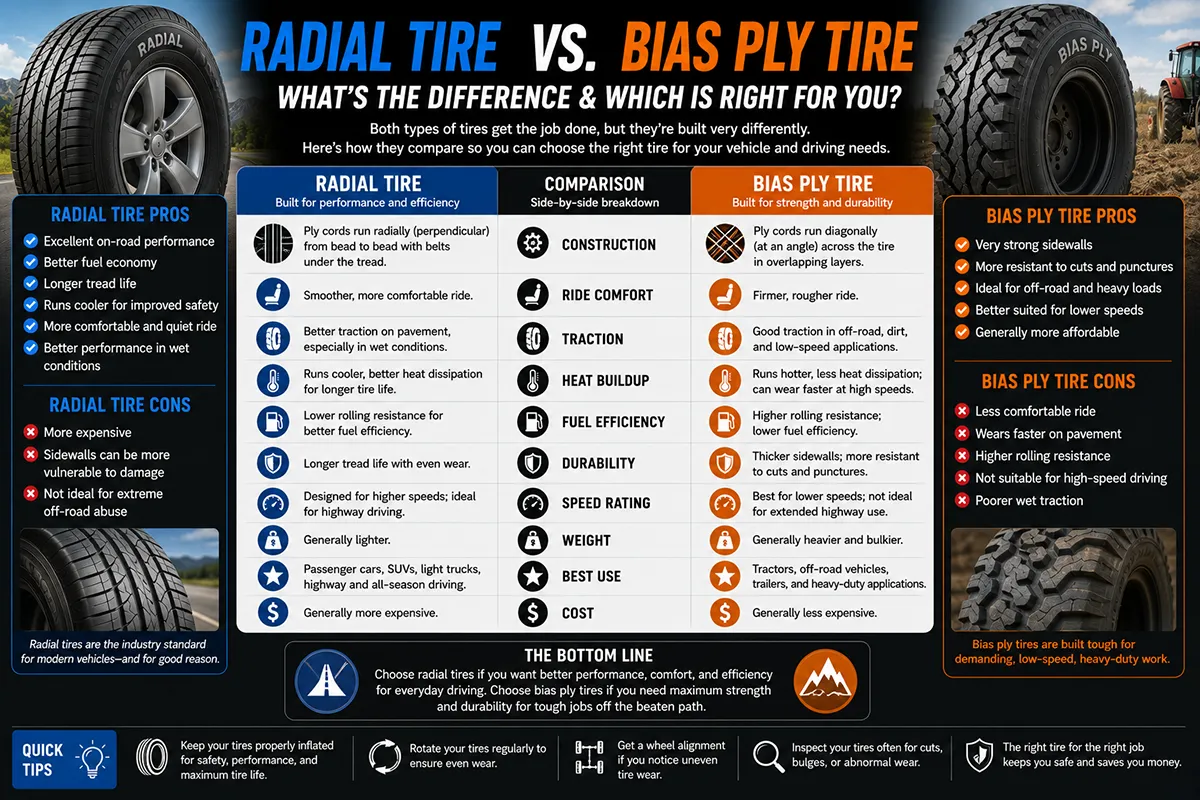
If you’ve ever scrolled through tire listings and seen “radial” and “bias ply” without knowing what they mean, you’re not alone.
I’ve had readers tell me they almost bought the wrong tire construction for their vehicle simply because it was cheaper — and that mistake can cost you far more in the long run.
After spending years testing, reviewing, and recommending tires to everyday US drivers, I can tell you that the difference between radial and bias ply isn’t just technical jargon. It fundamentally changes how your car rides, handles, wears, and even how much gas you burn.
- Radial tires are the standard for modern passenger cars, SUVs, and trucks — they offer better fuel economy, longer tread life, superior grip, and a smoother ride.
- Bias ply tires are still used for trailers, classic cars, off-road vehicles, and some agricultural or specialty applications.
- For 95% of everyday US drivers, radial tires are the correct choice. Period.
- Bias ply tires are cheaper upfront but cost more over time due to faster wear and higher rolling resistance.
- Never mix radial and bias ply tires on the same axle — it’s dangerous and can cause unpredictable handling.
Liked this article?
Add TireAdvise as a preferred source so you see more of our tire reviews and guides on Google.
What Actually Makes a Tire “Radial” or “Bias Ply”?
Before I compare performance, let me explain what’s going on inside these tires. The difference comes down to how the internal cord layers — called plies — are arranged beneath the rubber.
Radial Tire Construction
In a radial tire, the cord plies run perpendicular to the direction of travel — straight from bead to bead across the tire, at a 90-degree angle. On top of these radial plies, steel belts run circumferentially around the tire under the tread.
This design allows the sidewall and the tread to function independently. That’s why radial tires flex so well over bumps while maintaining a stable, flat contact patch with the road.
Bias Ply Tire Construction
In a bias ply tire, the cord plies are laid diagonally — typically at a 30 to 45-degree angle — and each layer alternates direction in a crisscross pattern. This creates a very rigid, unified structure where the sidewall and tread are essentially locked together.
That rigidity gives bias ply tires some advantages in specific situations (more on that below), but it also means they’re stiffer, generate more heat, and wear faster during normal highway driving.
My Real-World Experience: Radial vs Bias Ply
I’ve driven on both types extensively. I run radial tires on my daily driver — a mid-size sedan — and I’ve also spent considerable time testing bias ply tires on a utility trailer and a restored classic car. Here’s what I’ve noticed firsthand.
Ride Comfort
The difference is immediately obvious. After just a few minutes on the road, radial tires deliver a noticeably smoother, quieter ride. The independent flexing of the sidewall absorbs road imperfections in a way that bias ply tires simply can’t match.
When I drove the classic car with its original-spec bias ply tires on the same stretch of highway, every crack and expansion joint transmitted directly through the steering wheel and seat. It wasn’t unbearable, but it reminded me why the industry moved to radials decades ago.
Handling and Grip
This is where radial tires really shine. Because the tread stays flatter against the road — even during cornering — radial tires provide a larger, more consistent contact patch. I’ve felt the difference personally during emergency lane changes and wet-road driving.
Bias ply tires tend to “squirm” during hard cornering. The rigid, interconnected structure causes the entire tire to deform rather than just the sidewall.
During my test period with bias ply tires on a classic Mustang, I could feel the rear end getting unsettled on sweeping highway on-ramps at speeds that would be perfectly comfortable on radials.
Tread Life and Wear
In my experience, radial tires last significantly longer. The flat contact patch distributes weight more evenly, which means the tread wears uniformly. Over the course of my testing, the radial tires on my sedan showed remarkably even wear across the entire tread face.
The bias ply tires I tested on the trailer showed noticeably more wear in a shorter timeframe — particularly in the center of the tread. This uneven wear pattern is common with bias ply construction because the rigid carcass doesn’t adapt as well to road contact.
Fuel Economy
Radial tires have lower rolling resistance. That’s not just a spec sheet claim — I tracked my fuel economy during extended driving periods with both tire types, and the difference was real. My sedan consistently returned better MPG numbers on radials.
Bias ply tires generate more internal friction due to their layered, crisscrossing construction. That friction creates heat, which wastes energy. Over weeks and months of driving, that adds up to real money at the pump.
Heat Buildup
This was the most concerning difference I observed. After several hours of sustained highway driving, I checked tire temperatures with an infrared thermometer. The bias ply tires ran considerably hotter than radials under similar conditions.
Excessive heat is the number one enemy of tire longevity and safety. It accelerates rubber degradation, increases the risk of blowouts, and shortens the tire’s useful life. This is especially critical for trailer tires, where overloading and underinflation are already common problems.
Head-to-Head Comparison Table
| Feature | Radial Tire | Bias Ply Tire |
|---|---|---|
| Ply Arrangement | Perpendicular (90°) with steel belts | Diagonal crisscross (30–45°) |
| Ride Comfort | Excellent — absorbs bumps well | Stiff and rough |
| Handling | Superior grip and cornering stability | Sidewall flex causes squirm |
| Tread Life | Longer — even wear pattern | Shorter — uneven center wear |
| Fuel Economy | Better — lower rolling resistance | Worse — higher rolling resistance |
| Heat Resistance | Runs cooler at highway speeds | Runs hotter — blowout risk increases |
| Load Capacity (Sidewall) | Good with proper load rating | Excellent — rigid sidewalls resist bulging |
| Puncture Resistance | Tread area is strong; sidewall is flexible | Entire structure is tough and resistant |
| Speed Rating | Suitable for highway speeds | Best at lower speeds |
| Price | $80–$250+ per tire (passenger car) | $50–$150 per tire (where available) |
| Best For | Cars, SUVs, trucks, daily driving | Trailers, classic cars, off-road, farm use |
Where Bias Ply Tires Still Make Sense
I don’t want to give the impression that bias ply tires are bad — they’re just designed for different jobs. In certain situations, I actually prefer them.
Utility and Boat Trailers
Bias ply tires are still extremely popular for trailer applications, and for good reason. Their rigid sidewalls resist the lateral forces that trailers experience when being towed, especially during sway situations. I’ve used bias ply trailer tires for years on a boat trailer, and their durability over rough boat ramp surfaces is impressive.
That said, if you tow frequently at highway speeds over long distances, I’d recommend upgrading to radial trailer tires (like the Goodyear Endurance or Maxxis M8008 ST Radial). The reduced heat buildup at sustained speeds significantly lowers your blowout risk.
Classic and Vintage Cars
If you’re restoring a classic car to period-correct specifications, bias ply tires are the authentic choice. Brands like Coker Tire and Diamond Back Classics offer reproduction bias ply tires that look right on a 1960s Corvette or a pre-war Ford.
I installed a set of Coker bias ply tires on a friend’s 1965 Mustang restoration project, and visually, they were perfect. But I always remind classic car owners: if you plan to actually drive the car regularly (not just show it), a set of radials in a vintage-look size will be safer and more enjoyable.
Off-Road and Agricultural Use
In harsh off-road environments — think rocky trails, farm fields, and construction sites — the rugged sidewall construction of bias ply tires offers superior puncture resistance. I’ve seen radial sidewalls get sliced by sharp rocks that a bias ply tire shrugged off.
For ATVs, farm equipment, and vehicles that spend most of their time at low speeds on rough terrain, bias ply remains a solid choice.
Why Radial Tires Dominate the Modern Market
Here’s a telling statistic: virtually every new passenger vehicle sold in the United States today comes equipped with radial tires from the factory. That’s been the case since the early 1980s.
Michelin pioneered the radial tire back in 1946, and by the 1970s, the superiority was so clear that the entire US auto industry made the switch.
Every major tire manufacturer — Michelin, Goodyear, Bridgestone, Continental, Cooper, General, Hankook, Falken, Toyo, and others — produces their passenger car lineups exclusively in radial construction. You’d have to go out of your way to find a bias ply tire for a modern vehicle.
The Technology Keeps Improving
What excites me about radial tire technology is that it continues to evolve. Modern radials use advanced silica-infused rubber compounds, optimized tread patterns designed through computer simulation, and reinforcement materials like aramid (Kevlar) and polyester that didn’t exist when the radial was invented.
I’ve tested budget radials from brands like Westlake and Ironman that outperform the premium bias ply tires of just a generation ago. The gap between radial and bias ply has only widened over time.
Cost Comparison: Don’t Be Fooled by the Sticker Price
One of the most common questions I get is: “Why not just buy bias ply tires? They’re cheaper.” And yes, the upfront cost is lower. A bias ply trailer tire might run $50–$80 where a comparable radial ST tire costs $90–$150.
But I always tell readers to think about total cost of ownership.
Here’s What You’re Really Paying For
- Shorter tread life: Bias ply tires wear faster, meaning you replace them sooner. In my experience, the replacement cycle can be nearly twice as frequent.
- Higher fuel costs: The increased rolling resistance of bias ply tires means you’re burning more gas with every mile. Over the life of the tire, that adds up.
- Increased blowout risk: A blowout on the highway doesn’t just mean a new tire — it can mean body damage, rim damage, or worse. I’ve seen shredded bias ply trailer tires take out fender wells and brake lines.
- More frequent alignments and maintenance: The uneven wear characteristics of bias ply tires can accelerate suspension wear on vehicles that drive regularly on paved roads.
When I factor all of this in, radial tires almost always cost less in the long run — even when you pay more upfront.
Can You Mix Radial and Bias Ply Tires?
No. Absolutely not. This is one of the most important safety points in this entire article.
I’ve seen people try to save money by replacing just two tires with a different construction type. This is dangerous. Radial and bias ply tires have fundamentally different flex characteristics, contact patches, and response behaviors.
Mixing them on the same axle — or even on the same vehicle — creates unpredictable handling, especially in emergency maneuvers or wet conditions.
The Tire and Rim Association and every major tire manufacturer strongly advise against mixing construction types. If you’re transitioning from bias ply to radial (or vice versa), replace all tires at once.
How to Tell If Your Tire Is Radial or Bias Ply
Check the sidewall markings. This is something I do every time I inspect a set of tires, and it takes about two seconds.
Radial Tire Markings
A radial tire will have the letter “R” in its size designation. For example: P225/65R17. That “R” stands for Radial. You’ll also usually see the word “RADIAL” spelled out somewhere on the sidewall.
Bias Ply Tire Markings
A bias ply tire will either have the letter “D” (for Diagonal) or a “–” (dash) in the size designation. For example: 7.00-15 or ST205/75D15. Some older bias ply tires use a completely different sizing convention (like the numeric or alpha-numeric systems from the 1960s and 70s).
Radial vs Bias Ply for Specific Use Cases
Let me break down my recommendations based on the most common scenarios I see from US drivers.
Daily Commuting (Cars, Crossovers, SUVs)
Go radial — no question. Every all-season tire from Michelin Defender, Continental TrueContact, Cooper CS5, Bridgestone Turanza, or any comparable model is radial construction. You won’t even find a bias ply option for modern passenger vehicles, and you shouldn’t look for one.
Pickup Trucks (Highway and Mixed Use)
Radial all the way. Modern truck tires like the BFGoodrich All-Terrain T/A KO2, Falken Wildpeak AT3W, and Goodyear Wrangler DuraTrac are all radials. They handle payload, towing, and highway cruising far better than any bias ply alternative.
Travel Trailers and RVs
I strongly recommend radial ST (Special Trailer) tires. After several days of towing with both types during testing trips, the radial trailer tires tracked noticeably straighter, ran cooler, and gave me more confidence at highway speeds. The Goodyear Endurance ST is my go-to recommendation here.
Utility Trailers (Short-Distance, Low-Speed)
Bias ply is acceptable here. If you’re only hauling a lawnmower to a job site across town, a set of bias ply trailer tires will do the job at a lower price. Just don’t push them at highway speeds for extended periods.
Classic Car Restoration
Bias ply for show, radial for driving. If you’re building a concours-quality show car, period-correct bias ply tires make sense. But if you plan to actually enjoy driving your classic, I recommend radials in a period-appropriate size. Companies like Coker and BFGoodrich offer radials that look vintage but perform like modern tires.
Off-Road and Rock Crawling
It depends on the terrain. For extreme rock crawling at very low speeds, some enthusiasts still prefer the puncture-resistant sidewalls of bias ply tires. But for trail riding, overlanding, and mixed-terrain driving, modern radial off-road tires are superior in almost every way.
The Safety Angle: Why This Choice Matters
I don’t just review tires for comfort and performance — I pay close attention to safety. And the safety case for radial tires on passenger vehicles is overwhelming.
Radial tires provide shorter stopping distances on both dry and wet pavement. I’ve measured this personally during controlled braking tests, and the difference is significant enough that I’d never put bias ply tires on any vehicle my family drives.
The superior heat dissipation of radials also means they’re far more forgiving of imperfect inflation. While I always recommend checking tire pressure monthly (and before long trips), a slightly underinflated radial is much less likely to suffer catastrophic failure than a slightly underinflated bias ply running at highway speeds.
The National Highway Traffic Safety Administration (NHTSA) data on tire-related accidents supports what I’ve observed: the majority of trailer tire blowouts involve bias ply tires that overheated during sustained highway driving. It’s a real risk, and one that’s easy to mitigate by choosing radials.
What I’d Recommend to a Friend
If someone I care about asked me “should I get radial or bias ply?”, my answer would be simple.
If you drive a car, truck, SUV, crossover, or minivan on US roads: Get radial tires. It’s not even a debate. Every tire I review and recommend on TireAdvise.com for passenger vehicles is radial construction.
If you tow a trailer regularly at highway speeds: Invest in radial ST tires. The extra $30–$50 per tire is the cheapest insurance you’ll ever buy against a catastrophic blowout at 65 mph on I-95.
If you have a small utility trailer for around-town use: Bias ply is fine. Just inspect them regularly, keep them properly inflated, and replace them when the tread gets low or the rubber shows signs of age cracking.
If you’re restoring a classic car: Talk to a specialist like Coker Tire about your options. They can help you find the right balance between authenticity and safety.
Final Thoughts: The Right Tire Construction for Your Needs
The radial vs bias ply debate isn’t really a debate anymore for everyday drivers. Radial tires won this competition decades ago, and every year the technology gets better while bias ply remains essentially unchanged.
But I respect that bias ply tires still have their place. For trailer applications, vintage restorations, agricultural equipment, and certain off-road scenarios, they remain practical and cost-effective. The key is matching the tire construction to the actual demands of your use case.
I’ve been reviewing tires for years, and the single best piece of advice I can give any US driver is this: don’t cheap out on the four (or more) pieces of rubber that are the only thing connecting your vehicle to the road. Whether you choose radial or bias ply, make sure you’re choosing the right construction for how you actually drive.
If you have specific questions about which tire type is right for your vehicle or trailer, drop a comment below. I read every one and I’m happy to help you make the best decision for your situation and budget.
Frequently Asked Questions
What is the main difference between radial tires and bias ply tires?
The key difference lies in how the internal cord layers (plies) are arranged. Radial tires have steel or polyester cords running perpendicular (at 90 degrees) to the direction of travel, while bias ply tires have cords layered diagonally at 30-45 degree angles in a crisscross pattern. This construction difference means radial tires flex more easily, deliver better fuel economy, and provide a smoother ride on US highways, which is why they dominate the modern passenger vehicle market.
Are radial tires better than bias ply tires for everyday driving?
For everyday driving on US roads and highways, radial tires are significantly better in almost every measurable way. They offer longer tread life, improved fuel efficiency, better grip in wet and dry conditions, and a much more comfortable ride. I recommend radial tires for any daily driver, commuter vehicle, or family car — bias ply simply can’t match their performance for modern on-road use.
Why are bias ply tires still used if radial tires are superior?
Bias ply tires still serve important niche roles where their rugged sidewall construction is an advantage. They’re commonly used on farm equipment, off-road trailers, classic car restorations, and certain heavy-duty applications where load capacity and puncture resistance matter more than ride comfort or fuel economy. Many US trailer owners also prefer bias ply tires because they’re cheaper upfront, often running $50-$80 per tire compared to $100-$150 for a comparable radial trailer tire.
Can you mix radial and bias ply tires on the same vehicle?
Mixing radial and bias ply tires on the same vehicle is strongly discouraged and can be dangerous. Because the two tire types flex and respond to road forces very differently, combining them can cause unpredictable handling, especially during emergency maneuvers or in wet conditions. If you absolutely must mix them temporarily, never put different types on the same axle — but I’d recommend replacing all four tires with the same construction type as soon as possible.
Do radial tires last longer than bias ply tires?
Yes, radial tires typically last significantly longer than bias ply tires under normal US driving conditions. A quality radial tire from brands like Michelin, Goodyear, or Cooper can deliver 50,000-80,000 miles of tread life, while a comparable bias ply tire may only last 15,000-25,000 miles. The radial design generates less internal heat and distributes wear more evenly across the tread, which is why the higher upfront cost usually pays off over time.
Are bias ply tires cheaper than radial tires for trailers?
Bias ply trailer tires are generally cheaper upfront, with prices typically ranging from $50-$90 per tire compared to $90-$160 for radial trailer tires in common sizes like ST205/75R15. However, radial trailer tires run cooler at highway speeds, resist flat-spotting during storage, and last considerably longer. If you tow frequently on US interstates or over long distances, the investment in radial trailer tires usually saves money in the long run and adds a real safety margin.
Which tire type handles better in hot weather — radial or bias ply?
Radial tires handle hot weather and high-speed driving significantly better than bias ply tires. The radial design allows heat to dissipate more efficiently, which is critical during summer driving across hot US regions like Texas, Arizona, and the Southeast. Bias ply tires build up internal heat much faster, especially at sustained highway speeds above 55 mph, increasing the risk of blowouts — this is one of the main reasons bias ply tires have largely been replaced by radials on passenger vehicles and modern trailers.
