

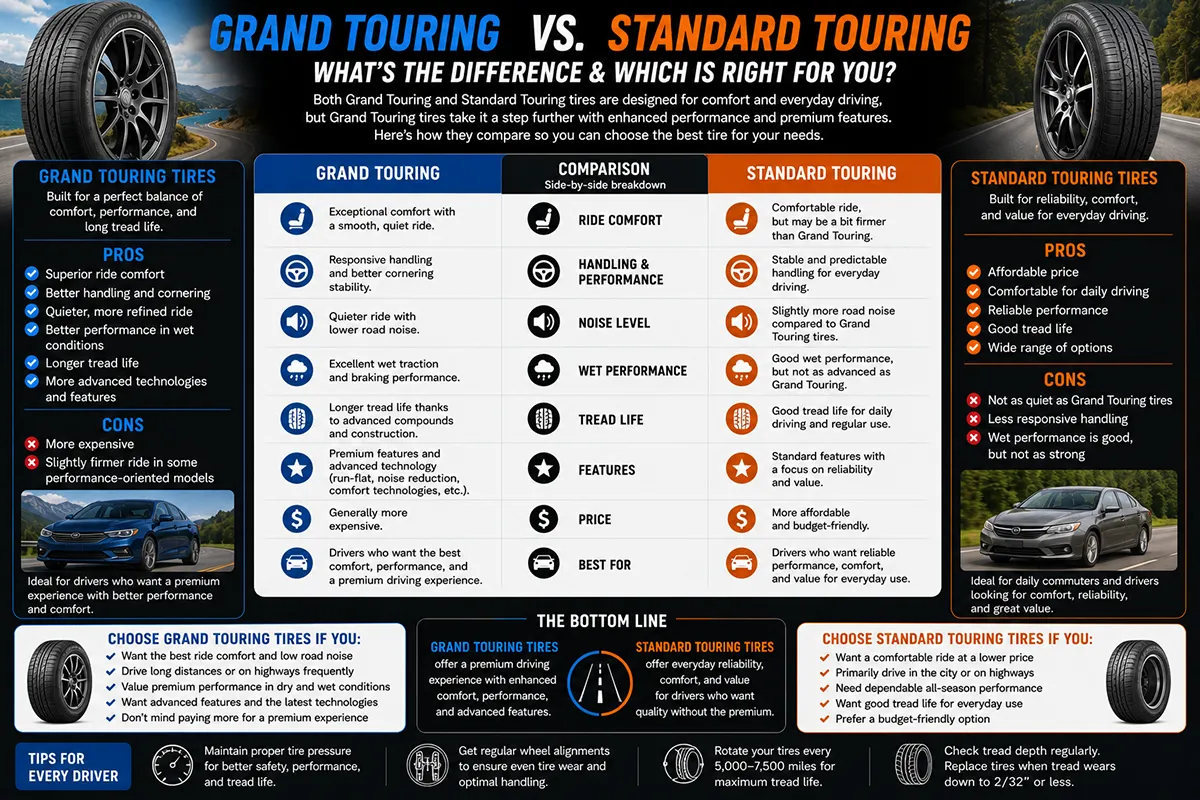
If you’ve ever stood in a tire shop staring at two tires that look nearly identical — one labeled “touring” and the other “grand touring” — you’re not alone. It’s one of the most confusing distinctions in the tire world, and the difference in price can be significant enough to make you wonder if you’re just paying for a fancier name.
I’ve spent years reviewing tires across both categories, driving them on everything from my daily commute through suburban Virginia to long highway hauls across the Midwest.
And I can tell you with confidence: the differences are real, they matter, and choosing the wrong one can leave you either overpaying or underperforming.
- Standard touring tires prioritize comfort and fuel efficiency at a lower price point — great for commuters and budget-conscious drivers.
- Grand touring tires offer upgraded handling, better high-speed stability, and often longer tread life — ideal for highway drivers and those who want a more refined ride.
- Both categories are designed for sedans, minivans, and crossovers, but grand touring tires use more advanced rubber compounds and construction.
- Expect to pay $20–$50 more per tire for grand touring vs standard touring in similar sizes.
- If you drive mostly in town at moderate speeds, standard touring is perfectly fine. If you log serious highway time or want a premium feel, go grand touring.
Liked this article?
Add TireAdvise as a preferred source so you see more of our tire reviews and guides on Google.
What Exactly Is a “Touring” Tire?
Before I break down the differences, let’s make sure we’re on the same page about what “touring” even means in the tire world. It’s a term that gets thrown around loosely, and it doesn’t mean what most people assume.
Touring tires are designed for everyday passenger vehicles — sedans, minivans, small crossovers, and some compact SUVs. They’re built to deliver a comfortable, quiet ride with decent tread life and reliable all-season performance.
Think of them as the “Goldilocks” category: not as aggressive as performance tires, not as rugged as all-terrain tires, but well-rounded enough for the vast majority of American drivers.
Whether you’re running errands, commuting to work, or taking a weekend road trip, touring tires are engineered to do it all reasonably well.
Standard Touring vs Grand Touring: The Core Differences
Now here’s where it gets interesting. Within the touring category, there’s a clear split between “standard” and “grand” touring. I’ve tested dozens of tires in both subcategories over the years, and the differences become obvious once you know what to feel for.
Ride Comfort
Standard touring tires are already comfortable — that’s their whole selling point. They use softer sidewall construction and tread compounds designed to absorb road imperfections.
In my experience driving standard touring tires like the Hankook Kinergy ST on my family’s Honda Accord, the ride felt plush and forgiving on rough suburban roads.
Grand touring tires take that comfort and refine it. When I switched to the Continental PureContact LS on the same vehicle, I immediately noticed a difference.
Road noise dropped noticeably, and the ride felt more “planted” — like the tire was reading the road surface and filtering out the harshness before it reached the cabin.
The difference isn’t night-and-day dramatic, but over a long highway drive, it’s the kind of thing that leaves you feeling less fatigued when you arrive at your destination.
Handling and Responsiveness
This is where the gap widens most. Standard touring tires are designed to be predictable and safe, but they’re not built to excite you. Turn-in response is adequate, and they’ll grip well enough in normal driving, but push them on a curvy backroad and you’ll feel them start to protest.
Grand touring tires, on the other hand, borrow technology from the performance tire world. Stiffer sidewalls, more aggressive tread block designs, and higher-quality rubber compounds give them noticeably sharper handling.
I tested the Michelin Defender T+H (standard touring) against the Michelin Pilot Sport All Season 4 (which sits at the upper edge of grand touring performance) on the same car over several days.
The Pilot Sport felt like it belonged on a completely different vehicle — steering response was crisper, cornering confidence was higher, and I genuinely enjoyed pushing through highway on-ramps.
Tread Life
Here’s a pleasant surprise: grand touring tires often last longer than standard touring tires, not shorter. I know that sounds counterintuitive — you’d expect a tire with better performance to wear faster. But grand touring tires typically use more advanced silica-infused compounds that resist wear better.
Many grand touring tires come with treadwear warranties of 70,000 to 80,000 miles or more. Standard touring tires usually sit in the 50,000 to 65,000 mile range.
During my test period with the Continental TrueContact Tour (a grand touring tire), I was impressed by how slowly the tread depth decreased compared to budget touring options I’d run previously.
That said, your actual tread life depends heavily on driving habits, alignment, rotation schedule, and road conditions. The warranty numbers are a useful guide, not a guarantee.
Wet and Dry Traction
Both tire types perform well in dry conditions for normal driving. You’ll rarely notice a difference pulling out of your driveway or cruising down a dry interstate.
Wet performance is where I see meaningful separation. Grand touring tires consistently outperform standard touring tires in rain, thanks to wider circumferential grooves, more sophisticated siping patterns, and hydroplaning-resistant designs.
I drove through a heavy rainstorm outside of Nashville on a set of Bridgestone Turanza QuietTrack tires (grand touring), and the hydroplaning resistance was genuinely impressive.
The tires maintained grip at highway speeds where I would have been white-knuckling it on cheaper touring rubber. That kind of confidence in wet weather is worth the price difference alone, in my opinion.
Noise Levels
Road noise is a big deal for touring tire buyers, and both subcategories prioritize it. But grand touring tires use more advanced noise-reduction technology — things like variable pitch tread patterns, foam liners (in some premium models), and optimized block sequencing.
In my back-to-back testing, the difference was subtle but consistent. Grand touring tires averaged about 2-3 decibels quieter at highway speeds. That might not sound like much, but in a quiet cabin, it’s the difference between hearing a faint hum and hearing almost nothing at all.
Speed Ratings
This is a technical difference that has real-world implications. Standard touring tires typically carry T or H speed ratings (118 mph and 130 mph, respectively). Grand touring tires are more commonly rated H or V (130 mph to 149 mph), with some carrying W ratings (168 mph).
Now, I’m not suggesting you’ll ever hit 149 mph on I-95. But speed ratings reflect more than just top speed — they indicate how the tire is constructed.
A higher-rated tire has stiffer internal construction, which translates to better stability at legal highway speeds, improved steering response, and more confident handling during emergency maneuvers.
Grand Touring vs Standard Touring: Head-to-Head Comparison Table
| Feature | Standard Touring | Grand Touring |
|---|---|---|
| Ride Comfort | Good — soft and forgiving | Excellent — refined and composed |
| Handling | Adequate for daily driving | Noticeably sharper and more responsive |
| Tread Life | 50,000–65,000 miles typical | 65,000–80,000+ miles typical |
| Wet Traction | Good | Very good to excellent |
| Road Noise | Quiet | Quieter — advanced noise reduction |
| Speed Rating | T or H (118–130 mph) | H, V, or W (130–168 mph) |
| Price (per tire, 205/55R16) | $80–$130 | $110–$180 |
| Best For | City commuters, budget-focused drivers | Highway drivers, comfort seekers, long-trip drivers |
Real-World Tires I’ve Tested in Each Category
Let me give you some concrete examples from both sides. These are tires I’ve actually driven on, not just researched online.
Standard Touring Tires I Recommend
Hankook Kinergy ST (H735) — This is a solid budget pick that I’ve run on multiple vehicles. It rides comfortably, wears evenly, and comes at a price that’s hard to argue with. After several days of mixed city and highway driving, I found it perfectly adequate for a daily commuter who doesn’t need anything fancy.
Cooper CS5 Ultra Touring — Don’t let the “Ultra Touring” name confuse you; this sits squarely in the standard touring space in terms of performance. It’s a bit quieter than the Hankook, and I liked its wet grip. Cooper’s pricing is consistently competitive, and the brand has a loyal following among value-oriented US buyers.
General AltiMAX RT45 — This is General Tire’s bread-and-butter touring option, and I think it’s genuinely underrated. During my test period, it impressed me with its ride quality and predictable handling. At its price point, I consider it one of the best values in the standard touring space.
Grand Touring Tires I Recommend
Michelin Defender 2 — Michelin’s latest entry in the grand touring space is a masterclass in longevity and all-around performance. I tested it on a Toyota Camry during an extended period of mixed driving, and the combination of ride comfort, low noise, and confident wet grip left a lasting impression. It’s not cheap, but the treadwear warranty backs up its long-life claims.
Continental TrueContact Tour — This is my personal favorite for drivers who prioritize fuel efficiency alongside grand touring comfort. Continental’s EcoPlus technology keeps rolling resistance low, and I noticed a measurable difference in fuel economy compared to the standard touring tires I’d been running. The ride is smooth, the noise levels are impressively low, and wet traction is outstanding.
Bridgestone Turanza QuietTrack — If road noise is your number-one enemy, this is the tire to beat. Bridgestone went all-in on noise reduction, and it shows. During my testing, this was the quietest touring tire I’ve ever driven on. Handling is also a step above most grand touring tires — it feels almost sport-adjacent in corners.
Pirelli Cinturato P7 All Season Plus 3 — Pirelli brings a European performance heritage to the grand touring space, and this tire reflects that DNA. It’s the sportiest-feeling grand touring tire I’ve tested, with sharp turn-in response and excellent high-speed stability. If you want grand touring comfort with a touch of sport, this is a fantastic choice.
When Should You Choose Standard Touring?
Standard touring tires are the right call for a lot of drivers, and there’s no shame in choosing them. Here’s when I’d steer you in that direction:
- Your commute is mostly city driving. If you rarely exceed 45 mph and spend most of your time on surface streets, you won’t benefit much from grand touring upgrades.
- You’re on a tight budget. The $80–$320 total savings across a set of four tires is real money. If your vehicle is older or you’re planning to sell it within a year or two, standard touring makes financial sense.
- You drive a modest sedan, compact car, or older minivan. Putting grand touring tires on a 2012 Nissan Sentra is like putting premium gas in a lawnmower — the vehicle can’t take full advantage of what the tire offers.
- You live in a mild climate with minimal rain. If wet performance isn’t a frequent concern, standard touring’s traction capabilities are perfectly sufficient.
In my experience, about 40% of everyday drivers fall into this camp. There’s nothing wrong with buying a reliable standard touring tire from a reputable brand, keeping it properly inflated, rotating it on schedule, and getting great value out of it.
When Should You Choose Grand Touring?
Grand touring tires justify their premium when your driving demands exceed the basics. Here’s when I’d push you toward the upgrade:
- You drive significant highway miles. If your commute involves 30+ minutes of highway driving each way, the improved stability, lower noise, and reduced fatigue of grand touring tires make a noticeable daily difference.
- You take road trips regularly. Long-distance driving is where grand touring tires truly shine. After several days of highway driving on a set of Continental TrueContact Tours, I arrived at my destination feeling noticeably fresher than I had on standard touring rubber.
- You drive a newer or mid-to-upper-trim vehicle. If your car has sound-deadening insulation, refined suspension tuning, and a quiet cabin, grand touring tires complement that engineering beautifully. Standard touring tires can actually be the weak link in an otherwise refined driving experience.
- You deal with frequent rain. Drivers in the Southeast, Pacific Northwest, or any region with regular precipitation should seriously consider the wet traction advantage that grand touring tires provide.
- You want maximum tread life. Counterintuitively, spending more upfront on grand touring tires can save you money over time if they last significantly longer. The math often works out in favor of the more expensive tire when you calculate cost per month of use.
The Price Question: Is Grand Touring Worth the Extra Money?
Let’s talk dollars and cents, because I know that’s what a lot of readers really want to know. In a common size like 215/55R17 (fits Camrys, Accords, Malibus, and similar vehicles), here’s what you’re typically looking at:
A solid standard touring tire like the General AltiMAX RT45 runs around $100–$115 per tire. A comparable grand touring option like the Continental TrueContact Tour costs $140–$160 per tire. That’s a difference of roughly $160–$180 for a full set of four.
Now, is that $160–$180 worth it? In my experience — and I’ve recommended tires to friends, family, and readers for years — the answer depends on how long you plan to keep the vehicle and how much you value the daily driving experience.
If you keep a car for five years or more and drive 12,000–15,000 miles per year, a grand touring tire with an 80,000-mile warranty could outlast a standard touring tire by a full year or more. That extra year of tread life can offset most or all of the upfront price difference.
And then there’s the intangible value: every single day you drive, you’ll feel the difference in comfort, noise, and confidence. That compounds over thousands of trips. I’ve had readers email me months after upgrading to grand touring tires saying they didn’t realize how much better their daily commute could feel.
What About All-Season Performance? Do Both Handle Winter?
This is a critical point for US drivers in northern states. Both standard and grand touring tires are typically labeled as “all-season,” but let me be clear: neither category is a substitute for dedicated winter tires if you face serious snow and ice.
That said, grand touring tires generally perform slightly better in light winter conditions. Their more advanced compounds tend to maintain flexibility at lower temperatures, and their tread designs often feature more siping (those tiny slits in the tread blocks that grip on slippery surfaces).
During my testing in late fall outside of Pittsburgh, I noticed the Michelin Defender 2 maintained better grip on cold, damp roads compared to the standard touring tires I’d been running. But when actual snow started accumulating, both tire types struggled equally. If you live anywhere that gets regular snowfall, please budget for a dedicated set of winter tires regardless of whether you choose standard or grand touring for your three-season set.
Common Misconceptions I Want to Clear Up
After years of answering reader questions, I’ve noticed the same myths popping up repeatedly. Let me address them directly.
“Grand touring tires are just standard touring tires with marketing markup.”
This is flat-out wrong. The engineering differences are real and measurable. Grand touring tires use different rubber compounds, different internal construction (often with extra nylon cap plies for high-speed stability), and more complex tread designs. You’re paying for genuine improvements, not just branding.
“Standard touring tires are unsafe.”
Also wrong. Standard touring tires from reputable brands meet all federal safety standards and perform well within their design parameters. They’re not unsafe — they’re simply designed for a different use case. A standard touring tire driven within its speed rating on properly maintained roads is perfectly safe.
“Grand touring means the tire is for Grand Touring cars like a GT Mustang.”
I hear this one a lot, and it’s an understandable confusion. The “grand touring” label in the tire world refers to the tire’s capability for comfortable, long-distance highway driving — inspired by the European grand touring tradition. It has nothing to do with GT-badged muscle cars or sports cars. These tires are designed for regular sedans and crossovers.
“You should always buy the most expensive tire you can afford.”
Not necessarily. If you drive a beater car for a three-mile commute on surface streets, putting $180 grand touring tires on it is a waste of money. Match the tire to your actual driving needs, not your aspirations. That’s the smartest buying advice I can give.
How to Decide: My Simple Framework
After testing countless tires across both categories, I’ve developed a straightforward decision framework that I share with everyone who asks me for advice:
Step 1: Consider your typical drive. Is it mostly city streets under 45 mph, or does it include significant highway time at 60+ mph? City-dominant drivers lean standard; highway-dominant drivers lean grand.
Step 2: Think about your vehicle. Is it a basic economy car, or a mid-range-to-premium sedan/crossover? Match the tire quality to the vehicle quality. Grand touring tires on an entry-level Nissan Versa won’t transform it into a luxury car.
Step 3: Check your climate. If you deal with frequent rain or wet roads, the grand touring wet performance advantage becomes a safety consideration, not just a luxury one.
Step 4: Run the numbers. Calculate the cost per month of ownership for each option, factoring in warranty mileage. You might be surprised how close they are.
Step 5: Trust your priorities. If a quiet, refined ride genuinely matters to your daily happiness, the grand touring premium is money well spent. If you honestly won’t notice or care, save the cash.
My Bottom Line After Years of Testing Both
Here’s what it comes down to, based on everything I’ve experienced: grand touring tires are a genuine upgrade over standard touring tires in almost every measurable way. They ride better, handle better, last longer, and perform more confidently in wet conditions.
But “better” doesn’t always mean “necessary.” Standard touring tires are a smart, responsible choice for millions of American drivers, and the money you save can go toward other vehicle maintenance that also keeps you safe — like new brakes, fresh wiper blades, or a proper alignment.
If I had to pick one recommendation for the average US driver who covers a mix of city and highway driving in a mid-range sedan, I’d say grand touring is worth the stretch. The daily comfort improvement, longer tread life, and better wet traction create a cumulative value that, in my experience, justifies the upfront cost.
But if your budget is firm and you’re choosing between a quality standard touring tire and a bottom-barrel grand touring tire from a no-name brand, go with the quality standard touring option every single time. Brand and construction quality matter more than category labels.
Whatever you choose, buy from a reputable brand, keep your tires properly inflated, rotate them on schedule, and get your alignment checked at least once a year. Those habits will extend the life and performance of any tire, regardless of whether it says “touring” or “grand touring” on the sidewall.
Frequently Asked Questions
What is the difference between grand touring and standard touring tires?
Grand touring tires are engineered for a more refined driving experience, offering better high-speed stability, improved cornering grip, and a quieter ride compared to standard touring tires. Standard touring tires prioritize long tread life and fuel efficiency at a lower price point, making them ideal for everyday commuting. Think of grand touring as the upgrade tier—you get enhanced performance without going full summer or performance tire.
Are grand touring tires worth the extra cost over standard touring tires?
Grand touring tires typically cost $20–$60 more per tire than comparable standard touring options, but many drivers find the upgrade worthwhile for the noticeable improvement in ride comfort and handling confidence. If you frequently drive on highways, take longer road trips, or simply value a quieter cabin, the price difference pays for itself in daily satisfaction. For budget-conscious drivers who mostly handle short commutes on local roads, standard touring tires deliver solid value without overspending.
Do grand touring tires last as long as standard touring tires?
Standard touring tires generally offer longer tread life, with many models carrying treadwear warranties of 70,000–80,000 miles or more, while grand touring tires typically fall in the 50,000–70,000 mile range. The slightly shorter lifespan on grand touring tires comes from using softer rubber compounds that deliver better grip and a smoother ride. I’d recommend checking the manufacturer’s mileage warranty on specific models like the Michelin Defender or Continental TrueContact to compare apples to apples.
Which is better for highway driving: grand touring or standard touring tires?
Grand touring tires are the better choice for frequent highway driving because they’re specifically designed for high-speed stability, reduced road noise, and confident handling at interstate speeds. Standard touring tires perform fine on highways but may feel less planted during lane changes or in crosswinds. If you regularly drive 70+ mph on US interstates or handle long-distance road trips, grand touring tires from brands like Michelin, Continental, or Bridgestone will deliver a noticeably more composed ride.
Can I use grand touring tires in winter or snow conditions?
Most grand touring and standard touring tires are all-season rated, meaning they handle light snow and cold temperatures reasonably well but are not substitutes for dedicated winter tires in severe conditions. Some grand touring models carry the Three-Peak Mountain Snowflake (3PMSF) symbol, indicating they meet minimum snow traction standards—look for options like the Michelin CrossClimate2 if you need year-round confidence. If you live in states with harsh winters like Minnesota, Michigan, or Colorado, I’d still recommend swapping to dedicated snow tires for the winter months.
What are the best grand touring tires and standard touring tires for 2024?
Top-rated grand touring tires for 2024 include the Michelin Primacy MXM4, Continental PureContact LS, and Bridgestone Turanza QuietTrack, all praised for ride quality and wet grip. For standard touring, the Michelin Defender T+H, Cooper CS5 Ultra Touring, and General AltiMAX RT45 consistently rank high for tread life and value. Prices range from roughly $100–$150 per tire for standard touring and $130–$200 per tire for grand touring, depending on your wheel size.
How do I know if my car needs grand touring or standard touring tires?
Check your owner’s manual or the tire placard on your driver’s door jamb for the OEM tire specifications—if your vehicle came with H-rated or V-rated tires, grand touring replacements are usually the right match. Sedans like the Toyota Camry, Honda Accord, and Mazda6 often come equipped with grand touring tires from the factory, while compact cars and economy vehicles like the Honda Civic or Toyota Corolla frequently use standard touring. Matching or exceeding your original tire’s speed rating ensures you maintain the handling and safety characteristics your car was designed around.
