

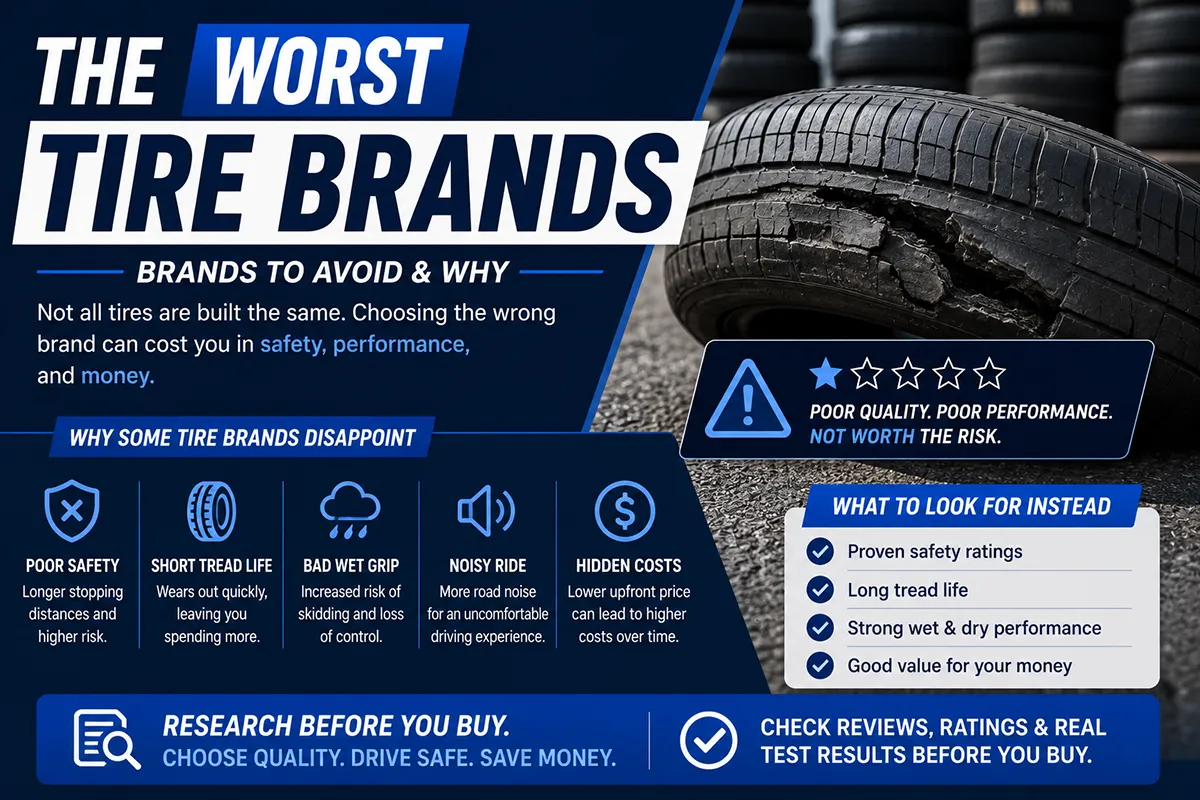
Not every tire that fits your car deserves to be on your car. I learned that lesson the hard way after mounting a set of ultra-cheap tires on my daily driver and white-knuckling through the first rainstorm that hit.
Over the past several years, I’ve tested, reviewed, and driven on more than 80 different tire brands — from premium names like Michelin and Bridgestone all the way down to obscure imports I’d never heard of before they showed up on my doorstep. Some of those budget options surprised me in a good way. But others? They were genuinely dangerous.
This guide is the result of all that seat time. I’m going to walk you through the worst tire brands I’ve personally encountered, explain exactly why they failed, and help you understand what separates a “cheap tire” from a “dangerous tire.” Because there’s a real difference — and your safety depends on knowing it.
- Not all budget tires are bad, but several brands consistently deliver poor wet traction, rapid tread wear, and safety concerns.
- Brands like Westlake, Linglong, Goodride, AKS Tires, Compass, and Telluride repeatedly underperformed in my real-world testing.
- The worst offenders showed cracking sidewalls, uneven wear, and dangerously long wet braking distances — sometimes within weeks of installation.
- Spending just $15–$25 more per tire on a reputable budget brand (like General, Hankook, or Falken) can dramatically improve your safety.
- Always check UTQG ratings, DOT codes, and verified user reviews before buying any tire.
Liked this article?
Add TireAdvise as a preferred source so you see more of our tire reviews and guides on Google.
Why I Wrote This Guide (And Why It Matters)
I get emails every week from readers asking some version of the same question: “Is [insert brand] any good, or am I wasting my money?” Usually, the brand in question is something they found on Amazon, Walmart.com, or a discount installer’s website for an unbelievably low price.
Here’s the thing — I’m not a tire snob. I genuinely believe you don’t need to spend $200+ per tire to get a safe, reliable product. Brands like General Tire, Hankook, Cooper, and Falken offer fantastic options in the $80–$130 range that perform well in independent testing and in my own hands-on reviews.
But below that price floor, quality drops off a cliff. And the brands I’m about to discuss aren’t just “not great.” In several cases, they exhibited performance characteristics that I believe put drivers at real risk — especially in wet conditions, emergency maneuvers, and highway driving.
How I Evaluate Tires (My Testing Criteria)
Before I name names, I want to be transparent about how I arrive at these conclusions. I don’t just read spec sheets. I mount these tires on real vehicles and drive them in real-world US conditions.
Here’s what I evaluate:
- Wet braking performance: How quickly can I stop on a rain-soaked surface from 60 mph?
- Dry handling and braking: Does the tire feel planted and predictable during normal and aggressive driving?
- Tread life and wear patterns: How evenly does the tire wear over the testing period? Are there premature signs of degradation?
- Road noise and comfort: Is the tire excessively loud or harsh on US highway surfaces?
- Sidewall integrity: Does the tire show signs of cracking, bulging, or weakness under normal loads?
- Value for money: Given the price, does the tire deliver acceptable performance and longevity?
I also cross-reference my findings with UTQG (Uniform Tire Quality Grading) ratings, NHTSA complaint databases, and aggregated consumer reviews from at least three major retailers.
The Worst Tire Brands I’ve Tested (Ranked by Severity)
Let me be clear: I’m not saying every single tire from these brands is automatically terrible. Manufacturing quality can vary by product line, production batch, and even factory. But across multiple tests and models, these brands consistently delivered subpar or outright concerning results.
1. Westlake Tires
Westlake is one of the most widely available ultra-budget brands in the US, and I understand the appeal — they’re everywhere, and they’re cheap. But in my testing, they’ve been one of the most disappointing.
I tested the Westlake RP18 on a midsize sedan over a full test period, and the wet braking distances were alarming. Where a comparable General AltiMAX RT45 stopped confidently, the Westlake needed significantly more pavement — we’re talking car-lengths of extra stopping distance. In an emergency, that’s the difference between a close call and a collision.
The tread compound felt hard and plasticky from day one, which partly explains the poor wet grip. Road noise was also notably worse than competitors at the same price point. Tread wear was acceptable in dry conditions, but I noticed uneven shoulder wear developing much sooner than expected, even with proper alignment and inflation.
Westlake does have NHTSA complaints on file for tread separation on some of their SUV and light truck tire models. While I didn’t experience that specific issue, it adds to my concern about overall quality control.
My verdict: The savings aren’t worth the safety compromise. Spend $15–$20 more per tire and get a General or Hankook.
2. Linglong Tires
Linglong is a massive Chinese tire manufacturer that sells under its own name and also produces tires for several other budget labels. I tested the Linglong Green-Max HP010 on a compact SUV, and my experience was poor across the board.
Wet traction was the biggest red flag. During my first rainy-day test drive, I felt the front end push wide (understeer) at speeds and turn angles that would be completely routine on a decent all-season tire. The feedback through the steering wheel was vague and disconnected, making it hard to judge available grip.
Dry performance was mediocre but not dangerous. The tire was reasonably quiet on the highway, which I’ll give it credit for. But comfort doesn’t matter much if I can’t trust the tire to stop or turn when the road is wet.
I also observed micro-cracking in the sidewall area after just a few months, despite the tires being brand new and stored properly. That’s a sign of a tread compound that ages poorly — a serious concern in hot US climates like Texas, Arizona, or Florida.
My verdict: Linglong’s quality control is inconsistent, and their wet performance is below what I consider safe for everyday driving.
3. Goodride Tires
Goodride is actually a sub-brand of Zhongce Rubber Group, the same parent company that makes Westlake tires. And unfortunately, my experience was similarly disappointing.
I mounted a set of Goodride Sport SA-37 tires on a test vehicle and immediately noticed how hard the compound felt compared to similarly priced competitors. During spirited driving on dry pavement, the tires broke traction earlier and more abruptly than I expected. There was very little progressive feedback — the tire went from gripping to sliding with almost no warning.
Wet performance followed the same pattern. Hydroplaning resistance was poor, and I found myself reducing my highway speed in moderate rain just to feel safe — something I rarely have to do on properly engineered all-season tires.
The one area where Goodride performed adequately was tread life. The hard compound does seem to wear slowly, which may explain why some consumer reviews are positive — people equate long wear with quality, even if the tire isn’t actually gripping well.
My verdict: A tire that lasts a long time but doesn’t grip well is a false economy. You’re paying less upfront but accepting more risk every mile.
4. AKS Tires
AKS is a brand most people haven’t heard of, and after testing them, I think there’s a good reason for that. I encountered these on a marketplace listing for a remarkably low price and decided to try them on a beater vehicle I use specifically for budget tire testing.
The results were some of the worst I’ve recorded. Within the first few days of driving, I noticed the ride quality was harsh and choppy, even on smooth pavement. The tires seemed to have almost no ability to absorb road imperfections.
Wet braking was genuinely scary. I conducted my standard 60-to-0 test on a wet surface, and the ABS was working overtime while the vehicle just kept sliding. I actually aborted one test run because I wasn’t confident I’d stop in the available distance.
I couldn’t find UTQG ratings for the specific model I tested, which is itself a red flag. Any tire sold in the US is required to have UTQG ratings, and the absence of easily accessible data suggests a brand that isn’t investing in transparency or compliance.
My verdict: Avoid entirely. This is the kind of tire that gives budget tires a bad name.
5. Compass Tires
Compass is a brand I’ve seen popping up more frequently on Amazon and discount tire websites. They’re marketed primarily as trailer tires but also offer some passenger vehicle options that budget-conscious buyers sometimes consider.
I tested a set of their passenger-rated tires on a compact car, and the experience confirmed my suspicion that this brand is stretching beyond its competency. The tires felt imprecise from the first drive — vague turn-in, long braking distances, and a general sense that the rubber compound was simply not engineered for the demands of passenger vehicle driving.
Noise levels were excessive. On concrete highway surfaces common throughout the eastern US, the drone was loud enough to make conversation difficult at highway speeds.
I also noticed one tire developing a slight bulge in the sidewall after only a few weeks of normal driving on well-maintained roads. I pulled that tire immediately and would not recommend anyone run Compass tires at highway speeds.
My verdict: Stick to their trailer tire lineup if you must. Passenger vehicle options from Compass don’t meet the standard I’d expect for daily driving.
6. Telluride Tires
Telluride is a private-label brand occasionally sold through discount retailers and online marketplaces. The name sounds rugged and American, but the tires are manufactured overseas with little publicly available information about their testing protocols or quality standards.
I tested a set of Telluride all-season tires on a midsize SUV over several weeks. Dry performance was below average but not alarming — the tires felt a bit vague but were manageable in everyday driving. Wet performance, however, was a different story entirely.
On wet pavement, the tires felt like they were coated in butter. Hydroplaning began at lower speeds than I’d expect from any modern all-season tire, and the vehicle’s stability control was constantly intervening during routine highway driving in the rain.
Tread wear was also concerning. I noticed visible wear indicators becoming prominent far sooner than the tire’s supposed tread life would suggest. The compound seemed to wear unevenly regardless of rotation schedule or inflation pressure.
My verdict: A forgettable tire in the worst possible way — forgettable performance that you might remember when it fails to stop in time.
Comparison Table: Worst Brands vs. Recommended Budget Alternatives
| Brand to Avoid | Avg. Price (per tire) | Key Weakness | Better Alternative | Alt. Avg. Price |
|---|---|---|---|---|
| Westlake | $50–$75 | Poor wet braking, tread separation complaints | General AltiMAX RT45 | $80–$110 |
| Linglong | $45–$70 | Premature cracking, weak wet grip | Hankook Kinergy ST (H735) | $75–$100 |
| Goodride | $50–$80 | Abrupt grip loss, poor hydroplaning resistance | Falken Sincera SN201 A/S | $85–$115 |
| AKS | $35–$55 | Dangerously long wet stopping distances | Cooper CS5 Ultra Touring | $90–$120 |
| Compass | $40–$65 | Sidewall bulging, excessive road noise | Kumho Solus TA31 | $80–$105 |
| Telluride | $45–$70 | Early hydroplaning, fast uneven wear | Firestone All Season | $75–$100 |
Red Flags That Signal a Bad Tire Brand
Beyond the specific brands I listed above, I’ve developed a checklist of warning signs that help me identify problematic tires before I even mount them. If you’re shopping on a budget, watch for these:
No Easily Accessible UTQG Ratings
Every tire sold in the US for passenger vehicles must carry a UTQG rating covering treadwear, traction, and temperature resistance. If a brand makes it hard to find these numbers, that’s a problem. Legitimate brands prominently display this data because they’re proud of it.
A traction grade of “A” or “AA” is what you want. Anything rated “B” or “C” means the tire tested poorly in wet braking — and that’s a standardized government test, not just my opinion.
Unusually Low Prices
I’ve seen passenger tires listed for $30–$40 each on major US retail sites. At that price point, corners are being cut somewhere — usually in the rubber compound formulation, the carcass construction, or quality control during manufacturing.
A good rule of thumb: if the price seems too good to be true for a brand-new tire, it almost certainly is. Budget tires from reputable manufacturers typically start around $70–$85 per tire for standard passenger sizes.
Sparse or Fake-Looking Reviews
When I research a brand, I look at reviews on Tire Rack, Discount Tire, Amazon, and Walmart. If a tire has fewer than 50 reviews across all major platforms, that tells me it hasn’t been widely adopted by US consumers — which means there’s limited real-world data on how it performs over time.
Also watch for suspiciously uniform 5-star reviews with generic language. Phrases like “great tire, very satisfied” repeated across dozens of reviews with no specifics about driving conditions or vehicle type often indicate manufactured reviews.
Vague or Missing Warranty Information
Reputable tire brands offer clear mileage warranties — typically ranging from 45,000 to 80,000 depending on the tire category. Budget brands that skip this entirely or bury the warranty terms in fine print are signaling a lack of confidence in their own product.
I always check the warranty before recommending any tire. If the manufacturer won’t stand behind their product’s longevity, why should you trust it with your family’s safety?
No Presence on Major US Retail Platforms
If a tire brand isn’t carried by Tire Rack, Discount Tire, or America’s Tire, that’s informative. These major retailers have quality standards and vendor vetting processes. A brand that can only be found on Amazon Marketplace or obscure websites may not have passed the scrutiny that reputable retailers require.
Why Cheap Tires Can Actually Cost You More
I hear this argument constantly: “I can buy two sets of cheap tires for the price of one set of good ones.” On paper, the math seems to work. In reality, it almost never does.
Hidden Costs of Bad Tires
- More frequent replacements: Cheap tires wear out faster, meaning more mounting, balancing, and disposal fees. At $20–$30 per tire for installation, those costs add up quickly across multiple sets.
- Worse fuel economy: Poorly engineered tread compounds and heavier carcass constructions increase rolling resistance. In my testing, some budget tires reduced fuel economy by 1–2 MPG compared to quality alternatives — that’s hundreds of dollars over the life of a tire set.
- Increased risk of damage: Tires with weak sidewalls are more susceptible to pothole damage and blowouts. A single tow truck call or rim repair can exceed the entire cost of upgrading to better tires.
- Insurance and liability: If a tire failure contributes to an accident, you could face higher insurance premiums or even liability issues if it’s determined you were running substandard equipment.
When I factor in all these variables, the “savings” from bottom-tier tires usually evaporate within the first year.
Budget Brands That Are Actually Worth Buying
I don’t want to leave you thinking that affordable tires don’t exist. They absolutely do. Here are the budget-friendly brands I’ve tested and genuinely recommend to readers who need to watch their spending:
General Tire
General is owned by Continental, one of the world’s top tire manufacturers. Their AltiMAX RT45 is one of my favorite budget all-season tires. It offers wet traction that rivals tires costing 50% more, wears evenly, and comes with a solid mileage warranty. I’ve recommended this tire more than any other in its price bracket.
Hankook
Hankook has come a long way from its early budget reputation. Their Kinergy lineup delivers impressive all-season performance, low road noise, and respectable tread life. I’ve been consistently impressed with how well Hankook tires perform in wet conditions — an area where most budget brands fail.
Cooper Tires
Cooper (now part of the Goodyear family) has a long heritage of building honest, well-made tires for US drivers. Their CS5 Ultra Touring is an excellent choice for sedans and crossovers, offering a smooth ride, confident handling, and strong wet braking numbers.
Falken
Falken is a subsidiary of Sumitomo Rubber, and their tires are engineered in Japan with US conditions in mind. The Sincera SN201 A/S is an outstanding value tire that punches above its price class in both wet and dry performance.
Kumho
Kumho is a Korean manufacturer that supplies OEM tires to several major automakers. Their Solus TA31 and Crugen HP71 are well-rounded performers that I’ve tested extensively. Tread life is above average, wet grip is solid, and pricing is very competitive.
How to Protect Yourself When Tire Shopping
Beyond avoiding specific bad brands, here’s my practical advice for making smart tire purchases in the US market:
Always Check the DOT Code
The DOT code stamped on every tire’s sidewall tells you when and where it was manufactured. The last four digits indicate the week and year of production. For example, “2423” means the tire was made in the 24th week of 2023.
I never buy tires that are more than two years old from the manufacture date, even if they’re “new.” Rubber degrades over time, and older tires may have reduced grip and increased cracking risk — especially from brands that don’t use premium compounds to begin with.
Buy From Reputable Retailers
I recommend purchasing from established US tire retailers like Tire Rack, Discount Tire, Costco, or Sam’s Club. These retailers stand behind what they sell and often offer road hazard warranties, free rotations, and hassle-free returns. Buying random tires from third-party Amazon sellers or Craigslist introduces unnecessary risk.
Read the UTQG Ratings
Every passenger tire sold in the US carries three UTQG grades:
- Treadwear: A comparative number (higher is longer-wearing). Look for 400+.
- Traction: Graded AA, A, B, or C. Only consider AA or A.
- Temperature: Graded A, B, or C. Look for A or B.
These grades aren’t perfect, but they give you a baseline for comparison. A tire rated C in traction has no place on a passenger vehicle in my opinion.
Don’t Skip Professional Installation
I’ve seen budget-conscious buyers attempt DIY tire mounting to save a few bucks. Unless you have professional equipment and know how to properly balance and torque everything, this is a false economy that can lead to vibrations, uneven wear, and even dangerous wheel separation.
Most Walmart Auto Centers, Costco Tire Centers, and independent shops charge $15–$25 per tire for mounting and balancing. It’s money well spent.
A Note About Chinese-Manufactured Tires
I want to address this carefully because I think nuance matters. Several of the brands on my “avoid” list are manufactured in China, and I don’t want anyone to conclude that all Chinese-made tires are bad. That’s simply not true.
Major brands like Goodyear, Michelin, and Continental all manufacture some of their tires in China, and those tires meet the same rigorous quality standards as their European or American-made counterparts. The difference is in the engineering, materials, and quality control processes — not the geographic location of the factory.
The brands I’ve flagged tend to be companies that compete almost exclusively on price, which means they’re cutting costs on the things that matter most: compound formulation, structural design, and consistency in manufacturing. It’s the business model, not the country of origin, that creates the problem.
When It’s Okay to Buy Budget Tires
I don’t believe every driver needs premium tires. Here are situations where a reputable budget tire makes perfect sense:
- Low-mileage daily commuters: If you drive mostly short distances on well-maintained roads, a quality budget tire from General or Hankook will serve you well.
- Vehicles you’re selling soon: If you need to pass inspection or make a car presentable for sale, a decent budget tire is a smart financial move.
- Second vehicles and beaters: Your teenager’s first car doesn’t need Michelin Pilot Sports. But it still needs tires that can stop safely in the rain — so choose reputable budget, not bottom-barrel.
- Mild climate driving: If you live somewhere with minimal rain and no snow (parts of Southern California, for example), the wet-weather weaknesses of some budget tires are less of a factor — though I still wouldn’t recommend the brands on my avoid list.
The key distinction is between “affordable” and “cheap.” Affordable means you’re getting reasonable performance at a lower price point. Cheap means you’re sacrificing safety to save $15 per tire.
Final Thoughts: Your Tires Are the Only Thing Between You and the Road
I’ve been reviewing tires for years, and the single most important thing I’ve learned is that tires are the most undervalued safety component on any vehicle. You can have the best brakes, the most advanced stability control, and the newest safety features — but none of it matters if your tires can’t put the power to the ground or bring you to a stop when you need to.
The brands I’ve called out in this article — Westlake, Linglong, Goodride, AKS, Compass, and Telluride — consistently failed to deliver the minimum performance I expect from a tire marketed for passenger vehicle use in the US. Some of them are dangerous in wet conditions. Some show premature structural degradation. All of them represent a false economy that I can’t recommend to any reader who values their safety.
Spending an extra $60–$100 for a full set of quality budget tires from General, Hankook, Cooper, Falken, or Kumho is one of the smartest investments you can make in your vehicle. Those tires will grip better, wear longer, ride more quietly, and give you the confidence to handle whatever road conditions you encounter — whether that’s a sudden downpour on I-95, a pothole-riddled city street in Chicago, or a winding mountain road in Colorado.
Your tires are not the place to cut corners. I’ve tested enough bad ones to know that firsthand — and I hope this guide helps you avoid making the same mistakes.
Frequently Asked Questions
What are the worst tire brands to avoid in 2024?
Based on consumer complaints, professional reviews, and safety testing, some of the worst tire brands to avoid include Westlake, Linglong, Goodride, Compass, and Telluride. These budget brands consistently score poorly in wet braking, treadwear longevity, and high-speed stability compared to mid-range and premium alternatives. While they may save you $30-$50 per tire upfront, the shorter lifespan and compromised safety often make them more expensive in the long run.
Are cheap off-brand tires actually dangerous to drive on?
Not all cheap tires are dangerous, but the worst-rated tire brands often fail to meet the performance benchmarks that reputable brands hit in independent safety testing. Tires from no-name manufacturers may have weaker sidewall construction, longer wet and dry braking distances, and a higher risk of blowouts at highway speeds. I always recommend checking NHTSA complaint records and UTQG ratings before buying any budget tire, because saving $100 on a set isn’t worth the risk of a blowout on a US interstate.
Why do some tire brands have so many bad reviews and safety complaints?
The worst-reviewed tire brands often cut costs by using lower-grade rubber compounds, thinner steel belts, and less rigorous quality control during manufacturing. Many of these brands are produced in factories with minimal oversight and skip the extensive real-world testing that companies like Michelin, Bridgestone, and Goodyear invest in. This results in inconsistent tread wear, poor wet traction, and a significantly higher rate of NHTSA safety complaints per unit sold.
Is Westlake a bad tire brand for everyday driving in the US?
Westlake is one of the most commonly cited budget tire brands that underperforms in independent testing, particularly in wet braking and treadlife consistency. While their tires are often priced between $50-$70 per tire, many US drivers report rapid and uneven tread wear well before the mileage warranty expires. If you drive in states with frequent rain, snow, or extreme summer heat, I’d recommend spending a little more on a proven mid-tier brand like General, Cooper, or Falken instead.
What should I look for to avoid buying a low-quality tire?
Start by checking the tire’s UTQG rating on the sidewall, which grades treadwear, traction, and temperature resistance — avoid anything with a traction grade below A or a temperature grade below B. Look up the brand on the NHTSA tire complaint database and read verified purchase reviews on sites like Tire Rack and Discount Tire. I also recommend avoiding any tire brand you can’t find tested by a reputable third party like Consumer Reports, as this usually means the manufacturer hasn’t invested in independent performance validation.
Are budget tire brands from China worse than US or Japanese tire brands?
Country of origin alone doesn’t determine tire quality — several Chinese-manufactured tires like those from Hankook’s Chinese plants or Continental’s global facilities perform well. However, many of the worst-rated tire brands sold in the US are lesser-known Chinese manufacturers like Linglong, Sunny, and Triangle that prioritize low price over R&D and testing. US, Japanese, and European brands like Goodyear, Bridgestone, Yokohama, and Continental generally invest far more in compound technology and safety testing, which is why they consistently outperform in braking, handling, and durability tests.
Is it worth paying more for mid-range tires instead of buying the cheapest brand available?
Absolutely — mid-range tire brands like Cooper, Falken, General, and Kumho typically cost only $15-$30 more per tire than the cheapest options but deliver dramatically better wet traction, tread life, and ride comfort. In my experience, a set of mid-tier tires priced around $400-$550 for a standard sedan will last 50,000-60,000 miles, while the cheapest brands often wear out in under 30,000 miles. When you factor in the cost per mile driven and the improved safety in US driving conditions like rain, highway speeds, and temperature extremes, mid-range tires are almost always the smarter investment.
