

You just bought a truck, or maybe you’re staring at your worn-out tires wondering what to replace them with — and suddenly you’re drowning in acronyms. AT, MT, HT, LT… it’s enough to make your head spin.
I’ve been there. A few years back, I switched from all-terrain tires to mud-terrains on my Tacoma because I thought “more aggressive equals better.” I was wrong — at least for my daily driving situation.
That expensive lesson taught me something critical: the best tire isn’t the most aggressive one. It’s the one that matches how you actually drive.
After spending considerable time testing both all-terrain and mud-terrain tires across various trucks and SUVs in conditions ranging from Texas highways to Colorado mountain trails, I’m breaking down everything you need to know to make the right choice.
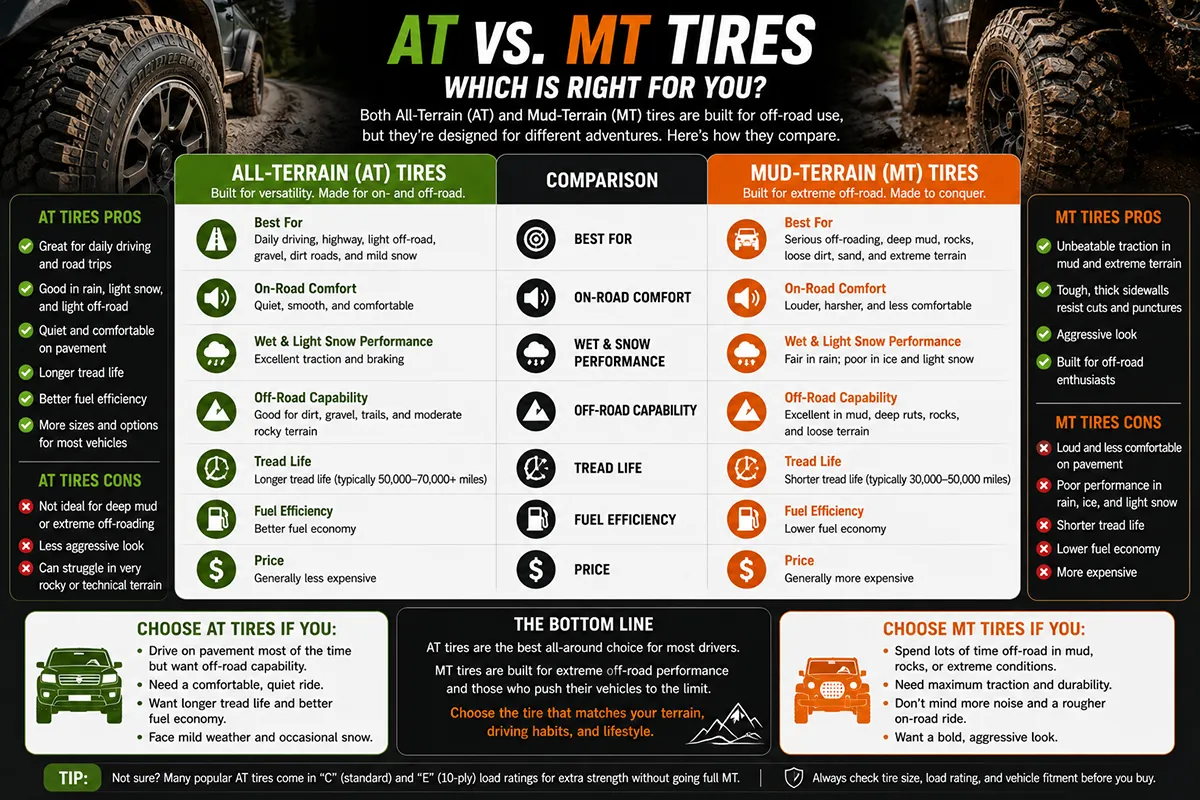
- All-Terrain (AT) tires are the jack-of-all-trades — solid on pavement, capable off-road, quieter, and longer-lasting. Best for drivers who spend 60%+ of their time on paved roads.
- Mud-Terrain (MT) tires are purpose-built for serious off-road use — deep mud, rocks, and crawling. They sacrifice road noise, fuel economy, and tread life for maximum off-road grip.
- If you’re a daily commuter who hits trails on weekends, go AT. If you’re a dedicated off-roader or live on unpaved roads, go MT.
- Expect to pay $150–$350 per tire for quality ATs and $200–$450+ per tire for MTs in popular truck sizes.
Liked this article?
Add TireAdvise as a preferred source so you see more of our tire reviews and guides on Google.
What Are All-Terrain (AT) Tires?
All-terrain tires are designed to perform reasonably well in a wide variety of conditions. Think of them as the Swiss Army knife of the tire world. They’re not the absolute best at any single thing, but they’re genuinely good at almost everything.
The tread pattern on an AT tire features moderately spaced lugs with siping (those tiny slits you see in each tread block) for wet and light snow traction. The sidewalls usually have some reinforcement and mild tread elements, but they’re not as aggressively armored as mud-terrains.
In my experience, a good AT tire — like the BFGoodrich KO2 or the Falken Wildpeak AT3W — can handle a surprising amount of off-road abuse while still being perfectly comfortable on your daily highway commute. I’ve driven on both of those for extended periods, and neither one made me dread Monday morning drives to work.
What Are Mud-Terrain (MT) Tires?
Mud-terrain tires are the off-road specialists. Everything about their design prioritizes traction in loose, slippery, or uneven terrain — deep mud, loose rocks, sand, and serious trail obstacles.
You can spot an MT tire from across a parking lot. The tread lugs are massive, deeply cut, and widely spaced. This aggressive void pattern allows mud, rocks, and debris to self-clean as the tire rotates. The sidewalls are heavily reinforced and often feature their own tread lugs for added grip when the tire is aired down and the sidewall contacts the terrain.
I ran a set of Nitto Trail Grapplers on my truck for an extended period, and the off-road performance was genuinely transformative. Sections of trail that used to make me nervous became almost boring. But here’s the trade-off nobody warns you about loudly enough: the road noise was significant, and I noticed my fuel economy take a measurable hit within the first few days of driving on pavement.
AT vs MT Tires: Head-to-Head Comparison
Let me break this down across every category that actually matters when you’re spending your hard-earned money on tires. I’m pulling from real driving experience here, not spec sheet theory.
| Category | All-Terrain (AT) | Mud-Terrain (MT) |
|---|---|---|
| On-Road Comfort | ★★★★☆ — Quiet and smooth | ★★☆☆☆ — Noticeably louder |
| Highway Noise | Low to moderate hum | Moderate to loud drone |
| Fuel Economy | Slight decrease vs. HT tires | Noticeable decrease |
| Tread Life | 40,000–60,000+ mile warranties common | Rarely warrantied; faster wear |
| Mud Performance | Moderate — can handle light mud | Excellent — purpose-built |
| Rock Crawling | Adequate for moderate trails | Superior grip and sidewall protection |
| Snow & Ice | Good; many carry 3PMSF rating | Poor to moderate; limited siping |
| Wet Pavement | Good hydroplaning resistance | Adequate; large voids help channel water |
| Price Range (per tire) | $150–$350 | $200–$450+ |
| Best For | Daily drivers who go off-road sometimes | Dedicated off-roaders and trail rigs |
On-Road Performance: AT Tires Win Easily
This isn’t even close. If you spend the majority of your driving time on paved roads — commuting, running errands, highway trips — all-terrain tires are dramatically better to live with on a daily basis.
During my test period with the Toyo Open Country AT III, I was genuinely impressed by how quiet these tires were at highway speeds. I could carry on a normal conversation, listen to podcasts at reasonable volume, and almost forget I wasn’t running highway tires. The ride quality was composed and predictable through corners.
When I switched to mud-terrains for a direct comparison, the difference was immediately obvious. Within the first few minutes on the highway, I noticed a persistent hum that grew louder above 55 mph. After several days of daily commuting, it became genuinely fatiguing. If you’ve ever driven behind a semi truck and heard that deep tire drone — that’s a toned-down version of what aggressive MTs sound like from inside your cab.
Fuel Economy Impact
I want to be honest here: all-terrain tires will cost you some fuel economy compared to stock highway tires. The heavier construction and slightly more aggressive tread pattern creates more rolling resistance. In my experience, the difference is usually noticeable but manageable.
Mud-terrains hit your wallet harder at the pump. The massive tread lugs, heavier carcass, and increased rolling resistance add up. Over the course of several weeks of mixed driving, I consistently saw worse fuel economy numbers on my truck’s trip computer with MTs versus ATs. For someone driving a lot of annual miles, that difference in fuel costs can actually approach the price difference between the tires themselves.
Off-Road Performance: MT Tires Are Built for This
Now let’s flip the script. If you’re actually going off-road — and I mean real off-road, not graded forest service roads — mud-terrain tires earn their keep fast.
In Deep Mud
This is literally what MT tires are named for, and the performance difference is dramatic. I tested both tire types on the same muddy trail section during a rainy week in East Texas. The all-terrain tires handled light mud okay, but once the ruts got deeper than a few inches, they started packing mud into the tread voids and losing grip quickly.
The mud-terrains were a different animal entirely. Those wide channels between the lugs shed mud actively as the tire rotated. I could feel the tires biting into the terrain and finding purchase where the ATs just spun. If you regularly encounter deep, soupy mud, there is no substitute for a proper MT tire.
On Rocks
Rock crawling and rocky trail driving is another area where MTs shine. The larger lugs grip irregular rock surfaces better, and the reinforced sidewalls provide critical protection against punctures and cuts from sharp edges.
I took a set of BFGoodrich KM3s through a rocky section in Moab, Utah, and the confidence they inspired was remarkable. Aired down to around 18-20 psi, the sidewall lugs engaged the rock surfaces and provided grip that I simply haven’t experienced with all-terrain tires on the same obstacles.
That said, I want to be fair to the AT category. Modern all-terrains like the Falken Wildpeak AT3W and the BFGoodrich KO2 handle moderate rocky terrain surprisingly well. Unless you’re doing technical rock crawling, a quality AT tire will get you through most rocky trails without drama.
In Sand
Sand is interesting because it somewhat levels the playing field. Both tire types benefit primarily from airing down to increase the contact patch. In my testing, MTs had a slight edge in very soft, deep sand, but properly aired-down ATs performed admirably. I wouldn’t choose MTs over ATs solely for sand driving.
Snow and Winter Performance: AT Tires Have the Edge
Here’s something that surprises a lot of people: all-terrain tires are generally better in snow and ice than mud-terrains. It seems counterintuitive — wouldn’t more aggressive tread grip better?
Not exactly. Snow traction relies heavily on siping — those thin slits cut into each tread block that create biting edges on slippery surfaces. Most quality AT tires feature extensive siping, and many carry the Three-Peak Mountain Snowflake (3PMSF) symbol, which means they’ve met established traction standards for severe snow conditions.
Mud-terrain tires typically have minimal siping because the large, stiff lugs are designed for a different type of grip. On packed snow or ice, those big lugs can actually reduce your contact patch and create a less predictable driving experience.
During a winter trip through the Colorado mountains, I felt noticeably more confident with the Falken Wildpeak AT3W (which carries the 3PMSF rating) than I did with any mud-terrain I’ve tested in similar conditions. If you live in the northern states and deal with real winters, this is a significant factor to consider.
Tread Life and Long-Term Value
Let’s talk about something that hits your bank account directly: how long these tires last.
All-terrain tires generally last significantly longer than mud-terrains. Many premium AT tires come with treadwear warranties in the 50,000–60,000 mile range. The BFGoodrich KO2, for example, offers a 50,000-mile warranty. The Toyo Open Country AT III comes with a 65,000-mile warranty. These warranties exist because the manufacturers are confident in the longevity of these tread compounds.
Mud-terrain tires? Most don’t come with any treadwear warranty at all. The softer rubber compounds that provide excellent off-road grip wear faster on pavement. The aggressive tread pattern also tends to wear less evenly, especially if you’re not diligent about tire rotations.
In my experience, a set of quality AT tires used primarily on-road can last significantly longer than a comparable set of MTs under the same conditions. When you factor in the higher purchase price of MTs plus the shorter lifespan, the total cost-of-ownership gap is substantial.
Noise Levels: The Dealbreaker Nobody Expects
I cannot stress this enough: test drive a vehicle with mud-terrain tires before you buy them. Or at the very least, watch some real-world driving videos with audio. The noise is the number one complaint I hear from people who switch from ATs to MTs, and it’s the number one reason people switch back.
After several days of daily commuting on mud-terrains, I found myself consistently turning up the radio and arriving at work more tired than usual. It sounds like a small thing, but road noise fatigue is real. That constant drone wears on you over time.
Modern AT tires have made remarkable progress in noise reduction. Computer-optimized tread patterns with variable pitch sequencing (where the tread blocks are slightly different sizes to cancel out harmonic resonance) have made the best ATs nearly as quiet as highway tires. The Continental TerrainContact A/T and the Michelin LTX A/T2 are particularly impressive in this regard.
Looks and Aesthetics: Let’s Be Honest
I know, I know — tire selection should be purely rational. But let’s be honest with each other: mud-terrain tires look incredible on a truck. That aggressive sidewall lettering, the chunky tread pattern, the trail-ready stance — it’s undeniably appealing.
I’ve seen countless truck owners choose MTs primarily for the look, and I don’t judge them for it. If the aesthetics make you happy and you’re willing to accept the trade-offs in noise, fuel economy, and tread life, that’s a perfectly valid reason. Just go in with your eyes open about what you’re giving up.
That said, some all-terrain tires look plenty aggressive. The BFGoodrich KO2 with its bold white lettering has become almost iconic in the truck community. The Nitto Ridge Grappler (which is technically a hybrid AT/MT) offers an aggressive look with better road manners than a full mud-terrain.
Popular AT Tires I Recommend
Based on my personal testing and extensive time spent evaluating these tires, here are the all-terrain tires I recommend most frequently:
- BFGoodrich KO2: The benchmark. Outstanding durability, solid off-road capability, reasonable road manners. I’ve run these on multiple vehicles and they consistently impress. Expect to pay around $200–$300 per tire depending on size.
- Falken Wildpeak AT3W: My pick for the best value in the AT category. Excellent wet and snow traction (3PMSF rated), surprisingly good off-road, and typically $30–$50 cheaper per tire than the KO2. This is the tire I recommend to most people.
- Toyo Open Country AT III: A premium option with an impressive 65,000-mile warranty. Quieter than most ATs and great in wet conditions. Priced around $180–$320 per tire.
- Cooper Discoverer AT3 4S: Another excellent value pick with strong snow performance and a comfortable on-road ride. Usually priced between $150–$260 per tire.
- Nitto Ridge Grappler: Technically a hybrid between AT and MT. If you want more aggressive looks and slightly better off-road capability than a pure AT without the full MT penalty, this is worth considering. Runs about $200–$350 per tire.
Popular MT Tires I Recommend
If you’ve read everything above and you’re still leaning MT — which might absolutely be the right call for your situation — here are the mud-terrains I’d point you toward:
- BFGoodrich KM3: The gold standard in mud-terrains. Excellent off-road traction, surprisingly manageable road noise for an MT (though still louder than any AT), and BFG’s legendary durability. Expect $250–$400+ per tire.
- Nitto Trail Grappler: My personal favorite MT for the balance of off-road capability and on-road livability. The road noise is noticeable but not punishing, and the off-road grip is outstanding. Runs about $250–$450 per tire.
- Toyo Open Country MT: A capable and reasonably priced MT option. Strong performance in mud and rocks with decent tread life for the category. Typically $200–$380 per tire.
- Mickey Thompson Baja Boss: If you want maximum off-road aggression and don’t care much about road manners, this is the tire. Incredible in mud and rocks, loud on pavement. Priced around $250–$450+ per tire.
Who Should Buy All-Terrain Tires?
Based on everything I’ve tested and experienced, I recommend AT tires for the following drivers:
- Daily commuters with a truck or SUV who want more capability than highway tires without significant compromises
- Weekend warriors who hit moderate trails, forest service roads, or camping spots regularly
- Drivers in northern states who need year-round traction including snow (look for 3PMSF-rated options)
- Anyone who values ride comfort and low noise but still wants to look ready for adventure
- Budget-conscious buyers who want the most value per dollar spent on tires
- Towing and hauling users who need predictable, stable on-road performance
Honestly, I’d estimate that 80% of truck and SUV owners who think they need mud-terrains would be better served by a quality all-terrain tire. That’s not a knock on MTs — it’s simply that most people’s actual driving patterns heavily favor pavement.
Who Should Buy Mud-Terrain Tires?
Mud-terrain tires make genuine sense for a smaller but passionate group of drivers:
- Dedicated off-road enthusiasts who spend a significant percentage of their driving time on trails
- People who live on unpaved roads — rural areas with dirt, gravel, or muddy roads as the primary surface
- Rock crawling enthusiasts who need maximum sidewall protection and grip on technical terrain
- Dedicated trail rigs and second vehicles that don’t serve as daily drivers
- Overlanders in extreme conditions who routinely encounter deep mud, sand, or remote terrain
If your truck is primarily a trail machine or a work vehicle that lives on unpaved surfaces, MTs are absolutely the right call. Don’t let anyone talk you into ATs if your genuine use case demands the extra off-road capability.
The Hybrid Option: Aggressive ATs and Mild MTs
The tire industry has recognized that many drivers want something between a traditional AT and a full MT, and several excellent hybrid options now exist.
The Nitto Ridge Grappler is probably the most popular example. It has a more aggressive tread pattern than a standard AT but tighter spacing than a true MT. In my testing, it delivers about 75% of a mud-terrain’s off-road capability with maybe 70% of an all-terrain’s on-road comfort. It’s a compelling middle ground.
The Toyo Open Country R/T (Rugged Terrain) is another option in this space, along with the General Grabber X3. These hybrid tires are worth serious consideration if you find yourself genuinely torn between AT and MT.
Real-World Cost Comparison
Let me break down the actual financial impact of this decision using a common size like 275/70R18, which fits a lot of popular trucks:
- Set of 4 quality ATs: Approximately $800–$1,200 installed
- Set of 4 quality MTs: Approximately $1,000–$1,600 installed
- Fuel economy difference: The MT penalty could cost you an extra $200–$500+ per year depending on how much you drive
- Replacement frequency: You’ll likely replace MTs sooner, adding another cost cycle faster
Over the life of ownership, the total cost difference between running AT versus MT tires can easily exceed $1,000–$2,000. That’s real money that only makes sense to spend if you’re genuinely using the MT capability.
My Personal Bottom Line
After years of testing both categories across different vehicles and conditions, here’s my honest, unfiltered recommendation:
If you have to ask whether you need mud-terrains, you probably don’t. The people who truly need MT tires usually know it because their driving demands it — they’re stuck in mud regularly, they’re on technical trails every weekend, or they live at the end of a rutted dirt road.
For everyone else — and I mean the vast majority of truck and SUV owners in the US — a high-quality all-terrain tire is the smarter buy. You’ll get a quieter ride, better fuel economy, longer tread life, superior snow traction, and still have plenty of off-road capability for occasional adventures.
If I could only own one set of tires for a truck that does everything — commuting, road trips, occasional trail runs, winter driving — I’d put on the Falken Wildpeak AT3W without hesitation. It’s the best balance of capability, comfort, and value I’ve tested.
But if you’re building a dedicated trail rig or you genuinely spend more time off-road than on, grab a set of BFGoodrich KM3s or Nitto Trail Grapplers and go have fun. Life’s too short to be stuck in the mud with the wrong tires.
Whatever you choose, make sure it matches your real driving life — not the driving life you fantasize about on Instagram. Your wallet and your eardrums will thank you.
Frequently Asked Questions
What is the main difference between AT and MT tires?
All-terrain (AT) tires are designed to perform well on both paved roads and light off-road surfaces, while mud-terrain (MT) tires feature aggressive tread patterns built specifically for extreme off-road conditions like deep mud, rocks, and loose soil. AT tires offer a balanced compromise between on-road comfort and off-road capability, whereas MT tires sacrifice highway manners for maximum traction in challenging terrain. If you split your driving between daily commuting and weekend trail runs, AT tires are usually the smarter choice.
Are mud-terrain tires good for daily driving on highways?
MT tires can be driven on highways, but they come with noticeable trade-offs including louder road noise, faster tread wear, and reduced fuel economy compared to AT tires. The aggressive lug pattern that makes MT tires excellent in mud creates vibrations and humming at highway speeds, which many daily drivers find fatiguing on long commutes. I’d only recommend MT tires for daily driving if you regularly encounter serious off-road conditions that AT tires can’t handle.
Do AT or MT tires last longer on pavement?
All-terrain tires generally last significantly longer on pavement, with many popular AT models like the BFGoodrich KO2 or Falken Wildpeak AT3W rated for 50,000 to 60,000 miles. Mud-terrain tires typically wear faster on asphalt because their softer rubber compound and widely spaced tread blocks flex more under load, often lasting 30,000 to 40,000 miles with regular highway use. If most of your driving is on paved US roads, AT tires will deliver better long-term value.
How much more expensive are MT tires compared to AT tires?
Mud-terrain tires typically cost 15% to 30% more than comparable all-terrain tires in the same size, with popular MT options like the Nitto Trail Grappler or Toyo Open Country MT ranging from $250 to $450 per tire depending on size. Beyond the higher purchase price, MT tires also increase your overall cost of ownership through reduced fuel economy and faster tread wear. For a set of four in a common truck size like 275/70R18, you can expect to pay $200 to $500 more total for MT tires versus a quality AT set.
Are all-terrain tires good enough for off-roading in mud and snow?
Quality AT tires handle moderate mud and light snow surprisingly well, especially models that carry the Three-Peak Mountain Snowflake (3PMSF) rating like the Falken Wildpeak AT3W or Cooper Discoverer AT3 4S. However, in deep mud or heavy clay, AT tires will pack up and lose traction much faster than MT tires because their tread voids are smaller and can’t self-clean as effectively. For most US drivers hitting forest service roads, gravel trails, or occasional muddy campsites, a good AT tire is more than capable.
Which is better for towing — AT or MT tires?
All-terrain tires are generally the better choice for towing trailers and hauling heavy loads on US highways because they offer more stable handling, lower rolling resistance, and more predictable braking on pavement. MT tires’ aggressive tread can make a loaded truck feel less planted at highway speeds and increase stopping distances, which is a real safety concern when towing. If you need to tow through serious off-road terrain to reach a remote job site or campsite, MT tires may be justified, but for standard highway towing an AT tire with a high load rating is the safer and more comfortable option.
Can I mix AT and MT tires on the same truck?
Mixing AT and MT tires on the same vehicle is generally not recommended because the different tread patterns and rubber compounds create uneven traction, which can confuse your truck’s ABS and stability control systems. This is especially problematic on 4WD and AWD trucks where mismatched tires can cause drivetrain stress and unpredictable handling in wet or icy conditions. If you’re on a budget, it’s better to choose one type — either a full set of AT or MT tires — rather than mixing them across axles.
