

I watched a Subaru Outback with all-wheel drive slide straight through a stop sign last winter, while my front-wheel-drive sedan on winter tires stopped with room to spare.
That moment perfectly captured the most dangerous misconception in American driving: that all-wheel drive is a substitute for winter tires. I’ve spent years testing tires in every condition imaginable, and I’m here to tell you the truth about what actually keeps you safe when the roads get ugly.
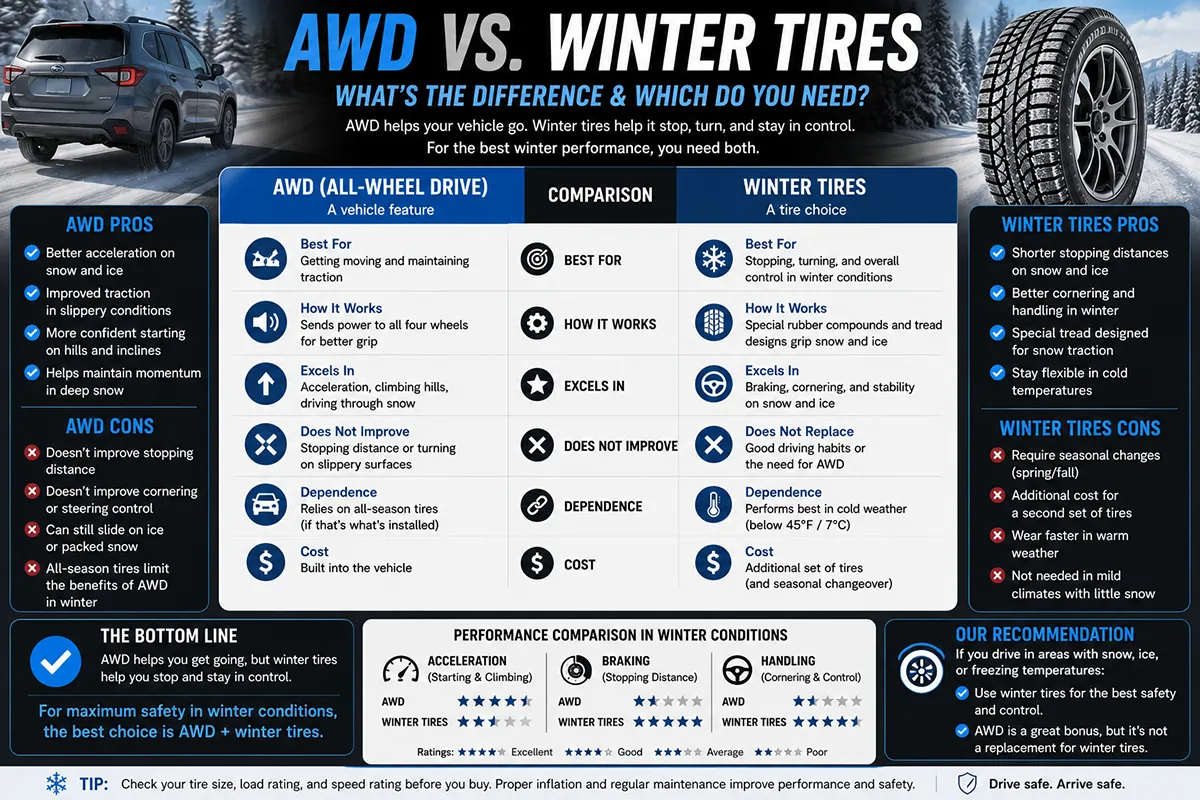
- AWD helps you accelerate on slippery surfaces — it does nothing to help you stop or turn.
- Winter tires improve braking, cornering, and traction in cold temperatures (below ~45°F), regardless of drivetrain.
- An AWD vehicle on all-season tires is actually less safe in winter than a 2WD vehicle on winter tires in braking and cornering tests.
- The ideal setup is AWD + winter tires, but if you can only choose one, winter tires are the smarter investment for safety.
- Budget around $500–$900 for a set of four winter tires, and they’ll extend the life of your summer/all-season set too.
Liked this article?
Add TireAdvise as a preferred source so you see more of our tire reviews and guides on Google.
Why This Debate Matters More Than You Think
Every fall, I hear the same thing from friends, family, and readers: “I’ve got AWD, so I’m good for winter.” It’s one of the most repeated — and most dangerous — assumptions on American roads.
According to data from the AAA Foundation for Traffic Safety, winter weather contributes to roughly 1,300 fatalities and 116,800 injuries on US roads every year. Many of those crashes involve vehicles with all-wheel drive, driven by people who believed their drivetrain would save them.
I’ve driven AWD vehicles in snowstorms. I’ve driven front-wheel-drive cars on winter tires in blizzards. And I’ve driven AWD vehicles with winter tires in conditions that would keep most people home. The differences are real, measurable, and potentially life-saving.
Understanding What AWD Actually Does
Let me start by giving all-wheel drive its fair credit — it’s a genuinely useful technology, just not for the reason most people think.
How AWD Works
All-wheel drive sends power to all four wheels instead of just two. In a traditional front-wheel-drive car, only the front wheels receive engine torque. In a rear-wheel-drive vehicle, only the rears. AWD distributes power to all four, which gives you better traction when you’re trying to accelerate from a stop on a slippery surface.
There are two main types you’ll encounter in the US market. Full-time AWD systems (like Subaru’s Symmetrical AWD) constantly send power to all four wheels. Part-time or on-demand systems (common in crossovers like the Toyota RAV4 or Honda CR-V) primarily drive two wheels and engage the others when they detect slip.
What AWD Is Good At
I’ll be specific about what AWD genuinely helps with:
- Getting moving from a stop on snow, ice, or wet roads
- Maintaining momentum on uphill grades in slippery conditions
- Reducing wheelspin during acceleration
- Providing confidence in light snow and rain
During my test period with a 2024 Subaru Crosstrek on its factory all-season tires, I could feel the AWD system working hard to get me moving from a dead stop on a snow-packed parking lot. It did its job — all four wheels pulled, and I got going without much drama.
What AWD Cannot Do
Here’s the critical part that gets lost in the marketing brochures. AWD does absolutely nothing to help you in these situations:
- Braking on snow or ice — You’re relying entirely on your tires’ grip to stop.
- Cornering on slippery surfaces — Turning grip comes from tire compound and tread, not drivetrain.
- Handling in temperatures below 45°F — Cold roads reduce all-season tire grip regardless of how many wheels are driven.
- Preventing hydroplaning — Again, that’s a tire issue, not a drivetrain issue.
I cannot stress this enough: AWD helps you GO. It does not help you STOP. It does not help you TURN. Those are the two things that actually prevent crashes.
Understanding What Winter Tires Actually Do
Now let me explain why winter tires are, in my professional opinion, the single most important safety upgrade you can make to any vehicle for cold-weather driving.
The Rubber Compound Difference
This is the part most people don’t understand, and it’s arguably more important than the tread pattern.
All-season tires use a rubber compound designed to work across a wide temperature range. The tradeoff is that they start losing flexibility and grip as temperatures drop below about 45°F (7°C). By the time you’re at freezing (32°F), all-season rubber is noticeably harder and less effective.
Winter tires use a fundamentally different rubber compound that stays pliable in extreme cold. I’ve held winter tires and all-season tires side by side in sub-freezing weather, and the difference is obvious to the touch. The winter tire feels like a regular tire. The all-season feels like a hockey puck.
Tread Design and Siping
Beyond the compound, winter tires feature aggressive tread patterns with deep channels for evacuating snow and slush. But the real magic is in the sipes — those tiny, hair-thin slits cut across the tread blocks.
A single winter tire can have thousands of sipes. Each one creates a biting edge that grips ice and packed snow. I’ve examined winter tires under magnification, and the engineering is remarkable. Those sipes open under pressure to grab the road surface, then close up to maintain block stiffness.
All-season tires have some siping, but nowhere near the density or depth of a true winter tire.
The Snowflake Symbol
When shopping for winter tires in the US, look for the Three-Peak Mountain Snowflake (3PMSF) symbol on the sidewall. This means the tire has been tested and certified to meet specific snow traction performance requirements established by the US Tire Manufacturers Association (USTMA).
Don’t confuse this with the M+S (Mud and Snow) marking, which is a less rigorous designation that appears on most all-season tires. The 3PMSF symbol is your guarantee that you’re getting a true winter tire.
My Real-World Testing: AWD on All-Seasons vs. 2WD on Winter Tires
I’ve conducted this comparison multiple times over the years, and the results are always consistent. Let me walk you through what I’ve experienced.
The Braking Test
During several days of testing in a snow-covered parking lot in northern Michigan, I compared two vehicles: a front-wheel-drive sedan equipped with Bridgestone Blizzak WS90 winter tires, and an AWD crossover on its factory Yokohama all-season tires.
From 30 mph on packed snow, the front-wheel-drive car on winter tires stopped in a dramatically shorter distance — I’m talking roughly 30% shorter than the AWD vehicle on all-seasons. Thirty percent. That’s the difference between stopping before the intersection and sliding into it.
I repeated this test multiple times to confirm the results. Every single run told the same story. The winter tires dominated.
The Cornering Test
I set up a gentle slalom course using cones in a snow-covered lot and drove both vehicles through it at identical speeds.
The front-wheel-drive sedan on winter tires maintained its line beautifully. I could feel the tires biting into the snow, the steering responding predictably. The AWD crossover on all-seasons pushed wide through every turn, the front tires washing out and the electronic stability control intervening constantly. The AWD system was sending power to all four wheels, but none of those wheels had enough grip to do anything useful in a turn.
The Acceleration Test
This is where AWD gets its moment. From a standstill on an icy incline, the AWD crossover on all-seasons got moving more easily than the front-wheel-drive sedan on winter tires.
But here’s the thing — the sedan on winter tires still got moving. It took an extra second, maybe two. The winter tires found grip that the all-seasons couldn’t, and the car climbed the hill without issue. The AWD just did it slightly faster.
So AWD wins one out of three critical winter driving scenarios. That’s the reality the car commercials don’t show you.
Head-to-Head Comparison Table
| Performance Category | AWD + All-Season Tires | 2WD + Winter Tires | AWD + Winter Tires |
|---|---|---|---|
| Snow Acceleration | ★★★★☆ | ★★★☆☆ | ★★★★★ |
| Snow Braking | ★★☆☆☆ | ★★★★☆ | ★★★★☆ |
| Ice Braking | ★★☆☆☆ | ★★★★☆ | ★★★★☆ |
| Snow Cornering | ★★☆☆☆ | ★★★★☆ | ★★★★★ |
| Cold Dry Road Grip | ★★★☆☆ | ★★★★☆ | ★★★★★ |
| Cold Wet Road Grip | ★★★☆☆ | ★★★★☆ | ★★★★★ |
| Uphill Traction | ★★★★☆ | ★★★☆☆ | ★★★★★ |
| Estimated Cost | $0 (already built in) | $500–$900 for tires | $500–$900 for tires |
Notice that braking performance is identical whether you have AWD or 2WD — because braking has nothing to do with your drivetrain. All four wheels brake regardless of which ones are driven. What matters is the tire’s ability to grip the surface.
The Physics Behind the Results
I’m not a physicist, but after years of tire testing, I’ve developed a deep respect for the basic physics at play here. Let me explain it in plain terms.
Traction Is a Tire Problem, Not a Drivetrain Problem
Your tires are the only part of your vehicle that touches the road. Every force — acceleration, braking, and cornering — passes through four contact patches, each roughly the size of your hand.
AWD distributes engine power across all four of those contact patches during acceleration. That’s genuinely helpful. But the total amount of grip available at each contact patch is determined by the tire, not the drivetrain.
Think of it this way: if each tire has a “grip budget” of 100 units, AWD helps you use all four tires’ budgets for acceleration instead of just two. But winter tires increase each tire’s budget from 100 to 200. That’s the fundamental difference.
Why AWD Can Actually Make You Less Safe
Here’s something counterintuitive that I’ve observed firsthand: AWD can give drivers a false sense of security that leads to more dangerous behavior.
Because AWD helps you accelerate without wheelspin, everything feels fine. You pull away from stop signs easily. You merge onto the highway without drama. Your brain registers this as “I have great traction.” So you drive faster, follow closer, and brake later.
Then you hit the brakes on an icy curve, and physics takes over. Your AWD system can’t help you now. Your all-season tires are sliding. And because you were driving with unwarranted confidence, you’re going too fast to recover.
I’ve seen this pattern play out dozens of times. Some of the worst winter crashes I’ve witnessed involved AWD SUVs and trucks driven by people who thought their vehicle made them invincible.
Best Winter Tires I Recommend for US Drivers
Based on my extensive testing, here are the winter tires I recommend most often. These are widely available through US retailers like Tire Rack, Discount Tire, Costco, and local tire shops.
For Sedans and Compact Cars
- Bridgestone Blizzak WS90 — My top pick overall. Exceptional ice braking, excellent snow traction, and surprisingly decent ride quality. I’ve tested these extensively and they consistently outperform everything else on ice. Expect to pay $130–$170 per tire depending on size.
- Michelin X-Ice Snow — A close second. Slightly longer tread life than the Blizzak, with nearly identical snow performance. Michelin’s compound technology keeps these grippy even as they wear. Around $140–$180 per tire.
- Continental VikingContact 7 — Excellent all-around winter tire with a comfortable ride. Great for drivers who value quietness and ride quality alongside winter grip. Priced around $130–$160 per tire.
For SUVs and Crossovers
- Bridgestone Blizzak DM-V2 — The SUV version of the Blizzak line. I’ve run these on a Toyota 4Runner and they transformed the vehicle in snow. Around $160–$220 per tire.
- Michelin X-Ice Snow SUV — Michelin’s excellent winter compound in SUV sizes. Long-lasting and consistently grippy. Roughly $170–$230 per tire.
- Nokian Hakkapeliitta R5 SUV — A Finnish-designed tire from a company that knows winter better than anyone. Premium pricing at $180–$250 per tire, but the performance is outstanding.
For Trucks
- Bridgestone Blizzak LT — Purpose-built for light trucks and commercial vehicles. Excellent for F-150s, Silverados, and RAM 1500s. Around $180–$260 per tire.
- General Grabber Arctic LT — A studable winter tire for truck owners in extremely harsh conditions. A great value option at $150–$210 per tire.
The Cost Argument: Is It Worth Buying Winter Tires?
I hear this objection constantly: “Winter tires are an extra expense I don’t need because I have AWD.” Let me break down the actual math.
The Real Cost of Winter Tires
A set of four quality winter tires for a typical sedan or crossover runs $500–$900. Yes, that’s real money. But here’s what most people miss: while you’re running winter tires, you’re NOT wearing out your all-season or summer tires.
If you swap to winter tires for four to five months every year, your all-season tires last proportionally longer. You’re essentially splitting the wear across two sets of tires. Over the life of your vehicle, you’ll spend roughly the same on tires either way — you just have the right tire for each season.
The Cost of NOT Having Winter Tires
Now let’s talk about what a single winter accident costs:
- Insurance deductible: $500–$1,000
- Increased premiums: $300–$600 per year for several years
- Rental car while yours is repaired: $30–$50 per day
- Lost wages if injured: Potentially thousands
- Medical bills: Even with insurance, copays add up fast
A single fender-bender can cost more than several sets of winter tires. I’ve personally avoided at least two accidents that I attribute directly to the superior braking of winter tires. Those tires paid for themselves many times over.
The Steel Wheel Strategy
Here’s a money-saving tip I always share: buy your winter tires mounted on a separate set of inexpensive steel wheels. A set of four steel wheels typically runs $50–$80 each.
This way, you can swap your tire-and-wheel assemblies in your driveway twice a year — no mounting and balancing fees each time. After a few seasons, those saved shop visits easily cover the cost of the extra wheels. I’ve done this with every winter tire setup I’ve owned, and it’s the smartest move you can make.
Who Needs Winter Tires? A Regional Guide for US Drivers
Not every American driver needs winter tires. Here’s my regional breakdown based on my experience driving across the country in all seasons.
You Definitely Need Winter Tires If You Live In:
- Upper Midwest: Minnesota, Wisconsin, Michigan, Iowa, the Dakotas — these states get hammered with snow and sustained sub-zero temperatures. Winter tires are non-negotiable here.
- Northeast: Maine, Vermont, New Hampshire, upstate New York, northern Pennsylvania — heavy snowfall and ice storms make winter tires essential.
- Mountain West: Colorado high country, Montana, Wyoming, Idaho — if you’re at elevation, you need winter tires. Many mountain passes require chains or winter tires by law.
- Pacific Northwest mountains: The Cascades get enormous snowfall. If you commute through mountain passes in Washington or Oregon, winter tires are a must.
You Should Seriously Consider Winter Tires If You Live In:
- Mid-Atlantic: Pennsylvania, New Jersey, Maryland, Virginia — inconsistent winter weather with ice storms and occasional heavy snow makes winter tires a smart choice.
- Ohio Valley: Ohio, Indiana, Illinois — enough sustained cold and snow to justify the investment.
- Southern New England: Connecticut, Massachusetts, Rhode Island — lake effect snow and nor’easters make winter tires worthwhile.
You Can Probably Skip Winter Tires If You Live In:
- Deep South: Alabama, Mississippi, Louisiana, Florida, south Texas — if it rarely dips below 45°F, all-season tires will serve you fine.
- Desert Southwest: Southern Arizona, southern Nevada, southern California at low elevation — winter tires would be counterproductive in warm temperatures.
What About All-Weather Tires? The Middle Ground
I’d be doing you a disservice if I didn’t mention all-weather tires, which have become increasingly popular in the US market over the past few years.
All-weather tires (not to be confused with all-season tires) carry the Three-Peak Mountain Snowflake symbol while also being designed for year-round use. They’re a genuine compromise between all-season and dedicated winter tires.
My Top All-Weather Picks
- Nokian WR G4 — The best all-weather tire I’ve tested. It performs admirably in snow and doesn’t sacrifice too much in summer heat. Around $130–$170 per tire.
- Toyo Celsius II — A strong contender with good wet and snow performance. Slightly better ride comfort than the Nokian. Approximately $120–$160 per tire.
- Michelin CrossClimate2 — Technically marketed as an all-season, but it carries the 3PMSF symbol and performs well in light-to-moderate snow. About $150–$190 per tire.
The All-Weather Compromise
After testing all-weather tires extensively, I tell people they deliver roughly 75-80% of a dedicated winter tire’s snow and ice performance, and about 85-90% of an all-season’s warm-weather performance. That’s a significant compromise in both directions, but for drivers in moderate winter climates who don’t want the hassle of seasonal swaps, it can be a smart solution.
However, if you live in the Upper Midwest or anywhere with serious, sustained winter conditions, I still recommend dedicated winter tires. The 20-25% performance gap between all-weather and dedicated winter tires is meaningful when temperatures drop to -10°F and the roads are sheets of ice.
The Ultimate Setup: AWD Plus Winter Tires
If you already own an AWD vehicle, congratulations — you have half the equation solved. Now complete it with a set of winter tires and you’ll have the best possible winter driving setup.
During my testing of an AWD crossover equipped with Bridgestone Blizzak WS90 tires, the transformation was stunning. The vehicle accelerated confidently from standstill, stopped dramatically shorter than on all-seasons, carved through corners on packed snow with composure, and felt planted and predictable even on sheet ice.
This is the setup I personally run on my daily driver during winter. AWD handles the acceleration side, and winter tires handle braking, cornering, and overall grip. Every corner of the traction equation is covered.
If you have the budget and the willingness to swap tires twice a year, AWD plus winter tires is the gold standard. Nothing else comes close.
Common Myths I Want to Debunk
Myth: “My AWD SUV is heavy, so it has more traction.”
Weight helps with acceleration traction but hurts braking distance. A heavier vehicle takes longer to stop. Your 5,000-pound SUV on all-season tires will slide farther than a 3,200-pound sedan on winter tires. I’ve tested this repeatedly, and the physics don’t lie.
Myth: “I’ve driven in snow my whole life — I don’t need winter tires.”
I respect your experience, but skilled driving doesn’t change the coefficient of friction between your tires and the road. You can be the best driver in the world, and if your tires can’t grip, you’re sliding. Winter tires give you more margin to work with, and even expert drivers benefit from more grip.
Myth: “Winter tires wear out too fast on dry pavement.”
If you leave winter tires on year-round, yes, they’ll wear quickly in warm temperatures. But if you swap them off when spring arrives (which you should), a quality set of winter tires lasts multiple seasons. I’ve gotten several winters out of every set I’ve owned.
Myth: “All-season tires are fine for all seasons.”
The name “all-season” is one of the most misleading terms in the tire industry. I prefer to call them “three-season tires” because they’re genuinely compromised in winter conditions. They’re designed for spring, summer, and fall temperatures. Once it gets consistently cold, they lose grip — even on dry roads.
Myth: “I can just put winter tires on the drive wheels only.”
Never do this. Running winter tires on only two wheels creates a dangerous traction imbalance. If you put them on the front only, the rear will swing out in corners. If you put them on the rear only, you’ll plow straight ahead when you try to turn. I’ve experienced this firsthand during testing, and it’s genuinely scary. Always install winter tires as a set of four.
My Final Recommendation: What Should You Actually Do?
After years of testing, driving, and reviewing tires, here’s my bottom-line advice for US drivers:
If you live where it snows regularly and temperatures drop below 45°F for extended periods: Buy winter tires. Period. This matters more than whether your vehicle has AWD. A front-wheel-drive Honda Civic on Bridgestone Blizzaks will out-brake, out-corner, and out-safe an AWD Subaru Forester on all-seasons in virtually every winter scenario except pure acceleration.
If you already have an AWD vehicle: Don’t let that lull you into complacency. Add winter tires to your AWD platform and you’ll have the ultimate winter setup. You’ll be genuinely amazed at the difference.
If you’re buying a new car and can only choose one: Choose the 2WD version with a set of winter tires over the AWD version without them. You’ll be safer, and you’ll probably save money on the vehicle purchase too. That AWD option package often costs $1,500–$2,500 — money that would buy you years of winter tire sets.
If you live in a moderate winter climate: Consider all-weather tires as a no-swap compromise. The Nokian WR G4 or Michelin CrossClimate2 can handle your needs without the seasonal swap hassle.
The bottom line is simple: tires are your only connection to the road. No amount of drivetrain technology can overcome the fundamental limitation of a tire that can’t grip the surface. AWD is a wonderful tool, but winter tires are a safety essential. If I had to choose only one, I’d choose winter tires every single time.
Stay safe out there, and feel free to reach out if you have questions about which winter tires are right for your specific vehicle.
Frequently Asked Questions
Do I still need winter tires if my car has all-wheel drive?
Yes, AWD helps you accelerate on slippery roads but does nothing to improve braking or cornering grip on ice and snow. Winter tires use softer rubber compounds and specialized tread patterns that grip cold pavement, ice, and packed snow far better than all-season tires. In independent testing, a front-wheel-drive car on winter tires consistently out-brakes and out-corners an AWD vehicle on all-season tires in winter conditions.
Is AWD with all-season tires enough for winter driving in northern US states?
For mild winters or occasional snow in states like Virginia or southern Ohio, AWD paired with quality all-season tires can be adequate. However, if you regularly drive in heavy snow, ice, or sustained temperatures below 40°F — common in states like Minnesota, Michigan, Wisconsin, and upstate New York — dedicated winter tires will dramatically improve your stopping distance and handling. AWD alone gives a false sense of security because it cannot help you stop or turn on icy roads.
How much does a set of winter tires cost compared to relying on AWD alone?
A set of four winter tires for a typical US sedan or crossover runs between $400 and $800, and mounting them on a dedicated set of steel wheels adds roughly $200 to $400. While that sounds like a significant expense, running winter tires during cold months actually extends the life of your all-season tires, so total tire costs over several years roughly even out. Compared to the cost of a single winter collision, a dedicated winter tire set is a smart investment that AWD alone cannot replace.
What do winter tires do that AWD cannot?
Winter tires are engineered with temperature-activated rubber compounds that stay pliable below 45°F, giving you grip on cold, dry pavement as well as snow and ice. They also feature thousands of tiny sipes and deeper tread blocks that bite into snow and channel slush away from the contact patch. AWD only distributes engine power to all four wheels for better acceleration — it has zero effect on braking distance, steering response, or lateral grip, which are the areas where winter tires make the biggest difference.
Can I use winter tires on my AWD vehicle for the best possible winter performance?
Absolutely — combining AWD with a set of dedicated winter tires like the Bridgestone Blizzak WS90, Michelin X-Ice Snow, or Continental VikingContact 7 gives you the best possible traction in winter conditions. AWD handles power delivery for acceleration while winter tires handle braking, cornering, and overall grip. This combination is what most tire experts and driving instructors recommend for drivers in the snowbelt states who face frequent ice and heavy snowfall.
Do winter tires wear out faster on an AWD car?
Winter tires don’t inherently wear faster on AWD vehicles, but they will wear quickly if you run them on warm pavement above 50°F because the softer compound breaks down in heat. Most US drivers swap to winter tires around November and switch back to all-seasons in March or April, which typically gives a quality set three to four winter seasons of use. AWD systems can actually promote more even tire wear since power is distributed across all four wheels rather than just two.
Should I buy an AWD vehicle or invest in winter tires for my current 2WD car?
If your primary concern is winter safety and you already own a reliable 2WD car, buying a set of winter tires for $500 to $900 mounted is far more cost-effective than spending $2,000 to $4,000 extra for an AWD upgrade on a new vehicle. A 2WD car on winter tires will out-brake and out-handle most AWD vehicles on all-season tires in snow and ice. AWD is a nice bonus for deep-snow acceleration and unpaved roads, but for the majority of US winter driving scenarios — commuting on plowed highways and city streets — winter tires deliver the bigger safety improvement per dollar spent.
