

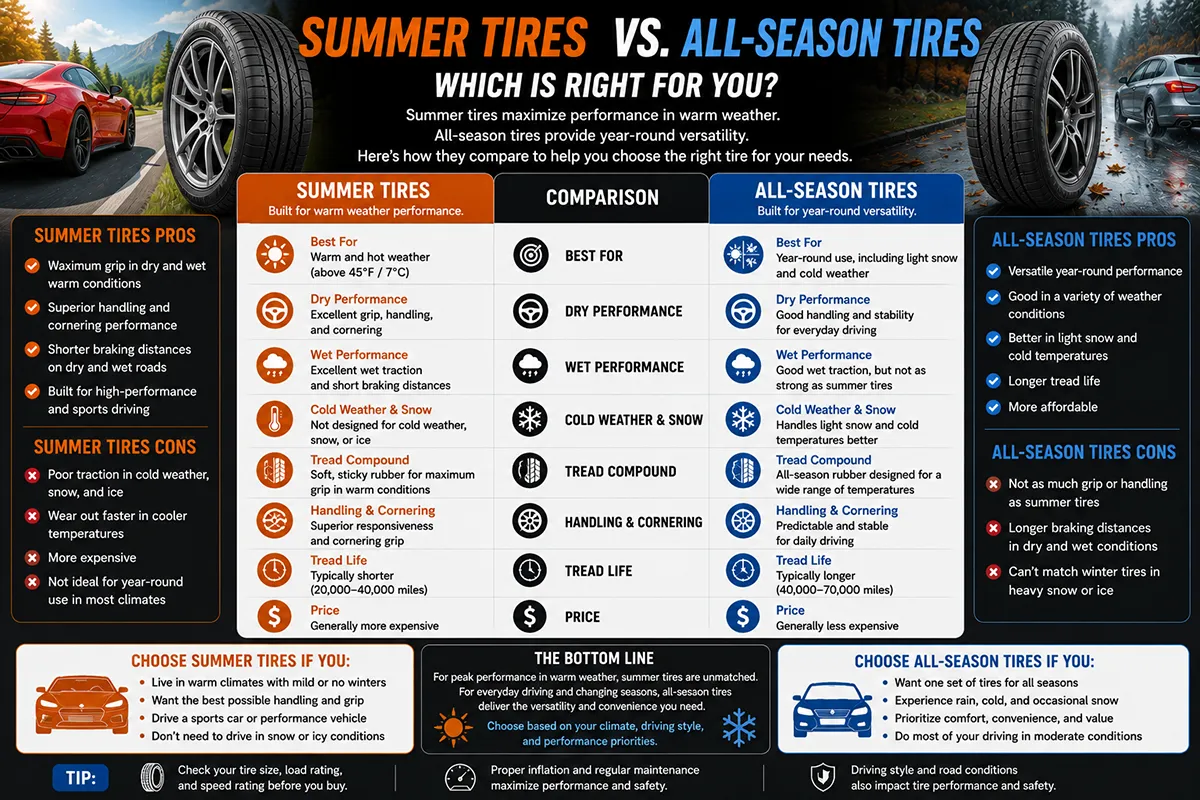
If you’ve ever stood in a tire shop staring at two tires that look almost identical but have completely different price tags and ratings, you know the frustration. One says “summer,” the other says “all-season,” and nobody on the sales floor gives you a straight answer about which one you actually need.
I’ve been reviewing and testing tires for over a decade, and this is hands-down the most common question I get from readers: “Do I really need summer tires, or are all-season tires good enough?” The answer isn’t as simple as most tire blogs make it sound — and it depends on factors most people never consider.
- Summer tires deliver significantly better grip, handling, and braking in warm weather — but they’re dangerous below ~45°F.
- All-season tires are the versatile compromise: decent in most conditions, exceptional in none.
- If you live where temperatures rarely dip below 40°F (think Texas, Florida, SoCal), summer tires are the performance upgrade you didn’t know you were missing.
- If you deal with any snow, ice, or regular sub-freezing temps, all-season tires are the smarter (and safer) year-round choice.
- The best setup for drivers in cold-winter states? A dedicated summer/winter tire swap — but that’s a separate budget conversation.
Liked this article?
Add TireAdvise as a preferred source so you see more of our tire reviews and guides on Google.
Why This Comparison Matters More Than You Think
Your tires are the only part of your car that actually touches the road. That’s not a cliché — it’s a physics reality that I remind myself of every time I push a test vehicle through a wet corner or slam the brakes on a hot highway.
The difference between summer and all-season tires isn’t just marketing. It’s a fundamentally different approach to rubber compound engineering, tread design, and intended use. And choosing the wrong one for your climate and driving style can cost you grip exactly when you need it most.
I’ve seen drivers in Phoenix running all-season tires and leaving performance on the table. I’ve also seen drivers in Ohio slap summer tires on in March and nearly slide off the road during an unexpected cold snap. Both scenarios are avoidable — if you understand what each tire is actually designed to do.
What Are Summer Tires? A Real-World Explanation
Summer tires — sometimes marketed as “performance” tires — are engineered for one thing: maximum grip in warm conditions. I’m talking about dry pavement, wet pavement, and temperatures consistently above 45°F.
The rubber compound in summer tires is softer and stickier at higher temperatures. During my testing, the difference in grip compared to an all-season tire on a hot day is immediately noticeable — especially through corners and during hard braking.
Tread Design
Summer tire treads tend to have larger, more continuous contact patches. You’ll notice fewer sipes (those tiny slits in the tread blocks) and wider circumferential grooves designed to evacuate water quickly.
This design maximizes rubber-to-road contact in dry conditions. It also performs surprisingly well in heavy rain — summer tires are specifically engineered to resist hydroplaning at highway speeds.
Rubber Compound
Here’s the critical difference most people miss. Summer tire rubber is formulated to remain pliable and grippy at elevated temperatures, typically above 45-50°F.
Below that threshold, the compound begins to harden dramatically. I’ve personally experienced this during an early-morning test drive in late October — the tires that felt glued to the road at 2 PM felt vague and slippery at 7 AM when the temperature had dropped to 38°F. That’s not a subtle difference. It’s alarming.
Who Summer Tires Are For
- Drivers in warm climates (Southern California, Texas, Florida, Arizona, the Southeast)
- Performance-oriented drivers who want the best possible handling and braking
- Sports car and enthusiast vehicle owners who prioritize driving feel
- Anyone willing to swap to winter tires when cold weather arrives
What Are All-Season Tires? The Real Story
All-season tires are the Swiss Army knife of the tire world. They’re designed to perform acceptably across a wide range of conditions — dry, wet, light snow, and a broad temperature window.
I want to be honest here: “all-season” is a bit of a misnomer. In my experience, a more accurate name would be “three-season” tires. They handle spring, summer, and fall competently, and they can manage light winter conditions — but they’re not true winter tires and shouldn’t be treated as such.
Tread Design
All-season treads are more complex. You’ll see a higher density of sipes, more tread blocks of varying sizes, and groove patterns designed to handle both water evacuation and light snow traction.
The trade-off is a smaller effective contact patch compared to a summer tire. More sipes and more gaps in the tread mean less rubber is touching the road at any given moment.
Rubber Compound
All-season rubber compounds are formulated to stay functional across a much wider temperature range, roughly from just above freezing to over 100°F. They achieve this by using a harder compound that doesn’t soften as much in heat and doesn’t harden as dramatically in cold.
The compromise? They’re never as sticky as a summer tire in hot weather and never as pliable as a dedicated winter tire in frigid conditions. During my back-to-back testing over several weeks, this compromise was measurable in braking distances and lateral grip.
Who All-Season Tires Are For
- Drivers who experience all four seasons but don’t want to swap tires twice a year
- Daily commuters who prioritize convenience and predictability
- Budget-conscious drivers who want one set of tires to last as long as possible
- Drivers in the mid-Atlantic, Pacific Northwest, or upper South where conditions vary
Head-to-Head: My Real-World Testing Breakdown
Over the past several years, I’ve tested dozens of summer and all-season tires on the same vehicles, the same roads, and in the same conditions. Here’s what I’ve consistently found.
Dry Braking Performance
This is where summer tires dominate. In my repeated 60-to-0 mph braking tests during warm weather, summer tires consistently stopped shorter than comparable all-season tires. I’m talking about a car-length or more of difference in some cases.
That might not sound like much until you’re the one staring at a stopped SUV in front of you. A car-length at 60 mph is the difference between a close call and a collision.
Wet Braking and Hydroplaning Resistance
This one surprises a lot of readers. Summer tires actually perform very well in rain — often better than all-season tires — as long as the temperature is warm. Their wide grooves are specifically designed for high-speed water evacuation.
During my wet-road testing sessions in mid-summer rainstorms, the summer tires I evaluated maintained confident grip at highway speeds. The all-season tires were competent, but I could feel the subtle loss of precision through the steering wheel.
Cornering and Handling
If you enjoy driving — even a little — summer tires will make your car feel like a different vehicle. The steering response is sharper, the turn-in is more immediate, and the lateral grip through corners is noticeably higher.
I tested this on both highway on-ramps and winding back roads over several days with each tire type. The summer tires consistently inspired more confidence. The all-season tires felt safe and predictable, but they lacked that connected, alive feeling that enthusiasts chase.
Noise and Comfort
All-season tires generally win on ride comfort and noise levels. Their more complex tread patterns are often tuned to reduce road noise, and their slightly softer sidewall construction absorbs road imperfections better.
Summer tires — particularly performance summer tires — tend to be firmer and louder on rough pavement. During my extended highway drives, this was noticeable but not deal-breaking. On smooth roads, summer tires are often whisper-quiet.
Tread Life and Longevity
All-season tires almost always last longer. Their harder rubber compound wears more slowly, and most come with treadwear warranties in the range of 50,000 to 70,000+ miles. Some premium all-season options I’ve tested showed remarkably even wear even after extended use.
Summer tires wear faster due to their softer compound. Treadwear warranties — when offered at all — are typically shorter. In my experience, you can expect summer tires to need replacement sooner than a comparable all-season set, sometimes significantly so.
Cold Weather and Snow Performance
This is the all-season tire’s decisive advantage over summer tires. All-season tires maintain reasonable grip in temperatures down to around 20-25°F and can handle light snow and occasional icy patches.
Summer tires are genuinely dangerous in cold weather. I cannot overstate this. Below about 45°F, the rubber gets hard and the tires lose grip in a way that feels sudden and unpredictable. I tested this in controlled conditions during late fall, and the summer tires felt like driving on polished marble compared to the all-season set. If you live anywhere that sees frost, do not run summer tires year-round.
Comparison Table: Summer Tires vs All-Season Tires
| Category | Summer Tires | All-Season Tires |
|---|---|---|
| Dry Grip | ⭐⭐⭐⭐⭐ Excellent | ⭐⭐⭐ Good |
| Wet Grip (Warm) | ⭐⭐⭐⭐⭐ Excellent | ⭐⭐⭐⭐ Good |
| Cold Weather Grip | ⭐ Dangerous | ⭐⭐⭐ Adequate |
| Snow/Ice Traction | ⭐ Not Suitable | ⭐⭐⭐ Moderate |
| Handling/Cornering | ⭐⭐⭐⭐⭐ Excellent | ⭐⭐⭐ Good |
| Braking (60-0 mph, Dry) | ⭐⭐⭐⭐⭐ Shortest | ⭐⭐⭐ Longer |
| Ride Comfort | ⭐⭐⭐ Firm | ⭐⭐⭐⭐ Comfortable |
| Road Noise | ⭐⭐⭐ Moderate | ⭐⭐⭐⭐ Quiet |
| Tread Life | ⭐⭐⭐ Shorter | ⭐⭐⭐⭐⭐ Longer |
| Price Range (per tire) | $100–$300+ | $80–$220+ |
| Temperature Range | 45°F and above | ~20°F to 100°F+ |
| Best For | Warm climates, enthusiasts | Year-round convenience |
Real Cost Comparison: What You’ll Actually Spend
Let’s talk money, because this is a huge factor for most drivers I hear from.
A solid set of four all-season tires for a typical midsize sedan — think a Toyota Camry or Honda Accord — will run you roughly $400 to $700 installed, depending on the brand and tire shop. Popular options like the Michelin Defender 2, Continental TrueContact Tour, or Bridgestone Turanza QuietTrack fall in this range.
Summer tires for the same vehicle will typically cost $500 to $900+ for a set of four installed. Well-regarded choices like the Michelin Pilot Sport 4S, Continental ExtremeContact Sport 02, or Bridgestone Potenza Sport are premium products priced accordingly.
The Hidden Cost Factor
Here’s what most comparison articles won’t tell you. If you run summer tires and live anywhere with a real winter, you need a second set of winter tires. That’s another $400 to $700 for the tires, plus the cost of a second set of wheels (or $50-$80 per swap at a shop, twice a year) and storage.
Over several years, the two-set approach costs significantly more than running all-season tires alone. I’ve done the math for my own vehicles, and the annual cost difference is meaningful — especially if you’re on a budget.
That said, the two-set approach also gives you the best possible performance in every season. It’s a genuine safety investment, not just a luxury. I personally run this setup on my daily driver in the mid-Atlantic, and the peace of mind is worth it to me.
The “All-Season Plus” Options: Ultra-High Performance All-Season Tires
There’s a category that blurs the line, and I think it deserves attention because it’s the best compromise for many US drivers.
Ultra-high performance (UHP) all-season tires use more advanced rubber compounds and aggressive tread designs that approach summer tire performance in warm weather while retaining cold-weather capability. Tires like the Michelin Pilot Sport All Season 4, Continental ExtremeContact DWS 06 Plus, and Bridgestone Potenza RE980AS+ fall into this category.
I’ve spent extensive time testing several UHP all-season tires, and I can tell you they’ve gotten remarkably good. During my warm-weather testing, the best UHP all-seasons came within striking distance of entry-level summer tires in grip and handling. The gap has narrowed significantly over the past few years.
They’re not cheap — expect $150 to $250+ per tire for the top options — but for drivers who want enhanced performance without the seasonal tire swap, they’re worth a serious look.
Climate-Based Recommendations for US Drivers
After years of testing and thousands of reader conversations, here’s how I break down the recommendation by region.
Sun Belt States (AZ, TX, FL, SoCal, NV, Southern GA, etc.)
My recommendation: Summer tires.
If your winters consist of temperatures in the 50s and 60s, you’re leaving real grip and safety performance on the table with all-season tires. Summer tires will give you shorter braking distances and better handling 365 days a year in these climates.
The exception? If you regularly drive to high-altitude areas or take winter road trips to colder states, all-season tires give you more flexibility.
Four-Season States (Mid-Atlantic, Ohio Valley, Pacific Northwest, Upper South)
My recommendation: All-season tires (or a summer/winter two-set rotation if budget allows).
These are the regions where all-season tires make the most sense as a single-set solution. You’ll experience everything from 95°F summer heat to occasional snow and ice, and all-season tires handle this spectrum competently.
If you’re enthusiastic about driving and have the budget, the summer/winter two-set rotation is the ideal approach. You get peak performance in every season.
Northern States and Mountain Regions (MN, WI, MI, CO mountains, New England, etc.)
My recommendation: Summer tires in warm months with dedicated winter tires, or all-season tires as a compromise.
Running summer tires year-round here is not an option — period. If you can manage the logistics and cost, a seasonal rotation gives you the best results. Otherwise, a good set of all-season tires with the three-peak mountain snowflake (3PMSF) symbol is a smart, safe choice.
Common Myths I Want to Bust
Myth: “All-season tires are fine in snow.”
They’re fine in light snow. In anything more than a dusting, all-season tires struggle compared to dedicated winter tires. I’ve tested this repeatedly, and the difference in a few inches of snow is dramatic. If you’re relying on all-season tires in serious winter conditions, you’re taking a risk.
Myth: “Summer tires are only for sports cars.”
Not even close. I’ve tested summer tires on everything from Mazda3s to Toyota Camrys. Any car benefits from better grip and shorter braking distances. You don’t need a sports car to appreciate the safety margin that comes from tires that stop shorter.
Myth: “All-season tires are always the safe choice.”
In hot weather, all-season tires actually provide less grip than summer tires. If you live in a warm climate and need to make an emergency stop, the all-season tire’s harder compound is working against you. “Safe” depends on your actual conditions.
Myth: “Summer tires wear out too fast to be practical.”
Yes, summer tires wear faster. But if you’re only running them during warm months (roughly April through October in many areas), the tread lasts proportionally longer because you’re putting fewer months on them per year. The math works out better than most people assume.
Tires I’ve Tested and Recommend
Here are specific tires I’ve personally evaluated and can confidently recommend in each category. These are based on my own testing, not just manufacturer specs.
Best Summer Tires
- Michelin Pilot Sport 4S — The gold standard. Outstanding dry and wet grip, surprisingly good tread life for a summer tire, and available in a huge range of sizes. This is the tire I recommend most often to warm-climate drivers. Expect $160-$280 per tire depending on size.
- Continental ExtremeContact Sport 02 — A fantastic alternative to the Michelin. I found it to be nearly as grippy with a slightly more comfortable ride. Often a bit less expensive. Around $140-$240 per tire.
- Bridgestone Potenza Sport — Bridgestone’s newest contender impressed me with excellent wet weather performance and precise steering feel. Competitive pricing around $150-$260 per tire.
Best All-Season Tires
- Michelin Defender 2 — The best overall all-season tire I’ve tested for everyday driving. Long tread life, low noise, and genuinely good wet grip. Around $130-$200 per tire.
- Continental TrueContact Tour — Excellent fuel efficiency and ride comfort. This tire impressed me during extended highway testing with its quiet, smooth personality. Around $120-$190 per tire.
- Bridgestone Turanza QuietTrack — Lives up to its name. This was the quietest all-season tire in my recent testing, and the wet grip was a pleasant surprise. Around $130-$200 per tire.
Best Ultra-High Performance All-Season Tires
- Michelin Pilot Sport All Season 4 — The best tire in this category, period. It’s the closest thing to a summer tire that can still handle cold weather. I was genuinely impressed by its dry grip during warm-weather testing. Around $170-$270 per tire.
- Continental ExtremeContact DWS 06 Plus — A strong all-rounder with good winter capability for an all-season tire. The “DWS” stands for Dry, Wet, Snow, and built-in tread indicators show when each capability has worn away. Around $150-$240 per tire.
How to Make Your Final Decision
I’ve developed a simple framework that I use when readers ask me which tire type to buy. Ask yourself these three questions:
1. What’s your coldest regular driving temperature?
If you regularly drive in temps below 45°F for any part of the year, summer tires alone won’t work. You either need all-season tires or a dedicated summer/winter rotation.
2. How much do you value driving feel and performance?
If you genuinely enjoy driving and notice the difference between a responsive car and a numb one, summer tires (or UHP all-seasons) will make you significantly happier. If you view driving purely as transportation, all-season tires give you the most convenience for the least cost.
3. What’s your budget for tires over the next few years?
If you can afford two sets of tires and wheels, the seasonal rotation approach gives you the best of both worlds. If you need one set to do everything, all-season is the practical choice. If you live in a warm climate and want the best single-set performance, summer tires are your answer.
My Honest Bottom Line
After testing more tires than I can count and driving in conditions ranging from Arizona heat to New England ice, here’s what I tell friends and family:
Summer tires are measurably, undeniably better in warm weather. The grip advantage isn’t small and it isn’t subjective. If your climate supports them, they make your car safer and more enjoyable to drive.
All-season tires are the smarter choice for most US drivers because most of us deal with at least some cold weather and don’t want the hassle or expense of a seasonal swap. The modern all-season tire is a remarkable piece of engineering that handles an incredibly wide range of conditions competently.
Neither choice is “wrong” — but the wrong tire for your climate absolutely is. A summer tire below freezing is a hazard. An all-season tire in Death Valley is leaving safety margin on the table.
My advice? Be honest about where you live, how you drive, and what you can spend. Then pick the tire that matches your reality — not the one that sounds coolest or costs least. Your tires are the single most important safety component on your car, and this decision deserves more thought than most people give it.
If you’re still not sure, drop a comment below with your location and vehicle, and I’ll give you a personal recommendation. That’s what I’m here for.
Frequently Asked Questions
Are summer tires really better than all-season tires for warm weather driving?
Yes, summer tires significantly outperform all-season tires in warm weather because they use a softer rubber compound and tread design optimized for grip on both dry and wet roads above 45°F. In independent braking tests, summer tires like the Michelin Pilot Sport 4S or Continental ExtremeContact Sport typically stop 10-15 feet shorter than comparable all-season tires at highway speeds. If you live in a region like the Southeast, Southwest, or Southern California where temperatures rarely drop below freezing, summer tires will give you noticeably better handling and cornering performance.
Can I use summer tires year-round in the US?
You can only use summer tires year-round if you live in a consistently warm climate where temperatures stay above 40-45°F, such as Southern Florida, coastal Texas, or Southern Arizona. Once temperatures drop below that range, the rubber compound in summer tires hardens dramatically, losing traction even on dry roads and becoming genuinely dangerous on ice or snow. Most US drivers in the Midwest, Northeast, and Pacific Northwest should plan to swap to all-season or winter tires once fall temperatures arrive.
How much do summer tires cost compared to all-season tires?
Summer tires generally cost $20-$60 more per tire than equivalent all-season models in the same size. For example, a popular 225/45R17 all-season like the Continental TrueContact Tour runs around $140-$160 per tire, while a comparable summer tire like the Continental ExtremeContact Sport 02 costs $160-$200. Keep in mind that if you run summer tires seasonally and swap to winters, you’re splitting wear across two sets, which can actually extend the total lifespan of both.
Do summer tires wear out faster than all-season tires?
Summer tires typically have a shorter tread life than all-season tires because their softer rubber compound prioritizes grip over longevity. Most summer tires last between 25,000-40,000 miles, while quality all-season tires from brands like Michelin, Goodyear, or Bridgestone often carry treadwear warranties of 50,000-80,000 miles. However, if you only use summer tires for 6-7 months of the year and store them properly during winter, a set can easily last 3-4 seasons.
What are the disadvantages of all-season tires compared to summer tires?
All-season tires compromise performance in every condition to be acceptable in most conditions, which means they offer less cornering grip, longer braking distances on hot pavement, and reduced steering responsiveness compared to summer tires. The harder rubber compound that helps all-season tires last longer and handle mild cold also means they don’t conform to the road surface as well in temperatures above 60°F. For enthusiast drivers or anyone who values precise handling on US highways and backroads during the warmer months, this trade-off can feel significant behind the wheel.
Are all-season tires good enough for most US drivers?
For the majority of US drivers who want one set of tires they never have to think about swapping, all-season tires are a practical and cost-effective choice that handles the widest range of conditions adequately. Modern all-season tires like the Michelin Defender 2 or Bridgestone Turanza QuietTrack perform well in rain, light snow, and summer heat across most of the continental US. However, they are not a true substitute for dedicated summer tires in hot-weather performance or winter tires in heavy snow and ice, so drivers in extreme climates benefit from a seasonal two-tire setup.
Should I buy summer tires or all-season tires for a sports car or performance sedan?
If you drive a sports car, Mustang, Camaro, or performance sedan like a BMW 3 Series, summer tires are the better choice for maximizing the car’s handling potential during warmer months. Many performance vehicles actually come equipped with summer tires from the factory because all-season tires cannot keep up with the cornering forces and braking demands these cars generate. I’d recommend pairing a set of summer tires like the Pilot Sport 4S or Firestone Firehawk Indy 500 with a dedicated winter set if you live where it snows, rather than compromising year-round with all-seasons that leave performance on the table in every season.
