

If you drive a truck or SUV, you’ve probably stared at a wall of tires at your local shop and wondered what the difference really is between HT, AT, and MT options.
It’s one of the most common questions I get from readers, and honestly, it’s a question that can save you hundreds of dollars — or cost you hundreds — depending on whether you get it right.
The wrong tire choice can make your daily commute miserable, destroy your fuel economy, or leave you stranded on a trail you had no business being on with street tires.
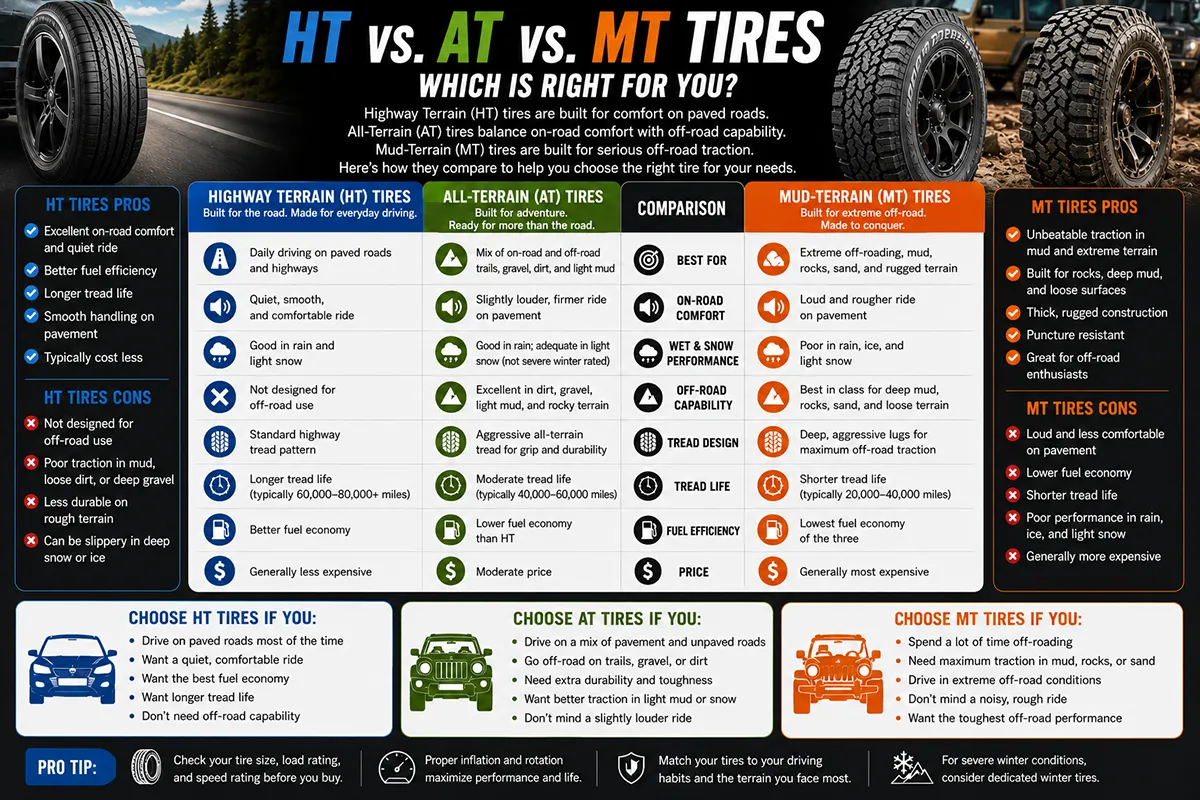
- HT (Highway Terrain): Best for daily drivers who rarely leave pavement. Smooth, quiet, fuel-efficient, and long-lasting.
- AT (All-Terrain): The versatile middle ground. Handles light off-road trails and still performs well on highways.
- MT (Mud-Terrain): Built for serious off-road use. Aggressive tread, loud on highways, and wears faster on pavement.
- My recommendation: If 80%+ of your driving is on-road, go HT. If you hit trails on weekends, go AT. Only go MT if you regularly tackle mud, rocks, and rugged terrain.
Liked this article?
Add TireAdvise as a preferred source so you see more of our tire reviews and guides on Google.
What Do HT, AT, and MT Actually Stand For?
Before I dive into my real-world testing impressions, let’s clear up the basics. These three-letter codes refer to the intended terrain each tire is designed to handle best.
**HT stands for Highway Terrain.** These are the tires your truck likely came with from the factory. They’re engineered for smooth, paved roads and prioritize comfort, low noise, and fuel efficiency.
**AT stands for All-Terrain.** Think of these as the Swiss Army knife of truck tires. They’re designed to perform reasonably well both on pavement and off-road, with a more aggressive tread pattern than HTs but not as extreme as MTs.
**MT stands for Mud-Terrain.** These are the beasts — big, chunky tread blocks designed to claw through mud, sand, rocks, and just about anything nature throws at you. They look intimidating, and they perform that way off-road.
My Experience Testing All Three Tire Types
Over the past several years, I’ve had the chance to run HT, AT, and MT tires on my personal trucks and test vehicles. I currently rotate between a half-ton pickup that handles my daily commute and a lifted three-quarter-ton that sees trail duty on weekends.
I’ve driven each tire type through Texas heat, Pacific Northwest rain, Colorado mountain passes, and the pothole-ridden highways of the Midwest. So when I tell you there are meaningful differences between these categories, I’m not pulling from spec sheets — I’m pulling from seat time.
Let me walk you through what I found in each category.
Highway Terrain (HT) Tires: The Commuter’s Best Friend
If you use your truck the way most Americans do — commuting to work, hauling groceries, towing a trailer a few times a year — highway terrain tires are almost certainly your best bet. I know they’re not as exciting as aggressive all-terrains or gnarly mud-terrains, but they do their job exceptionally well.
On-Road Performance
When I ran a set of HT tires on my daily driver, the difference in ride quality compared to the all-terrains I’d previously been running was immediately noticeable. Within the first few days, I realized how much road noise I’d been living with unnecessarily.
HT tires have a tightly packed tread pattern with smaller, closely spaced tread blocks. This design creates a larger contact patch with the road, which translates to better grip on dry and wet pavement, more predictable handling, and a significantly quieter ride.
During my test period with the Cooper Discoverer HTP II, I was genuinely impressed by how car-like the ride felt in a full-size truck. Braking distances were shorter, highway stability was excellent at speed, and I could actually hear my radio at a normal volume.
Fuel Economy
This is where HT tires really shine compared to their AT and MT counterparts. Because of their lower rolling resistance and smoother tread design, I consistently saw better fuel economy with highway terrain tires.
During several weeks of mixed city and highway driving, I noticed a meaningful improvement in miles per gallon compared to running all-terrains. We’re not talking a trivial difference — over the course of a year, the fuel savings alone can offset a significant chunk of the tire’s purchase price.
Tread Life
Highway terrain tires generally last the longest of the three types. The rubber compounds are optimized for pavement, and the even tread pattern promotes consistent wear.
Many HT tires come with treadwear warranties of 60,000 to 80,000 miles. Some premium options, like the Michelin Defender LTX M/S, even promise higher. In my experience, if you keep up with rotations and alignments, HT tires deliver on those promises.
Where HT Tires Fall Short
The obvious weakness is off-road capability. I took my truck with HT tires down a moderately rutted dirt road after a rainstorm, and it was clear these tires weren’t designed for that scenario. Traction was limited, the tires struggled to self-clean, and I found myself being overly cautious.
If you need to handle anything beyond a dry gravel road, HT tires will leave you wanting more.
All-Terrain (AT) Tires: The Do-Everything Compromise
All-terrain tires are by far the most popular upgrade for truck and SUV owners, and after spending extensive time on multiple sets, I completely understand why. They offer a compelling blend of on-road manners and off-road capability that fits the lifestyle of most American truck owners.
On-Road Performance
Here’s the truth that surprised me when I first tested modern all-terrain tires: they’ve gotten really, really good on pavement. The gap between AT and HT tires on-road has narrowed significantly in the past decade.
When I installed a set of Falken Wildpeak AT3W tires on my truck, the on-road experience was remarkably composed. Yes, there was slightly more road noise than the HT tires I’d been running, but it was a low hum rather than an annoying drone. After a few days, my brain filtered it out entirely.
Wet traction was also impressive. The deeper sipes and wider grooves that give AT tires their off-road bite also channel water effectively. During heavy rain on Texas highways, I felt confident and planted.
Off-Road Performance
This is where all-terrain tires earn their keep. I’ve taken AT-equipped trucks through sandy washes in Arizona, muddy Forest Service roads in Oregon, and rocky trails in Colorado. In each scenario, the tires provided noticeably more grip and confidence than any highway terrain tire ever could.
The wider tread voids between the lugs allow AT tires to dig into loose surfaces and self-clean — meaning mud and dirt get flung out of the tread as the tire rotates instead of packing in and turning your tires into slicks.
During one particularly memorable weekend on a trail outside Moab, my truck with Toyo Open Country AT III tires handled moderate rock crawling and sand with surprising composure. I wasn’t pushing the limits of what an MT tire could handle, but I also wasn’t worried about getting stuck.
Fuel Economy
You will pay a fuel economy penalty compared to HT tires. In my experience, running all-terrain tires typically costs me a noticeable amount at the pump compared to highway terrains. The more aggressive the tread, the higher the rolling resistance, and the more fuel you burn.
That said, the penalty is manageable for most budgets, and I consider it a worthwhile trade for the added versatility.
Tread Life
Modern AT tires have made major strides in longevity. Many premium options now carry treadwear warranties in the 50,000 to 65,000-mile range. The BFGoodrich KO2, one of the most iconic AT tires on the market, comes with a 50,000-mile warranty and in my experience delivers right around that number with proper maintenance.
Expect slightly faster wear than HT tires, but nothing that should scare you off.
Where AT Tires Fall Short
All-terrain tires are a compromise by design, which means they don’t excel in any single area the way HT or MT tires do in their respective domains. In deep mud, they’ll eventually reach their limit. On the highway, they’ll never be quite as quiet or fuel-efficient as a dedicated highway tire.
If you need the absolute best performance in one specific environment, an AT tire isn’t the answer. But if you need solid performance across many environments, it’s hard to beat.
Mud-Terrain (MT) Tires: Built for the Wild
Mud-terrain tires are the most aggressive, most visually striking, and most specialized option in this comparison. I have a love-hate relationship with them, and I think you’ll understand why after reading this section.
Off-Road Performance
Let me start with what MT tires do best, because when they’re in their element, they are absolutely incredible.
I ran a set of Nitto Trail Grappler M/T tires on my lifted truck during a week of trail riding in the Ozarks. The trails were a mix of thick clay mud, creek crossings, loose rock, and steep inclines. These tires ate it all for breakfast.
The massive tread blocks — some nearly an inch deep — bite into soft surfaces with authority. The wide channels between the lugs mean that even the stickiest mud gets ejected quickly, so the tire keeps finding fresh grip. And the reinforced sidewall lugs provided extra traction on off-camber sections where the sidewall was the primary contact point.
In deep mud, the difference between an AT and an MT tire is night and day. Where my AT tires would start spinning and searching for traction, the MT tires would dig in and pull through.
On-Road Performance
And here’s where the love-hate relationship begins. Mud-terrain tires on pavement are, frankly, a compromise I wouldn’t recommend for most people.
After several days of highway driving on my MT-equipped truck, I was genuinely fatigued by the road noise. It’s a constant, aggressive hum that increases with speed. At highway velocities, I found myself cranking the stereo volume higher than I’d like just to hold a conversation.
Handling on wet pavement also concerned me. The wide tread voids that are so effective off-road reduce the tire’s contact patch on smooth surfaces. During a few hard stops on rain-slicked roads, I noticed longer braking distances compared to my AT tires. It wasn’t dangerous, but it was enough to make me more cautious.
Fuel Economy
This is the biggest hit. Mud-terrain tires are heavy, and their aggressive tread creates significant rolling resistance. During my test period, my fuel economy dropped substantially compared to both HT and AT tires. If you’re daily driving an MT-equipped truck, you will feel it in your wallet every single week.
Tread Life
MT tires generally wear faster on pavement than either HT or AT options. The soft, aggressive rubber compounds that provide off-road grip are less resistant to the constant friction of highway driving.
Most MT tires don’t come with treadwear warranties at all, or if they do, they’re significantly shorter than AT equivalents. In my experience, you’ll get noticeably less life from a set of mud-terrains used primarily on pavement compared to all-terrains.
However — and this is important — if you’re actually using MT tires in off-road conditions, the thick tread depth means they can handle a lot of abuse from rocks, roots, and rough terrain before wearing down to a concerning level.
Where MT Tires Fall Short
Daily driving comfort, fuel economy, road noise, wet pavement traction, and tread life on pavement. That’s a long list of compromises, which is why I only recommend MT tires to people who genuinely need them.
If you’re running trails every weekend, crawling rocks competitively, or regularly encountering deep mud on your property or at job sites, MT tires are the right tool. But if you’re buying them because they look cool on your mall-crawler, you’re signing up for a lot of daily discomfort.
HT vs AT vs MT: Head-to-Head Comparison Table
| Feature | HT (Highway) | AT (All-Terrain) | MT (Mud-Terrain) |
|---|---|---|---|
| Highway Comfort | ⭐⭐⭐⭐⭐ | ⭐⭐⭐⭐ | ⭐⭐ |
| Road Noise | Very Quiet | Moderate | Loud |
| Fuel Economy | Best | Good | Worst |
| Tread Life (On-Road) | 60,000–80,000 mi | 50,000–65,000 mi | 30,000–40,000 mi |
| Dry Pavement Grip | ⭐⭐⭐⭐⭐ | ⭐⭐⭐⭐ | ⭐⭐⭐ |
| Wet Pavement Grip | ⭐⭐⭐⭐⭐ | ⭐⭐⭐⭐ | ⭐⭐⭐ |
| Mud Traction | ⭐ | ⭐⭐⭐ | ⭐⭐⭐⭐⭐ |
| Rock Crawling | ⭐ | ⭐⭐⭐ | ⭐⭐⭐⭐⭐ |
| Sand Performance | ⭐⭐ | ⭐⭐⭐⭐ | ⭐⭐⭐⭐⭐ |
| Snow/Ice (No Studs) | ⭐⭐⭐ | ⭐⭐⭐⭐ | ⭐⭐⭐ |
| Average Price (LT 275/70R18) | $180–$250/tire | $220–$310/tire | $280–$400/tire |
Which Tire Type Is Best for Snow and Winter Driving?
This is a question I get constantly from readers in the northern states, and the answer might surprise you.
All-terrain tires are generally the best performers in snow among these three categories. Many popular AT tires — including the Falken Wildpeak AT3W and the Toyo Open Country AT III — carry the Three-Peak Mountain Snowflake (3PMSF) symbol, which means they’ve been tested and certified for severe snow conditions.
The siping on AT tires provides excellent grip on packed snow and light ice. During a winter drive through a snowstorm in Wyoming, I felt more confident on my AT tires than I ever had on highway terrains in similar conditions.
MT tires can be decent in deep, unplowed snow — their aggressive lugs dig in similarly to how they dig into mud. But on packed snow and ice, the reduced contact patch actually hurts them. I found my MT-equipped truck sliding more on icy roads than when I had AT tires mounted.
HT tires are the weakest in snow, though some newer models with aggressive siping (like the Michelin Defender LTX M/S) perform surprisingly well in light winter conditions.
If you live somewhere that sees regular snow, an all-terrain tire with the 3PMSF rating is the sweet spot for year-round use without needing a dedicated winter set.
Cost Comparison: What You’ll Actually Pay
Let’s talk dollars, because tire purchases are significant investments. I’ll use a common size — LT 275/70R18 — as a reference point, since it fits many popular half-ton and three-quarter-ton trucks.
Highway Terrain Costs
You can expect to pay between $180 and $250 per tire for a quality HT option. A full set of four, mounted and balanced at a shop like Discount Tire or Tire Rack, will typically run you between $850 and $1,200 installed.
The longer tread life means your cost-per-mile is the lowest of the three types.
All-Terrain Costs
AT tires typically run $220 to $310 per tire in this size. A full set installed will cost roughly $1,050 to $1,450. You’re paying a premium for the added off-road capability, but I think it’s justified for most truck owners who actually use their vehicles.
Mud-Terrain Costs
MT tires are the most expensive option, ranging from $280 to $400+ per tire. A full set installed can easily hit $1,400 to $1,900. Factor in the shorter tread life and increased fuel consumption, and the total cost of ownership for MT tires is significantly higher than either alternative.
I always tell readers: be honest about your needs before spending MT money. If you’re not regularly off-roading in conditions that demand them, that $400–$700 difference between an AT and MT set could be spent on other upgrades or simply saved.
The “Aggressive AT” Option: A Fourth Category Worth Knowing
Over the past few years, I’ve noticed tire manufacturers creating a sort of unofficial fourth category that I call “aggressive all-terrains.” These tires blur the line between AT and MT, offering more off-road bite than a standard AT while maintaining better on-road manners than a true MT.
Examples include the Toyo Open Country R/T Trail, the Nitto Ridge Grappler, and the Falken Wildpeak R/T01. I’ve spent time on both the Ridge Grappler and the R/T Trail, and I think they’re fantastic options for people who want more off-road capability without going full mud-terrain.
The road noise on these aggressive ATs is louder than a standard AT but noticeably quieter than a true MT. Off-road, they handle moderate mud and rocks impressively well. And fuel economy falls right between AT and MT, as you’d expect.
If you’re reading this article and thinking “I want more than an AT but less than an MT,” this hybrid category might be your perfect match.
How to Decide: A Simple Framework
After testing all three tire types extensively, here’s the framework I use when advising friends, family, and readers:
Choose HT Tires If:
- 90–100% of your driving is on paved roads
- You prioritize ride comfort and low cabin noise
- Fuel economy matters to your budget
- You want the longest possible tread life
- Your idea of “off-road” is an occasional gravel parking lot
Choose AT Tires If:
- You split your driving between pavement and unpaved roads
- You go camping, hunting, fishing, or trail riding a few times a month
- You want year-round versatility, including winter capability
- You want a more aggressive look without major comfort sacrifices
- You need a tire that can handle unexpected conditions (dirt roads, construction sites, ranch work)
Choose MT Tires If:
- You regularly drive through deep mud, rocky trails, or extreme off-road terrain
- Your truck is a dedicated trail rig or weekend wheeler
- You’re willing to accept road noise, shorter tread life, and worse fuel economy
- You need maximum off-road traction and sidewall durability
- You work in industries (logging, mining, ranching) where conditions demand extreme tires
My Top Picks in Each Category for 2024–2025
Based on my hands-on experience and testing, here are the specific tires I’d recommend in each category right now:
Best Highway Terrain Tire: Michelin Defender LTX M/S
This tire has been a benchmark in the HT category for years, and for good reason. The ride quality is superb, the tread life is class-leading, and wet traction is outstanding. It’s not cheap, but the longevity makes it an excellent value over time. I’ve recommended this tire to dozens of people, and I’ve never heard a complaint.
Best All-Terrain Tire: Falken Wildpeak AT3W
In my opinion, this is the best value in the AT category right now. It carries the 3PMSF snow rating, delivers confident off-road traction, and rides surprisingly quietly on the highway. The price point is also competitive — often $20–$40 less per tire than comparable options from BFGoodrich or Toyo. After running a set through an entire season of mixed driving, I was thoroughly impressed.
Best Mud-Terrain Tire: BFGoodrich KM3
The KM3 replaced the legendary KM2 and improved on it in every way. I tested these on a weekend-warrior build and was blown away by the mud traction and rock grip. They’re also more livable on pavement than I expected for an MT tire — the road noise is present but not unbearable. If you need a true mud-terrain tire, this is the one I reach for.
Best Aggressive AT (Hybrid): Nitto Ridge Grappler
For the person who wants the best of both worlds, the Ridge Grappler is my go-to recommendation. It looks aggressive, performs well off-road, and doesn’t punish you on the highway. After spending several weeks with a set, I found myself wishing more manufacturers would invest in this hybrid category.
Common Mistakes to Avoid
I’ve seen a lot of truck owners waste money by choosing the wrong tire type. Here are the most common mistakes I encounter:
Buying MT tires for looks alone. I understand the appeal — mud-terrains look incredible on a lifted truck. But if you’re never going off-road, you’re paying a premium in purchase price, fuel costs, road noise, and tread life for aesthetics. An aggressive AT will give you a similar look with far fewer compromises.
Sticking with HT tires when you’ve outgrown them. If you’ve started camping, hunting, or exploring dirt roads more frequently, your factory HT tires might not be cutting it. I’ve talked to readers who’ve gotten stuck on Forest Service roads with HT tires when a basic AT would have sailed through.
Ignoring tire size when comparing categories. If you’re also upsizing your tires when switching from HT to AT or MT, keep in mind that the larger size itself will affect fuel economy, speedometer accuracy, and potentially your warranty. Compare apples to apples when evaluating the tire type itself versus the impact of sizing up.
Neglecting maintenance. Regardless of which type you choose, proper tire pressure, regular rotations, and alignment checks will dramatically extend the life of your investment. I’ve seen AT tires last as long as HT tires when meticulously maintained, and I’ve seen HT tires wear out prematurely when neglected.
Real-World Driving Scenarios: What I’d Choose
Let me paint a few real-world scenarios based on conversations I’ve had with readers:
Scenario 1: Suburban dad with an F-150 who commutes 45 minutes each way and tows a boat twice a summer. I’d recommend HT tires without hesitation. The Michelin Defender LTX M/S or the Continental TerrainContact H/T would be perfect.
Scenario 2: Weekend warrior with a Tacoma who hits trails in Moab or Big Bend a few times a year. AT tires all day. The Falken Wildpeak AT3W or the BFGoodrich KO2 will handle the trails and keep you comfortable on the drive out and back.
Scenario 3: Ranch worker in East Texas who drives through muddy pastures daily. This is an MT tire buyer. The constant mud exposure demands the self-cleaning capability and deep tread that only a mud-terrain can provide. I’d go with the BFGoodrich KM3 or the Toyo Open Country M/T.
Scenario 4: Colorado driver who sees everything — highway commuting, mountain passes, occasional fire roads, and heavy snow. A 3PMSF-rated all-terrain is the clear winner. The Falken Wildpeak AT3W or the Toyo Open Country AT III would be my first choices.
Final Thoughts: Be Honest About Your Driving
The single most important piece of advice I can give you is this: be brutally honest about how you actually use your truck, not how you wish you used it.
I’ve made this mistake myself. Years ago, I slapped a set of mud-terrain tires on my daily driver because I thought I’d be hitting trails every weekend. The reality? I went off-road maybe three times that year and spent the rest of my driving time dealing with road noise, poor fuel economy, and faster-than-expected tread wear. Lesson learned.
For
Frequently Asked Questions
What is the difference between HT, AT, and MT tires?
HT (Highway Terrain) tires are designed for on-road comfort, fuel efficiency, and long tread life on paved surfaces. AT (All-Terrain) tires split the difference with a more aggressive tread pattern that handles both highways and moderate off-road trails. MT (Mud-Terrain) tires feature the most aggressive tread blocks and sidewall lugs, built specifically for serious off-road use in mud, rocks, and sand but sacrificing road noise and tread wear on pavement.
Are all-terrain tires good for daily driving on highways?
Yes, modern AT tires like the BFGoodrich KO2 and Falken Wildpeak AT3W are engineered to perform well as daily drivers on US highways while still offering off-road capability. You will notice slightly more road noise and marginally lower fuel economy compared to HT tires, but most drivers find the trade-off worthwhile for the added versatility. Many AT tires also carry the 3-Peak Mountain Snowflake rating, making them a solid year-round option in states that see winter weather.
How much more do MT tires cost compared to HT and AT tires?
In the US market, HT tires typically range from $120 to $200 per tire for popular sizes, while AT tires usually run $150 to $250 per tire. MT tires are the most expensive, often costing $200 to $350 or more per tire depending on the brand and size. Beyond the purchase price, MT tires also wear faster on pavement and reduce fuel economy, so the total cost of ownership is significantly higher.
Can I use mud-terrain tires as my everyday tires?
You can, but I would not recommend it unless you spend a significant amount of time off-road. MT tires produce noticeably louder road noise at highway speeds, wear down faster on asphalt, and typically reduce your fuel economy by 1-3 MPG compared to HT or AT tires. If you only go off-road occasionally, a quality AT tire will handle most trails while being far more comfortable and economical for your daily commute.
Which tire type lasts the longest — HT, AT, or MT?
HT tires generally offer the longest tread life because their rubber compounds and tread patterns are optimized for paved roads, with many models rated for 60,000 to 80,000 miles. AT tires typically last between 40,000 and 60,000 miles depending on driving habits and the specific model. MT tires have the shortest lifespan on pavement, often wearing out between 20,000 and 40,000 miles due to their softer rubber compounds and aggressive tread blocks.
Are HT tires or AT tires better for snow and winter driving?
For snow and winter conditions, AT tires generally outperform HT tires thanks to their deeper tread patterns and wider channels that help evacuate snow and slush. Many popular AT tires sold in the US, such as the Toyo Open Country AT3 and Cooper Discoverer AT3 4S, carry the 3PMSF severe snow rating. HT tires can struggle in moderate to heavy snow, so if you live in a state with harsh winters and do not want to run dedicated winter tires, an AT tire is the better all-season choice.
What is the best tire type for a truck used for both commuting and weekend off-roading?
For most US truck owners who split time between highway commuting and weekend trail riding, an all-terrain tire is the ideal balance. AT tires from brands like BFGoodrich, Nitto, and Falken deliver solid off-road traction on dirt roads, gravel, and light mud without punishing you with excessive noise or poor fuel economy during the work week. I would only step up to MT tires if your off-road adventures regularly involve deep mud, rock crawling, or other extreme terrain that demands maximum grip.
