

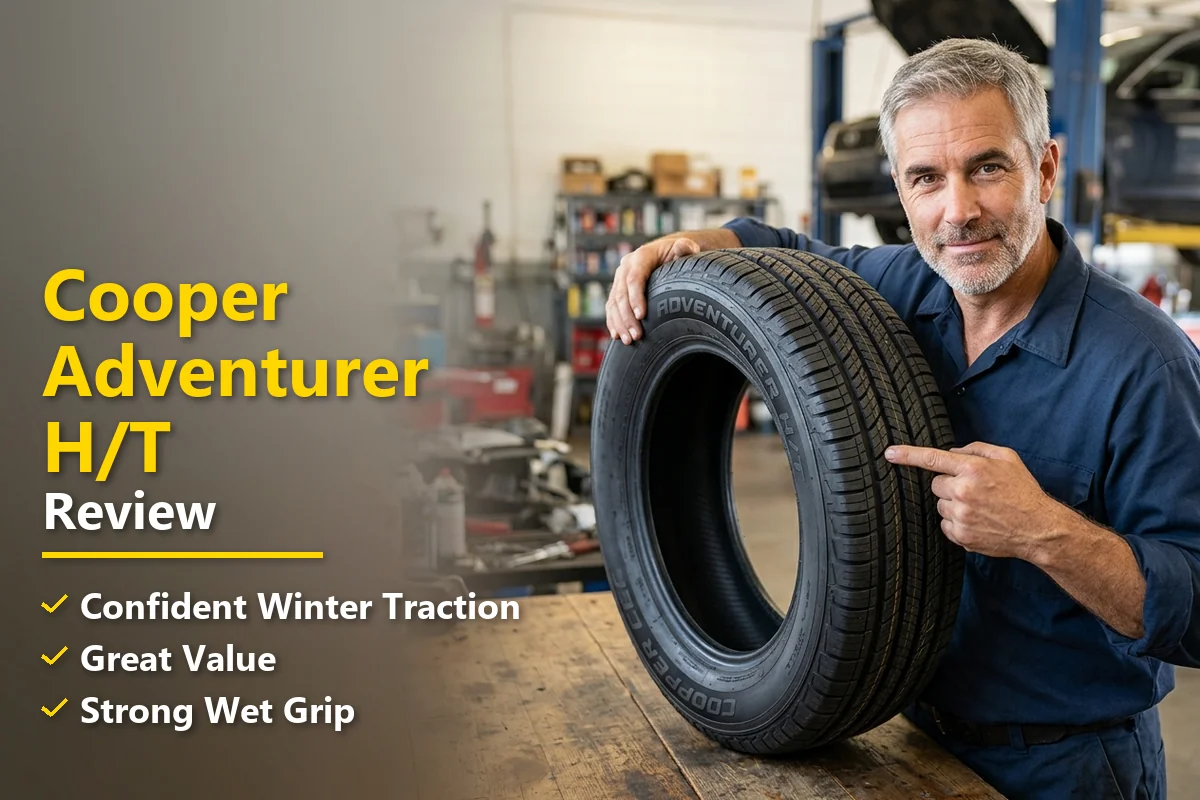
If you’ve ever stood in the tire aisle at Walmart or scrolled through Tire Rack’s listings thinking, “Do I really need to spend $200 per tire just to get something decent?” — you’re not alone.
The Cooper Adventurer H/T sits in that tempting sweet spot where the price tag won’t make you wince, but the brand name still carries some credibility. I wanted to find out if this tire actually delivers where it counts — or if it’s just a budget option dressed up in a respectable name.
After spending a serious amount of time with these tires on my SUV, I’m ready to break it all down for you. If you’re still getting familiar with Cooper as a brand before committing to a set, my Cooper tires review gives you the full brand picture first.
- The Cooper Adventurer H/T is a budget-friendly highway all-season tire best suited for SUVs, crossovers, and light trucks.
- Dry traction and ride comfort are genuinely impressive for the price point.
- Wet performance is adequate but not confidence-inspiring in heavy downpours.
- Tread life appears solid early on — Cooper backs it with a 65,000-mile treadwear warranty.
- Snow and ice performance is minimal — don’t rely on these as winter tires.
- Best for: budget-conscious drivers who primarily commute on highways and suburban roads in mild to moderate climates.
Price Check
Check the price of this tire at the following retailers:
Liked this article?
Add TireAdvise as a preferred source so you see more of our tire reviews and guides on Google.
What Exactly Is the Cooper Adventurer H/T?
The Cooper Adventurer H/T is an all-season highway terrain tire designed primarily for SUVs, crossovers, and light trucks. It’s part of Cooper’s more affordable Adventurer lineup, which is positioned below their premium Discoverer series.
Cooper — now a wholly-owned subsidiary of Goodyear since 2021 — has long been known as the “value play” in the American tire market. The Adventurer H/T is essentially their answer to drivers who want a reliable all-season tire without crossing into premium territory pricing.
You’ll find these tires predominantly at Walmart, which has been a primary retail partner for the Adventurer line. They’re available in a wide range of popular sizes, from 16-inch fitments all the way up to 20-inch for larger SUVs and trucks.
First Impressions Out of the Box
When I first pulled the Cooper Adventurer H/T out of the packaging, I noticed the tread pattern immediately. It has a fairly conventional symmetric design with four circumferential grooves and a good number of lateral sipes cut into the tread blocks.
The rubber compound felt reasonably firm to the touch — not the soft, almost sticky compound you’d find on a premium touring tire, but not rock-hard either. It sits somewhere in the middle, which told me Cooper was trying to balance tread life with grip.
The sidewall construction looked straightforward. There’s no aggressive shoulder lugs or any pretense that this is an off-road capable tire. It’s a highway tire through and through, and Cooper doesn’t try to oversell what it is. I actually appreciate that honesty.
Installation and Mounting
I had the Adventurer H/T tires mounted and balanced at a local tire shop. The technician mentioned they went on the rims without any issues — no bead seating problems, no unusual stiffness during mounting. Sometimes budget tires can be a headache during installation, but these were cooperative.
After balancing, only minimal weight was needed, which is generally a sign of decent manufacturing consistency. I drove off the lot and immediately started paying attention to how they felt compared to the factory tires I’d been running.
Dry Performance: Where These Tires Shine
Let me start with the good news: the Cooper Adventurer H/T performs admirably on dry pavement. This is where I was genuinely impressed, especially considering the price point.
During my initial test period over the first several days, I put these tires through a mix of highway commuting, suburban stop-and-go driving, and a few spirited on-ramp entries to test lateral grip. On dry roads, the tire feels planted and predictable.
Highway Stability
At highway speeds — I’m talking 65 to 75 mph on Texas interstates — the Adventurer H/T tracks straight and true. There’s very little wandering, and the tire responds well to subtle steering inputs when changing lanes.
I didn’t experience any vagueness in the steering feel, which is something that cheaper tires often struggle with. The center rib of the tread pattern does a good job of maintaining consistent contact with the road surface, and it shows.
Cornering and Lateral Grip
Now, I’m not going to pretend I was pushing these tires to their absolute limits on a track — that’s not what they’re built for. But during normal driving, including highway exit ramps and winding suburban roads, the lateral grip felt secure.
The tire does start to lose composure if you push it hard into a corner at speed, with a gradual and predictable slide rather than a sudden breakaway. For an everyday driver, this is actually what you want — the tire communicates its limits before exceeding them.
Braking on Dry Surfaces
I performed several hard braking tests from highway speeds on dry pavement. The Adventurer H/T stopped in distances that felt competitive with tires costing significantly more.
There was no dramatic pulling to one side, and the ABS engagement felt smooth and controlled. Dry braking is probably where this tire punches above its weight class the most.
Wet Performance: The Weak Spot
Here’s where the Cooper Adventurer H/T shows its budget roots most clearly. Wet performance is adequate — I want to be fair — but it’s not going to inspire confidence if you regularly drive in heavy rain.
Light to Moderate Rain
In light rain and on damp roads, the tire performs reasonably well. The four circumferential grooves do their job of channeling water away from the contact patch, and I didn’t experience any sudden loss of traction during normal driving on wet surfaces.
Braking distances on wet roads were longer than on dry pavement — which is expected for any tire — but they fell within an acceptable range for this price category.
Heavy Rain and Standing Water
This is where I noticed the biggest difference between the Adventurer H/T and more premium options I’ve tested. During heavy downpours, the tire’s hydroplaning resistance dropped noticeably.
At speeds above 55-60 mph in heavy rain, I could feel the front end getting light, suggesting the tire was losing contact with the road surface. I found myself naturally reducing speed more than I would with a premium all-season tire like the Michelin Defender or Continental CrossContact.
The sipe design, while adequate for light moisture, doesn’t evacuate large volumes of water as effectively as tires with more aggressive void patterns. If you live somewhere with frequent heavy rain — I’m thinking Gulf Coast states, the Pacific Northwest, or the Southeast — this is worth serious consideration.
Ride Comfort and Noise: Pleasantly Surprising
I’ll be honest — I expected the ride quality to be mediocre given the price point. I was wrong.
Noise Levels
The Cooper Adventurer H/T is a quiet tire. On smooth highway surfaces, road noise is well-suppressed and the cabin stays comfortable. I drove on freshly paved interstate as well as rougher secondary highways, and the tire kept noise to a minimum in both scenarios.
On coarse-chip pavement — the kind of rough surface you find on some rural Texas roads — the noise did increase, but it was a low-frequency hum rather than the aggressive drone you get from cheaper tires. It’s the kind of sound you can easily talk over.
Ride Quality
The Adventurer H/T does a solid job of absorbing small road imperfections. Expansion joints, small potholes, and rough patches are handled with a muted thump rather than a jarring impact.
The sidewall has enough compliance to smooth out the road without feeling mushy or disconnected. I was genuinely impressed by the comfort level, and I’d say it’s competitive with tires costing $30-40 more per tire.
I took the SUV on a longer road trip — several hours of continuous highway driving — and arrived without the kind of fatigue that harsh, noisy tires can cause. The Adventurer H/T is a comfortable cruiser, and this might be its single strongest selling point.
Snow and Ice Performance: Don’t Count On It
I want to be very direct here: the Cooper Adventurer H/T is not a winter tire, and its performance on snow and ice reflects that.
During a brief cold snap where I encountered some light snow and icy patches, the tire struggled noticeably. Traction on packed snow was poor, and I found myself relying heavily on my vehicle’s traction control system to maintain forward progress.
On ice, the tire was essentially helpless — but that’s true of virtually every all-season highway tire in this category. If you live in a region with regular winter weather, you absolutely need a dedicated set of winter tires. The Adventurer H/T won’t cut it.
The tire doesn’t carry the three-peak mountain snowflake (3PMSF) symbol, which tells you everything you need to know about Cooper’s own confidence in its winter capability. It has the M+S (mud and snow) rating, but that designation is so broad as to be nearly meaningless in real-world winter conditions.
Tread Life and Durability
Cooper offers a 65,000-mile treadwear warranty on the Adventurer H/T, which is competitive for a tire in this price bracket. The UTQG treadwear rating is 680, placing it in solidly average territory.
After several weeks of mixed driving — highway commuting, city errands, and one longer road trip — I examined the tread wear pattern carefully. Wear appeared even across the full tread face, which is a good sign for long-term tread life. I didn’t see any unusual cupping, feathering, or accelerated wear on the shoulder blocks.
Of course, actual tread life will vary enormously depending on your driving style, vehicle alignment, tire rotation habits, and road surfaces. I always recommend rotating your tires every oil change and keeping them properly inflated to maximize tread life on any tire.
The rubber compound feels like it’s designed to prioritize longevity over maximum grip, which is a reasonable trade-off for a highway touring tire. Drivers who maintain proper tire care habits should see solid life from these tires.
Pricing and Value Proposition
Let’s talk about what really matters for most shoppers — the price. The Cooper Adventurer H/T typically ranges from about $100 to $160 per tire depending on size, with most popular SUV sizes falling in the $115-$140 range.
At Walmart, which is the primary retail outlet for these tires, you can frequently find them on rollback pricing or bundled with installation deals. I’ve seen complete sets (four tires, mounted and balanced) come in under $600 for common sizes, which is remarkably affordable.
Here’s how the Adventurer H/T stacks up against its closest competitors:
| Feature | Cooper Adventurer H/T | Hankook Dynapro HT | General Grabber HTS60 | Michelin Defender LTX M/S |
|---|---|---|---|---|
| Avg. Price (per tire) | $115–$140 | $120–$160 | $130–$170 | $180–$240 |
| Treadwear Warranty | 65,000 mi | 70,000 mi | 65,000 mi | 70,000 mi |
| Dry Performance | ★★★★☆ | ★★★★☆ | ★★★★☆ | ★★★★★ |
| Wet Performance | ★★★☆☆ | ★★★☆☆ | ★★★★☆ | ★★★★★ |
| Ride Comfort | ★★★★☆ | ★★★★☆ | ★★★★☆ | ★★★★★ |
| Snow/Ice | ★★☆☆☆ | ★★☆☆☆ | ★★★☆☆ | ★★★☆☆ |
| Noise Level | ★★★★☆ | ★★★☆☆ | ★★★★☆ | ★★★★★ |
| 3PMSF Rated | No | No | No | No |
As you can see, the Adventurer H/T competes closely with the Hankook Dynapro HT at a similar or slightly lower price. The General Grabber HTS60 offers better wet performance for a modest price increase. And the Michelin Defender LTX M/S remains the gold standard — but you’re paying significantly more for it.
The value proposition of the Adventurer H/T is clear: you get about 80% of the performance of premium tires at roughly 55-65% of the cost. Whether that trade-off works for you depends entirely on your priorities and driving conditions.
Who Should Buy the Cooper Adventurer H/T?
Based on my testing, I’d recommend the Cooper Adventurer H/T for the following types of drivers:
- Budget-conscious commuters who primarily drive on highways and well-maintained roads in dry or mildly wet conditions.
- SUV and crossover owners who need a reliable all-season tire without spending premium prices.
- Drivers in Sun Belt states — Texas, Arizona, California, Florida (outside of the rainy season), and similar climates where dry performance and comfort are the top priorities.
- Anyone replacing worn-out factory tires on a mid-range SUV or crossover and looking for a straightforward, no-nonsense replacement.
- Ride quality-sensitive drivers who want a comfortable, quiet tire for daily driving without paying Michelin prices.
Who Should Look Elsewhere?
I’d steer you away from the Cooper Adventurer H/T if:
- You live in heavy rain regions. If you’re in Seattle, Houston during hurricane season, or anywhere in the Southeast that sees frequent downpours, consider the General Grabber HTS60 or Continental CrossContact LX25 for better wet grip.
- You need winter capability. Anywhere with regular snowfall demands either a dedicated winter tire or at minimum an all-season with the 3PMSF rating.
- You want maximum tread life. While 65,000 miles is decent, competitors like the Michelin Defender LTX M/S offer better long-term durability.
- You tow frequently. The Adventurer H/T’s load ratings and construction aren’t optimized for regular towing. Look at the Cooper Discoverer HT3 or similar LT-rated tires instead.
- You drive aggressively. This is a comfort-oriented highway tire. If you want sporty handling and maximum grip, this isn’t your tire.
My Experience with Cooper’s Warranty and Support
Cooper’s warranty terms for the Adventurer H/T are straightforward and competitive. The 65,000-mile treadwear warranty covers premature wear, and there’s a uniformity guarantee for the first year or first 2/32nds of tread wear.
Since Goodyear acquired Cooper, warranty claims are handled through Goodyear’s network, which actually makes things easier for consumers. There are more service locations and a more streamlined claims process than Cooper offered independently.
I haven’t personally needed to make a warranty claim on these tires, but I’ve dealt with Goodyear’s warranty process on other products in the past, and it’s been reasonable — not effortless, but not the nightmare that some cheaper brands put you through.
One thing worth noting: if you buy these at Walmart, make sure you keep your receipt and register the tires. Walmart’s Road Hazard Protection is a separate add-on that’s worth considering for an extra $10-15 per tire, especially if you drive on rough roads regularly.
Cooper Adventurer H/T vs. Cooper Discoverer HT3: What’s the Difference?
I get this question a lot, so let me clarify. The Adventurer H/T is Cooper’s budget-tier highway tire, primarily sold through Walmart. The Discoverer HT3 is their premium highway tire, available through traditional tire dealers and online retailers.
The Discoverer HT3 offers better wet traction, a more robust construction (available in LT sizes), and is better suited for light-duty trucks and towing. It also costs $30-50 more per tire in comparable sizes.
If you’re driving a midsize crossover like a RAV4, CR-V, or Equinox and don’t tow, the Adventurer H/T is probably all you need. If you have a full-size truck or tow a boat or small trailer, step up to the Discoverer HT3 or an equivalent LT-rated tire.
Available Sizes
The Cooper Adventurer H/T comes in a solid range of sizes covering most popular SUVs and crossovers on American roads:
- 215/70R16
- 225/65R17
- 225/70R16
- 235/65R17
- 235/70R16
- 245/60R18
- 245/65R17
- 255/65R18
- 255/70R17
- 265/70R16
- 265/70R17
- 275/55R20
- 275/60R20
This covers the vast majority of popular vehicles including the Toyota RAV4, Honda CR-V, Ford Explorer, Chevrolet Equinox, Jeep Grand Cherokee, Ford F-150 (in some configurations), and many others.
If your specific size isn’t listed, double-check with your local Walmart tire center or the Cooper website, as sizes are occasionally added or discontinued.
Tips for Getting the Most Out of These Tires
Based on my experience with the Cooper Adventurer H/T, here are a few practical tips to maximize your investment:
Keep Them Properly Inflated
This might sound obvious, but tire pressure matters more on budget tires than on premium ones. Budget tires tend to have less forgiving construction, so running them underinflated can accelerate shoulder wear dramatically. Check your pressure at least once a month and always follow your vehicle’s recommended PSI — not the max PSI printed on the tire sidewall.
Rotate Religiously
I’d recommend rotating these every 5,000-7,500 miles, or at every oil change interval. Consistent rotation will help you get the most even wear pattern and maximize the life of the tread.
Avoid Aggressive Driving in Wet Conditions
Given that wet performance is this tire’s weakest area, adjust your driving style accordingly when it rains. Leave more following distance, reduce your speed, and avoid sudden lane changes on wet highways.
Consider an Alignment Check at Installation
If you’re replacing worn tires — especially if they wore unevenly — get an alignment before or during your new tire installation. It’s typically $80-100 at most shops and can save you hundreds in premature tire wear.
Final Verdict: Is the Cooper Adventurer H/T Worth Buying?
After extensive testing across a variety of conditions and road types, here’s my honest assessment of the Cooper Adventurer H/T:
It’s a solid, no-frills highway tire that delivers good value for budget-conscious drivers in mild climates.
The dry performance surprised me in a good way. The ride comfort exceeded my expectations. And the noise levels are genuinely impressive for a tire in this price bracket. These are real, tangible strengths that matter in everyday driving.
However, the wet performance limitations are real and worth acknowledging. If you live somewhere that sees significant rainfall, you’re making a meaningful compromise by choosing this tire over something like the General Grabber HTS60 or Continental CrossContact LX25 — both of which cost more but handle rain noticeably better.
And winter capability? Forget about it. This is a three-season tire at best, and that’s being generous. If you see snow more than once or twice a year, plan accordingly.
I’d give the Cooper Adventurer H/T a solid 3.7 out of 5 stars. It does what it promises to do at a price that makes it accessible to almost any budget. It won’t blow you away, but it also won’t let you down in the conditions it’s designed for.
For the driver who needs reliable daily transportation, doesn’t face extreme weather, and wants to keep tire costs manageable — the Cooper Adventurer H/T earns a recommendation from me. Just go in with realistic expectations, and you’ll be satisfied with what you get.
Frequently Asked Questions
Is the Cooper Adventurer H/T a good tire for everyday driving?
The Cooper Adventurer H/T is a solid all-season highway tire designed for SUVs, crossovers, and light trucks used primarily for daily commuting and highway cruising. It delivers a comfortable, quiet ride with dependable dry and wet traction that most everyday drivers will appreciate. For the price point, typically ranging from $130 to $180 per tire depending on size, it offers strong value compared to premium competitors.
How long does the Cooper Adventurer H/T last in real-world driving?
Cooper backs the Adventurer H/T with a 65,000-mile treadwear warranty, which is competitive for an all-season highway tire in this price range. In real-world driving across typical US road conditions, many owners report getting 50,000 to 60,000 miles with proper rotation every 5,000 to 7,000 miles. Tread life can vary depending on driving habits, alignment, and whether you frequently drive on rough or poorly maintained roads.
How does the Cooper Adventurer H/T perform in rain and wet conditions?
The Cooper Adventurer H/T features circumferential grooves and lateral notches designed to channel water away from the contact patch, providing reliable wet traction for highway and suburban driving. In moderate to heavy rain common across the US Southeast and Pacific Northwest, drivers generally report confident handling and shorter braking distances compared to budget alternatives. However, it is not a performance tire, so aggressive cornering on wet roads should still be approached with caution.
Can the Cooper Adventurer H/T handle light snow and winter driving?
The Cooper Adventurer H/T can manage occasional light snow and cold temperatures, but it does not carry the Three-Peak Mountain Snowflake (3PMSF) rating, so it is not recommended as a dedicated winter tire. If you live in states like Minnesota, Michigan, or Colorado where heavy snowfall is common, you will want a separate set of winter tires for the cold months. For mild winter conditions in the mid-Atlantic or Southern states, the Adventurer H/T should handle adequately with cautious driving.
How does the Cooper Adventurer H/T compare to the Michelin Defender LTX M/S?
The Michelin Defender LTX M/S is a premium highway all-season tire that generally outperforms the Cooper Adventurer H/T in tread life, wet braking, and ride refinement, but it also costs $40 to $70 more per tire. The Cooper Adventurer H/T closes the gap significantly for budget-conscious drivers who want reliable all-season performance without paying top dollar. If you prioritize value and plan to keep the tires for 50,000 to 60,000 miles, the Cooper is a smart alternative that delivers roughly 80% of the Michelin’s performance at a noticeably lower cost.
Is the Cooper Adventurer H/T noisy on the highway?
Road noise is one area where the Cooper Adventurer H/T performs well, with most drivers reporting a quiet and comfortable ride at highway speeds between 60 and 75 mph. Cooper engineered the tread pattern with variable pitch sequencing to reduce harmonic noise, which is noticeable on smooth asphalt. On coarser road surfaces common in northern US states, you may hear a slight hum, but overall cabin noise levels stay well within acceptable range for a tire in this category.
What SUV and truck sizes does the Cooper Adventurer H/T come in?
The Cooper Adventurer H/T is available in a wide range of popular sizes from 16 to 20 inches, covering most midsize and full-size SUVs and crossovers sold in the US, including the Toyota RAV4, Ford Explorer, Chevy Equinox, and Jeep Grand Cherokee. Common fitments include 225/65R17, 235/70R16, 245/60R18, and 265/50R20 among others. I recommend checking Cooper’s official size finder or your local tire shop to confirm the exact size for your vehicle before purchasing.
