

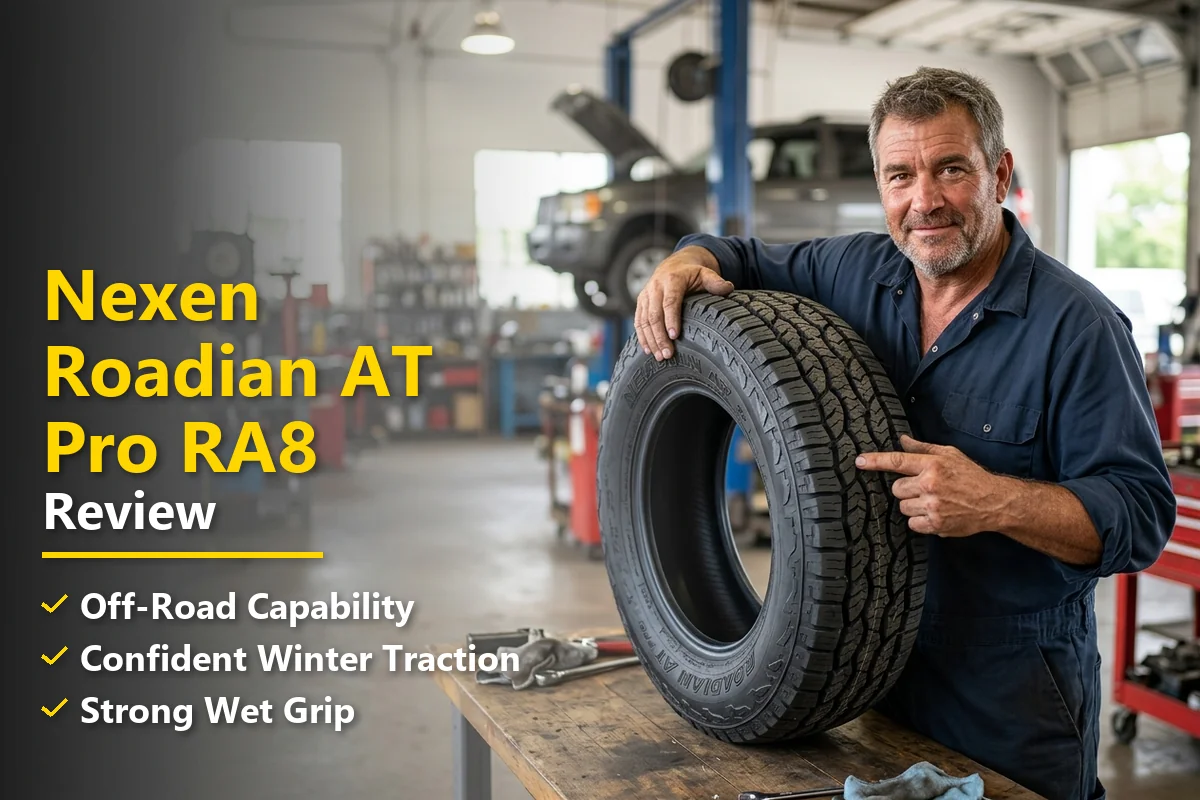
Finding an all-terrain tire that doesn’t destroy your wallet or your eardrums on the highway feels almost impossible. Most budget options compromise too much on road noise or wet grip, while the premium picks from BFGoodrich or Falken can push past $250 per tire for popular truck sizes.
That’s exactly the gap the Nexen Roadian AT Pro RA8 tries to fill — and after spending serious seat time with a set on my 2021 Toyota Tacoma, I can tell you it does a surprisingly good job.
If you’ve been exploring the brand, our comprehensive Nexen Tires Review covers their full lineup, but today I’m going deep on this specific all-terrain model.
- The Nexen Roadian AT Pro RA8 is a genuinely capable all-terrain tire at a budget-friendly price point — typically $130–$180 per tire depending on size.
- Highway comfort and noise levels impressed me more than expected; it’s quieter than many competitors in this price range.
- Off-road performance is competent on gravel, dirt, and light mud, though deep mud and rock crawling aren’t its strengths.
- Wet traction is solid thanks to the four wide circumferential grooves and 3D sipes.
- It carries the 3-Peak Mountain Snowflake (3PMSF) rating, making it a legitimate option for winter driving.
- Best for: daily drivers who want weekend off-road capability without sacrificing weekday comfort.
Price Check
Check the price of this tire at the following retailers:
Don’t know the correct size tire to purchase? Start here!
Liked this article?
Add TireAdvise as a preferred source so you see more of our tire reviews and guides on Google.
Who Is the Nexen Roadian AT Pro RA8 Built For?
Nexen designed the Roadian AT Pro RA8 for truck, SUV, and crossover owners who split their time between paved roads and light off-road trails. Think of the driver who commutes on the highway five days a week but hits forest service roads or unpaved campsites on weekends.
It’s available in a wide range of sizes — from 15-inch wheels all the way up to 22-inch — covering vehicles like the Ford F-150, Chevy Silverado, Toyota 4Runner, Jeep Wrangler, and Ram 1500. In my case, I ran the LT265/70R17 size, which is one of the most popular fitments for midsize trucks.
If you’re a hardcore rock crawler or mud bogger, this isn’t your tire. But if you need something that handles real-world mixed driving with confidence, the RA8 deserves a serious look.
First Impressions and Installation
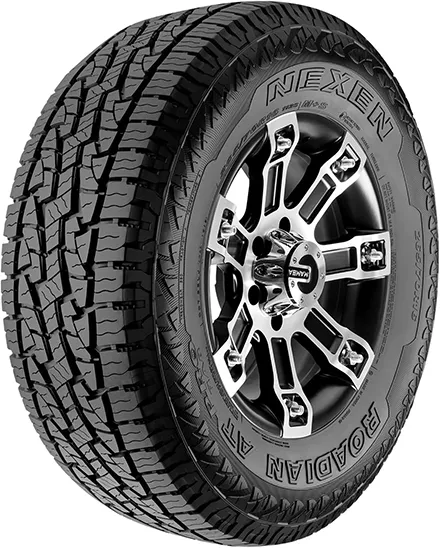
When I first pulled the RA8 out of the box, the tread pattern immediately caught my eye. It has an aggressive, blocky look with staggered shoulder lugs that give it a tough appearance without being obnoxiously loud-looking.
The sidewall features a subtle geometric design that adds some visual flair — my neighbor actually asked if I’d put on a set of BFGoodrich KO2s.
Installation at my local tire shop was straightforward. The technician mentioned the bead seated easily and the tires balanced without any issues. I noticed the ride felt slightly firmer than the stock Goodyear Wrangler SRAs I was replacing, but nothing harsh or uncomfortable.
Nexen Roadian AT Pro RA8: Key Features and Technology
Before I get into my real-world testing, let me break down the technology Nexen packed into this tire. Understanding what’s under the rubber helps explain why it performs the way it does.
Tread Compound and Design
The RA8 uses what Nexen calls an “all-weather” compound that’s engineered to stay pliable across a wide temperature range. The tread blocks are arranged in a variable pitch sequence, which is Nexen’s way of reducing pattern noise on the highway. I’ll get into how well that actually works shortly.
Four wide circumferential grooves channel water away from the contact patch, and the tread blocks themselves feature deep 3D sipes. These sipes create additional biting edges for wet and winter traction while maintaining block rigidity so the tire doesn’t feel squirmy during hard cornering.
Sidewall and Construction
The RA8 features a dual sidewall design — you get two different aesthetic options depending on which side faces out. One side has a more aggressive, rugged look while the other is cleaner and more street-oriented. I went with the aggressive side out because, well, why wouldn’t you?
The internal construction includes a two-ply polyester casing with two steel belts and a nylon cap ply. In LT sizes, you get a more robust construction for heavier loads and towing.
The stone ejectors between the tread blocks are another nice touch, preventing rocks from embedding in the grooves and potentially damaging the belts.
3-Peak Mountain Snowflake Certification
One of the RA8’s biggest selling points is its 3PMSF rating. This isn’t just an M+S (mud and snow) marking — the 3PMSF certification means the tire has been independently tested and proven to deliver a minimum level of traction in severe snow conditions.
For drivers in states like Colorado, Montana, or the upper Midwest, this is a meaningful feature that could eliminate the need for a dedicated winter tire set.
Highway Performance: Where I Spent Most of My Time
Let’s be honest — most all-terrain tires spend 90% of their lives on pavement. So highway performance matters more than anything else for the average buyer. I drove the RA8 extensively on Interstate highways, two-lane state roads, and suburban streets during my evaluation period.
Ride Comfort
The RA8 rides smoother than I expected for an all-terrain tire. Over expansion joints and rough pavement, it absorbs impacts well without transmitting harsh jolts into the cabin. It’s not as plush as a dedicated highway tire, but it’s far more comfortable than aggressive mud-terrains I’ve tested.
After several days of daily commuting — about 45 minutes each way on a mix of highway and surface streets — I never felt fatigued from a harsh ride. That’s a real-world benchmark that matters more than any lab test.
Road Noise
This is where the RA8 genuinely surprised me. I was expecting the typical all-terrain drone at highway speeds, but the variable pitch tread design actually works.
At 70 mph on smooth asphalt, the tire produces a low, steady hum that blends into the background. It’s noticeably quieter than the Falken Wildpeak AT3W I tested previously, though not quite as silent as the Continental TerrainContact A/T.
On coarse chip-seal pavement — the kind you find all over rural Texas and the Southwest — there’s more noise, as expected. But it never crossed the line into annoying territory, and I could hold normal conversations without raising my voice.
Dry Handling and Braking
On dry pavement, the RA8 feels planted and predictable. Turn-in response is decent for an all-terrain tire — there’s a slight initial softness as the tread blocks compress, but once the tire loads up, it holds its line well. I pushed it through highway on-ramps at spirited speeds and never felt a loss of confidence.
Braking performance was equally solid. During hard stops from 60 mph on dry pavement, the tires gripped consistently and the ABS didn’t intervene prematurely. This is an area where cheap tires often fall short, so I was pleased with the RA8’s stopping power.
Wet Performance
I drove through several heavy rainstorms during my test period, including one absolute downpour on I-35 where visibility dropped to about 100 yards.
The RA8 handled it with composure. I felt no hydroplaning tendencies at highway speeds, and the tires maintained strong grip through standing water on the road surface.
On wet curves, there’s good feedback through the steering wheel. The tire communicates its limits clearly — it doesn’t snap from grip to slip without warning. This progressive breakaway characteristic gives you confidence to drive normally in the rain rather than tiptoeing around.
Off-Road Performance: Gravel, Dirt, and Mud
Here’s where the rubber truly meets the trail. I took the RA8 through a variety of off-road conditions to see how well it lives up to the “all-terrain” label.
Gravel and Dirt Roads
On well-maintained gravel roads and packed dirt, the RA8 feels right at home. The staggered shoulder lugs bite into loose surfaces and provide excellent lateral stability.
I drove several miles of forest service roads in East Texas — the kind with loose gravel over hard-packed clay — and the tire tracked straight and true even at moderate speeds.
The stone ejectors do their job well. After a full day on gravel roads, I checked the tread and found minimal stone retention. This is important for long-term durability, as embedded stones can cause belt damage over time.
Mud Performance
Mud is where the RA8 starts to show its limitations — and honestly, this is expected for a tire in this category. In light to moderate mud, the tire clears well enough and maintains forward momentum.
The wide circumferential grooves help channel mud away from the contact patch, and the tread blocks are spaced far enough apart to provide reasonable self-cleaning.
However, in deep, thick mud — the kind that swallows your tire up past the tread — the RA8 struggles.
It packs up faster than a dedicated mud-terrain tire, and you’ll need to rely on momentum and lower tire pressures to get through. For occasional muddy trail encounters, it’s fine. For dedicated mud running, look elsewhere.
Sand and Loose Terrain
I aired down to about 20 psi and took the Tacoma onto a sandy wash area. The RA8 performed adequately, floating over the sand reasonably well once aired down. It’s not a sand-specific tire by any means, but for the occasional beach access road or sandy riverbed crossing, it’ll get the job done.
Rock and Trail Performance
On rocky trails with loose shale and moderate ledges, the RA8 provided decent grip and sidewall protection.
The shoulder lugs wrap slightly around the edge of the tread, giving some additional bite when the tire loads up on rocks. I didn’t attempt any serious rock crawling — this isn’t a KM3 or Trail Grappler — but for typical overlanding-style trails, it was more than capable.
Winter and Cold Weather Performance
The 3PMSF rating isn’t just marketing. I had the opportunity to drive the RA8 during a cold snap where temperatures dropped into the low 20s, and the compound remained noticeably pliable. On frosty morning roads, the tire gripped with confidence during acceleration and braking.
I didn’t get to test in deep snow during my evaluation, but based on the tread design, siping density, and the 3PMSF certification, I’m confident these tires would handle moderate snow with competence.
For drivers in the northern US who face occasional snow but don’t want dedicated winter tires, the RA8 is a legitimate year-round option.
Treadwear and Durability Observations
During my test period of several weeks of mixed driving, I observed even wear across the entire contact patch. There were no signs of irregular wear, cupping, or feathering. The tread depth barely showed measurable change, which bodes well for long-term durability.
Nexen backs the Roadian AT Pro RA8 with a 65,000-mile treadwear warranty on non-LT sizes and a 45,000-mile warranty on LT sizes.
That’s competitive with — and in some cases better than — more expensive competitors. Of course, real-world tread life depends heavily on alignment, tire pressure maintenance, driving style, and road conditions.
The rubber compound feels substantial and dense, not soft and gummy like some cheap tires that wear quickly. Based on my early observations, I’d expect solid tread life from this tire with proper maintenance.
Nexen Roadian AT Pro RA8 vs. Competitors
No review is complete without context. Here’s how the RA8 stacks up against three of its most common competitors in the all-terrain tire market.
| Feature | Nexen Roadian AT Pro RA8 | Falken Wildpeak AT3W | BFGoodrich KO2 | Toyo Open Country AT3 |
|---|---|---|---|---|
| Approx. Price (265/70R17) | $155–$175 | $180–$210 | $230–$260 | $190–$220 |
| 3PMSF Rated | Yes | Yes | Yes | Yes |
| Treadwear Warranty | 65,000 mi (P) / 45,000 mi (LT) | 55,000 mi | 50,000 mi | 65,000 mi |
| Highway Comfort | Very Good | Good | Good | Very Good |
| Road Noise Level | Low | Moderate | Moderate | Low |
| Off-Road Capability | Good | Very Good | Excellent | Very Good |
| Wet Traction | Very Good | Excellent | Good | Very Good |
| Best For | Value-focused daily drivers | All-around balance | Serious off-road use | Long-distance highway + trail |
vs. Falken Wildpeak AT3W
The Wildpeak AT3W is probably the RA8’s closest competitor in terms of all-around capability. In my experience, the Falken edges ahead in off-road grip — particularly in mud — and wet traction. However, the RA8 is noticeably quieter on the highway and costs $25–$40 less per tire. If your driving is 80%+ on-road, the RA8 is the smarter buy. If you lean more toward off-road adventures, spend the extra on the Falken.
vs. BFGoodrich KO2
The KO2 is the gold standard in all-terrain tires, and it deserves that reputation. It’s tougher, more capable off-road, and has legendary sidewall strength. But it’s also significantly more expensive — you’re looking at $75–$100+ more per tire.
For drivers who don’t need KO2-level off-road capability, the RA8 delivers 80% of the performance at 60% of the price. That’s a compelling value proposition.
The Toyo AT3 is an excellent tire that I rate highly. It matches the RA8 on highway comfort and exceeds it off-road. However, the price difference is meaningful — about $35–$50 per tire in comparable sizes.
The Toyo also has a slightly more refined steering feel on pavement. If budget isn’t your primary concern, the Toyo is the better tire. If you’re trying to save on a set of four, the RA8 won’t leave you wanting.
Pricing and Value
Let’s talk dollars, because for many buyers, this is the deciding factor. The Nexen Roadian AT Pro RA8 typically retails between $130 and $200 per tire depending on size, with the most popular truck sizes (265/70R17, 275/65R18, 275/60R20) falling in the $155–$185 range.
For a set of four in a common truck size, you’re looking at roughly $620–$740 before installation. Compare that to $800–$900 for Falken Wildpeak AT3Ws or $950–$1,050 for BFGoodrich KO2s in the same sizes.
That’s a savings of $150–$350 per set — real money that can go toward alignment, a tire protection plan, or just staying in your budget.
Nexen also frequently runs rebate promotions through retailers like Tire Rack, Discount Tire, and Walmart, where you can get an additional $50–$80 back on a set of four. Keep an eye out for these deals, especially during spring and fall tire-buying seasons.
What I Liked Most About the RA8
- Highway quietness: This is the RA8’s standout strength. For an all-terrain tire at this price point, the noise levels are remarkably low.
- Wet traction confidence: The four circumferential grooves and aggressive siping give this tire legitimate wet-weather credibility.
- Value for money: Dollar for dollar, it’s hard to find a better-equipped all-terrain tire. The 3PMSF rating, solid warranty, and overall performance make it a standout in the budget-to-midrange category.
- Aggressive looks: The dual sidewall design and staggered shoulder lugs give trucks and SUVs a rugged aesthetic that punches above its price class.
- Comfortable ride: It absorbs road imperfections better than many AT tires I’ve tested, even in LT sizing.
What Could Be Better
- Deep mud performance: This is the most obvious limitation. If you regularly encounter serious mud, you’ll want something more aggressive.
- Steering feel on dry pavement: There’s a slight vagueness around center that more premium tires like the Toyo AT3 avoid. It’s not a safety concern, but enthusiast drivers will notice it.
- Rock crawling protection: The sidewalls, while adequate for trail driving, don’t have the heavy-duty reinforcement you’d find on a KO2 or KM3. I’d be cautious on technical rock sections.
- Brand perception: Let’s be real — some truck owners are hesitant about running a Korean tire brand. Nexen has improved dramatically in quality over the past decade, but the stigma persists among certain buyers.
Who Should Buy the Nexen Roadian AT Pro RA8?
Based on my testing, here’s who I think this tire is perfect for:
- Daily commuters with trucks or SUVs who want an all-terrain look and light off-road capability without sacrificing highway comfort.
- Budget-conscious buyers who need a quality all-terrain tire but can’t justify $250+ per tire for a premium brand.
- Drivers in variable climates who want year-round traction including light snow, thanks to the 3PMSF rating.
- Weekend overlanders and campers who encounter gravel roads, dirt trails, and occasional mud but don’t do extreme off-roading.
Conversely, I’d steer you away from the RA8 if you regularly tackle deep mud, technical rock trails, or need maximum off-road capability. In those scenarios, spend the extra money on a Falken Wildpeak AT3W, BFGoodrich KO2, or a dedicated mud-terrain tire.
Installation Tips and Maintenance
A few practical tips I picked up during my time with the RA8:
Get an alignment. Whenever you install new tires, especially all-terrain models with aggressive tread, a fresh alignment ensures even wear. This is doubly important if you’ve lifted your truck or changed suspension components. Expect to pay $80–$120 at most shops.
Check pressures regularly. The RA8, like all tires, performs best at the manufacturer’s recommended pressures. I found the pressures listed on my Tacoma’s door jamb sticker (32 psi front, 32 psi rear) worked perfectly for on-road driving. For off-road use, I aired down to 20–25 psi depending on terrain.
Rotate every 5,000–7,000 miles. Nexen recommends regular rotation to maintain the treadwear warranty. I set a reminder on my phone to schedule rotations with my oil changes — it’s the easiest way to stay on top of it.
Final Verdict: Is the Nexen Roadian AT Pro RA8 Worth It?
After spending extensive time with the Nexen Roadian AT Pro RA8 across highways, back roads, gravel trails, and muddy paths, I can confidently say this tire overdelivers for its price.
It’s not the best all-terrain tire I’ve ever tested — that honor still goes to the Falken Wildpeak AT3W or BFGoodrich KO2, depending on your priorities. But it might be the best value in the all-terrain category right now.
The RA8 excels where most buyers actually need it: quiet highway cruising, confident wet traction, comfortable ride quality, and enough off-road grip to handle real-world trail driving.
Its weaknesses — deep mud, steering feel, and extreme off-road durability — are areas that most daily drivers will never push into.
If you’re shopping for replacement all-terrain tires and your budget is a real consideration, I recommend putting the Nexen Roadian AT Pro RA8 on your shortlist. It punches well above its weight class, and after my testing period, I wouldn’t hesitate to run another set when these wear out.
My overall rating: 8.2 out of 10. A strong value pick that does almost everything well and nothing truly poorly.
Frequently Asked Questions
Is the Nexen Roadian AT Pro RA8 a good all-terrain tire for daily driving?
The Nexen Roadian AT Pro RA8 is an excellent all-terrain tire for daily driving, offering a surprisingly smooth and quiet ride on highways while still delivering solid off-road grip. I found it handles wet and dry pavement confidently, making it a practical choice for drivers who split time between commuting and weekend trail adventures. For the price point, typically ranging from $130 to $220 per tire depending on size, it punches well above its weight compared to premium competitors.
How long does the Nexen Roadian AT Pro RA8 last in real-world driving?
Nexen backs the Roadian AT Pro RA8 with a 55,000-mile treadwear warranty, and most drivers report getting close to or exceeding that figure with proper rotation and alignment. In my experience, the tread compound wears evenly and holds up well through hot summers and cold winters typical across much of the US. Regular tire rotations every 5,000 to 7,000 miles will help maximize the lifespan of this tire.
How does the Nexen Roadian AT Pro RA8 perform in snow and ice?
The Roadian AT Pro RA8 carries the Three-Peak Mountain Snowflake (3PMSF) rating, meaning it meets industry standards for severe snow traction. In light to moderate snow conditions common in states like Colorado, Pennsylvania, and the Pacific Northwest, it provides dependable grip and braking. However, if you regularly face heavy ice or deep snowpack, I’d still recommend dedicated winter tires for maximum safety.
How does the Nexen Roadian AT Pro RA8 compare to the Falken Wildpeak AT3W?
Both the Nexen Roadian AT Pro RA8 and Falken Wildpeak AT3W are strong all-terrain contenders with 3PMSF ratings, but they differ in key areas. The Falken Wildpeak AT3W edges ahead slightly in aggressive off-road situations and deep mud, while the Nexen RA8 tends to be quieter on the highway and is typically $15 to $30 cheaper per tire. If your driving leans more toward on-road comfort with occasional trail use, the Nexen RA8 offers better value for the money.
Is the Nexen Roadian AT Pro RA8 noisy on the highway?
One of the standout features of the Nexen Roadian AT Pro RA8 is its low road noise for an all-terrain tire. The variable pitch tread pattern is specifically designed to reduce harmonics, and most owners report that it’s noticeably quieter than competitors like the BFGoodrich KO2. At highway speeds of 65 to 75 mph, the cabin stays comfortable without the typical all-terrain drone, which makes it ideal for long road trips across the US.
What truck and SUV sizes does the Nexen Roadian AT Pro RA8 come in?
The Nexen Roadian AT Pro RA8 is available in a wide range of sizes from 15 to 22 inches, covering popular US trucks and SUVs like the Ford F-150, Toyota Tacoma, Chevy Silverado, Jeep Wrangler, and Ram 1500. Common fitments include 265/70R17, 275/60R20, and 285/75R16, among many others. I’d recommend checking Nexen’s fitment guide or your local tire shop to confirm the correct load rating and size for your specific vehicle.
Is the Nexen Roadian AT Pro RA8 worth the money compared to more expensive all-terrain tires?
For budget-conscious US drivers, the Nexen Roadian AT Pro RA8 delivers exceptional value, often costing 25% to 40% less than premium all-terrain options like the Toyo Open Country AT3 or BFGoodrich KO2. You get a 55,000-mile warranty, 3PMSF winter certification, and strong on-road manners without the premium price tag. I consider it one of the best bang-for-your-buck all-terrain tires currently on the market, especially for drivers who prioritize highway comfort with occasional off-road capability.
