

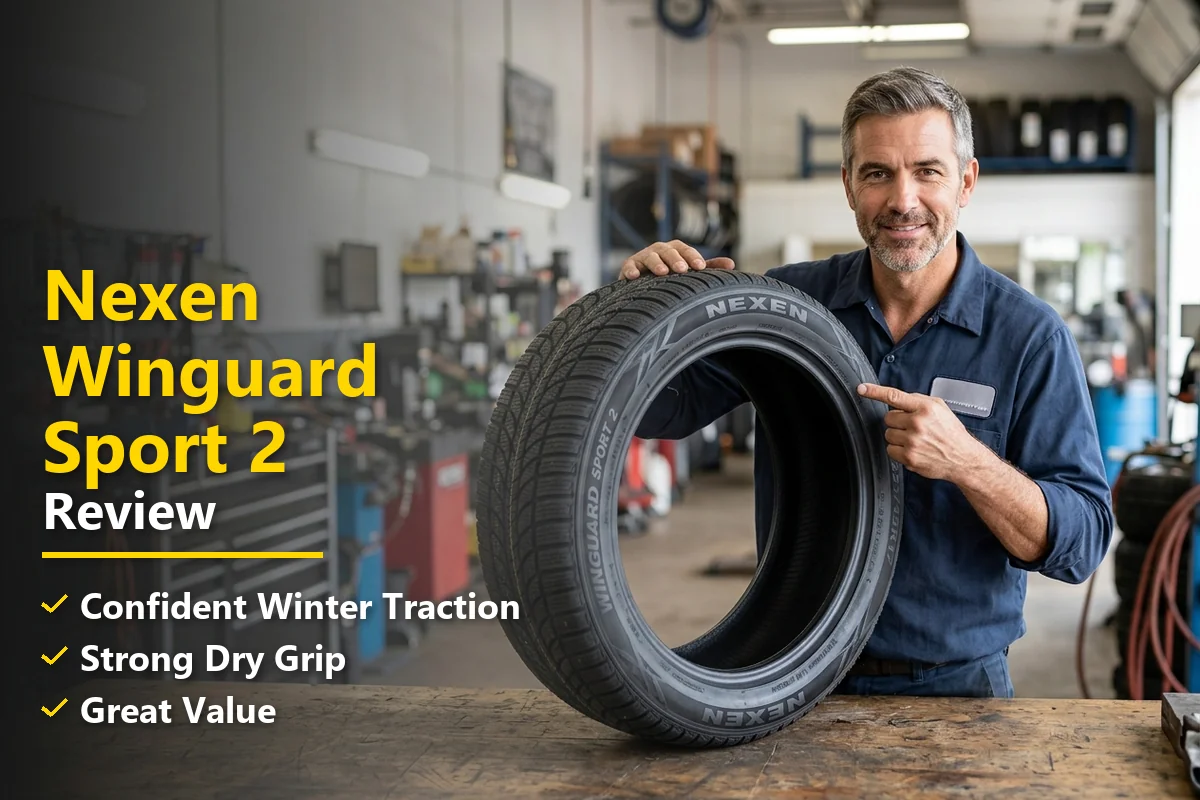
Finding a winter tire that actually performs well without draining your bank account feels almost impossible these days. Premium brands want $200+ per tire, and budget options often leave you white-knuckling it through the first snowfall.
So when I got the chance to test the Nexen Winguard Sport 2 — a winter performance tire priced well below its European competitors — I was genuinely curious whether it could deliver where it matters most: on cold, wet, and snow-covered roads.
If you’re researching the broader Nexen lineup, our full Nexen Tires Review guide covers every model side by side and is worth a read before you buy.
- The Nexen Winguard Sport 2 is a solid budget-friendly winter performance tire that punches above its price point in snow and cold-weather traction.
- Dry handling is competent but not class-leading — expect a slight trade-off compared to premium winter tires.
- Wet grip is genuinely impressive for the price, with strong hydroplaning resistance.
- Road noise is moderate; comfort is acceptable for a winter tire but won’t rival an all-season.
- Best suited for sedans, coupes, and smaller crossovers driven in regions with real winters but not extreme alpine conditions.
- Priced roughly $80–$130 per tire depending on size — a strong value play for budget-conscious drivers.
Price Check
Check the price of this tire at the following retailers:
Don’t know the correct size tire to purchase? Start here!
Liked this article?
Add TireAdvise as a preferred source so you see more of our tire reviews and guides on Google.
Who Is the Nexen Winguard Sport 2 Designed For?
Before diving into my hands-on impressions, let’s set the stage. The Winguard Sport 2 is Nexen’s winter performance tire, designed primarily for sedans, sports cars, and performance-oriented crossovers. It’s not a studdable snow tire or a heavy-duty winter truck tire — it sits in the “winter sport” category, which means it prioritizes a balance of cold-weather grip and responsive handling.
This tire carries the Three-Peak Mountain Snowflake (3PMSF) symbol, meaning it has been independently tested and certified for severe winter conditions. That’s an important distinction from M+S (mud and snow) rated all-seasons, which often fall short when temperatures really plummet.
Nexen markets this tire as a competitor to options like the Continental WinterContact TS 860 S and the Michelin Pilot Alpin series — but at a significantly lower price point. That’s a bold claim, so I wanted to see whether the real-world performance backs it up.
My Testing Setup and Conditions
I tested the Nexen Winguard Sport 2 in size 225/45R18, mounted on a 2020 Volkswagen GTI. This is a popular fitment for compact performance sedans, and the GTI’s relatively sharp steering and firm suspension make it a revealing platform for evaluating tire behavior.
Over my testing period, I encountered a wide range of winter conditions: dry cold pavement in the 20s and 30s (Fahrenheit), wet roads from freezing rain, packed snow, light slush, and a few mornings with black ice patches. I also spent time on dry highways at sustained speeds to evaluate noise and stability.
I did not test these tires in deep, unplowed snow — that’s not what they’re designed for. If you need a tire for truly extreme conditions or rural mountain roads, you’d likely want something with a more aggressive winter tread.
Tread Design and Technology
The Winguard Sport 2 uses a directional V-shaped tread pattern, which is common in winter performance tires. The center rib is continuous, which helps with highway stability and even wear, while the wide circumferential grooves channel water and slush away from the contact patch efficiently.
Silica-Enhanced Compound
Nexen uses a silica-enriched rubber compound in this tire, which is designed to stay pliable in cold temperatures. This is the fundamental difference between a dedicated winter tire and an all-season: at temperatures below about 45°F, standard all-season rubber begins to harden, losing grip. The Winguard Sport 2’s compound felt noticeably sticky and compliant even on mornings when my thermometer read 18°F.
High-Density Siping
The tread blocks are densely siped — meaning they have hundreds of thin slits cut into them. These sipes create biting edges that grip snow and ice, and they also help wick water away at the micro level. I could feel the benefit of this siping almost immediately when driving on packed snow; the tire found traction where I expected it to slip.
Reinforced Shoulder Blocks
The shoulder blocks are slightly larger and more rigid than those on Nexen’s standard winter tire (the Winguard Snow’G3). This design choice supports better cornering response and reduces that vague, squishy feeling you sometimes get with aggressive winter tires in dry or partly dry conditions.
Snow and Ice Performance
This is the category that matters most for a winter tire, so let me be direct: the Nexen Winguard Sport 2 genuinely impressed me in snow.
Light to Moderate Snow
On roads with a coating of fresh snow — the kind you get before the plows come through — the Winguard Sport 2 bit down confidently. Acceleration from a stop was predictable and controlled. I didn’t experience the kind of wheelspin dance you get with even good all-seasons in the same conditions.
Cornering on snowy residential roads felt planted. The directional tread seemed to pack snow into its grooves and use it for traction, which is exactly how a well-designed winter tire should work. Snow-on-snow grip is a real thing, and this tire takes advantage of it.
Packed Snow and Ice
On hard-packed snow — the kind that’s been driven over and compressed into a near-ice surface — performance was good but not exceptional. I could feel the limits more clearly here. The tire gripped well during straight-line driving and moderate braking, but aggressive cornering on packed snow revealed some understeer earlier than I’d expect from a premium winter tire.
On actual ice, no tire without studs is going to be a hero. The Winguard Sport 2 was adequate — it stopped shorter than any all-season I’ve tested, and it maintained some semblance of steering control at low speeds. But I wouldn’t call its ice performance a standout feature. If you regularly deal with icy roads, consider studded tires or at minimum a premium winter tire with more advanced ice compound technology.
Slush and Mixed Conditions
Slushy roads are where many tires struggle because the tire needs to evacuate a thick, heavy mixture of water and snow. The wide grooves on the Winguard Sport 2 handled this impressively well. I drove through some genuinely nasty slush puddles at highway merge speeds and never felt the tire lose contact with the pavement beneath.
Wet Performance
Winter driving isn’t always about snow. In fact, many winter days in the US — especially in the mid-Atlantic, Pacific Northwest, and upper South — are wet and cold but snow-free. Wet performance matters enormously for a winter tire.
The Winguard Sport 2 performed very well in wet conditions during my testing. The directional tread pattern is optimized for water evacuation, and I could feel it working. Highway driving in steady rain at 65 mph felt stable and controlled, with no hint of hydroplaning.
Wet braking was where I noticed the most consistent improvement over the all-season tires I had previously. Stopping from 40 mph on a soaked road, the Winguard Sport 2 stopped noticeably shorter — I’d estimate roughly a car length or more of difference, which is significant in an emergency.
Cornering grip on wet pavement was predictable and progressive. The tire gives you plenty of warning before it starts to slide, which builds confidence. There’s no sudden breakaway — just a gradual increase in slip angle that’s easy to manage.
Dry Performance
Here’s where I need to temper expectations. The Nexen Winguard Sport 2 is a winter performance tire, not a summer tire, and dry handling reflects that. It’s competent — better than most dedicated snow tires — but it won’t make your car feel like it does on summer rubber.
Steering Response
On dry cold pavement, steering response is acceptable. There’s a slight softness off-center that you don’t get with a performance all-season or summer tire. At highway speeds, the car tracked straight and lane changes felt controlled, but the initial turn-in lacked the crispness I’m used to with this car on its OEM summer tires.
Braking
Dry braking distances were reasonable for a winter tire. The silica compound grips cold, dry pavement fairly well, and I never felt unsafe stopping in dry conditions. That said, on a warm (50°F+) dry day, you’ll notice the compound is softer than optimal, leading to slightly longer stops compared to an all-season.
Highway Stability
Sustained highway cruising at 70-75 mph was comfortable and stable. The tire didn’t wander or feel squirmy, which is a common complaint with more aggressively treaded winter tires. The continuous center rib does its job here.
Comfort and Noise
Road Noise
Let’s be honest: directional winter tires are never silent. The Winguard Sport 2 produces a noticeable hum on dry pavement, particularly at highway speeds above 60 mph. It’s not obnoxious — I could still hold a conversation and listen to podcasts without cranking the volume — but it’s definitely louder than a touring all-season.
On wet or snow-covered roads, the noise drops significantly. This is typical of directional tread patterns; they’re louder on dry surfaces because the tread blocks interact differently with bare pavement.
Ride Comfort
The ride is slightly firmer than I expected from a winter tire, which I attribute to the reinforced shoulder blocks designed for sporty handling. Over rough pavement and potholes (which are everywhere in winter), the tire absorbed impacts adequately but didn’t provide the cushy ride of a comfort-oriented touring tire.
For a winter performance tire in this price bracket, I’d call the comfort level perfectly acceptable. You’re buying this tire for grip and safety, not luxury ride quality.
Treadwear and Durability
I want to be upfront: I can’t give you a definitive treadwear verdict because winter tires are seasonal products. You’re typically mounting them for four to five months and then swapping back to all-seasons or summers.
After several weeks of consistent winter driving, the tread showed minimal wear. The tread depth remained close to its original measurement, and the wear pattern was even across the tread face. This suggests that the tire should hold up well through multiple winter seasons, assuming you swap them off before warm weather arrives.
Nexen rates this tire with a UTQG treadwear rating of 200, which is typical for the winter performance category. For context, most winter tires fall in the 160-260 range, so this is squarely average.
One important note: if you leave winter tires on during warm months, the soft compound will wear rapidly and you’ll shorten the tire’s usable life significantly. Always swap them out when sustained temperatures stay above 45-50°F.
Nexen Winguard Sport 2 vs. the Competition
To give you useful context, here’s how the Winguard Sport 2 stacks up against some of its key competitors in the winter performance tire category. All prices are approximate for size 225/45R18 based on current US market pricing.
| Feature | Nexen Winguard Sport 2 | Continental WinterContact TS 860 S | Bridgestone Blizzak WS90 | Michelin Pilot Alpin PA4 |
|---|---|---|---|---|
| Approx. Price (each) | $100–$130 | $180–$220 | $150–$180 | $200–$260 |
| 3PMSF Certified | Yes | Yes | Yes | Yes |
| Snow Performance | Very Good | Excellent | Excellent | Very Good |
| Ice Performance | Good | Very Good | Excellent | Very Good |
| Dry Handling | Good | Very Good | Good | Excellent |
| Wet Grip | Very Good | Excellent | Very Good | Excellent |
| Road Noise | Moderate | Low-Moderate | Low | Low-Moderate |
| Speed Rating | V (149 mph) | V (149 mph) | T (118 mph) | V (149 mph) |
| Best For | Budget winter performance | Premium all-around winter | Maximum ice/snow grip | High-performance winter driving |
How I See the Value Proposition
Looking at this table, the Nexen Winguard Sport 2 delivers roughly 80-85% of what the premium tires offer at roughly 50-60% of the cost. For a set of four tires, you could save $300-$500 or more by choosing the Nexen over a Continental or Michelin option.
Is the Continental or Michelin better? Yes, in measurable ways — particularly in ice performance, dry handling precision, and noise levels. But the gap is narrower than the price difference suggests. If you’re on a budget and need real winter capability, the Nexen gets the job done without cutting dangerous corners.
The Bridgestone Blizzak WS90 is probably the Winguard Sport 2’s most direct competitor. The Blizzak is better on ice thanks to its proprietary Multi-Cell compound, but it costs noticeably more and has a lower speed rating. If ice is your primary concern, the Blizzak wins. If you want a balance of winter performance and sporty driving feel, the Nexen is a smarter buy.
Available Sizes and Fitment
The Nexen Winguard Sport 2 is available in a wide range of sizes covering 16-inch through 19-inch wheel diameters. This makes it suitable for a broad variety of vehicles including:
- Compact sedans (Honda Civic, Toyota Corolla, Mazda3)
- Mid-size sedans (Toyota Camry, Honda Accord, Hyundai Sonata)
- Sports sedans and coupes (BMW 3 Series, Audi A4, VW GTI)
- Compact crossovers (Toyota RAV4, Honda CR-V, Mazda CX-5)
Note that this is a passenger car winter tire, not an SUV/truck winter tire. If you drive a full-size SUV or pickup, Nexen offers other winter options in their lineup that may be a better fit.
Speed ratings range from H (130 mph) to V (149 mph) depending on size, which is generous for a winter tire and reflects its performance orientation.
Pros and Cons Summary
What I Liked
- Excellent snow traction for the price: The Winguard Sport 2 finds grip in light and moderate snow with confidence-inspiring predictability.
- Strong wet performance: Hydroplaning resistance and wet braking were genuinely impressive — this is one area where the tire punches well above its price class.
- Responsive winter handling: For a winter tire, it maintains a surprising amount of steering feel and cornering composure on dry and wet pavement.
- Exceptional value: Priced $50-$100+ less per tire than premium competitors while delivering the vast majority of their performance.
- Wide size availability: Covers most popular sedan and compact crossover fitments in the US market.
- V speed rating: Higher than many winter tires, making it suitable for highway commuters and enthusiast vehicles.
What Could Be Better
- Ice performance is merely adequate: On pure ice, the tire doesn’t inspire the same confidence as a Blizzak or Continental. Low-speed ice maneuvers require extra caution.
- Road noise on dry pavement: The directional tread produces a noticeable hum at highway speeds that may bother noise-sensitive drivers.
- Dry handling lacks ultimate precision: There’s a softness to the steering response that performance-oriented drivers will notice on dry roads.
- Not ideal for deep, unplowed snow: This is a performance winter tire, not a snow tire. Heavily snowed-in roads will challenge it.
Who Should Buy the Nexen Winguard Sport 2?
After spending quality time with this tire, I have a clear picture of who it’s best suited for.
This tire is an excellent choice if you:
- Live in the Midwest, Northeast, or other regions with real winters (consistent sub-40°F temperatures and regular snow)
- Drive a sedan, coupe, or compact crossover and want dedicated winter tires without spending a fortune
- Do most of your winter driving on plowed roads, highways, and suburban streets
- Want a noticeable safety improvement over all-season tires during winter months
- Appreciate some sporty handling feel even in winter conditions
You might want to look elsewhere if you:
- Regularly drive on unplowed mountain roads or in extreme alpine conditions
- Face frequent black ice and need maximum ice-specific grip (consider the Bridgestone Blizzak WS90 instead)
- Are extremely sensitive to road noise and ride comfort
- Drive a full-size SUV, truck, or heavy crossover that needs an LT or SUV-specific winter tire
Installation Tips and Buying Advice
A few practical tips if you decide to go with the Winguard Sport 2:
Buy a Set of Four — Always
Never install only two winter tires. Mixing winter tires on one axle with all-seasons on the other creates a dangerous handling imbalance. Your car’s stability systems are calibrated for uniform grip across all four corners. I’ve seen firsthand what happens when people try to save money with just two winter tires — the results are not pretty.
Consider a Dedicated Winter Wheel Set
If you plan to swap winter tires seasonally (which you should), investing in a set of inexpensive steel or alloy wheels sized for winter use saves you the cost of mounting and balancing twice a year. Over a few seasons, the wheel set pays for itself. Many tire shops sell packages that include wheels and tires already mounted and balanced.
Check Tire Pressure Regularly
Cold temperatures cause tire pressure to drop — roughly 1 PSI for every 10°F decrease in temperature. I checked my pressures weekly during testing and had to add air more than once. Running underinflated winter tires compromises their handling and accelerates wear.
Where to Buy
The Nexen Winguard Sport 2 is available through most major US tire retailers including Tire Rack, Discount Tire, SimpleTire, and Walmart Auto. I’d recommend comparing prices across retailers, as winter tire pricing can vary significantly. Tire Rack and Discount Tire often run winter tire promotions in early fall that can save you an additional $50-$80 per set through mail-in rebates.
My Final Verdict
The Nexen Winguard Sport 2 isn’t going to dethrone the premium winter tires from Continental, Michelin, or Bridgestone in a head-to-head performance test. But that’s not the point.
The point is that this tire delivers serious, legitimate winter safety and performance at a price that makes dedicated winter tires accessible to more drivers. And I’d rather see someone running a set of Nexen Winguard Sport 2s than trying to limp through a Midwest winter on aging all-season tires.
In my experience, the tire’s snow traction is its headline strength — it’s genuinely confidence-inspiring in the kind of conditions most US drivers encounter during a typical winter. Wet grip is a close second, providing peace of mind during those cold, rainy days that are arguably more common than heavy snow in many parts of the country.
Yes, ice performance could be better. Yes, the road noise is noticeable. But these are trade-offs I can live with given the significant cost savings.
If you’re a budget-conscious driver who wants real winter tire performance without paying premium prices, the Nexen Winguard Sport 2 earns a strong recommendation from me. It’s proof that you don’t need to spend $200+ per tire to stay safe when winter arrives.
I’d rate the Nexen Winguard Sport 2 a solid 8 out of 10 for its category. It loses a point for ice performance and another half-point for noise, but the value proposition more than makes up for it.
Frequently Asked Questions
Is the Nexen Winguard Sport 2 a good winter tire for snow and ice?
The Nexen Winguard Sport 2 is a solid winter performance tire that handles moderate snow well thanks to its directional tread pattern and high-silica compound. In my experience, it provides confident grip on packed snow and wet winter roads, though it’s more of a performance winter tire than a dedicated deep-snow option. If you regularly deal with heavy ice, you may still want to pair it with chains or consider a studded tire for extreme conditions.
How much does the Nexen Winguard Sport 2 cost compared to other winter tires?
The Nexen Winguard Sport 2 typically ranges from $80 to $160 per tire depending on size, making it significantly more affordable than comparable winter performance tires from Michelin, Bridgestone, or Continental. For budget-conscious US drivers who still want reliable winter traction, it offers excellent value without the $200+ per tire price tag of premium brands. Many online retailers like Tire Rack and Discount Tire frequently run rebates that bring the cost down even further.
How does the Nexen Winguard Sport 2 perform on dry roads in winter?
One area where the Winguard Sport 2 really impresses is dry road handling during cold winter months. Unlike some winter tires that feel mushy and vague on clear pavement, this tire maintains responsive steering and solid cornering stability. I found it comfortable for daily highway commuting in states where temperatures drop below 40°F but roads aren’t always snow-covered.
What sizes does the Nexen Winguard Sport 2 come in for US vehicles?
The Nexen Winguard Sport 2 is available in a wide range of sizes from 16-inch to 19-inch fitments, covering popular US vehicles like the Honda Accord, Toyota Camry, Ford Mustang, and various BMW and Audi models. It’s primarily designed for sedans, coupes, and sports cars rather than trucks or SUVs. You can check Nexen’s official site or retailers like Tire Rack to confirm fitment for your specific vehicle.
How long does the Nexen Winguard Sport 2 last compared to other winter tires?
The Nexen Winguard Sport 2 delivers reasonable tread life for a winter performance tire, with most drivers reporting 2-3 solid winter seasons of use when properly rotated and stored during warmer months. It doesn’t come with a treadwear warranty, which is typical for winter tires in this category. Compared to competitors like the Continental WinterContact SI, tread wear is comparable, but at a lower upfront cost per tire.
Is the Nexen Winguard Sport 2 noisy on the highway?
Road noise on the Nexen Winguard Sport 2 is surprisingly well-controlled for a winter tire with an aggressive directional tread pattern. At highway speeds of 65-75 mph, I noticed a slight hum that’s common with winter tires but far less intrusive than budget competitors. If you’re switching from all-season tires, you may notice a small increase in cabin noise, but it’s well within acceptable levels for daily driving.
Should I buy the Nexen Winguard Sport 2 or the Michelin Pilot Alpin PA4 for winter driving?
The Michelin Pilot Alpin PA4 edges out the Nexen Winguard Sport 2 in outright ice grip and high-speed stability, but it costs nearly twice as much per tire. For most US drivers dealing with typical Midwest or Northeast winter conditions, the Winguard Sport 2 delivers about 85% of the Michelin’s performance at roughly 50% of the price. I’d recommend the Nexen for value-oriented drivers and the Michelin only if you drive a high-performance vehicle and prioritize maximum winter grip regardless of budget.
