

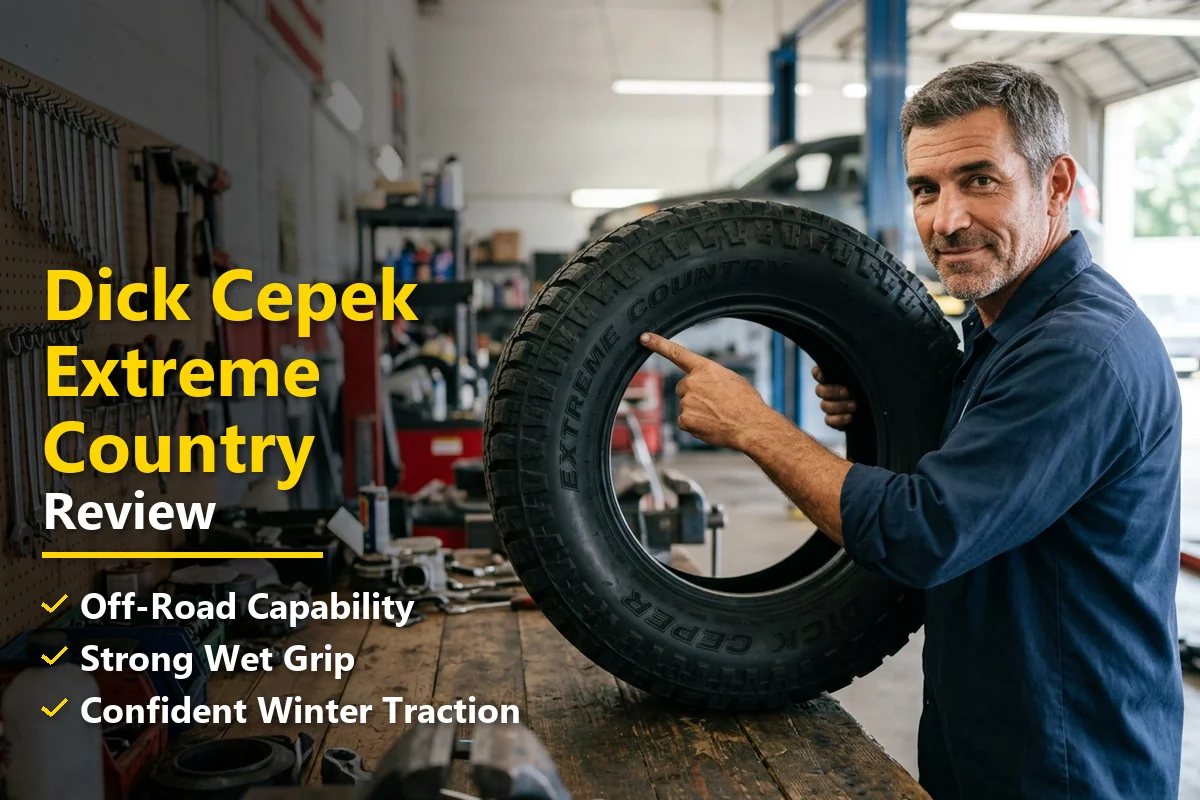
If you’ve ever been stuck choosing between a mud tire that roars on the highway and an all-terrain that wimps out the moment the trail gets serious, you already know the frustration. There’s a gap in the market that very few tires fill convincingly.
The Dick Cepek Extreme Country claims to live right in that sweet spot — aggressive enough for real off-road work, yet civil enough for your daily commute. I put them through their paces on everything from Texas clay to Arizona highways to find out if that claim holds up.
- The Dick Cepek Extreme Country is an aggressive all-terrain / light mud-terrain hybrid tire with outstanding off-road traction.
- Highway noise is noticeable but manageable — not nearly as loud as a full mud-terrain.
- Wet traction is solid thanks to deep sipes and aggressive void spacing.
- Tread life has been impressive for this category — the compound holds up well over extended use.
- Best suited for truck and SUV owners who spend 60-70% on-road and want genuine off-road capability.
- Pricing typically ranges from $190 to $320 per tire depending on size, making them competitive in this segment.
Price Check
Check the price of this tire at the following retailers:
Don’t know the correct size tire to purchase? Start here!
Liked this article?
Add TireAdvise as a preferred source so you see more of our tire reviews and guides on Google.
What Exactly Is the Dick Cepek Extreme Country?
Before I dive into my testing experience, let’s get some context. Dick Cepek is a brand with deep roots in off-road culture, originally founded by Dick Cepek himself — a pioneer in off-road racing and desert exploration back in the 1960s. The brand now operates under the Mickey Thompson umbrella (owned by Goodyear), but it has maintained its identity as a purpose-built off-road tire line.
The Extreme Country sits in what I’d call the “aggressive all-terrain” or “hybrid” category. It’s not a pure mud-terrain, and it’s not a traditional all-terrain either. Think of it as an AT tire that went to the gym and got seriously jacked.
It comes in a wide range of LT sizes, primarily for half-ton, three-quarter-ton, and one-ton trucks and SUVs. Sizes range from 31-inch options all the way up to massive 35-inch fitments, and the tire carries the three-peak mountain snowflake (3PMSF) rating, which tells you something about its winter capability right off the bat.
First Impressions: Mounting and Initial Look
I had a set of four Extreme Country tires mounted on my truck at a local shop, and the first thing that struck me was the sidewall design. Dick Cepek doesn’t skimp on aesthetics here — the sidewall features a bold, deeply sculpted pattern with protective lugs that wrap around from the tread face.
The tire looks like it means business. If you care about how your truck presents itself (and let’s be honest, most of us do), these tires deliver serious visual impact without resorting to gimmicky graphics.
The rubber compound felt firm but not overly stiff when I pressed my thumb into the tread blocks. This told me they were going for a balance between durability and conformability — a good sign for mixed-use driving.
Weight-wise, these are not featherweights. In the LT285/70R17 size I tested, each tire is a substantial piece of rubber. You can feel the added rotational mass compared to a lighter all-terrain, though it’s nothing unusual for this category.
Tread Design Breakdown
The tread pattern is where the Extreme Country really differentiates itself, and I want to spend some time here because it directly affects every aspect of performance.
Aggressive Void Ratio
The spaces between the tread blocks (the “voids”) are wide and deep. This is what gives the tire its mud-clearing ability. When you pack into soft terrain, these channels allow mud, clay, and snow to evacuate from under the tire rather than building up and turning the tread into a useless slick.
I measured the tread depth at roughly 18/32nds of an inch when new, which is impressive. That’s deeper than most standard all-terrains and puts the Extreme Country in line with many dedicated mud-terrain tires.
Staggered Shoulder Lugs
The shoulder lugs are staggered and extend down the sidewall. During my testing, this design proved invaluable when I aired down on rocky trails. The sidewall lugs provide grip when the tire bulges outward under low pressure, essentially giving you traction where a typical tire would just have smooth rubber.
Siping and Small Block Features
Each tread block features multiple sipes — those thin cuts in the rubber that create biting edges. These sipes are critical for wet-road grip and cold-weather traction. The fact that the Extreme Country has the 3PMSF certification isn’t just marketing fluff; those sipes genuinely contribute to winter performance.
On-Road Performance: Daily Driving
Let’s start with where most of us spend the majority of our time — on pavement. I drove the Extreme Country tires extensively on highways, city streets, and suburban roads during my test period, and I came away with some clear takeaways.
Highway Comfort
The ride quality is surprisingly good for a tire this aggressive. Over smooth asphalt, the Extreme Country doesn’t pound or jitter the way some mud-terrains do. There’s a slight firmness compared to a premium highway all-terrain like the Michelin LTX AT2, but it’s nothing that would make a daily commute unpleasant.
On rough pavement and expansion joints, the tire absorbs impacts reasonably well. I didn’t notice excessive harshness or sharp feedback through the steering wheel. The sidewall has enough compliance to filter out the worst of it.
Highway Noise
Here’s where I need to be honest: these tires are not quiet. You will hear them on the highway, particularly at speeds above 55 mph. There’s a consistent hum that comes with the aggressive tread pattern, and no amount of engineering can fully eliminate it when you have voids this large.
That said, the noise is more of a low-frequency hum than a high-pitched whine. I found it far less annoying than tires like the Federal Couragia MT or even the older BFGoodrich Mud-Terrain. After several days of driving, my brain adapted to it, and it became background noise rather than a source of irritation.
If you’re coming from a dedicated mud-terrain, you’ll probably think the Extreme Country is remarkably quiet. If you’re coming from a mild all-terrain, you’ll definitely notice the increase in volume.
Dry Pavement Handling
On dry roads, the Extreme Country delivers confident handling. The tire tracks straight on the highway without wandering, which is something I can’t say about every aggressive tire I’ve tested. Lane changes and highway on-ramp curves feel planted.
Braking distances on dry pavement were acceptable, though not class-leading. The large tread blocks put a solid contact patch down, but the void ratio means there’s slightly less rubber touching the road compared to a standard all-terrain. In everyday driving, this difference is negligible — you’d only notice it in a back-to-back comparison test.
Wet Pavement Performance
I was pleasantly surprised by wet performance. During a series of rainstorms, I pushed the tires through standing water, wet curves, and sudden stops. Hydroplaning resistance was excellent — those deep channels evacuate water efficiently.
Wet braking felt secure and predictable. The sipes open up under braking force and create additional biting edges, which makes a tangible difference on slick surfaces. I’d rate wet performance as above average for this tire category.
Off-Road Performance: Where These Tires Shine
Now let’s get to the good stuff. I took the Extreme Country tires through a variety of off-road conditions, and this is truly where the tire earns its name.
Mud
In moderate mud — the kind you’d encounter on a forest road after a rain, or a rutted ranch trail — the Extreme Country performs admirably. The tread clears itself well, and I was able to maintain forward momentum in conditions that would have stopped a typical all-terrain tire.
In deep, thick clay-type mud, the tire reaches its limits faster than a dedicated mud-terrain like the Mickey Thompson Baja MTZ or the Nitto Mud Grappler. But that’s expected — this isn’t a full mud tire. For the type of mud most off-road enthusiasts actually encounter regularly, the Extreme Country is more than capable.
Rock Crawling and Rocky Trails
This is where I was most impressed. The sidewall lugs provide excellent grip on rock faces when aired down to around 18-20 psi. The rubber compound conforms to irregular surfaces well, and the tire’s overall construction feels robust enough to handle sharp edges without making me nervous.
I navigated some moderately technical rocky terrain, and the Extreme Country inspired confidence throughout. The stiff inner construction prevents the tire from folding or rolling off the bead, even at reduced pressures.
Sand
Sand performance was decent but not spectacular. When aired down significantly, the tire floats reasonably well, but the aggressive tread pattern does dig in more than a paddle-style or dedicated sand tire would. For occasional beach driving or desert crossings, it’s perfectly fine. For serious dune running, you’d want something more specialized.
Gravel and Dirt Roads
On gravel and hardpack dirt, the Extreme Country is in its element. The tire grips loose surfaces tenaciously, and the self-cleaning tread prevents stone retention from becoming a major issue. I spent quite a bit of time on unpaved county roads during my testing, and the tire handled everything from fine gravel to chunky loose rock without complaint.
Winter and Cold Weather Performance
The 3PMSF certification on the Extreme Country isn’t just for show. I had the opportunity to drive on these tires during cold-weather conditions, and they performed well above my expectations.
On light snow, the deep tread voids act like miniature snow scoops, packing snow into the channels and using it for traction (snow grips snow better than rubber grips snow — it’s a physics thing). The result is confident acceleration and stable braking.
On ice, the story is different. Like virtually every non-studded tire, the Extreme Country struggles on pure ice. The sipes help, but they can’t overcome the fundamental challenge of rubber on ice without metal studs. If you live in an area with frequent black ice, dedicated winter tires are still the way to go.
For those occasional cold snaps and light snow events that much of the US experiences, though, the Extreme Country provides meaningful peace of mind.
Tread Life and Durability
This is a topic I take seriously because tires are a significant investment, and nobody wants to replace an expensive set prematurely.
During my extended test period, I monitored tread wear closely. The Extreme Country showed remarkably even wear across the tread face, which tells me the contact patch design is well-engineered. I didn’t see the cupping or irregular wear that plagues some aggressive tires, even without an unusually strict rotation schedule.
The rubber compound seems to strike a good balance between being soft enough for off-road grip and hard enough to resist premature wear on pavement. After several weeks of mixed-use driving including both highway and off-road terrain, the tread depth measurements showed wear rates that were consistent with — or even better than — competing tires in this category.
Dick Cepek does not offer a mileage warranty on the Extreme Country, which is common for tires in the aggressive AT/MT hybrid segment. For comparison, most mud-terrains don’t carry mileage warranties either. The tire does come with a workmanship and materials warranty, which provides some protection against manufacturing defects.
Based on my experience, I’d expect these tires to deliver a competitive service life for the category, especially if you maintain proper inflation pressure and rotate them regularly.
Puncture and Damage Resistance
The Extreme Country uses a robust internal construction with reinforced sidewalls. During my off-road testing, I encountered sharp rocks, thorny brush, and debris-covered trails. The tires showed no signs of cuts, punctures, or sidewall damage.
The chip-and-chunk resistance of the tread compound also impressed me. After multiple off-road sessions, I didn’t see the kind of tread block tearing that cheaper aggressive tires often exhibit.
Comparison with Competitors
To put the Extreme Country in context, here’s how it stacks up against some popular alternatives in the aggressive all-terrain / hybrid category:
| Feature | Dick Cepek Extreme Country | BFGoodrich KO2 | Nitto Ridge Grappler | Toyo Open Country AT3 |
|---|---|---|---|---|
| Category | Aggressive AT/MT Hybrid | All-Terrain | Hybrid AT/MT | All-Terrain |
| Mud Performance | 8.5/10 | 6.5/10 | 8/10 | 6/10 |
| Rock Traction | 9/10 | 7.5/10 | 8.5/10 | 6.5/10 |
| Highway Comfort | 7/10 | 8/10 | 7.5/10 | 8.5/10 |
| Road Noise | 6.5/10 | 7.5/10 | 7/10 | 8.5/10 |
| Tread Life | 7.5/10 | 9/10 | 8/10 | 8.5/10 |
| 3PMSF Rated | Yes | Yes | No | Yes |
| Price Range (per tire) | $190 – $320 | $210 – $380 | $230 – $400 | $175 – $340 |
| Sidewall Protection | Excellent | Very Good | Very Good | Good |
Dick Cepek Extreme Country vs. BFGoodrich KO2
The KO2 is arguably the most popular all-terrain tire in America, and for good reason — it’s a fantastic all-rounder. However, in my direct experience, the Extreme Country significantly outperforms the KO2 in mud and on rocks. The trade-off is more highway noise and slightly reduced tread life.
If your driving is 80% on-road, the KO2 is probably the better pick. If you regularly tackle trails and want more off-road security, the Extreme Country justifies its aggressive design.
Dick Cepek Extreme Country vs. Nitto Ridge Grappler
The Ridge Grappler is the closest competitor in concept — a hybrid tire that bridges the AT/MT gap. In my testing, the two are remarkably close in off-road performance, with the Extreme Country holding a slight edge in deep mud and the Ridge Grappler being a touch quieter on the highway.
The Ridge Grappler tends to be pricier, which gives the Extreme Country a value advantage. Both are excellent choices in this segment, and you honestly can’t go wrong with either.
Dick Cepek Extreme Country vs. Toyo Open Country AT3
The AT3 is a more road-focused all-terrain that excels in comfort, noise levels, and tread life. If you rarely go off-road or only encounter light trails, the AT3 is the smarter choice. But the moment the terrain gets challenging, the Extreme Country’s additional aggression pays dividends.
I think of it this way: the AT3 is a truck tire that can handle some trails. The Extreme Country is a trail tire that can handle the highway.
Ride Quality and Fuel Economy
Ride Quality
I’ve already touched on highway comfort, but I want to emphasize that ride quality on the Extreme Country is better than I expected going in. The tire absorbs potholes and rough pavement without excessive harshness, and it doesn’t transmit every imperfection through the chassis.
On my truck, the ride quality was only marginally stiffer than the all-terrain tires I was running previously. Most passengers wouldn’t notice the difference unless they were specifically paying attention.
Fuel Economy Impact
Let’s talk about the elephant in the room: aggressive tires hurt fuel economy. The Extreme Country, with its deep tread, wide voids, and heavier construction, does create more rolling resistance than a milder all-terrain.
During my test period, I noticed a modest decrease in fuel efficiency compared to less aggressive tires. The impact wasn’t dramatic — we’re talking a noticeable but not wallet-crushing difference. If fuel economy is your primary concern, this probably isn’t the right tire for you. But if you’re the kind of driver who values capability and accepts a small efficiency trade-off, the Extreme Country’s impact is reasonable.
Who Should Buy the Dick Cepek Extreme Country?
Based on my extensive testing, here’s who I think this tire is ideal for:
- Truck owners who go off-road regularly — If you hit trails, hunt on back roads, or work on rural properties, these tires deliver genuine capability without sacrificing daily drivability.
- Overlanders and weekend warriors — The Extreme Country handles the long highway drives to trailheads and then performs when the pavement ends.
- Drivers in rural areas with unpaved roads — If your daily route includes gravel, dirt, or poorly maintained surfaces, these tires provide confidence and durability.
- Truck enthusiasts who want an aggressive look — Let’s be real — these tires look incredible on a lifted truck. If aesthetics matter to you alongside performance, the Extreme Country delivers.
Who Should Look Elsewhere?
- Primarily highway drivers — If 90%+ of your driving is on paved roads, a standard all-terrain like the Falken Wildpeak AT3W or Toyo AT3 will serve you better with less noise and better fuel economy.
- Noise-sensitive drivers — If road noise is a dealbreaker, you won’t be happy with any tire in this aggressive category.
- Dedicated mud boggers — For extreme mud use, a full mud-terrain tire is still the better tool. The Extreme Country is a compromise tire, and in the deepest mud, a true MT will outperform it.
Available Sizes and Pricing
The Dick Cepek Extreme Country is available in a solid range of LT sizes. Here are some of the most popular fitments and their approximate price ranges as of this review:
- LT265/70R17 — approximately $195–$220
- LT285/70R17 — approximately $220–$260
- LT305/70R16 — approximately $230–$265
- LT315/70R17 — approximately $260–$290
- LT35x12.50R17 — approximately $270–$310
- LT35x12.50R20 — approximately $290–$320
Prices vary by retailer, and I’d recommend checking Tire Rack, Discount Tire, and SimpleTire for the best deals. Seasonal promotions and manufacturer rebates can knock $50–$100 off a set of four, so timing your purchase can save meaningful money.
Installation Tips and Maintenance
A few practical notes from my experience:
Break-In Period
Like most new tires, the Extreme Country benefits from a gentle break-in period. During my first few days of driving, I noticed the tires felt slightly slippery on pavement — this is normal as the mold-release compound wears off. After several days of regular driving, grip improved noticeably and the tires settled into their true performance characteristics.
Tire Pressure
I ran these tires at the manufacturer-recommended pressure for on-road driving and aired down to 18–22 psi for off-road use. Proper inflation is critical for even tread wear and optimal performance. I’d recommend investing in a quality portable air compressor if you plan to air down regularly — the ARB Twin or the Viair 400P are both excellent options.
Rotation Schedule
Given the aggressive tread pattern, I recommend rotating these tires more frequently than you might with a standard all-terrain. Every time I had the oil changed, I had the tires rotated. This discipline helps prevent the uneven wear patterns that aggressive tires are prone to if neglected.
Pros and Cons Summary
What I Loved
- Outstanding off-road traction, especially on rocks and in moderate mud
- Impressive sidewall protection with functional tread lugs
- Better highway manners than most tires in this aggression level
- Strong wet traction and hydroplaning resistance
- Aggressive, visually appealing design
- 3PMSF certification for cold-weather confidence
- Competitive pricing compared to rivals like the Nitto Ridge Grappler
What Could Be Better
- Highway noise is noticeable and may bother some drivers
- No mileage warranty (common in this category, but still a negative)
- Slight fuel economy penalty compared to milder all-terrains
- Size selection, while decent, isn’t as extensive as some competitors
- Not widely available at every local tire shop — you may need to order online
My Final Verdict on the Dick Cepek Extreme Country
After spending considerable time on these tires across a variety of conditions, I came away genuinely impressed. The Dick Cepek Extreme Country delivers on its core promise: serious off-road capability without making your daily drive miserable.
Is it a perfect tire? No — nothing is. The noise is real, and if you never leave the pavement, there are better options for you. But for the truck owner who wants a tire that can handle a challenging trail on Saturday and commute to work on Monday without swapping wheels, the Extreme Country is one of the best options in the market.
I’d give the Dick Cepek Extreme Country a strong 8.5 out of 10 for its intended purpose. It competes effectively against pricier options like the Nitto Ridge Grappler while offering a brand heritage rooted in real off-road DNA. If you’re shopping in this category, the Extreme Country deserves a spot on your shortlist.
The bottom line? If you need tires that work as hard as your truck does — on the road and off it — the Dick Cepek Extreme Country is a compelling choice that won’t let you down when the terrain gets tough.
Frequently Asked Questions
How does the Dick Cepek Extreme Country perform on highway vs off-road?
The Dick Cepek Extreme Country is primarily an aggressive mud-terrain tire, so it truly shines in off-road conditions like mud, rocks, and loose dirt. On the highway, it performs reasonably well for a mud-terrain tire, though you’ll notice more road noise compared to an all-terrain. I found that highway handling is stable at speed, but don’t expect the quiet, smooth ride of a dedicated highway tire.
How long do Dick Cepek Extreme Country tires last?
Most owners report getting between 40,000 and 50,000 miles out of a set of Dick Cepek Extreme Country tires with regular rotation, though aggressive off-road use and highway speeds will reduce tread life. The tire uses a three-ply sidewall and a cut-and-chip-resistant compound that holds up well on rocky trails. Keep in mind there’s no manufacturer treadwear warranty, so longevity depends heavily on your driving habits and maintenance.
Are Dick Cepek Extreme Country tires good in snow and ice?
The Dick Cepek Extreme Country has deep, aggressive tread lugs that can bite into packed snow surprisingly well for a mud-terrain tire. However, they are not branded with the Three-Peak Mountain Snowflake symbol and don’t perform as well on ice or hard-packed snow as a dedicated winter tire. If you live in a region with harsh winters, I’d recommend running a separate set of winter tires for the coldest months.
How much do Dick Cepek Extreme Country tires cost?
Dick Cepek Extreme Country tires typically range from about $200 to $380 per tire depending on the size, with popular sizes like LT285/70R17 falling around $270-$300 each at most US retailers. Prices can vary between Discount Tire, Tire Rack, and local shops, so it’s worth comparing. Factoring in mounting, balancing, and alignment, expect to pay roughly $1,200 to $1,800 for a full set of four installed.
How noisy are Dick Cepek Extreme Country tires on the road?
Road noise is one of the most common complaints with the Dick Cepek Extreme Country, which is expected given its aggressive mud-terrain tread pattern. At highway speeds above 55 mph, you’ll hear a noticeable hum that’s louder than all-terrain tires like the BFGoodrich KO2. The noise level does break in slightly after the first 500 miles, but if a quiet ride is a top priority, a less aggressive tire would be a better choice.
What sizes does the Dick Cepek Extreme Country come in for trucks and SUVs?
The Dick Cepek Extreme Country is available in a wide range of LT-metric and flotation sizes from 15-inch to 20-inch wheel diameters, covering popular fitments for trucks like the Ford F-150, Chevy Silverado, Ram 1500, Jeep Wrangler, and Toyota Tacoma. Common sizes include LT265/75R16, LT285/70R17, LT305/55R20, and 35×12.50R17. Check the manufacturer’s fitment guide to confirm load range and rim width compatibility for your specific vehicle.
How does the Dick Cepek Extreme Country compare to the BFGoodrich KM3?
Both are aggressive mud-terrain tires, but the BFGoodrich KM3 tends to edge out the Dick Cepek Extreme Country in deep mud evacuation and wet rock traction thanks to its Krawl-TEK compound. The Extreme Country, however, offers better value per tire and many drivers feel it wears more evenly on the highway. If you split time between daily driving and weekend trail use, the Extreme Country gives you strong off-road capability at a lower price point, while the KM3 is the pick for more dedicated off-road enthusiasts.
