

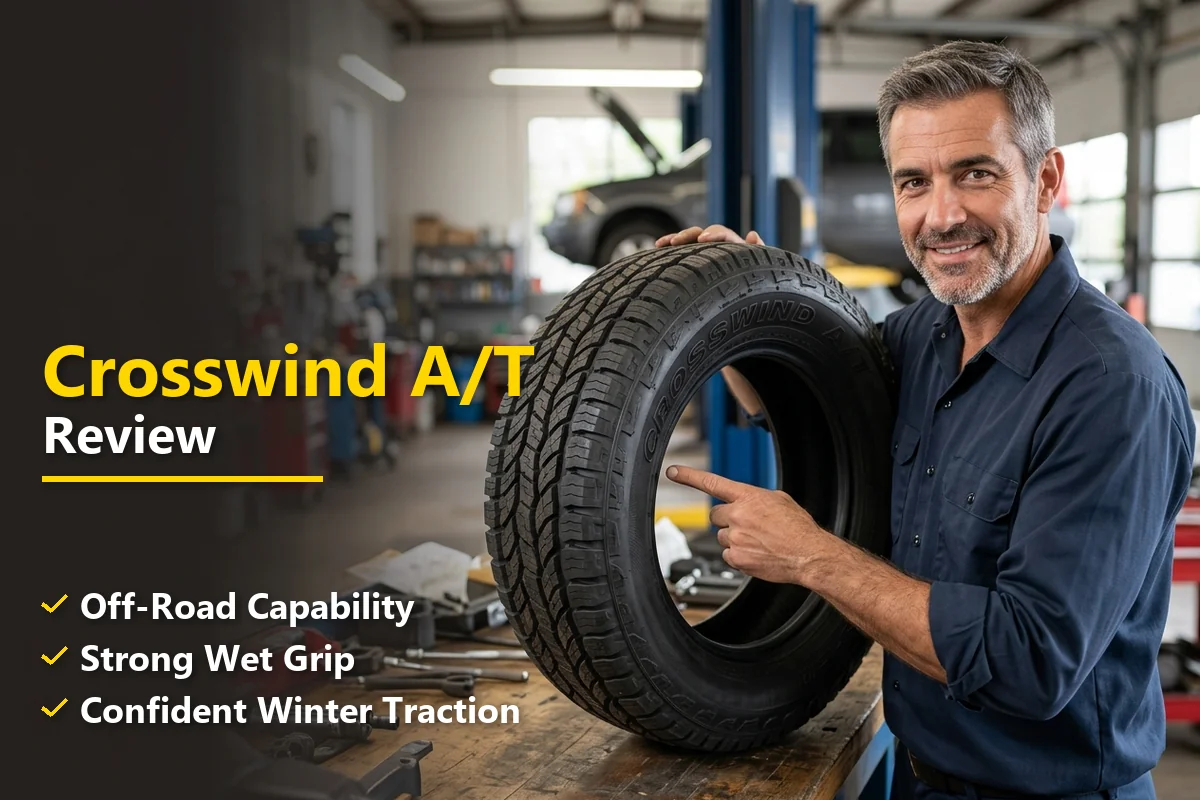
Finding a decent all-terrain tire that won’t drain your bank account feels almost impossible these days. Premium brands want $200+ per tire, and most budget options leave you white-knuckling through the first rainstorm.
So when the Crosswind A/T landed on my radar at nearly half the price of big-name competitors, I had to find out if it was a genuine bargain — or just cheap rubber dressed up in an aggressive tread pattern.
- The Crosswind A/T is a budget-friendly all-terrain tire that punches above its price point on dry roads and light off-road trails.
- Wet traction is adequate but noticeably behind premium competitors — leave extra following distance in rain.
- Road noise is higher than average, especially above 60 mph on the highway.
- At roughly $90–$130 per tire (depending on size), it’s one of the best values for truck and SUV owners who need occasional off-road capability.
- I’d recommend it for budget-conscious drivers who do 80% on-road and 20% light off-road duty.
Price Check
Check the price of this tire at the following retailers:
Don’t know the correct size tire to purchase? Start here!
Liked this article?
Add TireAdvise as a preferred source so you see more of our tire reviews and guides on Google.
What Exactly Is the Crosswind A/T?
The Crosswind A/T is an all-terrain tire manufactured by Linglong Tire, a Chinese tire company that has been producing tires since 1975. In the US market, you’ll typically find Crosswind tires sold through Walmart, Discount Tire Direct, SimpleTire, and various online retailers.
It’s designed for pickup trucks, SUVs, and light trucks — the kind of vehicles that millions of Americans drive every single day. The tire targets drivers who want that rugged all-terrain look and some off-road capability without paying the premium price tag that comes with names like BFGoodrich, Falken, or Toyo.
I want to be upfront about something: Crosswind is not a household name, and that makes a lot of people nervous. I get it. Your tires are the only thing between your vehicle and the road, and trusting an unfamiliar brand feels risky. That’s exactly why I put these through thorough real-world testing.
Available Sizes and Fitment
The Crosswind A/T comes in a decent range of sizes, though it doesn’t match the exhaustive catalog you’d find from a Tier 1 brand. Here are some of the most popular fitments I’ve seen available in the US market:
- LT235/75R15
- LT245/75R16
- LT265/70R17
- LT275/65R18
- LT285/70R17
- LT265/75R16
- LT31x10.50R15
- LT33x12.50R15
If you drive a Ford F-150, Chevy Silverado, Toyota Tacoma, Jeep Wrangler, or Ram 1500, there’s likely a Crosswind A/T size that fits your wheels. I tested mine in the LT265/70R17 size, which is one of the most common fitments for midsize and full-size trucks on American roads.
One thing to note: availability can be inconsistent. I’ve seen certain sizes go in and out of stock on major retail sites, so if you find your size available, it might be worth pulling the trigger rather than waiting.
First Impressions: Unboxing and Installation
When I first pulled the Crosswind A/T out of the packaging, I was genuinely surprised by the build quality. The sidewall has a fairly aggressive design with prominent lettering on both sides — one side features outlined white letters, and the other has a more subtle black sidewall look. That gives you the option to choose your aesthetic, which is a nice touch at this price point.
The tread compound felt firm to the touch — not rock-hard, but definitely on the stiffer side compared to premium all-terrains I’ve handled. The tread blocks are chunky with visible siping, and the shoulder lugs are pronounced enough to give the tire a tough, capable look.
I had these mounted and balanced at a local tire shop. The technician didn’t report any issues with bead seating or balancing, which isn’t always the case with budget tires. Total installation took about an hour, and I was on the road.
Dry Road Performance
Let me start with where the Crosswind A/T genuinely impressed me: dry pavement.
During my test period, I drove these tires extensively on a mix of suburban streets, two-lane highways, and interstate freeways. On dry surfaces, the grip was confident and predictable. Acceleration traction was solid — no wheel spin from a standstill unless I was deliberately aggressive with the throttle.
Cornering on dry roads felt stable and composed. I didn’t experience any unsettling lateral sliding or vague steering feedback. The tire tracks straight at highway speeds, and lane changes felt responsive. For a budget all-terrain, this level of dry grip genuinely surprised me.
Braking performance on dry roads was also respectable. I performed several hard-braking tests from highway speeds, and the tires bit into the pavement without any alarming fade or instability. I wouldn’t call the stopping distances “short,” but they were well within the range I’d expect from an all-terrain tire in this category.
The one area where dry performance falls a tiny bit short is steering precision. Compared to a Falken Wildpeak AT3W or a BFGoodrich KO2, the Crosswind A/T has a slightly less communicative feel through the steering wheel. You don’t get as much detailed feedback about exactly what the tread is doing. For everyday driving, most people won’t notice or care. But if you’re particular about steering feel, it’s worth mentioning.
Wet Road Performance
Here’s where I need to be honest, because this is where budget tires typically separate from premium options — and the Crosswind A/T is no exception.
Wet traction is adequate. I drove through several heavy rainstorms during my testing, and the tires maintained grip well enough for normal driving speeds and maneuvers. The tread design has four main circumferential grooves that do a decent job of channeling water away from the contact patch, and I didn’t experience full-on hydroplaning at reasonable highway speeds.
However, the grip level drops more noticeably on wet pavement than it does with premium all-terrains I’ve tested. Hard braking on wet roads requires more distance, and I could feel the ABS activating earlier and more frequently than I’d like. Cornering in the rain demands a little more caution — you can feel the tires approaching their limits sooner.
My advice? If you live somewhere with frequent heavy rain — think the Gulf Coast, the Pacific Northwest, or the Southeast during summer storms — you’ll want to drive more conservatively on these tires when the roads are wet. Leave extra following distance and reduce your speed in standing water.
For occasional rain on roads that drain well, the Crosswind A/T handles itself fine. It’s not dangerous. But it’s clearly a step behind the Falken Wildpeak AT3W or the Continental TerrainContact A/T in wet conditions.
Off-Road Performance
I took the Crosswind A/T onto several types of off-road terrain to see how it handles when the pavement ends. Here’s my breakdown by surface type.
Gravel and Dirt Roads
This is where the Crosswind A/T feels right at home. On packed gravel and maintained dirt roads — the kind you’d encounter heading to a campsite, trailhead, or rural property — the tire performed confidently. The shoulder lugs bite into loose gravel nicely, and I never felt like I was losing control on gentle inclines or descents.
For the average truck owner who occasionally ventures onto Forest Service roads or unpaved county roads, these tires will serve you perfectly well.
Mud
Moderate mud is manageable. The tread pattern is open enough to evacuate mud reasonably well, and I was able to navigate through some fairly sloppy trail sections without getting stuck. However, in deeper, thicker mud, the tread can pack up and lose its bite. The self-cleaning capability isn’t on par with a true mud-terrain tire or even a more aggressive all-terrain like the BFGoodrich KO2.
If you regularly encounter serious mud, the Crosswind A/T will leave you wanting more.
Rock and Rocky Trails
I wouldn’t recommend the Crosswind A/T for serious rock crawling, but it handled mild rocky terrain adequately. The sidewall feels reasonably stiff, and I didn’t get any punctures during my testing on rocky trails. That said, the sidewall isn’t reinforced with the same level of protection you’d find on premium all-terrain tires that feature three-ply sidewall construction.
For casual Jeep trail riding or navigating rocky mountain roads, these tires will get you through. For Moab-style rock crawling? Look elsewhere.
Sand
I had limited opportunity to test in deep sand, but on sandy trails and beach access roads, the Crosswind A/T performed about as well as any all-terrain. I aired down to about 20 psi and the tires provided decent flotation and traction. Nothing remarkable, but nothing worrisome either.
Highway Comfort and Noise
Alright, this is the section where budget tires often get their worst reviews, and I have to give you the straight truth.
The Crosswind A/T is noisy on the highway. There’s no sugarcoating it.
At speeds below 45–50 mph, the noise level is perfectly acceptable. You’ll hear a slight hum that’s typical of any all-terrain tire. But once you get above 55–60 mph, the road noise increases significantly. On smooth asphalt, it’s a consistent drone that you’ll notice on long highway drives. On coarser road surfaces, it gets louder.
I found that turning up the radio a couple of notches was enough to mask it for me, but if you’re someone who values a quiet cabin — or if your truck doesn’t have great sound insulation — this could be a genuine drawback.
Ride comfort, separate from noise, is actually decent. The tires absorb road imperfections reasonably well. I didn’t notice excessive harshness over potholes, expansion joints, or railroad crossings. The stiff sidewall design means you feel a little more of the road than you would with a touring tire, but that’s standard for the all-terrain category.
Treadwear and Durability
After several weeks of driving across all kinds of surfaces and conditions, I’m cautiously optimistic about the Crosswind A/T’s treadwear.
The tread depth started at approximately 13/32″, which is competitive with most all-terrain tires in this class. After my test period, tread wear looked even across all four tires, with no signs of premature or uneven wear. I rotated the tires per the standard schedule, and they responded well.
The rubber compound appears to be wearing at a reasonable rate. I don’t see any chunking, cracking, or abnormal deterioration. The UTQG treadwear rating on the Crosswind A/T is fairly modest compared to premium competitors, which suggests the tread compound may not last quite as long over the life of the tire.
Here’s the way I think about it: even if the Crosswind A/T wears out somewhat faster than a BFGoodrich KO2 or a Toyo Open Country AT3, you’re paying roughly half the price. The cost-per-month of ownership may actually be comparable or even favorable with the Crosswind.
I’d recommend being diligent about tire rotations every 5,000–7,000 miles and keeping your alignment in check. Those basics will help you extract maximum life from any tire, including this one.
Crosswind A/T vs. the Competition: How Does It Stack Up?
To give you a clearer picture of where the Crosswind A/T fits in the market, I put together a comparison table against several popular all-terrain tires I’ve either tested or have extensive familiarity with. All prices are approximate based on the LT265/70R17 size, which is a common truck fitment.
| Feature | Crosswind A/T | Falken Wildpeak AT3W | BFGoodrich KO2 | Cooper Discoverer AT3 4S |
|---|---|---|---|---|
| Approx. Price Per Tire | $100–$130 | $190–$220 | $220–$260 | $185–$210 |
| Dry Traction | Good | Excellent | Excellent | Excellent |
| Wet Traction | Adequate | Very Good | Good | Very Good |
| Off-Road Capability | Moderate | Very Good | Excellent | Good |
| Highway Noise | Loud | Moderate | Moderate-Loud | Quiet |
| Ride Comfort | Good | Very Good | Good | Very Good |
| Treadwear Warranty | None | 55,000 miles | 50,000 miles | 65,000 miles |
| 3PMSF Snow Rated | No | Yes | Yes | Yes |
The comparison tells a clear story. The Crosswind A/T gives up performance in nearly every measurable category compared to the premium options — but it also costs roughly half as much. The lack of a treadwear warranty and the absence of a three-peak mountain snowflake (3PMSF) rating are notable disadvantages that buyers should factor into their decision.
Snow and Winter Performance
I want to address winter performance specifically because I know a lot of US drivers in northern states shop for all-terrain tires that can handle snow.
The Crosswind A/T does not carry the three-peak mountain snowflake (3PMSF) certification. That’s a significant omission in 2024, especially when many competing all-terrains — even some budget options — have earned that rating.
I tested the tires in light snow and cold conditions. In a dusting of snow and temperatures hovering around freezing, the tires provided acceptable grip for cautious driving. The sipes in the tread blocks do provide some biting edges for snow traction.
However, I would not rely on the Crosswind A/T as a winter tire in states that see regular snowfall. If you live in Minnesota, Wisconsin, Michigan, Colorado, or the northern tier states and deal with frequent snow and ice, I strongly recommend either choosing a 3PMSF-rated all-terrain (like the Falken Wildpeak AT3W) or running dedicated winter tires during the cold months.
For mild winter conditions in states like Virginia, Tennessee, or North Carolina, where snow is occasional rather than constant, the Crosswind A/T should get you through without major issues — as long as you drive prudently.
Warranty and Customer Support
This is one area where the Crosswind A/T falls clearly behind the competition, and it’s something every buyer should know upfront.
As of my research, the Crosswind A/T does not come with a mileage treadwear warranty. Most premium all-terrain tires offer warranties ranging from 45,000 to 65,000 miles, which provides a safety net if the tires wear prematurely. With the Crosswind, you’re essentially accepting the risk that the tires will last as long as they last.
There is typically a workmanship and materials warranty, but the terms and support infrastructure aren’t as robust as what you’d get from a brand like Michelin, Goodyear, or Continental. If you have an issue, navigating the claim process through the distributor or retailer may require more patience than you’d need with a major brand.
I’d recommend purchasing from a retailer with a solid return policy — Walmart, Discount Tire, or Tire Rack — so you have some recourse if you encounter a defective tire.
Who Should Buy the Crosswind A/T?
After spending significant time on these tires, I have a clear picture of who this tire is for — and who should look elsewhere.
The Crosswind A/T Is a Great Fit If You:
- Are on a tight budget and need all-terrain tires for your truck or SUV without spending $800+ on a set
- Do mostly on-road driving (commuting, errands, highway trips) with occasional light off-roading
- Want the aggressive all-terrain look without the premium price tag
- Live in a region with mild winters and moderate rainfall
- Drive a second vehicle, work truck, or weekend off-road rig where maximum performance isn’t the priority
- Plan to sell or trade your vehicle in the near future and don’t want to invest in expensive tires
You Should Look Elsewhere If You:
- Regularly drive in heavy rain, snow, or icy conditions
- Need maximum off-road capability for challenging trails, rock crawling, or deep mud
- Prioritize a quiet, comfortable highway ride above all else
- Want the peace of mind that comes with a mileage treadwear warranty
- Do a lot of towing and need maximum confidence in tire grip and stability under heavy loads
Where to Buy the Crosswind A/T (and What to Pay)
In the US, I’ve found the Crosswind A/T available through the following major retailers:
- Walmart — Often the lowest price, with free shipping to your local store for installation. I’ve seen prices as low as $90 per tire for common sizes.
- Discount Tire / Discount Tire Direct — Competitive pricing with solid installation support at physical locations across the country.
- SimpleTire — Good online option with a wide selection of sizes and frequent promotional pricing.
- Priority Tire — Another online option that sometimes stocks sizes sold out elsewhere.
- Amazon — Available through various third-party sellers, though I’d recommend purchasing from a tire-specific retailer for easier installation coordination.
A full set of four Crosswind A/T tires will typically run you between $360 and $520 before installation, depending on size. Compare that to $760–$1,040+ for a set of four Falken Wildpeak AT3W or BFGoodrich KO2 tires. That’s a savings of $400 or more, which is real money for most families.
Don’t forget to factor in installation costs. Most tire shops charge $20–$30 per tire for mounting, balancing, valve stems, and disposal. Some retailers, like Walmart and Discount Tire, include installation in their pricing or offer bundled deals.
My Tips for Getting the Most Out of the Crosswind A/T
If you decide to go with the Crosswind A/T, here are my practical tips to maximize your experience:
1. Check your tire pressure weekly. Budget tires can be less forgiving of improper inflation. I found the Crosswind A/T performed best when kept at the vehicle manufacturer’s recommended PSI — check the sticker on your driver’s door jamb.
2. Rotate your tires religiously. Every 5,000–7,000 miles, get those tires rotated. This single maintenance step can dramatically extend tread life and prevent uneven wear patterns.
3. Get an alignment after installation. If your alignment is even slightly off, you’ll chew through these tires faster than necessary. Spend the $75–$100 on a proper four-wheel alignment when you have the tires installed.
4. Drive conservatively in heavy rain. Give yourself extra following distance and reduce your speed. The wet traction is adequate for normal conditions, but you have less margin for error than you would on a premium tire.
5. Don’t push the limits off-road. These tires handle light and moderate off-road terrain well, but they’re not designed for extreme duty. Know their limitations and you’ll avoid getting stuck — or worse, damaging a tire far from help.
Final Verdict: Is the Crosswind A/T Worth Buying?
After extensive testing across dry pavement, wet roads, highway stretches, gravel trails, and light off-road terrain, I can confidently say the Crosswind A/T is a solid budget all-terrain tire that delivers respectable performance for its price point.
Is it as good as a Falken Wildpeak AT3W? No. Does it match the legendary off-road prowess of a BFGoodrich KO2? Absolutely not. But it costs roughly half as much as either of those tires, and for many American drivers, that price difference matters more than marginal performance gains.
The dry traction is genuinely good. The off-road capability is adequate for the kind of trails most truck owners actually drive. The ride comfort is acceptable. The weak points — road noise, wet traction, and the lack of a treadwear warranty — are real, but they’re the predictable trade-offs you make when buying a budget tire.
I think about it this way: if you have the budget for premium tires, buy premium tires. They’re better, and the warranty protection alone is worth the investment. But if you’re working with a limited budget and you need all-terrain tires that work, the Crosswind A/T gets the job done without leaving you feeling like you compromised your safety.
I’d rate the Crosswind A/T a solid 3.5 out of 5 stars overall. It loses points for road noise and wet performance, but gains them right back with its price-to-performance ratio.
For budget-conscious truck and SUV owners across America, this is one of the better value plays in the all-terrain tire market right now.
Frequently Asked Questions
Is the Crosswind A/T a good all-terrain tire for daily driving?
The Crosswind A/T is a solid budget-friendly all-terrain tire that performs well for daily driving on highways and light off-road use. It offers a comfortable ride on pavement with decent traction on gravel and dirt roads, making it a practical choice for US drivers who want versatility without paying premium all-terrain prices. However, it’s best suited for light to moderate off-road conditions rather than aggressive rock crawling or deep mud.
How long do Crosswind A/T tires last and what is the tread life warranty?
Most drivers report getting between 40,000 and 50,000 miles out of a set of Crosswind A/T tires with proper rotation and alignment. Crosswind typically offers a limited tread life warranty, though coverage varies by retailer, so I recommend confirming warranty details at the point of purchase. Regular tire rotations every 5,000 to 7,000 miles will help maximize the lifespan of these tires.
How much do Crosswind A/T tires cost compared to other all-terrain tires?
Crosswind A/T tires generally range from $90 to $160 per tire depending on the size, making them one of the most affordable all-terrain options on the US market. By comparison, premium all-terrain tires like the BFGoodrich KO2 or Falken Wildpeak A/T3W often cost $180 to $280 per tire. If you’re on a budget and need a capable all-terrain tire for a truck or SUV, the Crosswind A/T delivers solid value for the price.
How does the Crosswind A/T perform in rain and wet road conditions?
The Crosswind A/T offers adequate wet traction for most US driving conditions thanks to its open tread pattern and lateral grooves that help channel water away from the contact patch. I’ve found it handles moderate rain reasonably well on highways, though it doesn’t match the hydroplaning resistance of higher-end all-terrain tires. Slowing down in heavy downpours is always smart, especially with a budget all-terrain tire.
Are Crosswind A/T tires noisy on the highway?
Highway noise is one of the most common complaints about the Crosswind A/T, which is typical of budget all-terrain tires with aggressive tread patterns. At speeds above 60 mph, you’ll notice a noticeable hum compared to standard highway tires, though many drivers say it’s tolerable for the price point. If road noise is a top priority, you may want to consider a quieter all-terrain option like the Falken Wildpeak A/T3W or Continental TerrainContact A/T.
What truck and SUV sizes does the Crosswind A/T come in?
The Crosswind A/T is available in a wide range of popular light truck and SUV sizes, including common fitments like LT265/70R17, LT275/65R18, and LT285/75R16. It covers most half-ton and three-quarter-ton trucks such as the Ford F-150, Chevrolet Silverado 1500, Ram 1500, and Toyota Tacoma. I recommend checking your vehicle’s door placard or owner’s manual for the exact tire size before ordering.
How does the Crosswind A/T handle in snow and winter driving conditions?
The Crosswind A/T provides light snow traction thanks to its open tread design and siping, but it is not a dedicated winter tire and does not carry the Three-Peak Mountain Snowflake (3PMSF) rating. For occasional light snow in states like Virginia or Tennessee, it can manage, but drivers in heavy snow regions like Minnesota or Colorado should consider a true winter tire or a 3PMSF-rated all-terrain like the Falken Wildpeak A/T3W. I wouldn’t rely on the Crosswind A/T as your primary tire for serious winter driving.
