

I’ll never forget the stomach-dropping moment when I noticed my front driver-side wheel wobbling slightly at highway speed — just a few days after having a fresh set of tires mounted. I pulled over, checked the lug nuts by hand, and discovered that two of them had loosened significantly.
That experience taught me a lesson I now share with every driver I know: **yes, new tires absolutely need to be retorqued**, and skipping this simple step can have genuinely dangerous consequences.
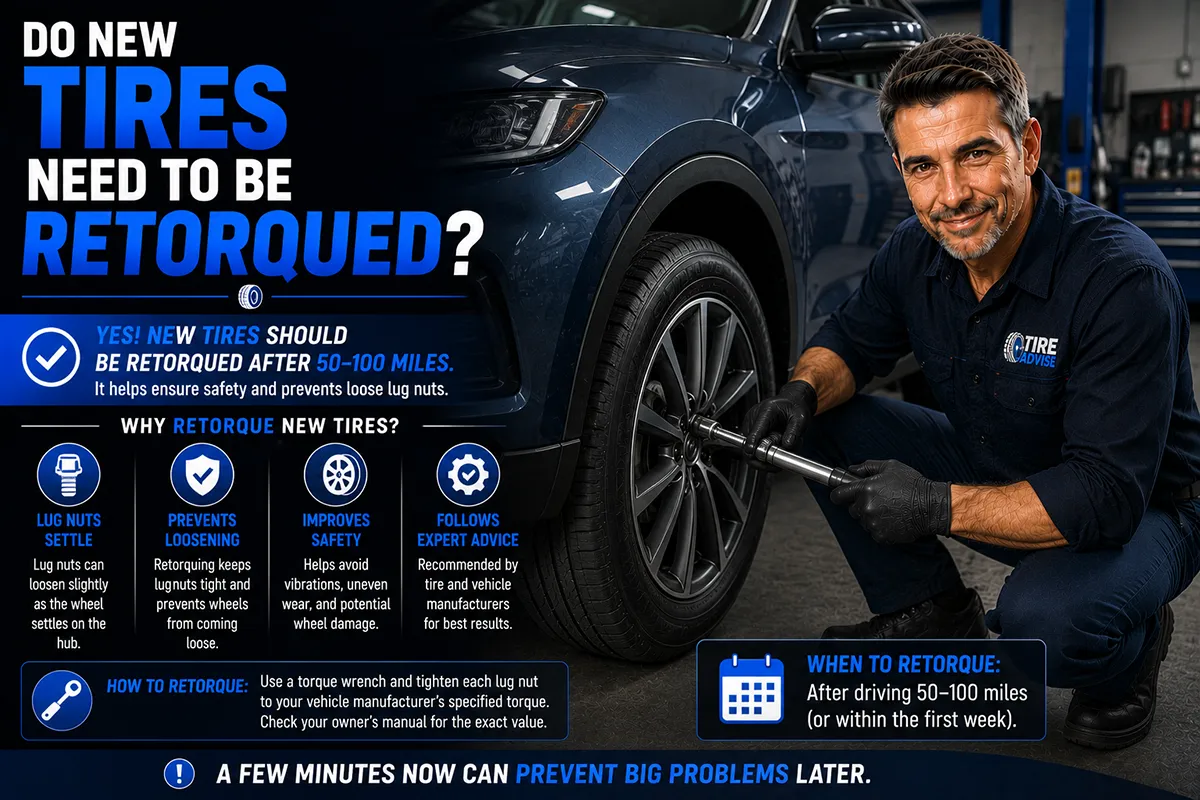
- New tires should be retorqued after approximately 50–100 miles of driving (typically a few days of normal use).
- Lug nuts loosen naturally as the wheel settles against the hub — this is normal, not a sign of a bad installation.
- Failing to retorque can cause wheel vibration, stud damage, warped brake rotors, and in extreme cases, a wheel coming off entirely.
- Most tire shops offer free retorque service — just drive back and ask.
- If you own a torque wrench, you can safely do this yourself in about 10 minutes.
- Always torque to your vehicle’s exact specification (found in the owner’s manual), not just “tight enough.”
Liked this article?
Add TireAdvise as a preferred source so you see more of our tire reviews and guides on Google.
What Does “Retorquing” Actually Mean?
Retorquing is the process of rechecking and retightening your lug nuts to the manufacturer’s specified torque value after your new tires have been driven on for a short period. It’s not the same as simply cranking them down harder — it’s about verifying they’re at the precise tightness your vehicle requires.
When a tire shop mounts new tires and installs your wheels, they torque the lug nuts to spec using a calibrated torque wrench (or at least they should). But after you drive for a few days, the metal-to-metal contact surfaces between the wheel, hub, and lug nuts undergo a natural settling process.
This settling can cause lug nuts to lose a small but meaningful amount of their clamping force. Retorquing restores them to the proper specification, ensuring your wheels are secure for the long haul.
Why Do Lug Nuts Loosen After New Tire Installation?
This is the question I get asked most often, and I understand the concern. If the shop did their job right, why would anything come loose? The answer lies in basic physics and metallurgy.
Thermal Cycling
As you drive, your brakes generate tremendous heat. That heat transfers through the rotor and hub assembly, causing the metal components to expand and contract repeatedly. This thermal cycling can subtly alter the clamping force on your lug nuts, especially during the first few days when the wheel is still “bedding in” against the hub surface.
Surface Settling and Micro-Deformation
When a wheel is freshly mounted, the contact surfaces between the wheel and the hub aren’t perfectly mated at a microscopic level. Over the first few days of driving, these surfaces undergo tiny amounts of deformation as they conform to each other under load. As this settling occurs, the effective stretch on the wheel studs decreases, which means the lug nuts lose some of their clamping force.
I’ve seen this happen even with brand-new wheels on brand-new hubs. It’s simply how metal behaves under pressure over time.
Vibration and Road Impact
Every pothole, railroad crossing, and rough patch of highway you hit sends shock loads through your suspension and into your wheel assembly. These repeated impacts can contribute to gradual loosening, particularly in that critical break-in period when the wheel hasn’t fully settled.
Paint and Coatings
Here’s one most people don’t think about. If your hub face has a layer of paint, rust, or protective coating on it, that material can compress or wear away slightly during the first few days of driving. As it does, the gap between the wheel and hub increases microscopically, and the lug nuts lose tension.
I always recommend cleaning the hub face with a wire brush before mounting a wheel. Many shops do this as standard practice, but not all of them.
When Should You Get Your New Tires Retorqued?
The industry standard recommendation — and the one I personally follow — is to retorque your lug nuts after approximately **50 to 100 miles of driving**. For most people with a typical daily commute, this works out to roughly **two to four days** after getting new tires.
I tell people not to overthink the exact distance. The key is: drive your car normally for a few days, then either return to the shop or check the torque yourself. Don’t wait weeks, and don’t do it after just a trip around the block.
Here’s the timeline I recommend based on my experience:
- Day of installation: Drive home normally. Avoid aggressive braking or high-speed highway driving if possible.
- After a few days of normal driving: Return to the tire shop or retorque the lug nuts yourself.
- One week after installation: If you haven’t retorqued yet, do it now — don’t put it off any longer.
- At your next tire rotation: Verify torque again as part of your regular maintenance routine.
What Happens If You Don’t Retorque Your New Tires?
I want to be direct here because I’ve seen the consequences firsthand, both on my own vehicles and on cars that come into shops with problems that could have been easily prevented.
Wheel Vibration
Loose lug nuts allow the wheel to sit slightly off-center on the hub. This creates an imbalance that you’ll feel as a vibration through the steering wheel, floorboard, or seat — especially at highway speeds. Many drivers assume this means their new tires are defective or improperly balanced, when in reality, the wheel just isn’t seated properly because the lugs have loosened.
I’ve personally diagnosed this exact issue more times than I can count. A quick retorque solves it instantly.
Warped Brake Rotors
When lug nuts aren’t evenly torqued, they create uneven clamping pressure on the brake rotor. Over time, this uneven pressure causes the rotor to warp, leading to a pulsing sensation when you brake. Replacing warped rotors can cost $200 to $400 or more per axle — all because of a retorque that takes ten minutes.
Damaged Wheel Studs
Loose lug nuts allow the wheel to shift slightly on the studs with every rotation. This repeated micro-movement can elongate the stud holes in your wheel or even damage the threads on the studs themselves. Replacing wheel studs isn’t outrageously expensive (usually $20 to $50 per stud including labor), but it’s completely avoidable.
Wheel Separation
This is the nightmare scenario, and it does happen. If lug nuts loosen enough, the wheel can actually come off the vehicle while driving. I’ve seen photos and dashcam footage of wheels rolling down highways after separating from vehicles. It’s terrifying, and it endangers not just the driver but everyone else on the road.
The National Highway Traffic Safety Administration (NHTSA) has documented cases of wheel separations linked to improper torque and failure to retorque. This isn’t a theoretical risk.
Do Tire Shops Remind You to Come Back for Retorquing?
In my experience, this is inconsistent. Some of the major chains — like Discount Tire, Tire Rack’s affiliated installers, Costco Tire Center, and Les Schwab — are generally good about reminding customers to return for a retorque. Many of them will hand you a printed reminder or include it on your receipt.
But plenty of independent shops and quick-service chains don’t mention it at all. I’ve had tires installed at well-known national shops and walked out with zero mention of retorquing. That’s a gap in customer service that I think the industry needs to address.
Here’s what I’ve observed across the major tire retailers in the US:
| Tire Retailer | Retorque Reminder Given? | Free Retorque Service? | Notes |
|---|---|---|---|
| Discount Tire | Usually yes | Yes | Often printed on receipt; walk-in retorque welcome |
| Costco Tire Center | Usually yes | Yes | Included in their installation package |
| Les Schwab | Yes | Yes | Known for excellent post-install follow-up |
| Walmart Auto Center | Sometimes | Yes | Varies by location; ask at the counter |
| Firestone Complete Auto Care | Sometimes | Yes | May not proactively mention it |
| Pep Boys | Rarely | Yes (if asked) | I’ve had to specifically request it |
| Independent Shops | Varies widely | Usually yes | Quality depends entirely on the shop |
My advice: **don’t wait for the shop to remind you.** Put a reminder on your phone the day you get new tires installed, and set it for three to four days out.
Can You Retorque Your Own Lug Nuts?
Absolutely, and I encourage anyone who’s even mildly handy to learn how. It’s one of the simplest and most important car maintenance tasks you can perform, and it requires only one specialized tool.
What You Need
- A torque wrench: A half-inch drive, click-type torque wrench is the standard. I recommend the Tekton 24335 or the EPAuto 1/2-inch drive click torque wrench — both are available on Amazon for $25 to $50 and are more than accurate enough for this job.
- The correct socket: Match the socket size to your lug nuts (common sizes are 17mm, 19mm, 21mm, and 22mm for most US-market vehicles).
- Your vehicle’s torque specification: Found in your owner’s manual or on a sticker inside the driver’s door jamb. If you can’t find it, a quick Google search of your year, make, and model plus “lug nut torque spec” will get you there.
How to Retorque: Step by Step
Here’s the exact process I follow every time:
- Park on a flat, level surface. Make sure the car is in park (automatic) or in gear (manual) with the parking brake engaged.
- Set your torque wrench to the specified value. For example, most Honda and Toyota sedans call for 80 ft-lbs, while many trucks and SUVs require 100 to 140 ft-lbs. Always use your vehicle’s exact spec.
- Work in a star pattern. Don’t go around the wheel in a circle. Instead, tighten in a crisscross or star pattern to ensure even pressure distribution across the wheel.
- Listen and feel for the click. When the torque wrench reaches the set value, it will produce a distinct click. Stop tightening immediately when you feel it — overtorquing is just as bad as undertorquing.
- Repeat for all four wheels. Don’t skip any, even if only one or two wheels had new tires mounted.
- Reset your torque wrench to its lowest setting before storing it. This preserves the calibration of the spring mechanism inside.
The whole process takes me about ten minutes across all four wheels. It’s fast, easy, and it could save your life.
Common Torque Specifications for Popular US Vehicles
To give you a starting point, here are the lug nut torque specs I’ve looked up and verified for some of the most popular vehicles on US roads. **Always confirm with your owner’s manual** — these are general references only.
| Vehicle | Lug Nut Torque (ft-lbs) |
|---|---|
| Toyota Camry | 76 ft-lbs |
| Honda Civic | 80 ft-lbs |
| Ford F-150 | 150 ft-lbs |
| Chevrolet Silverado 1500 | 140 ft-lbs |
| Toyota RAV4 | 76 ft-lbs |
| Honda CR-V | 80 ft-lbs |
| Jeep Wrangler | 95–100 ft-lbs |
| Tesla Model 3 | 129 ft-lbs |
| Subaru Outback | 89 ft-lbs |
| Hyundai Tucson | 80 ft-lbs |
Notice the wide range — from 76 ft-lbs on a Camry to 150 ft-lbs on an F-150. This is exactly why “hand-tight” or “as tight as I can get it” is never an acceptable approach. You need a torque wrench, period.
The Dangers of Overtorquing
While most of this article focuses on lug nuts coming loose, I want to spend a moment on the opposite problem: **overtorquing**. I see this happen frequently, especially at shops that rely on impact guns without finishing with a torque wrench.
An impact gun can easily deliver 200, 300, or even 500 ft-lbs of torque — far beyond what any passenger vehicle lug nut requires. Here’s what happens when lug nuts are overtorqued:
- Stretched or broken wheel studs: The stud is stretched beyond its elastic limit and can snap — sometimes immediately, sometimes later when you hit a bump.
- Warped brake rotors: Excessive and uneven clamping force distorts the rotor, causing brake pulsation.
- Cracked wheels: Especially common with alloy wheels, which are more brittle than steel.
- Impossible roadside tire changes: If your lug nuts are torqued to 300 ft-lbs, good luck getting them off with the basic lug wrench in your trunk if you get a flat on I-95.
I always ask the technician to use a torque wrench for the final tightening — not just an impact gun. Any reputable shop will accommodate this request without hesitation. If they won’t, I take my business elsewhere.
What About Tire Rotations? Do You Need to Retorque Then Too?
Yes. Any time a wheel is removed and reinstalled — whether for new tires, a tire rotation, brake work, or anything else — the same retorque recommendation applies. The settling process happens every single time the wheel-to-hub interface is disturbed.
I make it a habit to retorque after every tire rotation. Since I rotate my tires regularly as part of my maintenance routine, I’ve gotten into a rhythm. Rotate on Saturday, retorque the following Wednesday or Thursday. It takes almost no time and gives me peace of mind.
Special Considerations for Different Wheel Types
Not all wheels behave the same when it comes to torque retention. In my experience, some types require even more attention.
Alloy Wheels
Alloy wheels are softer than steel and more prone to micro-deformation at the lug seat. This means they tend to lose torque more readily during the settling period. If you have alloy wheels (which most modern cars do), retorquing isn’t optional — it’s essential.
Steel Wheels
Steel wheels are harder and generally hold torque better, but they’re still subject to the same settling physics. Don’t skip the retorque just because you have steel wheels.
Aftermarket Wheels
If you’re running aftermarket wheels, pay extra attention. Aftermarket wheels sometimes use different lug nut styles (conical seat vs. ball seat vs. flat seat), and using the wrong type of lug nut can prevent proper seating. I’ve seen aftermarket wheel setups where the lug nuts felt tight but the wheel was actually loose because the seat geometry was wrong.
Always verify that your lug nuts match your wheel’s seat type. This is a detail that even some shops overlook.
Signs That Your Lug Nuts May Have Loosened
If you’re past the retorque window and you’re now worried, here are the warning signs I tell people to watch for:
- Vibration at speed: A rhythmic vibration through the steering wheel or seat, especially at highway speeds, that wasn’t there before.
- Clicking or clunking sounds: A faint but consistent click or clunk coming from a wheel area, especially during turns or when hitting bumps.
- Visible wheel wobble: If you can see the wheel moving slightly when someone drives past you slowly (have a friend check), that’s an emergency.
- Steering pull: The car pulls to one side, or the steering feels “loose” and imprecise.
If you notice any of these symptoms after having new tires installed, **pull over safely and check your lug nuts immediately.** Do not continue driving. If you don’t have a torque wrench, tighten them as much as you can with your vehicle’s lug wrench and drive directly to a shop.
My Personal Retorque Routine
I’ve been reviewing tires and working on vehicles for years, and I’ve developed a routine that I follow without exception every time I get new tires or have wheels removed for any reason.
Day one: Drive home from the shop. I keep my speed moderate and avoid any aggressive driving. I listen carefully for any unusual sounds.
After a few days of normal commuting: I pull out my torque wrench and check all twenty lug nuts (five per wheel on most of my test vehicles). In my experience, at least one or two are always slightly below spec. Usually it’s not dramatic — maybe just a few foot-pounds low — but it’s enough to matter over time.
After about a week: I do one more check, mainly for my own peace of mind. At this point, they’ve always held firm.
This routine has never let me down. It takes minimal effort, costs nothing (assuming you own a $30 torque wrench), and eliminates a real and preventable safety risk.
The Bottom Line: Retorquing Is Non-Negotiable
I’ve tested hundreds of tires across dozens of vehicles, and I treat retorquing as just as important as choosing the right tire in the first place. It doesn’t matter if you bought premium Michelin Pilot Sport 4S tires or budget-friendly General Altimax RT45s — if the wheel isn’t properly secured, none of that performance matters.
Here’s what I want you to take away from this article:
- Retorquing is a normal, expected part of new tire installation — not a sign that something went wrong.
- Do it after a few days of driving, ideally within the first week.
- Most shops will do it for free — just ask.
- If you want to do it yourself, invest in a quality torque wrench. It’s one of the best $30–$50 you’ll ever spend on car maintenance.
- Never use “tight enough” as your standard. Use the manufacturer’s exact torque specification, every time.
Your tires are the only thing connecting your car to the road. Making sure they’re properly attached to your car isn’t extra credit — it’s the bare minimum. Take ten minutes, grab your torque wrench, and do the retorque. Your future self will thank you.
Frequently Asked Questions
Do new tires need to be retorqued after installation?
Yes, most tire shops and vehicle manufacturers recommend retorquing your lug nuts after driving 50 to 100 miles on new tires. This is because the wheels can settle against the hub and rotor during initial driving, which may cause the lug nuts to lose their proper clamping force. Skipping this step can lead to loose wheels, vibrations, or even a dangerous wheel-off situation on the highway.
What happens if you don’t retorque your lug nuts after getting new tires?
If you skip the retorque, your lug nuts may gradually loosen as the wheel assembly settles, which can cause a wobble, uneven brake rotor wear, or in worst cases the wheel detaching while driving. I’ve seen cases where drivers noticed a shaking steering wheel within a few hundred miles simply because they didn’t go back for a retorque. Most reputable shops like Discount Tire, Tire Rack, and Les Schwab include a free retorque as part of their new tire installation service.
How many miles after new tire installation should you retorque the lug nuts?
The standard recommendation is to retorque your lug nuts after 50 to 100 miles of normal driving. This gives the wheel enough time to fully seat against the hub while catching any torque loss before it becomes a safety issue. I’d suggest scheduling it within the first week after installation so you don’t forget, especially if you’re doing a lot of highway driving in the meantime.
Can I retorque my own lug nuts at home after buying new tires?
Absolutely, you can retorque your lug nuts at home if you have a calibrated torque wrench, which typically costs between $25 and $80 at auto parts stores like AutoZone or O’Reilly. Look up the correct torque specification for your vehicle in the owner’s manual or on the driver’s side door jamb, as specs usually range from 80 to 100 ft-lbs for most passenger cars and 120 to 140 ft-lbs for trucks and SUVs. Always tighten in a star pattern to ensure even clamping pressure across the wheel.
What torque spec should I use when retorquing lug nuts on new tires?
The correct lug nut torque specification varies by vehicle make and model, so always check your owner’s manual or the manufacturer’s recommendation rather than guessing. For example, most Honda and Toyota sedans call for around 80 ft-lbs, while Ford F-150s typically require 150 ft-lbs. Using an impact gun without a torque setting or just tightening by feel is one of the most common mistakes, and over-torquing can warp brake rotors or strip the wheel studs.
Do tire shops retorque for free after new tire installation?
Most major US tire retailers including Discount Tire, Costco Tire Center, Sam’s Club, and Les Schwab offer free retorque services as part of their tire installation package. You typically just need to drive back to the shop after 50 to 100 miles and they’ll check and re-tighten your lug nuts in about 10 minutes without an appointment. I always recommend taking advantage of this free service since it gives the technician a chance to visually inspect the new tires for any issues at the same time.
Is retorquing only necessary for new tires or also after a tire rotation?
Retorquing is recommended any time your wheels have been removed and reinstalled, which includes new tire installation, tire rotations, brake jobs, and even seasonal tire swaps for winter driving. The same 50 to 100 mile rule applies in each case because the wheel-to-hub connection needs time to settle regardless of whether the tires are new. This is an easy maintenance step that takes just a few minutes but can prevent serious safety problems down the road.
