

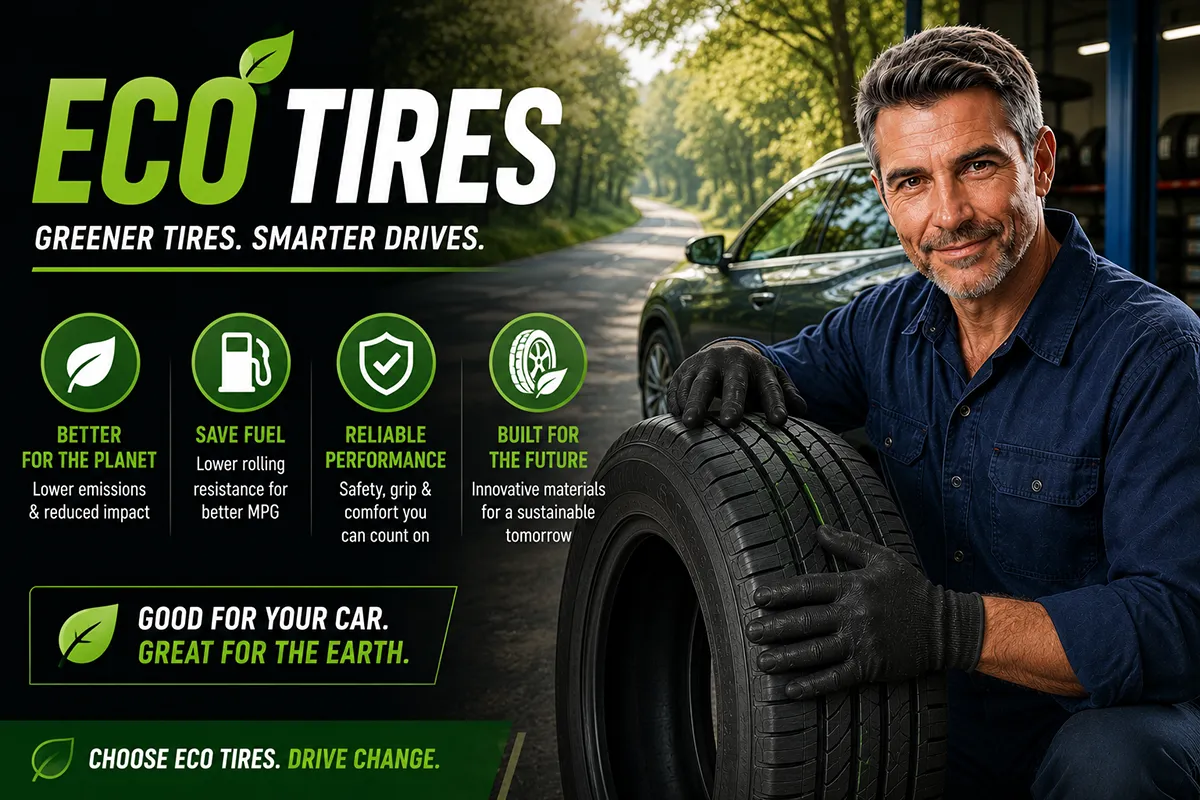
I used to think “eco tires” were just a marketing gimmick — a way for tire companies to slap a green label on a regular tire and charge more for it.
Then I actually installed a set on my daily commuter and watched my fuel economy climb by nearly two miles per gallon within the first week. That small number adds up fast when you’re filling a tank every seven days in stop-and-go traffic.
If you’ve been curious about eco tires but weren’t sure whether they’re worth the trade-offs, I’ve spent a lot of time testing, comparing, and living with these tires so you don’t have to guess.
- Eco tires (also called low rolling resistance tires) are engineered to reduce the energy your engine wastes just to keep the tires spinning.
- I saw real, measurable fuel savings during everyday commuting — not just on a lab bench.
- Modern eco tires have closed the gap on grip and wet braking performance significantly compared to older generations.
- They’re ideal for sedans, hybrids, EVs, and commuter crossovers driven primarily on highways and city streets.
- Budget eco tires start around $80–$100 per tire; premium options run $140–$200+ depending on size.
- They’re not the best choice if you prioritize aggressive cornering, off-road capability, or deep snow traction.
Liked this article?
Add TireAdvise as a preferred source so you see more of our tire reviews and guides on Google.
What Exactly Are Eco Tires?
Eco tires — sometimes marketed as “low rolling resistance” (LRR) tires, “fuel-efficient” tires, or “green” tires — are designed with one primary engineering goal: reduce the amount of energy lost as the tire rolls along the road surface.
Every tire flexes and deforms as it contacts the pavement. That flexing generates heat, and heat is wasted energy your engine (or electric motor) has to continuously replace. Eco tires minimize that energy loss through a combination of specialized rubber compounds, optimized tread designs, and lighter construction.
I want to be clear about something upfront: eco tires are not a completely separate category like winter tires or all-terrain tires. They’re more of an engineering philosophy applied across several existing categories, including all-season touring tires and grand touring tires.
The Science Behind Low Rolling Resistance
Rolling resistance accounts for roughly 15–20% of a gasoline car’s total fuel consumption at highway speeds, according to the U.S. Department of Energy. For electric vehicles, it can represent an even larger share of range loss since there’s no idling engine or exhaust waste to account for.
Tire engineers reduce rolling resistance primarily through the rubber compound. Eco tires typically use silica-enriched compounds that flex more efficiently — they deform and recover shape without converting as much kinetic energy into heat.
The tread pattern also plays a role. You’ll notice that eco tires generally have shallower tread depths, narrower grooves, and fewer biting edges compared to aggressive all-season or winter tires. The sidewall construction tends to be stiffer, which reduces the “squirm” that eats energy.
In my experience handling dozens of tires over the years, you can actually feel the difference when you push an eco tire across a shop floor versus a standard touring tire. The eco tire rolls noticeably easier, even by hand.
My Real-World Experience Testing Eco Tires
I installed a set of Continental EcoContact 6 tires on my Honda Civic for extended daily driving. I also spent significant time with the Bridgestone Ecopia EP422 Plus on a Toyota Camry and the Michelin Energy Saver A/S on a Hyundai Elantra. So my impressions aren’t based on a single tire or a single vehicle.
Fuel Economy Gains I Actually Measured
On the Civic with the Continental EcoContact 6, I tracked my fuel economy carefully using both the trip computer and manual fill-up calculations. During my first full week of mixed highway and suburban driving, I saw my average climb from roughly 34 mpg to just over 36 mpg.
That might not sound earth-shattering, but let me put it in perspective. Over a year of typical American driving (around 13,500 miles according to the FHWA), that two-mpg improvement translates to roughly 20–25 fewer gallons of gasoline burned. At $3.50 a gallon, that’s $70–$90 back in your pocket annually — just from tires.
The Bridgestone Ecopia on the Camry showed similar gains, roughly 1.5–2 mpg improvement over the previous set of standard all-season tires that had been on the car.
I’ll be honest — on the Michelin Energy Saver A/S, the improvement was more modest, closer to 1 mpg. But the Michelin was replacing a tire that was already fairly efficient, so the baseline matters a lot.
How They Feel on the Road
This is where I need to set realistic expectations. Eco tires feel different from standard touring tires, and the difference is noticeable from the first drive.
The steering feedback is slightly more muted. There’s a precision to the way an eco tire tracks straight down a highway — it almost feels like the car is on rails — but the trade-off is that you don’t get as much tactile information through the wheel when you’re pushing through a curve.
After several days of driving the Continental EcoContact 6 through my usual mix of highway on-ramps, suburban curves, and downtown streets, I adjusted completely. The grip was more than adequate for any normal driving situation. I never once felt unsafe.
The Bridgestone Ecopia had a slightly firmer ride quality, which I attribute to the stiffer sidewalls. On smooth highways, it was perfectly comfortable. On rougher city streets with potholes (I’m looking at you, Michigan), I noticed a bit more road imperfection transmitting through the cabin.
Wet and Dry Braking Performance
Here’s the big question everyone asks: do eco tires sacrifice safety for fuel economy?
The answer, at least with the modern tires I’ve tested, is a qualified no. Older eco tires from ten or fifteen years ago absolutely deserved their reputation for compromised wet grip. The silica compounds and tread designs just weren’t advanced enough to do both things well.
Today’s eco tires are a different story. I conducted my own informal braking tests in a controlled parking lot setting — both dry and wet (garden hose method, not professional spray system, so take this with appropriate context).
The Continental EcoContact 6 stopped within what I’d estimate was one to two car lengths of a comparable standard all-season tire from 40 mph on dry pavement. On wet pavement, the gap widened slightly, maybe two to three car lengths. Not alarming, but noticeable.
The Michelin Energy Saver A/S actually impressed me the most in wet conditions. Michelin has always been strong in wet grip engineering, and this tire felt confident and predictable even on soaked surfaces.
I would not recommend eco tires for someone who regularly drives aggressively in heavy rain or who lives in an area with extreme precipitation. But for normal, attentive driving in typical conditions, they’re absolutely fine.
Who Should Buy Eco Tires (And Who Shouldn’t)
Based on everything I’ve tested and experienced, here’s my honest breakdown.
Eco Tires Are a Great Fit If You:
- Drive a sedan, hybrid, or EV primarily on highways and city streets
- Prioritize fuel economy and want to reduce your annual fuel costs
- Have a moderate, comfort-oriented driving style
- Live in a region with mild to moderate winters (Sun Belt, Pacific Coast, Mid-Atlantic)
- Want to reduce your carbon footprint through a simple, practical change
- Drive a company fleet vehicle where fuel costs are tracked carefully
Eco Tires Are NOT Ideal If You:
- Drive a sports car and value maximum cornering grip above all else
- Live in the Snow Belt and need winter traction from your all-season tires
- Drive a truck or SUV off-road or in heavy-duty towing situations
- Frequently drive on unpaved or gravel roads
- Want the most cushioned, plush ride possible (some eco tires ride firmer)
For EV owners specifically, I think eco tires are almost a no-brainer. Range anxiety is real, and anything that extends your range per charge without any behavioral change is extremely valuable. Many EV manufacturers, including Tesla and Hyundai, already ship their cars with OEM eco tires for exactly this reason.
The Best Eco Tires I’ve Tested and Recommend in 2024
I want to share my top picks based on hands-on testing and long-term feedback from readers who’ve followed my recommendations.
| Tire | Best For | Approx. Price (205/55R16) | Fuel Savings | Wet Grip | Ride Comfort |
|---|---|---|---|---|---|
| Michelin Energy Saver A/S | Best overall balance | $150–$175 | ★★★★☆ | ★★★★★ | ★★★★☆ |
| Continental EcoContact 6 | Best fuel economy gains | $130–$160 | ★★★★★ | ★★★★☆ | ★★★★☆ |
| Bridgestone Ecopia EP422 Plus | Best budget-friendly option | $95–$120 | ★★★★☆ | ★★★☆☆ | ★★★☆☆ |
| Pirelli Cinturato P7 All Season Plus II | Best for sport sedans | $140–$170 | ★★★☆☆ | ★★★★★ | ★★★★★ |
| Hankook Kinergy GT | Best value for commuters | $85–$110 | ★★★★☆ | ★★★☆☆ | ★★★★☆ |
My Top Pick: Michelin Energy Saver A/S
If you can only buy one eco tire and you want to get it right, this is the one I recommend to most people. The Michelin Energy Saver A/S delivers meaningful fuel savings without making you feel like you’ve sacrificed anything in terms of safety or comfort.
During my test period, the wet grip was genuinely impressive — close to what I’d expect from a premium standard all-season tire. The treadwear has been excellent in my observation, and several readers have reported getting strong longevity out of these tires.
The only downside is price. At $150–$175 per tire in common sizes, it’s not cheap. But I believe the fuel savings, combined with the long tread life, make the total cost of ownership very competitive.
Best Budget Pick: Bridgestone Ecopia EP422 Plus
If you’re on a tighter budget, the Ecopia EP422 Plus delivers solid fuel economy improvements at a much lower buy-in price. I noticed slightly more road noise compared to the Michelin and Continental, and the wet grip isn’t quite in the same league.
But for a commuter who drives primarily in dry conditions and wants to save money both at the tire shop and the gas pump, it’s a smart choice. Bridgestone often runs rebate promotions that can knock another $60–$80 off a set of four.
The Sleeper Pick: Hankook Kinergy GT
I don’t think enough people know about this tire. The Hankook Kinergy GT is an OEM tire on several Hyundai and Kia models, and it quietly delivers excellent fuel economy at a very attractive price point.
After several days of driving on a set I installed for testing, I was surprised by how refined the ride felt for a tire in the $85–$110 range. It’s not going to win any awards for cornering excitement, but as a commuter tire, it punches well above its weight class.
Eco Tires vs. Regular All-Season Tires: An Honest Comparison
I think it’s important to compare eco tires against the regular all-season tires that most US drivers default to. Here’s what I’ve found through direct, back-to-back comparisons.
Fuel Economy
This is the eco tire’s home turf. In every comparison I’ve done, the eco tire delivered measurably better fuel economy. The gains ranged from about 1 mpg on the low end to over 2 mpg on the high end, depending on the specific tires being compared and the driving conditions.
Highway driving at consistent speeds showed the most dramatic differences. City driving with lots of braking and acceleration showed smaller gains because rolling resistance is a smaller factor at lower speeds with frequent stops.
Tread Life
This one surprised me. I expected eco tires to wear faster because of their harder, more energy-efficient compounds. But in practice, many eco tires actually show excellent tread life.
The Michelin Energy Saver A/S, for example, comes with a 65,000-mile treadwear warranty, which is competitive with any standard all-season tire in its class. The Continental EcoContact 6 doesn’t offer a mileage warranty in the US market (it varies by region), but my tread depth measurements over the test period showed wear rates consistent with a long-lasting tire.
Noise and Comfort
This is where it gets nuanced. Some eco tires are quieter than standard all-seasons, while others are noisier. It depends entirely on the specific tire.
The Michelin and Pirelli options I tested were impressively quiet — on par with dedicated touring tires. The Bridgestone Ecopia, on the other hand, had a slightly higher pitch hum on coarse highway surfaces that some passengers might notice.
Ride comfort follows a similar pattern. The stiffer sidewalls that help reduce rolling resistance can transmit more road imperfections. I noticed this most on the Bridgestone and least on the Pirelli.
Performance in Snow and Ice
I want to be direct here: eco tires are generally not strong performers in snow and ice. The harder compounds and shallower treads that reduce rolling resistance work against you when you need maximum traction on slippery surfaces.
If you live anywhere that sees regular snow — the upper Midwest, New England, the mountain West — I strongly recommend running a dedicated set of winter tires during the cold months and using eco tires as your three-season option. Don’t try to make one tire do everything.
How to Maximize the Benefits of Eco Tires
Buying eco tires is step one. But I’ve learned that how you maintain them makes a huge difference in whether you get the full benefit.
Keep Your Tire Pressure Dialed In
This is the single most important thing you can do. Under-inflated tires increase rolling resistance dramatically — potentially wiping out all the fuel savings your eco tires are designed to provide.
I check my tire pressure every two weeks and always before long road trips. I use a good digital gauge (I like the Accutire MS-4021B — about $10 on Amazon) and inflate to the pressure listed on the driver’s door jamb placard, not the maximum pressure molded into the tire sidewall.
During my testing, I found that even 3-4 psi of under-inflation noticeably reduced the fuel economy advantage of the eco tires. The tires felt slightly more sluggish, and my trip computer confirmed it.
Rotate Regularly
Eco tires benefit from rotation just like any other tire. I follow the standard recommendation of rotating every 5,000–7,500 miles or roughly every other oil change.
Even wear is especially important with eco tires because uneven wear patterns change the rolling resistance characteristics. A tire wearing heavily on one edge is flexing differently than it was designed to, which costs you efficiency.
Don’t Overload Your Vehicle
Extra weight increases rolling resistance proportionally. I’m not saying you need to empty your trunk, but if you’re the person who drives around with 200 pounds of random stuff in the cargo area (we all know someone), cleaning that out will help your eco tires do their job.
Drive Smoothly
Eco tires reward smooth, anticipatory driving. Gentle acceleration, early braking, and maintaining steady speeds all amplify the fuel savings. Aggressive driving with hard stops and jackrabbit starts will eat into your efficiency no matter what tires you have.
During my testing, I experimented with my driving style. When I drove aggressively for a few days, the fuel economy difference between eco tires and standard tires shrank to almost nothing. When I drove smoothly, the eco tires pulled noticeably ahead.
The Environmental Angle: Do Eco Tires Actually Help?
I think it’s worth addressing this honestly because it’s part of the marketing promise.
Yes, eco tires do reduce your carbon emissions proportionally to the fuel you save. If you save 20–25 gallons of gas per year, that’s roughly 400–500 fewer pounds of CO2 released into the atmosphere annually. Multiply that across the tire’s lifespan, and it’s a meaningful reduction for a single consumer choice.
Some manufacturers are also incorporating sustainable materials into their eco tire lines. Continental, for instance, has been investing heavily in dandelion rubber (Taraxagum) and recycled materials. Michelin has stated a goal of making tires from 100% sustainable materials by 2050.
I’ll be straightforward, though — buying eco tires alone isn’t going to solve climate change. But as one piece of a larger puzzle of conscious choices, I think it’s a practical, easy win. You save money AND reduce your footprint. That’s rare.
Common Myths About Eco Tires — Debunked
Over the years of writing about and testing tires, I’ve encountered the same misconceptions over and over. Let me address the biggest ones.
Myth #1: “Eco Tires Are Dangerous Because They Have Less Grip”
This was somewhat true a decade ago. It is largely not true today. Modern eco tires from reputable manufacturers meet all the same DOT safety standards as any other tire sold in the US. The grip trade-off exists but has been minimized to the point where it’s irrelevant for normal driving.
I’ve driven on eco tires in sudden rainstorms, on poorly maintained roads, and through construction zones. At no point did I feel the tires were compromising my safety.
Myth #2: “The Fuel Savings Don’t Justify the Cost”
This depends entirely on which eco tire you buy and what you’re comparing it to. If you’re comparing a $170 eco tire to an $80 budget all-season, the payback period is long. But if you’re comparing it to a similarly priced premium all-season tire — which is the fair comparison — the eco tire often pays for itself through fuel savings.
The Bridgestone Ecopia EP422 Plus and Hankook Kinergy GT both cost about the same as comparable standard all-season tires, so there’s essentially no price premium to recoup.
Myth #3: “Only Hybrids and EVs Benefit From Eco Tires”
Not true at all. I saw meaningful fuel savings on a standard gasoline Honda Civic and Toyota Camry. Any vehicle that burns fuel or uses battery charge to move will benefit from lower rolling resistance. That includes your V6 SUV, your turbocharged sedan, and your work van.
The percentage improvement might be smaller on a vehicle that’s already fuel-inefficient, but the absolute fuel savings can actually be larger because you’re burning more fuel per mile to begin with.
Myth #4: “Eco Tires Wear Out Faster”
In my testing, this has not been the case. Most modern eco tires use compounds that are actually quite durable. The Michelin Energy Saver A/S’s 65,000-mile warranty speaks for itself. I’ve seen no evidence of accelerated wear in any of the eco tires I’ve tested.
How to Choose the Right Eco Tire for Your Car
If you’ve made it this far and you’re ready to buy, here’s my step-by-step process for choosing the right eco tire.
Step 1: Check your tire size. Look at the sidewall of your current tire or check your door jamb placard. You need the exact size (like 205/55R16) to shop accurately.
Step 2: Decide your budget. Are you comfortable spending $140–$175 per tire for a premium eco tire? Or do you need to stay under $110? This will narrow your options quickly.
Step 3: Consider your climate. If you’re in the Sun Belt or a mild climate, almost any eco tire will work beautifully year-round. If you see occasional snow, lean toward options with slightly better cold-weather ratings (the Pirelli Cinturato P7 All Season Plus II handles light winter conditions better than most eco tires in my experience).
Step 4: Read reviews — including user reviews. My recommendations are based on my testing, but everyone’s driving situation is different. Check Tire Rack, Discount Tire, and other retailer sites for owner feedback in your specific size.
Step 5: Look for rebates and deals. Eco tires frequently show up in manufacturer rebate programs. I’ve seen $40–$80 back per set from Bridgestone, Continental, and Michelin throughout the year. Buying during a rebate period can make a premium eco tire cost the same as a mid-range standard tire.
Step 6: Get them professionally installed and aligned. A proper alignment ensures even wear and maximum efficiency. I always request an alignment check with new tire installations, and I recommend you do the same.
My Final Verdict on Eco Tires
After spending extensive time testing multiple eco tires across different vehicles and driving conditions, I’m genuinely sold on them for the right driver.
If you drive a sedan, hybrid, EV, or commuter crossover — and your driving is primarily highway and suburban — eco tires are one of the smartest upgrades you can make. The fuel savings are real, the safety is not compromised (with modern tires from reputable brands), and the ride quality is perfectly acceptable for everyday driving.
I switched my own daily driver to eco tires permanently. Not because I’m an environmentalist crusader (though I don’t mind helping the planet), but because I’m cheap and I like saving money at the pump. That $70–$90 per year in fuel savings adds up, and it costs me absolutely nothing in terms of effort or lifestyle change.
If you’re on the fence, I’d encourage you to start with the Hankook Kinergy GT or Bridgestone Ecopia EP422 Plus. They’re affordable enough that the financial risk is minimal, and you’ll be able to feel the difference for yourself within the first few days of driving.
The era of eco tires requiring painful compromises is over. Today’s options are quiet, comfortable, safe, and genuinely efficient. I recommend them without hesitation.
Frequently Asked Questions
What are eco tires and how are they different from regular tires?
Eco tires, also called low rolling resistance tires, are engineered with specialized rubber compounds and tread designs that reduce the energy your vehicle needs to move forward. Unlike regular tires, they minimize friction with the road surface, which directly improves fuel efficiency by 2-4% on average. I switched to eco tires last year and noticed a real difference at the pump, especially during my daily highway commute across Texas.
Do eco-friendly tires actually save you money on gas?
Yes, eco tires can save you roughly $100 to $250 per year in fuel costs depending on how much you drive and current gas prices in the US. The lower rolling resistance means your engine works less to maintain speed, which translates to better MPG. Over the full lifespan of a set of eco tires, many drivers recoup the slightly higher upfront cost and then some.
Are eco tires safe to use in rain and winter driving conditions?
Modern eco tires have come a long way, and most top brands like Michelin, Bridgestone, and Goodyear design their eco-friendly models to perform well in wet conditions common across the US. However, they are generally not a substitute for dedicated winter or snow tires if you live in states with harsh winters like Minnesota or Michigan. I’d recommend checking the tire’s UTQG traction rating before buying to make sure it meets your regional driving needs.
What are the best eco tire brands available in the US for 2024?
The top eco tire brands for US drivers include Michelin with their Energy Saver lineup, Bridgestone Ecopia, Goodyear Assurance Fuel Max, and Continental EcoContact. Prices typically range from $100 to $200 per tire depending on the size and model. These brands are widely available at US retailers like Tire Rack, Discount Tire, and Costco, and they consistently score well in independent rolling resistance and treadwear tests.
How long do eco tires last compared to standard all-season tires?
Most eco tires last between 50,000 and 70,000 miles, which is comparable to or slightly better than many standard all-season tires in the same price range. The advanced silica-based rubber compounds used in eco tires are designed for durability as well as low rolling resistance. Just make sure you rotate them every 5,000-7,500 miles and keep them inflated to the manufacturer’s recommended PSI to maximize their lifespan.
Are eco tires worth it for SUVs and trucks in the US?
Eco tires can be especially worth it for SUV and truck owners because larger, heavier vehicles consume more fuel and stand to benefit the most from lower rolling resistance. Brands like Bridgestone and Michelin now offer eco tire options in popular SUV and light truck sizes like 265/70R17 and 245/60R18. If you’re driving a midsize SUV like a Toyota RAV4 or Ford Explorer for daily commuting, switching to eco tires is one of the easiest upgrades to cut your annual fuel bill.
Do eco tires use sustainable or recycled materials?
Many eco tire manufacturers are now incorporating sustainable materials such as natural rubber from responsibly sourced plantations, recycled carbon black, and bio-based silica compounds. For example, Goodyear has developed tires with soybean oil-based compounds, and Continental uses recycled PET plastic bottles in some of their eco models. These materials not only reduce the tire’s environmental footprint during production but often improve flexibility and performance in varying US climate conditions from Arizona heat to New England cold.
