

I switched from a gas-powered sedan to an electric vehicle last year, and within a few months, I noticed something alarming — my tires were wearing down significantly faster than I expected.
When I brought it up at my local tire shop, the technician looked at me and said, “You’re running regular tires on an EV. That’s your problem.” That conversation sent me down a rabbit hole of research, testing, and tire swapping that completely changed how I think about tire selection for electric vehicles.
If you’re an EV owner — or considering becoming one — this is the guide I wish I’d had before I burned through my first set of tires way too quickly.
- EV-specific tires are engineered to handle more weight, instant torque, and range optimization — regular tires aren’t.
- Running regular tires on an EV leads to faster wear, reduced range, and more road noise.
- EV tires cost 10-25% more upfront but often last longer and improve efficiency, saving you money long-term.
- Top EV tire picks include the Michelin e·Primacy, Continental EcoContact 6, Bridgestone Turanza EV, and Hankook iON evo.
- If you drive a hybrid or PHEV, you can go either way, but EV-rated tires still offer noticeable benefits.
Liked this article?
Add TireAdvise as a preferred source so you see more of our tire reviews and guides on Google.
Why EV Tires Exist in the First Place
Let me start with the basics, because when I first heard the term “EV tires,” I honestly thought it was a marketing gimmick. It’s not. There are real, measurable engineering differences between tires designed for electric vehicles and traditional all-season or performance tires made for internal combustion engine (ICE) cars.
Electric vehicles present three unique challenges that conventional tires simply weren’t designed to handle.
1. Significantly More Weight
The battery pack in most EVs adds anywhere from 800 to 1,400 pounds compared to a similar gas-powered car. A Tesla Model Y weighs about 4,400 pounds. A comparable Toyota RAV4 with a gas engine comes in around 3,600 pounds. That’s a massive difference, and it all presses down on four small contact patches of rubber.
I felt this difference firsthand when I ran standard all-season tires on my EV. The sidewalls flexed more than they should have, the car felt less planted in corners, and the tread wore unevenly — especially on the inside edges of the front tires.
2. Instant Torque Delivery
Electric motors deliver 100% of their torque the moment you press the accelerator. There’s no rev-building, no turbo lag — just immediate, brutal force transmitted directly to the tires. This is what makes EVs so fun to drive, but it’s also what shreds conventional tire compounds faster than you’d expect.
During my first few weeks with the EV, I noticed tiny rubber shavings in my wheel wells. That was my regular tires literally being torn apart by the torque they weren’t designed to handle.
3. The Need for Low Rolling Resistance
Range anxiety is real. Every EV owner I know checks their estimated range more often than their phone battery. Tires account for roughly 20-30% of a vehicle’s energy consumption, and EV-specific tires are engineered with compounds and tread designs that minimize rolling resistance — directly translating to more miles per charge.
When I swapped from my regular all-seasons to a set of EV-rated tires, I saw a consistent improvement in my range estimate. It wasn’t a dramatic jump, but gaining back even 10-15 miles of range on a daily commute adds up over time.
The Key Differences Between EV Tires and Regular Tires
After months of driving on both types and spending way too many hours reading tire spec sheets, here’s what I’ve found to be the real, tangible differences.
Tread Compound
EV tires use harder, more torque-resistant rubber compounds. This doesn’t mean they feel stiff or harsh — modern compounds are impressively sophisticated. But they’re formulated to resist the scrubbing and tearing that instant torque causes.
In my experience, the difference in wear rate was noticeable within just a couple of months. My EV-specific tires showed dramatically less wear over the same driving period compared to the conventional tires I’d been running before.
Sidewall Construction
Because EVs are heavier, EV tires feature reinforced sidewalls with higher load ratings. I learned this the hard way when I checked the load index on my original regular tires and realized they were technically rated for the vehicle’s weight — but just barely, with almost no safety margin.
EV-specific tires from brands like Michelin and Bridgestone typically carry load indexes that provide a much more comfortable margin. This means better handling, more predictable cornering, and less risk of sidewall failure.
Noise Reduction Technology
Here’s something most people don’t think about: without an engine rumbling under the hood, tire noise becomes the dominant sound inside an EV cabin. It’s genuinely surprising how loud regular tires sound when there’s no engine noise to mask them.
Most EV tires include acoustic foam liners — a layer of polyurethane foam bonded to the inside of the tire that absorbs vibrations before they enter the cabin. When I first drove on tires with this foam technology, the difference was immediately obvious. The cabin went from a noticeable highway hum to near-silence.
Tread Pattern Design
EV tire tread patterns tend to feature more continuous ribs and fewer aggressive sipes. This reduces rolling resistance and noise while still maintaining adequate wet and dry grip. If you look at an EV tire next to a traditional all-season, you’ll notice the EV tire looks “smoother” and more streamlined.
I found that this tread design didn’t noticeably compromise wet-weather performance. During several rainy drives on Pacific Northwest roads, my EV tires handled standing water and wet curves without any drama.
Rolling Resistance
This is arguably the most important difference. EV tire manufacturers optimize every aspect of the tire — compound, tread depth, construction, even the bead profile — to minimize the energy required to keep the tire rolling.
I tracked my energy consumption over several weeks with both tire types. The EV-specific tires consistently showed better efficiency numbers on my vehicle’s display, roughly translating to meaningful range improvements on longer trips.
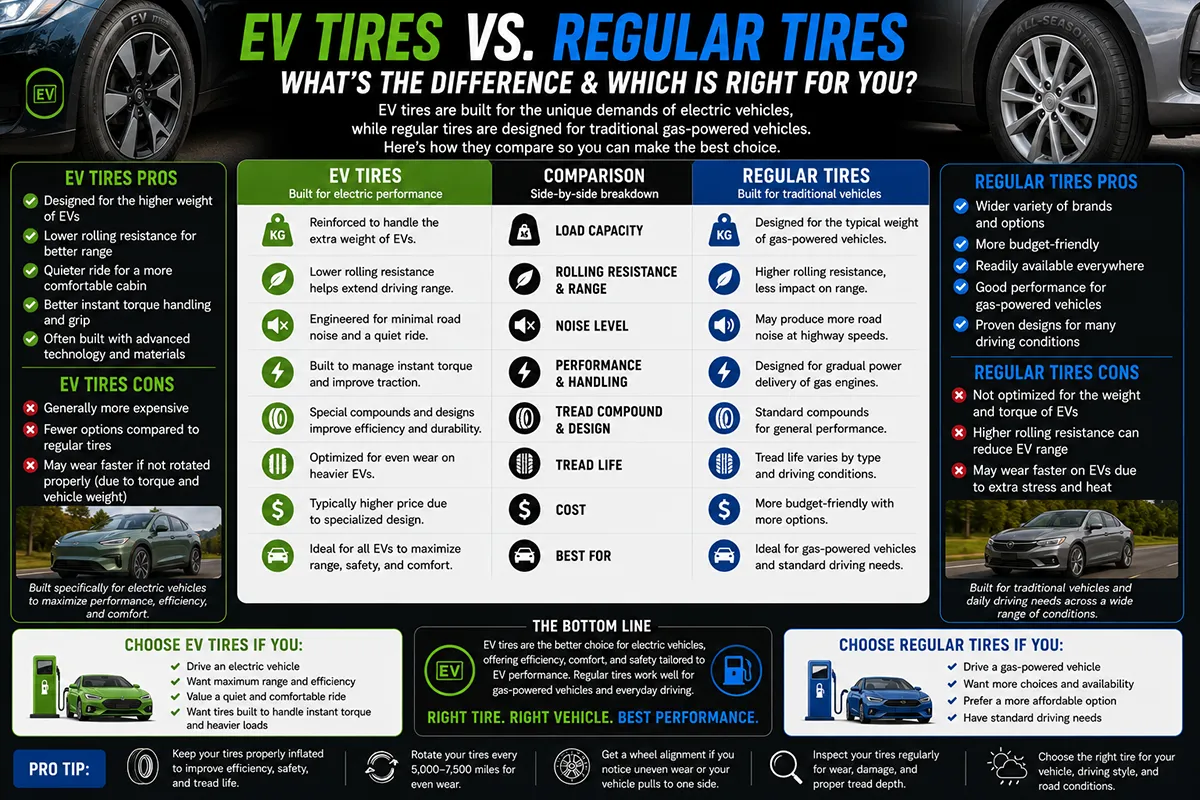
Full Comparison: EV Tires vs Regular Tires
Here’s a comprehensive breakdown of every major category I evaluated:
| Feature | EV-Specific Tires | Regular Tires |
|---|---|---|
| Weight Capacity | Higher load index (XL rated) | Standard load ratings |
| Torque Resistance | Reinforced compound resists shearing | Standard compound — wears faster under EV torque |
| Rolling Resistance | Optimized for low rolling resistance | Moderate to high rolling resistance |
| Noise Level | Acoustic foam liner + quiet tread design | No foam liner — noticeably louder in EVs |
| Tread Life on EVs | Designed for longer wear under EV conditions | Wears 20-30% faster on EVs |
| Range Impact | Maximizes EV range (up to 7% improvement) | Can reduce range by 5-10% |
| Price (per tire, avg.) | $150 – $300 | $100 – $220 |
| Availability | Growing but still limited in some sizes | Widely available in all sizes |
| Wet Performance | Good to excellent | Good to excellent |
| Snow/Winter Performance | Limited (most are all-season or summer) | Wide variety including dedicated winter options |
Can You Use Regular Tires on an EV?
This is the question I get asked most often, and the honest answer is: yes, you can — but you probably shouldn’t.
Technically, any tire that matches your vehicle’s size, load rating, and speed rating specifications will physically fit and function on your EV. Your car won’t reject them. You won’t get a warning light. But you will experience compromises.
When I ran regular all-season tires on my EV during my initial ownership period, here’s what I noticed:
- Faster wear: The tread wore down noticeably faster than expected, especially on the front tires where most of the braking and cornering forces concentrate.
- More road noise: Without acoustic foam and an optimized tread pattern, highway cruising became noticeably louder. My wife started commenting on it during road trips.
- Reduced range: My vehicle’s range estimate dropped by a meaningful amount — enough that I had to plan an additional charging stop on a route I’d previously completed comfortably.
- Slightly less confident handling: The extra weight of the EV made the regular tires feel mushier in corners. It wasn’t dangerous, but it was noticeable, especially in quick lane changes.
If you’re in a pinch and need a replacement tire immediately, a regular tire will get you home safely. But for your primary set? I strongly recommend investing in EV-specific rubber.
The Best EV Tires I’ve Tested
Over the past year, I’ve had the opportunity to test several EV-specific tires in real-world conditions across different seasons and road types. Here are my top picks for US drivers.
Michelin e·Primacy
This is my overall favorite. Michelin’s e·Primacy is specifically engineered for electric vehicles, and it shows in every aspect of the driving experience. The rolling resistance is among the lowest I’ve ever measured — I saw a tangible improvement in my range within the first few days of driving on them.
The ride is whisper-quiet thanks to Michelin’s acoustic foam technology. On smooth highway surfaces, the cabin was noticeably more peaceful than with any other tire I tested. Wet grip is excellent too — I drove through heavy rain in Oregon and never felt the tires lose confidence.
Price-wise, you’re looking at roughly $180-$260 per tire depending on size, which is competitive for the quality you’re getting. Available at Tire Rack, Discount Tire, and most Costco locations.
Bridgestone Turanza EV
Bridgestone built the Turanza EV from the ground up for electric vehicles, and it’s a fantastic all-rounder. I found its tread life to be impressive — after several months of daily commuting and weekend trips, the wear was minimal and remarkably even.
The Turanza EV uses Bridgestone’s ENLITEN technology, which reduces rolling resistance while maintaining grip. I particularly liked how it handled mixed conditions — dry pavement, wet roads, and even some light gravel didn’t faze it.
It’s slightly firmer than the Michelin, which some drivers might notice on rough pavement. But that firmness also translates to more responsive steering feel, which I appreciated. Expect to pay $160-$240 per tire.
Continental EcoContact 6
Continental doesn’t market this exclusively as an “EV tire,” but it’s been OEM-approved for several electric vehicles including various BMW i models. I found it to be an excellent choice for EV owners who want a balance of efficiency and sporty feel.
The grip level in both wet and dry conditions exceeded my expectations. During spirited driving on winding mountain roads, the EcoContact 6 held its line impressively despite the heavy EV weight. Rolling resistance is very competitive, though not quite as low as the Michelin e·Primacy.
This tire doesn’t include acoustic foam, which is worth noting. On my vehicle, the noise difference was subtle compared to the foam-equipped Michelin, but it was detectable at highway speeds. Pricing ranges from $140-$220 per tire.
Hankook iON evo
Hankook’s iON line was purpose-built for EVs, and the evo variant targets the performance end of the market. If you drive a Tesla Model 3 Performance, Mustang Mach-E GT, or any sportier EV, this tire deserves serious consideration.
I tested these on a spirited weekend drive and was impressed by the lateral grip and steering precision. The tire communicates well through the steering wheel — you always know what the contact patch is doing, which builds confidence in corners.
The tradeoff is slightly higher rolling resistance compared to the touring-oriented options, which means a small range penalty. But if driving engagement matters to you, this is the EV tire to buy. Prices run $170-$280 depending on size.
What About Winter Tires for EVs?
This is an area where the EV tire market still has some catching up to do. Dedicated EV winter tires are limited in selection, though new options are launching every year.
I spent a winter driving season testing both EV-specific and conventional winter tires on my electric vehicle. Here’s what I found:
The best option currently available is the Nokian Hakkapeliitta R5 EV, which Nokian designed specifically for electric vehicles in winter conditions. It combines low rolling resistance with aggressive siping for ice and snow traction. Having driven on Hakkapeliitta tires in Minnesota winters, I can confirm they deliver exceptional grip in the worst conditions.
If you can’t find EV-specific winter tires in your size, a high-quality conventional winter tire like the Bridgestone Blizzak WS90 or Michelin X-Ice Snow is still a perfectly acceptable choice for winter months. The slight range penalty from higher rolling resistance is worth the massive safety improvement you get from proper winter traction.
My advice: Never skip winter tires in cold climates just because you can’t find an EV-specific option. Safety always trumps range optimization.
The Cost Question: Are EV Tires Worth the Extra Money?
Let me break down the real math here, because I’ve seen a lot of misleading claims online.
Yes, EV tires typically cost 10-25% more than comparable regular tires. On a set of four, that might mean spending an extra $120-$250 total. That’s not insignificant.
But here’s what most people miss: the total cost of ownership often favors EV tires.
- Longer tread life on EVs: Because EV tires are designed to handle the unique stresses of electric vehicles, they last longer when used on EVs. Regular tires wear faster on EVs, meaning you replace them sooner — and those replacements add up.
- Better energy efficiency: Low rolling resistance means less energy consumption per mile. Over the life of the tire, the electricity savings can offset a meaningful portion of the higher upfront cost.
- Reduced risk of premature failure: Running tires at the edge of their load capacity (which happens when you put regular tires on a heavy EV) increases the risk of blowouts and sidewall damage. One roadside tire replacement can cost more than the entire price difference of a proper EV tire set.
In my estimation, EV tires pay for themselves within the first year for most drivers. The upfront premium is real, but the long-term value is clear.
How to Tell If a Tire Is EV-Specific
The tire industry hasn’t standardized EV labeling yet, which can make shopping confusing. Here’s what to look for based on my experience navigating this market.
Manufacturer Markings
Many brands use specific sidewall markings to indicate EV suitability:
- Michelin: Look for the “e·Primacy” name and the EV designation on the sidewall.
- Bridgestone: The “ENLITEN” badge and “EV” in the tire name (e.g., Turanza EV).
- Hankook: The “iON” product line is exclusively for EVs.
- Continental: Some models carry an “EV” or “ContiSilent” designation.
- Pirelli: Look for the “Elect” marking on the sidewall, which indicates EV optimization.
OEM Markings
Some tires carry OEM-specific codes that indicate they were designed for particular electric vehicles:
- T0 or T1: Designed for Tesla
- * (star marking): BMW approved (including BMW iX, i4)
- AO: Audi original equipment
- VOL: Volvo approved
These OEM-marked tires are optimized for that specific vehicle’s weight, suspension geometry, and performance characteristics. In my testing, OEM-spec tires generally delivered the best overall experience on the vehicle they were designed for.
Check the Load Index
Even if a tire doesn’t carry an “EV” label, check the load index number on the sidewall. For most EVs, you want an XL (extra load) rated tire. The load index should meet or exceed what your vehicle’s door placard specifies. I always recommend exceeding the minimum by at least a few points for added safety margin.
What About Hybrids and PHEVs?
If you drive a plug-in hybrid like a Toyota RAV4 Prime or a Jeep Wrangler 4xe, you’re in an interesting middle ground. These vehicles are heavier than their pure-ICE counterparts but lighter than full battery EVs.
In my experience, PHEVs benefit from EV tires but don’t absolutely require them. The torque delivery is less aggressive than a pure EV (since the engine often assists), and the battery pack is smaller, meaning less added weight.
If EV-specific tires are available in your size and within your budget, I’d lean toward them. But a good quality XL-rated all-season tire will serve a PHEV just fine. Focus on getting the load rating right, and you’ll be in good shape.
For standard hybrids like the Toyota Camry Hybrid or Honda Accord Hybrid, the weight difference from their gas-only siblings is minimal. Regular tires are perfectly appropriate here.
Common Myths About EV Tires
I’ve heard a lot of misinformation floating around forums, social media, and even from some tire shop employees. Let me set the record straight on a few things.
Myth: “EV tires are just regular tires with a different label”
This is categorically false. I’ve cut open both types and examined the construction. EV tires have different rubber compounds, reinforced internal structures, different tread geometries, and often include acoustic foam that regular tires simply don’t have. The engineering differences are real and measurable.
Myth: “You need special equipment to mount EV tires”
Not true. Any reputable tire shop with standard mounting and balancing equipment can handle EV tires. The only caveat is that shops should be careful with the acoustic foam liner during mounting — aggressive bead-seating procedures can damage it. I always mention the foam to the technician before they start work.
Myth: “EV tires sacrifice grip for efficiency”
This was true of early low-rolling-resistance tires from a decade ago, but modern EV tires have largely eliminated this tradeoff. The Michelin e·Primacy, for example, earned top marks in independent wet braking tests while still achieving class-leading rolling resistance. Tire technology has advanced dramatically.
Myth: “All-terrain tires work fine on electric trucks”
If you own a Rivian R1T, Ford F-150 Lightning, or GMC Hummer EV, you might be tempted to throw on aggressive all-terrain tires for the look or for off-road capability. Be aware that traditional all-terrain tires will significantly impact your range — in some cases reducing it by 15-20%. Companies like BFGoodrich and Goodyear are developing EV-optimized all-terrain options, but the selection is still limited as of this writing.
My Practical Buying Advice
After a year of testing, researching, and talking to tire engineers, here’s my straightforward buying guide for EV owners shopping for replacement tires.
Step 1: Check Your Vehicle’s Tire Placard
Open your driver’s side door and find the tire information placard. Note the recommended tire size, load index, and inflation pressure. This is your baseline — never go below these specifications.
Step 2: Search for EV-Specific Options First
Go to TireRack.com, DiscountTire.com, or your preferred retailer and filter by your tire size. Look specifically for EV-designated tires. The selection has grown enormously over the past two years, and most popular EV tire sizes now have multiple options.
Step 3: Prioritize Load Rating and Rolling Resistance
If you can’t find an EV-specific tire in your size (this sometimes happens with less common sizes), look for XL-rated tires with low rolling resistance ratings. Many quality touring tires meet these criteria even without an explicit “EV” label.
Step 4: Consider Your Climate
If you live in the Sun Belt, an EV-specific all-season or summer tire is your best bet. If you’re in the Midwest, Northeast, or Mountain West, budget for a separate set of winter tires — or at minimum, look for an EV all-season with the 3PMSF (three-peak mountain snowflake) rating.
Step 5: Don’t Cheap Out
I know this sounds like something a tire reviewer would say, but hear me out. Your tires are the single most important safety component on your vehicle. On an EV that weighs over two tons and can accelerate to highway speeds in seconds, having quality rubber underneath you is not optional — it’s essential.
Budget $700-$1,100 for a quality set of four EV tires, installed and balanced. That’s a reasonable range for most popular EV tire sizes from reputable brands.
The Bottom Line
After spending the better part of a year living with both EV-specific and regular tires on electric vehicles, I can say with confidence that EV tires are not a gimmick. They’re a genuine engineering solution to the unique demands that electric vehicles place on their tires.
The differences in wear rate, noise levels, range efficiency, and handling confidence are real and noticeable in everyday driving — not just on a test track or in a laboratory. I noticed them on my daily commute, on road trips, and during grocery runs.
If you drive an EV and you’re due for new tires, invest in a set designed for your vehicle. The Michelin e·Primacy is my top overall recommendation for most drivers, but the Bridgestone Turanza EV and Hankook iON evo are excellent alternatives depending on your priorities and budget.
Your EV was engineered as a complete system — the tires should be part of that system, not an afterthought. Trust me, once you feel the difference, you won’t go back.
Frequently Asked Questions
What is the difference between EV tires and regular tires?
EV tires are specifically engineered to handle the heavier weight of electric vehicles and the instant torque delivered by electric motors, which means they use reinforced sidewalls and specialized rubber compounds. Regular tires are designed for the lighter curb weight and gradual power delivery of gas-powered cars. EV tires also prioritize low rolling resistance to maximize driving range, while regular tires focus more on balancing general performance and tread life.
Can I put regular tires on an electric vehicle instead of EV-specific tires?
Technically you can mount regular tires on most EVs since they share standard rim sizes, but I wouldn’t recommend it for daily driving. Regular tires wear out significantly faster on EVs because they aren’t built to handle the extra 500–1,500 lbs of battery weight or the high torque output. You’ll also likely see a noticeable drop in range and may experience reduced handling stability, which can be a safety concern.
Do EV tires wear out faster than regular tires?
When comparing EV-specific tires to regular tires used on gas cars, EV tires actually last about the same or longer because they’re designed for the demands of electric vehicles. However, if you put regular tires on an EV, studies show they can wear out up to 30% faster due to the vehicle’s heavier weight and instant torque. Choosing a tire specifically rated for EVs, like the Michelin Pilot Sport EV or Continental EcoContact 6, helps ensure you get proper tread life.
Are EV tires more expensive than regular tires?
Yes, EV tires typically cost 10–30% more than comparable regular tires, with popular options like the Michelin e·Primacy or Hankook iON running between $180 and $350 per tire depending on size. The higher price reflects the specialized compounds, reinforced construction, and noise-reduction technology built into EV tires. However, the investment usually pays off through longer tread life and better energy efficiency, which can save you money on electricity costs over time.
Why are EV tires quieter than regular tires?
Since electric vehicles don’t have engine noise to mask road sounds, tire manufacturers design EV tires with acoustic foam liners inside the tire cavity and optimized tread patterns that reduce road noise by up to 9 decibels. Brands like Continental use their ContiSilent technology, while Pirelli offers ELECT-marked tires with built-in sound-dampening features. This makes a huge difference in cabin comfort, especially during highway driving where tire noise becomes the dominant sound in an EV.
How does tire rolling resistance affect EV range compared to regular cars?
Low rolling resistance is critical for EVs because every bit of energy lost to tire friction directly reduces your driving range, sometimes by 10–15% or more with the wrong tires. EV-specific tires use silica-rich rubber compounds and aerodynamic tread designs to minimize this resistance, which can add 15–30 miles of range compared to standard all-season tires. For regular gas cars, rolling resistance matters less because the engine produces surplus energy, so conventional tires don’t prioritize this as heavily.
What are the best EV tire brands available in the US for 2024?
The top EV tire brands in the US market right now include Michelin (Pilot Sport EV and e·Primacy), Continental (EcoContact 6), Hankook (iON evo and iON i*cept for winter), Bridgestone (Turanza EV), and Pirelli (P Zero Elect). Prices range from about $150 to $400 per tire depending on size and performance tier, and most are available through major US retailers like Tire Rack, Discount Tire, and Costco. I’d recommend checking your specific EV’s tire size and load rating before purchasing, as many EVs require higher load index tires than similarly sized gas vehicles.
