

I was helping my neighbor pick out new wheels last month when he asked me a question I hear constantly: “Should I just go with the cheap steel rims, or spend the extra money on alloys?” It’s a question that seems simple on the surface, but the answer depends on a lot more than just your budget.
After years of testing tires and wheels across dozens of vehicles — from daily-driven sedans to trucks that see real winter punishment — I’ve developed some strong opinions on this topic. And honestly, the “right” answer isn’t always what the internet tells you.
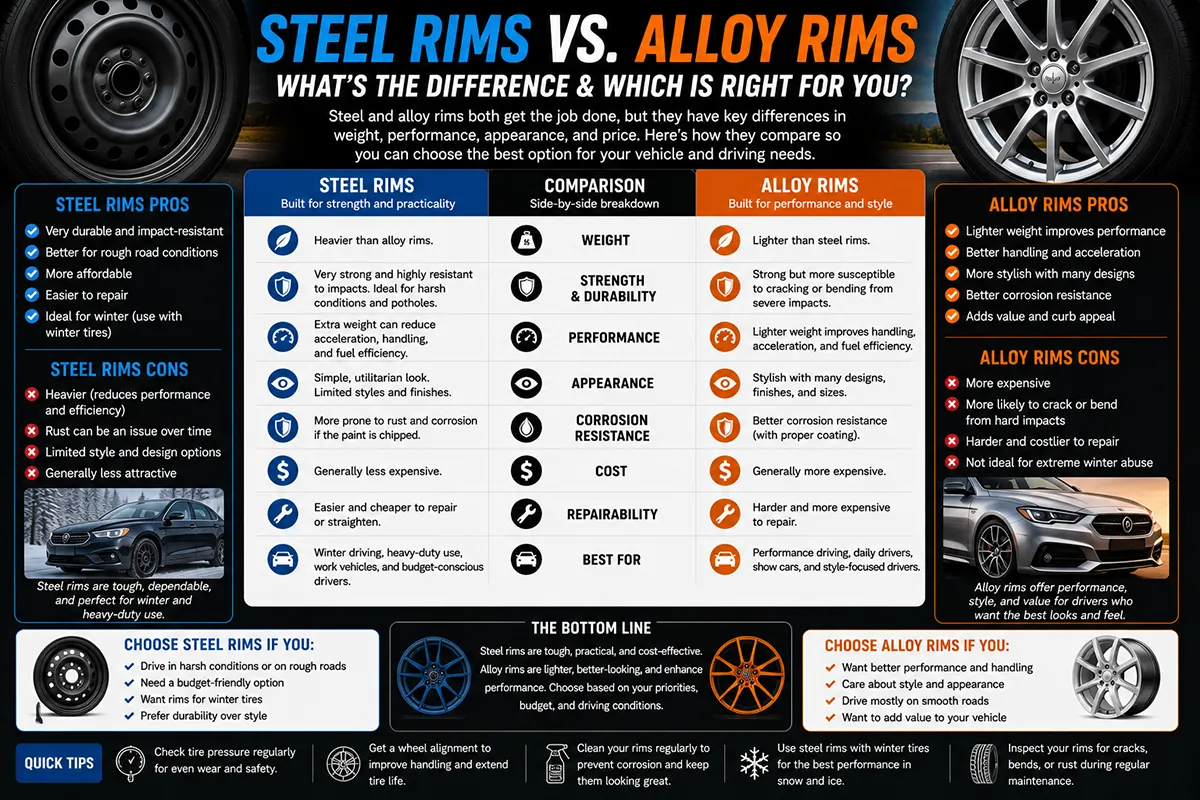
- Steel rims are cheaper ($50–$100 each), heavier, and nearly indestructible — ideal for winter setups, work trucks, and budget-conscious drivers.
- Alloy rims are lighter, better for performance and fuel efficiency, and look far better — but they cost $100–$500+ each and can crack on impact.
- For most US drivers with a single set of wheels, alloy rims offer the best overall value.
- If you live in a harsh winter state and want a dedicated snow tire setup, steel rims are the smarter second set.
- Neither type affects tire wear as much as people think — proper inflation and alignment matter far more.
Liked this article?
Add TireAdvise as a preferred source so you see more of our tire reviews and guides on Google.
What Steel Rims Actually Are (And Why They Still Exist)
Steel rims — sometimes called “steelies” — are exactly what they sound like: wheels stamped and welded from heavy-gauge steel. They’ve been around since the earliest days of automotive manufacturing, and there’s a reason they haven’t disappeared.
I’ve run steel rims on several winter setups over the years, and their biggest selling point is sheer toughness. You can bash a steel rim into a pothole that would crack an alloy wheel, and the steel will just bend. And bending, unlike cracking, can often be repaired.
Most new cars in the US still offer steel rims on their base trim levels. If you’ve ever seen a fleet vehicle or rental car with plain-looking wheels and plastic hubcaps, those are steelies underneath. They’re functional, reliable, and completely unexciting — which is exactly the point.
What Alloy Rims Are (And Why Most People Prefer Them)
Alloy rims are made from a blend of aluminum and other metals — typically nickel, magnesium, or silicon. This combination makes them significantly lighter than steel while still maintaining structural integrity. Most alloy wheels are either cast (molten metal poured into a mold) or forged (compressed under extreme pressure), and the manufacturing method affects both price and strength.
In my experience, alloy rims transform how a car feels on the road. I swapped a set of OEM steel wheels for 17-inch alloys on a Honda Civic a while back, and the difference in steering responsiveness was immediately noticeable — even during my first few days of driving on them.
Beyond performance, alloys simply look better. They come in hundreds of designs, finishes, and sizes. For most American drivers who care even a little about how their car looks, alloy rims are the default choice — and have been for years.
Steel vs Alloy Rims: Head-to-Head Comparison Table
| Feature | Steel Rims | Alloy Rims |
|---|---|---|
| Typical Price (per rim) | $50 – $100 | $100 – $500+ |
| Weight | Heavier (20–30 lbs typical) | Lighter (15–25 lbs typical) |
| Durability | Bends on impact, repairable | Can crack on impact, harder to repair |
| Corrosion Resistance | Prone to rust | Better resistance, but can corrode |
| Appearance | Basic, utilitarian | Wide variety of styles and finishes |
| Fuel Efficiency Impact | Slight negative (heavier) | Slight positive (lighter) |
| Handling | Adequate | Noticeably better responsiveness |
| Winter Performance | Excellent (tough, cheap) | Good, but vulnerable to salt and potholes |
| Repairability | Easy and cheap to repair bends | Cracks may require full replacement |
| Best For | Winter setups, work trucks, budgets | Daily driving, aesthetics, performance |
Weight: Why It Matters More Than You Think
This is where the steel vs alloy debate gets really interesting, and it’s something I’ve tested firsthand more times than I can count. Unsprung weight — the weight of components not supported by your suspension, including wheels and tires — has a direct impact on ride quality, handling, and braking.
A typical 16-inch steel rim weighs around 25 pounds. The same size in alloy might weigh 18–20 pounds. That’s a 5–7 pound difference per wheel, or 20–28 pounds total across all four corners. Doesn’t sound like much? Trust me, you feel it.
During a comparison I did on a midsize Toyota Camry, I ran the car on its stock alloy wheels for a couple of weeks, then swapped to a set of same-size steel rims. The steering felt noticeably heavier. Braking distances seemed slightly longer. The ride felt more sluggish over uneven pavement. These aren’t dramatic differences that make the car unsafe — but they’re real, and I noticed them within the first few days.
Fuel Efficiency and Weight
I get asked about fuel economy all the time. Here’s the truth: the difference between steel and alloy rims on fuel efficiency is real, but small. Most estimates put it at 1–2% better fuel economy with alloy wheels. On a car that gets 30 MPG, you might see 30.3–30.6 MPG with alloys.
Over a full year of driving, that could save you $30–$60 in gas depending on your mileage and fuel prices. It’s not nothing, but it’s not a primary reason to choose alloys either. I’d call it a nice bonus rather than a deciding factor.
Durability: The Category Steel Dominates
If I had to pick one area where steel rims are clearly, undeniably superior, it’s durability. And I don’t mean longevity in ideal conditions — I mean surviving the real-world abuse that US roads dish out every day.
I live in the Midwest, where winter potholes are basically a rite of passage. I’ve seen alloy rims crack from hitting a single bad pothole at 35 mph. Steel rims in the same situation? They bend. And a bent steel rim can usually be hammered back into shape at a tire shop for $25–$50. A cracked alloy rim is often toast — you’re buying a new one.
This is why I always recommend steel rims for dedicated winter tire setups. Between the potholes, road salt, and general chaos of winter driving in states like Michigan, Minnesota, Wisconsin, and the Northeast corridor, steel just makes more practical sense for a seasonal set.
Corrosion and Rust
Here’s where steel rims have a weakness, though. Steel rusts. Period. If you live anywhere that road salt is used, your steel rims will develop surface rust within a season or two. Most steel rims come with a painted or powder-coated finish, but once that finish gets chipped — which happens constantly from road debris — rust starts creeping in.
Alloy rims handle corrosion better, but they’re not immune. Salt can cause a type of oxidation called galvanic corrosion on alloy wheels, which shows up as white, powdery patches. I’ve seen this on alloy rims that were only a couple of years old in salt-belt states. Clear-coated and painted alloy rims resist this longer, but no rim material is truly maintenance-free in harsh environments.
Appearance and Style: No Contest
Let’s be real — this is the reason most people choose alloy rims, and I completely understand it. Your wheels are one of the most visually prominent features of your car. Steel rims, without hubcaps, look industrial. Some people embrace that look (the “steely” aesthetic has its fans in certain car communities), but most drivers prefer something more refined.
Alloy rims come in an almost infinite variety of designs. Split-spoke, mesh, multi-spoke, concave, deep-dish — whatever your taste, there’s an alloy wheel for it. Brands like Enkei, Konig, Motegi Racing, and American Racing offer styles for everything from economy cars to lifted trucks, and the finish options (machined, painted, chrome, gloss black, matte) are extensive.
I’ve personally run Enkei T6R wheels on a daily driver and Konig Ampliform wheels on a sportier car, and the visual transformation in both cases was dramatic. A good set of alloy rims can make a $25,000 car look like it costs $35,000.
Cost Breakdown: What You’ll Actually Spend
Let’s talk real numbers, because this is ultimately what drives most buying decisions for US consumers.
Steel Rims
- Per rim: $50 – $100 for most passenger car sizes (15″–17″)
- Set of four: $200 – $400
- With tires mounted and balanced: $600 – $1,000 total (depending on tire choice)
- Common sources: Tire Rack, Discount Tire, Walmart Auto Center, Amazon
Alloy Rims
- Budget alloys per rim: $100 – $175
- Mid-range alloys per rim: $175 – $300
- Premium/forged alloys per rim: $300 – $800+
- Set of four (mid-range): $700 – $1,200
- With tires mounted and balanced: $1,200 – $2,200+ total
- Common sources: Tire Rack, Discount Tire, Fitment Industries, Custom Offsets
The price gap is significant. A full winter setup on steel rims with budget snow tires might cost $600–$800. The same setup on alloy rims could easily run $1,000–$1,500. That’s real money, and for a seasonal set that only sees four or five months of use, I think steel makes the smarter financial play.
For your primary, year-round wheels? I think mid-range alloys in the $150–$250 per wheel range offer the best value. You get a meaningful upgrade in weight, appearance, and performance without breaking the bank.
Performance: What I’ve Actually Felt on the Road
I want to be honest here, because I think a lot of wheel reviews overstate the performance differences. If you’re a normal driver doing normal things — commuting, running errands, taking road trips — the handling difference between steel and alloy rims is noticeable but not transformative.
Where I’ve felt the biggest difference is in two scenarios: spirited driving on twisty roads and emergency maneuvers. The lighter alloy wheels respond to steering inputs faster. The car changes direction more willingly. Braking feels a touch sharper because there’s less rotating mass for the brakes to slow down.
During one of my test periods, I ran a Mazda3 on 18-inch alloy wheels through some of my favorite back roads in southern Ohio. The car felt composed, eager, and fun. When I swapped those same tires onto 16-inch steel rims (with appropriate tire size adjustment), the car still handled well — but it lost some of that sharpness. It felt a bit more disconnected. Not bad, just less engaging.
For the average highway commuter, though? You’ll probably adapt to either wheel type within a few days and stop thinking about it. The performance difference matters most to enthusiast drivers who are actively seeking engagement from their car.
Heat Dissipation: A Hidden Advantage of Alloys
This is something most people don’t think about, but it matters — especially if you live somewhere hot or do a lot of highway driving. Alloy rims dissipate heat from your brakes more effectively than steel rims.
Aluminum alloy is a better thermal conductor. When your brakes generate heat (which they constantly do), alloy wheels help pull that heat away from the brake components and radiate it into the airflow. Steel rims trap more of that heat, which can lead to brake fade during aggressive use.
I noticed this most during a test in the Texas summer heat. After sustained highway driving followed by repeated hard braking, the car on alloy rims maintained more consistent brake feel compared to steel rims. For regular commuting, you’ll probably never notice. But for towing, mountain driving, or aggressive stop-and-go in hot weather, alloy’s heat management is a genuine safety advantage.
Winter Driving: Where My Recommendation Gets Specific
If you live in a state that sees real winter — I’m talking snow, ice, sub-freezing temperatures, and road salt — I have a very specific recommendation that I give to almost everyone.
Buy a dedicated winter tire and wheel package on steel rims.
Here’s my reasoning, based on years of doing exactly this:
- Cost savings: Steel rims are half the price of alloys, leaving more budget for quality winter tires (which matter far more than the wheel material).
- Durability: Winter roads destroy rims. Potholes, salt, gravel, curb strikes in snow-covered parking lots — steel handles all of it better.
- Protect your alloys: Running your nice alloy wheels through winter is a guaranteed way to corrode, scratch, and possibly crack them. A cheap set of steelies protects your investment.
- Easy seasonal swaps: Having two complete sets (summer tires on alloys, winter tires on steelies) means you can swap in your garage or have a shop do it in 20 minutes. No mounting and balancing twice a year.
I’ve been running this exact setup for years — alloy wheels with all-season or summer tires from April through October, then steel wheels with Bridgestone Blizzaks or Michelin X-Ice from November through March. It’s the single best practical upgrade I recommend to any driver in the snow belt.
Repair and Maintenance: Long-Term Ownership Realities
Over the long haul, how your rims hold up and what it costs to maintain or fix them matters. This is an area where I think people underestimate the advantage of steel.
Repairing Steel Rims
A bent steel rim can be fixed at almost any tire shop in America. The process is straightforward — they use a hydraulic press or a specialized machine to push the rim back into round. Cost is typically $25–$75 per wheel. I’ve had this done three times over the years, and each time the rim was perfectly functional afterward.
Repairing Alloy Rims
Alloy rim repair is more complicated and more expensive. Small bends in cast alloy wheels can sometimes be fixed, but there’s always a risk of micro-fractures that aren’t visible to the naked eye. A cracked alloy rim is usually beyond repair — at least beyond what I’d consider safe repair.
Cosmetic damage to alloy rims (curb rash, scratches, finish peeling) is another ownership reality. Having an alloy wheel refinished typically costs $75–$150 per wheel. If you’re someone who parallel parks frequently in cities like New York, Chicago, or San Francisco, you’ll be dealing with curb rash eventually. It’s not a matter of if, but when.
Maintenance Tips for Both Types
- Steel rims: Inspect the painted finish regularly. Touch up chips with rust-preventive paint. Wash off road salt promptly after winter driving.
- Alloy rims: Use a pH-neutral wheel cleaner (I like Sonax Full Effect). Avoid automatic car washes with harsh chemicals. Apply a wheel sealant or ceramic coating for longer-lasting protection.
- Both types: Check for proper torque on lug nuts after any wheel service. Inspect rims for cracks or bends during every tire rotation.
Resale Value: Something Most Guides Forget
Here’s a factor that rarely comes up but matters if you ever plan to sell your car: alloy rims meaningfully improve resale value and curb appeal. I’ve sold cars before, and I can tell you from experience that vehicles with attractive alloy wheels generate more interest and sell faster on platforms like Facebook Marketplace, Craigslist, and CarGurus.
Clean, well-maintained alloy wheels signal that the owner cared about the car. Steel rims with faded hubcaps signal the opposite — even if the car is mechanically perfect underneath. It’s not fair, but it’s reality in the US used car market.
If you’re buying alloy rims, consider them partly as an investment in your vehicle’s resale value. The $400–$800 premium you pay for a nice set of alloys can easily return $200–$500 at resale time, especially on popular models like the Honda Accord, Toyota RAV4, or Ford F-150.
Who Should Buy Steel Rims
Based on everything I’ve tested and experienced, here’s who I think should go with steel:
- Drivers building a dedicated winter wheel and tire set. This is the #1 use case for steel rims in my book.
- Work truck and fleet vehicle owners. If your vehicle earns its living and appearance doesn’t matter, steel’s durability and low cost are ideal.
- Extremely budget-conscious buyers. If you need wheels and every dollar counts, steel gets you rolling safely for less.
- Off-road enthusiasts who abuse their wheels. If you’re rock crawling or running rough trails where wheel damage is likely, steel bends instead of cracking.
- Drivers who keep a car only 1–2 years. If you’re not keeping the car long enough to care about resale aesthetics, save the money.
Who Should Buy Alloy Rims
And here’s who I think should choose alloy:
- Anyone using one set of wheels year-round in a mild climate. If you’re in Texas, California, Florida, or the southern US, there’s little reason to choose steel.
- Drivers who value appearance. If how your car looks matters to you (and there’s nothing wrong with that), alloys are the way to go.
- Performance-oriented drivers. If you enjoy spirited driving, autocross, or just want the best handling, the weight savings of alloys pay off.
- Anyone planning to keep their car 5+ years. The long-term aesthetic and resale benefits justify the upfront investment.
- Towing or heavy braking situations. The heat dissipation advantage of alloys adds a real safety margin during demanding use.
My Personal Setup (And Why I Run Both)
I want to share what I actually do with my own vehicles, because I think it illustrates the ideal approach for a lot of US drivers.
On my daily driver — a midsize sedan — I run a set of 18-inch Enkei alloy wheels with quality all-season tires from about April through October. These are my “good” wheels. I keep them clean, I’m careful in parking lots, and they look fantastic.
Come November, I swap to a set of 16-inch steel rims with Michelin X-Ice Snow tires. The smaller diameter lets me run a taller tire sidewall, which actually improves ride comfort on rough winter roads and adds an extra buffer of rubber between pothole and rim. These steel wheels are ugly. They have surface rust. I don’t care. They do their job perfectly.
This two-set approach costs more upfront, but over the life of the car, it actually saves money. My alloy wheels stay pristine because they never see salt. My tires last longer because each set only sees half a year of use. And I never have to pay for mounting and balancing during the seasonal swap — just a quick bolt-on, bolt-off at the shop for about $40–$60.
Common Myths I Want to Debunk
“Alloy rims are fragile”
Not true in normal driving conditions. Modern cast alloy rims from reputable brands are engineered to handle typical road impacts. Yes, they can crack under severe abuse, but millions of Americans drive on alloy rims every day without issues. I’ve run alloys on daily drivers for years without cracking a single one during normal street use.
“Steel rims are unsafe”
Completely false. Steel rims meet the same safety standards as alloy rims. They’ve been standard equipment on countless vehicles for decades. The weight difference doesn’t make them unsafe — it just makes them slightly less responsive in extreme handling situations.
“You need alloy rims for proper TPMS function”
This one comes up a lot. Modern TPMS (tire pressure monitoring system) sensors work fine with both steel and alloy rims. When buying steel rims for a winter set, just make sure they’re compatible with TPMS sensors — most aftermarket steel wheels designed for specific vehicle fitments already account for this. You may need to purchase a second set of sensors, which typically cost $30–$50 each.
“Bigger alloy rims are always better”
I actually disagree with this trend. Upsizing to larger alloy rims often means running a lower-profile tire, which reduces ride comfort, increases vulnerability to pothole damage, and can actually hurt handling on rough roads. In my experience, sticking close to your OEM rim size (or going up one inch at most) gives you the best balance of looks, performance, and comfort.
Where to Buy: My Recommended US Retailers
I’ve purchased wheels from all of these retailers and can vouch for their service:
- Tire Rack (tirerack.com): The best overall selection and filtering tools. Excellent for finding vehicle-specific fitments in both steel and alloy. They also offer mounted-and-balanced packages shipped to your door or to a local installer.
- Discount Tire (discounttire.com): Great in-store experience with knowledgeable staff. Competitive pricing, and they’ll price-match in most cases. Largest independent tire and wheel retailer in the US.
- Fitment Industries (fitmentindustries.com): Ideal for the enthusiast crowd looking at aftermarket alloy wheels. Their gallery feature lets you see how specific wheels look on your exact car model.
- Walmart Auto Center: Surprisingly decent selection of budget steel and alloy wheels. Good option if you want everything handled in one trip.
- Amazon: Wide selection but be cautious about no-name brands. Stick to recognized wheel manufacturers even when buying through Amazon.
Final Verdict: Which Should You Choose?
After all my testing, here’s how I’d sum it up as simply as possible.
If you’re buying one set of wheels for year-round use: Go with alloy rims. The weight savings, better appearance, improved performance, and resale value advantages are worth the extra cost for most drivers. Aim for the $150–$250 per wheel range from a reputable brand, and you’ll be very happy.
If you’re building a dedicated winter setup: Go with steel rims. Save the money, protect your good wheels, and put the savings toward the best winter tires you can afford. The tires matter infinitely more than the rims when it comes to winter traction.
If you’re on a strict budget and need wheels now: Steel rims will get you rolling safely and reliably for half the cost. There’s no shame in it. Upgrade to alloys later when your budget allows.
The wheel material under your tires matters, but it’s not the most important decision you’ll make. Choosing the right tire for your driving conditions, keeping them properly inflated, and maintaining your alignment will always have a bigger impact on safety and performance than whether your rims are steel or alloy. Start with the tires, then pick the rims that make the most sense for your budget, climate, and priorities.
That’s what I do, and after years of testing both, I’ve never regretted it.
Frequently Asked Questions
Are steel rims or alloy rims better for everyday driving in the US?
For most US drivers doing daily commuting and highway driving, alloy rims offer a better overall experience because they’re lighter, improve fuel efficiency, and provide better heat dissipation during braking. However, if you drive primarily on rough roads or in areas with harsh winters and heavy pothole damage, steel rims can be the more practical and budget-friendly choice. I’d recommend alloy for most drivers in moderate climates and steel for those prioritizing durability in extreme conditions.
How much do steel rims cost compared to alloy rims for replacement wheels?
Steel rims typically cost between $50 and $150 per wheel in the US, while alloy rims range from $100 to $500 or more depending on the brand and finish. For a full set, you could save $200 to $1,000 or more by going with steel over alloy. Budget-friendly alloy options from brands like RTX or Vision Wheel can narrow that gap, but steel remains the cheapest option for drivers on a tight replacement budget.
Do alloy rims actually improve gas mileage compared to steel rims?
Yes, alloy rims are lighter than steel rims, which reduces unsprung weight and can improve fuel economy by roughly 1-2% in real-world US driving conditions. While that sounds small, over tens of thousands of miles per year it can add up to noticeable savings at the pump, especially with current gas prices. The improvement is most significant on lighter vehicles like sedans and compact SUVs where the weight difference has a proportionally larger impact.
Are steel rims better than alloy rims for winter tires and snow driving?
Steel rims are widely considered the better choice for dedicated winter tire setups in states with harsh winters like Michigan, Minnesota, and the Northeast corridor. They resist damage from road salt, potholes, and curb strikes far better than alloy rims, and they’re much cheaper to replace if they do get damaged. Many US drivers buy a second set of steel rims specifically for mounting winter tires, saving their alloy rims from corrosion and cosmetic damage during the cold months.
Can I replace my alloy rims with steel rims to save money on my car?
In many cases yes, but you need to verify that steel rims are available in the correct bolt pattern, offset, and diameter for your specific vehicle. Some modern US-market cars, especially performance trims and luxury models, may not have steel rim options that fit properly or clear the brake calipers. I’d recommend checking with a tire shop or using a fitment tool on sites like Tire Rack or Discount Tire to confirm compatibility before purchasing.
How long do alloy rims last compared to steel rims before needing replacement?
Steel rims can last the lifetime of your vehicle if they don’t develop severe rust, though surface corrosion is common in salt-heavy US states and they may need repainting. Alloy rims are more resistant to cosmetic rust but are prone to cracking from pothole impacts and can develop curb rash that’s expensive to repair. In terms of structural longevity, a well-maintained alloy rim typically lasts 5-10+ years, while steel rims often outlast the car itself in milder climates.
Do steel or alloy rims affect tire wear and ride quality differently?
Alloy rims generally provide a slightly better ride quality because their lighter weight reduces unsprung mass, allowing your suspension to respond more effectively to road imperfections. This lighter weight also promotes more even tire wear over time, which can extend the life of your replacement tires. Steel rims add more weight per corner, which can cause marginally faster tire wear and a slightly heavier road feel, though most average US drivers won’t notice a dramatic difference in day-to-day driving.
