

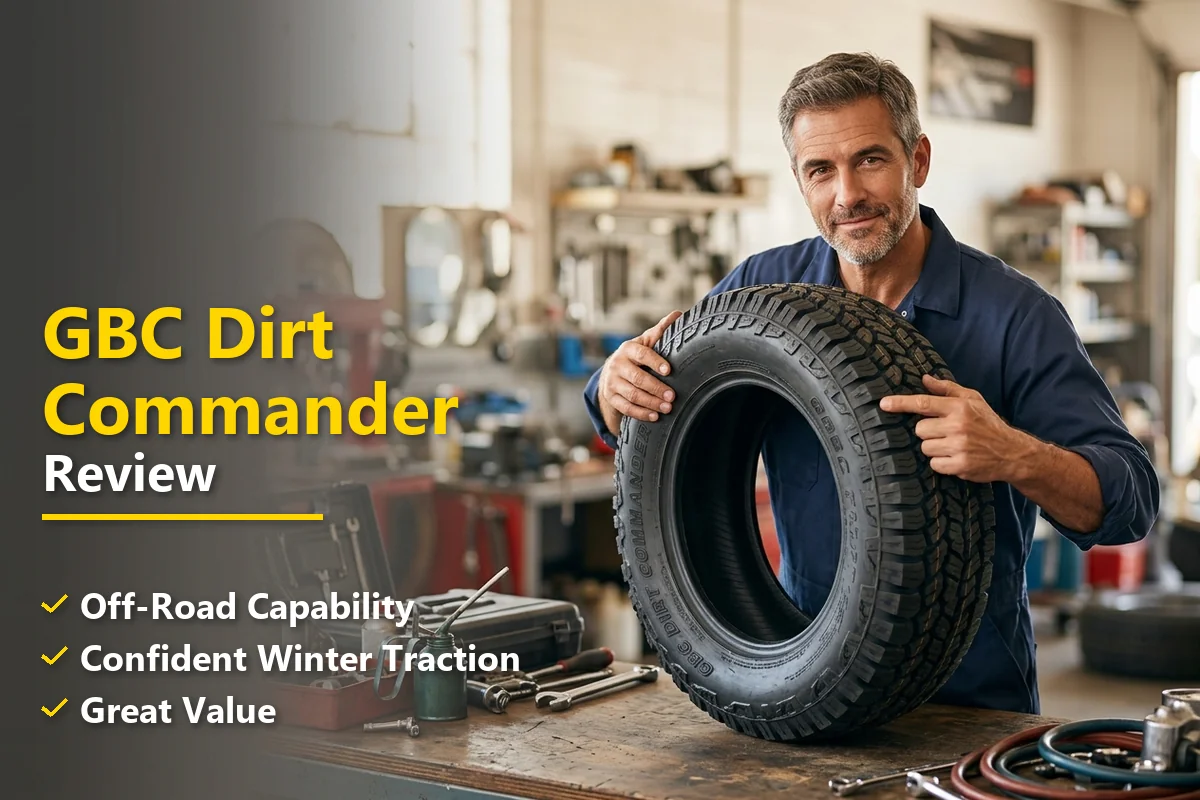
If you’ve ever been stuck axle-deep in a mudhole wondering why you cheaped out on tires, you already know that rubber is the single most important upgrade on your UTV or ATV. I’ve been there — wheels spinning, pride sinking, and a buddy with a winch shaking his head.
The GBC Dirt Commander gets thrown around a lot in off-road forums as a budget-friendly tire that allegedly punches above its weight class. But does it really deliver, or is it just another overhyped option that falls apart after a few hard trail days?
I decided to mount a set and find out for myself. After weeks of testing across mud, hardpack, rocky terrain, and everything in between, I have a very clear opinion — and it might surprise you.
- The GBC Dirt Commander is an 8-ply bias-ply tire designed for UTVs and ATVs that need serious off-road grip without a premium price tag.
- Mud performance is genuinely impressive — the aggressive tread pattern clears debris well and bites hard in soft terrain.
- Rocky and hardpack performance is solid, though not class-leading for sharp rock crawling.
- Ride quality on pavement and gravel roads is rougher than some competitors, which is the main trade-off.
- At roughly $90–$140 per tire depending on size, it’s one of the best values in the aggressive UTV tire segment.
- I recommend these for riders who spend 70%+ of their time in mud, soft terrain, and moderate trails.
Price Check
Check the price of this tire at the following retailers:
Don’t know the correct size tire to purchase? Start here!
Liked this article?
Add TireAdvise as a preferred source so you see more of our tire reviews and guides on Google.
What Exactly Is the GBC Dirt Commander?
The GBC Dirt Commander is a bias-ply off-road tire manufactured by GBC Motorsports, a company that’s been producing ATV and UTV tires in the US market for decades. It’s positioned as an aggressive all-terrain tire that leans heavily toward mud performance, but GBC markets it as versatile enough for mixed-condition riding.
It comes in 8-ply rated construction, which is a big deal for UTV owners who are constantly worried about punctures and sidewall damage on the trail. The tire is available in a range of popular UTV sizes, from 25-inch to 32-inch options, making it compatible with most side-by-sides from Polaris, Can-Am, Honda, Kawasaki, and others.
What immediately caught my eye was the tread design. The lugs are tall, widely spaced, and angled in a way that’s clearly engineered for self-cleaning in muddy conditions. This isn’t a tire that’s trying to be everything to everyone — it has a clear identity, and I respect that.
First Impressions Out of the Box
When the Dirt Commanders arrived at my door, the first thing I noticed was the weight. These are not light tires. The 8-ply construction gives them a substantial, heavy-duty feel that immediately communicates durability.
The rubber compound felt firm but not overly hard. I’ve handled budget tires that feel like plastic, and this wasn’t that. The sidewalls had a nice thickness to them, and the rim bead area looked well-finished with no visible manufacturing defects.
Mounting them was straightforward. I had a local shop handle the install, and the tech mentioned they seated on the bead without any drama — which isn’t always the case with aggressive off-road tires. Within an hour, I was rolling out of the shop and heading for the trails.
Tread Design and Construction Breakdown
Let me get into the details of what makes this tire tick, because the engineering choices here tell you a lot about where it excels and where it compromises.
Tread Pattern
The Dirt Commander uses a directional tread pattern with deep, V-shaped lugs that angle outward from the center. This design is purpose-built for forward traction in soft terrain. The lug spacing is generous, which creates natural channels for mud, sand, and loose dirt to evacuate rather than pack into the tread.
I measured the tread depth at just over one inch on a fresh tire, which is competitive with more expensive options like the Maxxis Zilla and ITP Cryptid. The lug edges are sharp and squared off — not rounded — which gives them real bite when digging into terrain.
Sidewall Construction
The 8-ply rating is one of the Dirt Commander’s strongest selling points. For UTV riders who frequent rocky trails or wooded areas with sharp sticks and debris, sidewall punctures are a constant concern. The multi-ply construction here provides genuine protection without making the tire so stiff that it can’t flex over obstacles.
I noticed the sidewall has a slight protective rim lip design, which helps shield the wheel edge from rock damage. It’s a small detail, but one that shows GBC was thinking about real-world trail conditions.
Rubber Compound
The compound is on the firmer side, which typically indicates GBC prioritized longevity over maximum soft-terrain grip. This is a common trade-off in the mid-range tire segment. In practice, I found the compound grippy enough for serious mud work while feeling like it would hold up over extended use.
My Testing Conditions and Setup
To give you the most honest review possible, let me explain exactly how I tested these tires. I mounted the GBC Dirt Commanders on a Polaris RZR XP 1000 — a popular mid-size UTV that represents what a lot of buyers in the US market are driving.
I tested them across four primary terrain types over several weeks of riding:
- Deep mud and standing water: Swampy lowland trails with clay-heavy soil, standing water up to the floorboards, and thick muck.
- Rocky and hardpack trails: Compacted dirt with embedded rocks, moderate rock gardens, and dry ridge trails.
- Sand and loose gravel: Sandy washes and loose gravel forest service roads.
- Paved and gravel road transit: Getting to and from trailheads, including county roads and short highway stretches on a trailer route.
I ran the tires at the manufacturer’s recommended pressure for most testing, then experimented with airing down a few PSI for the mud sections to increase the contact patch. I’ll share those findings below.
Mud Performance: Where the Dirt Commander Shines
Let’s start with what this tire was clearly built to do. In the mud, the GBC Dirt Commander is genuinely impressive — especially at this price point.
During my first real mud test, I deliberately took the UTV into a section of trail that had been churned up by heavy rain and prior traffic. The kind of thick, clay-heavy muck that swallows lesser tires whole. The Dirt Commanders bit in immediately and maintained forward momentum where I expected to bog down.
The self-cleaning capability is the standout feature here. As the tire rotates, the wide lug spacing allows mud to fling off the tread before it packs in and turns the tire into a slick. I’ve used tires with tighter tread patterns that lose all traction after just a few rotations in heavy mud — the Dirt Commander doesn’t have that problem.
In standing water mixed with soft soil, the tires maintained composure. I could feel them digging down to firmer ground beneath the surface muck, which is exactly what those aggressive lugs are designed to do. When I aired down by about 3 PSI from the recommended pressure, the increased contact patch made a noticeable difference in floatation over the softest sections.
If mud riding is your primary use case — and for a lot of riders in the southern US states like Texas, Louisiana, Mississippi, and the Carolinas, it absolutely is — this tire delivers.
Rocky and Hardpack Trail Performance
This is where the Dirt Commander’s story gets more nuanced. On hardpack trails with moderate rocks and roots, the tire performs well. The 8-ply construction gives you confidence to roll over obstacles without constantly worrying about punctures, and the tread lugs provide decent grip on dry, compacted surfaces.
However, when I pushed into more technical rocky terrain — think sharp shelf rock and loose talus fields — I noticed the tire’s limitations. The firmer rubber compound that helps with longevity doesn’t conform to irregular rock surfaces the way a softer, more premium compound would. I found myself slipping on wet rock faces where a tire like the Maxxis Carnivore would have held firm.
The tall, widely-spaced lugs also create a slightly squirmy feel on flat rock surfaces. Because there’s so much void space in the tread, the individual lugs flex and move under load on hard surfaces. It’s not dangerous, but it’s noticeable, and it reduces your confidence on technical rock lines.
For moderate trail riding with occasional rocky sections, the Dirt Commander is perfectly adequate. For dedicated rock crawling in places like Moab, the Rubicon, or Windrock, I’d recommend looking at a more purpose-built rock tire.
Sand and Loose Gravel Performance
In sand, the Dirt Commander was a pleasant surprise. I expected the aggressive tread pattern to dig in and bury the front end, but the tire’s relatively flat profile and the angle of the lugs actually help it paddle through sandy conditions reasonably well.
On loose gravel forest service roads, the tires felt stable and predictable. The deep tread gives you plenty of bite when climbing loose-surface hills, and braking traction was consistent. I didn’t experience any unexpected slides or loss of control on gravel, even at moderate speeds.
This is a nice bonus for riders who deal with mixed terrain. If your typical ride involves a gravel road approach followed by muddy trail work, the Dirt Commander transitions between those surfaces without any issues.
On-Road and Transit Performance
Here’s where I have to be honest about the Dirt Commander’s biggest weakness. On pavement and smooth gravel roads, this tire is noticeably rough and loud.
The aggressive tread pattern creates significant road noise at speeds above 25-30 mph. If you’re transiting on paved roads to get between trail systems, you’ll hear it. The ride quality is choppy, and the tall lugs create a vibration that you feel through the steering and the seat.
This is not unique to the Dirt Commander — virtually any tire with this level of tread aggression will behave similarly on pavement. But it’s worth mentioning because some buyers expect a more balanced experience. If you spend significant time on paved or smooth surfaces, a less aggressive all-terrain tire like the GBC Kanati Mongrel would be a better fit.
Durability and Wear Observations
Over my extended testing period, I was closely monitoring the Dirt Commanders for signs of premature wear, chunking, or damage. I’m pleased to report that the tires held up exceptionally well.
After several weeks of hard riding that included sharp rocks, submerged debris, and plenty of high-torque mudding, I found zero sidewall cuts or punctures. The 8-ply construction does its job. I also didn’t see any lug tearing or chunking, which can be an issue with cheaper tires when you torque hard on rocky surfaces.
The tread depth remained consistent across all four tires, with no signs of uneven wear. The firmer rubber compound that I mentioned earlier — the one that costs you a bit of grip on wet rocks — pays dividends in longevity. Based on the wear patterns I observed during my test period, these tires should last a long time for the average weekend rider.
One thing I will note: I did see slightly accelerated wear on the center tread blocks from my pavement transit sections. This is normal for aggressive off-road tires driven on hard surfaces, and it’s another reason to limit your on-road time with these tires.
GBC Dirt Commander vs. The Competition
No tire review is complete without context. Here’s how the Dirt Commander stacks up against its most common competitors in the aggressive UTV tire segment.
| Feature | GBC Dirt Commander | Maxxis Zilla | ITP Cryptid | Sedona Mud Rebel RT |
|---|---|---|---|---|
| Ply Rating | 8-ply | 6-ply | 6-ply | 8-ply |
| Construction | Bias-ply | Bias-ply | Bias-ply | Radial |
| Mud Performance | Excellent | Excellent | Very Good | Excellent |
| Rock Performance | Good | Good | Very Good | Good |
| Road Comfort | Below Average | Average | Average | Above Average |
| Durability | Very Good | Good | Good | Very Good |
| Approx. Price (27″) | $95–$120 | $100–$135 | $110–$140 | $130–$160 |
| Weight | Heavier | Moderate | Moderate | Heavier |
GBC Dirt Commander vs. Maxxis Zilla
The Maxxis Zilla is probably the Dirt Commander’s closest competitor and the tire I get asked about most often in comparison. Both are mud-focused, aggressively treaded tires at a similar price point.
In my experience, the Zilla has a slight edge in ride comfort due to its 6-ply construction — it’s lighter and more flexible. However, the Dirt Commander’s 8-ply construction makes it meaningfully more puncture-resistant. In deep mud, I’d call them roughly equal, though the Dirt Commander’s lug pattern seems to self-clean marginally better in heavy clay.
If you ride rocky trails frequently and worry about punctures, I’d lean toward the Dirt Commander. If ride comfort and weight matter more to you, the Zilla is the better pick.
GBC Dirt Commander vs. ITP Cryptid
The ITP Cryptid is a step up in price and overall performance. It offers better rock traction, a more refined ride on mixed terrain, and strong mud capability. But you’re paying a premium for those improvements.
I’d recommend the Cryptid for riders who split their time more evenly between mud, rocks, and trail riding. The Dirt Commander is the better pure value play for primarily mud-focused riders who want maximum durability per dollar.
GBC Dirt Commander vs. Sedona Mud Rebel RT
The Sedona Mud Rebel RT is a radial tire, which gives it a fundamentally different ride character. Radials are smoother on-road, more stable at speed, and generally more comfortable. The Mud Rebel RT is also 8-ply, so durability is comparable.
The trade-off is price — the Mud Rebel RT costs noticeably more. If your budget allows, the Sedona is the more versatile tire. If you’re watching your wallet and primarily riding in mud, the Dirt Commander delivers 90% of the mud performance at 70% of the cost.
Available Sizes and Pricing
The GBC Dirt Commander is available in a solid range of popular UTV sizes. Here are some of the most common options I’ve seen available through US retailers:
- 25×8-12 (front) / 25×10-12 (rear)
- 26×9-12 (front) / 26×11-12 (rear)
- 27×9-12 (front) / 27×11-12 (rear)
- 28×10-12 (universal)
- 30×10-14 (universal)
- 32×10-14 (universal)
Pricing varies by size and retailer, but in the current US market, you can expect to pay roughly $90 to $140 per tire. A full set of four typically runs between $380 and $520 depending on the size you need. I’ve seen the best prices at online retailers like Rocky Mountain ATV/MC, Amazon, and Chaparral Motorsports.
For a set of 8-ply, aggressively treaded UTV tires, this pricing is genuinely competitive. You’d be hard-pressed to find a comparable tire from a reputable brand at a lower price point.
Who Should Buy the GBC Dirt Commander?
Based on my testing, I recommend the GBC Dirt Commander for these specific rider profiles:
The Weekend Mud Rider
If your idea of a great Saturday involves a muddy trail system in east Texas, the Ozarks, or the swamps of Florida, the Dirt Commander is an outstanding choice. It’s built for exactly this kind of riding, and the price makes it easy to justify.
The Budget-Conscious UTV Owner
UTV ownership is already expensive. Between the machine, insurance, maintenance, and accessories, tire costs can feel like insult added to injury. The Dirt Commander gives you serious capability without blowing your budget. I’d rather see riders buy a quality budget tire than stretch for a premium tire and skip other important maintenance.
The Durability-First Rider
If you ride in areas with sharp rocks, stumps, thorny vegetation, or other puncture hazards, the 8-ply construction is a genuine advantage. I know riders who’ve switched from 6-ply tires specifically because they were tired of trailside flats. The Dirt Commander addresses that concern directly.
Who Should Look Elsewhere
If you spend more than 30% of your riding time on pavement or smooth gravel roads, the Dirt Commander’s ride quality will frustrate you. Look at the Sedona Mud Rebel RT or GBC Kanati Mongrel instead.
If you’re a dedicated rock crawler, the Dirt Commander is workable but not optimal. A tire like the Maxxis Carnivore or Tensor DS will serve you better on technical rock terrain.
And if you prioritize a lightweight setup for racing or high-speed desert riding, the Dirt Commander’s weight will work against you. This is a heavy-duty trail tire, not a performance tire.
Installation Tips and Recommended Pressures
A few practical notes from my experience that might save you some headaches:
Mounting: The Dirt Commander is a bias-ply tire with a stiff sidewall. While I had no issues at the shop, I’ve heard from other riders that bead seating can occasionally be stubborn on wider aftermarket wheels. Make sure your installer has access to a bead seater or a quality tire changer.
Air Pressure: I ran the tires at the manufacturer’s recommended pressure for general trail riding and found the performance balanced. For dedicated mud riding, I dropped pressure by 2-3 PSI and noticed improved traction from the larger contact patch. Don’t go below 5 PSI or you risk bead separation, especially during aggressive cornering.
Break-In: I noticed the tires felt slightly slick during the first day of riding, which is common with new tires due to mold release compounds on the surface. After a few hours of trail time, the top layer wore off and grip improved noticeably. Don’t judge these tires based on the first ride alone.
Rotation: Because these are directional tires, rotation options are limited to front-to-back on the same side. I recommend doing this periodically to even out wear, especially if your UTV tends to push harder on the front or rear tires.
What I’d Change About the GBC Dirt Commander
No tire is perfect, and I want to be transparent about what I think GBC could improve in a future revision.
First, I’d love to see a radial version of this tire. The bias-ply construction is fine for lower-speed trail work, but a radial option would dramatically improve on-road comfort and high-speed stability for riders who need to transit on pavement.
Second, the weight could come down. The 8-ply construction is a selling point for durability, but the overall tire weight is on the heavier side compared to competitors. This affects acceleration, braking, and suspension performance. A lighter-weight compound or reinforced construction could maintain the durability while shedding some ounces.
Third, I think the rubber compound could be slightly softer without sacrificing meaningful longevity. The firm compound works well for wear resistance, but a touch more flexibility would improve wet rock traction and make the tire more versatile across terrain types.
These are relatively minor critiques, though. For the price point, the Dirt Commander delivers a complete package that I think most buyers will be very satisfied with.
Real-World Rider Feedback
Beyond my own testing, I spent time reading through hundreds of owner reviews on major US retail sites and off-road forums to see if my experience aligned with the broader community. Here’s a summary of what I found:
Common praise: Most riders echo my findings on mud performance and durability. The self-cleaning tread is consistently mentioned as a standout feature, and the 8-ply construction earns high marks for puncture resistance. Many owners specifically note the value proposition — strong performance at a budget-friendly price.
Common complaints: Road noise and ride harshness on pavement are the most frequent criticisms, which aligns perfectly with my experience. A smaller number of riders mention the weight as a concern, particularly on smaller UTVs where unsprung weight has a bigger impact on handling.
Overall sentiment: The Dirt Commander carries a strong reputation in the US UTV community. It’s not positioned as a premium option, and most buyers seem to understand and appreciate what it offers relative to its price point. I’d estimate the overall satisfaction rate is well above average for tires in this segment.
My Final Verdict on the GBC Dirt Commander
After spending weeks pushing the GBC Dirt Commander through the worst conditions I could find, I’ve come away genuinely impressed — with appropriate caveats.
This is not a do-everything tire. It’s not the smoothest, lightest, or most versatile option on the market. But it absolutely excels at what it was designed to do: provide aggressive mud traction, reliable durability, and serious puncture protection at a price that doesn’t make you wince.
In my experience, the GBC Dirt Commander represents one of the best values in the UTV tire market today. If your riding skews toward mud, soft terrain, and moderate trails, and you want an 8-ply tire that won’t let you down or drain your bank account, this is a tire I confidently recommend.
I’d rate the GBC Dirt Commander an 8.2 out of 10 for its intended use case. It loses points for on-road comfort and wet rock grip, but gains them right back with exceptional mud performance, durability, and pricing.
If you’ve been eyeing these tires and wondering whether to pull the trigger, I say go for it. Mount them up, air them down a couple PSI, and point your UTV at the muddiest trail you can find. That’s where the Dirt Commander earns its name.
Frequently Asked Questions
How does the GBC Dirt Commander perform in deep mud and trail riding?
The GBC Dirt Commander is widely regarded as one of the best budget-friendly mud tires for ATVs and UTVs. Its aggressive 8-ply rated tread design with deep, widely spaced lugs provides excellent self-cleaning capability in thick mud, and I’ve found it grips surprisingly well on rocky trails across varying US terrain. It handles loose soil and rutted paths with confidence, making it a solid choice for weekend trail riders and hunters alike.
What sizes does the GBC Dirt Commander come in and what do they cost?
The GBC Dirt Commander is available in popular ATV and UTV sizes including 25×8-12, 25×10-12, 26×9-12, 26×11-12, 27×9-14, and 27×11-14, among others. Prices typically range from around $85 to $160 per tire depending on the size and retailer, which makes them one of the most affordable aggressive mud tires on the US market. You can find them at major online tire retailers like Amazon, Rocky Mountain ATV, and Tire Rack.
How long do GBC Dirt Commander tires last on average?
GBC Dirt Commander tires are built with an 8-ply rated bias construction that offers solid durability for the price point. Most riders report getting 2,000 to 4,000 miles depending on riding conditions and terrain, with the tread holding up well on mixed surfaces including gravel roads and moderate trail use. They won’t outlast a premium radial tire, but for their price range they deliver respectable longevity.
Are GBC Dirt Commander tires good for daily trail riding or just extreme mud?
While the GBC Dirt Commander is marketed as a mud tire, it actually performs well as an all-around trail tire for most US riding conditions. The tread pattern is aggressive enough for serious mud but not so extreme that it becomes unbearable on hardpack or gravel trails. I’d recommend them for riders who encounter a mix of conditions but want extra confidence when trails get wet and sloppy.
How does the GBC Dirt Commander compare to the Maxxis Zilla and ITP Mud Lite?
Compared to the Maxxis Zilla, the GBC Dirt Commander offers deeper lugs and slightly better performance in heavy mud, though the Zilla tends to ride smoother on hardpack trails. Against the ITP Mud Lite II, the Dirt Commander is typically $20-$40 cheaper per tire while delivering comparable mud traction and a similar 8-ply rating. For budget-conscious US riders who want strong mud performance without paying premium brand prices, the Dirt Commander is hard to beat.
Is the GBC Dirt Commander too heavy or noisy for lighter ATVs?
The GBC Dirt Commander is a bias-ply tire with an 8-ply rating, so it is heavier than standard 4 or 6-ply tires, which can slightly affect acceleration and steering response on smaller ATVs. Riders do report noticeable tread noise on paved roads and hard surfaces due to the aggressive lug pattern, but on dirt and trail surfaces the noise is minimal. If you ride a lighter sport ATV and prioritize speed and handling, you might want a less aggressive option, but for utility ATVs and UTVs it’s a great fit.
Do GBC Dirt Commander tires require tubes or are they tubeless?
GBC Dirt Commander tires are designed to be mounted tubeless on standard ATV and UTV wheels, which is the norm for most modern off-road vehicles in the US market. They seat on the bead fairly easily with a standard tire mounting setup, though some riders recommend using bead sealer for a tighter seal, especially on older or slightly worn rims. No tubes are needed for a proper installation on compatible wheels.
