

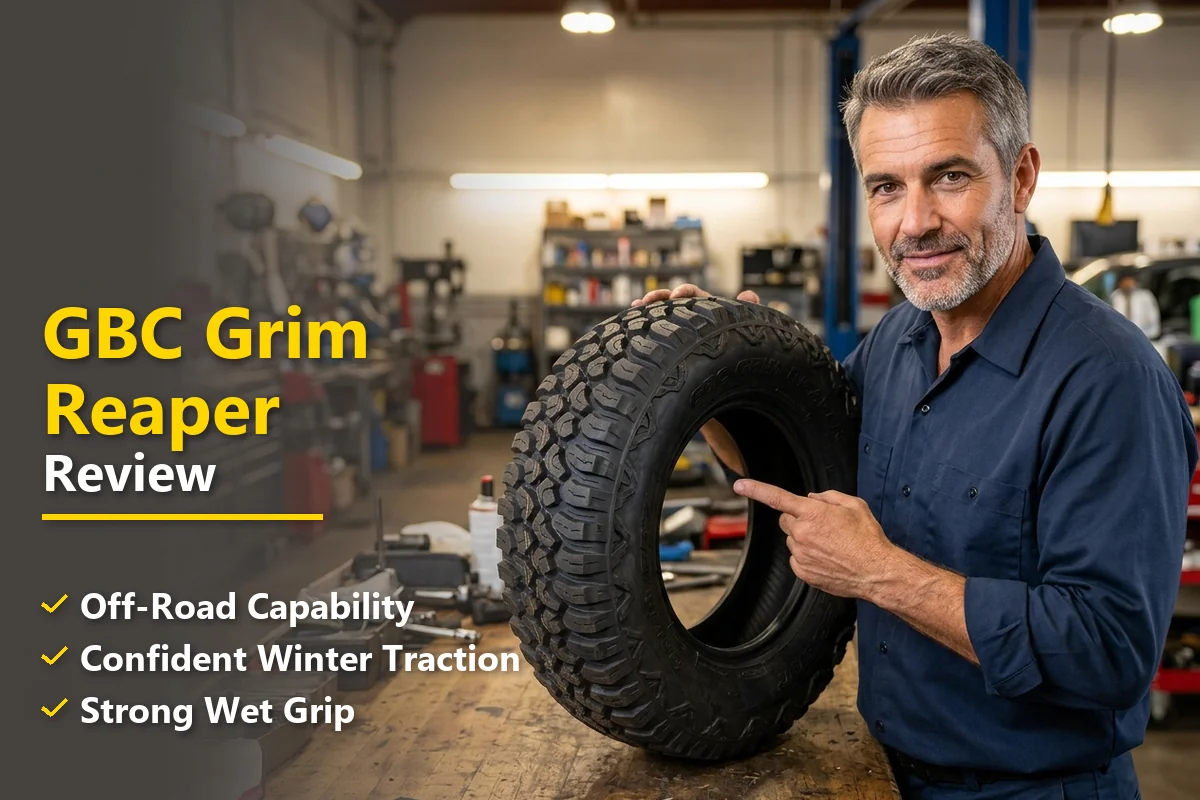
If you’ve ever been stuck axle-deep in a mud hole watching your buddy disappear over the next ridge, you know exactly how frustrating it is to run the wrong tires on your side-by-side. I’ve been there — white-knuckling the throttle while my stock tires spun uselessly in the muck.
That’s precisely the kind of moment that made me start researching aggressive ATV/UTV tires, and the GBC Grim Reaper kept showing up in every forum thread and riding group I followed. So I decided to mount a set and put them through real-world punishment to see if they deserve the reputation.
- The GBC Grim Reaper is a versatile ATV/UTV tire designed for mixed terrain — mud, hardpack, trails, and light rock.
- Excellent traction in muddy and loose conditions thanks to its angled lug pattern and 1-inch tread depth.
- Surprisingly smooth ride on hardpack trails and gravel roads for such an aggressive tire.
- 8-ply rated construction handles punctures and abuse well in rough terrain.
- Ride noise is noticeable on pavement, but that’s expected for this class of tire.
- Priced competitively between $100–$180 per tire depending on size — a strong value in the segment.
- I recommend the Grim Reaper for riders who split time between mud, trails, and moderate rock terrain.
Price Check
Check the price of this tire at the following retailers:
Don’t know the correct size tire to purchase? Start here!
Liked this article?
Add TireAdvise as a preferred source so you see more of our tire reviews and guides on Google.
What Exactly Is the GBC Grim Reaper?
The GBC Grim Reaper is an all-terrain ATV and UTV tire manufactured by GBC Motorsports, a company that’s been producing off-road tires in the US market for decades. It’s positioned as a do-it-all tire that bridges the gap between pure mud tires and standard trail tires.
What makes it stand out is the tread design — a series of angled, ramped lugs with deep voids between them. GBC engineered this pattern to provide aggressive bite in soft terrain while still maintaining a relatively smooth ride on harder surfaces. The lugs are approximately 1 inch deep, which gives you serious grip without going to the extremes of a dedicated mud tire.
The Grim Reaper is available in a range of popular UTV sizes, including 25×8-12, 25×10-12, 26×9-12, 26×11-12, and 27×11-12 among others. It comes in an 8-ply (4PR) rated construction, which is important for side-by-sides that carry passengers and cargo over rough terrain.
My Testing Setup and Conditions
I mounted a full set of GBC Grim Reapers on my Polaris RZR 900 — 26×9-12 up front and 26×11-12 in the rear. I run steel beadlock wheels, which paired nicely with the Grim Reaper’s bead design. Mounting was straightforward, and the tires seated on the beads with a standard air compressor without any drama.
I ran these tires at 8 PSI for trail riding and dropped to about 5 PSI for the muddier outings. For my test period, I rode extensively across multiple terrain types in the Southeast US — red clay mud, rocky creek beds, sandy washes, hardpack forest trails, and some unavoidable stretches of gravel road and pavement between trailheads.
The conditions ranged from bone-dry summer heat to post-rainstorm slop. I wanted to see how the Grim Reaper handled the full spectrum, not just its ideal scenario.
First Impressions Out of the Box
The first thing I noticed when I pulled the Grim Reapers out of the shipping box was the rubber compound. It has a firm but pliable feel — not rock-hard like some budget off-road tires I’ve handled. The sidewalls have a nice thickness to them, and the 8-ply rating feels genuine when you press your thumb into the carcass.
The tread lugs are sharply molded with clean edges right out of the factory. There’s no excessive flash or manufacturing artifacts on the tread face, which tells me GBC’s quality control is solid. The tire also has a noticeable rim guard lip that adds a layer of protection for your wheels on rocky terrain.
Visually, these tires look aggressive. They transformed the stance of my RZR immediately, and I’ll admit — that matters when you’re pulling up to a trailhead.
Performance in Mud: Where the Grim Reaper Earns Its Name
Let’s start with mud, because that’s where most people shopping for the Grim Reaper want to know it performs. In my experience, these tires are genuinely impressive in moderate to heavy mud conditions.
The angled lug design works brilliantly for self-cleaning. As the tire rotates, the lugs scoop mud and then shed it effectively. I rode through several deep mud pits — the kind where you’re committed once you hit the throttle — and the Grim Reapers clawed through without hesitation. There’s a satisfying “dig and grab” feel that gives you confidence the tire is finding traction beneath the slop.
Where I noticed the most difference compared to my previous stock tires was in thick clay mud. Stock tires would pack up and become slicks within seconds. The Grim Reaper’s deep tread voids resisted packing much longer and cleared themselves out more effectively.
Now, I want to be honest — the Grim Reaper is not a dedicated mud tire like the GBC Mud Hog or a Gorilla Silverback. If you’re riding in waist-deep swamp conditions every weekend, you’ll want something with even more aggressive tread and paddle-style lugs. But for the rider who encounters mud as part of a mixed ride rather than the sole purpose of it, the Grim Reaper is outstanding.
Rut Performance
In rutted-out trails with standing water and deep grooves, the Grim Reaper’s sidewall lugs provided noticeable lateral grip. I could follow a rut without the tire climbing the sidewall and pulling me off-line. This is one of those subtle things that makes a massive difference in rider confidence and fatigue over a long day on the trails.
Trail Riding Performance
Here’s where the GBC Grim Reaper really surprised me. I expected an aggressive tire like this to beat me up on hardpack trails, but the ride quality was remarkably composed.
On packed dirt singletrack, the Grim Reaper tracked straight and predictable. The tread pattern, despite its aggressive appearance, lays down enough rubber on firm surfaces to avoid that “walking on stilts” feeling you get with extreme mud tires. Steering response was direct and confidence-inspiring through sweeping turns and tight switchbacks alike.
Over the course of several days riding forest service trails in the Appalachian foothills, I came to appreciate how balanced this tire is. You give up a small amount of hardpack precision compared to a true trail tire, but you gain so much versatility in return. The tradeoff is absolutely worth it for how most people actually ride.
Cornering and Stability
During aggressive cornering on dry trails, the Grim Reapers held their line well. I didn’t experience any alarming sidewall roll at the 8 PSI I was running, which can be an issue with some softer-sidewall tires. The 8-ply construction clearly contributes to a stable, planted feel even when you’re pushing hard into turns.
At higher speeds on open trails, there’s minimal wander or vibration. The tire is well-balanced from the factory, and I didn’t need to add any wheel weights to eliminate vibration on my setup.
Rocky Terrain Performance
I spent a couple of afternoons navigating rocky creek beds and moderately technical rock trails. The Grim Reaper handled it better than I expected, though this isn’t its primary design intent.
The rubber compound is tough enough to resist cuts from sharp-edged rocks. After several days of riding that included plenty of rocky sections, I didn’t find any significant cuts or gouges in the tread or sidewalls. The 8-ply rated carcass gives you peace of mind that you’re not going to blow a sidewall on a hidden rock.
Grip on wet rocks was adequate but not exceptional. The tread pattern’s spacing is designed more for soft terrain evacuation than for gripping hard, smooth surfaces. On dry rock, the lugs bite well, especially on textured or rough stone surfaces. If serious rock crawling is your primary activity, you’d want a dedicated rock tire — but for the occasional rocky section on an otherwise mixed ride, the Grim Reaper handles it confidently.
Sand and Loose Gravel
In sandy washes, the Grim Reaper performed better than I anticipated. The wide footprint of the rear tires (26×11-12) helps distribute weight, and the aggressive lug pattern provided decent forward bite without excessive digging. I kept my speed up through the deeper sandy sections, which is standard practice, and the tires responded well.
On loose gravel roads — the kind you inevitably encounter getting to and from trailheads — the Grim Reapers tracked well and provided confident braking. There’s a slight looseness in the steering on deep gravel, but nothing that felt unsafe or unpredictable.
Road Manners and Noise
Let’s talk about the elephant in the room: pavement performance. If you trailer your UTV everywhere, you can skip this section. But if you’re like many riders who occasionally have to cross paved roads or ride short stretches to connect trails, this matters.
On pavement, the Grim Reaper is noticeably loud. The aggressive lug pattern creates a pronounced hum that increases with speed. It’s not unbearable for short stretches, but you’ll definitely know you’re running an off-road tire. At lower speeds around a campground or parking area, the noise is barely noticeable.
Ride comfort on pavement is acceptable. The lugs create a mild vibration, but the tire’s carcass absorbs it reasonably well. Handling on pavement is predictable, though obviously you don’t have the contact patch of a street tire.
Wear on pavement would be accelerated compared to trail riding, so I’d strongly recommend minimizing your asphalt time if you want to maximize the life of these tires. That said, occasional road crossings and short pavement stretches won’t destroy them.
Durability and Wear Assessment
After several weeks of consistent use across all the terrain types I described, the GBC Grim Reapers showed impressively little wear. The tread lugs maintained their sharp edges, and the tread depth hadn’t diminished noticeably. The rubber compound seems to be well-formulated for longevity without being so hard that it sacrifices grip.
I deliberately rode through areas with sharp sticks, thorny brush, and rocky debris. The sidewalls came away with cosmetic scuffs but no structural damage. The 8-ply construction genuinely seems to deliver on its promise of rugged durability.
One thing I’ll note — I haven’t experienced any punctures during my test period, and I rode through some terrain that has flatted tires on me before. The thick carcass and tread depth provide a meaningful buffer against trail hazards. I’m not saying these tires are puncture-proof, but they’re significantly more resilient than the 4-ply stock tires I replaced.
GBC Grim Reaper vs. Competitors: How Does It Stack Up?
You’re probably wondering how the Grim Reaper compares to other popular tires in this segment. I’ve ridden on several of these competitors over the years, so here’s how I’d break it down based on my experience.
| Feature | GBC Grim Reaper | Maxxis Bighorn 2.0 | ITP Mud Lite XTR | Sedona Mud Rebel RT |
|---|---|---|---|---|
| Primary Terrain | Mixed/Mud-Trail | All-Terrain/Trail | Mud/Mixed | Mud/Mixed |
| Tread Depth | ~1 inch | ~3/4 inch | ~1 inch | ~1.125 inches |
| Ply Rating | 8-ply | 6-ply | 6-ply | 8-ply |
| Mud Performance | Excellent | Good | Excellent | Excellent |
| Trail Comfort | Very Good | Excellent | Good | Good |
| Rock Performance | Good | Very Good | Fair | Good |
| Weight | Moderate | Heavier | Moderate | Moderate-Heavy |
| Approx. Price (each) | $100–$180 | $120–$200 | $100–$170 | $110–$175 |
| Road Noise | Noticeable | Low-Moderate | Noticeable | Noticeable |
GBC Grim Reaper vs. Maxxis Bighorn 2.0
The Maxxis Bighorn 2.0 is one of the most popular all-terrain UTV tires on the market, and for good reason. In my experience, the Bighorn 2.0 is the better tire for riders who prioritize trail comfort, road manners, and rock crawling. It’s quieter, smoother, and offers exceptional grip on hard surfaces.
However, the Grim Reaper clearly outperforms the Bighorn 2.0 in mud. The deeper tread, wider voids, and more aggressive lug angles give the Grim Reaper a decisive advantage in soft terrain. If your riding is 50/50 trail and mud, the Grim Reaper is the better choice. If it’s 80/20 trail to mud, go with the Bighorn.
GBC Grim Reaper vs. ITP Mud Lite XTR
The ITP Mud Lite XTR is another tire I’ve spent time on, and it’s a solid competitor in this space. Mud performance between the two is very similar — both handle moderate to heavy mud conditions with confidence.
Where the Grim Reaper edges ahead, in my opinion, is durability. The 8-ply construction versus the Mud Lite XTR’s 6-ply gives the Grim Reaper a meaningful advantage in puncture resistance and sidewall strength. If you ride in areas with sharp rocks or heavy debris, that extra protection matters. The Grim Reaper also felt slightly more composed on hardpack trails at speed.
GBC Grim Reaper vs. Sedona Mud Rebel RT
The Sedona Mud Rebel RT is the most direct competitor to the Grim Reaper. Both are 8-ply rated, both target the mud/trail crossover segment, and both are priced similarly. This is genuinely a close comparison.
In my experience, the Mud Rebel RT has a slight edge in deep mud thanks to its marginally deeper tread. But the Grim Reaper felt smoother and less fatiguing on long trail rides. The Grim Reaper also seemed to self-clean slightly better in heavy clay. Honestly, you’d be well-served by either tire — I’d recommend choosing based on which size options fit your specific machine better.
Available Sizes and Pricing
GBC offers the Grim Reaper in a solid range of sizes that cover most popular ATVs and UTVs. Here are the sizes I’ve seen available in the US market:
- 25×8-12 (front)
- 25×10-12 (rear)
- 26×9-12 (front)
- 26×11-12 (rear)
- 27×9-12 (front)
- 27×11-12 (rear)
Pricing varies by size and retailer, but generally you’re looking at $100–$180 per tire. A full set of four typically runs between $450–$650 depending on your size combination. I’ve seen them available at major online retailers like Amazon, Rocky Mountain ATV/MC, and Discount Tire Direct, as well as local powersports dealers across the country.
At this price point, the Grim Reaper represents strong value. You’re getting an 8-ply tire with genuinely aggressive tread for less than many 6-ply competitors. That’s a compelling proposition for budget-conscious riders who don’t want to sacrifice capability.
Who Should Buy the GBC Grim Reaper?
After spending extensive time on these tires, I have a clear picture of who they’re ideal for — and who should look elsewhere.
The Grim Reaper Is Perfect For:
- Mixed-terrain riders who encounter mud, trails, gravel, and occasional rocky sections on a typical ride.
- Southeast and Midwest riders who deal with clay mud, seasonal wet conditions, and forest trails.
- Riders replacing stock tires who want a significant upgrade in mud traction without sacrificing too much trail comfort.
- Budget-conscious buyers who want 8-ply durability without paying premium prices.
- Utility riders who use their UTV for property work, hunting access, and recreational trail riding.
Look Elsewhere If:
- You’re primarily a mud rider — get a dedicated mud tire like the GBC Mud Hog or Gorilla Silverback for extreme bog conditions.
- You prioritize trail comfort above all else — the Maxxis Bighorn 2.0 or GBC Dirt Commander will give you a smoother, quieter ride on hardpack.
- You do serious rock crawling — you’ll want something with a stickier compound and lug design optimized for hard surface grip.
- You spend significant time on pavement — the noise and accelerated wear make the Grim Reaper a poor choice for road-heavy use.
Installation Tips and Recommendations
Based on my experience mounting and running the Grim Reapers, here are a few practical tips that’ll save you time and headaches.
Tire pressure matters enormously. I found the sweet spot for trail riding to be around 7–9 PSI, depending on your machine’s weight and the terrain. For muddier conditions, dropping to 5–6 PSI increases the footprint and improves traction dramatically. Just be careful on rocky terrain at low pressures — the risk of a pinch flat increases.
Break them in gently. During my first couple of rides, I took it easy and avoided full-throttle launches. New tires have a release agent on the surface from the manufacturing process, and they need a short break-in period before they deliver full grip. After a few hours of riding, the tires felt noticeably grippier.
Consider running tire sealant. Even with the 8-ply construction, I always run tire sealant in my UTV tires as an extra layer of puncture protection. A product like Slime or TireJect costs a few bucks per tire and can save you from being stranded on the trail.
Check the bead seating carefully. The Grim Reaper seated easily on my beadlock wheels, but if you’re running standard wheels, make sure you have adequate air pressure and use bead sealer to get a proper initial seal. Some riders have reported needing a bead blaster for certain wheel combinations.
Long-Term Outlook and Value Assessment
While I can’t predict exactly how many seasons you’ll get out of a set of Grim Reapers — that depends entirely on how you ride, what terrain you favor, and how well you maintain proper tire pressure — I can tell you that the wear pattern I observed during my test period was very encouraging.
The lugs wore evenly across the tread face, with no signs of cupping or irregular wear. The rubber compound maintained its flexibility and didn’t show any cracking or checking. Based on the wear rate I observed and the tread depth available, I’d confidently expect these tires to deliver multiple seasons of riding for the average weekend warrior.
From a pure value standpoint, the GBC Grim Reaper is hard to beat. You’re getting a tire that competes with options costing $20–$40 more per tire, with the added benefit of 8-ply construction that many competitors in this price range don’t offer. For the rider who wants maximum versatility without breaking the bank, this is one of the smartest buys in the segment.
Final Verdict: Is the GBC Grim Reaper Worth It?
After putting the GBC Grim Reaper through everything I could throw at it, I came away genuinely impressed. This tire delivers on its promise of versatile, aggressive performance across a wide range of terrain types without the compromises you typically associate with aggressive tread patterns.
The mud performance is excellent for a tire in this class. The trail manners are surprisingly good. The durability and puncture resistance from the 8-ply construction provide real peace of mind. And the price is competitive enough to make it accessible to riders who don’t want to spend a fortune on rubber.
Is it perfect? No. It’s louder on pavement than a trail-oriented tire, and it won’t match a dedicated mud tire in extreme bog conditions. But for the vast majority of UTV and ATV riders who want one set of tires that can handle whatever the trail throws at them, the GBC Grim Reaper is an outstanding choice.
I recommend the GBC Grim Reaper without hesitation for mixed-terrain riders. It earned its spot as one of my go-to recommendations in this category, and based on everything I experienced during my testing, I’m confident it’ll serve you well on the trails.
Overall Rating: 4.5 out of 5 stars
- Mud Performance: ★★★★★
- Trail Comfort: ★★★★☆
- Rock Performance: ★★★★☆
- Durability: ★★★★★
- Value: ★★★★★
- Road Noise: ★★★☆☆
Frequently Asked Questions
How does the GBC Grim Reaper perform in mud and rough terrain?
The GBC Grim Reaper is built for aggressive off-road use, and in my experience it excels in muddy, rocky, and loose terrain thanks to its deep, angled tread lugs that provide excellent grip and self-cleaning capability. The 8-ply rated construction handles sharp rocks and roots without puncturing easily, making it a solid choice for trail riding across diverse US terrain from Appalachian mud to desert hardpack. It does tend to throw mud efficiently, which keeps traction consistent even in the sloppiest conditions.
What size options are available for the GBC Grim Reaper tire?
The GBC Grim Reaper is primarily designed for UTVs and ATVs and comes in popular sizes like 25×8-12, 25×10-12, 26×9-12, and 26×11-12, among others. These sizes fit most common side-by-side and ATV bolt patterns used by Polaris, Can-Am, Honda, and other popular US brands. I’d recommend checking your owner’s manual or measuring your current tires to confirm the right fitment before ordering.
How long do GBC Grim Reaper tires last compared to other ATV tires?
In my experience, the GBC Grim Reaper offers above-average tread life for an aggressive off-road tire, typically lasting 2,000 to 4,000 miles depending on terrain and riding style. The 8-ply rated rubber compound is tougher than many competitors in the same price range, though riding primarily on hard-packed surfaces or pavement will wear them down faster. Compared to tires like the Maxxis Bighorn or ITP Mud Lite, the Grim Reaper holds up well for the money.
How much do GBC Grim Reaper tires cost and where can I buy them?
GBC Grim Reaper tires typically range from $90 to $150 per tire depending on size, with a full set of four costing roughly $360 to $600. You can find them at popular US retailers like Rocky Mountain ATV/MC, Amazon, Tire Rack, and local powersports dealers. I’ve found that shopping online and comparing prices often saves $20-$40 per tire, and many retailers offer free shipping on full sets.
Are GBC Grim Reaper tires good for trail riding and everyday ATV use?
Yes, the GBC Grim Reaper is a versatile tire that works well for both aggressive trail riding and general recreational use. The tread design strikes a nice balance between mud performance and a relatively smooth ride on groomed trails and hardpack, so you won’t feel beaten up during longer rides. I’ve found them to be a great all-around option for riders in the US who encounter mixed terrain conditions and don’t want to swap tires constantly.
How does the GBC Grim Reaper compare to the GBC Dirt Devil and Kanati Mongrel?
The GBC Grim Reaper is more aggressive than the GBC Dirt Devil, offering deeper lugs and significantly better performance in mud and soft terrain, while the Dirt Devil is lighter and better suited for hard-packed trails. Compared to the Kanati Mongrel, the Grim Reaper provides better mud evacuation and off-road traction, but the Mongrel has a DOT-rated radial design that rides smoother on roads and mixed surfaces. If your riding is primarily off-road in challenging US conditions, the Grim Reaper is the better choice of the three.
Is the GBC Grim Reaper tire noisy on pavement and hard surfaces?
Like most aggressive off-road ATV tires, the GBC Grim Reaper does produce noticeable road noise on pavement due to its deep, widely spaced tread lugs. If you regularly ride on paved roads or smooth gravel, you’ll hear a steady hum that’s louder than an all-terrain or radial tire. That said, the noise is typical for this tire category and is a reasonable tradeoff for the outstanding off-road grip the Grim Reaper delivers in mud, sand, and loose terrain.
