

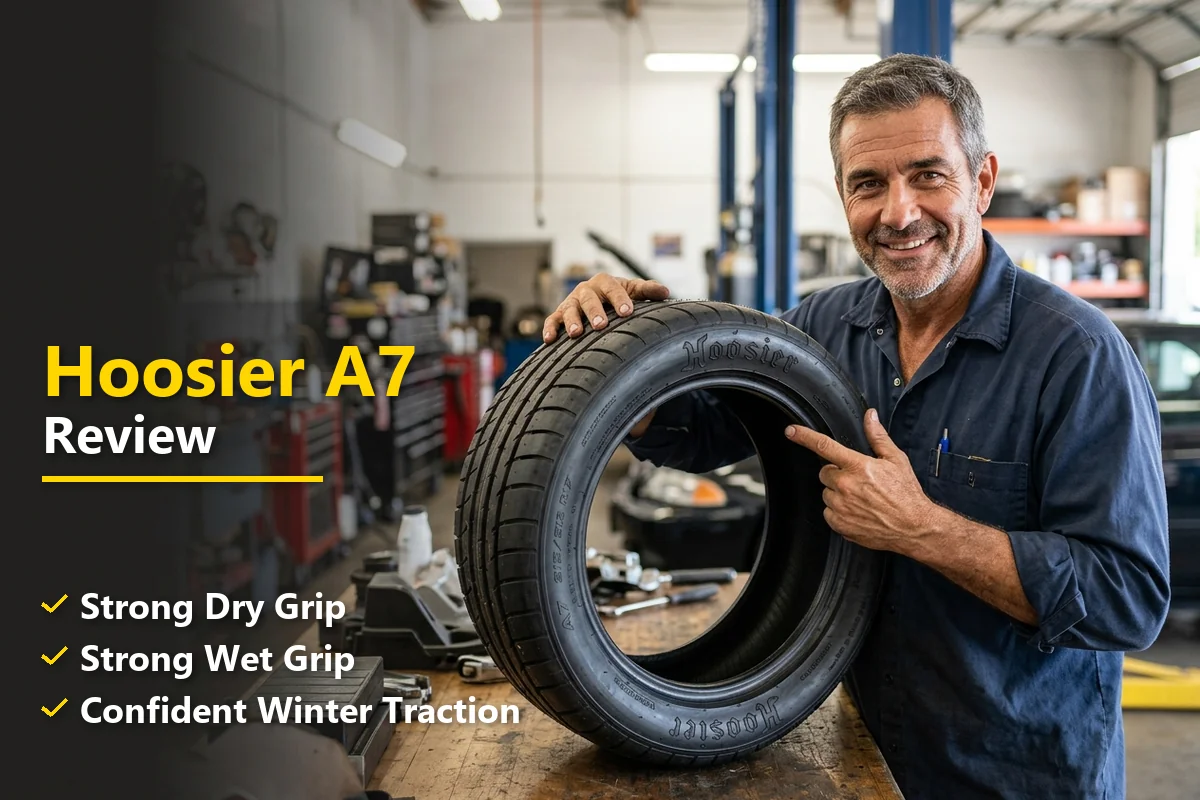
If you’ve ever white-knuckled your way through a fast sweeper and felt your tires start to give up before you did, you know the frustration. Your driving is ready for the next level, but your rubber isn’t.
That’s exactly where I was before I mounted a set of Hoosier A7 tires for my track day and autocross adventures. I’d been chasing tenths of a second with diminishing returns, and I suspected the tires were the weak link. Spoiler: I was right.
- The Hoosier A7 is a DOT-legal competition tire designed for autocross, time attack, and track days — not daily driving.
- Grip levels are extraordinary, especially at operating temperature, and far exceed even the best 200-TW street tires.
- Treadwear is aggressive — these tires are consumables, not long-term investments.
- Heat cycling matters: the A7 has a specific operating window and rewards drivers who understand tire management.
- Best suited for dedicated track cars or trailer queens; technically street-legal but impractical for commuting.
- Pricing ranges from roughly $180–$350+ per tire depending on size, making them competitive in the DOT R-compound space.
Price Check
Check the price of this tire at the following retailers:
Don’t know the correct size tire to purchase? Start here!
Liked this article?
Add TireAdvise as a preferred source so you see more of our tire reviews and guides on Google.
What Exactly Is the Hoosier A7? Understanding the Tire’s Purpose
Before I dive into performance impressions, let me be crystal clear about what the Hoosier A7 is — and what it isn’t. This is a DOT-approved R-compound competition tire. It carries enough tread and meets the minimum federal requirements to be technically street-legal, but it is purpose-built for motorsport use.
Hoosier Racing Tire, based in Lakeville, Indiana, has been manufacturing competition tires since 1957. They don’t make all-season commuter tires or highway touring rubber. Every tire that rolls out of their facility is designed for some form of racing. The A7 sits in their road racing and autocross lineup as a softer, grippier compound option alongside the harder A6.
I’ve heard people ask, “Can I daily drive on Hoosier A7s?” The technical answer is yes. The practical answer is absolutely not — and I’ll explain why throughout this review.
My Setup and Testing Context
I ran the Hoosier A7 compound in 245/40R17 on a dedicated track car — a modified Mazda MX-5 (ND) with coilovers, upgraded sway bars, and a mild power bump. The car weighs about 2,400 lbs with me in it, which is fairly representative of the lightweight sports cars that gravitate toward this tire.
My testing took place over several track day weekends and a handful of autocross events at venues across the mid-Atlantic and Southeast US. I experienced the tires in ambient temperatures ranging from the low 50s (chilly November mornings) to the mid-80s (humid summer days). I also drove on them briefly on public roads to get to and from the paddock when the trailer wasn’t an option.
This isn’t a tire I evaluated on my morning commute. I evaluated it in the environment it was designed for — and that context matters enormously.
First Impressions: Right Out of the Box
When I first pulled the Hoosier A7s out of the packaging, a few things jumped out at me. The tread compound feels noticeably softer and stickier than a typical 200-TW tire like a Bridgestone RE-71RS or Yokohama A052. If you drag your thumbnail across the tread surface, it leaves a visible mark. That’s the R-compound at work.
The tread pattern itself is relatively simple — shallow circumferential grooves with minimal siping. There’s enough tread to technically qualify as a DOT tire, but you can tell at a glance that water evacuation is an afterthought. This tire exists to maximize the contact patch on dry pavement, period.
Mounting and balancing was straightforward. My local tire shop had no issues getting them seated on my 17×9 wheels, and they balanced without requiring excessive weight. I will note that Hoosier tires sometimes have a reputation for inconsistent manufacturing compared to big-brand consumer tires, but my set was perfectly round with no vibration issues.
Dry Grip Performance: Where the Hoosier A7 Shines
Let me cut right to the headline: the dry grip from the Hoosier A7 is absolutely phenomenal. This is, without exaggeration, the most mechanical grip I’ve ever experienced from a DOT-legal tire.
Initial Grip (Cold Tires)
The A7 needs heat to perform. On my first out-lap during a crisp morning session, the tires felt almost greasy — noticeably less confident than a good 200-TW tire would feel in the same cold conditions. It took me about a lap and a half on a two-mile road course to bring them into their operating window.
This is important context for autocross competitors: on a 60-second autocross run, you may not fully heat the A7 on your first run of the day. I found that doing aggressive warm-up maneuvers in the staging lanes (weaving, heavy braking) helped, but the first run was consistently my slowest in morning sessions.
Peak Grip (Operating Temperature)
Once the Hoosier A7s reached their operating temperature — which I monitored with a tire pyrometer aiming for around 160–200°F across the tread surface — the grip was transformative. Corners where I previously had to manage understeer became flat-out sections. Braking zones shortened dramatically. The car felt like it had gained hundreds of pounds of downforce.
The lateral grip is what impressed me most. In long, sustained sweepers, the A7 just hooks up and holds. There’s a progressive breakaway character that gives you confidence to push right up to the limit. When the tire does start to slide, it communicates clearly through the steering wheel — no sudden snap oversteer or unexpected loss of front end.
I estimate I was pulling consistently higher lateral g-forces compared to my previous setup on a premium 200-TW tire. My lap times at my home track dropped significantly within a single session of switching to the A7s.
Longitudinal Grip (Braking and Acceleration)
Braking performance was equally impressive. I was able to brake later and harder without triggering ABS intervention as frequently. Straight-line traction out of slow corners was outstanding — my car rarely broke traction under acceleration except on the most aggressive throttle applications out of first-gear hairpins.
The combined grip — braking or accelerating while turning — is where the A7 truly separates itself from street tires. On street rubber, you’re constantly making compromises: you can brake hard OR turn, but not both at full capacity simultaneously. The A7 expands that traction circle so dramatically that trail braking becomes much easier and more rewarding.
How the Hoosier A7 Handles Heat and Extended Sessions
Thermal Management
R-compound tires generate heat, and the A7 is no exception. During hot summer sessions, I noticed the tire could overheat if I pushed hard for too many consecutive laps without a cool-down period. When the surface temperature climbed above 220°F, I started feeling the grip fall off — the tire got “greasy” and the front end would push.
My strategy was to run hard for three to four laps, then do a cool-down lap at moderate pace. This kept the tires in their sweet spot and also extended their life. If you’re running 20-minute open track sessions without pitting, you’ll likely cook the A7 by the end, especially on a heavier car.
In cooler weather (ambient temps in the 50s and 60s), the A7 was much more forgiving. I could run extended stints without significant degradation, and the grip window was broader. If you’re in the northern US and primarily do spring/fall track days, this tire is even more compelling.
Heat Cycling Sensitivity
Here’s something not everyone talks about: the Hoosier A7 is sensitive to heat cycles. Each time you bring the tire up to operating temperature and let it cool back down counts as one heat cycle. Over multiple heat cycles, the compound hardens and loses grip.
I noticed a perceptible difference after several track days on the same set. The tires still outperformed street rubber, but the razor-sharp, “stuck to rails” feeling of a fresh set was gone. Hoosier themselves acknowledge this, which is why serious competitors often run a fresh set for qualifying or final runs.
For the weekend warrior doing a few track days per season, this isn’t a dealbreaker. But if you’re chasing a championship in autocross or time attack, budgeting for fresh rubber at key events is part of the game.
Wet Performance: The Elephant in the Room
I have to be honest here: I intentionally avoided hard driving on the Hoosier A7 in wet conditions, and you should too. The tread pattern has minimal water-channeling capability. The shallow grooves fill quickly, and the R-compound doesn’t interact well with water the way a silica-rich street tire does.
During one track day that had light rain in the afternoon, I went out cautiously during a wet session. The grip in standing water was alarming — or rather, the lack of it was alarming. Hydroplaning came much earlier than I expected, and the car felt nervous even at moderate speeds through puddles.
In light drizzle with no standing water, the A7 was manageable but nowhere near confidence-inspiring. I would rate wet grip as genuinely poor — maybe 3 out of 10 compared to a good all-season tire’s wet performance.
My recommendation: if rain is in the forecast, either have a set of rain tires ready to swap on or park the car. Running the A7 in the wet on track is risky, and running it in the wet on public roads is genuinely dangerous.
Treadwear and Longevity
Let’s talk about the question everyone asks: how long do Hoosier A7s last?
The answer depends heavily on your car, driving style, alignment, and how many heat cycles you put on them. In my experience, the tire delivered its best performance during the first several track days. After that, I could tell the compound was aging — lap times crept up slightly, and the feedback became less sharp.
The physical tread wore relatively evenly thanks to my alignment settings (I run about -3.0° of camber up front), but I could see the tread depth decreasing noticeably after each event. These are not tires that will last you multiple seasons of heavy use. If you’re doing two or three track days per month, expect to go through sets quickly.
For autocross, where each run is roughly a minute long and you might do six to eight runs per event, the tires last considerably longer in terms of calendar time — but heat cycles still accumulate.
I want to emphasize: the Hoosier A7 is a consumable performance part, not a long-lasting tire. Budget accordingly. Treat them like brake pads — they’re designed to be used up in the pursuit of performance.
Hoosier A7 vs. the Competition: How Does It Stack Up?
The DOT R-compound and extreme-performance tire market has gotten crowded. Here’s how the Hoosier A7 compares to its main competitors based on my experience:
| Feature | Hoosier A7 | Toyo Proxes RR | BFGoodrich g-Force R1 S | Nankang AR-1 |
|---|---|---|---|---|
| Tire Type | DOT R-Compound | DOT R-Compound | DOT R-Compound | DOT R-Compound |
| Dry Grip | ★★★★★ | ★★★★☆ | ★★★★☆ | ★★★★☆ |
| Wet Grip | ★★☆☆☆ | ★★☆☆☆ | ★★★☆☆ | ★★★☆☆ |
| Heat Cycle Sensitivity | High | Moderate | Moderate | Low-Moderate |
| Treadwear | Low | Low-Moderate | Moderate | Moderate |
| Price Range (per tire) | $180–$350+ | $200–$370+ | $200–$350+ | $140–$280+ |
| Size Availability | Good | Limited | Good | Good |
| Best For | Max grip, autocross, time attack | Road racing, endurance events | Track days, HPDE, road racing | Budget track days, autocross |
Hoosier A7 vs. Toyo Proxes RR
The Toyo RR is probably the A7’s closest competitor in terms of outright dry grip. In my experience, the A7 has a slight edge in peak grip, but the Toyo is more consistent over longer stints and seems less sensitive to heat cycling. The Toyo is also slightly harder to source in some sizes. If you’re doing endurance events or longer road racing sessions, the Toyo might be a better fit. For pure autocross or short time attack sessions, I’d give the nod to the A7.
Hoosier A7 vs. BFGoodrich g-Force R1 S
The BFG R1 S is what I’d call the “sensible” R-compound tire. It doesn’t quite match the A7’s peak grip, but it’s more forgiving of heat cycles, wears more slowly, and handles cool temperatures better. It also has slightly better wet performance. If you’re a track day enthusiast who doesn’t want to obsess over tire management, the R1 S is excellent. But if you want the absolute last tenth of a second, the A7 is the answer.
Hoosier A7 vs. Nankang AR-1
The Nankang AR-1 is the value play in this segment. It’s significantly cheaper, and for a beginning track enthusiast, it’s a fantastic entry point into R-compound tires. However, the A7 out-grips it noticeably, especially in high-speed corners where confidence matters most. I see the AR-1 as a tire you graduate from, and the A7 as a tire you graduate to.
Hoosier A7 vs. A6: Which Compound Should You Choose?
This is one of the most common questions I get, and it deserves its own section. The Hoosier A6 and A7 share the same carcass construction but differ in compound softness. The A7 is the softer, grippier compound. The A6 is harder and more durable.
Choose the A7 if:
- You prioritize maximum grip over tire longevity
- You’re competing in autocross or time attack where every tenth matters
- You have a lighter car (under 3,000 lbs) that won’t overstress the softer compound
- You’re willing to manage heat cycles and budget for more frequent replacement
- Ambient temperatures at your events are moderate (50°F–85°F)
Choose the A6 if:
- You want longer tread life per set
- Your car is heavier (3,000+ lbs) and generates more heat through the tires
- You’re doing extended road racing sessions (30+ minutes)
- You live in a region with consistently hot track temperatures (95°F+ ambient)
- You’re new to R-compound tires and want a more forgiving learning curve
In my experience, the A7 is the better compound for the majority of autocross competitors and time attack drivers running lightweight cars. But if I were running a heavier Camaro or Mustang in endurance events during a Texas summer, I’d seriously consider the A6.
Noise, Comfort, and Street Manners
I realize this is a competition tire review, but some of you will inevitably drive on these on the street — even if it’s just to get from the trailer drop-off to the track entrance. So here’s what that experience is like.
Noise
The Hoosier A7 is loud on the street. The tread pattern produces a droning hum at highway speeds that is significantly louder than any street tire I’ve used. It’s not unbearable for a short drive, but doing an hour-long highway cruise would be exhausting. Turn up the radio.
Ride Comfort
The sidewall construction is stiff — it’s designed to resist deflection during hard cornering, not to absorb potholes on I-95. Ride quality on the street is harsh. You’ll feel every crack and seam in the road surface. Combined with an already stiff suspension setup on a track car, it’s genuinely uncomfortable.
Cold Weather Performance
Below about 40°F, the A7 compound becomes noticeably hard and slippery. I drove cautiously to a November autocross event on cold morning roads, and the tires felt downright sketchy until the sun warmed things up. Never, ever use these as winter tires. The compound will be rock-hard, and you’ll have virtually no traction on cold, wet, or icy roads.
Pricing and Where to Buy
Hoosier A7 pricing varies significantly by size. For common sizes used on Miatas, BRZ/86 platforms, and Civic Type Rs, expect to pay roughly $180 to $250 per tire. Larger sizes for Corvettes, Mustangs, and similar platforms can run $280 to $350 or more.
The best places to purchase Hoosier tires in the US include:
- Tire Rack — Excellent selection, competitive pricing, and they ship fast. This is where I bought my sets.
- Hoosier’s direct dealer network — Check their website for authorized dealers near you. Many race shops carry Hoosier in stock.
- Local motorsport shops and speed shops — If you have a dedicated racing supplier in your area, they often stock popular Hoosier sizes and can order quickly.
- Grassroots Motorsports marketplace and forums — Sometimes you can find lightly used sets at a discount, though be cautious about heat cycles on used R-compounds.
One thing to budget for: you won’t get as many events out of these as you would from a 200-TW tire, so your per-event tire cost is higher. I like to think of it as the cost of admission to a higher performance tier. Once you feel the grip difference, it’s hard to go back.
Who Should Buy the Hoosier A7?
After spending significant seat time on these tires across multiple events and conditions, here’s my honest assessment of who this tire is for — and who should look elsewhere.
The Hoosier A7 Is Perfect For:
- Competitive autocross drivers who are chasing class wins or top PAX times and need maximum grip from a DOT-legal tire
- Time attack competitors running lightweight, well-prepared cars in classes that allow R-compound tires
- Track day enthusiasts who have a dedicated track car (not a daily driver) and want the ultimate in grip
- Experienced drivers who understand tire management, heat cycling, and are comfortable driving at the limit
The Hoosier A7 Is NOT For:
- Daily drivers — the noise, ride quality, wet performance, and treadwear make this completely impractical for commuting
- Beginners at track days — if you’re still learning car control, a 200-TW tire like the Bridgestone RE-71RS or Continental ExtremeContact Force will teach you more at a lower cost
- Wet weather use — I cannot stress enough how poor these tires are in standing water
- Heavy vehicles — if you’re putting these on a 4,000+ lb car and running long sessions, the A6 compound or a different tire entirely may serve you better
Tips for Getting the Most Out of Your Hoosier A7s
After running these tires extensively, here are my top tips for maximizing their performance and lifespan:
- Run appropriate tire pressures. I found optimal grip in the 28–34 psi range (hot) depending on the car’s weight and track layout. Start around 30 psi cold and adjust based on pyrometer readings and tire wear patterns.
- Check temperatures across the tread. You want even temps from inside to outside edge. If the inside is significantly hotter, you need less negative camber. If the outside is hotter, add camber.
- Do cool-down laps. After pushing hard for a few laps, take a cool-down lap to bring surface temps back into the optimal window. This also extends tire life.
- Store them properly. When not in use, store the tires in a cool, dark place away from UV light. I keep mine in tire bags in the garage. Heat and sunlight accelerate compound aging.
- Track your heat cycles. I keep a simple spreadsheet noting each event, approximate number of runs or sessions, and ambient temperature. This helps me predict when a set is past its prime.
- Don’t cheap out on alignment. A proper competition alignment with appropriate negative camber and toe settings is essential to getting the full benefit of these tires. A lazy street alignment will waste their potential.
My Final Verdict on the Hoosier A7
The Hoosier A7 is a tire that does one thing extraordinarily well: it delivers maximum dry grip within a DOT-legal tire. It’s not versatile. It’s not practical. It won’t last forever. But when you’re on a dry track, pushing hard through a series of sweepers with the tires at operating temperature, there’s almost nothing in the DOT-legal space that can touch it.
I’ve run a lot of tires over the years — from budget all-seasons to premium ultra-high-performance summer tires to multiple R-compound offerings. The Hoosier A7 represents the top tier of grip available to a grassroots racer without going to full slicks. The feel through the steering wheel, the confidence in high-speed corners, and the sheer mechanical grip available are addictive.
Is it worth the money? If you’re serious about competitive motorsport and you’re at a skill level where tire grip is your limiting factor, absolutely yes. The A7 will find you time on the clock that no suspension adjustment or power modification can match dollar-for-dollar.
If you’re a casual track day participant who drives your car to the track and back, look at a high-performance 200-TW tire instead. You’ll get better daily usability, longer tread life, and adequate grip for learning and having fun.
The Hoosier A7 isn’t the tire for everyone. But for the right driver, with the right car, in the right conditions — it’s a revelation. I can’t imagine going back to anything else for competition use.
Frequently Asked Questions
Is the Hoosier A7 a good tire for autocross and track days?
The Hoosier A7 is one of the most popular DOT-legal competition tires for autocross and track day events in the US. It delivers exceptional grip and consistent lap times thanks to its soft compound and aggressive tread pattern. I’ve found it outperforms many street-legal performance tires in timed events, making it a top choice for SCCA and NASA competitors.
How long does a set of Hoosier A7 tires last?
Tread life on the Hoosier A7 varies significantly based on driving style, track surface, and alignment, but most drivers report getting between 3,000 and 8,000 miles of competitive use. These are not designed as daily-driver tires, so longevity takes a back seat to maximum grip. If you’re running aggressive autocross events every weekend, expect to replace them within one to two seasons.
What is the difference between the Hoosier A7 and the Hoosier R7?
The Hoosier A7 uses a softer compound that prioritizes maximum grip and faster lap times, while the R7 features a harder compound designed for longer tread life and more heat resistance during extended track sessions. If you’re primarily doing short autocross runs, the A7 is the better performer. For longer road course stints where tire degradation is a concern, the R7 may be the smarter investment.
How much do Hoosier A7 tires cost and where can I buy them?
Hoosier A7 tires typically range from $180 to $350 per tire depending on the size, with common autocross sizes like 225/45R15 and 275/35R18 sitting in the $200 to $300 range. You can purchase them from authorized Hoosier dealers, Tire Rack, or specialty motorsport shops across the US. I recommend checking Hoosier’s dealer locator for the most current pricing and availability in your area.
Can you daily drive on Hoosier A7 tires?
While the Hoosier A7 is DOT-approved and technically street legal, daily driving on them is not recommended. The soft compound wears extremely fast on regular roads, and wet-weather performance is significantly worse than a dedicated all-season or summer street tire. Most drivers mount them on a separate set of wheels and swap them on only for competition events to preserve the tread and save money.
What sizes are available for the Hoosier A7 tire?
Hoosier offers the A7 in a wide range of sizes covering 13-inch through 18-inch wheel diameters, with popular fitments including 205/50R15, 225/45R15, 245/40R17, and 275/35R18. These sizes cover many common autocross and track day vehicles like the Mazda Miata, Honda Civic, Subaru BRZ, and Corvette. I’d suggest checking Hoosier’s official fitment guide to confirm the best size for your specific vehicle and competition class rules.
How does the Hoosier A7 perform in wet or cold conditions?
The Hoosier A7 struggles in wet and cold conditions due to its minimal tread depth and competition-focused compound that hardens significantly below 40°F. In rain, hydroplaning risk is much higher compared to street tires with deeper tread grooves. If you encounter unexpected rain at a track day, reduce speed significantly and consider switching to a rain tire or sitting out the session for safety.
